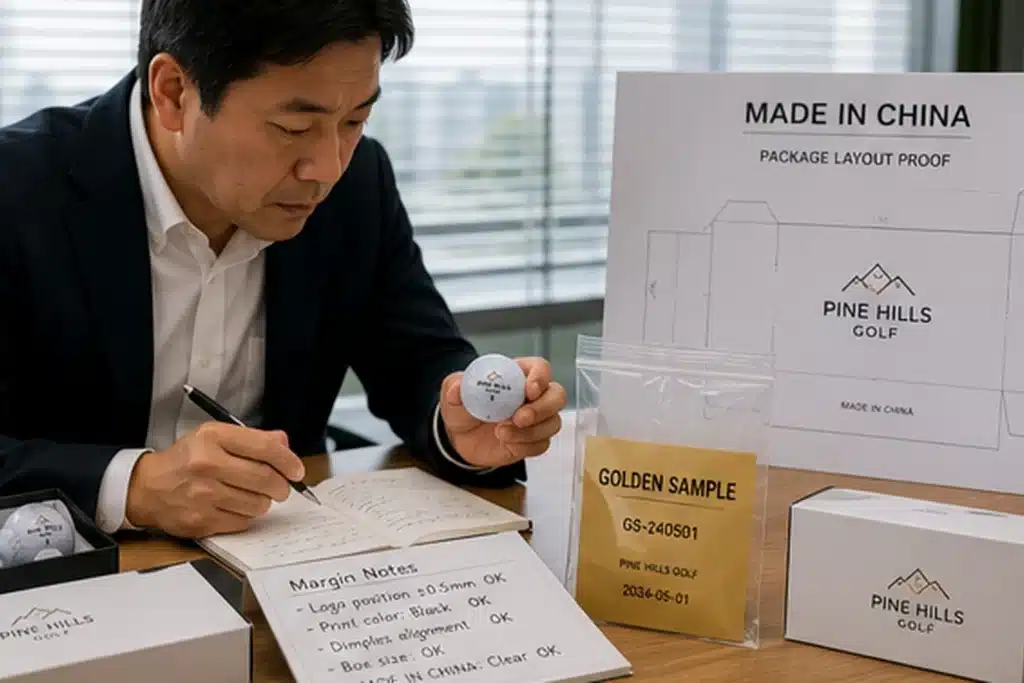
To import golf balls from China to Japan, verify whether the SKU is Japan-ready before bulk production—not just whether it can clear customs.
A Japan-ready golf ball order should be margin-safe, shelf-ready, COO-ready, visually consistent, and sample-approved. Buyers should check JDM margin, retail packaging proof, Made in China layout, Golden Sample control, PPS approval, logo finish, cosmetic consistency, and sample-to-bulk evidence.
| Japan import check | Buyer risk | What to request | Buyer action |
|---|---|---|---|
| JDM margin | Low-profit SKU | 2-piece vs 3-piece worksheet | Check channel fit |
| Retail acceptance | Distributor rejection | Shelf-ready sample | Approve before bulk |
| Packaging precision | Crushed boxes | GSM / dieline proof | Test packaging |
| COO mark | Trust / claim issue | Made in China layout | Review before print |
| Visual consistency | Sample drift | Golden Sample photos | Compare bulk |
| Logo finish | Retail complaint | Color / gloss proof | Lock standard |
| RFQ control | Weak supplier promise | Japan-ready checklist | Add to PO |
Use this guide to check whether your China OEM golf ball order can pass Japanese retail, DTC, pro shop, promo, range, or gift-channel review before production starts.
What Should Japanese Buyers Check First?
Your team may search how to import golf balls from China to Japan and expect a customs answer. The stronger first check is whether the product can pass Japanese channel acceptance after it arrives.
Your first Japan import check is not only whether golf balls can clear customs; it is whether the SKU is margin-safe, shelf-ready, COO-ready, and visually consistent enough for your channel. Before bulk production, request a JDM margin worksheet, packaging proof, COO layout, Golden Sample approval, and cosmetic inspection plan.
Finished golf balls can start from Japan Customs 9506.32 000 for classification review, but customs should not become the whole article or the whole buying decision. Mixed gift kits, towels, tees, markers, tools, or accessories should be reviewed item by item before shipment. The Japan Customs Chapter 95 tariff schedule can support shipment-date classification review, while your supplier file should also prove packaging, origin layout, sample control, and retail presentation.
| First check | Buyer risk | What to request | Buyer action |
|---|---|---|---|
| SKU margin | Weak profit | Margin worksheet | Verify channel fit |
| Retail look | Shelf rejection | Shelf-ready sample | Approve before bulk |
| Packaging | Damaged box | GSM / dieline proof | Test packaging |
| COO mark | Claim risk | Layout proof | Review before print |
| Sample control | Bulk drift | Golden Sample ID | Lock standard |
| Inspection | Missed defects | Cosmetic report | Hold release |
As of 2026, verify again before shipment and production approval. Tariff treatment, consumption tax handling, packaging cost, exchange-rate assumptions, distributor margins, retail pricing, and channel acceptance can vary by SKU, shipment, buyer role, and sales model. Japan Customs also explains that imported goods are generally subject to consumption tax, with a standard tax rate of 10%, so duty review should not be confused with full commercial readiness. Japan tariff and tax overview
Retail acceptance means your buyer-side channel standard, not an official legal term. It asks whether the order is clean enough for Japanese distributors, pro shops, DTC unboxing, corporate gifts, range programs, and event delivery. Your Japan Import Readiness Pack should match SKU, channel, margin, packaging, COO layout, Golden Sample, and inspection plan before production approval.
✔ True — Japan-ready import planning starts with channel acceptance
A golf ball can clear customs and still fail your distributor, pro shop, DTC, or gift-channel review if packaging, finish, logo, or sample control is weak.
✘ False — “A customs-ready golf ball order is automatically retail-ready for Japan”
Customs review is only one checkpoint. Japan-ready buying also needs margin, packaging, COO, cosmetic, and sample-to-bulk evidence.
Can China OEM Pass Japanese Retail Checks?
China OEM golf balls can work for Japan, but the supplier must prove that the approved sample can be repeated in bulk. A clean sample alone is not enough for retail, gift, or DTC acceptance.
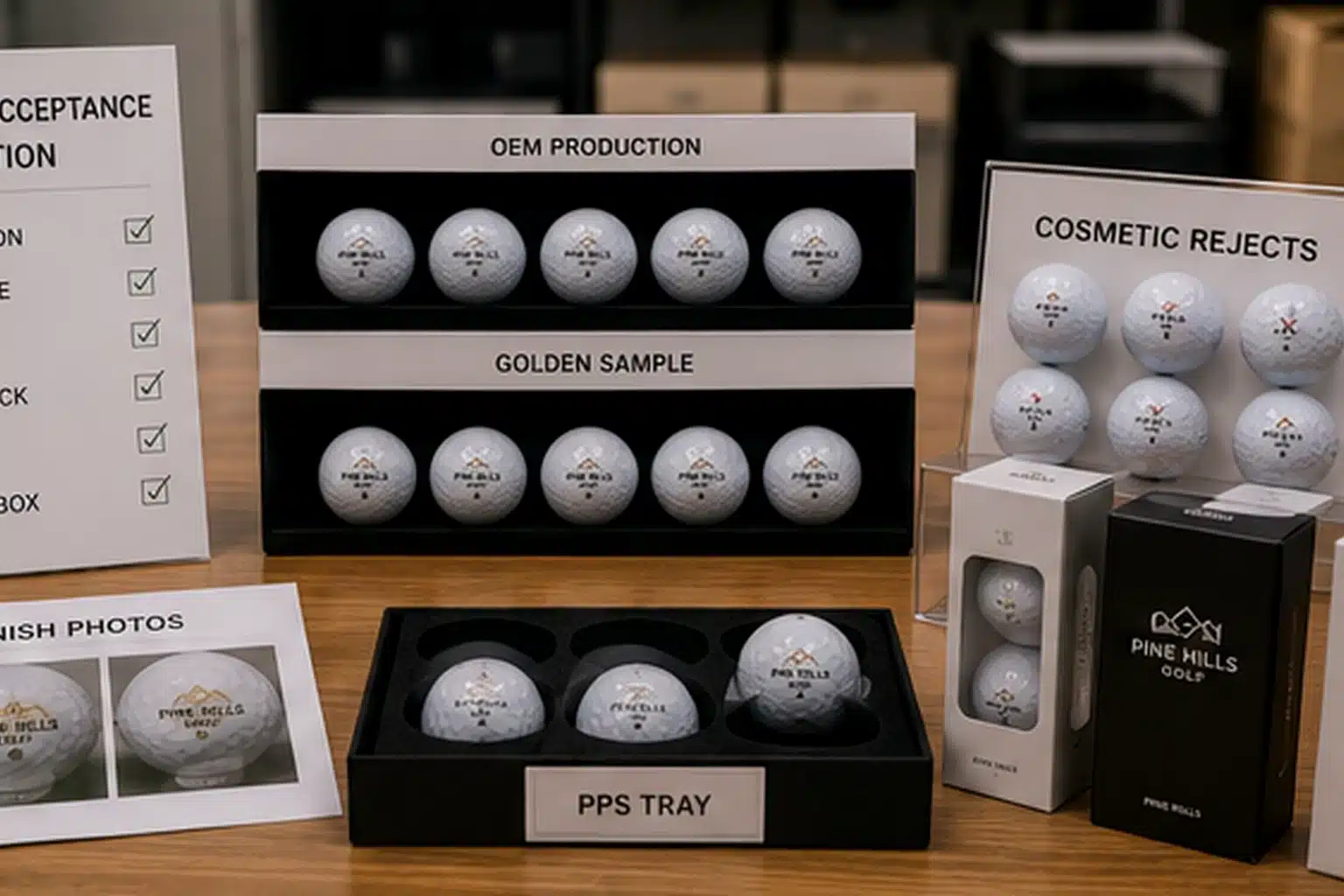
China OEM golf balls can pass Japanese retail checks only when sample quality becomes shelf-ready bulk proof. Your team should lock the Golden Sample, approve PPS, define cosmetic defects, request logo and finish comparison photos, and hold shipment release until the bulk lot matches the Japan-channel standard.
Japanese buyers may reject issues that look minor in a factory chat: logo edge blur, white-tone mismatch, clearcoat gloss drift, paint dots, pinholes, dimple-edge contamination, box scuffs, or gift-box corner dents. The ball may still play well, but the channel may not accept it as a retail product.
| Retail check | Rejection risk | What to request | Buyer action |
|---|---|---|---|
| Logo edge | Blurry print | Macro photos | Compare sample |
| Ball color | White mismatch | Color reference | Lock approval |
| Clearcoat | Gloss drift | Finish photos | Match sample |
| Paint void | Cosmetic defect | Defect table | Classify risk |
| Bulk lot | Sample drift | PPS / retained sample | Compare before ship |
| Box surface | Shelf scuffs | Packing photos | Approve cartons |
Supplier says Japan retail is “no problem” but cannot provide Golden Sample and PPS proof is a failure signal. A Japan Retail Acceptance Proof Pack should include Golden Sample ID, PPS approval, retained sample reference, logo edge proof, finish photos, defect classification, packed-carton photos, and bulk comparison images.
Your PO should state that any color, gloss, logo, box, or finish change requires written buyer approval before shipment. Buyer approval of Japan-bound bulk production requires verified match to the approved Golden Sample and PPS for ball color, finish gloss, logo edge, logo position, packaging condition, COO layout, and carton protection.
Which Ball Type Protects JDM Margin?
The best Japan SKU is not automatically the lowest-cost 2-piece ball or the highest-spec 3-piece ball. It is the product structure that fits your channel, price point, packaging, and defect allowance.
The best Japan import SKU is the one that protects margin after FOB, logo printing, packaging, freight, clearance, local delivery, channel discount, and defect allowance. Your team should compare 2-piece wholesale, 3-piece DTC, corporate gift, range, promo, and retail distributor programs with a JDM margin worksheet.
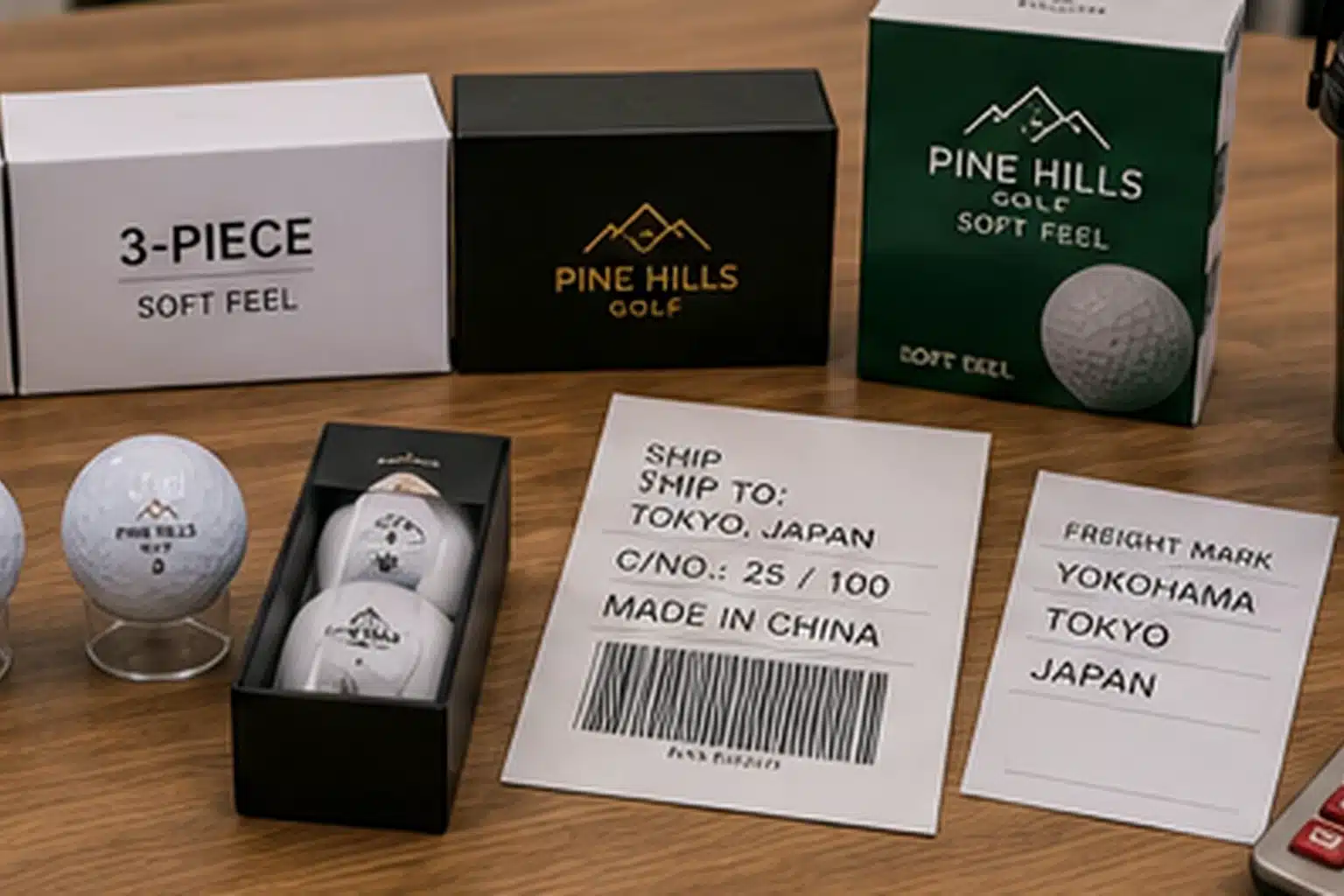
A 2-piece ball can suit range, entry-level retail, corporate promo, and volume programs. A 3-piece ball can suit DTC, premium gift, pro shop, and brand-led programs. The wrong choice is not “2-piece” or “3-piece”; the wrong choice is approving bulk production before the channel economics are visible.
| SKU path | Margin risk | What to verify | Buyer action |
|---|---|---|---|
| 2-piece wholesale | Price pressure | Channel price | Build worksheet |
| 2-piece promo | Low unit value | Logo / pack cost | Check fit |
| 3-piece DTC | Higher proof burden | FOB + retail price | Model margin |
| Premium gift | Packaging cost | Box approval | Include allowance |
| Range order | Volume pressure | Durability / price | Confirm use case |
| Retail SKU | Return risk | Acceptance rate | Add defect buffer |
Use this worksheet logic before RFQ approval: margin per ball equals expected Japan selling price minus FOB, logo printing, packaging, freight, clearance, import-tax handling, local delivery, channel fee, and defect allowance. A 2025 market report estimated Japan’s domestic golf gear market at 293.33 billion yen in 2024, with a forecast increase for 2025, but market size does not prove your SKU profit. Japan golf gear market context
Your deliverable is a JDM SKU Margin Worksheet. Run margin by SKU, channel, package, shipment route, defect allowance, and FX assumption before committing to bulk. No production approval until the target SKU has a written margin model and channel-fit decision.
✔ True — Ball structure and sales channel should be chosen together
A low-cost 2-piece, 3-piece DTC SKU, range order, and premium gift program can each work when margin, packaging, and acceptance standards match the channel.
✘ False — “Importing the lowest-cost golf ball from China is automatically the safest Japan strategy”
Low FOB can disappear after packaging, channel discounts, local delivery, returns, defects, and weak shelf presentation.
Is Your Packaging Ready for Japan Retail?
Packaging is not a decoration cost for Japan-bound golf balls. It is part of the product promise, especially for pro shops, DTC brands, corporate gifts, and retail distributors.
Japan retail packaging should be approved as part of the product, not treated as an accessory. Before production, request packaging dieline, paper GSM, fold precision, PET or sleeve proof, gift-box structure, master carton protection, COO placement, packed-carton photos, and pre-production packaging approval.
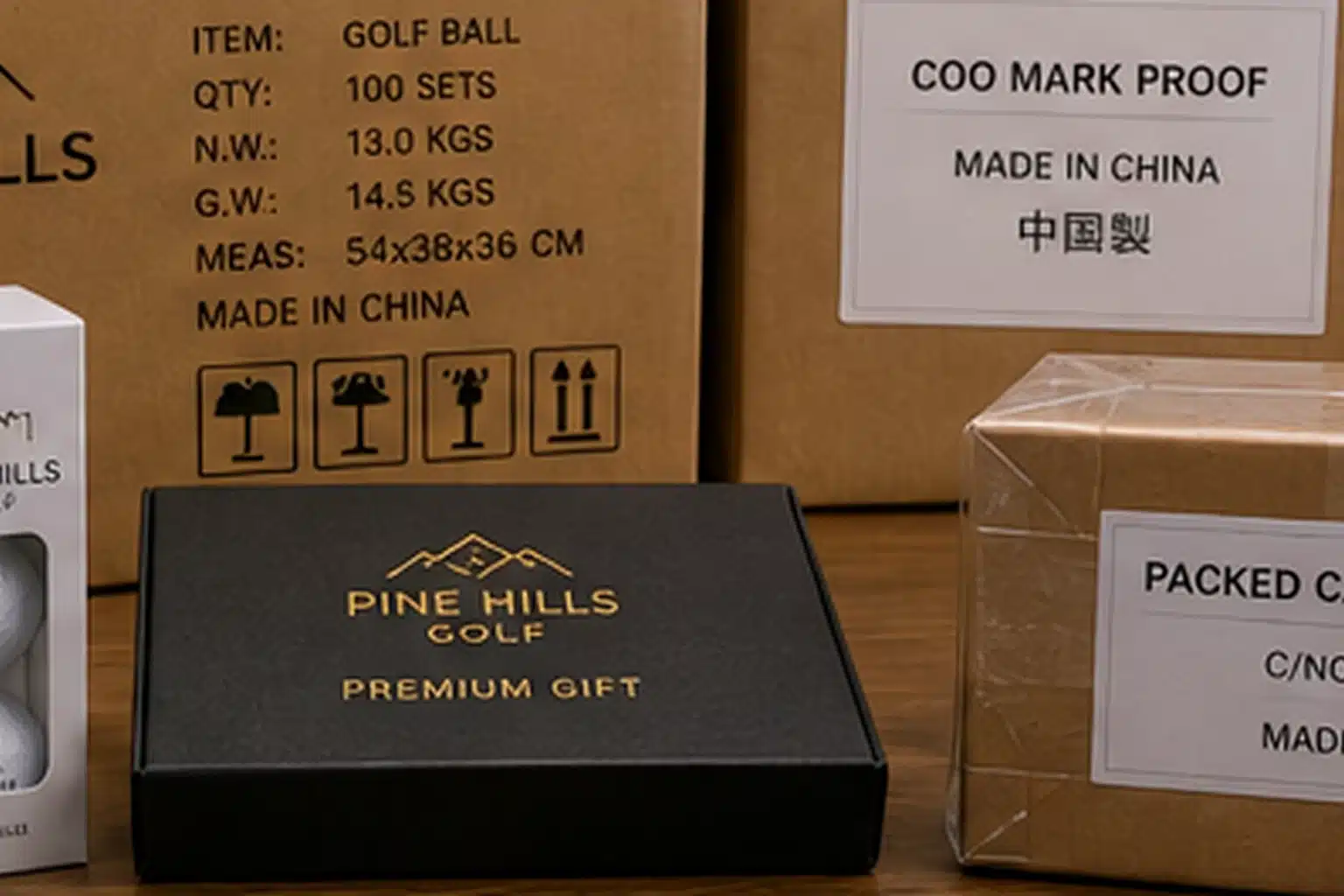
White sleeves, 3-ball sleeves, PET window boxes, premium gift boxes, EVA inserts, and master cartons all carry different channel risks. A PET box can show scratches. A gift box can arrive with corner dents. A white sleeve can feel cheap if the paper and finish do not match the channel. A master carton can protect the ball but still crush the sellable retail box.
| Packaging item | Japan risk | What to request | Buyer action |
|---|---|---|---|
| White sleeve | Cheap feel | Paper / finish spec | Approve sample |
| PET window | Scratches | PET thickness proof | Inspect sample |
| Gift box | Corner damage | Structure proof | Test packing |
| Dieline | Misfolding | Dieline file | Approve before print |
| Master carton | Crushed retail box | Carton spec | Check protection |
| COO space | Layout conflict | Artwork proof | Review mark |
Packaging approved only as artwork, not as a physical retail sample, is a failure signal. A dieline can look perfect on screen and still fold poorly, scuff easily, or protect the product badly. Your supplier should provide physical packaging samples, packed photos, carton specification, box-corner proof, and master carton protection logic before bulk packaging production.
Your PO should state that packaging approval covers physical sample, dieline, GSM, print finish, PET window if used, insert, COO placement, master carton, and packed photo proof. Any packaging material, dieline, print finish, insert, carton, or facility change requires written buyer approval.
How Should COO Appear on Packaging?
COO should not be handled as a design nuisance or hidden in a corner after artwork is finished. It should be clear, accurate, and professionally integrated before packaging is printed.
COO should be clear, accurate, and layout-approved before packaging is printed. Your team should review the Made in China mark, carton label, invoice, packing list, SKU, and lot ID together so the origin story is consistent across customs, retail, warehouse, and sales documents.
Country-of-origin information should tell the same story everywhere: retail box, master carton, commercial invoice, packing list, SKU label, lot ID, and sales copy. The goal is not to hide “Made in China.” The goal is to make origin information legible, accurate, and cleanly placed so it does not conflict with brand claims or Japanese-language packaging.
| COO item | Buyer risk | What to request | Buyer action |
|---|---|---|---|
| Retail box mark | Trust issue | COO layout | Approve before print |
| Master carton | Warehouse mismatch | Carton label | Match SKU |
| Invoice | Customs mismatch | Origin field | Check document |
| Packing list | File gap | Origin / lot info | Keep record |
| Sales copy | Misleading claim | Claim review | Remove risk |
| Lot ID | Mixed-origin doubt | Lot photos | Match shipment |
Tokyo Customs states that goods with false or deceptive indication of origin cannot be imported into Japan unless the indication is removed or corrected. origin indication reference That makes COO a shipment-level evidence issue, not a branding afterthought.
COO layout checked after printing instead of before packaging approval is a failure signal. Your deliverable is a COO Layout and Shipment Claim Review. Check retail packaging, carton, invoice, packing list, SKU, lot ID, and marketing copy before print approval. No “Japan-made” or Japan-origin implication should appear unless shipment-level documents support it.
✔ True — COO proof is shipment-level evidence
Your retail box, master carton, invoice, packing list, SKU, lot ID, and sales copy should tell the same accurate origin story.
✘ False — “A Japan-linked brand name, model claim, or catalog page proves Japanese origin”
Brand positioning cannot replace accurate origin marking and shipment documents.
What Should Your Japan RFQ Require?
A Japan RFQ should not ask only for FOB price, logo printing, packaging, and lead time. It should force the supplier to prove channel fit before production begins.
Your Japan RFQ should require proof of margin, packaging, COO, sample control, and cosmetic consistency before bulk production starts. Ask for ball structure, target channel fit, packaging proof, COO layout, Golden Sample ID, PPS approval, finish photos, logo proof, carton protection, and pre-shipment cosmetic inspection.
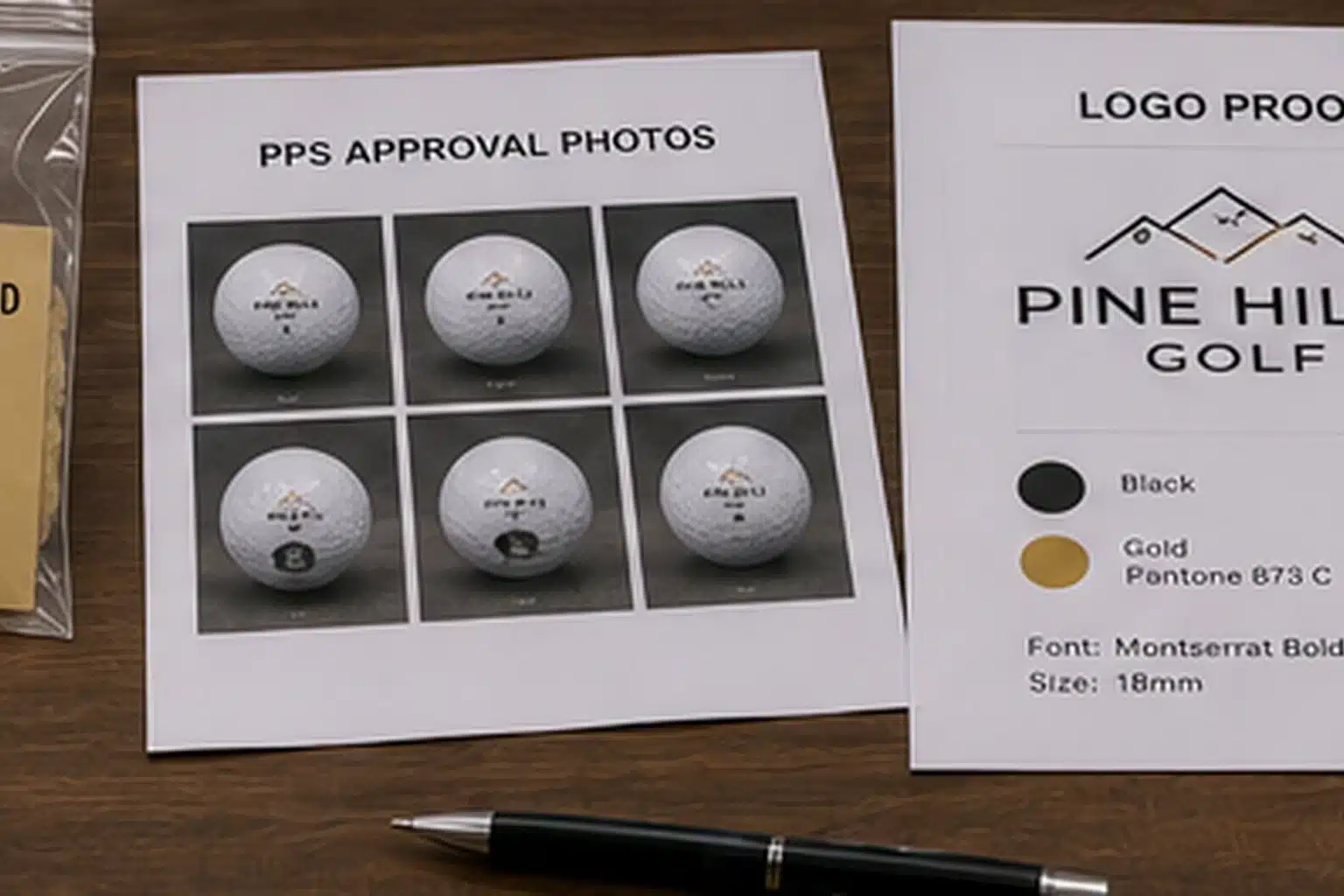
A Japan-ready RFQ converts soft promises into approval evidence. It should define the target channel, ball structure, packaging version, logo setup, sample approval path, inspection method, and no-change rule before the supplier moves into mass production.
| RFQ item | Why it matters | What to request | Acceptance evidence |
|---|---|---|---|
| Target channel | Fit risk | Retail / DTC / gift | Channel note |
| Ball structure | Margin risk | 2-piece / 3-piece spec | SKU worksheet |
| Packaging | Shelf risk | GSM / dieline / sample | Approved pack |
| COO | Claim risk | Layout proof | Print approval |
| Golden Sample | Bulk drift | Sample ID | Retained sample |
| Logo proof | Complaint risk | Macro photos | Buyer sign-off |
| Finish proof | Visual drift | Bulk comparison | Photo report |
| Inspection | Release control | Cosmetic PSI | Hold / release rule |
Supplier shall provide a Japan-bound shipment approval file before production release, including target channel, ball structure, FOB basis, packaging version, COO layout, Golden Sample ID, PPS photos, logo artwork revision, finish specification, retail packaging proof, carton protection proof, and pre-shipment cosmetic inspection evidence.
Buyer approval of Japan-bound bulk production requires verified match to the approved Golden Sample and PPS for ball color, finish gloss, logo edge, logo position, packaging dieline, retail box condition, COO layout, and carton protection. Shipment release requires sample-to-bulk comparison photos, packed-carton proof, and a cosmetic inspection result tied to the production lot.
You can place this wording directly into your Japan-bound OEM RFQ:
“Please quote this Japan-bound golf ball order based on our target channel, retail packaging requirement, and approved sample standard. Confirm the ball structure, FOB price, packaging option, COO marking layout, Golden Sample ID, PPS approval process, color and finish consistency proof, logo position tolerance, retail box GSM and dieline proof, master carton protection, pre-shipment cosmetic inspection, and sample-to-bulk comparison photos before bulk shipment approval.”
FAQ
What is the HS code for golf balls in Japan?
Finished golf balls can start from Japan Customs 9506.32 000 for classification review, but your team should verify the tariff line at shipment date.
Ask for item-level product breakdown before shipment. Mixed gift kits, towels, tees, markers, tools, or accessories may need separate review. Keep classification proof in the import file, but do not let the HS code become the whole Japan import strategy.
What is the import duty on golf balls in Japan?
Japan Customs tariff references can show the current starting point for finished golf balls, but your team should verify current treatment before shipment.
Even when a duty line appears favorable, import planning still needs consumption-tax handling, broker review, product-mix checking, and landed execution. For Japan-bound custom golf balls, the bigger buying decision is whether the SKU is margin-safe and channel-ready.
Is it profitable to import golf balls to Japan?
It depends on SKU, channel, packaging, exchange rate, freight, local delivery, channel margin, and defect allowance.
Build a JDM margin worksheet before bulk approval. Compare 2-piece wholesale, 3-piece DTC, corporate gift, range, and distributor scenarios. Do not approve production based only on a low FOB quote, because packaging and channel costs can erase the advantage.
Why are Japanese market golf balls different?
Japanese channels often judge more than playability; packaging, visual consistency, white tone, logo finish, and shelf presentation can affect acceptance.
Define your target channel before requesting samples. A range buyer, pro shop, DTC brand, corporate gift buyer, and distributor may not use the same cosmetic or packaging standard. Use Golden Sample approval and packaging proof to make expectations measurable.
How strict is Japanese quality control for imported golf balls?
For channel sales, the practical concern is not only AQL pass or fail; it is whether the product looks consistent enough to sell.
Your inspection plan should cover logo edge, print position, color tone, clearcoat gloss, surface blemishes, box scuffs, gift-box corners, carton damage, and sample-to-bulk comparison. Make cosmetic categories clear before the supplier starts mass production.
Are small-batch logo golf balls suitable for Japan?
They can fit corporate gifts, events, DTC launches, and pro shop programs when sample-to-bulk control is tight.
Confirm logo size, color count, print position, and finish before production. Request PPS, retained sample, macro logo photos, and final bulk comparison photos before shipment. Small batch does not mean loose control; often it needs tighter presentation control.
How should Made in China be shown for Japan?
The mark should be accurate, clear, and professionally integrated into the package layout.
Review the retail box and master carton label together with invoice, packing list, SKU, and lot ID. Do not hide the COO mark or imply Japan origin unless documents support it. A clean layout protects both compliance and brand trust.
How do I avoid sample-to-bulk drift?
Lock the Golden Sample, approve PPS, and require pre-shipment comparison photos for color, finish, logo position, packaging, and carton condition.
Assign a sample ID, keep a retained sample, and define which changes require buyer approval. Any material, coating, ink, artwork, packaging material, COO layout, carton specification, or production-facility change should trigger written review.
What should a Japan golf ball RFQ include?
A Japan RFQ should include target channel, ball structure, JDM margin inputs, packaging proof, COO layout, Golden Sample ID, PPS approval, logo proof, finish photos, and cosmetic inspection rules.
Ask the supplier to prove Japan-channel readiness before mass production. The RFQ should make the acceptance standard measurable so your team is not relying on a low FOB price and one attractive sample.
Conclusion
The safest Japan import is not the cheapest China OEM quote. It is the order your team can defend across margin, retail packaging, COO, cosmetic consistency, and sample-to-bulk control.
Before importing golf balls from China to Japan, confirm the target channel, margin worksheet, ball structure, packaging proof, COO layout, Golden Sample, PPS, visual inspection, logo proof, and retail-ready delivery expectation.
If the supplier cannot prove those details before bulk production, the order is not yet Japan-ready. The balls may clear customs, but the shelf can still say no.
You might also like — Golf Ball QC in China: 4 Must-Have Tests for OEM Buyers