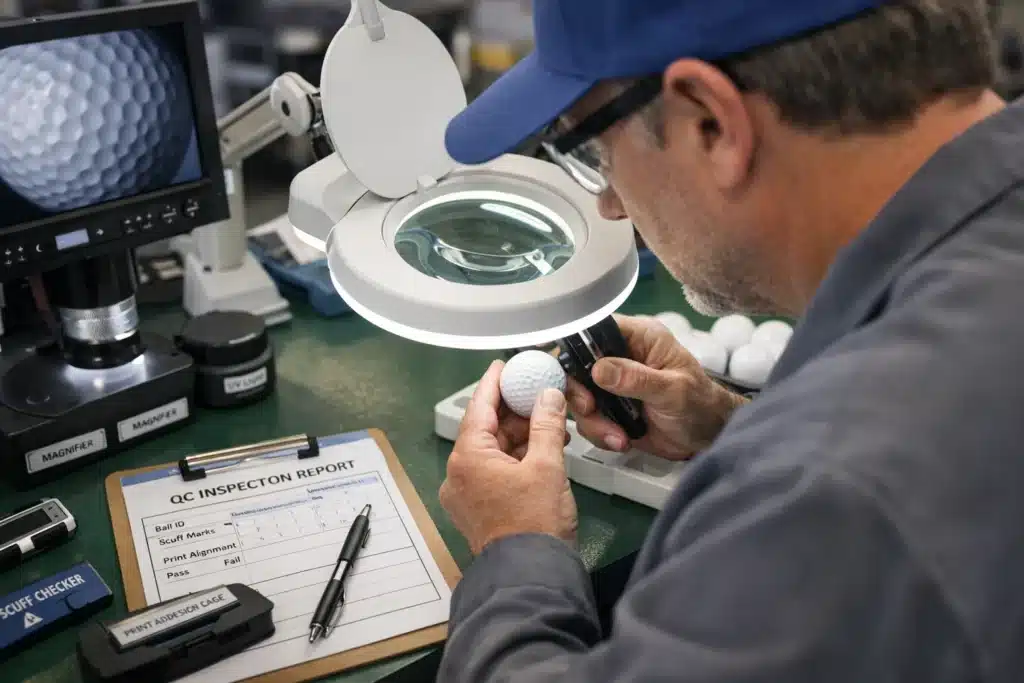
Bulk golf ball buying fails when “2-piece vs 3-piece” is treated as marketing instead of a spec decision. The result is scuff complaints, mismatched feel, and reorders that arrive late.
What is the difference between 2-piece and 3-piece golf balls?
A 2-piece golf ball uses a large solid core and a durable Surlyn/ionomer cover to prioritize distance, durability, and bulk cost control. A 3-piece golf ball adds a mantle layer so designers can separate long-game speed from short-game spin and feel, and many designs pair this with urethane or TPU covers.
In B2B, the right choice depends less on “layers” and more on your loss rate, cover family, and the QC evidence your supplier can document.
Use the quick definition first, then lock the specs and QC reports that protect your margin and your members’ expectations.
What’s the difference between 2-piece and 3-piece balls?
A 2-piece golf ball uses a large solid core plus a durable Surlyn/ionomer cover to prioritize distance, durability, and bulk cost control.
A 3-piece ball adds a mantle layer so designers can separate long-game speed from short-game spin and feel, often paired with urethane/TPU covers.
When “piece count” is used as a quality shortcut, bulk programs drift into the wrong SKU fast. That’s how you end up paying for feel at the range—or selling a “cheap-feeling” ball through the pro shop.
The practical difference is what the designer can tune—and what your program will actually notice. A classic 2-piece build is core + cover, so you typically buy it for predictable distance, fewer scuff complaints, and easier cost control. A 3-piece build adds a mantle layer, which gives more “knobs” for separating long-game behavior (speed and spin management) from short-game behavior (sound/feel and stopping).
Compression is where buyers get misled. Compression is not a clean 2-piece vs 3-piece divider. Independent measurements have shown 2-piece balls spanning from mid-compression “distance” builds (e.g., a measured value around 84) down to very low compression “soft” builds (e.g., around 47). Tour-style multi-layer balls often sit in the high-80s to low-90s band, but that’s a pattern—not a rule you can purchase blind. Use them as reference anchors, then confirm your supplier’s batch distribution with your chosen measurement method.
✔ True — Piece count is an architecture decision, not a guaranteed “feel grade.”
Compression, cover chemistry, and layer hardness targets can make a 2-piece feel surprisingly soft or a 3-piece feel firm and fast. In B2B, treat layers as your starting point, then verify the measurable specs that matter to your channel.
✘ False — “3-piece automatically means premium.”
Premium perception comes from the whole recipe—cover family, thickness, surface system, and consistency. If you need “premium,” specify it and ask for proof, rather than assuming layers will deliver it.
You can make this decision with one simple request: ask for a cutaway photo set (core/mantle/cover visible) plus a one-page spec sheet for each SKU. That turns “2-piece vs 3-piece” into a real comparison you can circulate internally.
Does cover material matter more than layer count?
Many bulk programs overpay for “3-piece” on the quote and under-spec the cover. Then the ball either scuffs too fast for a range, or fails to deliver the short-game perception a club expected.
For most bulk programs, the cover material is the quickest predictor of durability and greenside control.
Surlyn/ionomer covers usually resist scuffs and keep costs down, while urethane/TPU families are used when you need more “grab” and a different feel on short shots. Layers help tune performance, but cover choice sets the ceiling.
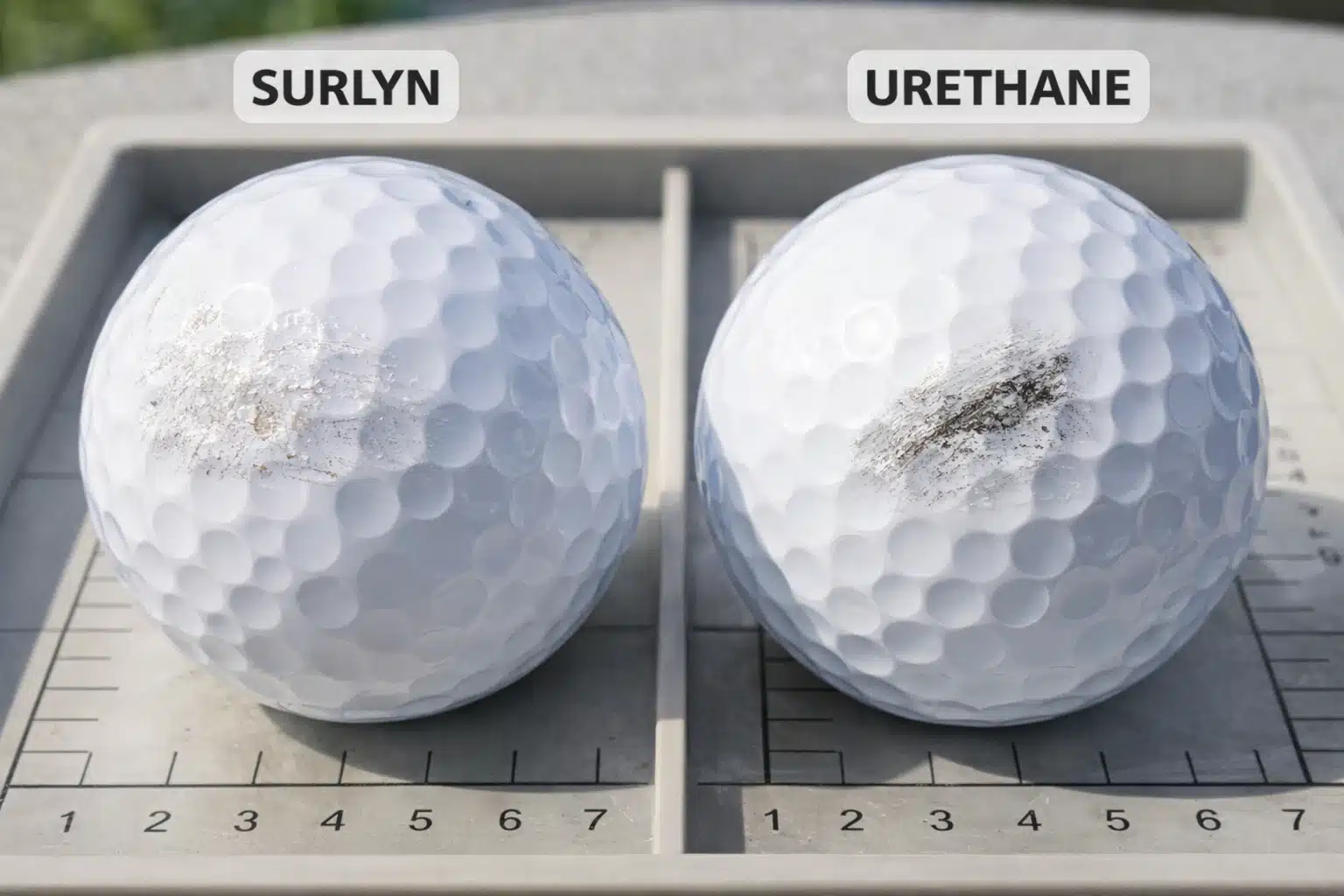
If you’re buying for ranges, the cover is your abuse shield and your branding surface. Ionomer-style covers tend to be chosen because they’re forgiving under repeated impacts, carts, and mixed storage. If you’re buying for member play, tournaments, or pro shops, the cover family is also your “perception engine,” because it’s what the clubface and grooves interact with on partial wedges.
A useful mental model is this: layers help you shape “driver vs wedge separation,” but cover chemistry and surface system often determine the top end of greenside friction. That’s why robot-style testing discussions often show tour-type balls exceeding 7,000 RPM on ~50-yard wedge shots (one reported example is 7,150 RPM), while non-urethane models average notably lower in comparable short-wedge tests (one reported average is 3,849 RPM around a ~40-yard wedge setup). Those figures are reported examples under specific robot-test protocols, not purchase guarantees—verify the test setup (club, speed, strike, and turf) before using them as acceptance criteria.
How do TPU and cast urethane covers differ?
TPU is typically injection-molded and scalable, while cast (thermoset) urethane is typically positioned for the highest-end “tour” feel.
For bulk buying, the day-to-day difference is how predictable the process is at volume, and what durability and consistency you can lock with evidence.
Treat “urethane,” “TPU,” and “hybrid cover” as spec families, not interchangeable labels. Some suppliers use “urethane” to refer to injection-molded TPU systems; others mean cast thermoset urethane. If you don’t define it, you’re buying a story, not a build.
Write one line into your RFQ and you’ll prevent weeks of back-and-forth later: require the supplier to declare the cover family (ionomer/Surlyn, TPU, or thermoset urethane), provide a target cover thickness and hardness window, and attach an abrasion plus adhesion photo report from pre-production samples.
Which specs should you lock in before buying bulk?
Price debates get loud when specs are vague. Without acceptance criteria and traceability, the buyer ends up holding the scrap risk, the print complaints, and the “this batch feels different” problem.
Bulk buyers should lock specs that can be measured and re-checked: compression distribution, weight/diameter, layer concentricity, and cover durability.
Then require a 12-ball QC report with average + SD + range, plus method notes and photos for coating/print adhesion and abrasion. This is how you avoid “sample vs shipment” surprises.
Here’s a table that keeps quote comparisons grounded in actions and evidence:
| Buying decision | What to choose (typical) | What to request next |
|---|---|---|
| High-loss range use | 2-piece Surlyn/ionomer focus | Request abrasion + print/coat adhesion report; approve before PO |
| Member play / short-game priority | 3-piece with urethane/TPU family cover | Request wedge-control proxy + cover thickness/hardness data; approve sample |
| Brand needs “premium feel” | 3-piece (or higher) with tuned mantle | Request compression distribution + concentricity evidence; lock acceptance limits |
| Tournament eligibility needed | Current conforming-list model/marking | Request proof of current listing or define who funds submission/renewal |
| Inventory scuff/aging risk | Durable surface system + stable packaging | Request packaging spec + storage conditions; set receiving inspection steps |
| Cost dispute risk | Spec-driven comparison, not “layers” | Ask for a per-SKU QC pack and batch traceability plan; compare apples-to-apples |
Two buying moves matter more than most people expect.
First, separate “quality” from “competition eligibility.” Some tournaments and clubs require balls that appear on a current conforming list for the exact marking/model. A listing not being current doesn’t automatically mean the ball is low quality, but it can matter for events that require eligibility. Your deliverable is straightforward: have the supplier provide the marking artwork plus proof of current listing for that exact marking/model, or a conformity testing plan that clearly assigns who pays for submission and renewal.
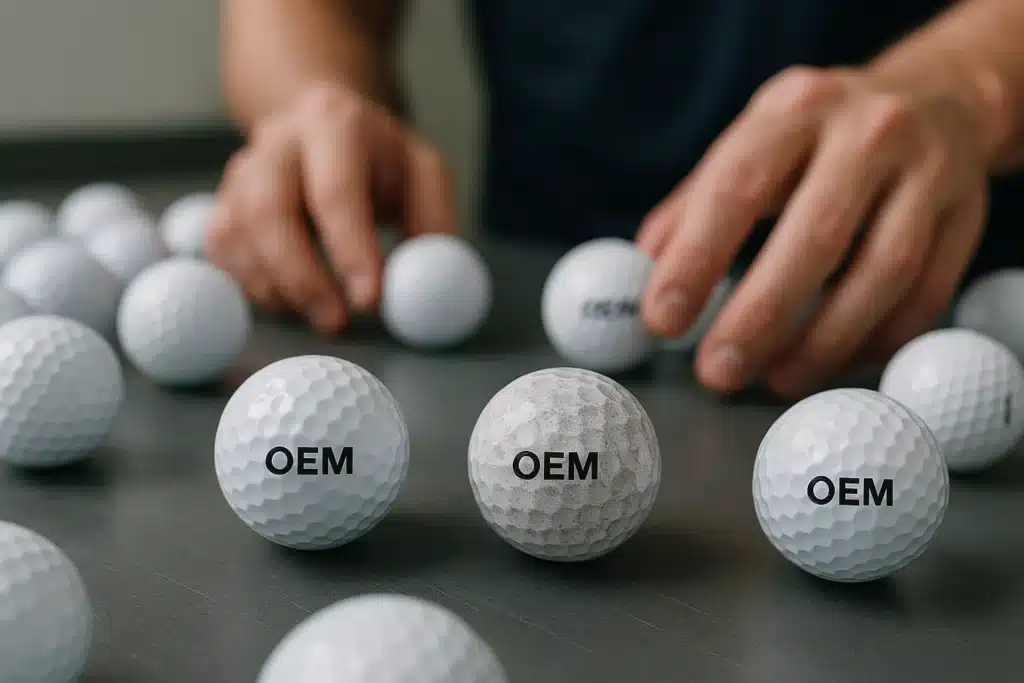
Second, insist on distribution, not just averages. Averages hide drift. A telltale sign you should treat as a receiving stop is a Wide compression spread within a dozen on a first-article set. It often shows up as inconsistent sound/feel feedback, and it can foreshadow uneven production control.
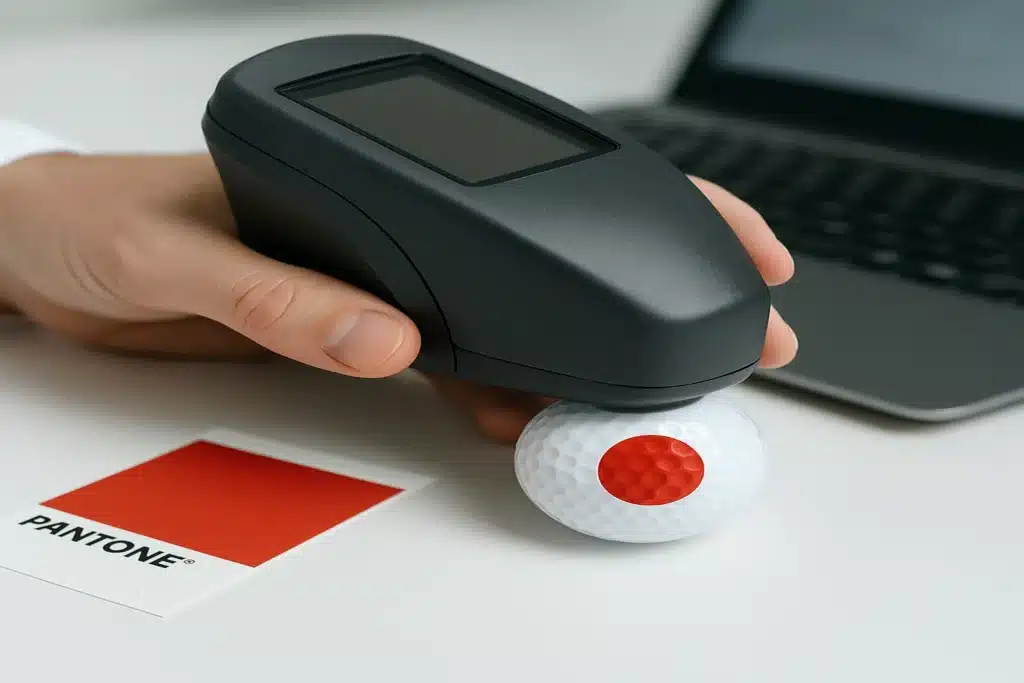
If you’re ordering custom logo golf balls, don’t treat printing as “artwork approval only.” Surface prep and coating windows can change the real-world outcome, which is why you want method + photo evidence tied to the same batch ID that ships.
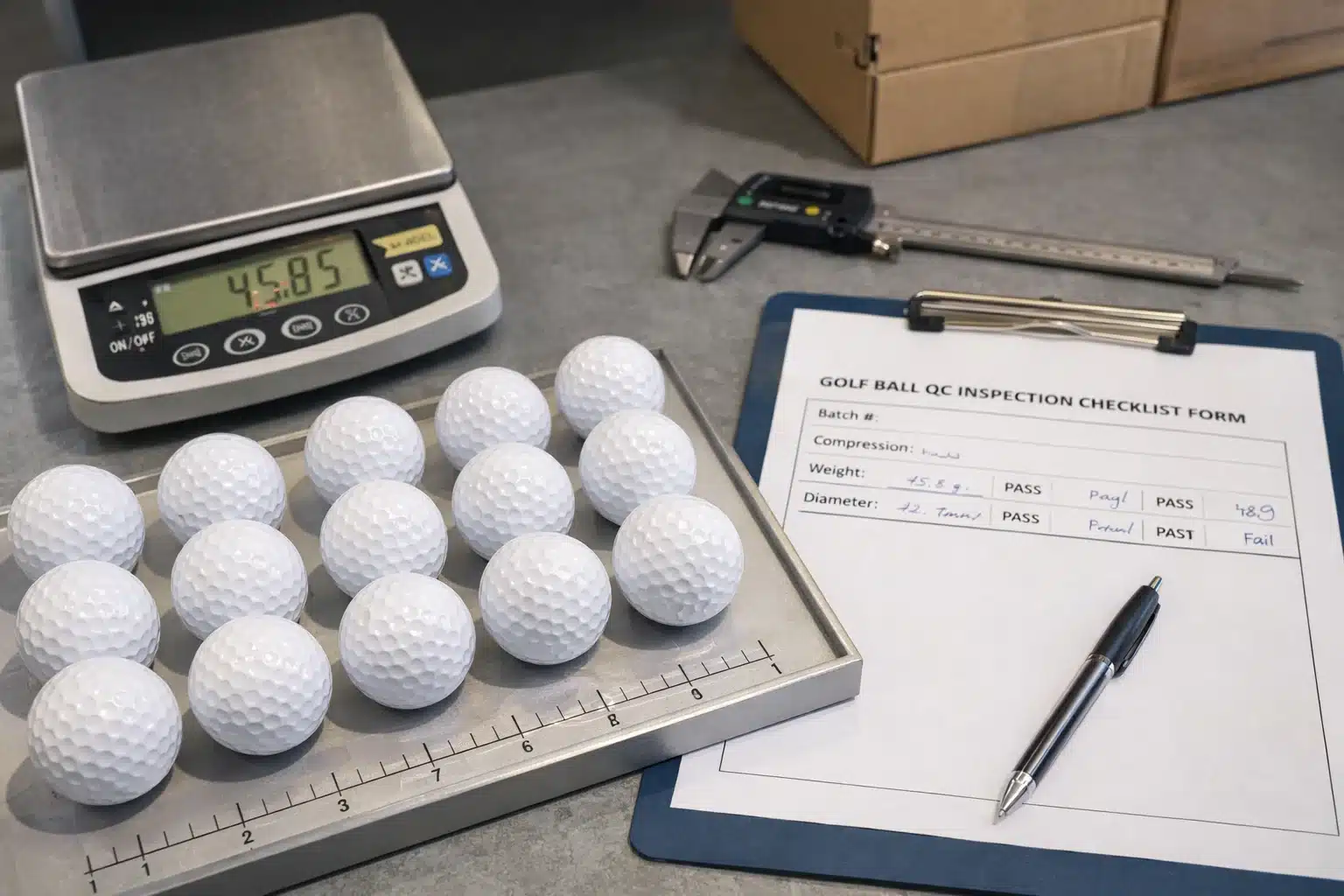
Locking specs only works if they’re enforceable. Put one acceptance clause into your PO so the “proof” is not optional: require compression (ATTI or equivalent) reported as average + SD + range, weight and diameter measured per an agreed method and within agreed limits, concentricity/center offset verified by X-ray/CT (or equivalent) within an agreed limit, and coating/print adhesion plus abrasion documented with method notes and photos. Any out-of-spec result should trigger corrective action and re-approval before mass shipment.
The most buyer-friendly RFQ request is also the one that reduces “sample vs shipment” arguments:
Provide a 12-ball pre-production sample report and a 12-ball first-article report showing:
(1) compression (ATTI or equivalent) with average + SD + range,
(2) weight + diameter pass/fail,
(3) concentricity/center offset (X-ray/CT or equivalent) with acceptance limits,
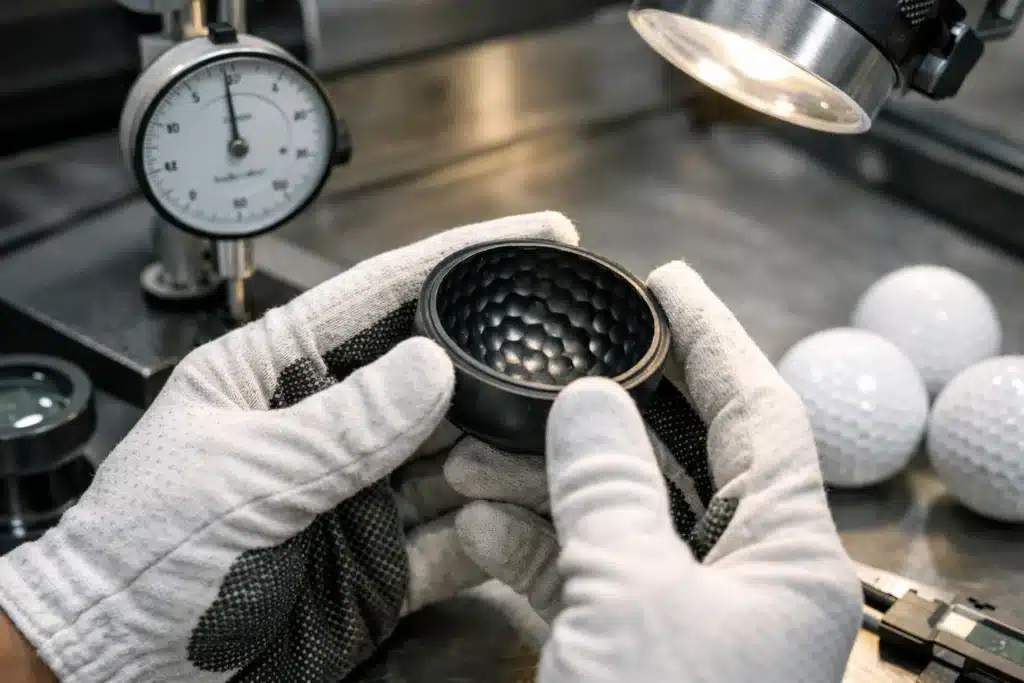
(4) cover thickness map,
(5) coating/print adhesion and abrasion results with method + photos,
plus instrument model + calibration status and a batch/lot ID that will match the production cartons.
✔ True — The fastest “cost saving” is preventing the first dispute.
A 12-ball report with distribution stats and traceable batch IDs catches drift early and keeps approvals objective. That’s more valuable than arguing over whether a 3-piece “should” cost more in the abstract.
✘ False — “If the prototype is good, production will match automatically.”
Bulk failures usually come from process windows and batch variation. Your paperwork should prove consistency, not just capability.
Which ball fits ranges, giveaways, and pro shops?
Trying to force one ball into every channel is how programs lose money in two directions. The range cares about survival and replacement economics; the pro shop cares about perceived value and member expectations.
Driving ranges and high-loss promotions should default to 2-piece Surlyn because durability and replacement cost matter most.
Private clubs and pro shops should stock a 3-piece option when members value greenside control and feel, especially for events and gifts. Keep it simple: one workhorse, one upgrade, both sample-approved.
This is where channel language helps you sell the decision internally. Your “workhorse” SKU is your operational ball: predictable durability, stable printing, easy replenishment. Your “upgrade” SKU is your perception ball: short-game feel, presentation, and member satisfaction—without forcing tour-level cost into high-loss environments.
If you’re buying wholesale 2-piece golf balls for a range or academy bucket program, the win condition is rarely “best feel.” It’s fewer early scuffs, fewer logo issues, and fewer headaches when the next shipment arrives and the ball looks/plays noticeably different.
When should ranges default to 2-piece Surlyn?
When your loss rate is high and the surface takes punishment, a range ball is a consumable, not a showcase item.
A 2-piece build with an ionomer/Surlyn-style cover is often the default because it can be more forgiving under repeated impacts and mixed storage, while staying cost-controllable at volume.
You can validate that decision with a small, controlled check rather than a full-season gamble. Run a mini pilot that mirrors your reality: track visible scuffs per 100 hits under your normal bucket workflow, and include a quick logo wipe/handling check by staff. If you’re choosing an “upgrade” SKU for academies or member practice, add a short-game mini blind test focused on 30–60 yards to see whether your players actually notice a stopping/feel difference.
The failure mode to watch for is simple: Fast cover scuffing under driver-range abuse. If it shows up early in a pilot, treat it as a cover-spec problem, not a “2-piece vs 3-piece” debate.
Should you source TPU hybrid-cover balls in 2026?
Hybrid covers are trending because buyers want “urethane-like” short-game perception without tour-ball loss cost. That demand is real, but only works for bulk if you define the spec and protect consistency.
TPU or “hybrid” covers are worth sourcing when you need a more premium short-game feel than Surlyn, but you also need injection-scale cost control for bulk orders.
Treat “hybrid cover” as a spec: define the cover family, require compliance documents, and lock a durability + consistency QC pack.
As of January 2026, the most useful market lens is “performance down-market.” Buyers increasingly want a two-tier lineup: a Surlyn/ionomer workhorse for high-loss programs, and a TPU/hybrid-cover option for member play, retail, and premium gifting where perception matters. That lineup strategy reduces complaints without turning every channel into a tour-ball cost structure.

Use this table to decide whether TPU/hybrid makes sense for your program and how to protect the buy:
| TPU/hybrid decision | Risk if undefined | What to lock in next |
|---|---|---|
| Cover family (TPU vs thermoset vs coated) | Marketing mismatch; inconsistent feel | Request cover declaration + thickness/hardness targets; approve sample |
| Durability target for your program | Scuff complaints; high replacement rate | Require abrasion + adhesion report with photos and method; set pass/fail |
| Batch consistency evidence | Good sample, weak production | Require 12-ball report with average + SD + range; include batch ID linkage |
| Compliance document chain | Customs/retail compliance risk | Request material CoC + required compliance statements tied to resin lot |
| MOQ and lead-time control | Overstock or late deliveries | Use split shipments/piggyback option; define lead time vs delivery date in PO |
Hybrid programs often succeed or fail on planning discipline. “Lead time” is frequently misunderstood, so define it in writing as a sequence: artwork freeze → pilot/first-article approval → mass production slot → ship-ready date. If you’re seasonal, split shipments can keep inventory sane, and piggyback-on-batch options can help you avoid ordering a full MOQ every time you adjust packaging or artwork.
A red flag that predicts expensive rework is Logo smearing or peel after wipe/adhesion check on pre-production samples. Don’t explain it away. Require method + photos, then fix surface prep, coating, or cure windows before you lock the mass-production slot.
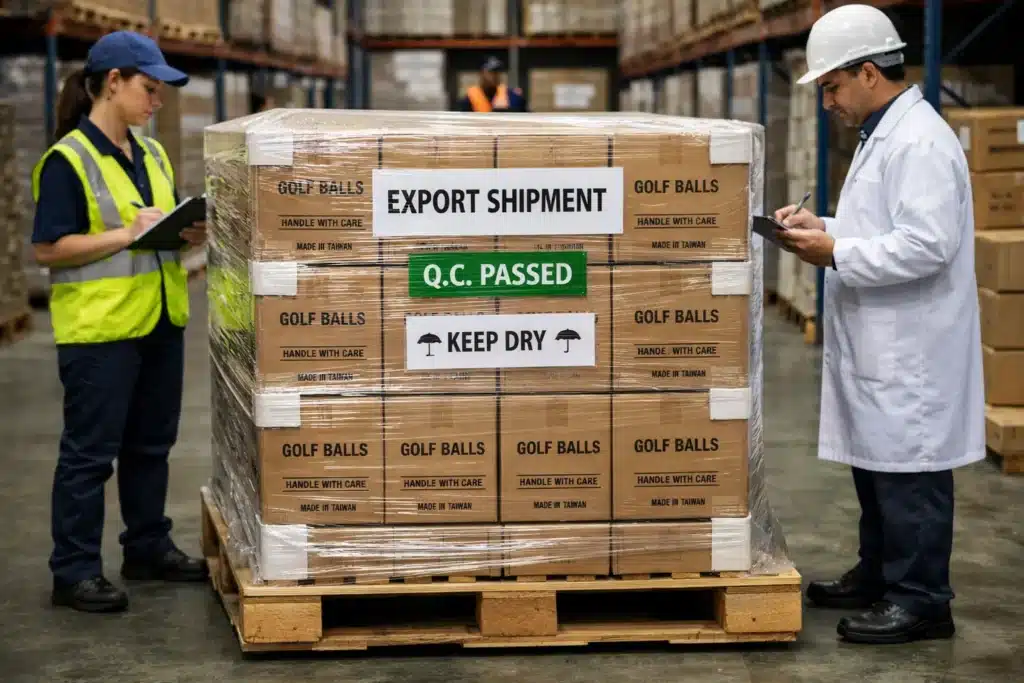
One PO clause prevents the most common “which batch was this?” argument: require a unique batch/lot ID printed on outer cartons, a trace pack linking cover resin lot and core compound lot to the batch QC report, and a retain-sample plan (for example, one dozen retained per batch for an agreed period) for dispute resolution.
✔ True — Hybrid covers win when you control the definition and the evidence.
TPU-style covers can deliver a more premium short-game perception than basic ionomer while staying scalable for bulk orders—if you specify the cover family, thickness/hardness targets, and durability/adhesion methods up front.
✘ False — “Hybrid cover automatically equals tour-level spin.”
Greenside behavior depends on cover chemistry, thickness, surface system, and layer tuning. If you need a particular outcome, lock a proxy test and demand reportable proof.
FAQ
Are 3-piece golf balls better for high handicappers?
Sometimes, but only when your players’ loss rate is low enough for them to benefit from short-game control and “feel” differences.
If balls disappear quickly, durability and cost control usually matter more than layers, even for improving golfers.
High-handicap segments can be split into two very different buyer realities: high-loss casual play and structured improvement (lessons, academy, repeat practice). For the first, a durable workhorse prevents frustration and keeps your program predictable. For the second, a 3-piece option can make sense if instructors and players actually notice better stopping behavior in the 30–60 yard window. A small mini blind test with your real users is more reliable than picking based on handicap assumptions.
How much more does a 3-piece ball cost in bulk?
The premium is factory- and cover-dependent, so avoid treating any single number as a planning truth.
You’ll get a cleaner comparison by locking the same packaging, logo complexity, and QC evidence requirements across quotes, then comparing landed cost under identical assumptions.
In bulk, “price per dozen” often hides the real drivers: extra process stages, QA gate density, scrap risk, coating/printing complexity, and compliance paperwork. Lead-time certainty can also be worth paying for in seasonal programs if it prevents missed tournament windows or emergency freight.
Does urethane vs Surlyn matter more than layers?
For short-game control and feel perception, cover chemistry is often more predictive than piece count.
Layers help tune how the ball behaves at different speeds, but cover choice typically sets the greenside friction ceiling and strongly influences scuffing and logo durability.
If your program relies on member perception, specify the cover family in the RFQ (ionomer/Surlyn, TPU, or thermoset urethane), and request a cover thickness/hardness target plus an abrasion and adhesion photo report. Then validate with a short-game-focused pilot rather than relying only on driver distance talk.
How long do 2-piece vs 3-piece balls last in inventory?
Shelf life depends more on packaging, storage conditions, and coating/print systems than on piece count.
Treat aging as a receiving-and-storage SOP with traceability, not a guess based on whether the ball is 2-piece or 3-piece.
Ask your supplier for recommended storage conditions and a packaging spec that protects surface finish and logos in transit and warehouse handling. Use batch/lot IDs to rotate inventory, and keep basic receiving checks consistent across shipments. If you expect long storage windows, consider a simple re-check step before distribution, such as a spot-check on adhesion and a small compression check.
Do you need a current USGA/R&A listing for bulk orders?
Only if your tournaments or club rules require current eligibility for the exact marking/model you will ship.
An expired listing alone doesn’t prove low quality, but it can affect competition eligibility if your program adopts the conforming-ball requirement.
Confirm the requirement first, then align the supplier deliverable. Ask for the exact marking artwork tied to the listed model, and define what “current” means for your event date. If submission or renewal is needed, assign who pays and what happens if timing slips.
What QC reports should you ask for on your first order?
Ask for reports that catch batch drift: compression distribution, concentricity evidence, and surface durability with methods and photos.
Require batch/lot ID linkage so every carton can be traced back to a specific production run and QC record.
For first orders, insist on a 12-ball pre-production report and a 12-ball first-article report with average + SD + range for compression, weight, and diameter; concentricity/center offset evidence; a cover thickness map; and coating/print adhesion plus abrasion documentation. If you keep retain samples per batch, you’ll be able to troubleshoot objectively if a dispute happens months later.
Conclusion
Choose construction by channel and loss rate, then make the deal predictable by locking cover family and QC evidence. A 2-piece Surlyn/ionomer workhorse protects durability and cost control in high-abuse programs; a 3-piece option earns its keep when members and retail buyers value greenside perception.
Your cleanest procurement path is spec → sample → documented QC pack → batch traceability → delivery terms that match your seasonality, incoterms/ports, branding scope, compliance must-haves, landed-cost band variables, and expected annual volume.
You might also like — How to Choose a Reliable Golf Ball Manufacturer in China?