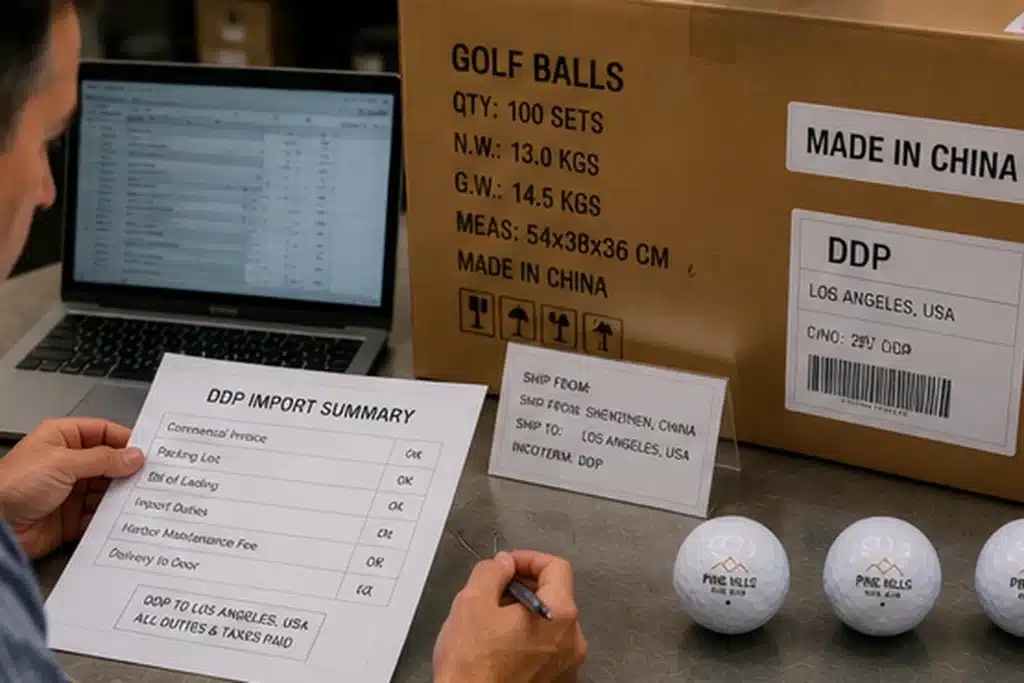
Many golf balls are made in China, especially mass-market, promo, range, and private-label OEM balls.
China is one of the major manufacturing bases for 2-piece ionomer / Surlyn golf balls, value 3-piece builds, logo balls, range balls, and packaging-heavy private-label programs. But country of origin is not a quality score. Your buying decision should depend on cover process, batch QC data, traceability, packaging control, and landed-cost logic.
For OEM buyers, the real question is not only “Are golf balls made in China?” It is whether China fits your SKU: a 2-piece promo ball, a value urethane-family private-label ball, a range program, a DTC gift box, or a tour-style premium project that needs stronger process proof.
Use this guide to understand what China commonly produces, where China-made golf balls fit best, and how to verify supplier claims before you approve samples, packaging, or bulk production.
Are most golf balls made in China in 2026?
If you’re typing “Where are golf balls manufactured” into Google, you’re usually not debating geography—you’re trying to predict operational risk: returns, reviews, and whether your next reorder turns into a weekend emergency.
Yes—China remains one of the biggest global manufacturing bases for golf balls in 2026, especially for 2-piece ionomer/Surlyn and private-label OEM runs. Many premium tour-positioned balls are still more concentrated in other high-end hubs, but a large share of value and mid-market SKUs are produced on China’s mature molding, coating, and packaging lines.
You’ll see trade dashboards and public shipment views used as proof. They’re useful as activity signals, not guaranteed market-share truth. For example, one public trade dashboard showed a month-to-month export uptick from $4.59M to $5.62M in late 2025.
The more useful buyer question isn’t “Is China big?” It’s “Is China the right default shortlist for my SKU?” A clean way to decide is to split by construction and promise:
-
If you sell 2-piece distance or value 3-piece, China often belongs on the shortlist because high-volume molding and finishing are mature.
-
If you sell tour-aspirational urethane, don’t assume “urethane” means the same process everywhere—verify process type, surface durability, and repeatability before you scale past samples.
A simple evidence action that keeps teams honest is to write your SKU promise as acceptance criteria before you talk price. Decide what you’ll measure (and how) so your supplier selection doesn’t drift into “the sample felt nice.”
✔ True — Your SKU segment predicts risk better than origin
The more “value + volume” your SKU is, the more China’s ecosystem tends to fit. The more “tour + feel” you promise, the more you should demand process proof and batch statistics before committing inventory.
✘ False — “Country of origin equals quality”
Origin is only a filter. Quality is process control, tooling, materials, and traceability—things you can verify with evidence.
What Types of Golf Balls Does China Make?
Older sourcing content often over-focuses on one coastal cluster. In real purchasing, you’ll get better outcomes by choosing a hub based on what it’s optimized for: speed and packaging ecosystem, stable mass output, flexible MOQs, or capacity density.
China’s OEM golf ball capacity is clustered by “what they’re optimized for,” not just geography. Shenzhen/Dongguan are often shortlisted for fast customization plus a dense packaging ecosystem. Xiamen/Quanzhou/Zhangzhou are commonly associated with continuity for steady value SKUs. Ningbo/Hangzhou are frequently discussed for flexible small runs and customization. Shandong/Qingdao is often cited for scale in ball-body capacity.
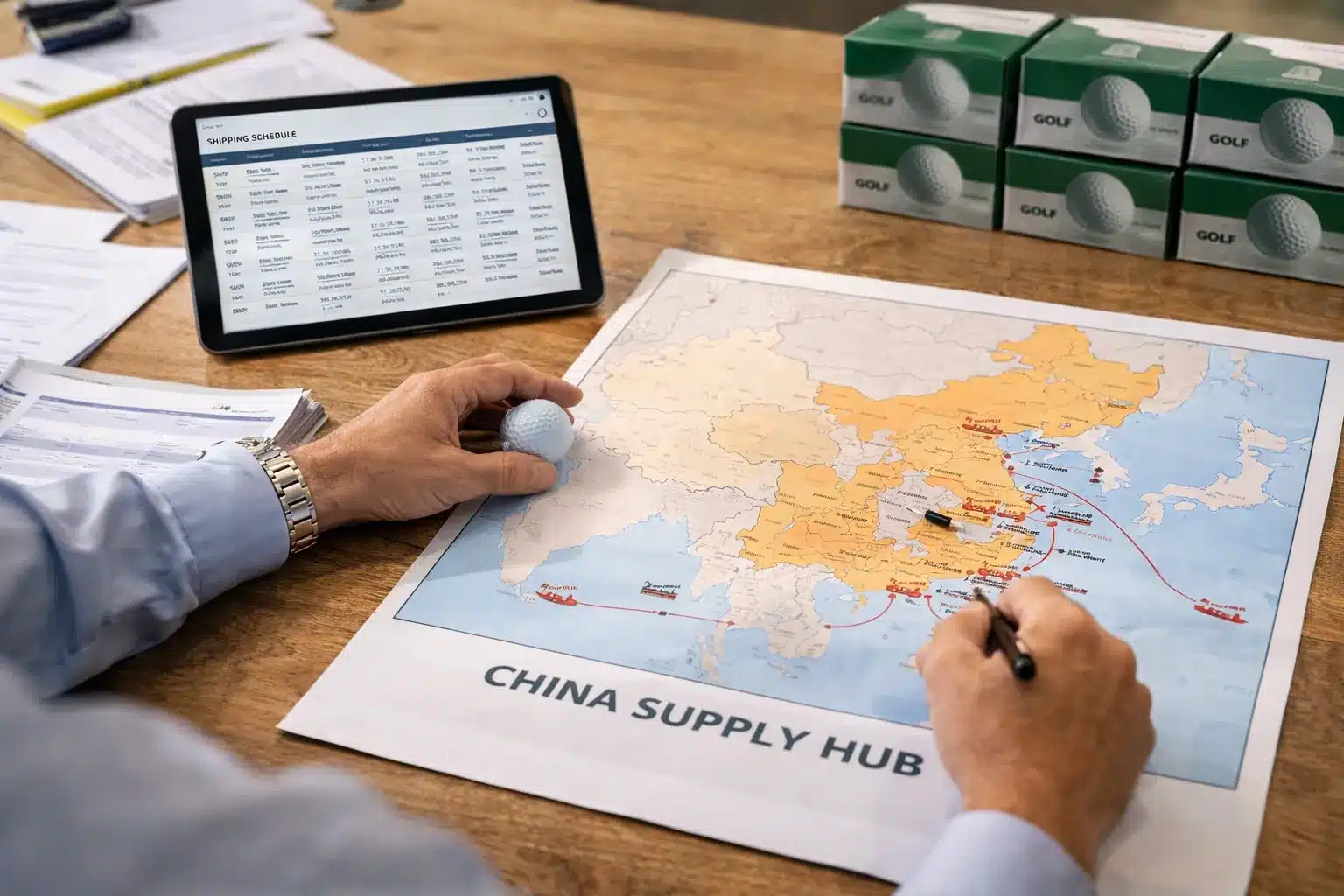
If you need fast custom plus packaging variety, Guangdong is often the first stop because the “ball + box + print + accessories” ecosystem is dense. That matters when you’re juggling multiple SKUs, holiday sleeves, display boxes, or a promo program that lives and dies on packaging execution. If you’re prioritizing steady output for a value SKU, Fujian hubs are commonly shortlisted for continuity and stable runs. If you’re testing a smaller private-label run, Zhejiang is frequently discussed for flexibility and faster iteration.
Shandong/Qingdao can be a smart lane when you’re chasing capacity, but keep it verify-first. Don’t accept it on vibes. Ask for (1) a primary product list, (2) line video evidence (molding/painting/printing), and (3) shipment references that match your channel and packaging format.
MOQ is not a universal constant. It can change with construction, print method, packaging complexity, and how busy a coating line is when you place an order. Use any MOQ you see online as a conversation starter and verify it per factory.
| China-made golf ball type | Common China fit | Buyer risk | Evidence to request | Better next step |
|---|---|---|---|---|
| 2-piece ionomer / Surlyn balls | Strong fit for distance, promo, range, and value retail | Treating low price as proof of consistency | Ask for weight, diameter, compression, durability, and print QC. | Compare batch QC before price. |
| Value 3-piece / TPU-route urethane balls | Good fit for private-label and value-premium programs | Assuming “urethane” means cast thermoset | Require TPU vs cast route declaration and cover-process proof. | Match cover process to SKU promise. |
| Logo and corporate gift balls | Strong fit when packaging and print are important | Logo failure, color mismatch, or late packaging | Request artwork proof, print adhesion, box dieline, and carton mark approval. | Approve packaging before PO. |
| Range and practice balls | Strong fit for durability and repeat volume | Weak coating, poor marking, or inconsistent batch quality | Ask for abrasion, compression, coating, and retained sample records. | Set batch acceptance criteria. |
| Tour-style premium balls | Selective fit, not automatic | Overclaiming Pro V1-style performance | Request cover process, spin data, concentricity, IV/USGA logic, and retained samples. | Use evidence-backed performance wording. |
China’s production base is not one single cluster. Guangdong often fits fast promo and packaging-heavy work, Fujian is commonly used for stable mid-volume OEM continuity, and Zhejiang is useful for lower-MOQ private-label testing. For a deeper regional breakdown, use the China golf ball factory hub guide.
A pattern worth watching across hubs is slow, unclear quoting with constant back-and-forth even when your RFQ is structured. That often points to hidden subcontracting or weak internal process control—both show up later as batch drift.
Do major golf brands manufacture in China?
This is the reassurance question: buyers want signals that serious brands also source in China. The trap is that brand-level answers can be misleading, and the most reputable suppliers often can’t disclose client names.
Sometimes—but most “who makes for who” details are NDA-protected, so buyers shouldn’t rely on rumors. The safer approach is to validate capability (equipment, QC stats, process type) and confirm origin through packaging and shipping documentation, instead of demanding name-drops that reputable suppliers won’t provide.
If your team is searching “Are Titleist balls made in China?” or “Top 10 golf ball manufacturers in China,” reframe it into verifiable questions:
-
What’s the golf ball country of origin for the exact SKU you’re benchmarking?
-
Does the supplier behave like a specialist (golf balls as the core product), or like a broad catalog trader?
-
Can they show line evidence and batch discipline without dodging?
Country-of-origin is SKU-specific, not brand-specific. Build your internal approval flow around packaging proofs (retail box + master carton) and shipment documentation, so you’re not rewriting listings and labels at the last minute. When a supplier offers “big brand” hints, treat that as a soft signal and ask for hard proof you can audit: equipment lists, calibration context, sample sets tied to a batch ID, and a clear description of how the model stays stable over time.
One telltale sign to avoid is a “USGA listed” claim without model/batch linkage. Even when it’s unintentional, it signals sloppy documentation habits—usually not what you want for private-label.
✔ True — Capability proof beats client-name proof
If a factory can document process type, QC statistics, and traceability, you can build a defensible private-label supply chain without forcing anyone to break an NDA.
✘ False — “If they won’t name brands, they must be low tier”
Refusing to name clients can be professionalism. Push for evidence you can audit instead: raw QC data, calibration proof, and batch mapping.
Why premium lines stay local and NDAs matter
Premium positioning lives or dies on repeatability, not a great sample. NDAs often protect process stability as much as they protect branding. If you sell tour-aspirational, require proof of cover process (cast vs TPU) and batch consistency; if you sell value SKUs, prioritize stable batch QC and packaging execution.
How do you verify a China factory’s golf ball quality?
The buyer anxiety behind this is simple: “Can China match my US/Japan benchmark consistently?” The answer isn’t a slogan—it’s a verification workflow you can repeat for every SKU.
The fastest way to de-risk China OEM golf balls is to verify consistency with device-backed batch data, not marketing claims. Ask for raw measurements with method and instrument details, confirm essential test equipment and calibration, and validate that the cover process (TPU injection vs cast urethane) matches your performance promise before you scale.
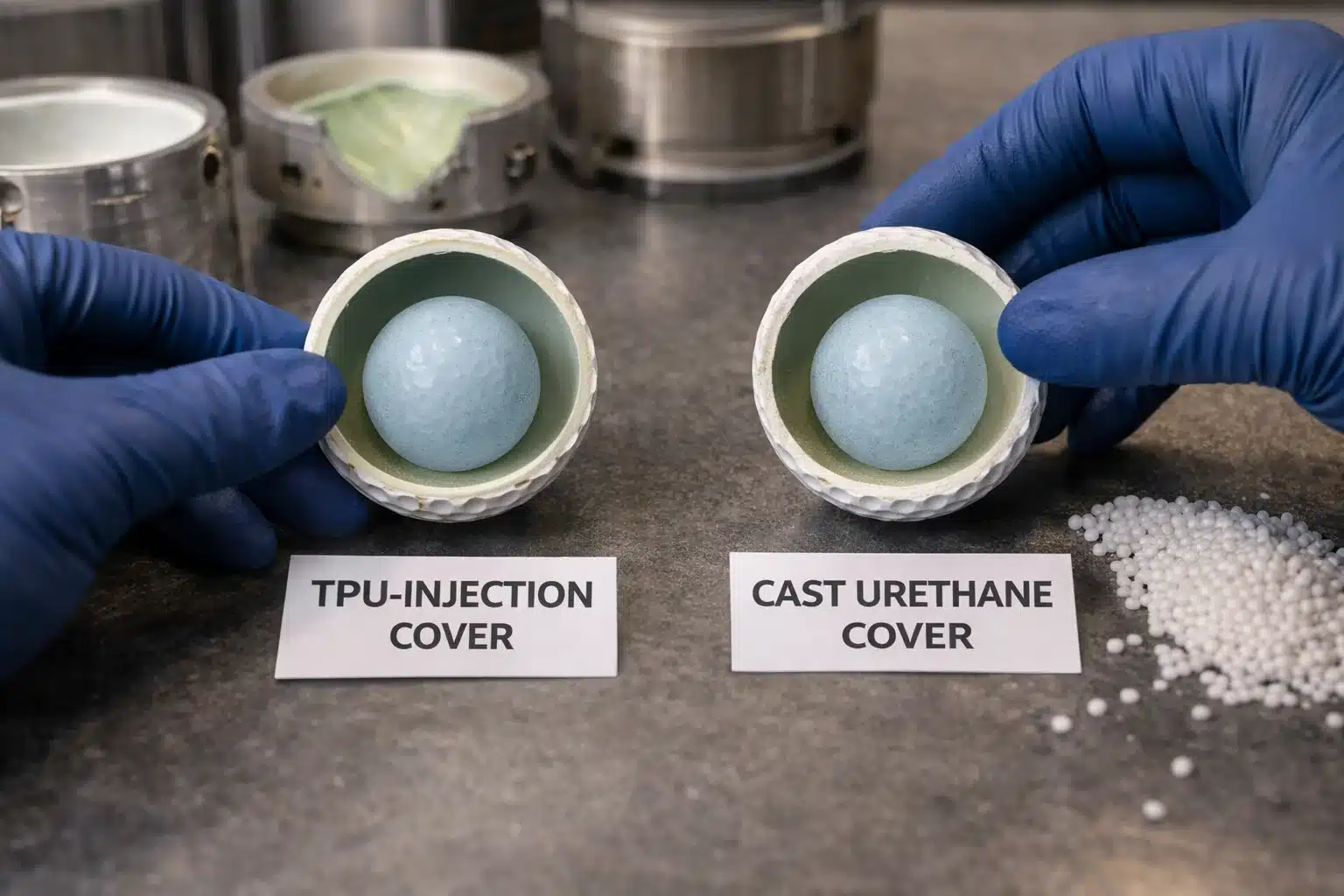
Evaluate suppliers on two questions. First, are you dealing with a real factory that’s specialized? Second, can their QC discipline hold up beyond samples?
A real specialist can usually provide a capability pack that includes line videos (molding/painting/printing), a golf-ball-focused catalog, and shipment references that make sense for your channel (retail vs promo vs range). A batch-capable supplier can provide raw QC data (not just a “pass” statement) plus method and instrument model, an equipment list, and calibration certificates.
Your highest-leverage RFQ move is to request the same data package for every SKU, every time, so suppliers are compared on evidence—not on who writes the prettiest PDF.
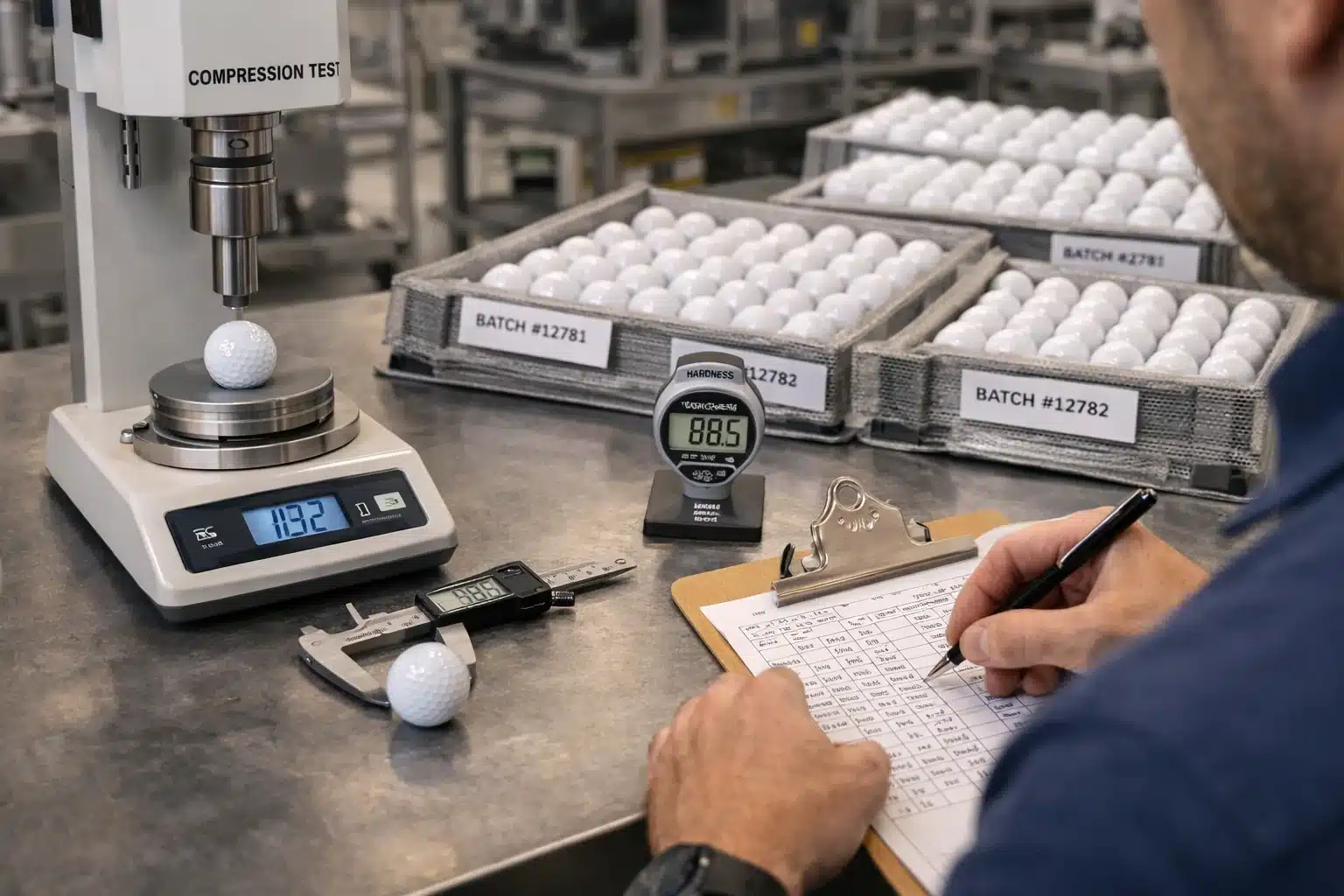
Request a “12-ball QC packet” per SKU: raw measurements (weight/diameter/compression), test method + instrument model, last calibration certificates, and batch ID mapping (resin lot + mold ID + coating line) for traceability.
A bright red flag is no calibrated compression device on-site. If compression is reported without the instrument model and calibration context, you’re setting yourself up for batch drift arguments later.
| QC question | Proof to request | How you verify | Pass/Fail trigger | Next step |
|---|---|---|---|---|
| Is compression stable? | Raw compression data + instrument model | Compare to your benchmark set | Wide spread or no method stated | Re-sample or reject |
| Is concentricity controlled? | X-ray/CT evidence + report format | Confirm metric definition | No imaging capability | Use third-party lab |
| Will paint/ink hold up? | Durability test plan + coated samples | Repeat hit/wear checks | Early cracking/scuffing | Adjust coating spec or supplier |
| Is “tournament legal” needed? | Listing evidence OR channel rationale | Verify channel requirement | Vague “legal” claims | Write channel rule into spec |
Once the factory clears the data hurdle, make the next step operational. Don’t only test “does the sample pass?” Test “does the factory document how the sample was made?” Ask how resin lots are tracked, how mold IDs are recorded, and how coating lines are separated so you can troubleshoot later without blaming the moon phase.
When cartons land, keep it boring on purpose. Spot-check a consistent sample size per batch, compare results to your agreed spec window, and log the batch ID with the test record. That habit catches drift early and gives you clean data for corrective action. It also makes supplier conversations faster, because the data trail is already organized.
If you’re selling through retail/wholesale, consistency beats “best feel.” A slightly less “buttery” cover that ships stable batches often beats a great-feeling sample that drifts later.
Supplier must mark each carton with Batch ID and provide a batch map linking: resin lot (core + cover), mold ID, coating line, production date, and QC report file name. Any mixed-batch shipment requires buyer pre-approval.
What does USGA/R&A conformity really prove?
USGA/R&A conformity is a channel gate, not a quality score. It confirms a specific model meets equipment rules for tournament-legal play, but it doesn’t replace your own QC evidence. If your channel requires it, treat it as a compliance requirement tied to the exact model; if you sell range/promo, document why it’s unnecessary and focus on durability and batch stability.
What does China sourcing cost in 2026?
FOB pricing is the number that makes a slide deck look exciting. The number that matters is whether you still win margin after packaging, logistics, and channel cuts—especially when you’re scaling beyond your first container.
FOB is only the starting line—your margin is decided by landed cost, packaging choices, and channel cuts. In 2026, buyers who win tend to standardize packaging, lock production ahead of peak months, and model a realistic FOB-to-retail multiplier before assuming “cheap China” automatically means high profit.
You’ll see public sample quotes for “Vice-style” 3-piece builds in ranges like $0.80–$1.40 per ball FOB (≈$9.60–$16.80 per dozen). You’ll also see premium retail listings that can be around $54.99 per dozen for tour-positioned balls, and value listings around $29.99 per dozen for certain distance/value models. These anchors move—verify current MSRP or street price in your target market at the time of ordering before you lock your pricing math. For detailed cost modeling, use the golf ball manufacturing cost guide and the China import landed-cost guide.
For margin-focused projects, golf ball OEM China is often the first sourcing route teams test—then the math gets real in packaging, timing, and channel decisions. Two buyers can source the same ball and end up with opposite outcomes simply because one standardized packaging and booked production early, while the other treated packaging and timing as “later.”
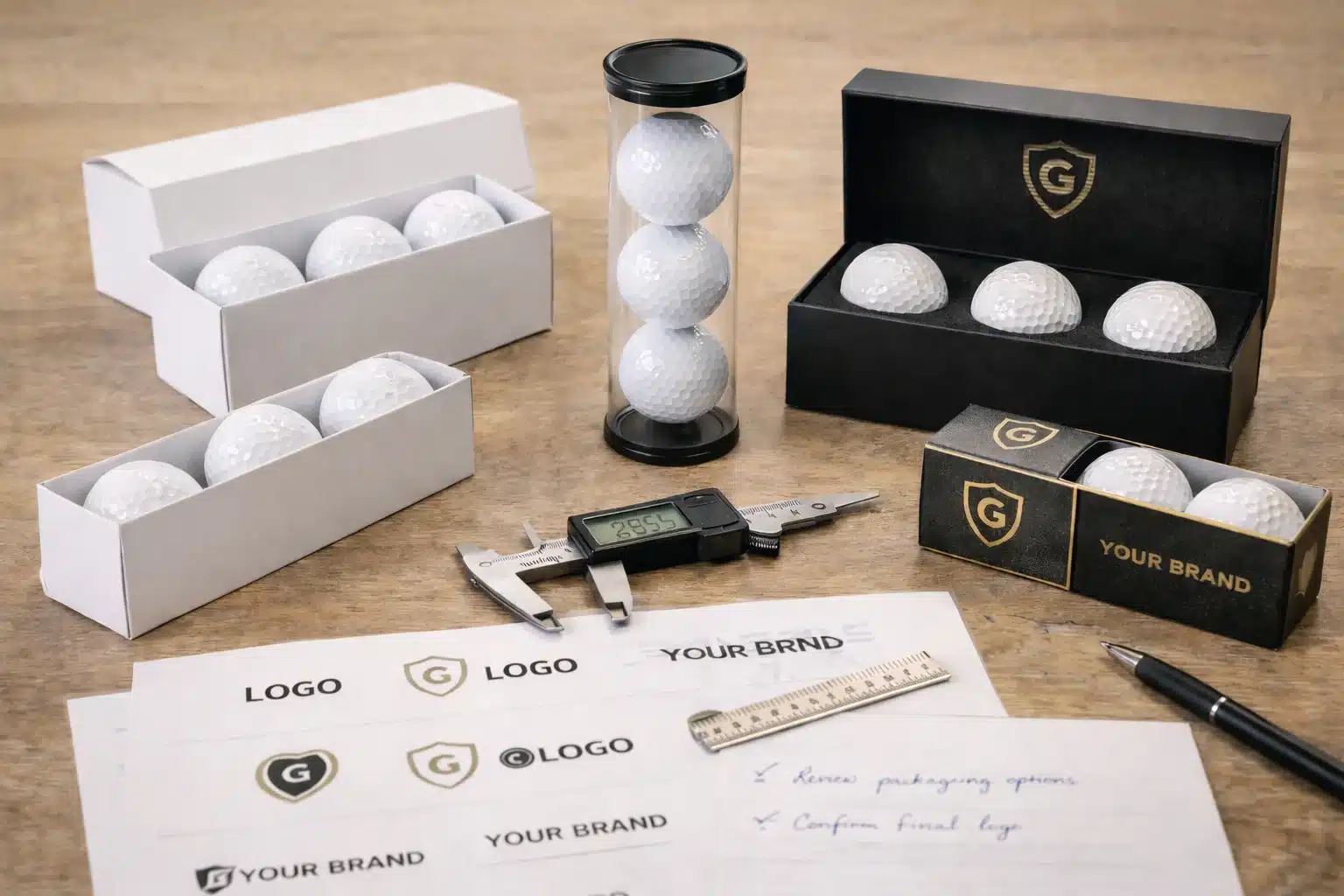
| Cost driver | Where it hides | How it changes per SKU | Buyer control lever | Next step |
|---|---|---|---|---|
| Packaging | Box/PET/insert + labor | High variance by design | Standardize to 1–2 formats | Request per-ball packaging breakdown |
| Peak-season logistics | Space + sailing delays | Worse in Q4 + pre-holiday | Book earlier + buffer lead time | Place orders outside peaks |
| Landed-cost leakage | Freight/clearance fees | Adds a fixed layer to FOB | Choose Incoterms + consolidate | Build a landed-cost sheet |
| Channel margin | Wholesale/DTC economics | Wholesale compresses profit | Pick channel-first SKU | Run 2 margin scenarios |
If you’re DTC, packaging and storytelling drive the multiplier. That means you should price packaging as a strategy (and test it), rather than letting it appear as a late-stage “design request” that quietly eats margin. If you’re wholesale/retail, packaging still matters, but stability and on-time availability often matter more than making the unboxing feel like a luxury watch.
What should buyers watch in 2026 logistics and packaging?
Plan for freight and schedule volatility by treating logistics as a range, not a single number, and by booking production earlier around known peaks. On the packaging side, retail channels are increasingly documentation-hungry, so build packaging proofs and print durability checks into sampling instead of discovering ink scuffing after thousands of boxes are printed.
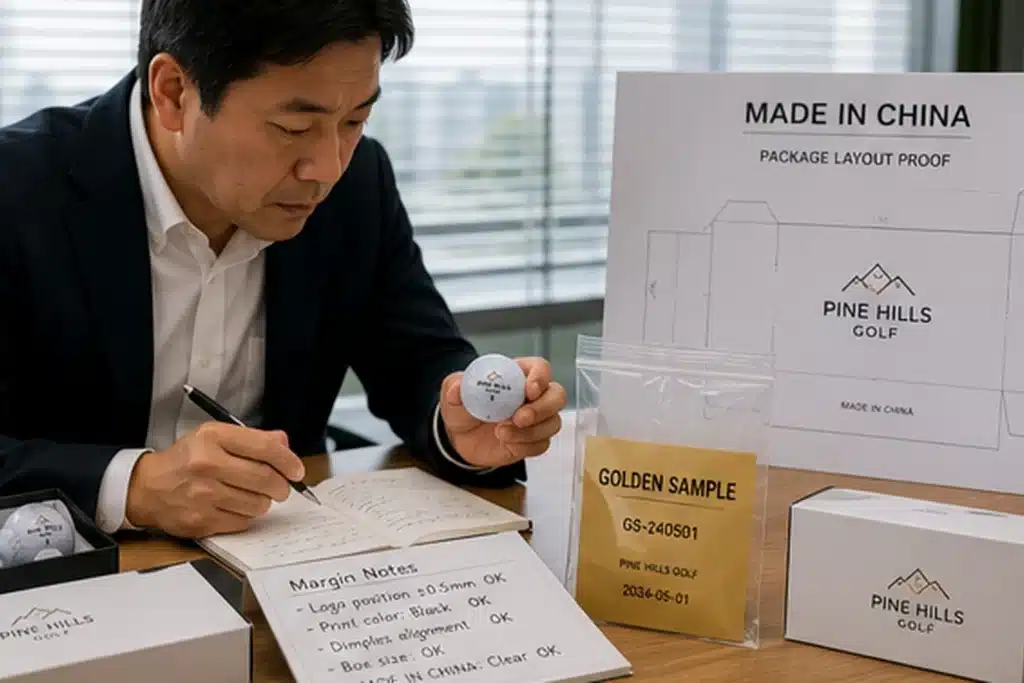
One practical way to de-risk launches is to run packaging like a QC item, not a marketing afterthought. Ask for dielines early, approve a physical proof (not only a PDF), and include a simple abrasion/scuff check during sampling. If packaging is your differentiator, you want it to survive handling, not just look good under a studio light.
To reduce “it’s late and it costs more” surprises, define Incoterms, packaging spec, and the production window you’re booking in the PO before you approve artwork.
✔ True — Packaging is a margin lever
A standardized white-box program protects speed and margin. Premium formats can lift conversion, but only when you model per-ball packaging cost and channel economics upfront.
✘ False — “FOB savings guarantee profit”
FOB can look great while packaging, freight, and channel cuts quietly compress margin. Landed-cost worksheets and channel scenarios keep the math honest.
FAQ
Which golf ball brands are made in the USA?
Some premium and tour-focused lines are produced in the USA, often emphasizing tight consistency and tour validation.
For sourcing, brand headlines matter less than SKU reality. Start with country-of-origin on the box, then verify by the exact model because brands can source different lines in different regions. If your benchmark is a US-made tour ball, convert that into acceptance criteria (compression range, weight/diameter windows, durability expectations) rather than relying on feel adjectives.
Are Callaway or TaylorMade balls made in China?
Brand-level answers can be misleading because manufacturing can vary by model, year, and region, and many relationships are NDA-protected.
Treat this as a documentation problem, not a rumor problem. Verify country-of-origin by the specific SKU you’re comparing. If a supplier claims they produce for a major brand, ask for proof you can audit (process evidence, QC format, traceability), not name-dropping.
How can I verify a Chinese golf ball factory’s quality?
Ask for device-backed batch data, confirm essential test equipment on-site, and log your own batch results over time.
Request a 12-ball QC report with raw values plus method and instrument model. Confirm they can measure compression and hardness consistently, and that they have a plan for concentricity and surface geometry verification when required. Keep your own batch records (batch ID, incoming spot-checks, and field feedback) so drift shows up early, not after reviews do.
Do I need USGA/R&A conformity for private-label balls?
Only if your channel requires tournament-legal compliance; otherwise it’s often a capability signal rather than a must-have.
If you sell into tournament-legal environments, treat conformity listing as a compliance requirement tied to the exact model you sell. If you sell promo or range, focus on durability, consistency, and traceability, and document why conformity isn’t required. Also clarify who funds testing/listing and what “model stability” means so you don’t get surprised mid-project.
What’s the difference between TPU urethane and cast urethane?
Both can be called “urethane,” but TPU injection tends to optimize yield and cost, while cast thermoset urethane tends to optimize tour-level feel/spin at higher complexity.
The operational risk is expectation mismatch: “urethane” can mean different processes. Put the process type in your spec (TPU injection vs cast), then validate with a comparison plan that checks scuff resistance and consistency—not just first-impression feel.
How do I estimate landed cost when importing golf balls from China?
Use a simple landed-cost worksheet per SKU and run at least two channel scenarios (wholesale vs DTC).
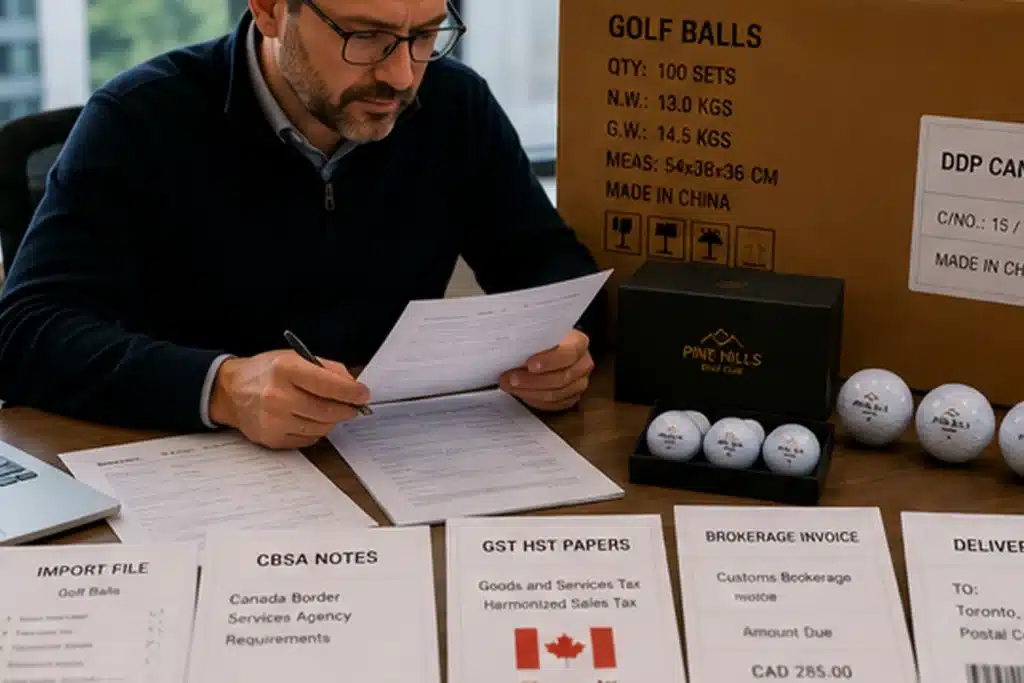
Start with FOB, then add packaging per ball, freight/clearance as a range, and any market-specific compliance/labeling work you need. Don’t forget that packaging format (white box vs PET vs gift) can change unit economics as much as the ball itself. Finally, stress-test pricing with channel reality: wholesale cuts can compress margin quickly, while DTC can carry richer packaging—if your conversion supports it. Verify current freight and market pricing inputs at the time of ordering before you lock your model.
How do I spot a trading company posing as a factory?
Look for specialization and line evidence, then test their QC discipline with raw data requests.
A true golf-ball specialist can usually show golf-ball-focused catalogs, line videos (molding/painting/printing), and structured answers to technical questions. Trading companies often show broad catalogs, vague QC language, and delays that sound like “we need to check with the factory” on basic details. Ask for line proof, equipment lists, calibration context, and shipment references. If they can’t tie a QC report to a batch ID and production line details, assume hidden subcontracting risk until proven otherwise.
Conclusion
China remains a major OEM base for mass-market and private-label golf balls, but your results depend on verification: process clarity (TPU vs cast), device-backed batch data, and traceability—not assumptions based on country-of-origin.
Shortlist by hub strengths, standardize how you evaluate QC evidence per SKU, and model landed cost with packaging and channel baked in. When those habits are disciplined, sourcing stops feeling like a leap of faith and starts behaving like a repeatable supply system.
You might also like — Where Are Golf Ball Factories in China?