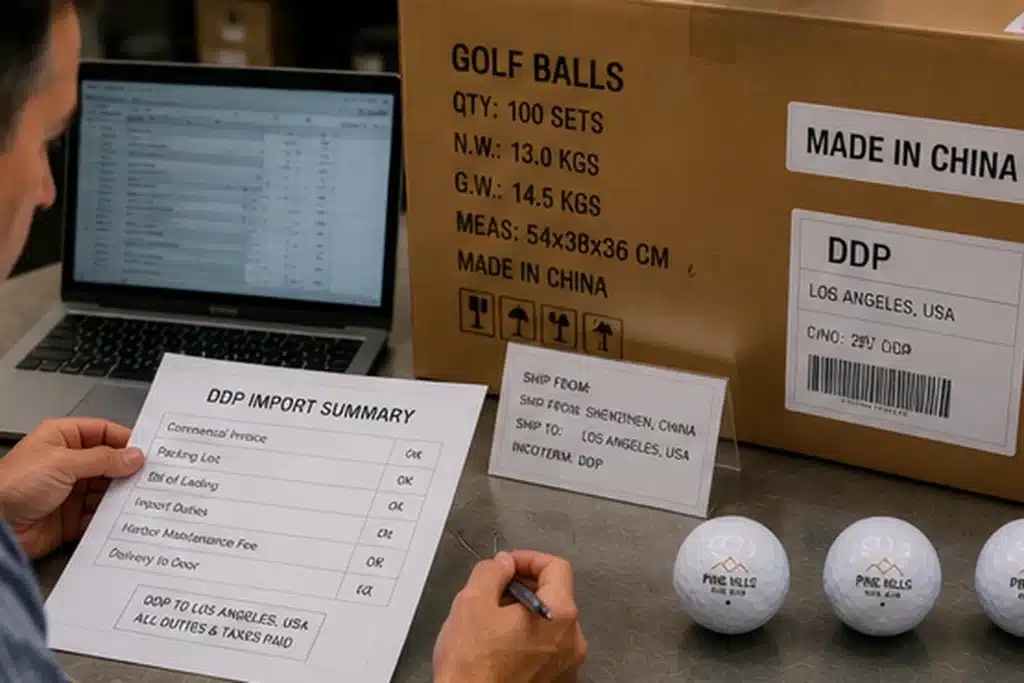
Thailand has real golf ball manufacturing, but the best-known plant is not the one most private-label buyers can hire.
The Top 3 golf ball manufacturers in Thailand for OEM buyers in 2026 are Titleist Ball Plant IV / Acushnet Thailand, Toppoint Corporation, and Nova Teknika. Titleist Ball Plant IV in Rayong is a brand-owned premium cast-urethane benchmark, not public private-label OEM capacity. Toppoint and Nova Teknika are the practical Thailand-linked names to investigate for 2-piece Surlyn, range, logo, practice, and colored-ball programs. Before ordering, verify OEM access, factory role, ATTI compression variance, C.O.R. records, cover process, MOQ, and origin documents.
If you are searching for Top 3 Golf Ball Manufacturers in Thailand for OEM, do not confuse Thailand’s premium reputation with bookable capacity. The real buyer question is not “Can Thailand make great golf balls?” It can. The question is whether this supplier can manufacture your exact ball—or whether it is a broker selling logo printing, packing, or imported blanks under a Thailand story.
This guide keeps the focus on Thailand golf ball factory due diligence, not price. You will see which Thai names matter, why Titleist Ball Plant 4 Rayong Thailand is benchmark-only, how the local 2-piece Surlyn golf ball manufacturer Thailand tier fits, and how to separate golf ball brokers vs real manufacturers before a directory turns into a bad PO.
Who Are the Top Thailand OEM Names?
You need the real Thailand shortlist, but the three names do not offer the same manufacturing role, product tier, or OEM access.
Thailand’s Top 3 golf-ball OEM names should be read as a directory of manufacturing roles, not equal private-label access. Titleist Ball Plant IV is the premium cast-urethane benchmark, while Toppoint and Nova Teknika are the practical Thai names to investigate for 2-piece Surlyn, range, logo, practice, and colored-ball programs.
| Factory / name | Location | Best classification | Buyer warning |
|---|---|---|---|
| Titleist Ball Plant IV / Acushnet Thailand | Rayong | Brand-owned cast-urethane benchmark | Not public private-label OEM capacity |
| Toppoint Corporation | Bangkok / Rayong | 2-piece Surlyn / logo / range supplier | Verify batch data and OEM scope |
| Nova Teknika | Ayutthaya | 2-piece / range / colored-ball OEM/ODM reference | Verify legal entity, origin, and full process |
Thailand is a credible golf-ball export base, but credibility is not the same as access. The country’s real structure is narrow: a world-class brand-owned premium facility at the top, then a small local OEM tier more relevant for 2-piece Surlyn, logo, range, practice, and colored-ball supply.
That structure creates confusion. A buyer searches “Thailand golf ball OEM” and sees the Titleist halo. Then a broker offers a “Thai-made urethane ball” without showing core molding, cover process, compression data, or C.O.R. records. That is how the Titleist illusion turns into the broker trap.
Thailand is credible, but its open OEM capacity is narrow. You should classify each Thai supplier by actual role before sending a PO: brand-owned benchmark, open OEM factory, local 2-piece supplier, exporter, broker, packer, or printing node. Ask for the legal manufacturer, factory address, product type, process control, and private-label OEM acceptance.
For macro context, Thailand’s golf-ball exports are meaningful at country level, supported by manufacturing around the Eastern Seaboard and logistics through Laem Chabang. Do not attribute that whole export base to Toppoint or Nova Teknika. For your RFQ, the only number that matters is whether the supplier can prove the exact SKU, lot, process, and origin behind your order.
✔ True — Thailand has real golf-ball manufacturing.
Thailand’s credibility is not the issue. The buyer question is whether the specific supplier has open OEM access for your construction, MOQ, packaging, and lot-control needs.
✘ False — “Every Thailand Top 3 name is an open OEM factory.”
Titleist is benchmark capacity, while local Thai options should be verified by product tier, factory role, and batch evidence.
Can You Book Titleist Capacity?
You may assume that because Pro V1 is made in Thailand, you can find a Thai factory to make your own Pro V1-style private-label ball.
Titleist Ball Plant IV proves Thailand can produce world-class cast-urethane golf balls. It does not prove that Thailand has open private-label Pro V1-style OEM capacity. Treat Ball Plant IV as a manufacturing benchmark, not a factory your new brand can normally hire.
| Buyer assumption | Reality | What you should do |
|---|---|---|
| Titleist makes Pro V1 in Thailand, so Thai OEMs can make mine | Ball Plant IV is brand-owned and operated | Treat it as benchmark capacity |
| Any Thai urethane quote is Pro V1-level | Cast thermoset urethane needs heavy assets and QA | Request process proof |
| 3-piece PU means tour ball | It may be TPU or value urethane | Define Cast Thermoset vs Injection TPU |
This is the Titleist illusion. Public manufacturing information identifies Titleist golf-ball production in owned and operated facilities, including Thailand. Pro V1 and Pro V1x production is publicly described as running through Ball Plant 3 in Massachusetts and Ball Plant 4 in Thailand under matching manufacturing and quality-assurance systems. That is a strong benchmark for Thailand’s capability.
It is not an invitation for private-label buyers.
The Rayong facility is a large industrial golf-ball plant, not a small OEM workshop. Public manufacturing-property information identifies the Thailand golf-ball facility at about 230,003 square feet, within a broader owned golf-ball manufacturing footprint. That scale helps explain why tour-level cast thermoset urethane is not something a small local supplier can casually copy after receiving your RFQ.
“Titleist name, no OEM access” is a failure signal. A supplier may borrow Thailand’s premium halo without proving that its own factory has cast-urethane equipment, QA discipline, yield control, or private-label access. “Urethane claim, no cover-process declaration” is another warning sign. The word urethane can hide very different products: injection TPU, value urethane, or true cast thermoset urethane.
Ask any Thai urethane supplier for a cover-process declaration, cast thermoset proof, wedge-durability data, retained-sample policy, and OEM-access confirmation. Check whether the supplier actually controls cast urethane manufacturing or is only borrowing Thailand’s country reputation. Do not approve a Pro V1-style private-label claim without cast-process evidence and proof of bookable OEM capacity.

Brand-Owned vs. Open OEM Slots
A brand-owned plant is built to serve its owner’s product system. It is not a public marketplace where new buyers can rent identical capacity.
Open OEM slots are different. They require confirmed private-label acceptance, MOQ by construction, artwork rules, packaging scope, batch testing, retained samples, and clear ownership of process steps. A supplier that cannot explain those items is not giving you OEM access; it is giving you a story.
Who Makes 2-Piece Surlyn in Thailand?
You may dismiss Thailand because Titleist capacity is closed, but local Thai suppliers may still fit 2-piece Surlyn, range, logo, and practice-ball programs.
The practical open Thai OEM tier is mostly 2-piece Surlyn, range, logo, practice, and colored-ball supply. Toppoint and Nova Teknika are names worth investigating, but buyers should verify legal entity, factory address, production stages, batch data, and origin documents before treating either as a full-process source.
| Buyer goal | Thailand fit | Verification needed | Buyer action |
|---|---|---|---|
| 2-piece logo balls | Toppoint / Nova-style route may fit | Print durability + batch compression | Request test data |
| Range / practice balls | Thailand can be explored | Cover durability + C.O.R. | Verify lot records |
| Colored balls | Possible local tier | Color fastness + coating adhesion | Pilot first |
| Cast urethane flagship | Very limited open access | Cast-process evidence | Do not assume availability |
This is where Thailand can still work well. A 2-piece Surlyn golf ball manufacturer Thailand route may fit practice balls, corporate logo balls, driving-range supply, colored balls, and value retail programs. These products do not require the same cover chemistry, capital spending, or process window as a cast thermoset urethane flagship.
Toppoint and Nova Teknika should be investigated as Thailand-linked local OEM names in this category, not automatically promoted into open premium urethane factories. Public directory and trade references can support activity, but they do not replace factory verification. A supplier listing is not a production audit. A product page is not batch-level proof.
For 2-piece Surlyn, your team should focus on durability, compression consistency, print adhesion, color fastness, C.O.R., cover scuffing, and packaging accuracy. For colored balls, pilot the coating and color stability before mass order. For range balls, test wear, repaint expectations, and ball-life assumptions. For logo balls, validate stamping or printing against repeated abrasion.
The value of local Thai OEM is not that it gives you a secret Pro V1 factory. It is that it may offer a non-China-origin route for simple, stable 2-piece programs if the supplier proves process control. That is a very different decision, and it should be treated honestly.
Request a product-scope confirmation showing exactly which 2-piece Surlyn, range, logo, colored, or practice-ball SKUs the supplier can manufacture. Check legal entity, factory location, actual process steps, origin documents, and batch-level QC data. Approve Thai 2-piece Surlyn sourcing only when product scope and batch evidence match your channel.
✔ True — Thai local OEM can still fit practical channels.
A supplier does not need Pro V1-style capacity to be useful for range balls, logo balls, colored balls, or durable 2-piece Surlyn programs.
✘ False — “If it cannot make cast urethane, it is useless.”
The right supplier depends on your product tier. Practice, range, and logo channels often need durability and consistency more than tour-spin positioning.
How Do You Verify a Thai Factory?
You may meet a supplier claiming Thailand manufacturing, but the company may only broker, print, repack, or coordinate finished balls.
To verify a Thai golf ball factory, do not rely on packaging photos or catalog claims. Ask for batch-level ATTI compression variance, C.O.R. or initial-velocity records, production-stage photos, core and cover process evidence, retained samples, COO support, and lot-linked QC records. Brokers usually cannot provide these factory-floor records.
| RFQ question | Why it filters brokers | Evidence to request | Buyer action |
|---|---|---|---|
| Can you provide ATTI compression variance by lot? | Brokers lack batch data | Raw report + lot ID | Check variance |
| Can you provide C.O.R. / initial-velocity records? | Shows performance testing access | Test record + sample ID | Match to lot |
| Do you mold cores in-house? | Separates makers from packers | Process photos + equipment | Confirm site |
| Do you mold or cast covers in-house? | Defines real construction control | Process declaration | Verify capability |
| Can you show production-stage photos? | Packaging photos are easy to fake | Core/cover/paint/stamp/QC images | Check process |
| Can COO match the process flow? | Prevents origin confusion | COO + process map | Verify before PO |
A packaging room is not a golf ball factory. A Bangkok-area warehouse, logo-printing desk, or carton line can look convincing in photos, especially when the supplier uses careful angles. That is why golf ball brokers vs real manufacturers is not a theory problem. It is a PO-risk problem.
The best filter is to ask for manufacturing proof that a repacker cannot easily invent. ATTI compression variance shows whether the supplier can discuss lot-level consistency. C.O.R. or initial-velocity records show whether performance testing exists. Production-stage photos show where core molding, cover molding or casting, painting, stamping, and final QC happen.
Packaging photos, no batch data is a failure signal. It means the supplier may be able to print or pack, but has not proven manufacturing control. For multilayer claims, ask for X-ray or concentricity evidence as well. For vague urethane claims, require exact wording: 2-piece Surlyn/Ionomer, Injection TPU, or Cast Thermoset Urethane.
Place this in your RFQ: “Please confirm whether you manufacture cores and covers in-house, whether the cover is 2-piece Surlyn/Ionomer, Injection TPU, or Cast Thermoset Urethane, and whether you can provide batch-level ATTI compression variance, C.O.R. or initial-velocity records, production-stage photos, COO/process-flow evidence, and retained samples for the exact lot.”
Ask your supplier to provide a process-flow map showing where core molding, cover molding or casting, painting, stamping, final QC, packing, COO documentation, and export documentation are performed for the exact SKU and lot.
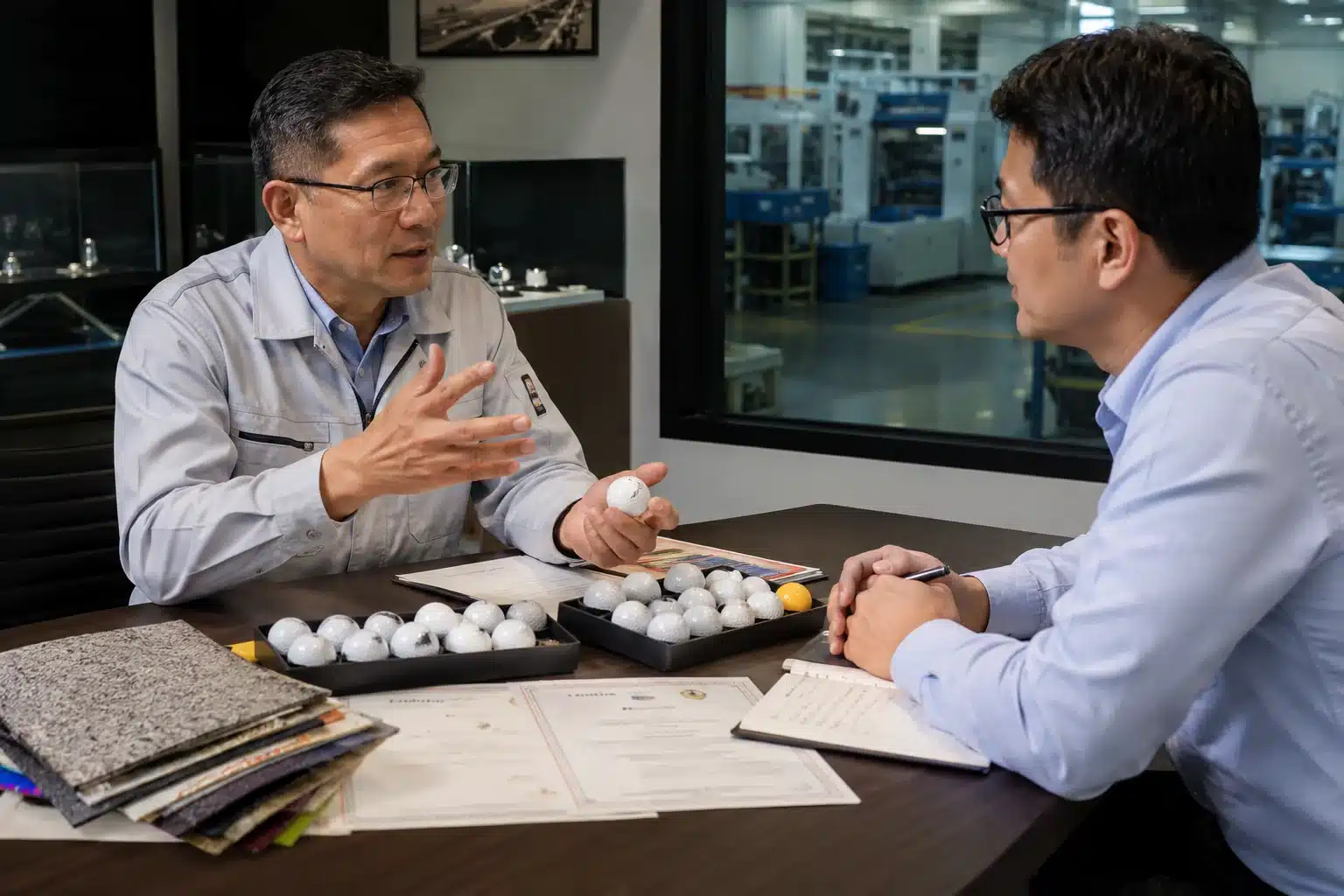
✔ True — batch-level records beat factory photos.
Real manufacturers can discuss compression variance, C.O.R., lot IDs, retained samples, and process stages. Brokers usually stay near logo printing and cartons.
✘ False — “Warehouse and carton photos prove Thai manufacturing.”
Photos can show packing activity without proving core molding, cover process, lab testing, or origin control.
When Should You Use China + Thailand?
You may overcommit to a scarce Thai route before proving demand, packaging, MOQ, or SKU economics.
Use Thailand when your SKU is mature, stable, and origin-sensitive; use China when your program still needs low-MOQ testing, fast samples, custom packaging, or many variants. A China + Thailand hybrid route helps you avoid overcommitting to scarce Thai capacity before the product proves demand.
| Buyer goal | Thailand route | Better practical route | Evidence to request |
|---|---|---|---|
| Pro V1-style private label | Hard to access; Titleist is closed benchmark | China or other verified open urethane route | Cast-process proof |
| 2-piece logo / practice balls | Toppoint / Nova can be explored | Compare with China MOQ and packaging | ATTI + C.O.R. data |
| 1,000–3,000 pcs MVP test | May be rigid | China low-MOQ pilot first | Pilot quote |
| Many colors / gift sets | May be slower | China packaging ecosystem | Pack-out proof |
| Mature non-China-origin SKU | Possible if access confirmed | Book early and simplify variants | OEM slot + MOQ |
Thailand’s problem is not quality. It is access. Once Titleist Ball Plant IV is removed from the bookable OEM list, the number of practical Thai golf-ball factories becomes small. That scarcity can shift leverage toward suppliers through stricter MOQ, longer booking windows, and lower customization tolerance.
For new brands, that is risky. Your first order is rarely your final version. You may still need to adjust hardness, logo size, sleeve artwork, mixed-color packs, gift packaging, or channel positioning. Locking into a scarce Thai lane too early can turn product learning into inventory pressure.
China is often the practical first route for MVP testing because flexible clusters can support low-MOQ pilots, logo work, custom packaging, fast sample feedback, and seasonal variants. Golfara can support low-MOQ custom programs from about 1,000 pcs where construction, artwork, and packaging fit. That makes China useful as a buyer-risk control route, not just a production country.
The scarcity of Thai golf-ball factories shifts leverage toward suppliers. Protect your launch with a China low-MOQ pilot before committing to a rigid Thai lane. Use Thailand when the SKU is mature, stable, and origin-sensitive. Use China when your program still needs iteration.
For MOQ planning, see how to negotiate MOQ with Chinese golf ball manufacturers. If the Thailand access check pushes you back toward China, compare supplier options in the Top 10 Golf Ball Manufacturers in China for OEM.
Ask your supplier to provide batch-level ATTI compression variance, C.O.R. or initial-velocity records, retained-sample ID, cover-process declaration, production-stage photos, and lot-linked QC records before mass-production approval.
Request separate quotes for China MVP, Thailand 2-piece Surlyn, and mature origin-sensitive volume. Compare MOQ, access, process proof, packaging flexibility, batch test data, lead time, and repeat-order control. Do not move into Thailand until SKU maturity, origin need, factory access, and MOQ are confirmed.
Test Before You Commit to Thailand
Thailand can be a strong route for mature, origin-sensitive SKUs, but it is not always the safest place to test a new idea. If your product still needs market feedback, packaging changes, logo revisions, mixed colors, or channel testing, start with a low-MOQ China pilot through Golfara before committing to scarce Thai capacity.
- Low-MOQ custom programs from about 1,000 pcs when construction, artwork, and packaging fit
- Logo, color, and packaging trials before mass commitment
- ATTI / C.O.R. and batch-level QC evidence available for approval planning
- Useful for DTC tests, corporate gifts, range balls, and seasonal SKUs
FAQ
Where are Titleist Pro V1 golf balls manufactured?
Titleist Pro V1 and Pro V1x golf balls are publicly described as being made at Ball Plant 3 in New Bedford, Massachusetts and Ball Plant 4 in Thailand, using matching manufacturing and quality-assurance processes. This proves Thailand’s premium capability, but it does not create open private-label OEM access.
Treat Ball Plant 4 as a benchmark. Do not assume bookable OEM capacity. If another Thai supplier claims similar performance, ask for cast-process evidence, wedge-durability data, batch-level QC records, and private-label access confirmation.
Can I find custom cast urethane OEM in Thailand?
It is difficult for new brands. Thailand has world-class cast-urethane benchmark capacity through Titleist, but that capacity is brand-owned. Most practical open Thai OEM investigation should start with 2-piece Surlyn, range, logo, and practice-ball categories.
Ask for exact Cast Thermoset Urethane wording, cover TDS, process photos, ATTI data, C.O.R. records, MOQ, and private-label acceptance. For flexible multilayer urethane development, China or another verified open urethane route may give you more practical access.
How do I verify a Thailand golf ball supplier?
Do not rely on warehouse photos or packaging lines. Ask for ATTI compression variance, C.O.R. or initial-velocity records, process-stage photos, retained samples, factory address, legal manufacturer, COO process flow, and lot-linked QC data.
Ask where the core is molded, where the cover is molded or cast, and where painting, stamping, final QC, packing, and export documentation happen. A real manufacturer should be able to connect the sample, test report, lot ID, retained sample, and production stage.
What is the MOQ for golf ball factories in Thailand?
MOQ depends on the supplier, construction, color, packaging, and whether the order is open OEM or a mature repeat SKU. Because Thailand has few practical golf-ball sources, buyers should expect less flexibility than China and should verify MOQ before sampling.
Ask for pilot MOQ and mass MOQ separately. Also ask by construction, artwork, color, sleeve, carton, and gift packaging. If your team needs a 1,000 pcs-style MVP test, China is often the more practical starting point.
Are Toppoint and Nova Teknika full-process factories?
They are Thailand-linked names worth investigating for 2-piece Surlyn, range, logo, practice, and colored-ball programs. Public directory evidence supports activity, but buyers should still verify the legal entity, factory address, production stages, batch QC data, and origin documents.
Do not assume cast-urethane capability. Check exact exporter and manufacturer names, product process, batch compression data, C.O.R. test records, and COO process flow before awarding a PO.
What is the difference between 2-piece Surlyn and cast urethane?
2-piece Surlyn is durable, cost-stable, and suitable for practice, range, logo, and value programs. Cast Thermoset Urethane is a high-threshold process used for tour-style feel, wedge spin, and premium positioning, but it requires stronger process control and is not widely open in Thailand.
Surlyn fits volume durability. Cast urethane fits premium spin and feel. Do not accept vague “urethane” wording if your channel expects tour-style performance. Require process declaration and pilot-lot QC data.
Can a broker supply Thai-made golf balls?
A broker may coordinate sourcing, logo printing, or packing, but that is not the same as manufacturing control. If the supplier cannot provide batch-level ATTI, C.O.R., production-stage photos, and process-flow evidence, treat it as a broker until proven otherwise.
Some brokers can still be useful coordinators, but your risk changes. Separate broker service from factory control, verify the legal manufacturer, and do not accept origin claims from photos alone.
When should I choose China instead of Thailand?
Choose China when your program needs low MOQ, fast sample feedback, custom packaging, mixed colors, seasonal SKUs, or early MVP validation. Choose Thailand when the SKU is mature, the origin story matters, and the supplier has proven capacity and batch data.
Use hybrid routing by SKU stage. China can help you test the product and packaging first. Thailand may make sense later for stable, origin-sensitive programs where access, MOQ, and batch evidence are already confirmed.
Conclusion
Thailand is real, but narrow. Titleist Ball Plant IV proves Thailand can make world-class cast-urethane balls, yet it should be treated as a brand-owned benchmark, not open private-label OEM capacity. The more realistic Thai OEM investigation starts with 2-piece Surlyn, range, logo, practice, and colored-ball programs through names such as Toppoint and Nova Teknika.
Your safest move is to verify first and commit second. Ask for ATTI compression variance, C.O.R. records, cover-process declarations, production-stage photos, retained samples, and COO process-flow evidence before treating any Thai supplier as a full-process manufacturer.
For low-MOQ development, fast packaging, mixed variants, and MVP testing, China is often the practical first route.
You might also like — China vs Thailand Golf Ball Costs: 2026 Tariff, BOI & Landed Cost Guide