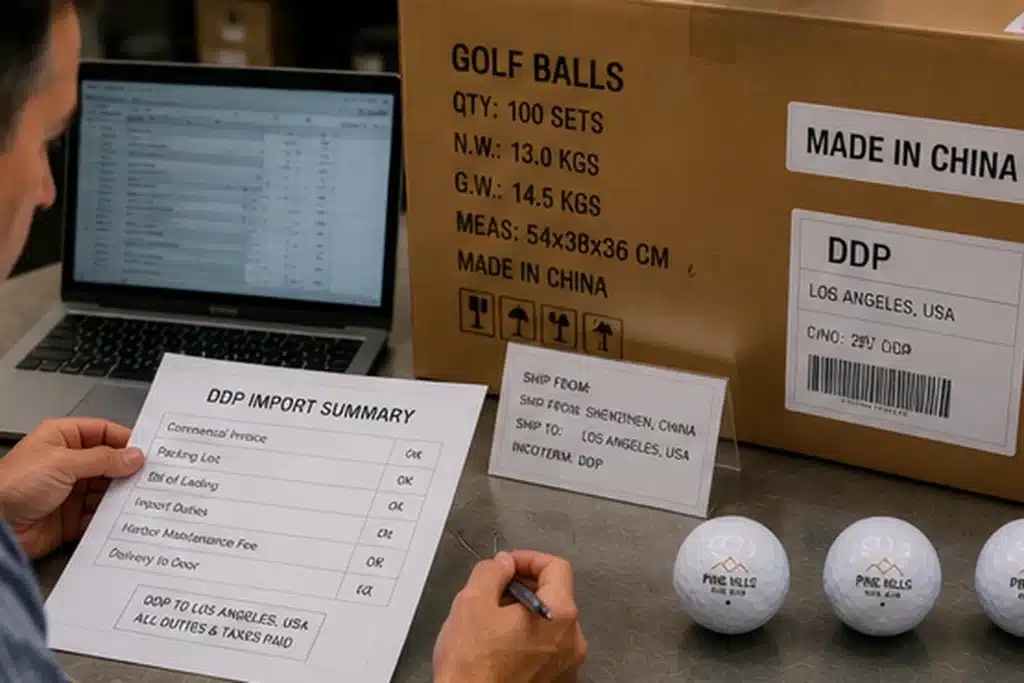
For most amateur golfers, Surlyn / ionomer golf balls are the safer starting point because they are durable, straighter on mishits, and cheaper to replace.
Urethane becomes the better choice when you already hit and hold greens, need more wedge spin, and want faster stopping around the green. For OEM buyers, the same decision should follow the target player: value, range, and promo SKUs usually fit Surlyn / ionomer, while premium retail SKUs need urethane proof.
Use this guide to compare Surlyn vs urethane by tee-shot forgiveness, greenside spin, cover durability, cost per round, construction, and OEM material fit.
Are Amateur Golfers Better Off with Surlyn or Urethane?
For most amateurs, begin with Surlyn/ionomer. Its side-spin reduction and higher durability keep off-center strikes straighter and cut consumables. Switch to urethane once you consistently land irons on the green and want tour-level short-game spin for tighter, more predictable stopping inside 50 yards.
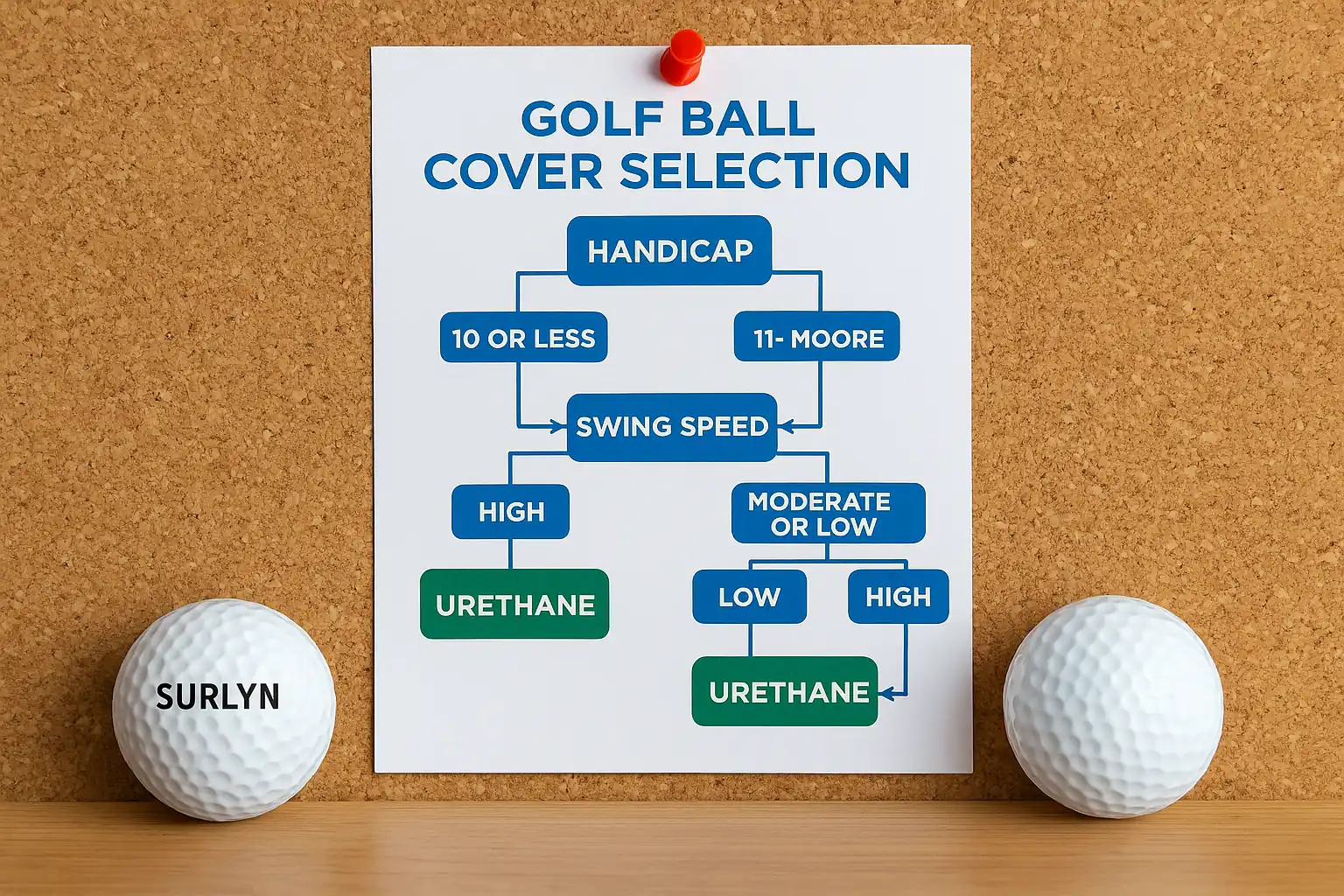
Quick decision matrix (swing speed/handicap/lost-ball rate)
Three signals: driver speed <95 mph, handicap ≥15, or losing ≥2 balls/round. Hit ≥2 ⇒ Surlyn. Hit ≤1 and practice your short game regularly ⇒ try urethane. In the gray band (HCP 12–18), test 3-piece urethane and see if greenside control improves.
When to upgrade from Surlyn to urethane (trigger points)
Pick two of three: (1) 9-iron/wedge regularly holds greens; (2) inside 50 yards you get too much rollout; (3) fast/firm greens push approaches past the target window. Then urethane’s value unlocks.
Budgeting with a fast “cost-per-round” estimate
Cost per round ≈ (ball price ÷ usable holes) + (lost-ball rate × replacement share). On unknown courses or with water/penalty risk, Surlyn lasts longer and needs fewer replacements. On scored rounds, urethane’s scoring return can justify the premium.
| Player signal | Better starting cover | Why it fits | When to test the other option |
|---|---|---|---|
| Higher handicap, slower driver speed, or frequent ball loss | Surlyn / ionomer | Straighter mishits, tougher cover, lower replacement cost | Test urethane when short-game control starts costing strokes. |
| Mid-handicap player who holds greens more often | 3-piece urethane or TPU-route urethane | More spin and softer feel without jumping straight to a tour-style SKU | Keep Surlyn for unknown or hazard-heavy courses. |
| Lower-handicap or competitive player | Cast urethane | Better wedge bite, approach control, and greenside stopping | Test Surlyn only when durability or budget matters more. |
| Practice, range, or corporate giveaway use | Surlyn / ionomer | Durable, logo-friendly, and economical | Use urethane only for premium gifts or pro-shop positioning. |
✔ True — Urethane’s edge is greenside and approach control
Inside 50 yards it produces higher spin and quicker deceleration for reliable stop-and-drop.
✘ False — “Urethane is always longer off the tee”
Driver gaps are usually small or player-dependent; face angle and strike quality dominate.
What Changes off the Tee and Around the Green?
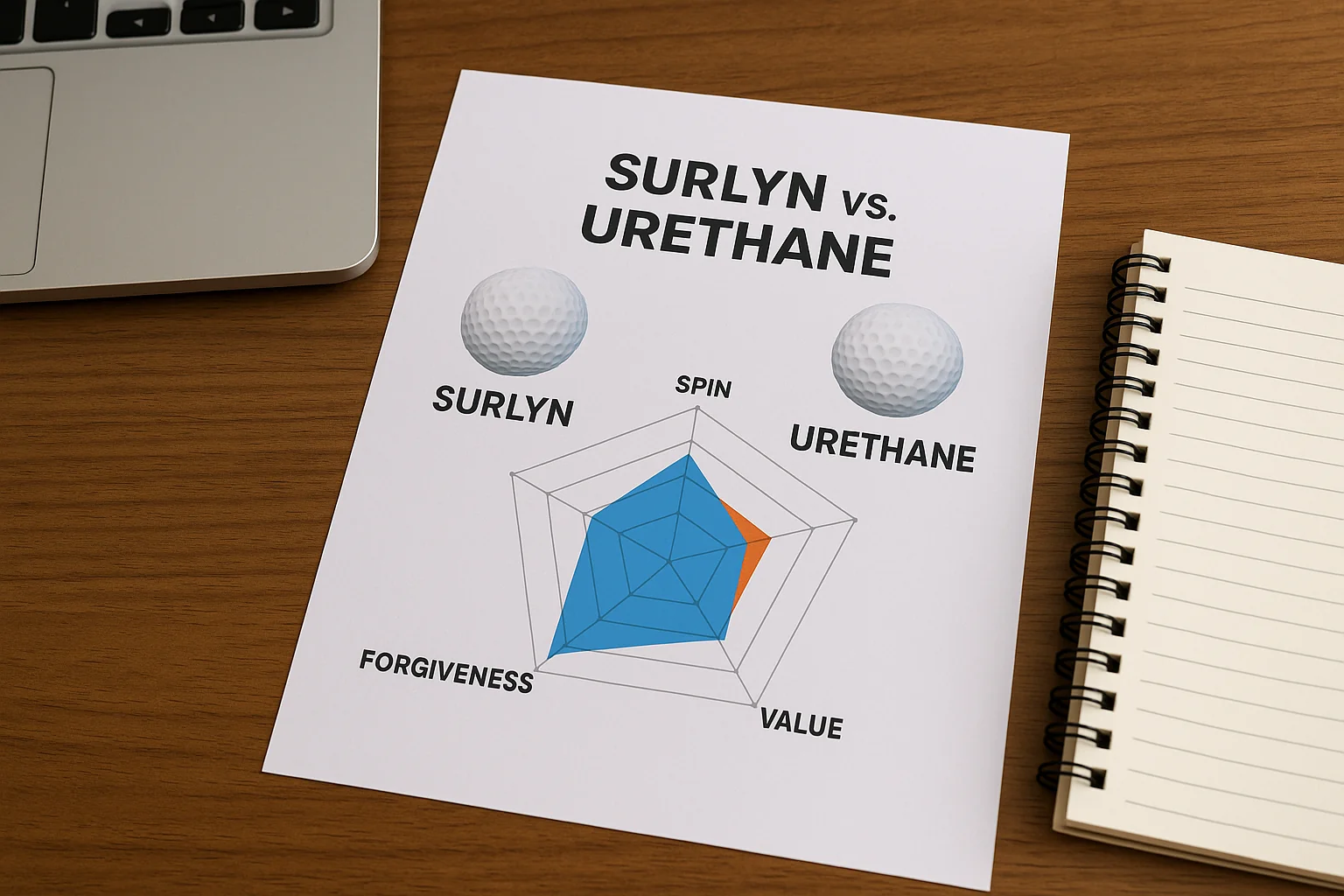
Off the tee, real-world gaps are small and vary by player; mishits amplify sidespin. Surlyn’s side-spin reduction tightens dispersion. Around the green is the divider: cast urethane yields higher spin, softer feel, and faster on-green deceleration, improving land-and-stop proximity.
Driver sidespin and dispersion
Surlyn: commonly lower side spin, moderating slices/hooks. Urethane: moderate spin, fine when delivery is solid, but more sensitive to strike quality.
50-yard spin/rollout and consistency
Urethane’s thinner, softer cover grips grooves better, giving shorter rollout and more consistent stopping. Surlyn often rolls out more on firm greens, while urethane is more likely to check and stop when the player delivers enough loft, spin, and clean contact.
Green speed/hardness and material choice
Fast/firm greens magnify urethane benefits; slow/soft reduce the gap. If you mainly play muni/resort speeds, Surlyn is sufficient; for tournament-speed greens, urethane shines.
Course quick rules (≤30 words): Hard/fast → urethane; soft/slow → gap shrinks; wind/links → 3–4-piece urethane; hazards/water → Surlyn; sharp bunkers → Surlyn for cover life.
Nail start line and face control first. When you already hit and hold, chase higher greenside spin and stop-and-drop.
| Dimension | Surlyn/ionomer | Urethane |
|---|---|---|
| Driver side-spin suppression | ★★★★☆ | ★★★☆☆ |
| Iron distance stability | ★★★★☆ | ★★★★☆ |
| <50-yard spin | ★★☆☆☆ | ★★★★★ |
| Land-and-stop ability | ★★☆☆☆ | ★★★★★ |
| Feel (soft/finesse) | ★★☆☆☆ | ★★★★★ |
✔ True — Feel/spin drive proximity, not raw distance
Soft feel aids touch and deceleration; driver distance depends on launch, spin, and compression fit.
✘ False — “Softer always goes farther”
Treat distance, compression, and spin as separate levers and fit each deliberately.
How Do Durability and Cost Change per Round?
Surlyn excels at scuff resistance and survives thin strikes/bunker shots with fewer cover burns—great for practice and high-loss rounds. Urethane scuffs sooner and costs more. Use cost per round = (price ÷ typical usable holes) + (lost-ball rate × replacement share). On unknown/wet/hazardous layouts, Surlyn is more economical.
Sand and sharp grooves: cover wear
Hard sand and sharp grooves raise fuzzing/scuffs on urethane; Surlyn’s ionomer cover resists chipping and keeps appearance longer.
Total cost of ownership (TCO) by play frequency
0–1 round/week or range-heavy: Surlyn value dominates. 1–2 rounds/week with scoring goals: 3-piece urethane pays back around the green. ≥2 rounds/week/tournaments: 3–4-piece urethane for consistency and wind stability.
Dual-ball strategy to keep feel continuity
Use Surlyn for practice/unknown courses; urethane for scored/fast-green days. Keep similar compression to reduce switching shock.
Compare cost per round against scoring return—not sticker price alone.
| Cover choice | Cost behavior | Durability behavior | Best use | Buyer action |
|---|---|---|---|---|
| Surlyn / ionomer | Lower replacement pressure | Strong scuff and abrasion resistance | Practice, range, high-loss rounds, value retail | Compare cost per usable round. |
| TPU-route urethane | Middle-cost material path | Better feel than Surlyn with more scalable production | Value-premium private label and mid-tier retail | Verify TPU vs cast route before quoting. |
| Cast urethane | Higher proof and process burden | Softer cover but more scuff-sensitive | Premium retail, club-shop, and tour-style positioning | Require spin, scuff, cover-process, and batch evidence. |
How Should Cover Choice Match 2-, 3-, and 4-Piece Builds?
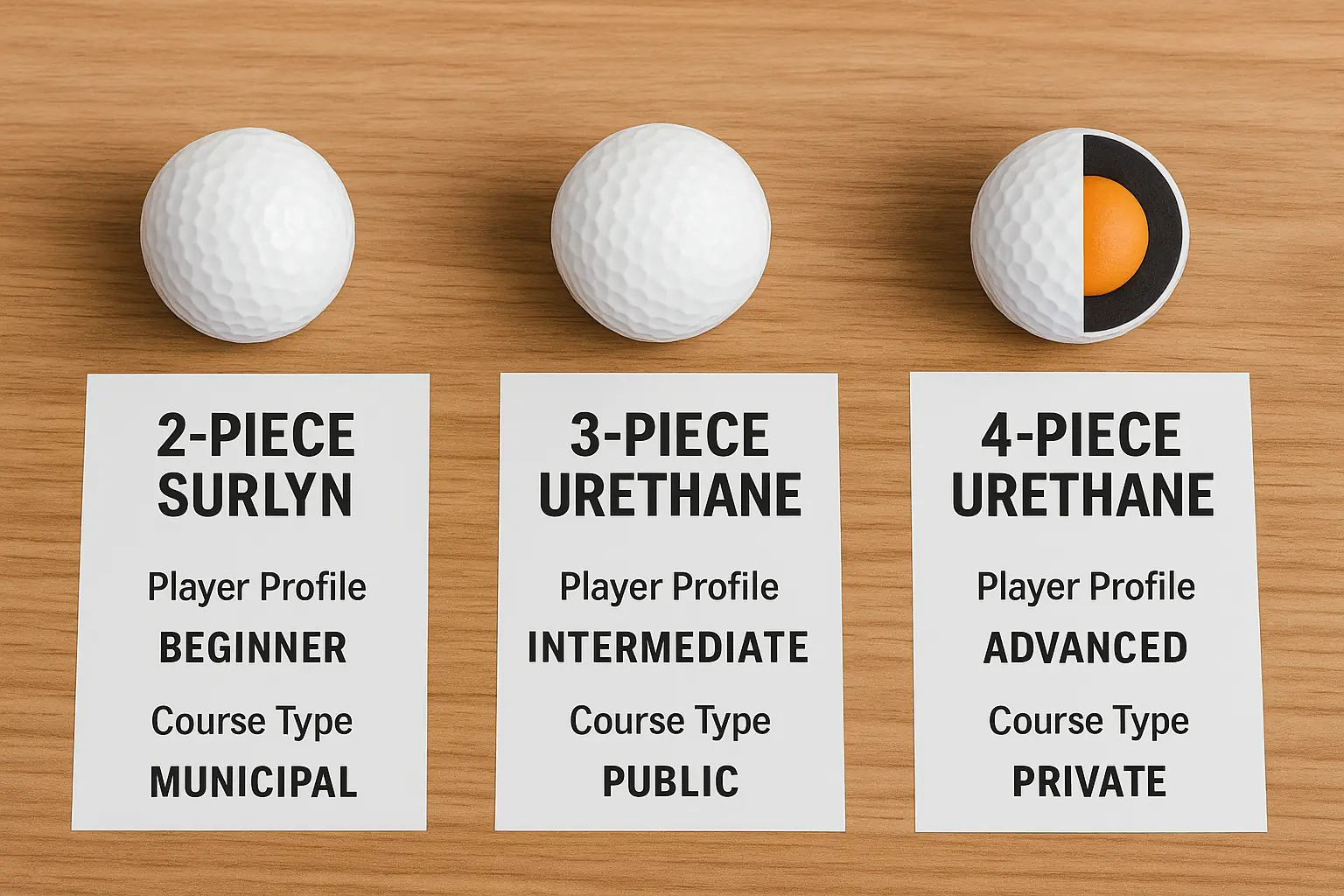
More layers ≠ more distance. High-volume entry is 2-piece + Surlyn for distance, forgiveness, durability, and practice. Mid-tier can be 3-piece TPU-route urethane or selected cast urethane, depending on price point, spin promise, and supplier proof. Premium is 3–4-piece + cast urethane when the player or channel needs full-bag stability, tighter tolerances, and stronger greenside control.
Who fits 2-piece Surlyn, 3-piece urethane, and 4-piece urethane
2-piece Surlyn: new golfers, HCP ≥20, higher loss. 3-piece urethane: HCP 10–20, regular practice. 4-piece urethane: HCP ≤10, ≥105 mph, competitive play.
Compression with feel/swing speed linkage
Lower compression helps low/mid speeds with launch/feel; higher speeds prefer mid–high compression. When changing covers, match compression to keep feel continuity.
Wind/fast greens/links: construction priorities
Wind/links: 3–4-piece urethane for flight stability. Fast greens: urethane advantage grows. Typical muni speeds: 2-piece Surlyn is adequate.
Start with player and course; then pick layers. Consider TPU when splitting the difference on budget and spin.
| Layers × cover | Speed/HCP | Typical course | Note |
|---|---|---|---|
| 2-piece × Surlyn | <95 mph / ≥20 | Public/range; hazards | Forgiveness/durability first |
| 3-piece × Urethane | 95–105 mph / 10–20 | Club, slightly faster greens | Approach stopping |
| 4-piece × Urethane | ≥105 mph / ≤10 | Wind/links | Full stability/consistency |
| 3-piece × TPU | 90–100 mph / 15–22 | Mixed | Balanced cost/performance |
How Can You Test Surlyn vs Urethane in 30–50 Yards?
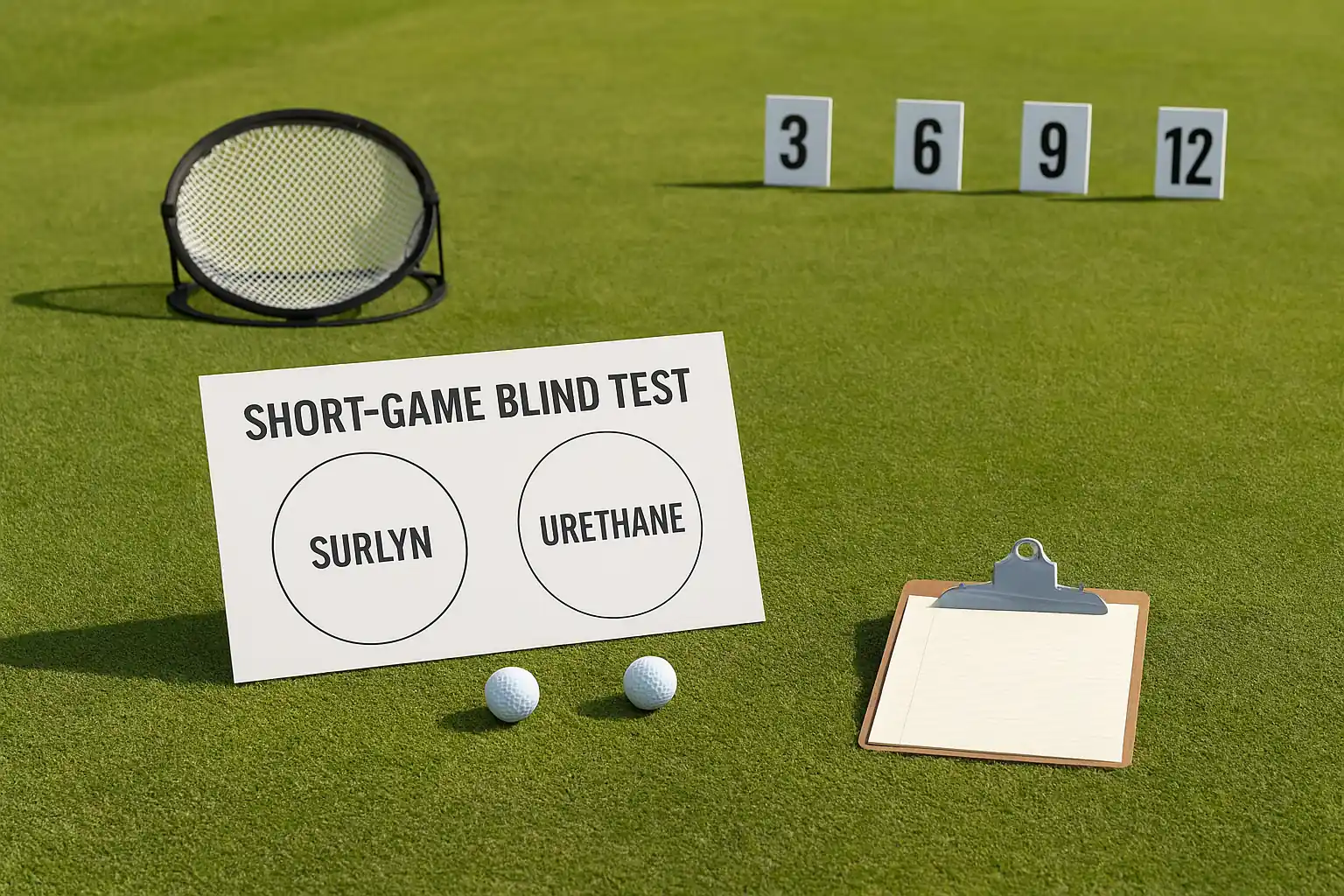
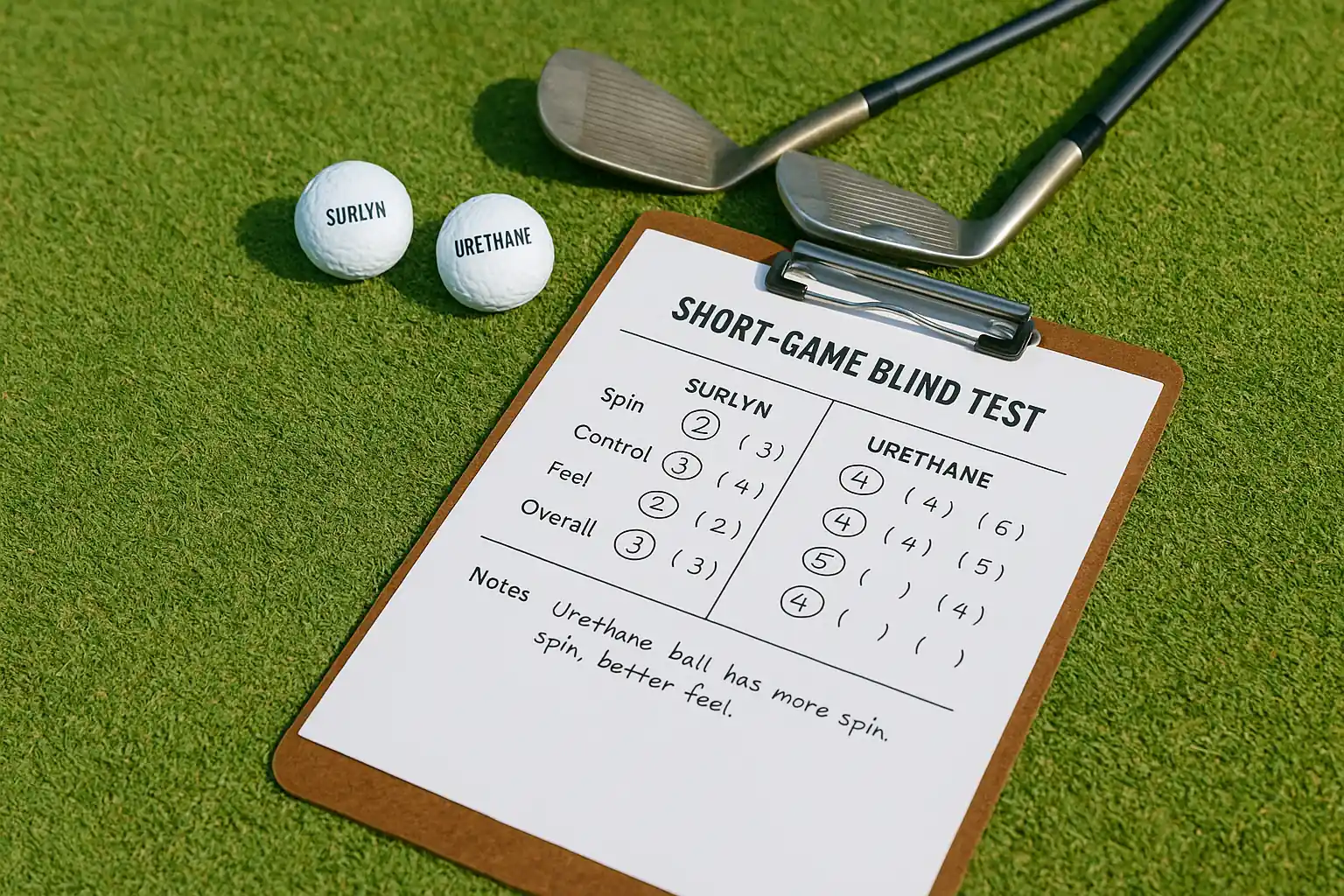
Same course & club; hit 5+5 balls. If urethane gives a repeatable rollout or stopping advantage that affects scoring, adopt it for score-focused rounds. If the difference is small or inconsistent, stay with Surlyn to control spend.
Log template (model/landing/rollout/feel)
Fields: model, cover, layers, compression, landing-to-cup distance, rollout, total leave, subjective feel.
Green speed and wind: test interference
Run two sessions to dilute small-sample noise. When wind or slope changes, swap hitting order and landing windows.
Use data, not guesswork. Once the gap is clear, both confidence and buying efficiency improve.
| Model | Cover/Layers | Compression | 5 landings–cup (m) | 5 rollouts (m) | Avg. leave (m) | Feel (1–5) |
|---|---|---|---|---|---|---|
| A | Surlyn/2 | Low | 4.1/3.8/4.2/3.9/4.0 | 3.2/2.9/3.1/3.3/3.0 | 6.9 | 3 |
| B | Surlyn/3 | Mid | … | … | … | … |
| C | Urethane/3 | Mid | … | … | … | … |
| D | Urethane/4 | High | … | … | … | … |
How Should OEM Buyers Translate Material Choice into SKUs?
For OEM buyers, Surlyn vs urethane is not only a player-feel decision. It decides SKU tier, cost structure, logo durability, MOQ, lead time, and the performance promise your brand can safely make.
Use Surlyn / ionomer for value, range, promo, corporate, and high-volume programs where durability and replacement cost matter most. Use urethane only when the target player or channel can pay for softer feel, higher greenside spin, and stronger proof requirements.
| OEM SKU type | Better cover route | Why it fits | Main risk | Evidence to request |
|---|---|---|---|---|
| Range / practice SKU | Surlyn / ionomer | Durable cover, lower replacement pressure, stable volume | Weak marking or coating durability | Ask for abrasion, wash, and retained sample proof. |
| Corporate logo ball | Surlyn / ionomer | Cost control, print stability, fast replenishment | Logo scuffing or color mismatch | Request print proof and packaging approval. |
| Value retail ball | 2-piece Surlyn / ionomer | Good distance, durable cover, broad player fit | Competing only on low price | Ask for compression, durability, and batch QC. |
| Mid-tier private label | 3-piece TPU-route urethane or ionomer blend | Better feel and positioning without full cast burden | Vague “urethane” wording | Require TPU vs cast route declaration. |
| Premium retail / pro shop | Cast urethane | Softer feel, wedge spin, premium story | Overclaiming tour-style performance | Request spin, scuff, cover-process, and retained-sample evidence. |
Do not write “urethane cover” into an RFQ without defining the process route. TPU-route urethane and cast thermoset urethane can both appear under urethane language, but they carry different cost, spin, yield, and proof requirements.
For a deeper process comparison, use the TPU vs cast urethane golf balls OEM guide. For product-tier selection before material choice, use the Range vs Game vs Tour golf balls guide. For printed logo durability, use the custom golf ball printing methods guide.
FAQ
Will low swing speed (≤90 mph) lose distance with urethane?
Usually not by much—and not guaranteed to be longer either. Driver distance depends most on impact quality, launch, spin, and compression fit, not cover alone. If short-game spin matters more, try 3-piece urethane; if you lose balls often, start with Surlyn.
Match compression to minimize feel shock. If your blind test shows a repeatable stopping advantage with urethane, the scoring ROI may outweigh small tee-box differences.
I lose 2–3 balls per round—which cover saves money?
Choose Surlyn. It’s more scuff-resistant and cheaper per unit, so cost per round is easier to control. On unfamiliar or hazard-heavy courses, Surlyn reduces replacement frequency and appearance-driven discard.
When you know the course and lose fewer balls, deploy urethane for scored rounds or faster greens. A dual-ball strategy balances budget and scoring.
Can Surlyn stop on hard/fast greens?
Yes, but placement and height matter more. On fast/firm greens, Surlyn typically rolls farther, so pick a more forward landing spot and increase descent angle. If you already attack pins and value hold, urethane makes it easier.
On slower/softer greens the gap shrinks. For fast-green events, a temporary urethane switch is a smart adjustment.
Is TPU the same as cast urethane?
No. TPU is thermoplastic polyurethane, while cast urethane is a thermoset cover process. Both can be discussed under urethane-family language, but they do not carry the same cost, spin, feel, yield, or proof burden.
TPU can be a practical middle route for value-premium OEM balls. Cast urethane is stronger for premium greenside spin and tour-style positioning when the supplier can prove cover process, scuff behavior, and batch repeatability.
Will practicing with Surlyn and competing with urethane hurt feel stability?
Impact can be managed. Keep similar compression/feel bands and schedule 10–15 minutes of short-game acclimation before rounds when switching. Most players adapt within one or two cycles.
Blend blind-test results with cost per round. If urethane gives clearly shorter rollout and repeatable stopping, switching on “score days” is meaningful; otherwise, staying all-Surlyn is fine.
On sandy courses or sharp-groove wedges, which cover is tougher?
Surlyn lasts longer. Ionomer covers are more abrasion- and chip-resistant; urethane is more prone to fuzzing/scuffs after hard-sand escapes.
If you play such conditions often, reserve urethane for scored rounds and use Surlyn otherwise. For urethane, consider groove maintenance and more frequent rotation.
For mid handicaps (10–20), 3-piece urethane or 2-piece Surlyn?
It depends on short game and ball loss. If you hold greens regularly and care about grab-and-stop, 3-piece urethane fits. If you lose ≥2 balls/round or play unknown courses often, 2-piece Surlyn protects budget.
In the gray area, try 3-piece urethane and run the 50-yard blind test. If proximity improves materially, keep urethane for score days.
Do multi-color logos behave differently on Surlyn and urethane?
Yes. Cover material, coating, ink, curing, and surface treatment all affect logo durability. Surlyn may need surface activation or primer, while urethane can be more sensitive to ink and solvent choices.
For OEM logo programs, do not approve artwork from a digital proof alone. Request printed samples, adhesion checks, rub or abrasion evidence, and coating notes on the exact cover material.
Conclusion
For most amateur golfers, Surlyn / ionomer is the safer starting point because it protects distance, durability, and replacement cost. Urethane becomes more valuable when the player can already hit and hold greens and wants more wedge spin, softer feel, and faster stopping around the green.
For OEM buyers, the same logic becomes a SKU decision. Use Surlyn / ionomer for range, promo, corporate, and value retail programs. Use TPU-route urethane or cast urethane only when the channel, target player, and price point can justify stronger proof.
The best choice is not “Surlyn or urethane” in isolation. It is the cover material your player can benefit from, your channel can price correctly, and your supplier can verify in production.
You might also like — TPU vs Cast Urethane Golf Balls: OEM Buyer Guide