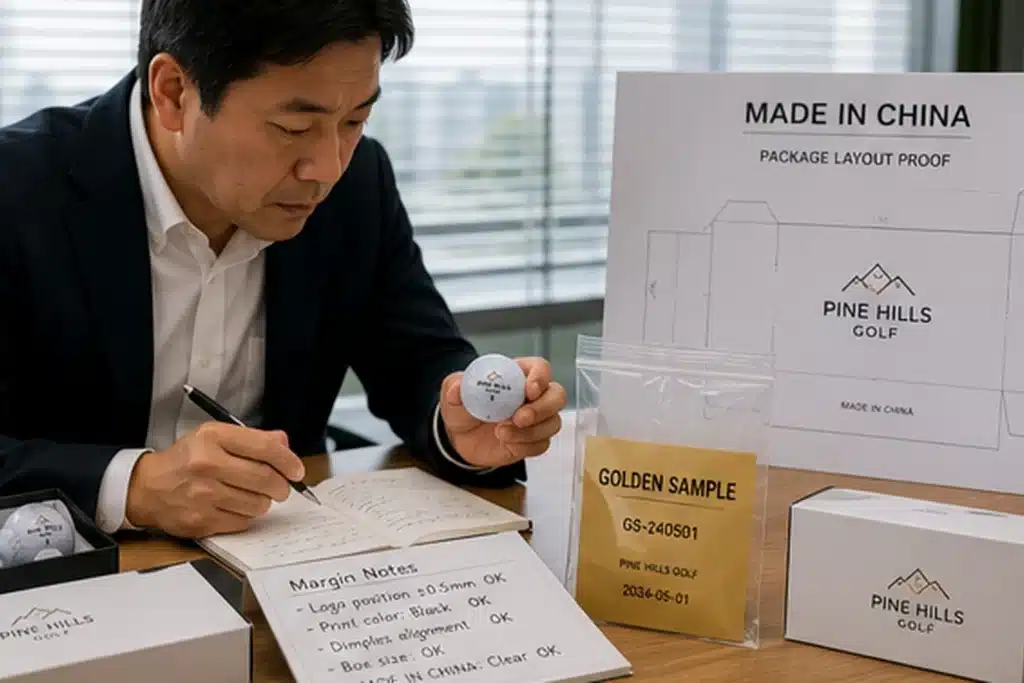
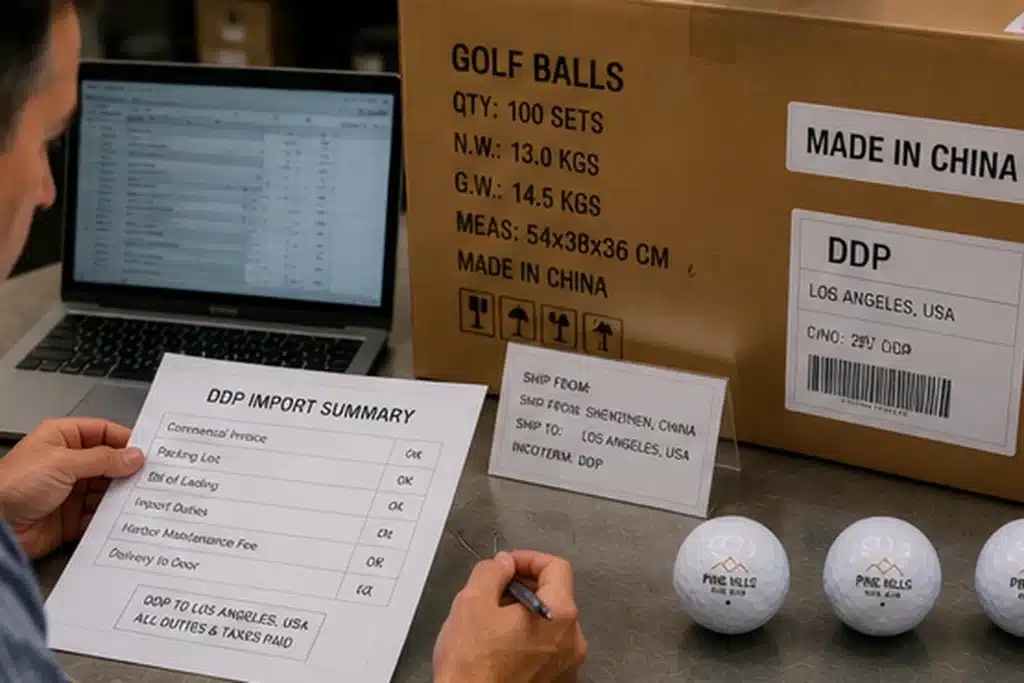
Yes, China can manufacture tour-quality or near-tour golf balls, but only when the OEM factory proves repeatable process control—not just a beautiful sample sleeve.
China can manufacture premium golf balls when the factory controls the right cover route, USGA performance margin, cast urethane chemistry, Cpk, CT/X-ray concentricity, compression spread, coating weight, adhesion, and robot-test dispersion. The risk is not geography; it is mistaking mature Surlyn or TPU production for repeatable thermoset cast urethane mass production.
| R&D question | Short answer | Proof to request |
|---|---|---|
| Can China make tour-quality balls? | Yes, in selected factories | Sample, pilot, and mass QC data |
| Is “urethane” always tour-grade? | No | TPU or cast thermoset route |
| Can samples prove premium quality? | No | Random-ball Cpk/SPC data |
| What prevents dead sound? | Layer bonding control | Primer, adhesion, shear test |
| What protects flight consistency? | Geometry and coating control | CT/X-ray, dimple, paint data |
| What proves performance? | Repeatable testing | Driver and wedge robot dispersion |
For the 2026 premium OEM sourcing cycle, screen every tour-intent China golf ball project through five gates:
-
Cover route: confirm whether the ball is Surlyn, injection TPU, compression TPU, or thermoset cast urethane.
-
Rule margin: verify weight, symmetry, Initial Velocity margin, COR proxy, coating weight, and dimple-depth retention.
-
Cpk proof: require random-ball data for weight, diameter, compression, cover thickness, and concentricity.
-
Adhesion and sound: test whether the core, mantle, primer, and cover survive impact without dead feel or early cracking.
-
Robot validation: compare driver distance, wedge spin, dispersion, and cover durability across sample, pilot, and mass lots.
The hard answer for R&D buyers is this: China can build premium golf balls, but the winning factory is not the one that sends the prettiest 12 samples. It is the one that proves chemistry, process capability, coating control, and batch repeatability before your reviewers, retailers, and repeat customers test the ball for you.
Can China match tour-quality golf balls?
You may want a tour-style urethane DTC flagship, but a few good samples do not prove your China OEM can repeat tour-quality performance in bulk.
China can manufacture tour-quality or near-tour golf balls, but only when the factory proves repeatability beyond hand-picked samples. Your approval should depend on cover route, USGA margin, CT/X-ray concentricity, compression spread, cover thickness, robot-test dispersion, and Cpk evidence.
China’s 2/3-piece Surlyn and ionomer capability is mature. For value, distance, logo, range, corporate, and mid-tier retail balls, the process window is broad enough for experienced factories to deliver stable quality. The sharper question begins with 3/4-piece urethane, especially when your brand wants soft feel, wedge spin, durable coating, and review-proof consistency.
Tour-quality should not mean a clone claim. It should mean a production system that holds legal performance margin and repeats the approved window. Under the USGA Equipment Rules, a golf ball must stay under the 45.93 g weight ceiling. The USGA/R&A Initial Velocity Test Procedure controls Initial Velocity against the official 250 ft/s standard with the applicable tolerance. For OEM buyers, paint grams, core cure, compression, symmetry, and cover thickness all need enough margin that mass production stays safe—not just the sample sleeve.
Use this first screen before approving premium language.
| Buyer question | Safe answer | Evidence to request | Buyer move |
|---|---|---|---|
| Can China make premium balls? | Yes, in selected factories | Cover route + QC pack | Verify route |
| Can samples prove tour grade? | No, samples start the test | Random batch data | Pilot first |
| Can it match big-brand intent? | Only with process proof | Robot + CT/X-ray | Avoid clone claims |
| What protects rule margin? | Weight and IV control | Weight, IV / COR proxy, symmetry data | Track production |
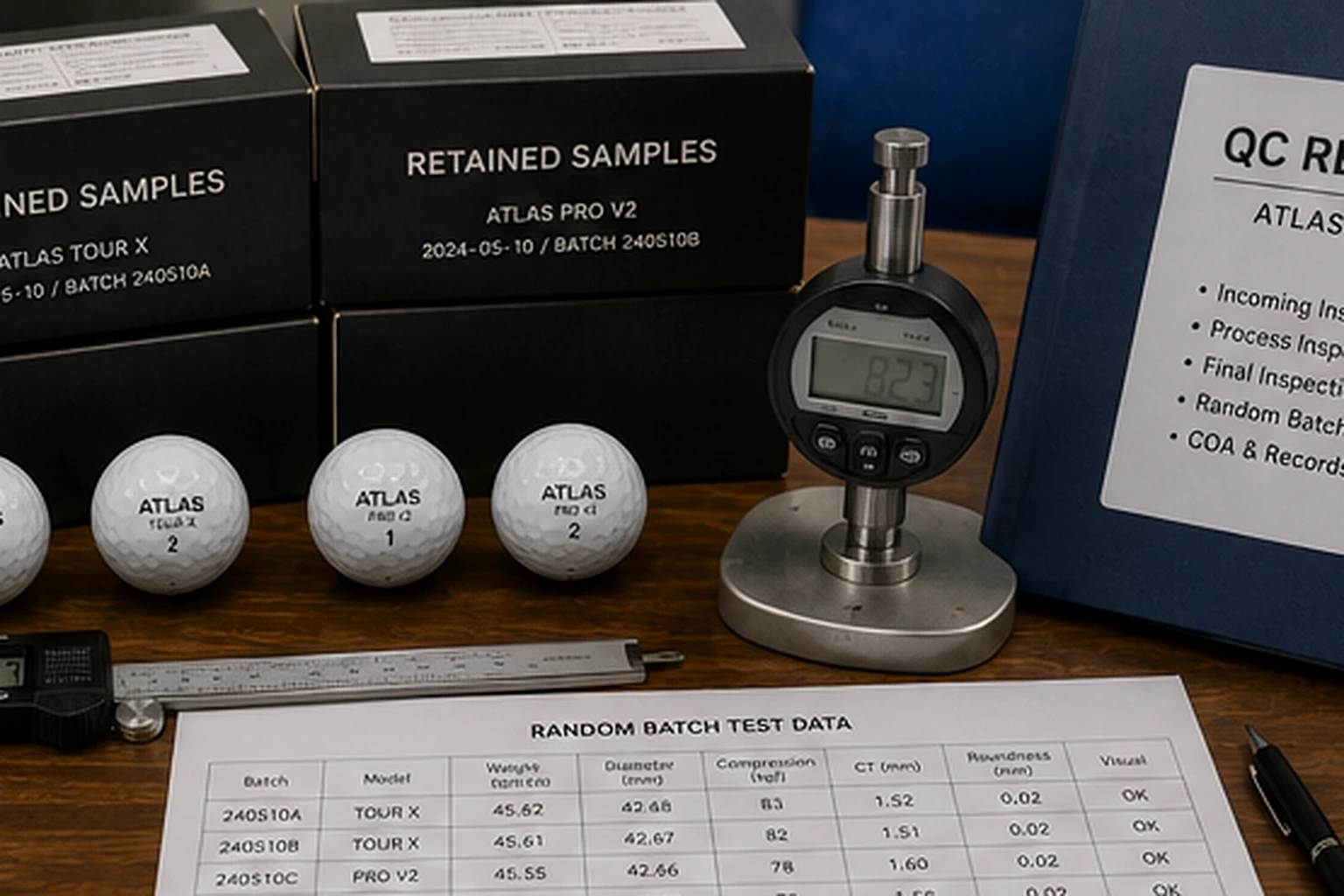
R&D buyers prefer proof over adjectives. A supplier may send 12 beautiful balls that feel fast, sound crisp, and spin well on one test day. That proves possibility. It does not prove takt-time production, curing stability, coating control, center alignment, or reorder consistency.
Request a premium OEM proof pack, not only sample balls. Compare sample, pilot, and mass data for weight, diameter, compression, cover thickness, concentricity, coating stack, and dispersion. Do not approve tour-quality language unless batch data supports the sample performance. Supplier responses should include the approved sample ID, batch ID, testing method, equipment ID, calibration date, and retained-sample plan.
✔ True — China can support premium golf ball projects.
Selected OEM factories can build strong Surlyn, TPU, and urethane-covered models when the process route and QC gates are controlled.
✘ False — “Chinese factories cannot make tour-quality balls.”
The real issue is whether your chosen factory can prove repeatable chemistry, coating, concentricity, compression, and batch control.
Where is the Surlyn-urethane divide?
You may see “urethane” on a quotation and assume you are buying a flagship cast urethane ball.
The biggest technical divide is not China versus the West; it is TPU versus cast thermoset urethane. TPU can make a practical value-premium ball. Cast urethane requires tighter chemical control, mold temperature, pot life, cure time, adhesion, and cover-thickness repeatability.
Surlyn and ionomer 2/3-piece builds are China’s comfort zone. They are durable, scalable, and well matched to entry, mid-tier, logo, range, and value-distance programs. TPU urethane is also common because it is thermoplastic, injection-friendly, cost-efficient, and easier to repeat than a true thermoset cast route. It can be a good commercial choice when your channel wants a premium story without demanding tour-level wedge bite.
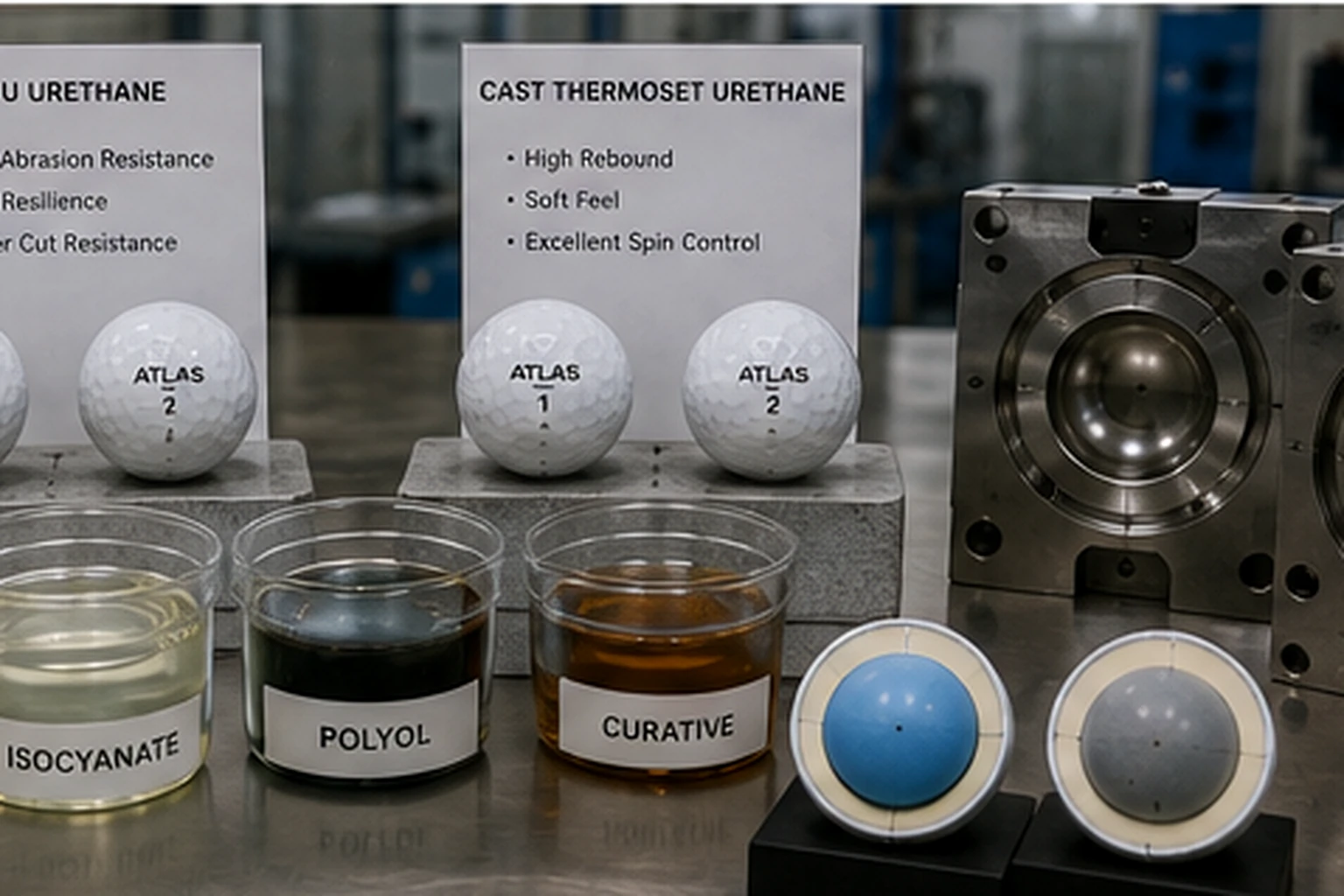
Cast thermoset urethane is different. It is not simply “better plastic.” Titleist’s Team Titleist FAQ explains that EXP•01 uses a thermoplastic urethane cover, while Pro V1, Pro V1x, and AVX use thermoset cast urethane technology; both can be called “urethane,” but they use different materials and processes. Industrial cast polyurethane processing guidance shows why the cure window matters: cast polyurethane is processed in a liquid state, then cast into a mold or onto a surface so the cure advances into a solid, and processing conditions can affect the final properties. For OEM buyers, that means cover route, pot life, mold temperature, primer, cure time, and coating stack must be locked before pilot approval.
That is why ordinary factories can make urethane-looking balls, while disciplined factories can repeatedly produce thin, soft, high-spin cast covers. The RFQ should separate three different businesses: a durable Surlyn retail ball, a TPU value-premium ball, and a cast urethane flagship. They may all look white in product photos. They do not carry the same chemistry, cost, risk, or launch promise.
| Build route | Strength | Risk | Buyer question |
|---|---|---|---|
| 2/3-piece Surlyn | Mature, durable, scalable | Not tour-spin positioning | Is this value or flagship? |
| Injection TPU | Fast, economical, repeatable | Generic urethane wording | Is it TPU? |
| Cast thermoset urethane | Soft feel, spin, premium story | Cure and adhesion control | Is it cast? |
| 4-piece dual mantle | Speed/spin tuning | Off-center and bonding risk | Can you prove layers? |
Is it TPU or cast urethane?
Ask this exact question early: is the cover injection-molded TPU, compression TPU, or thermoset cast urethane? A vague “urethane” quote is not enough for a flagship DTC ball.
A failure signal appears when a quote says “urethane” but the supplier will not name the cover route. TPU is not automatically bad. It can be durable, cost-friendly, and scalable. The problem is selling TPU as if it were a cast urethane flagship. Your promise to the golfer should match the chemistry.
Ask the supplier to name the cover route in writing. Match the quote, sample, PO, and QC file to TPU injection, TPU compression, or cast thermoset urethane. Reject generic “urethane” wording for flagship projects unless the exact cover process is declared.
Supplier shall identify the cover route as injection-molded TPU, compression TPU, or thermoset cast urethane, and shall provide dimple-tool ID, cover material route, primer/adhesion method, coating stack, paint thickness target, approved sample ID, production batch ID, and retained-sample location before pilot approval.
What separates samples from Cpk proof?
You may receive 12 beautiful balls that were hand-selected, but your bulk lot still fails in flight, feel, weight, or cover consistency.
A tour-quality claim starts with process capability, not sample beauty. Require random-ball raw data, CT/X-ray or cut-ball concentricity proof, cover-thickness control, compression distribution, paint/coating data, and Cpk/SPC where available before approving mass production.
Hand-picked samples are the oldest trick in premium OEM sourcing. They may be sorted by weight, appearance, compression, or feel before they reach your desk. They are useful, but they are not production proof. Production proof comes from random-ball raw data, batch-linked records, equipment ID, calibration date, and retained samples.
Cpk≥1.33 can be used as a buyer-side target for critical-to-quality dimensions where the supplier has enough data. It is not an official golf rule. It is a practical process-capability gate. For golf balls, the important CTQs include weight, diameter, roundness, concentricity, cover thickness, compression, and coating or paint thickness.
Paint is not cosmetic decoration in a premium ball. Too much primer or clearcoat can shift final weight, soften dimple edges, reduce dimple-depth retention, and narrow USGA performance margin. A glossy ball that hides molding defects may still punish driver flight and wedge consistency.
| CTQ | Failure mode | Evidence | Buyer move |
|---|---|---|---|
| Weight | USGA margin loss | Raw weights + mean/range | Hold near limit |
| Diameter / roundness | Flight inconsistency | SPC / gauge data | Track Cpk |
| Concentricity | Off-center flight | X-ray/CT proof | Reject hidden drift |
| Cover thickness | Spin / durability drift | Thickness map | Gate before scale |
| Compression | Feel and speed drift | Raw data + sigma | Compare to sample |
| Paint/coating | Dimple fill / weight shift | Paint grams + coating thickness | Lock stack |
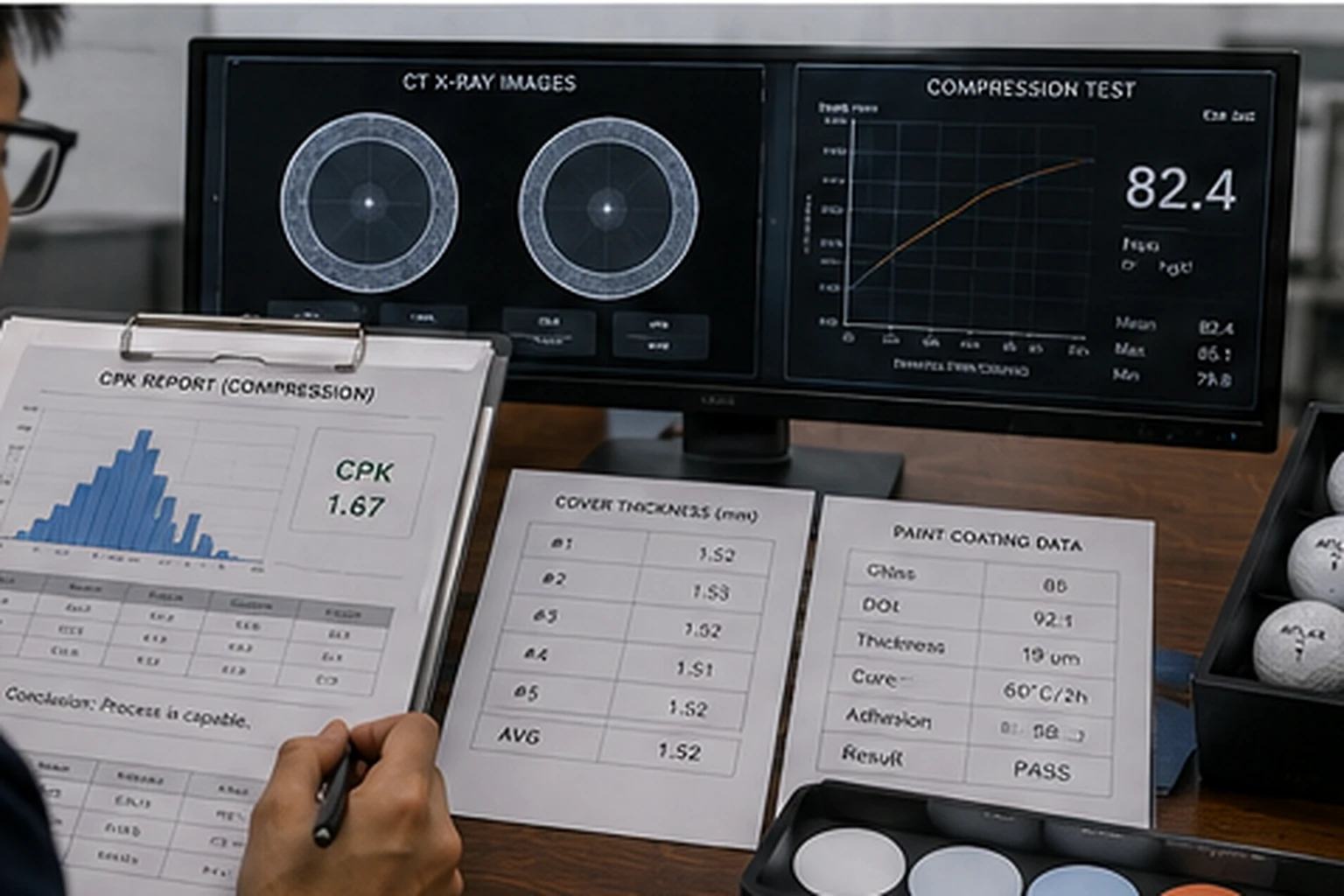
A second failure signal appears when a supplier sends perfect samples but refuses random-ball batch data. A third appears when the supplier hides paint/coating thickness and post-paint weight. Those are not small gaps; they are the exact places where sample beauty turns into mass-production drift.
Which CTQs need Cpk?
Prioritize the CTQs that affect legality, flight, feel, and durability. Weight, diameter, roundness, concentricity, cover thickness, and compression deserve the strongest controls.
For premium builds, compression sigma≤2 can be used as an internal pre-shipment gate when it matches the buyer’s spec and testing method. Cover thickness should be mapped, not guessed. Concentricity should be shown through X-ray/CT or cut-ball evidence. Paint grams and coating thickness should be locked, especially when the ball is close to weight or dimple-depth limits.
Mass-production release shall require random-ball raw data for weight, diameter, compression, cover thickness, roundness, and concentricity; CT/X-ray or cut-ball evidence; Cpk/SPC where available with Cpk≥1.33 as buyer-side target for critical-to-quality dimensions; equipment ID; calibration date; sample ID; batch link; and retained samples.
✔ True — Samples prove possibility.
A good sample tells you the target is reachable. Random-ball data and Cpk evidence tell you whether the factory can repeat it.
✘ False — “One good sample sleeve proves tour grade.”
Premium approval should depend on batch evidence, not a dozen carefully selected balls.
How do you validate tour-level OEM capability?
You may rely on founder feel-testing, but your market will judge the ball through launch monitors, wedges, reviewers, and reorder consistency.
Validate a China OEM ball through sample, pilot, and mass data—not founder feel alone. Use robot testing, wedge-spin dispersion, CT/X-ray or cut-ball checks, destructive adhesion testing, acoustic feedback, compression mapping, and retained samples before printing a premium DTC claim.
Human testing still matters. Players can detect feel, sound, wedge bite, durability, and confidence. But human testing is noisy. A founder flushing three drives is not a data set; it is a good afternoon. Premium validation needs repeatable strike conditions, random sample selection, and lot-level comparison.
Robot testing can compare driver speed, launch, spin, carry, total distance, and dispersion. Wedge robot testing can check spin retention, cover scuffing, and short-game control. Use example conditions only when they match your target player, such as a 105 mph driver or 40 mph wedge protocol. The number matters less than repeating the method across sample, pilot, and mass lots.
Dead sound usually points to energy-transfer trouble. In 4-piece or dual-mantle builds, the core, mantle layers, primer, and urethane cover must work as one system. Weak adhesion can create microscopic separation under high-speed impact. The ball may look clean, but sound muted, lose speed, scuff early, or crack after wedge strikes.
| Validation gate | What it catches | Evidence | Buyer move |
|---|---|---|---|
| Robot driver test | Distance and dispersion drift | Speed/spin/carry SD | Compare lots |
| Wedge robot test | Spin decay and greenside control | Spin SD / cover scuff | Verify cover route |
| Cut / shear test | Layer adhesion failure | Destructive sample record | Reject dead-sound risk |
| Compression map | Feel drift | Raw values + sigma | Hold wide spread |
| Coating audit | Paint/dimple distortion | Coating thickness data | Lock paint stack |
| Retained samples | Reorder mismatch | Lot-linked samples | Use for claims |
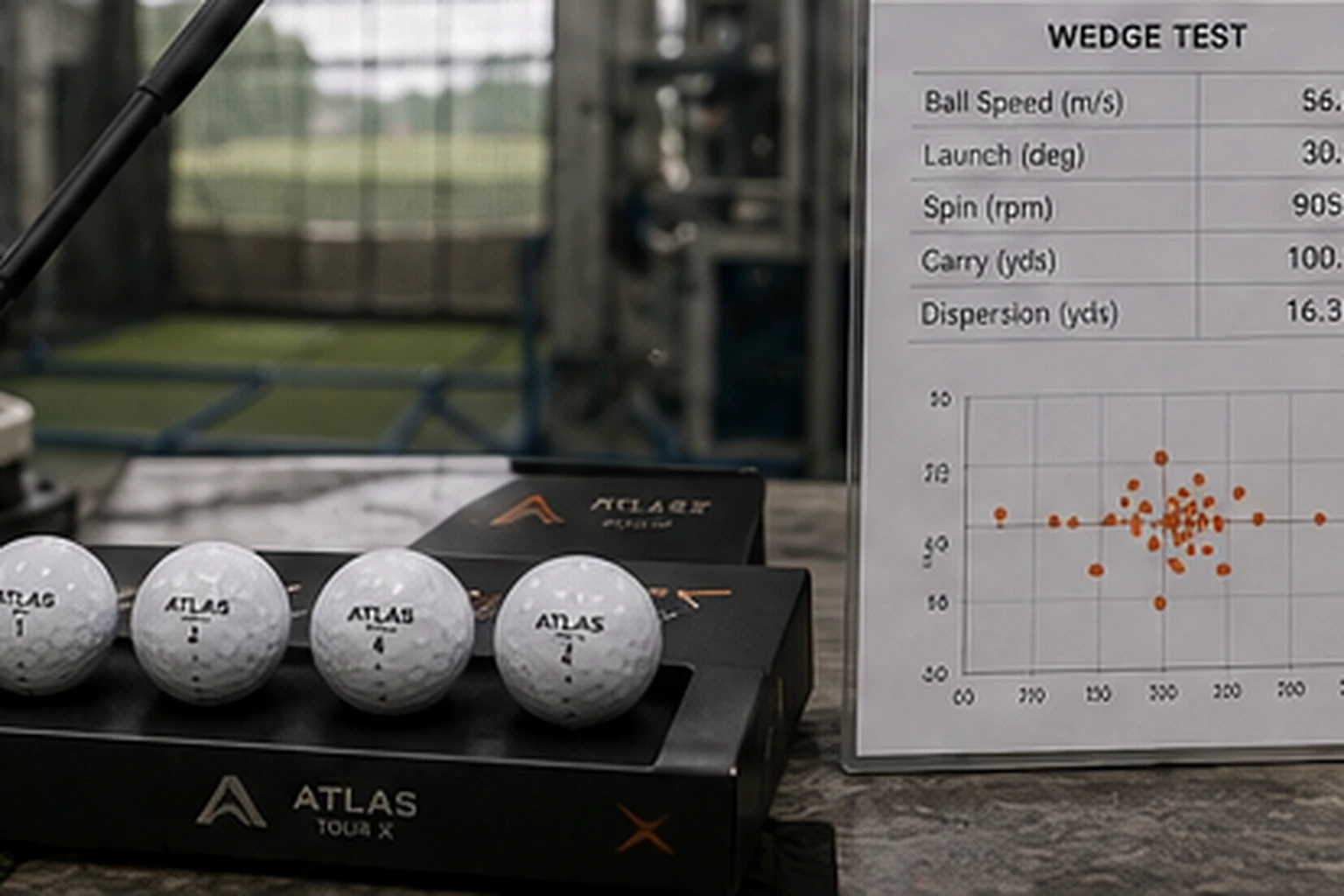
What should robot testing prove?
Robot testing should prove dispersion control, not just one impressive distance number. Look at standard deviation across speed, spin, carry, offline dispersion, and wedge spin.
PBR core control matters here. Storage humidity, mixing, curing, and vulcanization influence IV / COR proxy behavior. If the core is unstable, the ball may lose distance even when the nominal compression looks right. Coating control also matters. Overbuilt paint can shift weight and dimple behavior.
Ask the supplier to state whether the cover is injection-molded TPU or thermoset cast urethane, then provide cover route, dimple-tool ID, cast cure window, primer/adhesion method, paint/coating stack, CT/X-ray concentricity evidence, compression distribution, robot-test data, cover-thickness data, Cpk/SPC where available, and retained samples before mass approval.
Approve premium positioning only when validation evidence matches your target player and channel. DTC founders prefer review-proof launches, because public reviewers will test the ball for you if you do not test it first. Their comment section is not a lab you control.
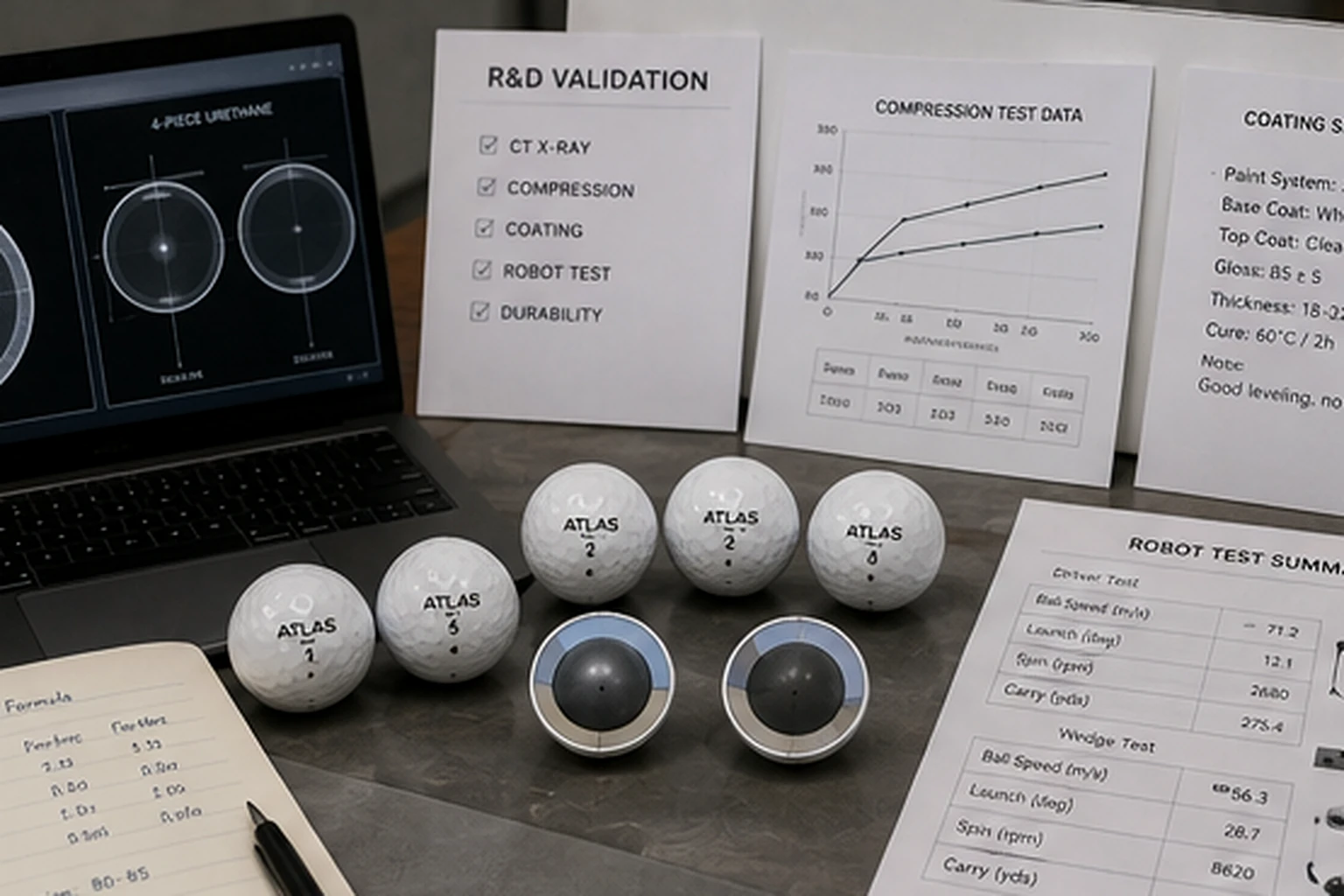
You need a practical supplier shortlist, but you cannot approve a supplier by catalog wording alone.
Use China OEM names as a shortlist, not proof of tour quality. Grasbird, Golfara, MLG Sports, and Shenzhen Xinjintian can start supplier screening, but premium approval depends on cover-route proof, dimple-tool ID, pilot data, Cpk/SPC, and batch QC.
The original price anchor for China 3/4-piece urethane programs sits around $1.2–$2.5 FOB per ball, with actual pricing affected by cover route, layer count, yield, coating, testing, packaging, and volume. Treat very low quotes as a route and QC question. A cheap “urethane” quote may be TPU, a simplified construction, weak QC scope, or packaging excluded from the comparison.
Do not turn the supplier list into a trophy wall. Use it as a screening table, then demand proof.
| Company | Location | Likely fit | MOQ signal | Buyer move |
|---|---|---|---|---|
| Grasbird | Hangzhou, Zhejiang | 2-piece Surlyn, some 3-piece | 3,000–5,000 pcs | Verify premium limits |
| Golfara | Ningbo, Zhejiang | 2/3/4-layer, urethane-covered models | from 1,000 pcs | Request premium QC pack |
| MLG Sports | Xiamen, Fujian | 2/3/4/5-piece Surlyn and urethane | 2,000–3,000 pcs | Verify multilayer route |
| Shenzhen Xinjintian | Shenzhen, Guangdong | 2/3/4-piece, mold/line claims | 2,000–3,000 pcs | Verify factory control |
Golfara fits premium China OEM discussions when your team needs cover-route clarity, realistic pilot planning, Urethane validation, packaging review, batch QC, CT/X-ray communication, compression data, and retained-sample control. That does not mean every project should jump straight to a cast urethane flagship. It means the build should match the brand promise, channel price, and proof budget.
Request current MOQ, cover route, dimple-tool ID, sample lead time, pilot plan, and anonymized QC pack. Compare suppliers under the same target build and the same CTQ gates. Do not approve a supplier for premium urethane unless the route and batch evidence match your brand claim.
✔ True — A shortlist helps you start screening.
Supplier names, locations, and MOQ signals help organize the RFQ. Premium approval still requires cover-route proof and batch evidence.
✘ False — “Any supplier that says urethane can make your flagship.”
A value TPU program, a catalog urethane claim, and a cast urethane flagship require different proof.
FAQ
Are Chinese golf balls as good as American ones?
They can be when the factory controls the same engineering variables: cover route, weight margin, compression, concentricity, cover thickness, coating, adhesion, and batch repeatability. Quality is produced by process control, not geography.
Do not compare country labels only. Compare sample, pilot, and mass data. Avoid clone or guaranteed-equivalent claims, especially when discussing famous models or patented designs. The professional question is whether the factory can prove the target window across random-ball production lots.
What is the difference between TPU and cast urethane?
TPU is a thermoplastic urethane route that is faster and more cost-friendly. Cast thermoset urethane is a chemical cure route used for premium soft-feel, high-spin positioning, but it is harder to process and validate.
Ask the supplier to name the route. Use cast only when the channel pays for the added process difficulty, testing, and yield control. Write the cover route into the PO so “urethane” does not become a convenient but vague sales word.
How do you test OEM golf ball quality?
Use random-ball batch data, not only hand-picked samples. Request weight, diameter, compression, cover thickness, CT/X-ray or cut-ball concentricity, robot-test dispersion, destructive cover checks, and retained samples.
Use sample → pilot → mass gates. Track raw values, mean, range, sigma, and Cpk where available. Keep retained samples by lot so disputes and reorder drift can be investigated with evidence instead of memory.
Why is my golf ball distance shorter with the same specs?
Distance can fall if core curing, Initial Velocity margin, COR proxy, paint thickness, dimple-depth retention, or symmetry drifts. The same nominal spec does not guarantee the same energy return or aerodynamic behavior.
Check PBR core cure, compression distribution, post-paint weight, coating thickness, and concentricity. Compare pilot and mass data. A ball can share the same layer count and still fly shorter if the core or surface process is unstable.
Can China make cast urethane golf balls?
Yes, selected China OEM factories can support cast urethane or tour-intent builds, but buyers must verify the route. Ask for thermoset cast wording, cure controls, adhesion proof, CT/X-ray, cover-thickness data, and pilot-lot evidence.
Do not accept generic “urethane.” Require cast-route evidence and pilot before scaling. Cast urethane is a chemistry and process-control decision, not a brochure adjective.
What Cpk should I request for golf ball production?
Cpk≥1.33 can be used as a buyer-side process capability target for critical dimensions where the supplier has enough data. It is not an official golf-ball rule, but it helps protect repeatability.
Apply it to CTQs such as weight, diameter, roundness, concentricity, cover thickness, and compression where measurement methods are reliable. Ask for method, sample size, equipment ID, and raw data. Pair Cpk with CT/X-ray and retained samples.
Can paint thickness affect golf ball performance?
Yes. Paint and coating can affect weight, appearance, dimple-depth retention, and aerodynamic consistency. That is why premium OEM orders should lock paint/coating stack and measure post-paint weight.
Ask for coating thickness, post-paint weight, adhesion checks, and dimple-depth retention where available. Do not use paint to hide molding or cover defects. Pretty gloss is not a substitute for controlled grams.
What price should I expect for China urethane balls?
The original price anchor for 3/4-piece urethane programs is about $1.2–$2.5 FOB per ball, depending on cover route, layer count, yield, coating, testing, packaging, and volume. Treat very low quotes as a route and QC question.
Ask whether the quote is TPU or cast urethane. Separate ball cost from packaging. Compare QC scope before price. A low quote with no CT/X-ray, no robot data, and no coating control is not a premium offer yet.
Conclusion
China can manufacture tour-quality or near-tour golf balls when the buyer chooses the right cover route, writes the right CTQ gates, and validates sample-to-mass consistency. The winning factory is the one that proves chemistry, Cpk, coating control, and robot-tested repeatability—not the one that sends the prettiest sample sleeve.
Surlyn and value TPU are mature. Cast urethane is possible in selected projects, but it rewards engineering discipline and punishes wishful thinking. Golfers do not care how persuasive the RFQ sounded. They care whether the 50-yard wedge grabs, whether the driver flight repeats, and whether the next dozen feels like the first.
You might also like — Why 80% of Golf Balls Are Made in Asia: 2026 OEM Sourcing Guide