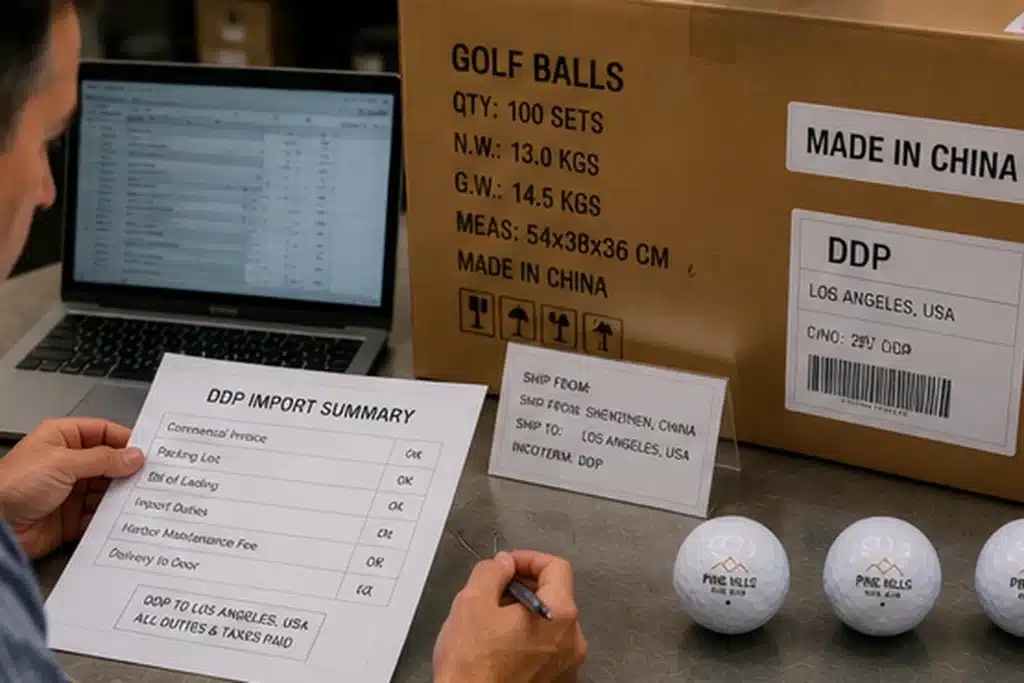
Chinese OEM golf balls may share material families, production equipment, generic construction platforms, and target performance windows with big-brand supply chains, but they do not automatically share flagship recipes, dimple IP, mold cavities, QC gates, or production priority. The safest B2B answer is: similar window, not same ball.
A “same factory as big brands” claim is not useless, but it is incomplete until your team audits five layers: machines, materials, molds, QC window, and priority. Same factory may mean shared operators or equipment; it does not prove the same core formula, cover route, dimple tooling, batch tolerance, or delivery status.
Use this guide to separate shared platform access from proprietary golf ball technology, then verify the claim with molds, QC data, launch-monitor comparison, and supplier priority checks.
You may hear that a Chinese OEM uses the same factory, material family, or machinery as a big brand, but that does not tell you which technology layer is actually shared.
Shared golf ball technology usually means access to similar material families, machines, construction platforms, and performance windows. It does not automatically mean the same recipe, dimple tooling, mold cavity, QC window, or production priority as a big-brand flagship ball.
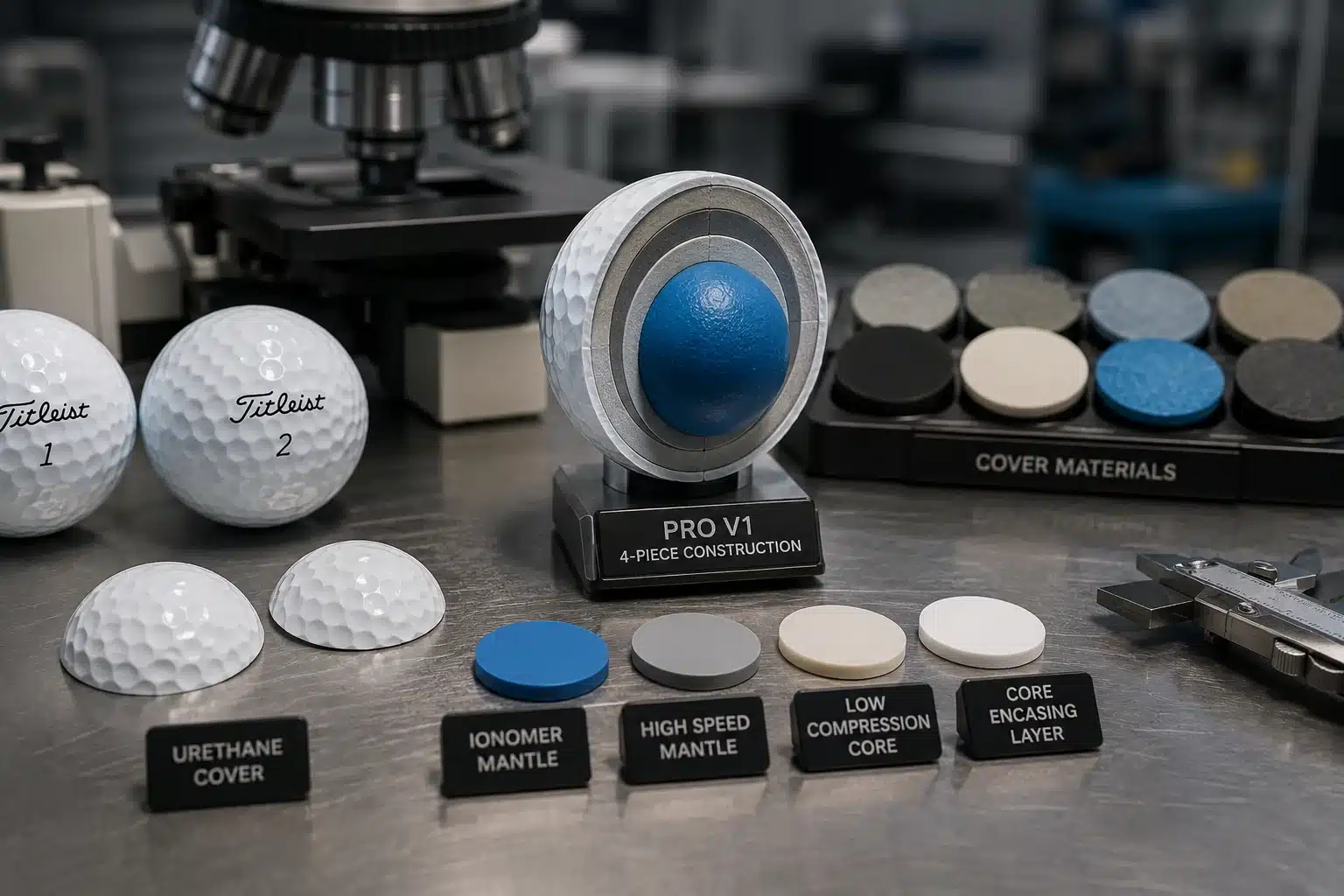
A golf ball is a system, not a single material label. Public technical guidance breaks golf ball performance into golf ball core, mantle, cover, and dimple pattern, and each layer can change speed, launch, spin, feel, durability, or flight. That is why a “same factory” claim must be separated into layers before your team believes it.
A Chinese golf ball OEM may share broad resin families, injection or compression equipment, polishing lines, coating processes, operator experience, and generic construction platforms. It may also help your private label golf ball program target a similar performance window: low-spin ionomer distance, mid-tier multilayer control, TPU urethane value-premium, or selected premium urethane positioning.
That is commercially useful. It is not the same as inheriting a big brand’s flagship product. Exact core formulation, cure curve, mantle gradient, cast cover chemistry, dimple geometry, mold cavities, statistical quality gates, and production priority may remain protected.
Country and factory labels tell you where balls are made. QC data tells you how tightly they are controlled.
| Pain/decision | Often shareable | Usually proprietary | Proof to request |
|---|---|---|---|
| “Same factory” claim | Machine park / operators | Recipe and QC window | Layer audit |
| Material family | Ionomer / TPU family | Exact blend / additives | Material declaration |
| Construction platform | 2-piece / 3-piece / 4-piece route | Core gradient / cure curve | Compression distribution |
| Cover route | Generic ionomer or TPU | Cast surface chemistry | TPU / cast declaration |
| Dimple pattern | Generic OEM pattern | Flagship dimple tooling | Tooling rights |
| Production access | Available capacity | Strategic priority | OTIF record |
✔ True — Shared platform does not mean shared flagship
A Chinese OEM may give your team access to similar materials, machines, and performance windows. That still does not prove the same formula, mold, QC gate, or production priority.
✘ False — “Same factory means same ball”
The same building can produce different products under different recipes, molds, tolerances, coatings, inspections, and customer priority rules.
Platform access vs flagship formula?
Platform access means you can buy into a technical neighborhood. It does not mean you own the most protected house on the street.
Ask the OEM to map the claimed shared technology by layer: machine park, material family, core/mantle window, cover route, dimple tooling, QC window, and production priority. Then request evidence for each layer.
Do not approve a “shared tech” claim unless the supplier can explain what is actually shared and what is not. Serious buyers should audit the claim, not repeat the same-factory slogan.
What stays proprietary to big brands?
You may hope a Chinese OEM can quietly offer the same flagship technology as a global brand, but the most valuable parts are usually protected by recipes, tooling, process windows, and QC gates.
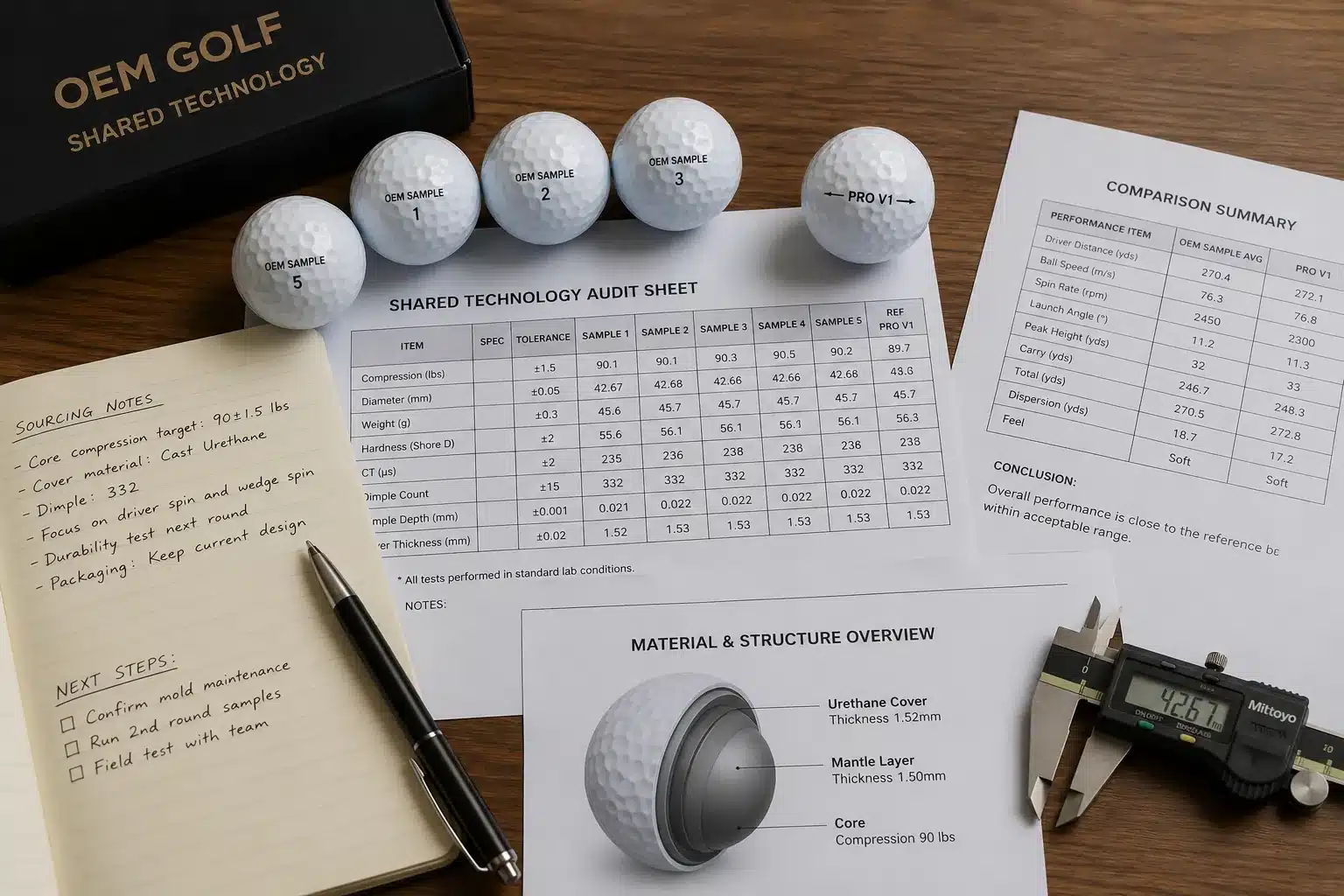
Big-brand golf ball technology is not only a material recipe. The protected value often sits in core formulation, cure curves, mantle gradients, cast cover chemistry, dimple tooling, mold cavities, statistical QC gates, test databases, and production priority.
Big-brand performance is a controlled manufacturing window. One leading brand describes its golf ball production as happening in owned and operated facilities, with premium models moving through many process and product quality checks. That matters for OEM sourcing: an independent factory may use similar polymer families or machines, but it does not automatically inherit the same QC gates, scrap rules, statistical tolerances, or production priority.
This matters because “similar inputs” do not guarantee “similar outcomes.” Two balls can use a urethane-family cover and still differ in cover route, hardness, thickness, coating, surface friction, wedge scuff behavior, and batch repeatability. Many China-origin “urethane” balls are more accurately injection-molded TPU urethane programs, while some flagship tour balls use cast thermoset urethane with different chemistry and process control.
Your RFQ language should target a performance window, not a protected clone. Ask for driver spin, iron spin, wedge behavior, compression range, cover route, durability, and launch-monitor comparison versus a named reference ball. Do not ask the supplier to “make the same as” another brand’s flagship. That creates IP risk and weakens your own brand story.
| Pain/decision | Similar window possible | Protected boundary | Buyer evidence |
|---|---|---|---|
| Core performance | Compression range | Exact formulation / cure | Spread data |
| Mantle behavior | Material family | Gradient and thickness recipe | Construction note |
| Cover claim | TPU / ionomer route | Cast chemistry and treatment | Route declaration |
| Dimple count | Similar count possible | Dimple geometry / mold cavities | Tooling list |
| QC level | Basic outgoing checks | Statistical gates and scrap rules | QC window |
| Brand comparison | Reference-ball testing | 1:1 clone claim | Target window |
Recipes, molds, cure curves, and QC windows?
The protected value is usually the system, not one dramatic ingredient.
A supplier may use similar polymer families, injection equipment, polishing steps, or coating lines. That does not prove the same core chemistry, mantle gradient, dimple tool, cast urethane process, or quality gate.
Ask the OEM what it can prove without overclaiming. Your RFQ should target performance windows and acceptance criteria, not someone else’s recipe.
When does “same factory” become risky?
You may hear “same factory as big brands” and feel reassured, but the claim can be partly true and still commercially dangerous.
“Same factory” becomes risky when your team assumes shared recipe, shared mold, shared QC window, shared IP protection, or shared production priority. A factory can share machines and operators while giving different customers different specs, tooling rights, inspection depth, and delivery priority.
A same-factory claim is persuasive because it may contain a piece of truth. A plant may have served larger brands, produced mid-tier balls for several customers, or built both OEM golf balls and private label golf balls. It may genuinely know 2-piece ionomer, 3-piece TPU urethane, multilayer constructions, coating systems, and logo workflows.
The danger begins when the claim replaces evidence. “Same factory” does not tell your team whose molds are used, whether the dimple pattern is generic, whether the cover is TPU or cast, whether the QC window is narrow, or whether your order receives priority when the line is full.
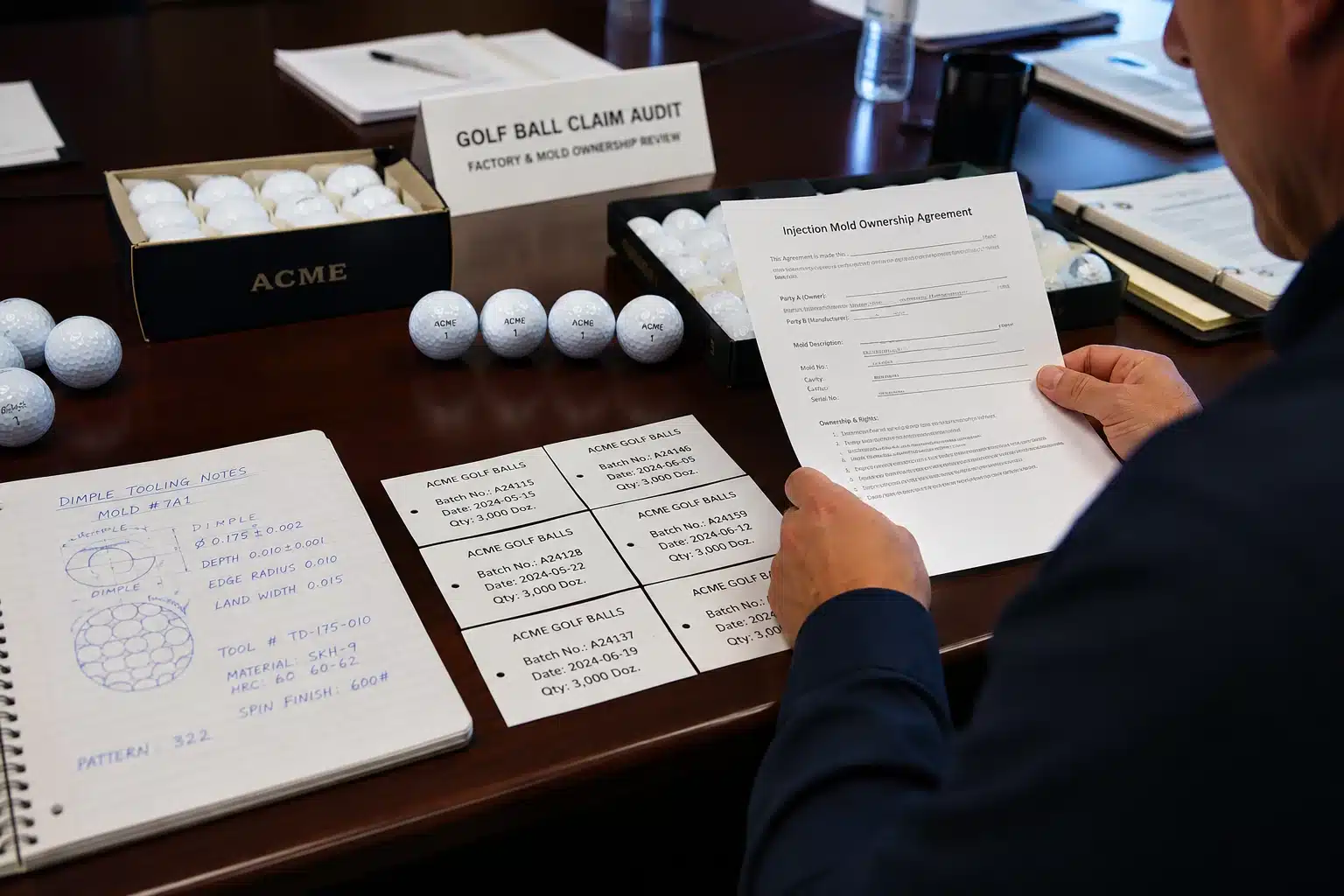
Mold ownership is often the line between buying a generic OEM platform and building a defensible product. If the factory owns the dimple tool and can reuse it freely, your “exclusive model” may only be exclusive in your sales deck. That may be fine for a value program, but it is not enough for a differentiated DTC brand.
Supplier says “same factory” but cannot show mold or batch proof is a failure signal.
✔ True — The claim may be true but incomplete
A supplier may share an industrial site, equipment type, or operator pool with bigger accounts. That still does not prove shared tooling, recipes, QC gates, or production priority.
✘ False — “Same factory removes sourcing risk”
It can add risk if your team stops asking for process route, mold ownership, batch data, launch-monitor protocol, and sample-to-bulk traceability.
Generic platform vs protected product?
A generic platform is useful when you know it is generic and validate it honestly.
Generic OEM models can be practical for value retail, range, corporate, tournament, or early private label programs. A protected product line needs stronger control: dedicated molds, written tooling rights, defined QC windows, batch-linked samples, and clear exit terms.
Artwork, alignment marks, dimple visuals, packaging files, and logo treatments also deserve light protection. They may not be the core formula, but they still shape product identity before launch.
You may not need a full factory audit to evaluate every supplier, but you do need a focused shared-tech audit before trusting a performance or same-factory claim.
Audit shared tech through five control points: cover route, tooling rights, sample-lot QC, reference-ball testing, and production priority. If the supplier cannot connect claims to molds, data, and batches, the claim is marketing, not evidence.
The most useful question is not “Have you made balls for famous brands?” It is “Which part of that capability can you legally, technically, and repeatedly provide for this program?”
Start with the cover route. If the quote says “urethane,” ask whether it means injection-molded TPU, compression-molded TPU, or cast thermoset urethane. Then ask for construction stack, material family, coating system, and route-specific risk. Keep deeper cover-process choices in a dedicated TPU vs cast article; here, the route is evidence for the shared-tech claim.
Next, audit tooling. Ask for tooling list, dimple drawing control, mold ownership, storage terms, transfer rights, scrap or exit clauses, and whether the same dimple tool can be used for other customers. Dimple count is not enough. Public aerodynamics and tooling guidance shows why dimple tooling and mold cavities matter: dimple depth, edge angle, and shape can affect ball flight, and dimple designs must be translated into steel mold cavities that press the final dimple pattern into the golf ball cover.
Supplier shall link approved sample, tooling reference, dimple pattern reference, mold ownership status, batch ID, retained sample, QC report, coating lot, launch-monitor report, and bulk shipment under one traceable program record.
| Pain/decision | Audit item | Why it matters | Buyer evidence |
|---|---|---|---|
| Urethane ambiguity | Cover route | Prevents false equivalence | TPU / cast declaration |
| Generic model risk | Tooling rights | Protects differentiation | Tooling ownership list |
| Dimple claim | Dimple tool | Controls flight identity | Drawing / tool reference |
| Sample theatre | QC data | Proves repeatability | 12-ball report |
| Benchmark claim | Reference test | Shows performance window | Launch protocol |
| Bulk drift | Traceability | Links sample to lot | Batch ID / retained sample |
Molds, data, and launch-monitor proof?
A serious shared-tech audit should connect what the supplier says to what the supplier can prove.
Request process route, tooling rights, dimple-tool reference, sample-lot QC, launch-monitor protocol, reference ball, batch ID, and retained sample. Then check whether the proposed evidence matches your SKU promise.
Your team should also ask who controls change approval. A small change in cover route, coating, dimple tool, print file, or production site can move the performance window. Good suppliers document those changes before pilot or bulk release.
What QC proves the tech is repeatable?
You may approve a polished sample and a launch-monitor screenshot, but shared materials do not prove shared performance unless the factory can repeat the QC window in bulk.
Repeatable shared technology is proven by spread data, not sample theatre. Ask for 12-ball QC, compression distribution, weight, diameter, Shore hardness, CT/X-ray or cutaway evidence, launch-monitor test conditions, reference-ball comparison, retained samples, and batch traceability.
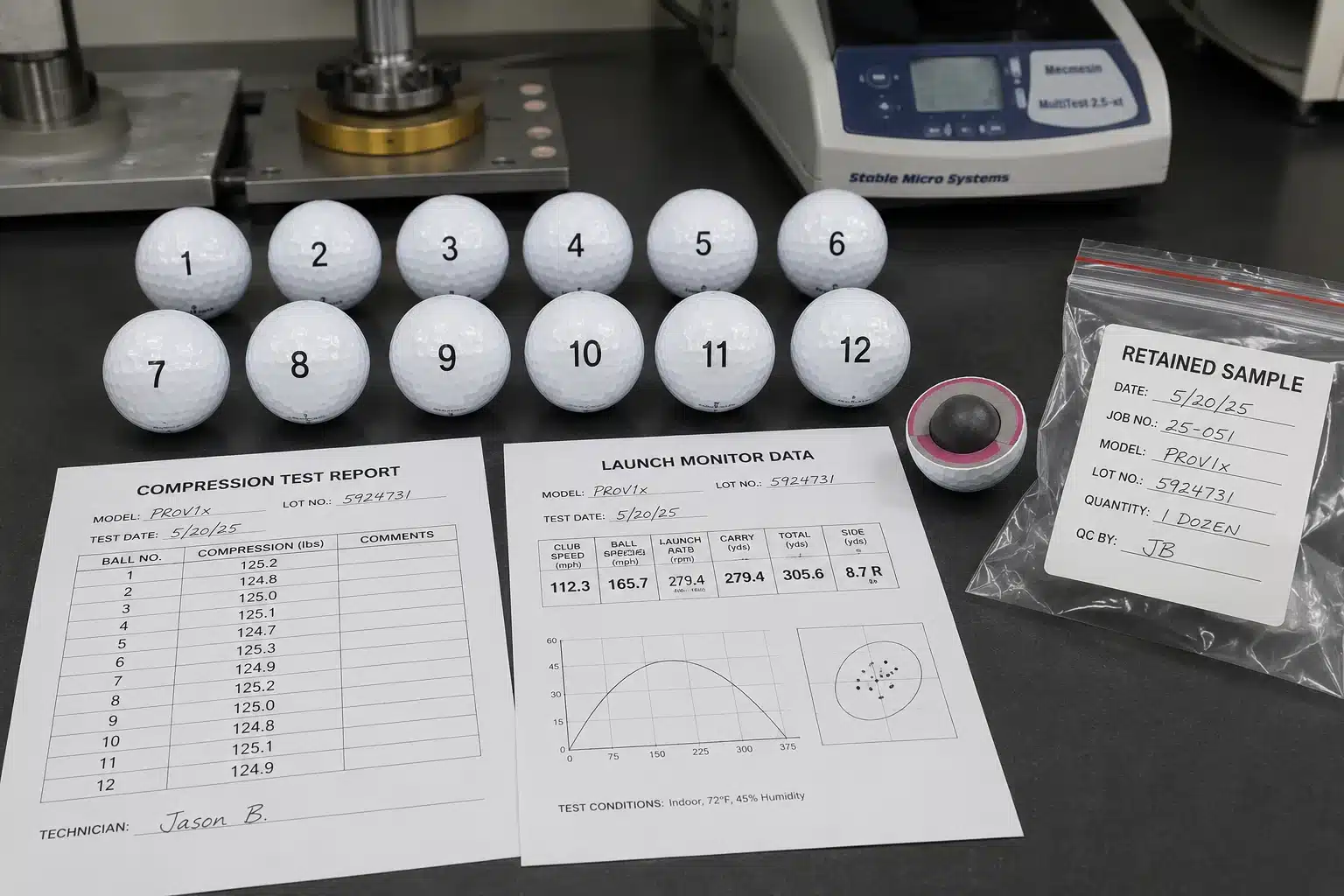
A single sample can look excellent and still fail as a production standard. What matters is spread. Are compression values clustered? Are diameter and weight controlled? Is the core centered? Is cover thickness stable? Does the coating survive handling and play? Does the launch-monitor pattern stay inside the target window?
Ask for a 12-ball QC report tied to the sample lot and intended production path. The report should include raw values, mean, standard deviation or range, equipment model, calibration status, sample ID, and batch ID where practical. For technical procurement teams, this turns “good quality” into acceptance evidence.
Launch-monitor data should also be auditable. Ask for device type, club model, loft, swing speed, shot count, test temperature, reference ball, and whether the test used the same session and setup. A screenshot without conditions is not enough.
For hardness, use method language carefully. The ASTM D2240 Shore hardness method is based on the penetration of a specified indentor under controlled conditions, so it can support Shore hardness control for cover or material comparisons. It does not replace whole-ball compression, wedge scuff, or launch testing.
Supplier claims shared tech with no 12-ball QC spread is a failure signal.
| Pain/decision | Proof item | What it proves | Buyer evidence |
|---|---|---|---|
| “Good quality” claim | 12-ball QC report | Consistency spread | Raw data + range |
| Feel drift | Compression distribution | Batch feel control | Average + SD/range |
| Cover claim | Shore hardness | Cover/material window | Method + sample size |
| Layer risk | CT/X-ray or cutaway | Centering / uniformity | Images or report |
| Flight claim | Launch monitor | Target window | Same test protocol |
| Bulk mismatch | Retained sample | Sample-to-lot link | PO reference |
✔ True — QC window is the real shared-tech proof
Shared materials do not guarantee shared performance. The buyer needs compression spread, weight and diameter data, centering evidence, reference testing, and retained samples.
✘ False — “One good sample proves the factory can repeat it”
A polished sample can hide loose process control. Bulk confidence comes from spread data, batch records, and sample-to-lot traceability.
Spread data, not sample theatre?
Your team should approve the QC window, not the prettiest ball in the sample sleeve.
Ask the OEM to provide a shared-tech audit pack with cover-route declaration, mold/tooling ownership, dimple-tool reference, 12-ball QC report, compression distribution, Shore hardness method, CT/X-ray or cutaway evidence, launch-monitor protocol, reference ball, batch ID, retained sample, and sample-to-bulk traceability.
Supplier shall disclose any change in core formulation, mantle material, cover route, dimple tooling, mold cavity, coating system, print/marking file, QC window, or production site before pilot or bulk release.
Do not approve bulk production until the sample, QC report, retained sample, and intended production route all point to the same program.
How should you manage OEM priority risk?
You may prove that a factory has real capability, but that still does not prove your account will receive priority when capacity tightens.
Same factory does not mean same production priority. Track lead-time drift, MOQ jumps, slower RFQ replies, reduced engineering support, pricing changes, and capacity-excuse frequency before assuming your OEM relationship is still stable.
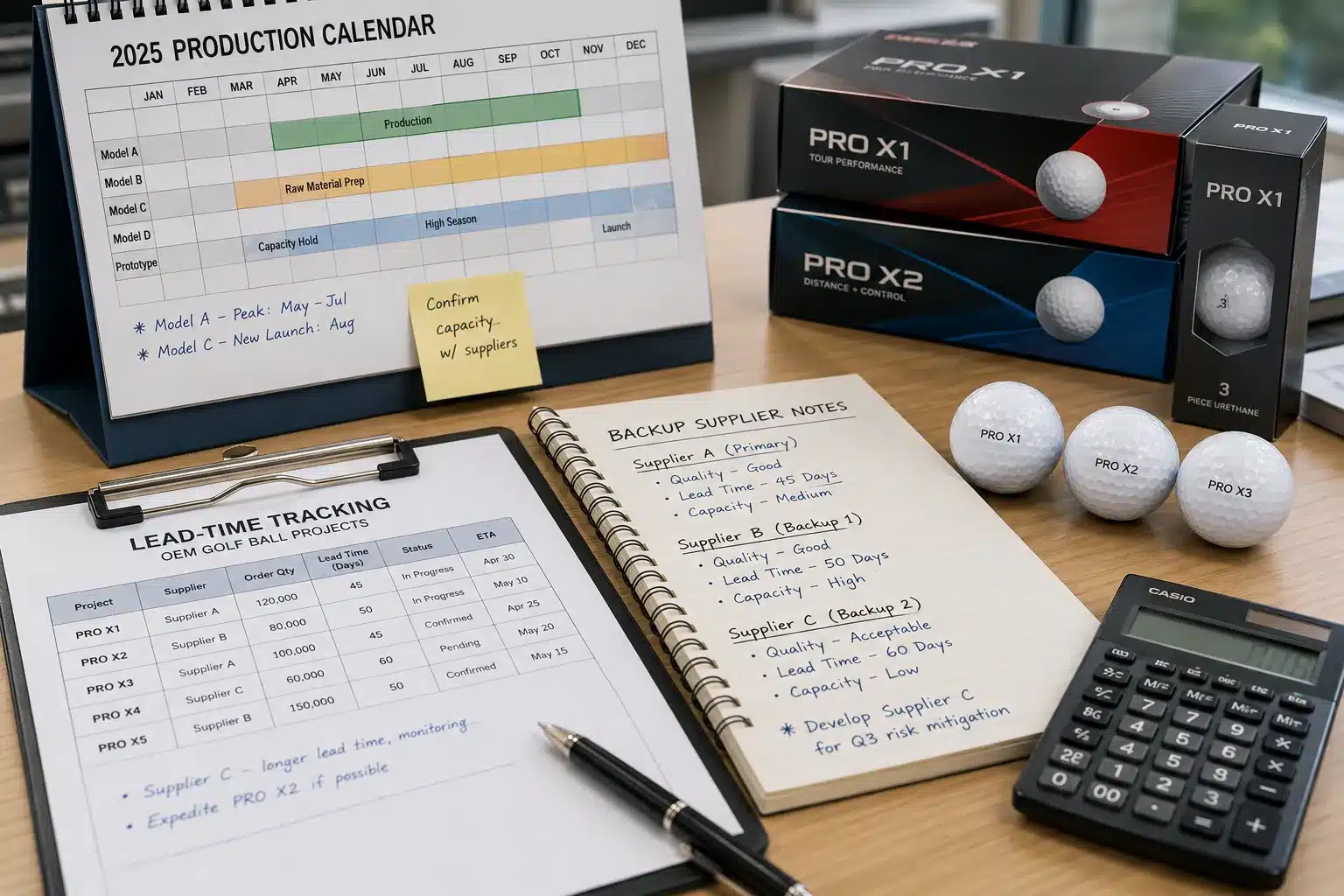
Shared factory risk often appears slowly. Lead times move from predictable to vague. MOQs become rigid. Special colors, markings, or packaging suddenly become inconvenient. Engineering support shrinks. RFQ replies slow down. The supplier pushes only standard models. None of these signals proves bad faith, but together they may show your account is losing priority.
This matters for DTC founders, private label buyers, distributors, and investor teams because a shared factory may treat smaller programs as flexible filler volume. If a captive brand, strategic customer, or larger account needs capacity, your order may slide. You may still be buying from a capable plant, but not from a plant where your program matters enough.
China’s OEM advantage should be written honestly. The advantage is not that every plant equals a captive tour factory. The advantage is a distributed OEM base with flexibility, lower pilot friction, fast logo and packaging coordination, and enough technical depth for many mid-tier and selected premium programs if your team audits the plant and locks the evidence.
Lead times drift while RFQ replies become vague is a failure signal.
| Warning signal | What it may mean | Buyer move | Evidence to track |
|---|---|---|---|
| Lead time drifts | Lower slot priority | Request capacity plan | OTIF history |
| MOQ jumps | Capacity rationing | Compare backup quote | MOQ trend |
| RFQ replies slow | Lower account value | Escalate or diversify | Response time |
| Engineering support drops | Standard-model push | Secure tooling terms | Change logs |
| Price terms shift | Strategic repricing | Re-benchmark supplier | Quote history |
| Data becomes slogans | Marketing over proof | Demand QC pack | Audit record |
Captive plants, lead-time drift, and backup supply?
Priority risk is managed by tracking behavior before failure becomes obvious.
Track on-time in-full delivery, average RFQ response time, lead-time drift, MOQ changes, engineering support, and capacity-excuse frequency. If three signals move the wrong way, start sizing a backup OEM supplier before you need one.
Chinese OEM flexibility is valuable when your team locks tooling, QC, and priority evidence. Your backup plan should protect continuity, not start a country-label debate.
FAQ
Are Chinese OEM golf balls the same as big-brand balls?
No. Chinese OEM golf balls may share material families, machinery, construction platforms, and target performance windows, but they do not automatically share a big brand’s flagship recipe, dimple IP, QC gates, or production priority.
Use “similar window, not same ball” as the buyer-safe framing. A serious OEM can help you target compression, spin, feel, durability, and price positioning. It should not ask you to market the product as a clone of a protected flagship ball.
Does “same factory” mean the same recipe and QC window?
No. The same factory may run different recipes, molds, materials, inspection plans, coatings, and production priorities for different customers. Same factory is a starting point for questions, not proof.
Ask for cover route, tooling rights, dimple-tool reference, 12-ball QC, launch-monitor protocol, retained sample, and batch ID. If the supplier cannot connect the same-factory claim to actual evidence, the claim is incomplete.
Which golf ball technologies can an OEM share?
An OEM can often share broad material families, machine platforms, standard construction routes, generic dimple tools, TPU or ionomer cover platforms, coating workflows, and mid-tier performance windows.
That can still be valuable. Many private label and DTC programs do not need a copied flagship ball; they need a reliable target-performance window. The key is knowing which layer is shared and which layer must be uniquely specified.
What stays proprietary in premium golf balls?
Premium proprietary value often stays in core formulation, cure curves, mantle gradients, cast urethane surface chemistry, dimple tooling, mold cavities, statistical QC windows, testing databases, and production priority.
These are the areas that turn a material family into a repeatable product. Do not ask an OEM for someone else’s protected recipe. Ask for your own target window, tooling strategy, and acceptance criteria.
Does USGA/R&A listing prove big-brand technology?
No. A Conforming Ball List entry proves that a specific submitted ball type was ruled to conform. It does not prove shared flagship technology, shared molds, or big-brand QC.
The list is model-level evidence, not a shortcut for factory capability. Treat listing status separately from recipe ownership, dimple tooling, QC window, and supplier priority. A listed model can still be different from a flagship ball, and an unlisted factory may still have strong process capability for non-tournament programs.
What proof should an OEM provide before you trust shared tech?
Ask for cover-route declaration, tooling ownership, dimple-tool reference, 12-ball QC report, compression spread, weight and diameter data, Shore hardness, CT/X-ray or cutaway evidence, launch-monitor conditions, reference ball, retained sample, and batch link.
The goal is not to bury the supplier in paperwork. The goal is to replace a vague “shared tech” claim with a traceable evidence pack your sourcing, technical, and brand teams can approve.
Can a private-label ball match a performance window?
Yes. A private-label ball can target a performance window without copying a flagship recipe. Use a reference ball, launch-monitor protocol, QC spread, and batch repeatability to validate the result.
The safer language is “target performance window versus a reference ball,” not “same as Pro V1” or any other protected flagship. That keeps your marketing credible and your sourcing process cleaner.
Conclusion
Chinese OEM golf balls can share useful parts of the industrial platform: material families, machinery, production experience, generic construction routes, and performance windows. They do not automatically share a big brand’s flagship recipe, dimple IP, mold cavity package, QC gate, or production priority.
Do not buy “same factory” as a slogan. Audit what is shared, what is proprietary, what your mold rights protect, what QC window can be repeated, and where your order sits in the supplier’s priority stack.
You might also like — Can China Manufacture Tour-Quality Golf Balls? The 2026 R&D Reality