A supplier says your golf ball is made in the “same factory” as a major brand. That sounds reassuring, but it still does not tell you what your SKU actually shares with that brand’s product.
A verified “same factory” relationship can show that two programs share a manufacturing site, equipment family, or manufacturing platform, but it does not prove the same golf ball. Your SKU may still use different formulations, tooling, process settings, acceptance criteria, and production priority.
“Same factory” is a relationship claim, not a finished-product specification.
For a B2B buyer, the useful question is:
What exactly is shared, what applies to my SKU, and what evidence proves that distinction?
Then verify the claim layer by layer:
Claim → Shared Layer → SKU-Specific Layer → Proof → Production Access

What Does “Same Factory” Actually Prove?
Your supplier says, “We make golf balls in the same factory as major brands.” The risk begins when that relationship is silently translated into same recipe, same tooling, same quality, or same product.
“Same factory” is a relationship claim, not a finished-product specification. It may establish a shared site, equipment family, operator experience, or production environment, but it does not establish product equivalence.
Ask “same what?” before you use borrowed brand reputation to approve your own SKU.
That distinction matters because one manufacturing system can support very different products.
| Supplier Claim | What It May Prove | What It Cannot Prove | Evidence | Buyer Action |
|---|---|---|---|---|
| Same factory | Site relationship | Same finished ball | Site / process statement | Ask “same what?” |
| Same machines | Equipment access | Same settings / window | Route declaration | Verify SKU route |
| Same materials | Material-family access | Same formulation | Material / process note | Specify your SKU |
| Same platform | Similar architecture | Same tooling / rights | Platform + tool status | Confirm access |
| Same line | Production access | Same priority / version | Production reference | Confirm path |
| Same QC | Test capability | Same release criteria | SKU-specific evidence | Define acceptance |
Even within one manufacturer, different models can follow different control paths. Titleist’s manufacturing information says its balls are produced in owned and operated facilities while describing about 90 process and product quality checks for Pro V1 and AVX and about 120 for Pro V1x. Those numbers are Titleist-specific—not an OEM standard—but they illustrate a useful sourcing principle: the same manufacturer does not automatically mean the same product-control path.
That is why big-brand proximity is a weak substitute for your own specification.
A supplier may genuinely have experience serving demanding programs. That experience matters. It still does not tell you whether your SKU receives the same material formulation, tooling, settings, release criteria, or production access.
A supplier repeatedly using “same factory” without defining what is shared is a failure signal.
Request a Shared-Layer Declaration covering the site, equipment/process family, material family, production route, applicable tooling status, QC scope, and production access relevant to your SKU.
✔ True — Same-factory experience can be useful industrial evidence.
It may show that a supplier operates inside a capable manufacturing environment. You still need to identify which part of that capability applies to your product.
✘ False — “Two golf balls made in the same factory are therefore substantially the same ball.”
One plant can manufacture different SKUs under different formulas, tools, settings, inspection rules, approval versions, and customer requirements.
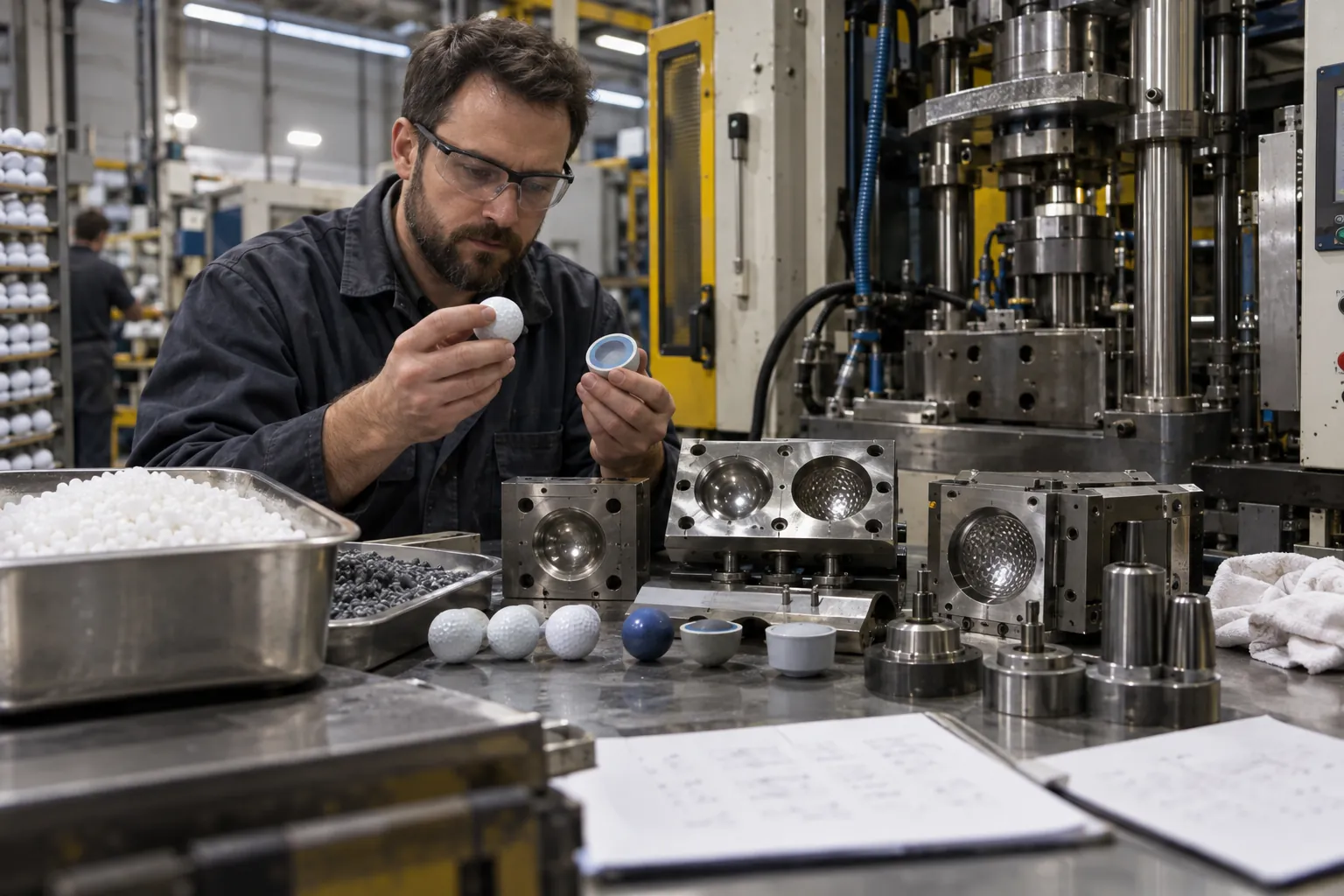
You confirm that the factory uses similar machinery or materials to larger programs. The next sourcing mistake is allowing evidence from one layer to prove another layer that was never verified.
Shared golf ball technology can include equipment, material families, process experience, and generic manufacturing platforms. It does not automatically include another customer’s formulation, tooling rights, manufacturing settings, acceptance window, or validated production version.
Shared infrastructure can be valuable without creating the same golf ball.
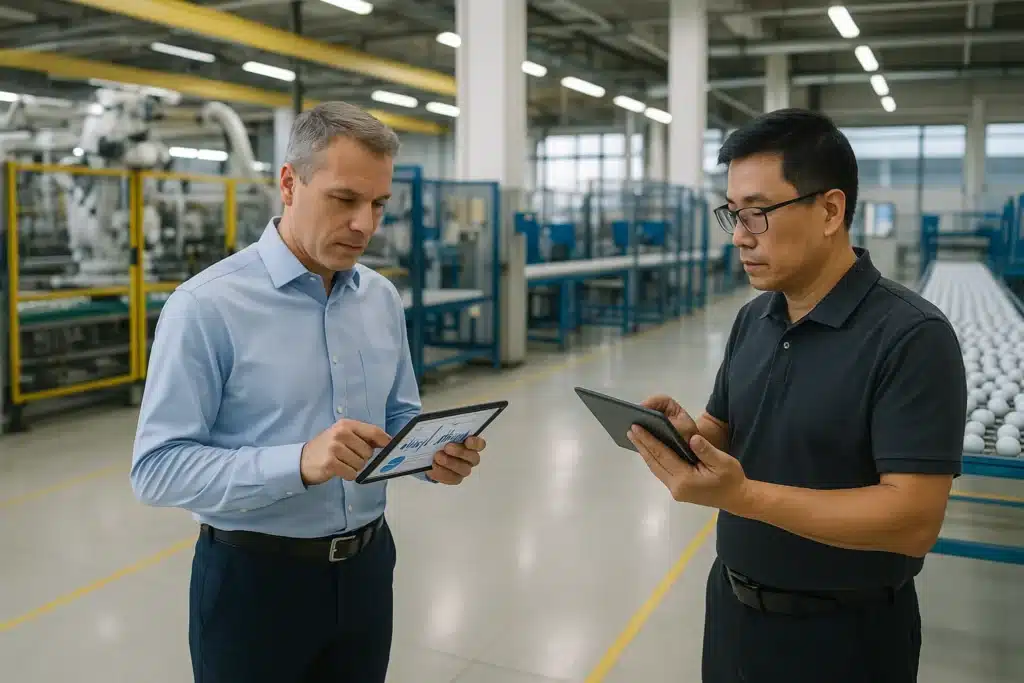
A mature OEM may legitimately give you access to established molding equipment, broad resin families, multilayer manufacturing experience, generic molds, coating processes, and skilled operators.
For many private-label programs, that is enough to create real commercial value.
A value-retail ball, corporate program, range product, or mid-market SKU may not need anyone else’s flagship formula. It needs an appropriate performance window and repeatable production.
| Technology Layer | May Be Shared? | What Remains Unknown | Verification | Buyer Action |
|---|---|---|---|---|
| Equipment family | Yes | Settings / process window | Route record | Verify SKU |
| Material family | Yes | Blend / formulation | Material note | Define spec |
| Construction platform | Yes | Exact layer design | SKU construction | Approve version |
| Urethane family | Yes | TPU vs cast route | Cover route note | Lock route |
| Generic tooling | Sometimes | Use rights / exclusivity | Tool status | Confirm rights |
Material language is an easy place to overreach. Two golf balls can both use a polyurethane-family cover without sharing the same manufacturing route. “Same urethane” does not prove “same technology.”
If that distinction becomes relevant to your sourcing decision, move the material-selection question to the dedicated guide on the TPU vs cast urethane manufacturing route.
The same principle appears in decoration. Two SKUs can use the same printing equipment while differing in artwork version, ink system, surface preparation, coating, curing, and approved print version. Same machine does not mean same production version.
This is where private-label sourcing becomes more productive: define the outcome your channel actually needs instead of asking the supplier to recreate another customer’s identity.
Your Performance Window Brief might define a target compression window, feel, relevant driver or wedge behavior, durability, dispersion, and channel positioning. It should describe what your customer is paying for—not simply say “same as Brand X.”
Ask the supplier to identify the actual construction and manufacturing route used for your SKU, even when the equipment or material family is shared.
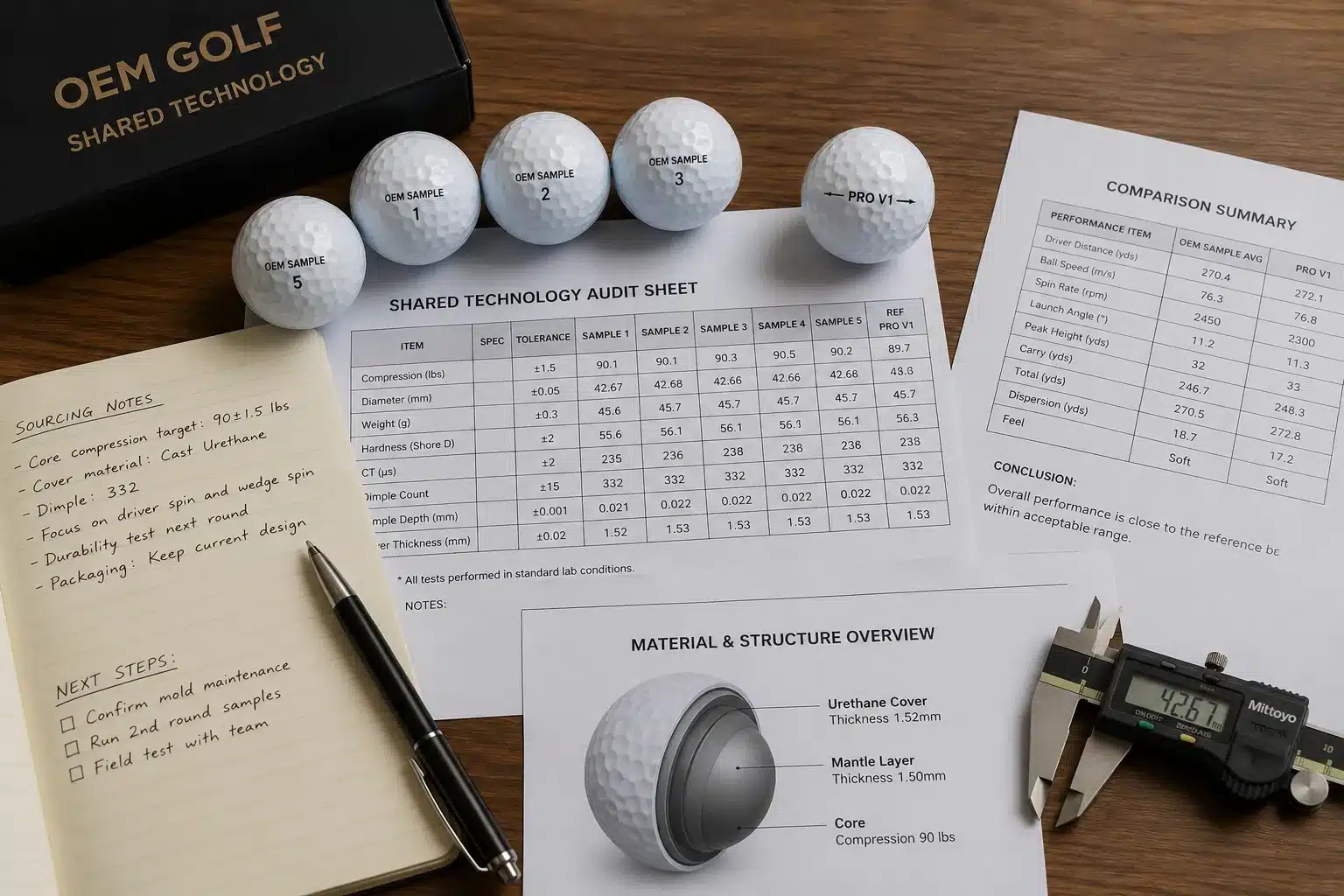
What Usually Stays Customer-Specific?
Finding a mold, formula, process, or technical capability inside a factory does not answer the commercial question that matters: whether your program is entitled to use it.
Access to a factory asset does not mean that asset belongs to your program. Formulations, tooling, process settings, dimple references, release windows, validation records, and artwork may be customer-specific, separately controlled, protected, or simply unavailable to your SKU.
Available in the plant is not automatically available to you.
This is the distinction behind:
Access ≠ Rights
Tooling is a good example. Titleist’s Pro V1 story describes R&D dimple designs being translated by a tooling team into specific hobs and mold cavities. That does not prove every golf-ball tool in every OEM plant is proprietary or unavailable. It does show that tooling can be a distinct product-development layer rather than a generic machine setting.
So if a factory tells you it “has the mold,” your next questions are commercial, not theatrical.
Is the tool generic or dedicated? Who owns it? Is your SKU authorized to use it? Can other customers use it? Can the same tooling be used again on your reorder? What happens if the program moves?
The same logic applies to formulations, process settings, and validation data. Your sourcing team does not need another customer’s confidential recipe. You need a clear statement of what the supplier can legitimately and repeatedly provide to your program.
A generic OEM platform can still be an excellent commercial choice when you know it is generic and its performance fits your product promise. Shared infrastructure does not become inferior simply because it is shared.
Request written Tooling / Use Status for any asset material to your SKU. Record whether it is generic or dedicated, ownership/use status, applicable SKU, change authority, reorder availability, and exit or transfer terms where relevant.
If you need to go beyond this claim and inspect the supplier’s wider processes, use the guide on how to audit the golf ball factory behind the claim.
✔ True — A shared or generic platform can still be commercially valuable.
Many private-label programs need a controlled platform that fits their performance and price position, not exclusive access to another customer’s product identity.
✘ False — “If the factory owns or possesses the tooling, my SKU automatically has unrestricted rights to use it.”
Physical access, ownership, authorized use, exclusivity, and reorder availability are separate sourcing questions. Put the applicable rights in writing.
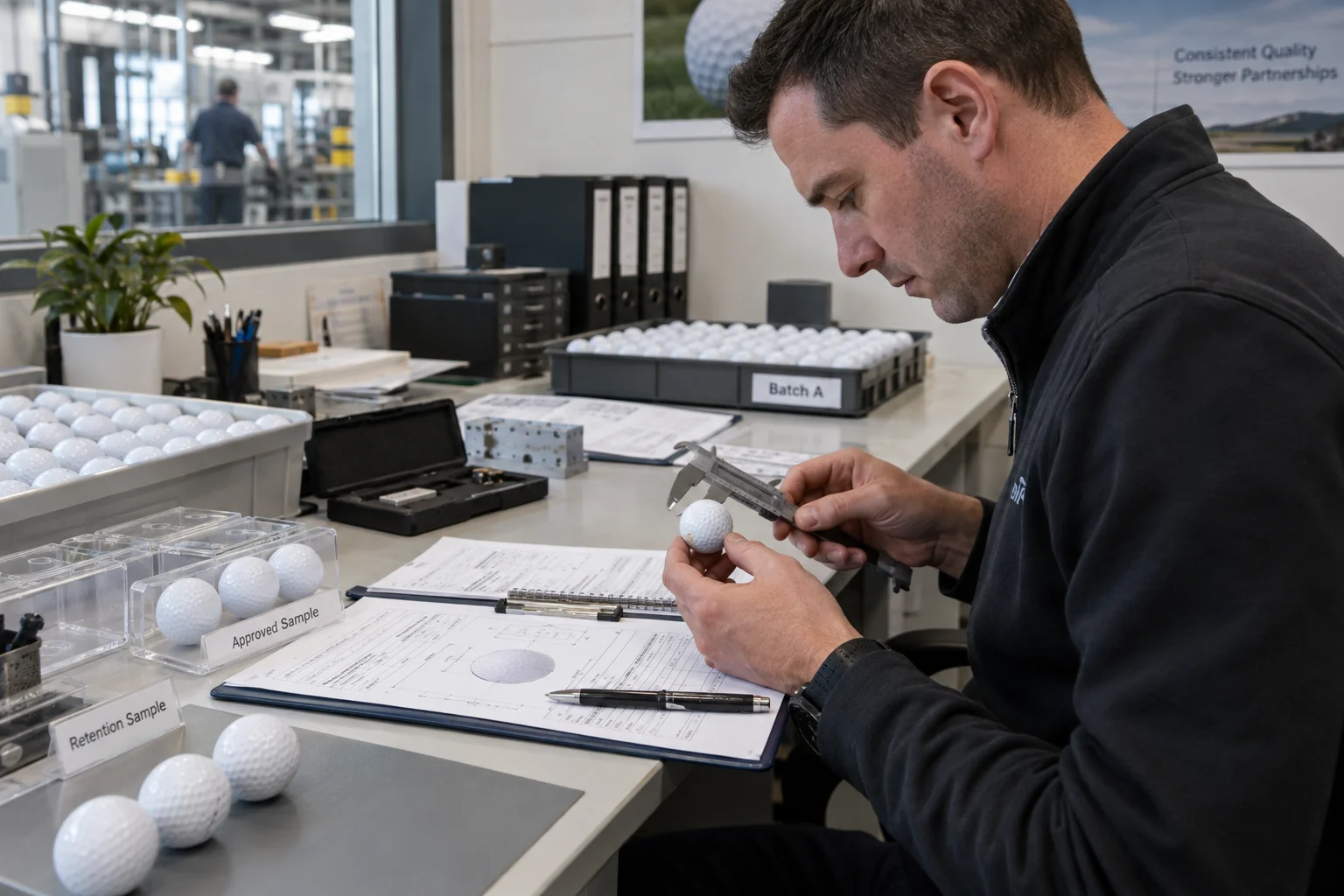
What Evidence Should Test the Claim?
A supplier names a famous customer, forwards another product’s report, or shows you a performance number. The document may be genuine and still prove almost nothing about the SKU you are buying.
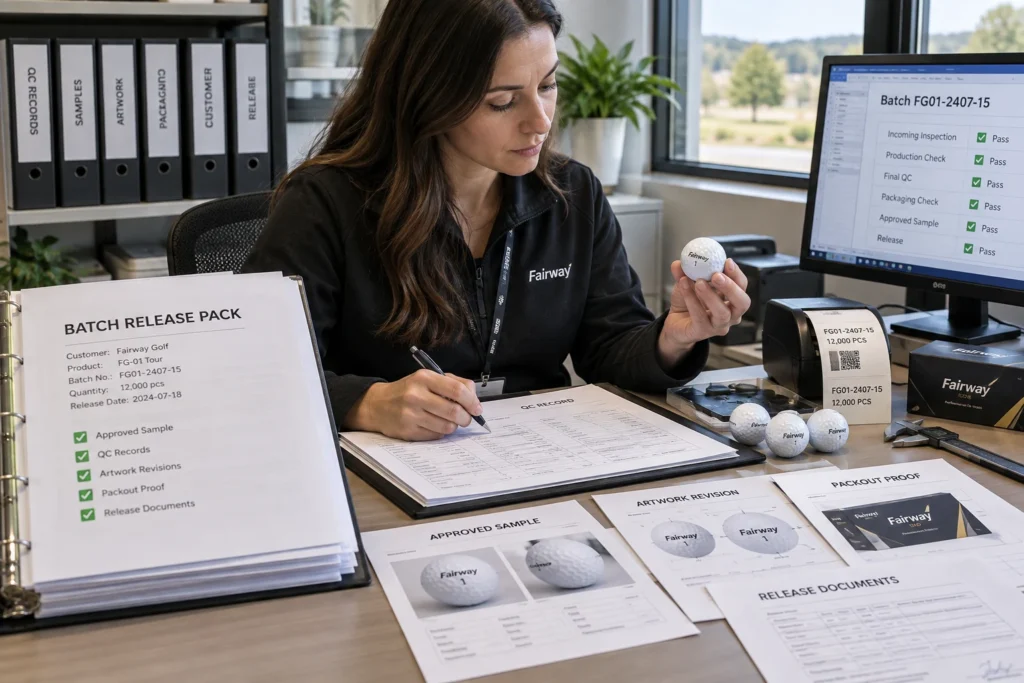
The evidence that matters must belong to your SKU: the declared route, applicable tooling status, approved sample, buyer-agreed measurements, and production or batch reference. Borrowed reputation becomes useful only when it is converted into evidence your own team can verify and approve.
Use a simple claim-to-evidence test.
| Supplier Claim | SKU Evidence | What It Proves | What It Cannot Prove | Buyer Action |
|---|---|---|---|---|
| Same technology | Route + sample | Your route exists | Brand equivalence | Verify result |
| Same tooling | Tool / use status | Applicable access | Exclusive rights | Confirm status |
| Same quality | Agreed critical-to-quality (CTQ) evidence | Your measured window | Permanent capability | Bind to batch |
| Same performance | Same-method comparison | Reference window | Clone identity | Define benchmark |
| Famous-client proof | None by itself | Relevant experience | Your SKU acceptance | Ask own evidence |
This is especially important when a performance number is borrowed from a reference product.
A Japanese buyer once asked us to develop a two-piece ionomer OEM ball against a reference product marketed with a COR of 0.88, and wanted to use 0.88 as the target for the new program. We did not treat that number as directly transferable because the measurement method behind the reference value had not been defined to us.
Separately, we had purchased another overseas two-piece ball marketed at COR 0.85 and measured it at approximately 0.803 under our own defined test setup. That result did not prove the marketed 0.85 figure was wrong. Without equivalent test conditions and measurement methods, the two values could not responsibly be treated as directly comparable.
The sourcing lesson was simple: a performance number from a reference product should not become a PO acceptance target until the measurement method is defined and the benchmark can be reproduced under comparable conditions.
A benchmark claim is not a procurement specification until the measurement method is defined and the reference result can be reproduced.
The same rule applies to a “same factory” claim: borrowed credibility becomes useful only when it can be converted into evidence for your own SKU.
The USGA’s Initial Velocity Test Protocol illustrates why method matters. It defines ball conditioning, impact geometry, target impact speed, rebound measurement, contact time, and the calculation framework in which COR is used. The point here is not a universal standalone COR limit. It is No Method → No Comparable Number.
The same evidence discipline should apply when the sales language changes from “same COR” to “same quality,” “same technology,” or “same performance.”
Another customer’s report can demonstrate supplier experience. It should not become acceptance evidence for your order.
For traceability, your PO can state:
Supplier shall identify which claimed shared-factory elements apply to the quoted SKU, including production route, applicable tooling reference, approved sample ID and production batch. Evidence from another customer or unrelated SKU shall not be used as acceptance evidence.
Use this verification request once in your RFQ:
Please identify the production route, applicable tooling status, approved sample reference and buyer-agreed evidence used to support any same-factory or shared-technology claim for this exact SKU.
A supplier substituting another customer’s reputation or data for evidence generated on your SKU is the second failure signal.
For the broader test plan, sampling logic, and lot-linked records behind those results, use the guide on how to verify golf ball QC with batch-linked evidence.
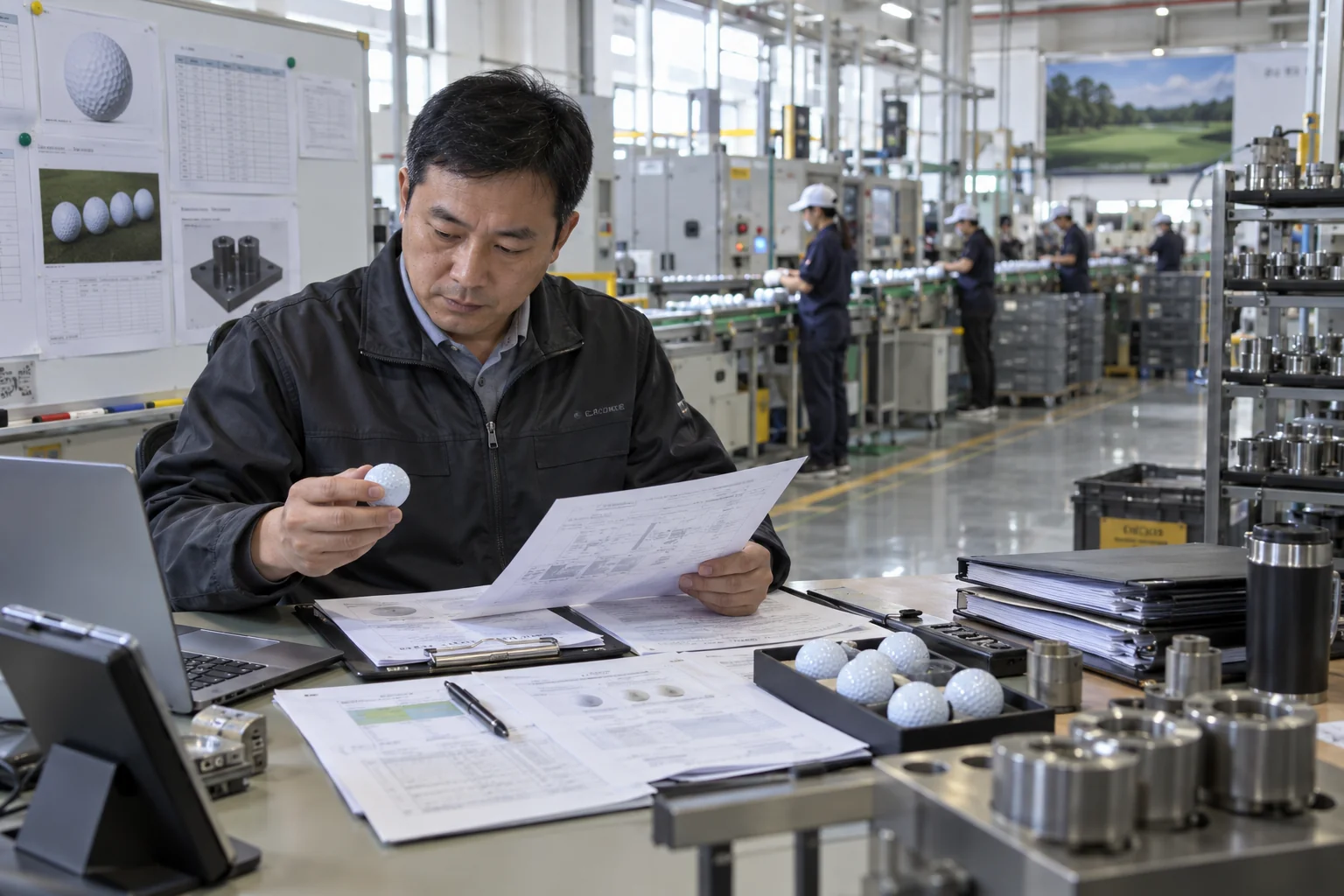
You prove that the plant has the equipment, route, and experience. One risk still remains: assuming technical capability guarantees your program equal production access later.
A capable shared factory may still treat different programs differently when capacity tightens. Confirm the production path, expected access, engineering support, and change-notification process for your SKU so technical capability does not become a scheduling assumption.
Same factory does not automatically mean same production priority.
Technical access and commercial production access are different variables.
A supplier may be capable of making your approved ball while a larger program receives different tooling availability, engineering attention, scheduling protection, or change-management support. That does not automatically make the supplier unreliable. It means your production access should be defined independently of its famous-customer history.
Ask which route your volume order will use. Confirm that the applicable tooling remains available. Clarify how material, site, line, cover-route, or externally provided process changes will be communicated before a reorder.
Most importantly:
A same-factory claim has an expiry condition.
If the approved program later changes its production site, line, tooling, cover route, key material family, or relevant external process, the old shared-tech claim may no longer describe the product you are buying.
Changed production path → Revalidate the claim.
This does not mean every machine adjustment requires a full supplier audit. It means materially changed production conditions should not inherit old credibility automatically.
A production route that changes while the old same-factory story remains untouched is the third failure signal.
For proof and version control, your PO can state:
Supplier shall notify the buyer before any change to the production site, applicable tooling, cover route, material family or production path used for the approved SKU, and shall provide buyer-agreed revalidation evidence before the changed version is released.
Once the famous-brand relationship is stripped away, the next question is straightforward: can this supplier actually execute your product? Use the dedicated framework to verify the factory’s exact golf ball manufacturing capability.
✔ True — Technical capability and commercial production access are separate sourcing variables.
The factory may possess the right technology while your program still needs a defined production path, applicable tooling access, change notification, and continuity at reorder.
✘ False — “Once the factory proves capability, my future orders permanently inherit the same access.”
Production sites, routes, tools, materials, providers, and capacity conditions can change. Revalidate the parts of the claim your next order still relies on.
FAQ
Are OEM Golf Balls Made in the Same Factories as Big Brands?
Sometimes. An OEM supplier may share a manufacturing site, equipment, operators, or supply-chain resources with larger programs, but that relationship does not prove identical finished golf balls.
Ask what “same factory” specifically means. A legitimate shared manufacturing relationship can be useful evidence of experience, but approve your SKU from its own route, tooling/use status, sample, measurements, and production reference rather than another customer’s identity.
Does the Same Factory Mean the Same Golf Ball?
No. Two golf balls can come from the same plant while using different formulations, construction details, tooling, settings, coatings, inspection criteria, and production versions.
Treat the relationship as background evidence, not product equivalence. The procurement question is whether the exact production path and measurable window promised for your SKU have been documented and verified.
Can an OEM Use the Same Materials as a Major Brand?
Yes, an OEM may use the same or similar material families, but that does not establish the same formulation, manufacturing route, processing conditions, or finished-ball performance.
Specify your own material and process requirement. If “urethane” is used as evidence of shared technology, confirm the actual manufacturing route rather than inferring it from the material-family name.
Should You Ask Which Big Brands a Factory Makes For?
You can ask, but a famous client name is weak SKU evidence and may legitimately be protected by an NDA. A supplier declining to reveal confidential customers is not automatically a warning sign.
Ask for non-confidential proof you can actually approve: declared production route, tooling/use status, approved sample, relevant process records, and measurements generated for your own program.
Can a Private-Label Ball Match a Branded Performance Window?
Yes. A private-label ball can target a branded reference window without claiming to be the same product, provided the relevant outcomes are defined and compared under suitable, consistent conditions.
Benchmark what your customer cares about, use comparable methods, and approve the resulting window on your own production version. “Comparable performance against this defined reference” is much more defensible than “same as Pro V1.”
Does a Shared Mold Mean Your Golf Ball Is Exclusive?
Not necessarily. A mold being present in the factory does not tell you whether it is generic, dedicated, buyer-owned, supplier-owned, restricted, or available to multiple programs.
Confirm tooling/use status in writing. Where exclusivity matters, document authorized use, applicable SKU, change approval, reorder availability, and exit or transfer terms. Access to a mold and rights to that mold are separate commercial facts.
Conclusion
A same-factory claim can be a useful signal of industrial experience. It is not a finished-product specification and should never replace evidence generated for your own SKU.
Keep the sourcing distinctions clear: Same Factory ≠ Same Ball. Shared Platform ≠ Shared Product. Access ≠ Rights. Reference Performance ≠ Clone. Capability ≠ Equal Priority. The value of the claim is whatever route, tooling access, measurable performance, and repeatable evidence the supplier can legitimately provide for your program.
You might also like — What Can a China Golf Ball OEM Factory Actually Build?