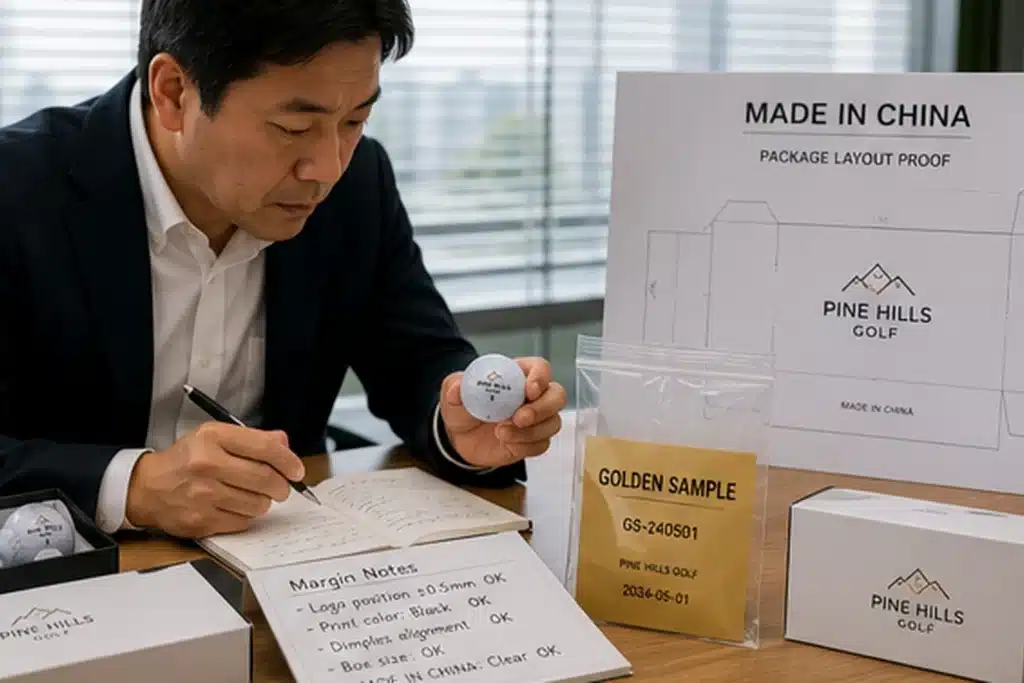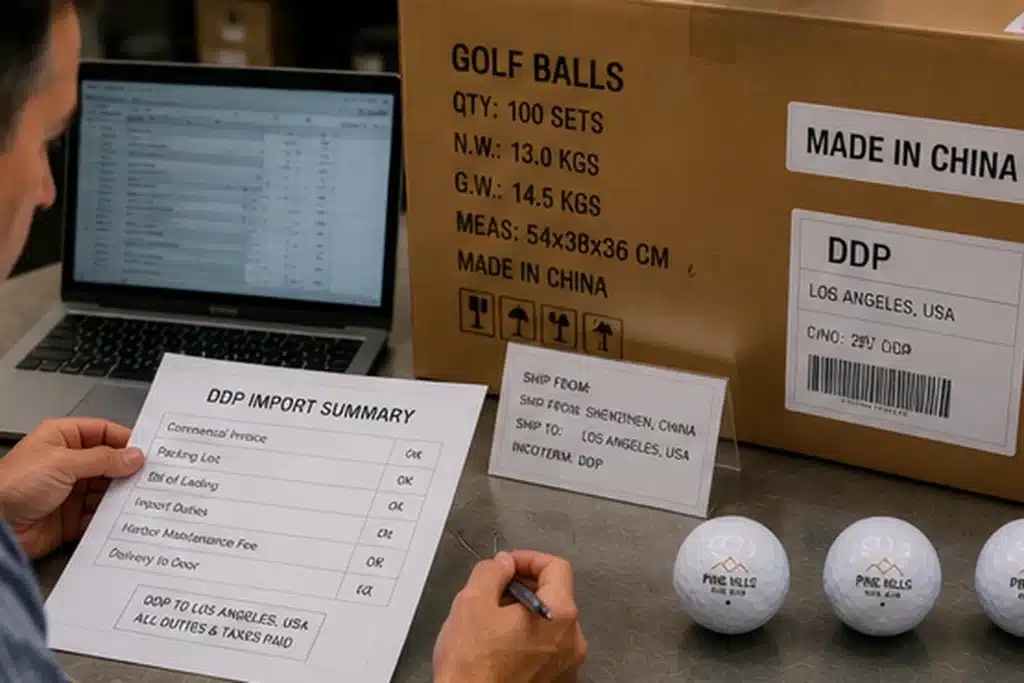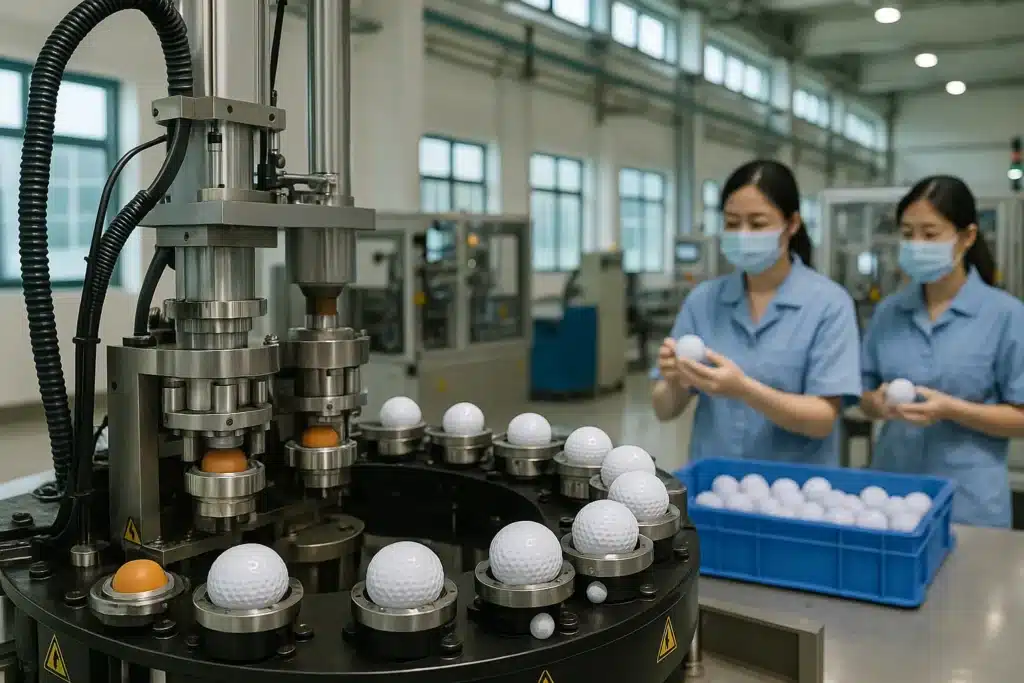
The country label does not make a golf ball premium. The process window does.
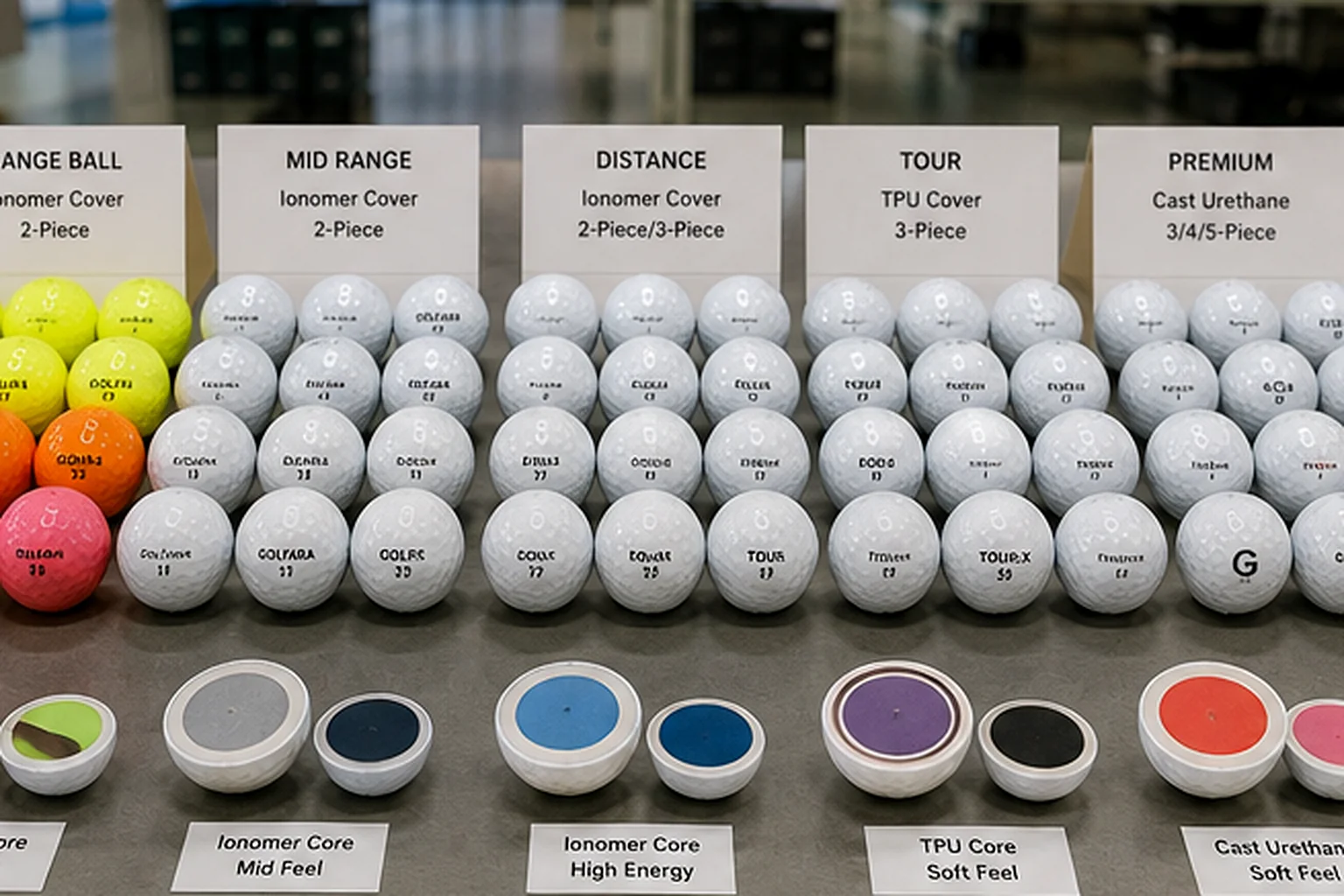
Golf balls manufactured in China include 1–2-piece ionomer range balls, 2-piece logo and practice balls, 2–3-piece game balls, 3-piece TPU retail balls, and selected 3-to-5-piece cast thermoset urethane OEM builds. China is not limited to budget Surlyn-style balls, but not every factory can produce premium cast urethane either.
For OEM buyers, the safer question is not “Is it Made in China?” It is which cover process, layer construction, concentricity control, compression stability, and batch-level proof the factory can show. A good China-made golf ball is proven by process data, not by country perception or a perfect sample sleeve.
China’s strongest volume categories are 2-piece ionomer, range, practice, logo, and private-label value balls. Its higher technical ceiling includes 3-piece TPU programs and selected 3-to-5-piece cast urethane builds for premium retail or advanced development SKUs. Before scaling, judge three files: the origin file, the process file, and the batch-quality file.
Are known golf brands made in China?
You may worry that a Made in China label makes your brand look low-end, especially if your target channel sells premium urethane or DTC retail balls.
Made in China does not automatically mean low-end. For golf balls, origin can change by batch, color, revision, and capacity plan. Your safer decision is to verify the exact batch and process data, not judge quality by country label alone.
Some well-known retail and DTC golf balls have had China-made generations or batches. Kirkland Signature Performance+ is the cleanest buyer lesson because reported sourcing has shifted by generation: earlier injected-urethane versions were reported as China-made, while later production has also been linked to Vietnam. That does not prove “Kirkland is always made in China.” It proves something more useful: serious retail programs qualify production by generation, recipe, capacity, cost target, and supply-chain risk.
Brand buyers are becoming origin-pragmatic. A country label may matter for customer perception, but it is not a quality metric by itself. Origin is batch-specific; performance is process-specific.
How do batches change origin claims?
A model can shift by generation, color, revision, or production window. That is why your team should verify the current batch instead of relying on a permanent origin story.
The clean origin file includes the box origin label, Certificate of Origin, shipping documents, batch code, model revision, and retained sample. Keep those records with the PO and QC file so later complaints can be traced to the exact production run, not a vague country assumption.
A supplier that treats Made in China as one fixed quality level is showing a failure signal. It may be trying to sell against bias, but serious buyers need batch proof. Ask the supplier to identify model revision, country-of-origin record, approved sample ID, cover process, construction version, batch number, and retained sample plan before pilot approval. Any material, cover-process, dimple, coating, label, or production-line change should require written buyer approval.
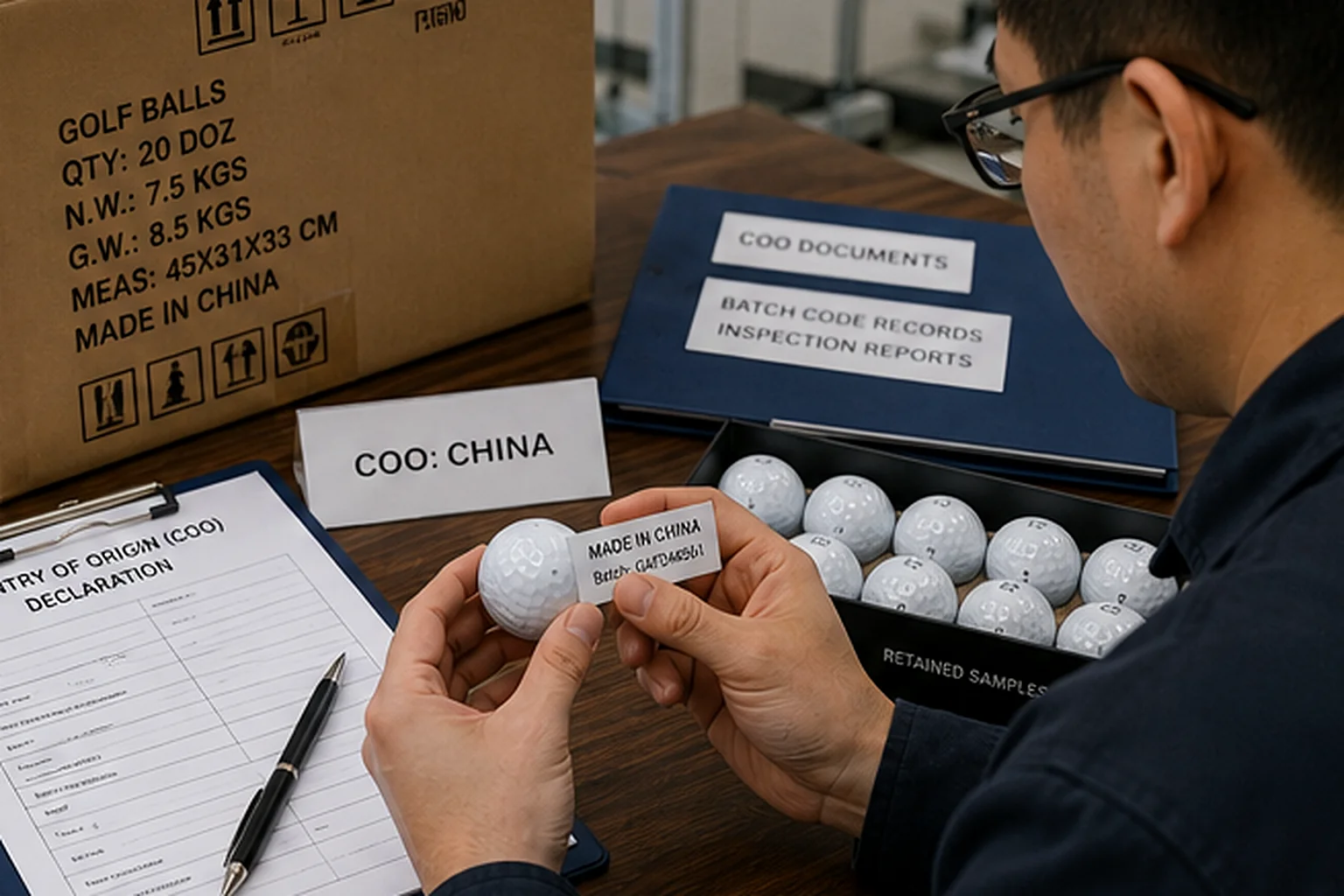
✔ True — Origin is batch-specific; performance is process-specific.
A China origin label tells you where that batch was made. It does not prove or disprove cover control, concentricity, compression stability, or retail performance.
✘ False — “A China origin label makes a golf ball low quality.”
Country is not a substitute for engineering data. Verify the batch, the process, and the QC file before accepting or rejecting a program.
What can China factories actually build?
You may assume China only makes 2-piece Surlyn or range balls, or you may overcorrect and assume every Chinese factory can make tour-grade cast urethane.
China can manufacture more than budget 2-piece golf balls, but capability is factory-specific. The practical range runs from 2-piece ionomer volume balls to 3-piece TPU retail balls and selected 3-to-5-piece cast thermoset urethane builds.
The volume base is still 2-piece ionomer. That is where China’s supply chain is especially efficient: durable covers, high-volume printing, range and practice programs, corporate logo balls, and private-label value SKUs. These balls may not sound glamorous, but they are commercially important because consistency, packaging, and delivery matter more than wedge-spin theater.
The next layer is 3-piece TPU. This is often the DTC and value-urethane sweet spot: a more premium story than basic ionomer, with a scalable process and a cleaner cost structure than cast thermoset urethane. For many mid-market brands, TPU is not a downgrade. It is the correct margin-performance decision.
Selected factories can support 3-to-5-piece cast thermoset urethane, but treat that as the technical ceiling, not the default baseline. A 5-piece claim should be handled as verified line capability only.
| Category | Typical construction | Cover process | Buyer use | Proof to request |
|---|---|---|---|---|
| Range | 1–2-piece | Ionomer / Surlyn® | Practice, range, promo | Durability, weight, diameter, print test |
| Game | 2–3-piece | Ionomer or TPU | DTC, retail, logo resale | Compression window, coating, batch QC |
| DTC sweet spot | 3-piece | TPU injection / compression | Value urethane programs | Cover process, hardness, spin proxy |
| Premium | 3–4-piece | Cast thermoset urethane | High-spin retail | Cpk, cover thickness, X-ray/CT |
| Tour ceiling | 4–5-piece | Cast thermoset urethane | Advanced development SKU | Verified line only: SPC, concentricity, pilot-lot repeatability |
Why is urethane not one process?
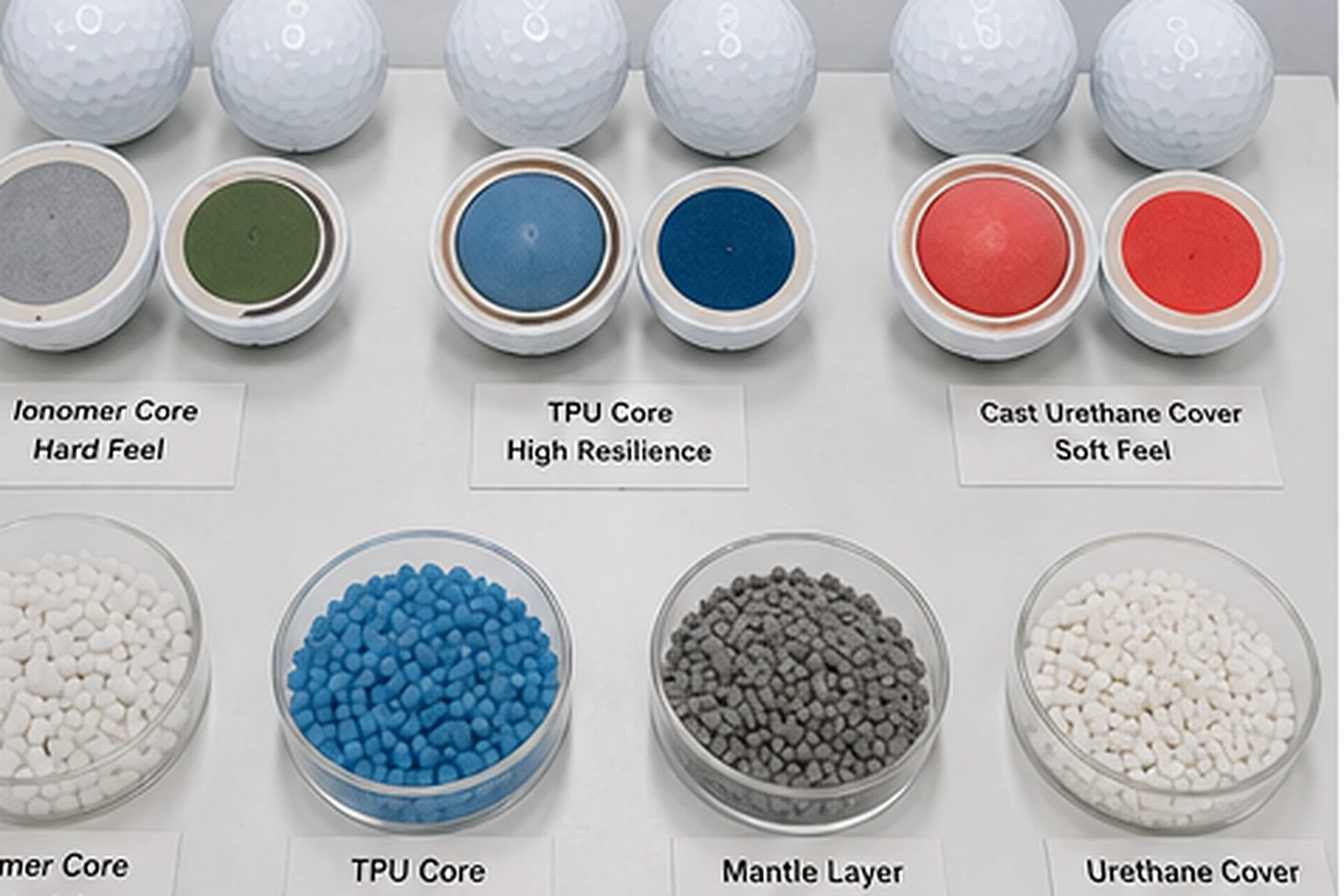
The word “urethane” is incomplete until the factory states the process. TPU injection, TPU compression, and cast thermoset urethane are not the same manufacturing route.
TPU is thermoplastic. It can be melted, molded, and processed efficiently, which helps yield, cost, and scalability. Cast thermoset urethane is different: liquid materials react inside the mold through a controlled curing process, and once cured, the cover does not simply re-melt like TPU. This is why a China cast urethane golf ball factory must prove more than a sales label.
Supplier says “urethane” but cannot say TPU or cast thermoset is the second failure signal. Ask for construction capability by layer count, cover process, finish, MOQ band, and recent production evidence. Treat 3-to-5-piece cast urethane as verified line capability, not China-wide capability.
✔ True — China can build across the golf ball spectrum.
The range covers 2-piece ionomer volume balls, 3-piece TPU retail programs, and selected cast urethane multilayer builds. The audit must still match the exact factory line.
✘ False — “China can only produce 2-piece range balls.”
That belief is outdated. The better question is whether the chosen supplier can prove the exact construction you plan to sell.
How do you prove quality beyond origin?
You may hear a factory say Pro V1 level, tour grade, or premium urethane, but those words do not prove repeatability.
The right question is not whether a ball is China-made; it is whether the factory can prove repeatability. Ask for pilot-lot Cpk, SPC charts, X-ray/CT concentricity, cover-thickness data, and compression sigma before scaling.
Made in China is a process, not a spec. So is Made in USA, Made in Vietnam, or Made in Taiwan. A golf ball made in any country can fly poorly if the core is off-center, the cover thickness drifts, the compression spread is too wide, or the coating process is unstable. Country does not prevent an off-center ball. Process control does.
Use engineering evidence instead of adjectives. Cpk ≥1.33 can be a strong process-capability target for a buyer-side audit, especially when tied to the right CTQ items. Compression sigma ≤2 on the same calibrated gauge can help flag feel and distance spread. Weight and diameter distribution, X-ray/CT concentricity, cover-thickness histograms, Shore hardness, and retained samples give your team a real picture of line control.
| Claim to test | Engineering proof | Why it matters | Buyer action |
|---|---|---|---|
| Tour-level feel | Compression mean + sigma | Checks feel spread | Request same-gauge raw data |
| Straight flight | X-ray/CT concentricity | Checks core/layer offset | Ask for images/report |
| Premium cover | Cover thickness histogram | Checks cover control | Compare pilot and bulk |
| Stable process | Cpk / SPC chart | Checks repeatability | Ask for pilot-lot data |
| Legal build | Current model-level list if needed | Checks rule eligibility | Verify exact model string |
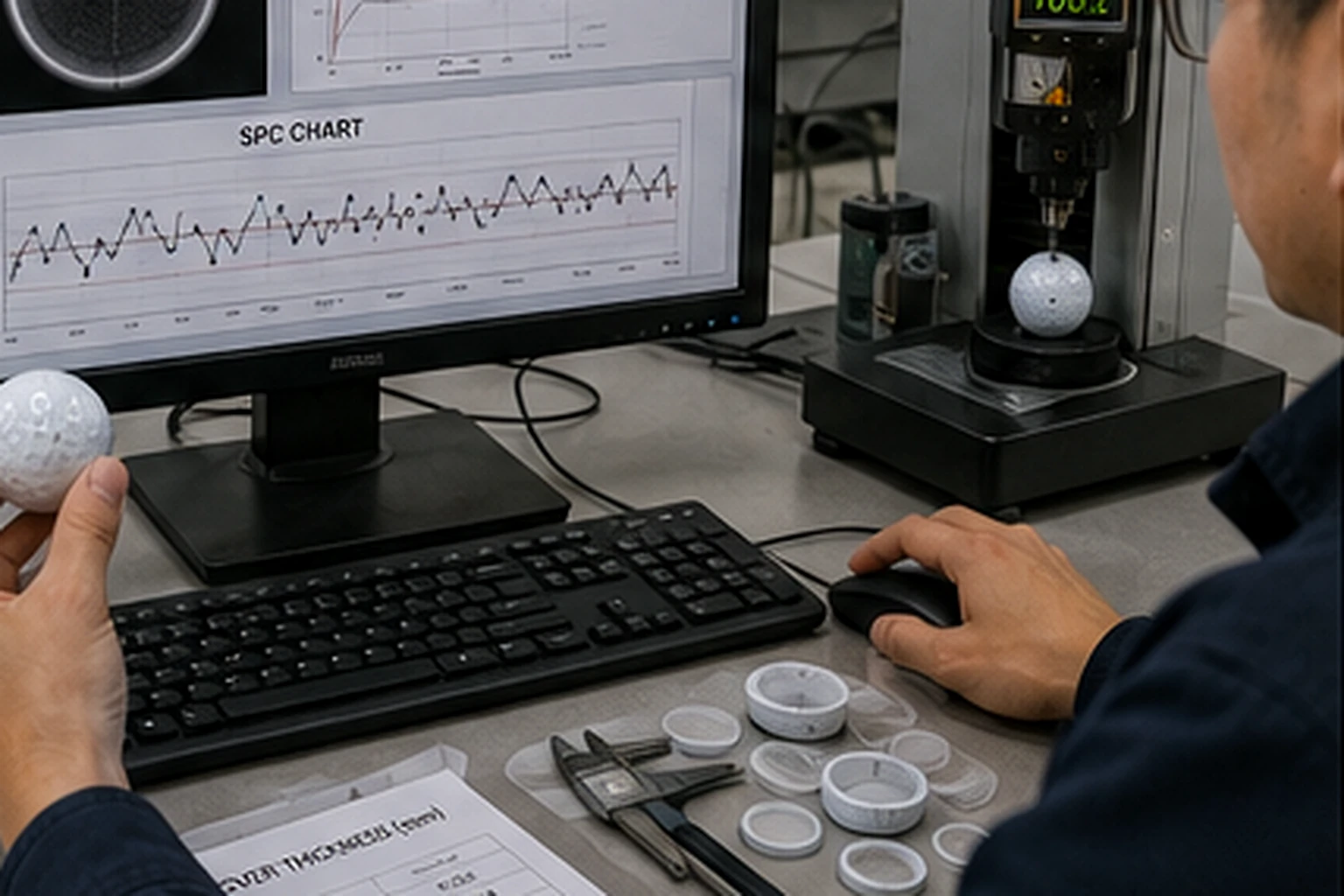
Which metrics expose fake tour claims?
A fake tour claim usually collapses when you ask for batch-linked data. “Pro V1-level” is not a spec; Cpk, SPC, X-ray, cover thickness, and compression spread are closer to proof.
Ask the factory to state whether the cover is TPU injection, TPU compression, or cast thermoset urethane, then provide pilot-lot Cpk, SPC chart, X-ray/CT concentricity evidence, cover-thickness data, and compression sigma from the same batch.
A supplier claiming tour grade with no X-ray/CT or Cpk data is the third failure signal. For higher-end programs, pilot-lot acceptance should include raw values and statistics for weight, diameter, compression, cover thickness, hardness, and concentricity, with method, sample ID, batch link, equipment ID, and calibration date.
Model-level legality still matters when your channel needs it, but do not confuse rules eligibility with manufacturing stability. A current conforming model string helps with regulated play. It does not replace batch QC, retained samples, or process-control evidence.
How does China compare on value?
You may need to justify China against Vietnam, Taiwan, Thailand, Japan, or the USA without turning the decision into a country-ranking contest.
China’s strongest advantage is cost-to-performance at export scale, especially when the project combines balls, printing, packaging, and private-label kitting. Compare countries by the same construction and proof requirements, not by country reputation alone.
For OEM buyers, the comparison only works when the same variables are held constant: construction, cover process, tolerance, finish, print method, packaging, MOQ, QC deliverables, and delivery term. Comparing a China TPU price against a Taiwan cast urethane quote is not analysis. It is apples-to-range-balls math.
China is often strong in 2-piece ionomer, range/practice balls, 3-piece TPU retail programs, custom logo balls, and private-label kits where printing and packaging matter. Taiwan, Thailand, Vietnam, Japan, and the USA may fit different brand, process, or consistency needs depending on the construction and sales channel.
| Buyer decision | China fit | Alternative fit | Risk to avoid | Buyer action |
|---|---|---|---|---|
| 2-piece value ball | Strong cost and volume | Vietnam / Thailand possible | Only comparing unit price | Compare landed set cost |
| 3-piece TPU retail | Strong value-to-mid fit | Taiwan / Vietnam possible | Generic urethane wording | Lock cover process |
| Cast urethane premium | Selected factories only | Taiwan / Thailand often considered | Overclaiming tour grade | Ask engineering proof |
| Private-label kits | Strong packaging ecosystem | Region varies | CBM and kitting delays | Quote packaging together |
| Brand-risk diversification | Useful as one base | Multi-country backup | Single-source dependency | Qualify backup line |
Engineering-led buyers prefer process proof over country stereotypes. Use China for validated export-scale capability and process-specific fit, not blanket dominance claims. If China wins the same-spec comparison, document why. If another country fits a premium line better, qualify it honestly.
✔ True — Cost-to-performance only works under the same spec.
Construction, cover process, packaging, MOQ, tolerance, and QC proof must match before country comparisons mean anything.
✘ False — “The cheapest country is automatically the best source.”
A cheaper quote can hide a different cover process, weaker tolerance, simpler packaging, or missing batch evidence.
What should buyers verify before scaling?
You may have a good sample and a credible China-made product, but scaling without origin, process, and batch control can create disputes.
Before scaling a China-made golf ball, verify three files: origin file, process file, and batch-quality file. The box label tells you where the batch came from; the RFQ/PO tells you what process was ordered; the QC file tells you whether production repeated.
The origin file should include box label, COO, shipping documents, batch code, model revision, and retained samples. This prevents a future debate about whether the batch your customer received matches the batch your team approved.
The process file should lock construction, cover process, dimple tool, coating, label, and production line. For urethane projects, it should state TPU injection, TPU compression, or cast thermoset urethane. “Urethane” alone is not a process file.
The batch-quality file should include the Engineering Metrics Pack: weight, diameter, compression, cover thickness, hardness, concentricity, method, equipment ID, calibration date, sample ID, batch link, and retained sample location.
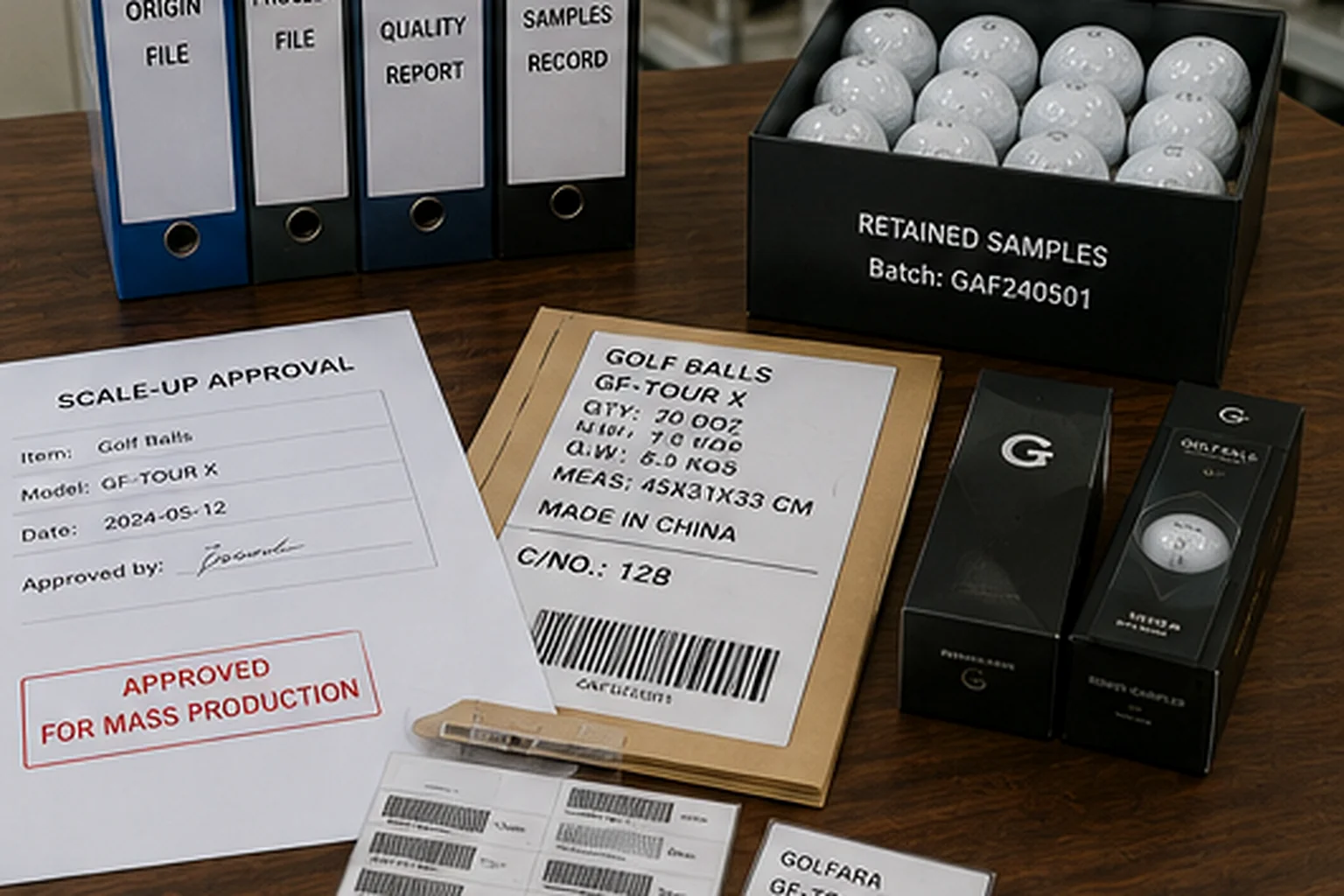
A good pilot sample is not enough to scale. Scaling requires origin proof, process lock, and batch-linked QC. Verify model-level legality only when competition or regulated retail use requires it, then connect that file to the exact model string and production batch. Do not use a conforming list as a hidden OEM address database.
For a China OEM route, ask the supplier for these three files before volume approval. Scale only when origin, process, and batch-quality records match the approved sample and your buyer channel.
FAQ
Are any professional tour golf balls made in China?
Some China OEM lines can support tour or near-tour constructions, but you should not accept that claim without process and batch evidence. Ask for cast thermoset urethane proof, Cpk, X-ray/CT concentricity, cover-thickness data, and compression stability.
- Separate TPU injection from cast thermoset urethane.
- Ask for pilot-lot engineering data.
- Do not scale from a single perfect sample.
Are Kirkland golf balls manufactured in China?
Some Kirkland Signature Performance+ generations or batches have been reported as China-made, while later production has also been linked to Vietnam. The safe answer is batch-specific: check the current box, model revision, and COO.
- Do not assume one permanent origin.
- Track generation, color, and packaging label.
- Use Kirkland as proof of batch flexibility, not China-only sourcing.
What is the difference between TPU and cast urethane?
TPU is thermoplastic and can be injection- or compression-molded from pelletized material. Cast thermoset urethane forms through chemical reaction inside the mold and does not re-melt after curing.
- TPU often fits value-to-mid programs.
- Cast urethane fits premium spin and feel when the factory can control the process.
- Write the exact process in the RFQ and PO.
Can Chinese OEM factories make 4-piece balls?
Yes, selected Chinese OEM factories can produce 4-piece golf balls, but the claim must be verified by line capability, layer alignment, compression distribution, cover-process proof, and pilot-lot repeatability.
- Ask for cutaway or construction evidence.
- Use X-ray/CT or OOR checks for higher-value builds.
- Expect higher MOQ and stricter QC needs.
Can Chinese OEM factories make 5-piece balls?
Some advanced suppliers may support 5-piece development, but this is not a commodity China-wide capability. Treat it as a high-complexity project requiring SPC, Cpk, concentricity data, and tight process control.
- Ask whether the factory has run the construction before.
- Verify mantle alignment and cover thickness.
- Use pilot-lot data before marketing the SKU.
Are China-made golf balls USGA conforming?
They can be, because conformance is model-based rather than country-based. Verify the exact model on the current Conforming Ball List when competition or regulated retail use requires it.
- Check the exact model string.
- Do not infer hidden OEM factory address from the list.
- Pair the list with COO and batch QC records.
What golf balls are most commonly made in China?
China is especially strong in 2-piece ionomer, range/practice, logo balls, private-label value balls, 3-piece TPU programs, and selected multilayer urethane projects.
- Match construction to channel.
- Use TPU for many value urethane programs.
- Audit cast urethane separately.
How do I verify a China factory’s tour-level claim?
Ask for data rather than adjectives. A serious claim should be backed by cover-process declaration, Cpk or SPC evidence, X-ray/CT concentricity, cover-thickness data, compression sigma, and retained pilot samples.
- Do not rely on Pro V1-level wording.
- Request pilot-lot and recent mass-run evidence.
- Link every report to batch and sample ID.
Conclusion
China can manufacture a broad range of golf balls, from value ionomer range balls to 3-piece TPU retail programs and selected premium multilayer cast urethane builds. The correct buyer question is not “Is China good enough?” It is “Can this factory prove the exact process and repeat it by batch?”
Judge the supplier by three files: origin file, process file, and batch-quality file. The origin file proves where the batch came from. The process file proves what was ordered. The batch-quality file proves whether production repeated the approved sample.
You might also like — USGA Conforming Golf Balls: 2026 Compliance Costs in China OEM