A custom golf ball logo can be approved and still start peeling, rubbing off, smearing, or fading in use—turning a print issue into a customer complaint, return risk, or repeat-order risk.
A golf ball logo can wear off when the finished print system has not been validated for the ball surface and real-use stress. Possible failure layers include surface condition, ink compatibility, preparation, curing, protective build, or production drift; identify the symptom and use case before changing the production print route.
The expensive mistake is accepting “normal wear” or a durability claim before anyone defines the test and approved sample. Start with one question: What changed between the approved printed sample and the ball that failed?
Symptom → Failure Layer → Use Case → Relevant Test → Production Match → Re-release
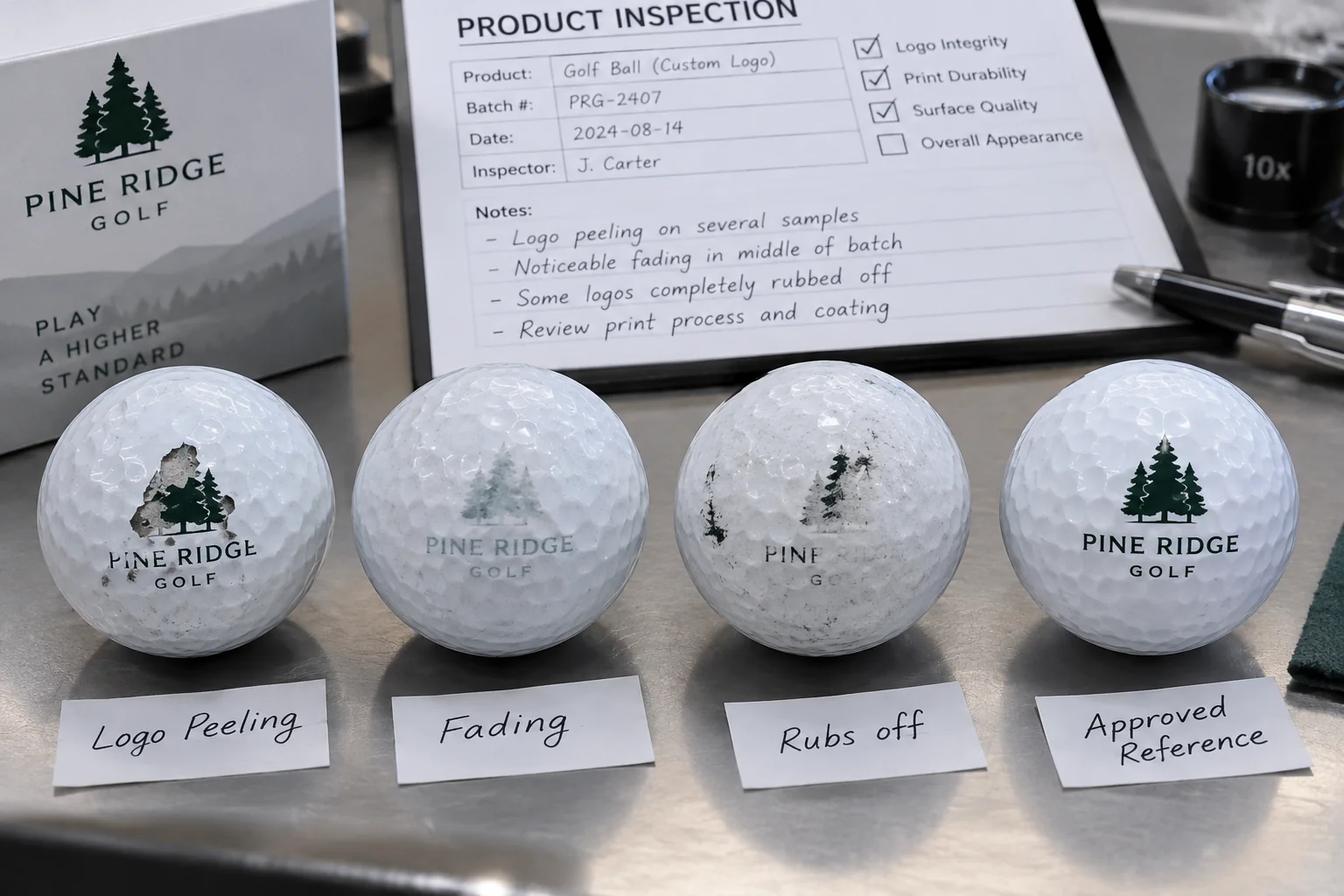
Why Is Your Golf Ball Logo Wearing Off?
A logo starts peeling or fading, and the first question is often, “Was it Pad printing or UV printing?” That can send the investigation toward the wrong variable.
If your golf ball logo is peeling, rubbing off, or fading, diagnose the symptom before the printing-method label. Possible failure layers include surface condition, ink compatibility, curing, protective build, use-case stress, and process drift, so visible damage should guide the investigation rather than predetermine the root cause.
| Symptom | Possible failure layer | Evidence to request | Do not assume | Buyer action |
|---|---|---|---|---|
| Peeling / flaking | Bonding / prep / compatibility | Failed ball + approved sample | One cause is proven | Hold release |
| Smearing | Ink / cure / process | Rub / wipe comparison | Method itself is wrong | Review process |
| Scratching | Abrasion / protection | Before / after images | More coating fixes all | Review full system |
| Fading | Wear / exposure / cleaning | Use-case history | One fixed lifespan | Identify stress |
| Bulk ≠ sample | Version / process drift | Sample ID + lot link | Sample still represents bulk | Hold lot |
The same visible failure can point to several possible causes. Smearing may justify investigation of ink or cure conditions without proving under-curing. Scratching may involve abrasion, protective build, or a use environment that was never represented during approval. Fading may reflect cleaning, impact, handling, exposure, or a combination of stresses.
Method names are not durability grades. Both Pad and UV-related systems can fail if the complete printed system is poorly controlled.
A universal “X hits,” “X washes,” or “X months” claim with no defined use case is a failure signal. A durability number only becomes useful when you know what was tested, on which ball, under which method, and against what acceptance condition.
Normal Wear or Premature Failure?
Do not invent a universal number of rounds, impacts, or washer cycles that separates normal wear from a defect.
Ask instead:
Is this wear consistent with the buyer-agreed use case, or is the logo failing earlier, more severely, or less consistently than the approved expectation?
Retain the failed ball where possible, record the customer’s actual use and cleaning history, and compare it with the approved reference before changing the process.
✔ True — Start with the observed failure and the conditions that produced it.
The failed ball, use history, and approved reference provide a stronger investigation starting point than a printing-method label alone.
✘ False — “If the logo wears off, the printing method must be wrong.”
The visible failure may involve bonding, surface condition, curing, protection, use stress, or a production-version change.

Which Part of the Print System Failed?
A peeling logo tells you something failed. It does not tell you whether the problem began with the surface, ink, cure, protection, or a later production change.
A peeling logo does not identify one failed printing method. Trace the complete printed-surface system—final cover or coating, preparation, ink, curing, and protective build—then test the suspected failure layer on a corrective physical sample instead of treating appearance alone as root-cause proof.
Our production experience treats those variables as connected. Surface contamination or release-related residue can be a plausible adhesion risk, which is why preparation may matter before printing. In relevant production, we match the ink system and coating or clear-coat system to the actual ball surface and process rather than treating ink as an isolated purchase.
Marabu’s golf-ball printing guidance likewise frames print performance around inks working on demanding plastics and coatings with controlled processing, adhesion, abrasion resistance, and mechanical resistance.
That gives you a more useful investigation than simply asking, “Was it Pad or UV?”
A photo can reveal a failure pattern, but it cannot prove the complete production history, so we treat customer images as a hypothesis rather than a confirmed root cause.
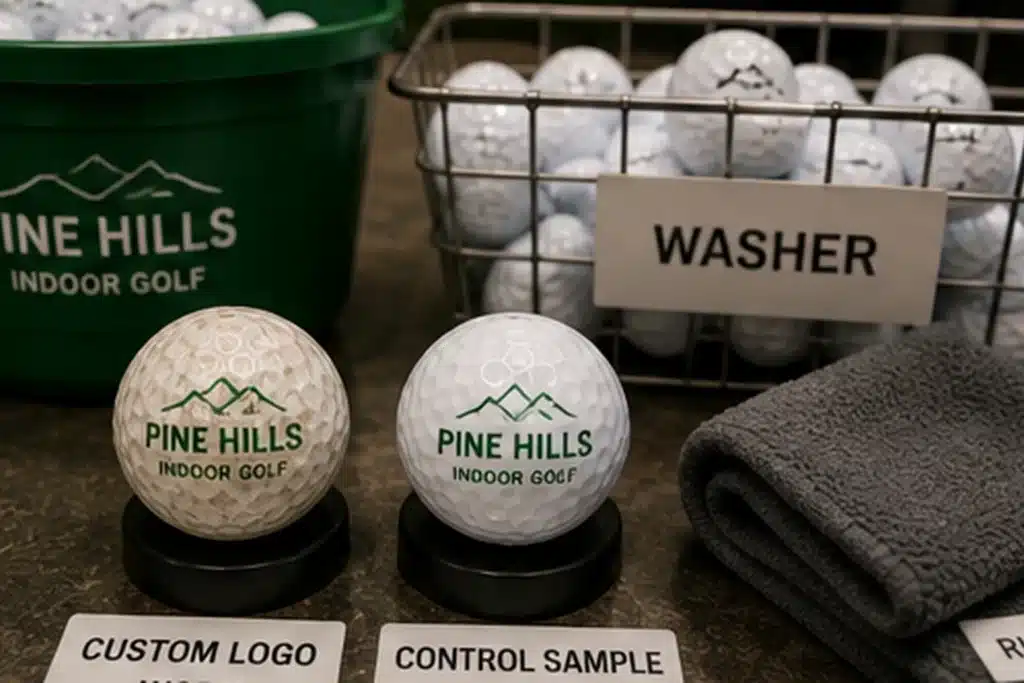
A Canadian indoor-golf customer came to us after logos on a previous supplier’s two-piece Surlyn balls began peeling after roughly ten rounds of customer-reported field use. From his high-resolution photos, our preliminary—not final—diagnosis pointed to two plausible gaps: the marking appeared insufficiently protected within the finished coating system, while weak bonding to the finished surface also remained possible. For our corrective sample, we used controlled surface preparation and incorporated the marking into the validated coating sequence used for that project before its final protective clear coat. The customer approved the revised physical sample and has continued placing repeat orders.
The problem could not be solved responsibly by declaring one printing method “better.” We had to trace the surface condition, marking, bonding, cure, and protection as one system before the revised sample could be approved.
| Observed issue | Possible failure layer | What we checked | Buyer action |
|---|---|---|---|
| Peeling after indoor use | Protection / adhesion | Coating sequence + surface | Re-sample |
| Mark appeared insufficiently protected | Protective build | Project coating route | Verify finished sample |
| Weak bonding remained plausible | Surface / preparation | Controlled preparation | Request process note |
| Revised sample accepted | Corrective system | Physical sample | Lock revised version |
One U.S. golf-ball printing patent documents a route in which a printed mark is cured and then covered with clear paint for protection. It shows one documented protective sequence; it does not establish a universal golf-ball process or prove the Canadian supplier’s root cause.
Clear coat can help protect a compatible printed system, but it is not a substitute for diagnosing weak bonding underneath.

What Can Photos Tell You?
High-resolution photos can show peel location, exposed edges, flaking, uneven wear, or whether the mark appears unusually exposed. They cannot prove the precise cure condition, coating sequence, release-agent residue, silicone or wax contamination, or one unique root cause.
If the physical failed ball is available, keep it. It gives you a stronger comparison against the retained approved sample.
Request one Print-Process Note linking the failed condition and corrective sample to the final surface, preparation route, print/ink system, cure route, and protective build.
If diagnosis eventually shows that the production route itself is unsuitable, return upstream to choose the right golf ball logo printing method.
Does the Logo Match Its Real Use Case?
A corporate-gift logo and a commercial-range logo may look identical when new, but the customer expects them to survive very different environments.
A custom golf ball logo does not need one universal lifespan; it needs to survive the use case you bought it for. Gift, playable, range, simulator, and resale programs face different combinations of impact, handling, cleaning, abrasion, and presentation risk, so they should not share one automatic durability gate.
| Use case | Main logo stress | Evidence priority | Buyer risk | Next action |
|---|---|---|---|---|
| Corporate gift | Handling / packaging | Appearance + light rub | Brand presentation | Set handling gate |
| Event play | Club impact | After-hit comparison | Early visible wear | Define acceptance |
| Commercial range | Wash / sort / repeat use | Washer / use comparison | Lost visibility | Match workflow |
| Indoor facility | Impact / cleaning / handling | Rub / wipe / use evidence | Premature wear | Define routine |
| Retail resale | Cosmetic consistency | Sample / batch comparison | Complaints / returns | Keep reference |
The useful market lens is simple: a logo does not need to survive every imaginable stress. It needs to survive the stress your customer actually expects it to face.
A corporate gift may mainly face packaging contact and light handling. Event balls add club impact. Commercial range balls add repeated hits, washing, sorting, bucket contact, and high-frequency handling. Indoor programs can combine repeated play with routine wiping or cleaning.
That is why the Canadian customer’s indoor-use complaint could not be judged against a display-only gift standard.
Write the use case into the durability requirement before choosing the test.
Use case: indoor facility / repeated play / routine wiping
is actionable.
Logo must be durable
is not.
For your PO or approval file, you can write the acceptance condition this way:
Logo durability acceptance shall use the buyer-agreed test gate for the stated use case. Before release, the supplier shall provide the agreed before/after evidence and confirm that the production print system matches the approved sample.
✔ True — Durability should match the real channel.
A useful durability gate represents the impact, handling, cleaning, or abrasion the logo will actually face after delivery.
✘ False — “A gift-ball sample automatically proves range or facility durability.”
A presentation sample can prove appearance without proving repeated-use durability.

Which Durability Test Should You Request?
“Do a durability test” sounds specific until the supplier returns a number with no clear sample, apparatus, cleaner, method, or acceptance rule.
Choose the golf ball logo durability test from the stress you actually need to verify. Rub, wipe, after-hit, washer, or adhesion-style checks answer different questions, and the result has purchasing value only when the method, exact sample ID, use case, and before/after result are identifiable.
| Test option | What it checks | Suitable use | Evidence format | Buyer action |
|---|---|---|---|---|
| Dry rub | Surface abrasion | Gift / resale | Before / after | Compare change |
| Wet rub | Moisture response | Cleaning / outdoor risk | Defined record | Set acceptance |
| Wipe check | Cleaning interaction | Simulator / facility | Cleaner + photos | Match routine |
| After-hit | Play-use appearance | Playable ball | Pre/post close-ups | Define wear |
| Washer comparison | Facility cleaning wear | Commercial range | Method + images | Match workflow |
| Adhesion-style check | Bonding weakness | Failure diagnosis | Sample-linked record | Verify layer |
A supplier saying “passed 50 washes” has given you a number, not necessarily comparable evidence. Without washer type, cleaning chemistry, cycle duration, mechanical action, exact sample, print version, and acceptance definition, that number is difficult to compare across suppliers—or even across two lots from the same supplier.
Which Test Matches Which Stress?
More tests do not automatically mean stronger evidence. Relevant, defined, repeatable tests are stronger than a long checklist that does not reproduce the customer’s actual stress.
ASTM D5264 is useful as a printed-material rub and abrasion reference because it uses a defined procedure and predetermined comparison criteria. Its formal scope covers printed graphics on flat substrates, not curved, dimpled golf balls.
So use the logic—not a false golf-ball certification claim.
A curved-ball durability record should identify:
Method + Exact Sample ID + Use Case + Before/After Result
Where relevant, also record the cleaner or apparatus, test date, test condition, acceptance rule, and production version.
Durability evidence from another ball model or finish is a failure signal. Generic factory photos cannot prove the durability of your exact SKU.
Before asking, “Did it pass?” ask:
What was tested, how, on which exact ball, and against what acceptance condition?

What Must Match Before You Release Bulk?
A corrective sample can pass the relevant test and still stop protecting your order if mass production later changes the condition that was approved.
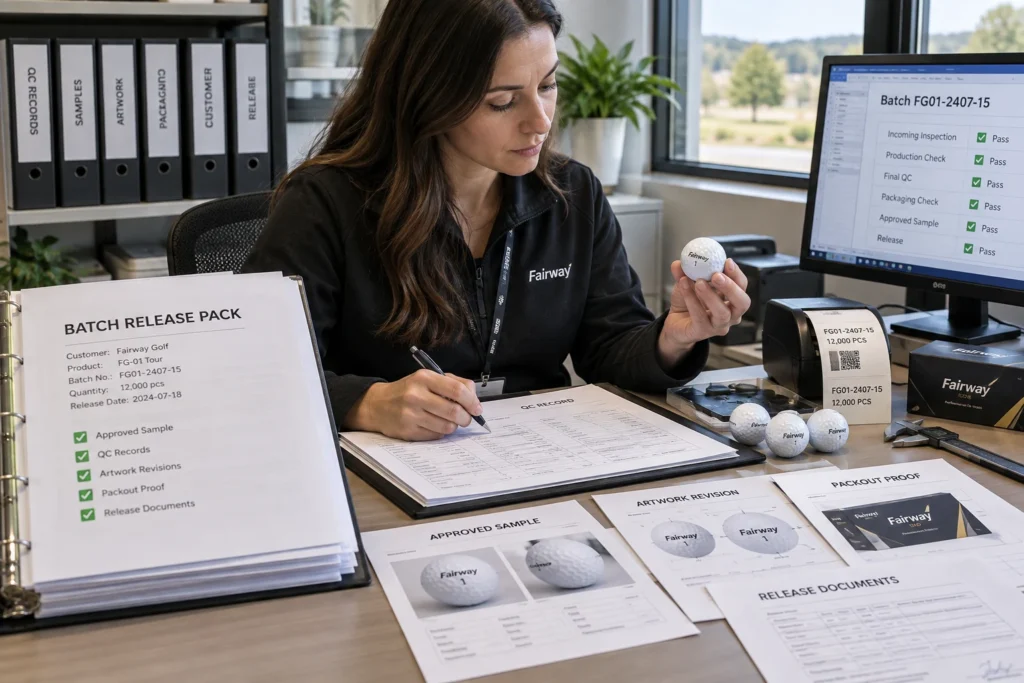
A passed sample protects your order only when bulk production repeats the approved print system. Before release, link the physical sample, final surface, process version, durability evidence, and production lot so a later complaint can be traced to an identifiable production condition instead of reconstructed from emails and memory.
Use one release chain:
Approved Sample → Sample ID → Durability Evidence → Print-System Version → Production Lot → Release
What Changes Trigger Revalidation?
A cover or finish change, different ink system, revised preparation route, cure change, protective-build change, or different printing route can make previous durability evidence less representative.
That does not mean every microscopic internal adjustment needs buyer approval.
The practical rule is:
If the changed variable could make the previous durability evidence unrepresentative, review whether revalidation is required before release.
For traceability, the PO can state:
Supplier shall link the approved printed sample, sample ID, print-process version, final cover/finish, and production batch to the durability evidence used for release. Generic test evidence from another ball model or finish shall not be used for approval.
If a complaint arrives, preserve a compact Complaint Evidence Pack where available:
-
failed physical ball and clear close-up photos;
-
customer-reported use and cleaning/handling history;
-
SKU and finish;
-
retained approved sample and sample ID;
-
batch or shipment ID;
-
print-process version;
-
corrective physical sample;
-
revised process version;
-
buyer disposition.
The failed physical ball is particularly useful. It can reveal peel location, edge behavior, coating condition, and differences that a production beauty photo cannot.
Please provide the approved printed sample ID, final ball model and finish, print-process version, buyer-agreed durability method, before/after evidence, and production-batch link used to release this logo for the stated use case.
Bulk production that cannot be traced to the approved printed sample is a failure signal. Require one Logo Durability Release Record rather than a folder of unrelated screenshots.
For the wider sampling, inspection, calibration, and lot-release system beyond printing durability, use the guide on how to control batch-linked golf ball QC evidence.
✔ True — Durability approval belongs to an identifiable production condition.
The approved sample, durability method, process version, and production lot should still describe the same controlled printed system.
✘ False — “Once one sample passes, later process changes do not matter.”
When a material change makes previous evidence unrepresentative, the old approval may no longer protect the order.
FAQ
How Long Should a Custom Golf Ball Logo Last?
There is no universal lifespan for every custom golf ball logo. Durability depends on the finished print system, actual ball surface, customer use, and the method used to judge acceptable wear.
A gift ball and a commercial-range ball face different stresses. Avoid “X hits” or “X washes” claims unless the test method and exact sample are documented. Keep the approved durability evidence linked to its sample ID and intended use.
Is UV Printing More Durable Than Pad Printing?
Not automatically. Pad and UV are process descriptions, not universal durability grades; the finished result also depends on the surface, ink system, preparation, cure, protective build, and real-use conditions.
If you need to select a route, use the printing-method guide. If you are diagnosing wear, compare evidence from the exact approved ball rather than using the method name as the answer.
Can Clear Coat Stop a Golf Ball Logo From Peeling?
A compatible protective clear coat can help protect a sound printed mark, but it cannot be assumed to repair poor underlying bonding, contamination, an unsuitable ink/surface combination, or uncontrolled curing.
Investigate the original system first, then verify the corrective sample. “Add more clear coat” is not a root-cause analysis and should not replace evidence that the underlying print system works.
Should Range-Ball Logos Be Tested Differently?
Yes, if the real workflow adds repeated washing, sorting and handling.
Document the facility workflow and choose evidence that represents it. A washer comparison may be appropriate, but one facility’s test should not become a universal wash-cycle requirement for every commercial-range logo.
Can a Sample Pass While the Bulk Logo Still Fails?
Yes. A sample can pass while bulk later fails if a material production condition moves away from the approved sample.
-
Compare the sample ID with the production lot.
-
Check whether surface, ink, cure or protection changed.
-
Revalidate if the previous evidence no longer represents bulk.
What Should You Keep After a Logo Complaint?
Keep enough evidence to compare the failed condition, approved condition, actual use, and production version that shipped. That is far more useful than a complaint message saying only that the logo “came off.”
Retain failed balls where possible, clear photos, the approved sample and sample ID, batch or shipment information, SKU/finish, use and cleaning history, relevant process records, and any corrective sample.
Conclusion
A custom golf ball logo wearing off should not be diagnosed from a printing-method name or an isolated durability number. Start with the symptom, trace the complete printed system, define the real-use stress, select the relevant test, and re-release production only when the corrective evidence belongs to the same approved sample and production version.
Use the troubleshooting chain:
Symptom → Failure Layer → Use Case → Relevant Test → Production Match → Re-release
You might also like — Which Golf Ball Logo Printing Method Fits Your Order?