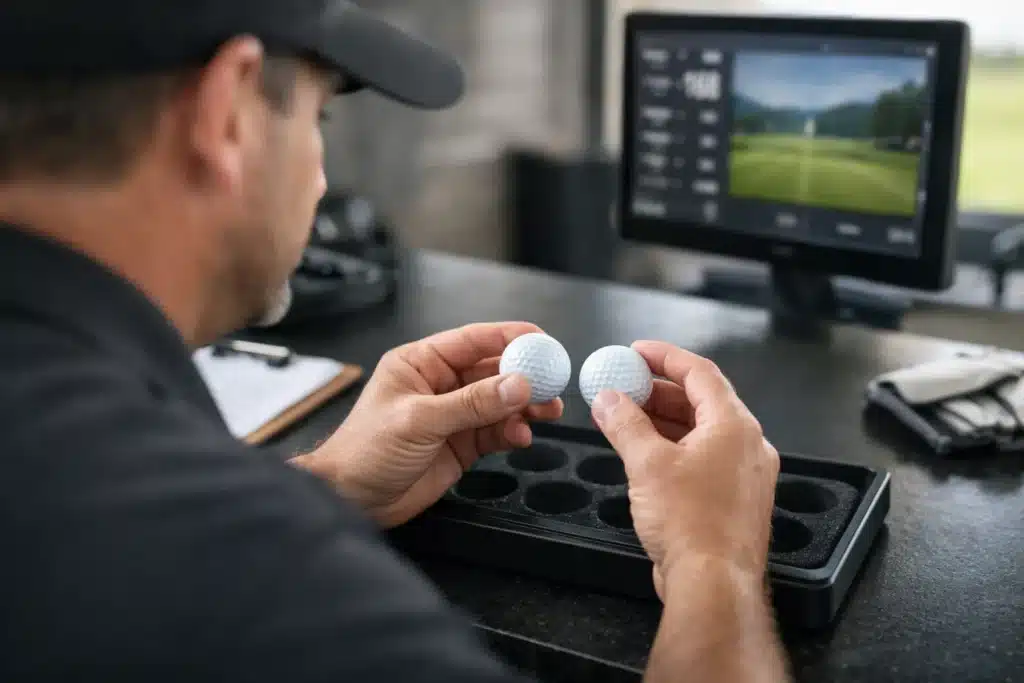
Dead or inconsistent range balls can distort launch-monitor data by changing ball speed, launch, spin, carry, and shot-to-shot consistency before visible failure appears. For clubs and ranges, the real buying question is not only how long the balls last, but how stable the ball population remains for practice, fitting, and coaching.
A launch monitor is only as honest as the ball population in front of it.
That is the real buying problem for US and EU clubs, ranges, and golf entertainment venues. You are not only buying a durable range ball. You are buying a stable data environment for lessons, gapping, fitting decisions, entertainment-bay consistency, and everyday member trust.
Once that framing is clear, the question changes. Instead of asking, “Why are members suddenly losing yardage?” you start asking, “How stable is this ball population after repeated use?” That is a much better question before the next 1,000+ ball order.
Why Do Dead Range Balls Distort Radar Data?
Dead range balls distort radar data when the ball population stops behaving consistently. The problem usually appears as unstable ball speed, launch, spin, carry, or smash readings caused by mixed wear states, weak compression consistency, or structural drift inside balls that still look usable.
When the ball population becomes the hidden variable
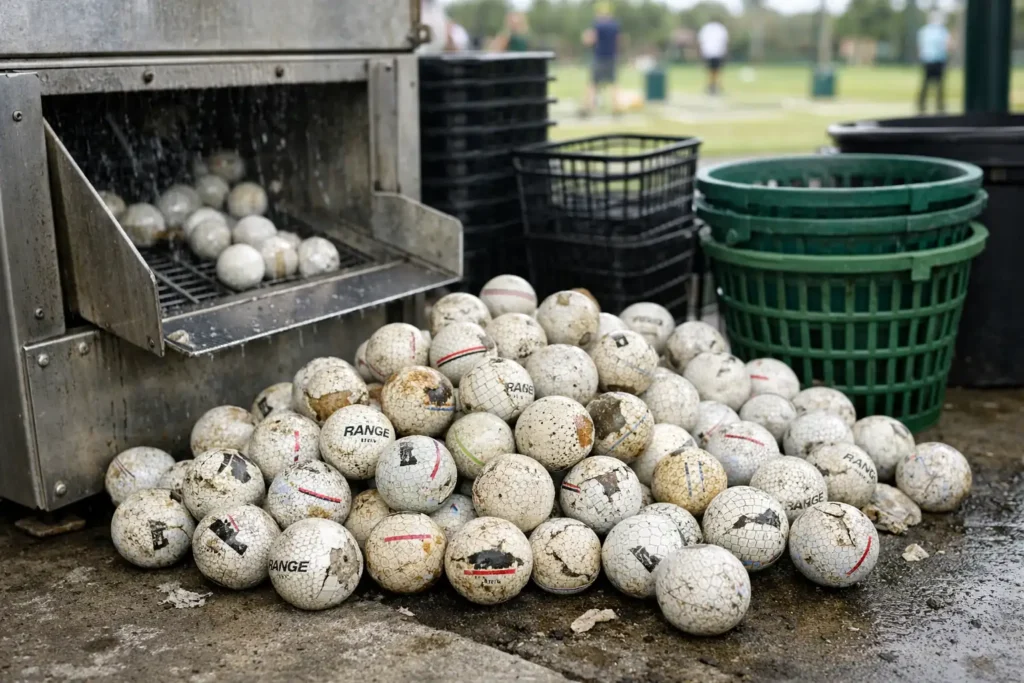
Radar-equipped venues are no longer buying only balls; they are buying data stability. That is why the best buying rule for this category is simple: consistency first, fit second. If one bucket contains the same logo but different wear states, different ages, or mixed lot behavior, the launch monitor session starts measuring the bucket as much as the golfer.
This is where “dead ball” complaints become expensive. A Head Pro sees wedge gapping drift. A fitter gets noisier smash and carry windows. Members think their swing has changed because a 7-iron starts reading short or inconsistent from bay to bay. The range team often blames the device first because the device is where the complaint shows up. But if the ball population is unstable, the launch monitor becomes a liar in practical buyer terms.
That is also why low opening quotes can be deceptive. When suppliers cut too close on process control, test discipline, or lot release logic, the weakness does not always appear as a cracked ball on day one. It can appear first as a bucket that looks usable but reads short. In B2B terms, that is not just a quality problem. It is a coaching, fitting, and member-trust problem.
A better decision screen looks like this:
| Decision area | Operational risk | What buyer checks | Evidence to request | Next step |
|---|---|---|---|---|
| Data accuracy | Launch monitor output drifts | Compare fresh vs repeated-use samples | Illustrative radar log format | Set a replacement rule |
| Bucket consistency | One bay reads differently from another | Sort by lot and wear state | Blind batch sample set | Control mixed populations |
| Member trust | 7-iron yardages feel unfair | Run side-by-side ball comparison | Head Pro test notes | Validate one stable build |
| Procurement | Cheap quote hides instability | Review sample-to-lot proof | Lot-linked QC format | Buy on stability, not just opening price |
The practical move is to compare ball-population stability before blaming radar setup alone. Your operating spec should define when drift in feel, appearance, or data stability triggers segregation, replacement, or bay-by-bay sorting. That is far cheaper than letting bad input conditions slowly weaken every lesson and fitting conversation.
✔ True — Bad radar data can begin with unstable range balls, not only with bad device setup.
A radar bay can be configured correctly and still produce noisy results if the balls in circulation no longer behave like one controlled population. That is an input-quality problem, not just a hardware problem.
✘ False — “If the balls still look mostly usable, the data should still be good enough.”
Visual survival is not the same as data stability. A bucket can stay serviceable to the eye while becoming less reliable for lessons, gapping, and member-facing feedback.
What Makes a Ball Look Fine but Read Dead?
A range ball can look usable before it behaves consistently. That is why “dead ball” problems often show up first as unstable data, feel, or carry rather than as an obvious crack, and why cross-section proof matters more than surface appearance alone.
Why cover survival is not the same as core stability
Buyers can usually spot scuffs, dull finish, fading logos, or seam wear. What they cannot see at a glance is whether the structure under that cover is still behaving like the sample they approved. That is why cover survival and data stability are two different buying decisions.
The safer explanation is not that one material automatically causes every dead-ball complaint. It is that poor core centering, compression inconsistency, off-center structure, uneven cover thickness, and mixed wear states can all reduce ball-population stability. A ball may remain white enough for circulation while becoming less trustworthy as a test ball for radar-based practice.
Cross-section proof is powerful because it turns an invisible question into a visible one. Is the core centered? Are the layers reasonably concentric? Does cover thickness look uniform enough across the sample set? A ball that drifts in these basics can remain visually serviceable while becoming less stable in feel, launch behavior, or repeated-use consistency.
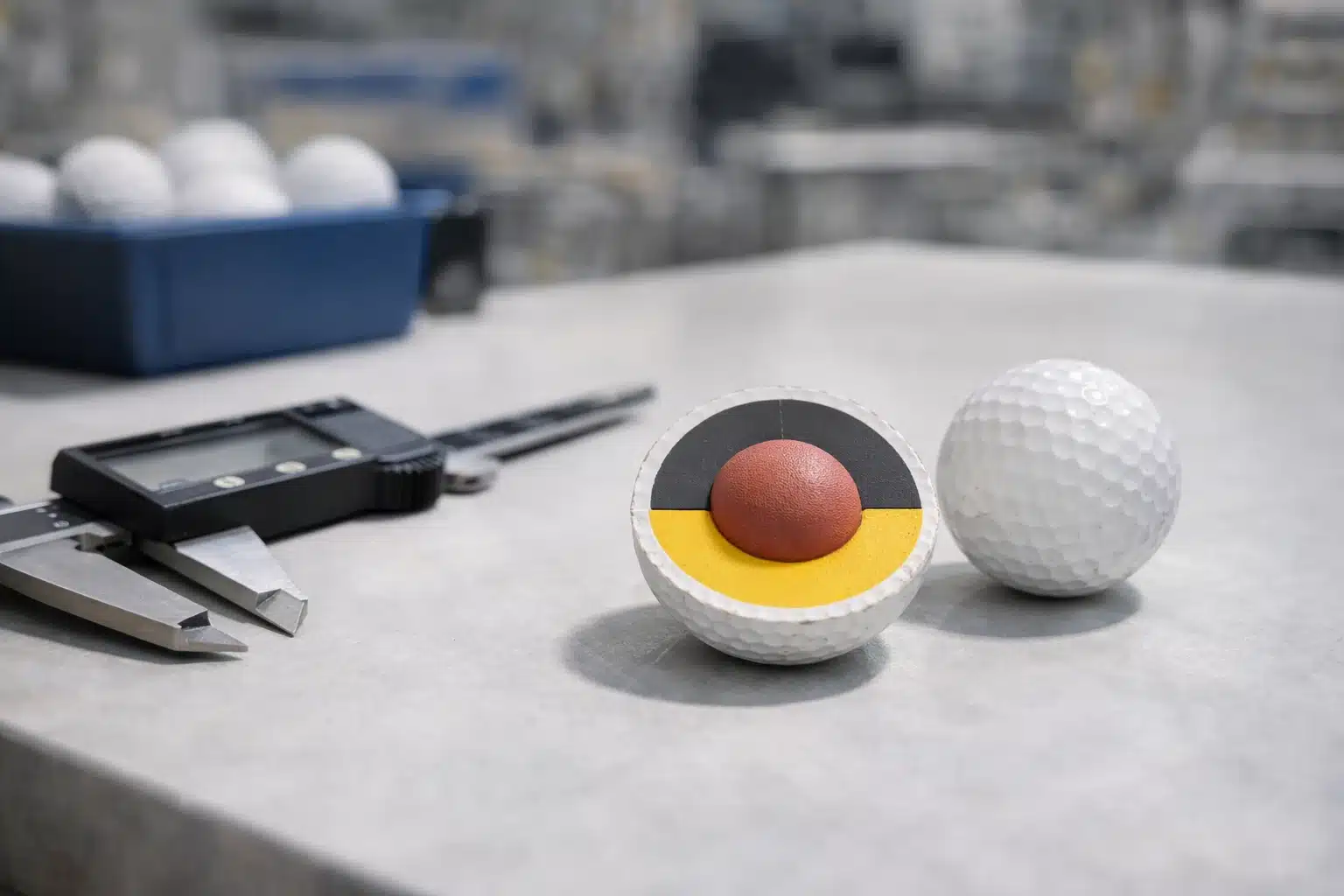
That is why a bisected sample is not a decorative sales asset. It is one of the fastest buyer-facing structural checks available. Ask for a bisected sample, a raw sample, and a finished sample from the intended build, then compare centering, concentricity, and cover-thickness uniformity before approving structure. If one bucket also shows mixed wear state inside the same circulation group, treat that as a data-quality warning, not just a housekeeping issue.
The right acceptance logic is simple: any meaningful structural drift between the approved sample and blind batch should trigger review before release. Buyers do not need to prove the exact cause of every short-reading shot. They need to prove that the shipped ball population still behaves like the approved one.
How Do You Verify Compression Consistency?
Compression consistency is verified by method control, not by one impressive number. Buyers should compare blind batch samples, use the same measurement method across lots, and combine radar-baseline testing with cross-section proof before approving a bulk range-ball order.
A single advertised compression score does not solve a commercial buying decision. It only starts one. In commercial buying, core compression matters less as a standalone number than as a consistency signal across one controlled ball population. Compression becomes useful when it is measured with the same gauge, the same method, and the same acceptance window across the approved sample and the intended lot. Without that discipline, buyers end up comparing numbers that sound technical but are not truly comparable.
That is why the verification path needs three layers. First, test behavior under one repeatable radar setup. Second, inspect structure through cross-section proof. Third, review one lot-based compression-control format that makes the method visible. Behavior, structure, and release logic should support each other. If one of those three is missing, the buyer is still guessing.
One warning sign is easy to miss in a sales review but obvious in a buyer review: the approved sample feels firmer than the blind batch. That does not automatically fail the lot, but it should stop release until structure, method, and lot proof line up. The whole point of batch proof is to catch drift before the bucket reaches the bay.
Use this as a buyer-operable QC path:
| QC check | What buyer does | What failure looks like | Evidence to keep | Next step |
|---|---|---|---|---|
| 1. Radar baseline | Hit the sample set under one fixed setup | Early drift in ball speed, launch, or smash | Illustrative data log | Flag the build for review |
| 2. Cross-section check | Inspect multiple samples | Off-center core or uneven layers | Bisected sample photos | Request revised proof |
| 3. Lot-based compression control | Review one lot with one method | Wide spread or unclear method | Example QC sheet format | Approve only method-stable lots |
The tables below should be treated as illustrative reference formats, not as universal claims. One can be an example repeated-impact session log. The other can be an example lot-based compression-control sheet. That framing keeps the buyer focused on method and comparability instead of chasing one magic number.
The buyer takeaway is not the exact number in the table, but whether the supplier can show one repeatable method and one lot-linked acceptance rule.
Request one radar-evaluation kit with a bisected sample, blind batch samples from the intended lot, one example compression-control sheet, and one repeated-impact session log template.
Write this into the RFQ or PO: compression evidence must state gauge ID, calibration status, sample size, measurement method, and lot identifier. Results are only comparable when measured with the same gauge, the same method, and the same acceptance window.
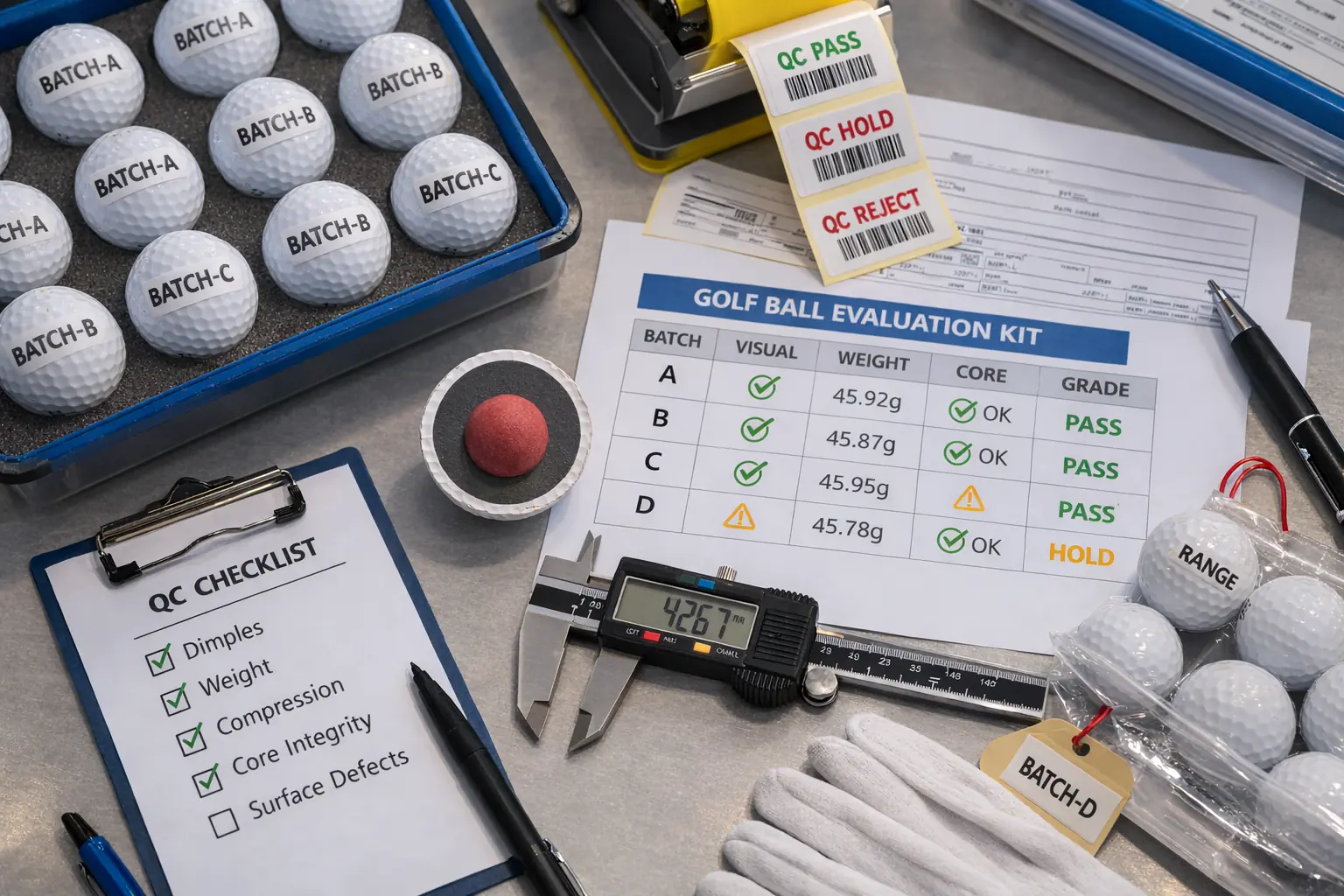
The right deliverable is not a dramatic claim about “higher compression.” It is a lot-based control format plus blind batch proof that lets the buyer decide whether the build stays stable under one repeatable method. Predefine what counts as unacceptable drift in structure, feel, or repeated-use stability before the first pallet is released.
✔ True — Method control is what makes compression evidence meaningful.
Compression can help procurement, but only when the gauge, method, and acceptance window remain constant across lots. That is why lot-to-lot comparability matters more than one impressive number on a quote sheet.
✘ False — “A single compression score proves the build is ready.”
A score without method discipline is just decoration. Buyers need blind-batch proof, structural proof, and repeatable testing before release decisions become trustworthy.
What 3 QC Checks Should Head Pros Demand?
Head Pros should demand three QC checks before approving range balls: a same-setup radar baseline, a cross-section structural check, and a blind-batch comparison tied to the intended lot. Those three checks expose drift far better than one fresh-looking sample.
-
Run one same-setup radar baseline. Use the same bay, same operator, same club, and one controlled sample group. The goal is not to prove a universal yardage gap against every other ball on earth. The goal is to see whether this sample set stays stable enough for lessons, gapping sessions, fitting days, and entertainment-bay calibration.
-
Cut at least one sample open. The cross-section does not need to look beautiful. It needs to answer buyer questions. Is the core reasonably centered? Do the layers look consistent across the sample set? Does the build still resemble the approved benchmark structurally, not just cosmetically?
-
Review blind-batch samples from the intended lot. One showroom sample is not a release standard. The approved sample should be tied to the lot that will actually ship, not to the ball that photographed best during quoting. This is where a lot of disappointment begins: buyers approve a nice sample, then receive a bulk lot that is “basically the same” until the radar bay says otherwise.
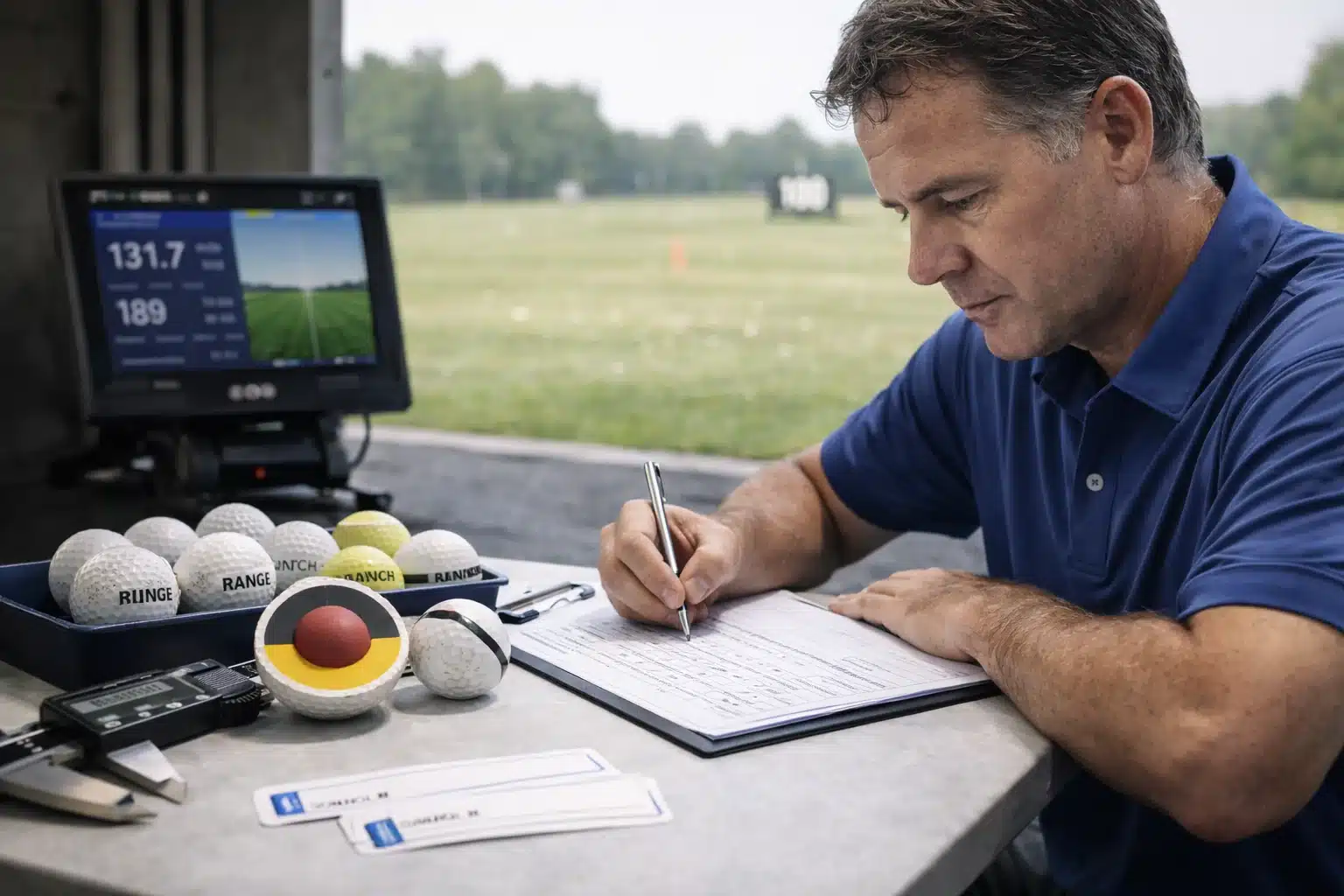
A simple Head Pro checklist should record setup, hit count, observations, lot reference, and the reasons a build is accepted, held, or rejected. Separate fail points for data drift, structural inconsistency, and finish degradation. That turns “seems fine” into a repeatable acceptance routine, which is exactly what radar-heavy venues need before balls enter daily use.
Can Direct Sourcing Reduce Inventory Risk?
Direct sourcing can reduce inventory risk when buyers use smaller, proof-backed replenishment cycles instead of one large speculative buy. The advantage is not guaranteed speed; it is better lot control, lower hoarding pressure, and a tighter link between testing, release, and reordering.
Why micro-batches solve inventory pressure, not every lead-time problem
Micro-batch direct sourcing works best as inventory flexibility, not as a promise of magical speed. As of 2026, the smarter factory-direct play is to separate production, QC release, booking, transit, customs, and final mile instead of compressing all of it into one cheerful ETA. That keeps working capital, lot accountability, and replenishment timing on the same page.
Annual hoarding creates its own hidden costs. You tie up cash, extend your exposure to lot drift, and reduce the number of learning loops available to you during the season. Smaller replenishment cycles do not remove logistics risk, but they make it easier to test, learn, and reorder against fresh proof rather than against old assumptions.
The conversation gets better when buyers look at it this way:
| Variable | Risk | Verification path | Deliverable | Next step |
|---|---|---|---|---|
| Production + QC | Sample truth breaks before release | Review lot proof before dispatch | Pre-shipment QC summary | Approve by lot, not by promise |
| Transit + customs | Timeline opacity | Use milestone map | Order-to-door process diagram | Quote ETA as checkpoints |
| Inventory cash flow | Annual hoarding ties up budget | Review replenishment rhythm | Micro-batch plan | Match batch size to real usage |
Ask for an order-to-door milestone map, redacted logistics proof, and a document checklist that makes ownership visible. Confirm who owns customs, document errors, packaging protection, and final-mile timing before the order leaves the factory, not after the ETA slips. A good compression-control program still fails commercially if the receiving team cannot trace the delivered lot back to the approved proof.
Write this into the buying file: approved sample, blind batch samples, and shipped lot must be linked by lot number, production date, retained-sample reference, and the matching pre-shipment QC summary. Any change in structure, finish system, or test method requires buyer review before release.

Micro-batches usually help because they lower hoarding pressure and tighten lot accountability. Release each replenishment cycle only after lot proof and milestone visibility are in place. That is how direct sourcing becomes a control system instead of a gamble.
✔ True — Micro-batches usually make inventory risk easier to control.
Smaller cycles let buyers learn faster, reorder more deliberately, and tie each release to fresh proof. That is valuable even when shipping itself is not magically faster.
✘ False — “Micro-batches always solve lead-time problems.”
They solve inventory pressure better than transit uncertainty. Buyers still need milestone visibility, document discipline, and clear ownership across the chain.
FAQ
Do range balls always read shorter on launch monitors?
No. Ball type, wear state, setup, and measurement context all matter, so buyers should compare against one controlled reference instead of expecting one universal yardage gap.
Some range balls do read shorter, but the bigger issue for commercial buyers is inconsistency, not one fixed penalty. One known ball type under one repeatable setup is manageable. A mixed bucket with unknown wear states is not. That is why same-setup comparison matters more than internet folklore about “range balls are always X yards short.” The useful question is whether your ball population stays stable enough for the purpose of that bay.
Can software or normalization fully fix bad range-ball data?
No. Software can help standardize assumptions, but it is not a full substitute for a stable ball population with known wear state, structure, and lot behavior.
Correction tools can be useful, especially when they account for ball type or environment. But they still depend on reasonable input conditions. If the balls in circulation vary too much in wear, feel, or structural behavior, the software layer is working on unstable raw material. Buyers should treat normalization or conversion as a support tool, not as permission to ignore the ball program itself. Fix the bucket first, then decide how much correction logic you trust.
What should I ask for if I want to test radar compatibility before buying?
Ask for structure proof, blind-batch proof, and one repeatable session format. Those three items make radar compatibility something you can test instead of something you can only be promised.
A practical buyer checklist includes a bisected sample, blind batch samples from the intended lot, one repeated-impact session log template, and a lot-linked QC sheet format. That gives you a way to test structure, same-setup behavior, and lot proof together. The key is repeatability. You are not chasing perfect laboratory conditions. You are building a fair, buyer-controlled comparison before the bulk PO is approved.
Is higher compression always better for commercial range balls?
No. The safer buying rule is consistency first, fit second. Absolute compression by itself is not enough to predict whether the program will behave well in practice.
A single number can sound impressive, but it means little without method context. Buyers should ask whether the same gauge, the same method, and the same acceptance window were used across lots. They should also look at spread, not only average. A stable program with method-controlled compression evidence is more useful than a louder claim about one “high” number that cannot be compared fairly across builds or batches.
Can micro-batches reduce cash pressure without adding sourcing risk?
Yes, when logistics visibility and lot discipline are mature. The real risk is usually not geography alone but opacity, weak handoffs, and unclear release logic.
Smaller replenishment cycles help when each batch is tied to lot proof, milestone visibility, and clear document ownership. They can reduce hoarding pressure and improve learning loops, but only if the supplier can show what is shipping, when it is shipping, and who owns each stage. Buyers should ask for a milestone map, a document checklist, and lot proof before dispatch. That turns micro-batching into control rather than wishful thinking.
What should receiving inspect before radar-range balls enter use?
Receiving should inspect the same sample, lot, and finish cues used during approval, so procurement logic survives the handoff into daily operations.
Keep a retained sample linked to the approved lot, then compare the delivered batch against it under consistent lighting and handling. Check lot reference, appearance consistency, logo sharpness, packaging condition, and any obvious feel or finish drift where practical. Receiving does not need to become a laboratory. It needs to become the final checkpoint in the same proof chain used during approval. That continuity is what keeps a radar-range program stable after the PO is closed.
Conclusion
Dead range balls are not just a performance problem. They are a data-integrity problem. When the ball population becomes inconsistent, coaching feedback gets noisier, fitting decisions get weaker, member trust drops, and replenishment timing gets harder to judge.
The practical response is also simple: test the balls in your own radar environment before the bulk PO. Use one repeatable session, one structural check, one lot-linked proof trail, and one clear release standard. That is how you buy compression consistency instead of guessing at it.
You might also like — Private Label Golf Balls Economics: Tour-Quality on a Budget