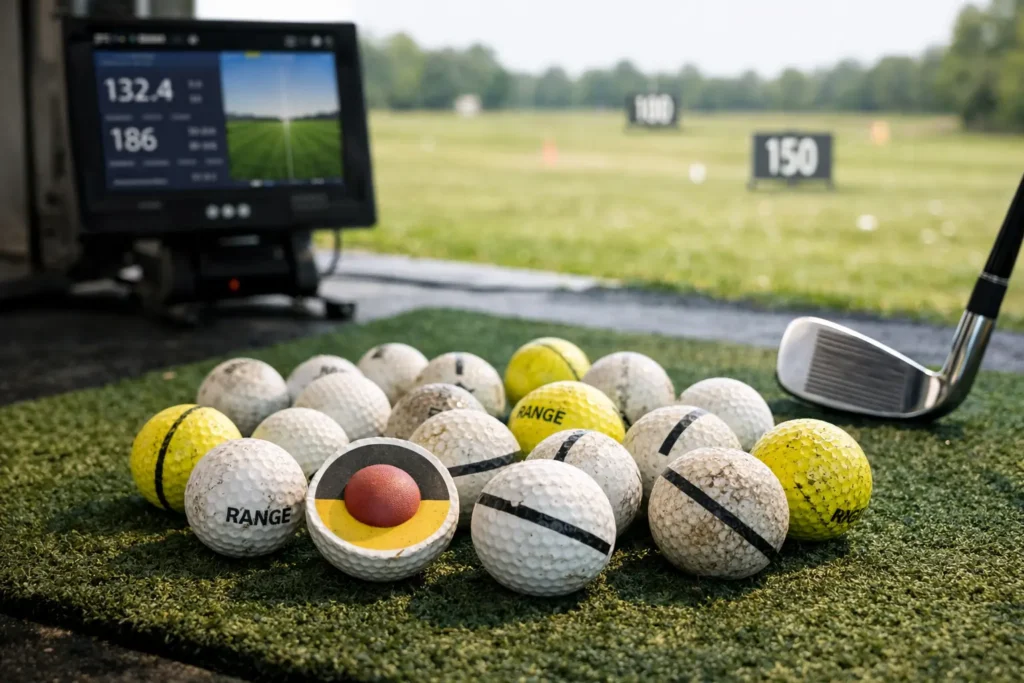
Range balls affect launch-monitor accuracy when compression decay, core fatigue, surface wear, or mixed-lot buckets change ball speed, launch, spin, carry, and smash factor. In a radar-heavy facility, an unstable ball population can make the launch monitor measure the bucket as much as the golfer.
Your launch monitor may be calibrated, your coach may be right, and your numbers may still be wrong. A ball that looks usable can already be “dead” for data purposes if its core no longer returns energy consistently or its worn surface changes drag and spin.
That is the real B2B buying problem. You are not only purchasing durable range balls; you are protecting lesson accuracy, fitting confidence, simulator trust, bay-to-bay consistency, and member experience.
Use this guide to connect compression decay, material fatigue, radar drift, surface wear, and cost per reliable radar hit before your next bulk range-ball order.
Why do range balls corrupt radar data?
Your radar setup can be correct while your data still looks wrong because the ball population has mixed wear states, mixed lots, compression drift, or surface damage.
Range balls corrupt radar data when they stop behaving like one controlled population. Your team should compare fresh, repeated-use, and blind-batch balls under one fixed setup before blaming the launch monitor, coach, or golfer.
A launch monitor reads outcomes: ball speed, launch, spin, carry, curve, and smash. If one bucket contains balls from different lots, different ages, different compression histories, and different surface wear states, the input is no longer controlled. Your facility may think it is measuring the player, but the system is also measuring the ball population.
This is why “dead range balls” are not only a durability issue. They are a data-integrity issue. A Head Pro sees wedge gapping drift. A fitter sees noisier carry windows. A member sees a 7-iron suddenly reading short and starts doubting the bay. The ball becomes the hidden variable in every lesson and fitting conversation.
TrackMan defines Smash Factor as ball speed divided by club speed, which makes energy transfer central to data trust. TrackMan also notes that gaining 1 mph of ball speed can increase driver distance by up to about 2 yards. That does not create one universal formula for every shot, but it does show why 1–2% ball-speed or energy-transfer drift can create several yards of driver-distance noise.
Ball survives visually but ball-speed or smash drift is not tracked is a failure signal. Radar-heavy facilities should buy stable ball populations, not only durable-looking range balls.
| Pain/decision | Likely ball variable | Data symptom | Evidence to request |
|---|---|---|---|
| Bay-to-bay yardage drift | Mixed lots/wear states | Carry windows move | Same-bay baseline |
| Smash factor noise | Ball-speed instability | Energy transfer unclear | Ball speed spread |
| Wedge gapping changes | Compression decay | Shorter or unstable carry | Fresh vs worn comparison |
| Member trust drops | Bucket inconsistency | Golfer doubts facility | Replacement trigger |
| Device blamed first | Input instability | False calibration concern | Controlled ball population |
✔ True — Your launch monitor may be right while your ball population is wrong
A radar or camera-based launch-monitor bay can be configured correctly and still produce noisy data if the balls in circulation no longer behave like one controlled input group.
✘ False — “Balls that still look usable always produce useful radar data”
Visual survival is not the same as data stability. A mostly clean range ball can already be unstable enough to weaken lessons, fittings, and member-facing feedback.
When does the bucket become the hidden variable?
The bucket becomes the hidden variable when ball condition, lot history, compression spread, and surface wear are not controlled before the session starts.
Request or build a same-setup radar baseline format with ball speed, launch, spin, carry, smash, sample ID, lot ID, and wear state. Test one controlled ball set against a mixed daily bucket before changing launch-monitor calibration assumptions.
Your range should define ball-speed, carry, or smash drift thresholds that trigger segregation, review, or replacement. The operating problem is not whether one ball survives; it is whether the whole bucket stays data-stable.
What makes range balls go dead early?
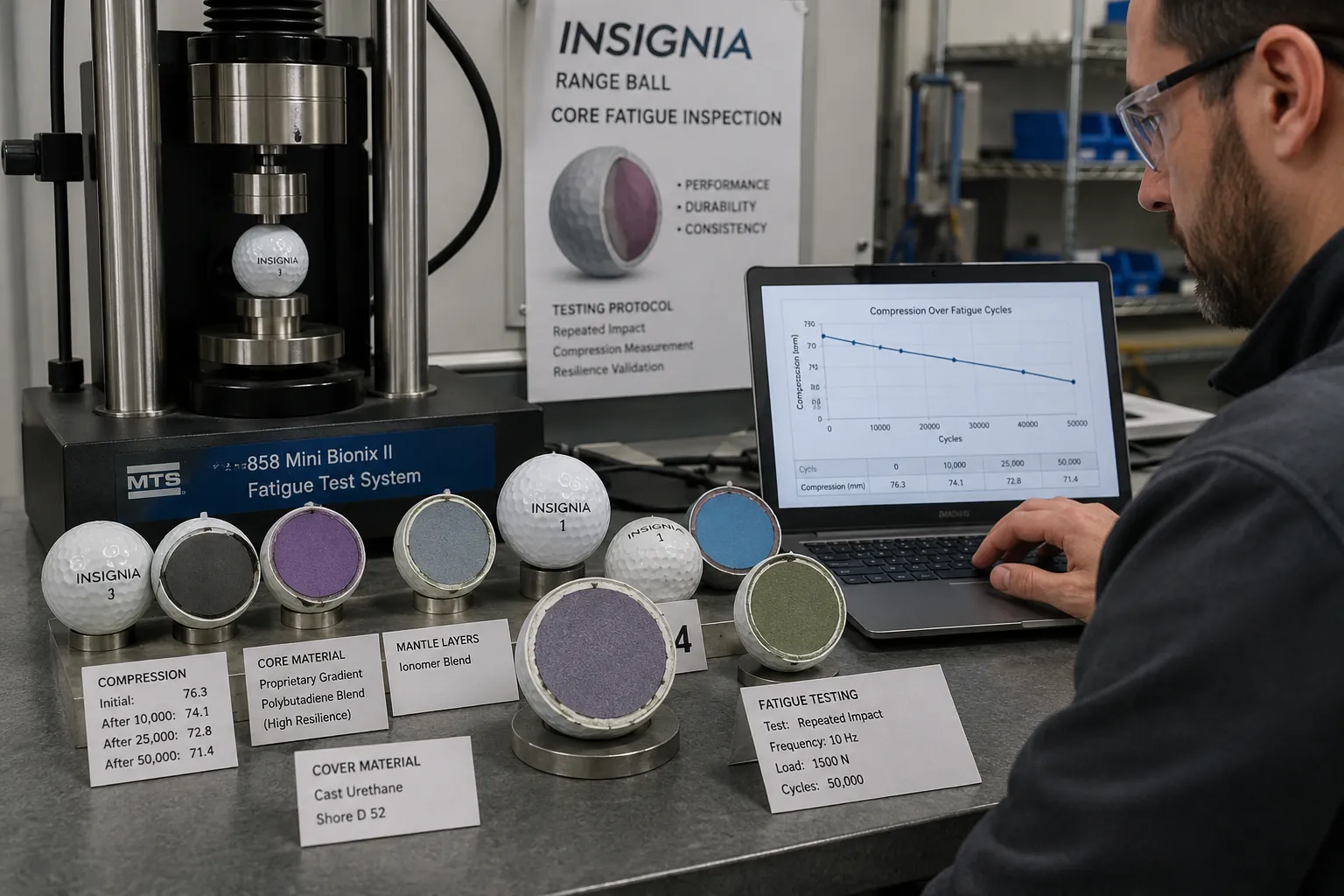
Your balls may become “dead” before they crack because the core loses rebound stability, compression consistency, or energy-transfer behavior after repeated impacts.
A dead range ball is often a core-stability problem before it becomes a visible crack. Ask how much compression and rebound remain after repeated impacts, not only how clean the cover looks after normal use.
The core is the engine of range-ball data. Every high-speed impact compresses the ball and asks the core to recover. If the rubber compound, mixing dispersion, curing cycle, cooling, or conditioning is weak, the ball may still look acceptable while energy return becomes less stable.
This is where golf ball core fatigue becomes a procurement issue. A ball does not go dead in one dramatic moment. It usually drifts. The core returns slightly less energy. Compression distribution widens. Ball speed becomes noisier. Launch and spin windows become harder to trust. The cover may still be white enough for circulation, but the ball has already started damaging your data environment.
Material logic matters here. Golf-ball cores are commonly built around polybutadiene-type rubber systems because the core must deform and recover quickly. Materials literature on high-cis polybutadiene rubber connects high cis-1,4 structure with properties such as wear resistance, low heat build-up, low rolling resistance, and high flex-fatigue resistance. That does not mean a supplier can simply write “Nd-BR” and win the order. It means your team should ask whether the supplier understands core chemistry, crosslinking, curing control, and repeated-impact behavior.
A serious repeated-impact core resilience report should state impact method, impact speed, temperature, sample size, pre/post compression, rebound or COR proxy, mean, standard deviation, range, and lot ID. Without those details, “long-lasting range balls for simulation” is just a promise.
Do not use specific decay percentages unless the supplier provides auditable test conditions and raw data. A claim such as “5,000 hits with low drift” can be useful only when the test method, ball count, temperature, impact speed, and measurement tools are visible.
| Pain/decision | Core variable | Failure mode | Evidence to request |
|---|---|---|---|
| Balls feel hard early | Curing / conditioning | Compression shifts | Pre/post data |
| Carry drops before cracks | Rebound resilience | Ball speed fades | Impact protocol |
| Lots behave differently | Mixing dispersion | Population spread | SD/range |
| Supplier says durable | Material proof missing | Cover survives, core drifts | Core evidence |
| High-volume simulator use | Fatigue resistance | Fast decay | Repeated impacts |
How does Nd-BR fatigue affect rebound?
Nd-BR and high-cis BR logic matters because range balls live under repeated deformation, not one showroom impact.
Request repeated-impact core resilience evidence with fixed impact method, temperature, sample size, pre/post compression, rebound proxy, and lot ID. Compare approved sample, blind batch, and repeated-impact samples under the same measurement method.
Your team should treat “dead ball” as a measurable core-fatigue risk, not a complaint label. A ball is not only dead when it cracks; it can become commercially dead when it no longer supports stable launch-monitor data.
How should compression decay be measured?
Your supplier can quote a target compression, but one average does not tell you whether the lot will stay stable across bays, days, or replacement cycles.
Compression decay should be measured by distribution, not one score. Your team should require the same gauge, same method, same conditioning, same tolerance window, and lot-linked data before treating a compression number as procurement evidence.
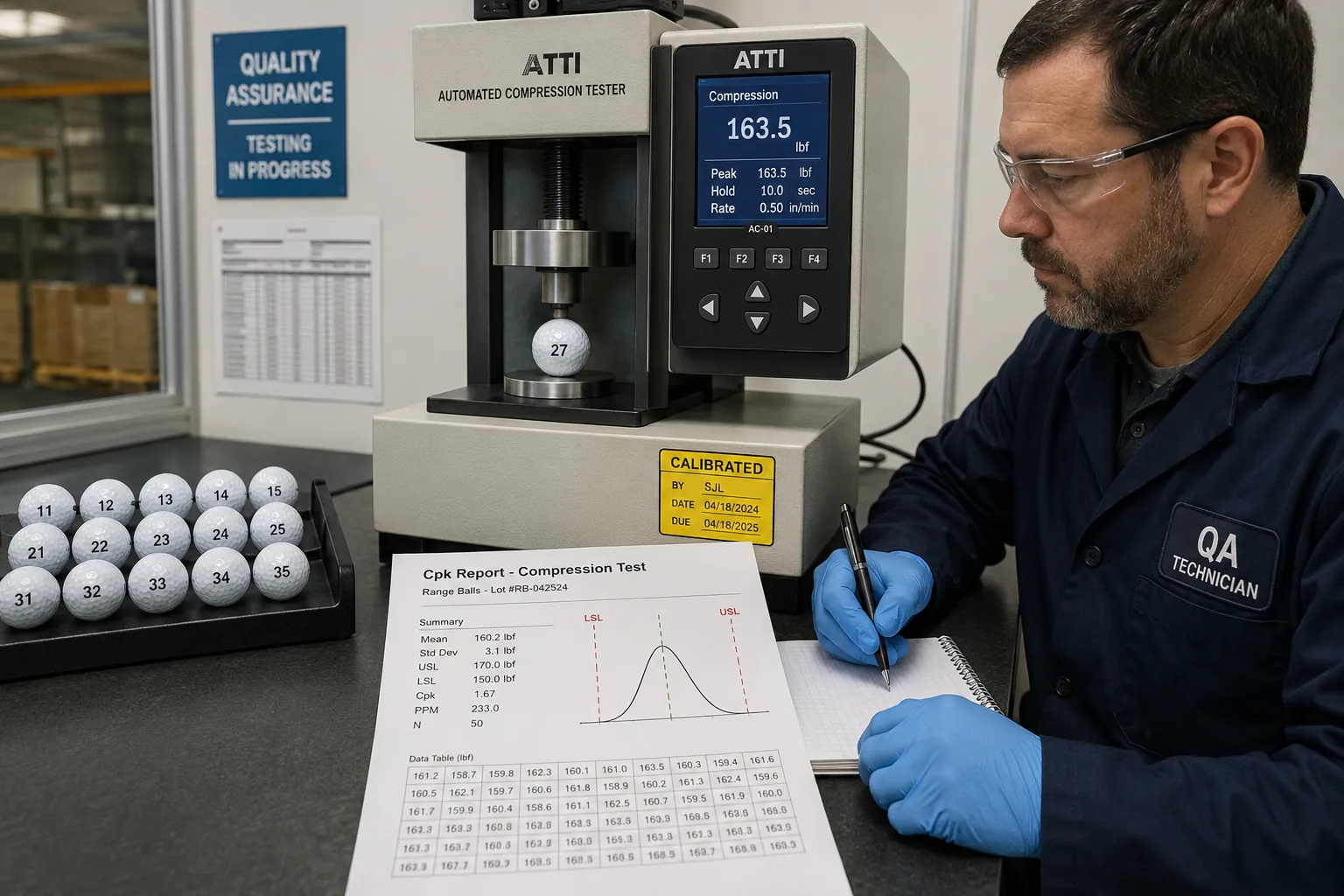
Compression evidence becomes useful only when the method is visible. Ask for ATTI, OK Automation 55-M, or equivalent whole-ball compression testing. The report should show raw values, mean, standard deviation, range, equipment model, gauge ID, calibration status, conditioning notes, sample size, batch ID, and lot reference. A single compression number may help a quote sheet; it does not release a bulk lot.
Cpk can be helpful because it speaks the language of process capability. But Cpk only means something when specification limits, sample size, method, and distribution are defined. For premium radar-range programs, a buyer may set a tighter compression window, such as target ±3 points, if the supplier can support it. Standard commercial range balls may use a wider agreed tolerance. The important point is not the exact window by itself; it is whether the supplier can hold the window repeatedly.
Do not confuse compression with Shore hardness. ASTM D2240 is a durometer indentation-hardness method based on penetration of a specified indentor under specified conditions. Use ASTM D2240 / Shore checks for cover or material hardness consistency, not as a replacement for whole-ball compression testing. A serious range-ball RFQ should require both.
Supplier gives one compression number with no SD, Cpk, method, or lot ID is a failure signal.
| Pain/decision | Metric | Risk if missing | Evidence to request |
|---|---|---|---|
| One score looks good | Mean | Spread hidden | Raw values |
| Buckets feel mixed | SD / range | Population drift | Tolerance window |
| Process capability unclear | Cpk | No release confidence | Limits + sample size |
| Methods change | Gauge/method ID | False comparison | Same method |
| Hardness confused | Shore A/C/D | Wrong test used | Separate D2240 report |
✔ True — Method control makes compression evidence meaningful
Compression can guide procurement only when gauge, method, conditioning, sample size, tolerance, and lot reference remain consistent across sample and bulk.
✘ False — “One compression score proves the lot”
A score without spread and method discipline is decoration. Radar-heavy facilities need lot capability, not one polished sample number.
What should Cpk and tolerance show?
Cpk and tolerance should show whether the production process can hold the agreed compression window with measurable confidence.
Request a lot-linked compression report with gauge ID, calibration status, method, sample size, raw data, mean, SD, range, Cpk, and batch ID. Check whether the approved sample and blind batch were measured with the same gauge and acceptance window.
For radar-heavy programs, your buying file should define compression target, tolerance, SD, agreed Cpk target, and hold/release rules before bulk dispatch. Put this in the RFQ: compression evidence must state method, gauge ID, calibration status, sample size, mean, SD, range, Cpk calculation basis, and lot identifier. That turns compression from a sales number into a lot-release decision.
How does surface wear distort ball flight?
Your team may focus on core compression while worn clear coat, logo abrasion, and damaged dimple geometry are also changing drag, spin, and shot-shape stability.
A range ball can lose radar reliability from the outside as well as the inside. Your team should ask whether clear coat, abrasion resistance, and dimple fidelity are controlled after repeated use, not only whether the logo remains visible.
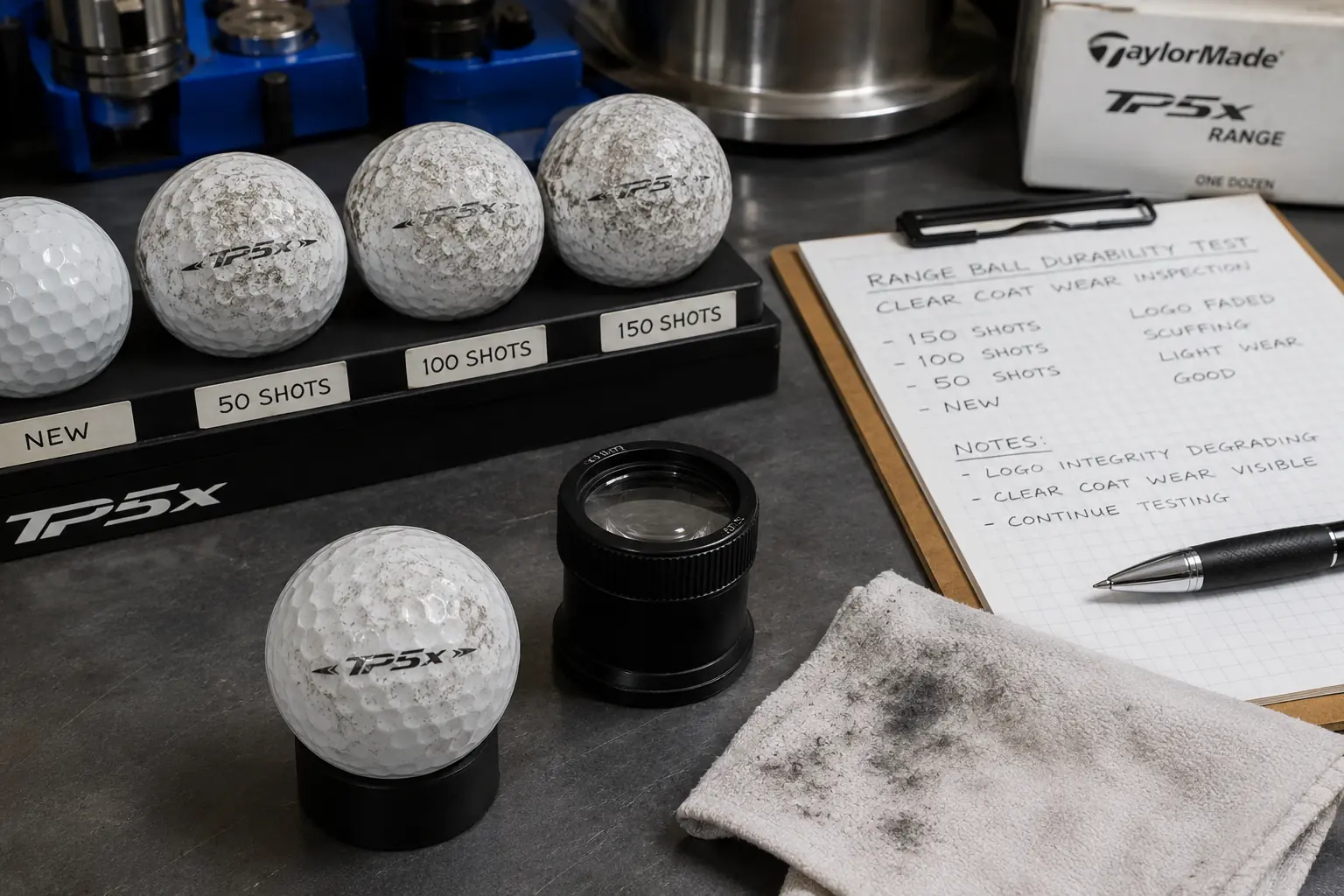
Surface wear is not only cosmetic. A range ball’s cover and coating protect the dimple geometry that helps control airflow. When the clear coat scuffs unevenly, the logo abrades badly, or the dimple shoulders get damaged, the ball can behave differently even if the core is still acceptable.
For radar-heavy venues, that matters because launch-monitor data depends on repeatable launch conditions. A surface that changes drag or friction can affect spin, curve, carry, and dispersion. Golfers may describe the symptom as “random hook,” “floating ball,” “bad read,” or “this bay feels different.” The actual problem may be surface inconsistency inside the bucket.
Do not turn finish review into a beauty contest. Range-ball finish requirements are practical: recognition, abrasion resistance, large-batch stability, and reasonable operating cost. Ask for clear-coat micron mapping, abrasion photos, rub or cleaning results, UV/weathering notes, and dimple-fidelity checks. If the supplier says the coating is “strong” but provides no abrasion or dimple-fidelity evidence, keep pushing.
Clear-coat durability described as “strong” with no abrasion or dimple-fidelity evidence is a failure signal. The finished surface should protect data stability, not only branding.
| Pain/decision | Surface variable | Data risk | Evidence to request |
|---|---|---|---|
| Hook/slice looks random | Dimple wear | Drag changes | Dimple-fidelity check |
| Radar spin gets noisy | Coating scuff | Surface friction changes | Abrasion test |
| Logo disappears early | Ink/clear mismatch | Identification loss | Rub evidence |
| Ball looks dull | UV/weathering | Wear accelerates | UV notes |
| Coating claim vague | μm uniformity | Pooling/clogging | Thickness map |
When does clear coat protect data integrity?
Clear coat protects data integrity when it preserves dimple geometry, surface consistency, and identification through repeated use.
Request clear-coat μm map, abrasion photos, rub/cleaning result, dimple-fidelity notes, and after-use comparison photos. Check whether surface wear changes dimple edges or creates inconsistent spin/drag behavior in the radar baseline.
Define surface-wear rejection criteria tied to data stability, not only cosmetic appearance. Your radar bay needs the finished ball surface to stay consistent, not just attractive.
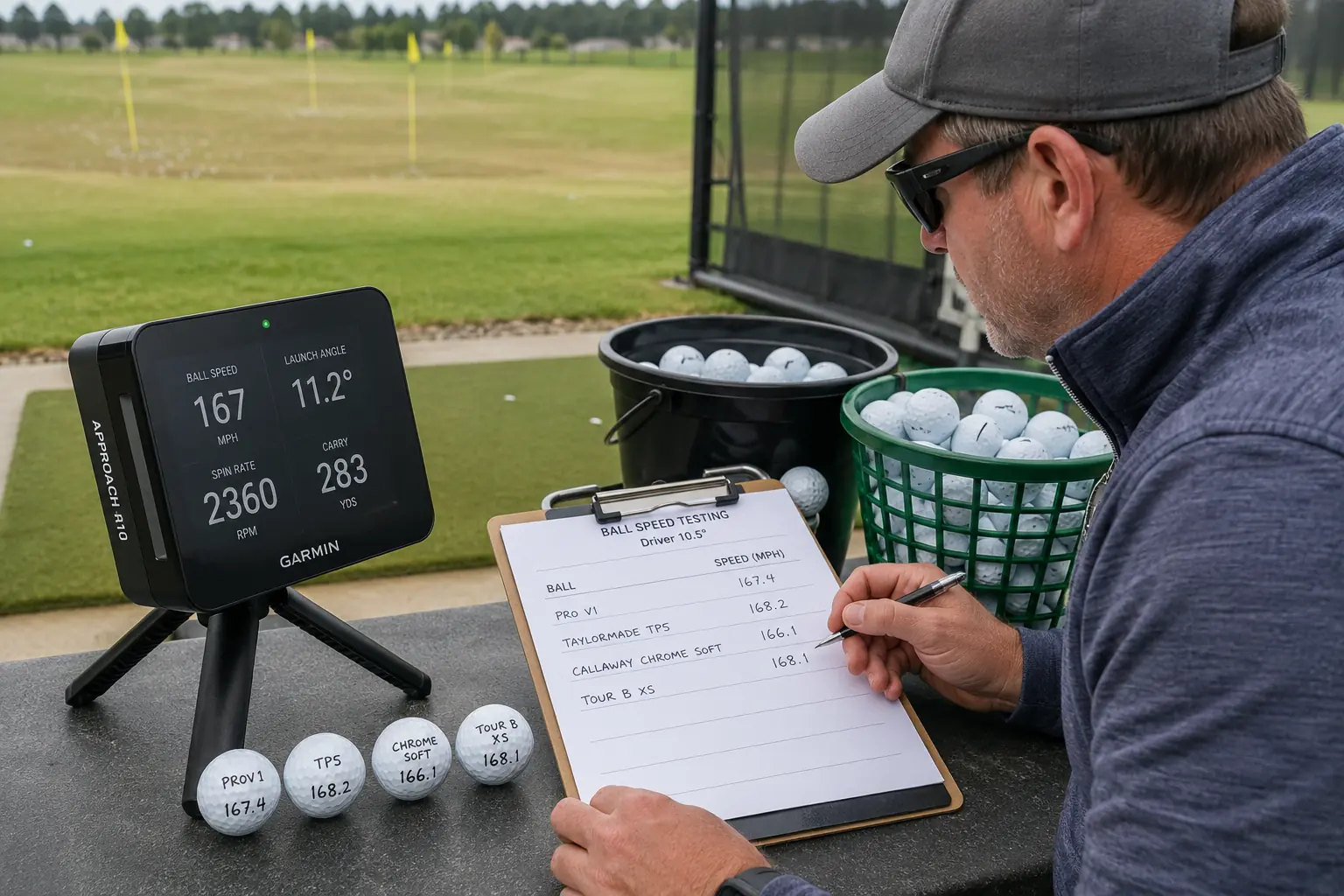
Your facility may save on unit price while losing money through earlier replacement, noisier lessons, weaker fitting confidence, and member distrust.
Cheap range balls are expensive when they shorten your reliable data window. Your team should compare cost per stable hit, replacement threshold, member-facing data quality, and lot proof before choosing the lowest unit price.
Lowest unit price is seductive because it is easy to compare. Cost per reliable radar hit is harder, but it is the number that protects operations. A ball that costs less but loses compression stability early can raise your real cost through faster replacement, more sorting, weaker lesson credibility, and member complaints.
A better model asks one commercial question: how many reliable radar hits does this population support before ball-speed, smash, carry, spin, or surface condition drifts beyond your facility’s threshold? If the supplier cannot define impact count, test conditions, sample size, drift threshold, and lot proof, the hit-life claim should not drive your purchasing decision.
Micro-batches can help when they are tied to proof, not hope. Smaller replenishment cycles can reduce annual hoarding, keep lots fresher, and give your team more learning loops. They do not magically solve lead time or freight risk. Use them as a control system: sample, test, release, receive, compare, reorder.
For detailed order planning, keep MOQ and replenishment economics in a separate guide such as a golf ball OEM MOQ and replenishment guide. Here, the buying point is simpler: the buyer’s real metric is cost per reliable radar hit, not lowest unit price.
| Pain/decision | Cheap-ball risk | Operating cost | Evidence to request |
|---|---|---|---|
| Low unit price | Early compression drift | More replacements | Stable-hit cost model |
| Radar noise | Bad input data | Lesson/fitting trust loss | Data threshold |
| Annual hoarding | Old mixed inventory | Lot drift | Micro-batch plan |
| No lot proof | Unknown release quality | Receiving disputes | QC pack |
| Member complaints | Trust damage | Retention risk | Complaint-to-test log |
✔ True — Cost per reliable hit beats lowest unit price
A range ball is cheap only if it protects data stability long enough to support lessons, fitting, simulator play, and member trust.
✘ False — “A durable-looking range ball always lowers operating cost”
A ball can look acceptable while costing more through noisy data, early replacement, bay inconsistency, and lost confidence.
How should you price cost per reliable hit?
Cost per reliable hit should combine unit price, verified stable-hit window, replacement trigger, freight, receiving QC, and reorder rhythm.
Request a worksheet using unit price, tested stable-hit window, replacement trigger, freight, receiving QC, and replenishment rhythm. Check whether supplier proof supports the hit-life assumptions used in your operating-cost model.
Do not accept longevity claims unless hit count, impact speed, sample size, temperature, and drift threshold are defined. Your budget decision should protect coaching accuracy and member trust, not only purchase price.
What proof should buyers require before bulk?
Your team can approve a nice sample and still receive a bulk lot that behaves differently unless every proof point is connected.
Before bulk, ask for a radar-range evidence pack, not a promise that the ball is durable. The pack should connect sample, blind batch, compression control, Shore hardness, surface durability, repeated-impact behavior, and shipped lot under one traceable release rule.
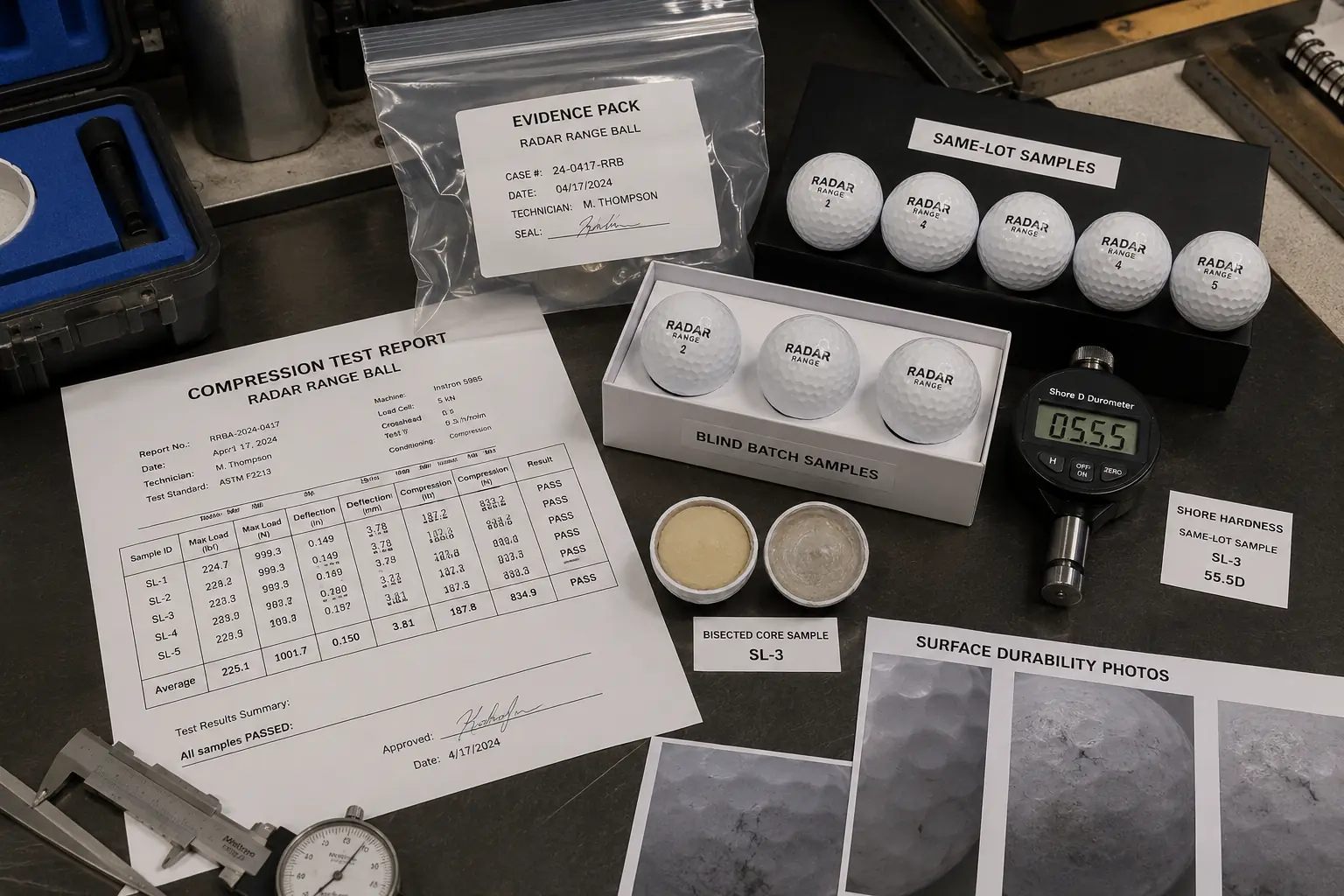
The evidence pack should start with same-lot samples and blind batch samples. Blind samples help your team see whether the bulk-like population behaves like the approved sample, not just whether one hand-picked ball looks good. Add a bisected sample so structure is visible, especially if your facility has seen early data drift or unexplained feel changes.
Then separate compression from hardness. ATTI or equivalent compression supports whole-ball deformation and energy-transfer control. ASTM D2240 / Shore hardness supports cover or material hardness consistency. Do not let a supplier use one test to replace the other.
Range balls do not always need to sit on a conforming-ball list for ordinary practice contexts. Still, serious buyers should control the logic behind stable, controlled-speed, non-hot, non-dead ball populations. The R&A conformance framework divides golf-ball requirements into general, weight, size, spherical symmetry, initial velocity, and overall distance standard categories.
The USGA explains that the Conforming Ball List Local Rule is recommended for competitions limited to highly skilled players. A separate USGA Rules FAQ also states that practice or X-Out golf balls may be used when the Committee has not required the Conforming Ball List.
For commercial ranges, the practical rule is not “tour badge or nothing.” It is controlled speed, stable compression, spherical behavior, surface durability, and lot-to-lot repeatability.
Please provide a radar-range evaluation kit with same-lot sample balls, blind batch samples, pre/post repeated-impact compression data, ATTI or equivalent method, gauge ID, calibration status, sample size, mean, SD, Cpk, Shore hardness method, clear-coat abrasion evidence, dimple-fidelity notes, and lot-linked release criteria.
| Pain/decision | Proof item | What it verifies | Evidence to request |
|---|---|---|---|
| Sample may be special | Blind batch samples | Bulk-like behavior | Test before PO |
| Compression drift | ATTI report | Whole-ball stability | Raw data/Cpk |
| Hardness confusion | D2240/Shore report | Cover/material hardness | Separate from compression |
| Dead after use | Repeated-impact log | Decay curve | Hit protocol |
| Surface breaks down | Abrasion/clear evidence | Dimple/finish stability | Photos/μm map |
| Lot mismatch | Traceability pack | Sample-to-shipment link | Approve by lot |
What belongs in a radar-range evidence pack?
A radar-range evidence pack should connect sample, method, lot, surface durability, compression control, and release criteria.
Request same-lot samples, blind batch samples, bisected sample, compression report, Shore hardness report, repeated-impact protocol, surface-durability evidence, and lot release criteria. Compare sample, blind batch, and pre-shipment lot for method consistency and data stability.
Your PO should require the approved sample, blind batch sample, repeated-impact test sample, pre-shipment lot, retained sample, production date, batch ID, compression report, Shore hardness report, clear-coat evidence, and shipped cartons to be linked under one traceable lot reference.
Bulk release should require the agreed compression window, Cpk target, Shore method, clear-coat evidence, repeated-impact result, and sample-to-lot traceability. Your team should not buy a container until the proof pack shows the ball population will protect your radar environment.
FAQ
Why do range balls fly shorter?
Range balls may fly shorter because of intentional limited-flight design, surface drag, core energy loss, or mixed wear states. For radar-heavy facilities, the bigger issue is not one fixed distance penalty; it is whether the ball population stays consistent enough for coaching and fitting.
Some commercial range balls are designed to reduce flight for safety or space control. Others start flying shorter because the core loses rebound stability, the surface wears unevenly, or the bucket mixes lots and ages. Compare one controlled ball set before judging distance loss. Track ball speed and smash spread, not only carry.
How long should range balls last?
There is no universal hit count that fits every facility. Range-ball lifespan should be defined by tested drift in compression, rebound, surface wear, ball-speed stability, and member-facing data quality under your actual usage environment.
A busy simulator center and an outdoor range do not create the same wear pattern. Use a fixed repeated-impact protocol and record temperature, impact speed, sample size, method, and pre/post data. Set replacement thresholds from measured drift, not calendar age or a generic supplier promise.
Do range balls affect TrackMan readings?
Yes, range balls can affect TrackMan or other launch-monitor readings when compression decay, mixed lots, surface wear, or wear-state differences change ball speed, launch, spin, carry, or smash factor. The device may be accurate while the bucket is not controlled.
Run a same-bay baseline before recalibrating every assumption. Separate fresh, worn, and blind-batch samples. If the controlled set reads more stable than the daily bucket, your issue is likely input population control, not only device setup or golfer delivery.
Why are my radar numbers inconsistent?
Your radar numbers may be inconsistent because the ball population is not stable. Mixed lots, compression decay, worn surfaces, or different wear states can create ball-speed, launch, spin, carry, and smash-factor noise.
Control the input before blaming the monitor. Use the same bay, same club, same operator, and one labeled sample group. If the controlled group produces cleaner windows than the daily bucket, the facility needs a range-ball replacement or segregation rule.
What is core compression in range balls?
Core compression is a whole-ball deformation and energy-transfer control metric. In B2B buying, the useful value is not one number; it is target, tolerance, method, standard deviation, Cpk, sample size, and lot link.
Request ATTI or equivalent compression testing. Ask for raw values, mean, range, standard deviation, gauge ID, calibration status, and lot number. Do not confuse compression with ASTM D2240 Shore hardness. Compression controls whole-ball behavior; Shore hardness controls cover or material indentation response.
Are one-piece range balls better?
One-piece range balls can be durable, but they may not be the best fit for radar-heavy facilities that need stable, realistic data. Your team should choose by data stability, durability, and replacement economics.
A simple structure can be practical for some outdoor practice environments. Simulator centers, coaching bays, and fitting studios may need a more controlled performance profile. Test radar baseline before choosing structure, compare cost per reliable hit, and match the design to simulator, outdoor range, or limited-flight use.
Conclusion
Radar accuracy starts with a stable ball population. A serious B2B range-ball program should connect core fatigue logic, compression-decay measurement, Shore hardness, surface durability, radar baseline, tolerance controls, and cost-per-reliable-hit economics before the next bulk order.
The cheapest ball in the quote sheet can become the most expensive ball in the bay if it damages coaching trust, fitting accuracy, or member confidence. Buy the population, not the promise.
You might also like — Golf Ball QC in China: The 4 Must-Have Testing Processes