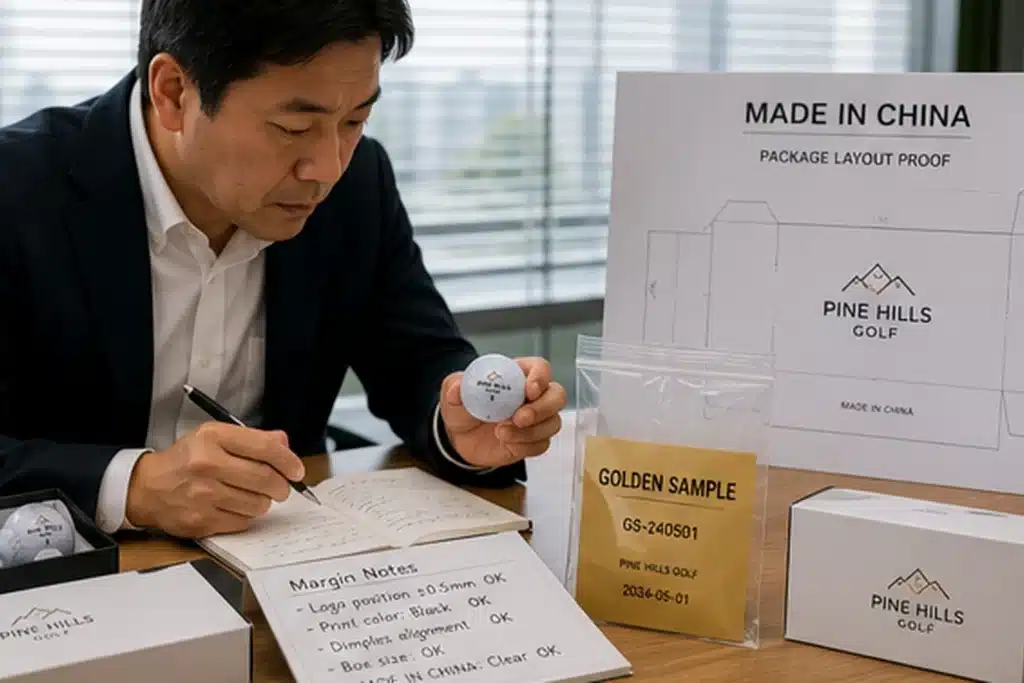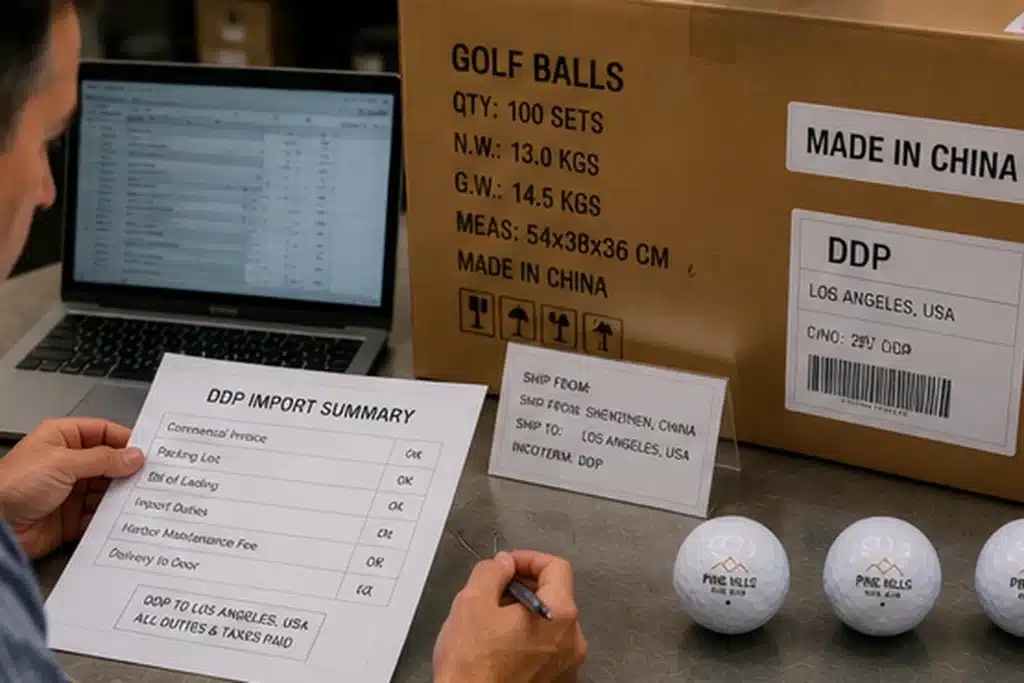
The real custom logo golf ball MOQ is the highest applicable minimum created by your ball supply, fresh production, logo printing, artwork, packaging, or development requirements. That controlling constraint is your binding MOQ.
Three suppliers may therefore quote 500, 1,000, and 3,000 balls for what looks like the same custom-logo order. All three numbers can be valid if each supplier is quoting a different production or fulfillment route.
An “MOQ: 1,000 pcs” quote is incomplete unless the supplier states whether that minimum applies per order, per ball model, per artwork, per print configuration, per packaging run, or per production batch.
Some specification changes create an MOQ Reset and increase the quantity you must commit to. Others create only a Cost Reset, changing setup charges or unit price without changing the ball MOQ. Your purchasing team should know which one applies before approving any artwork, packaging, or product revision.
Which MOQ Is Actually Blocking Your Order?
A quotation marked “MOQ: 1,000 pcs” looks clear until you discover that the ball, logo, artwork versions, packaging, and development route can each carry a different minimum.
Your custom-logo order can carry several minimums at the same time, and the highest applicable one becomes the binding MOQ. A supplier may have enough finished balls for your order while facing a higher fresh-production, per-artwork, packaging, or tooling minimum.
The useful model is an MOQ Stack rather than one factory number. Fixed setup, production changeovers, batch requirements, packaging, and upstream supplier minimums do not necessarily shrink just because your order does. Shopify’s current guide to minimum order quantity similarly notes that MOQ can involve complex production, packaging, and upstream-supplier constraints rather than one simple threshold.
| Pain / decision | MOQ layer | What may create it | What to verify | Buyer action |
|---|---|---|---|---|
| Finished balls available | Stock-ball minimum | Inventory / supplier policy | Already produced? | Confirm stock route |
| Fresh balls required | Production minimum | Batch / production slot | New run required? | Request fresh-run MOQ |
| Logo requested | Printing minimum | Print configuration | What setup is quoted? | Confirm print scope |
| Multiple designs | Artwork minimum | Separate versions | MOQ per artwork? | Split by version |
| Custom retail pack | Packaging minimum | Upstream pack supplier | Separate pack MOQ? | Quote it separately |
| New development | Development minimum | Tooling / new process | Existing route or new? | Separate development |
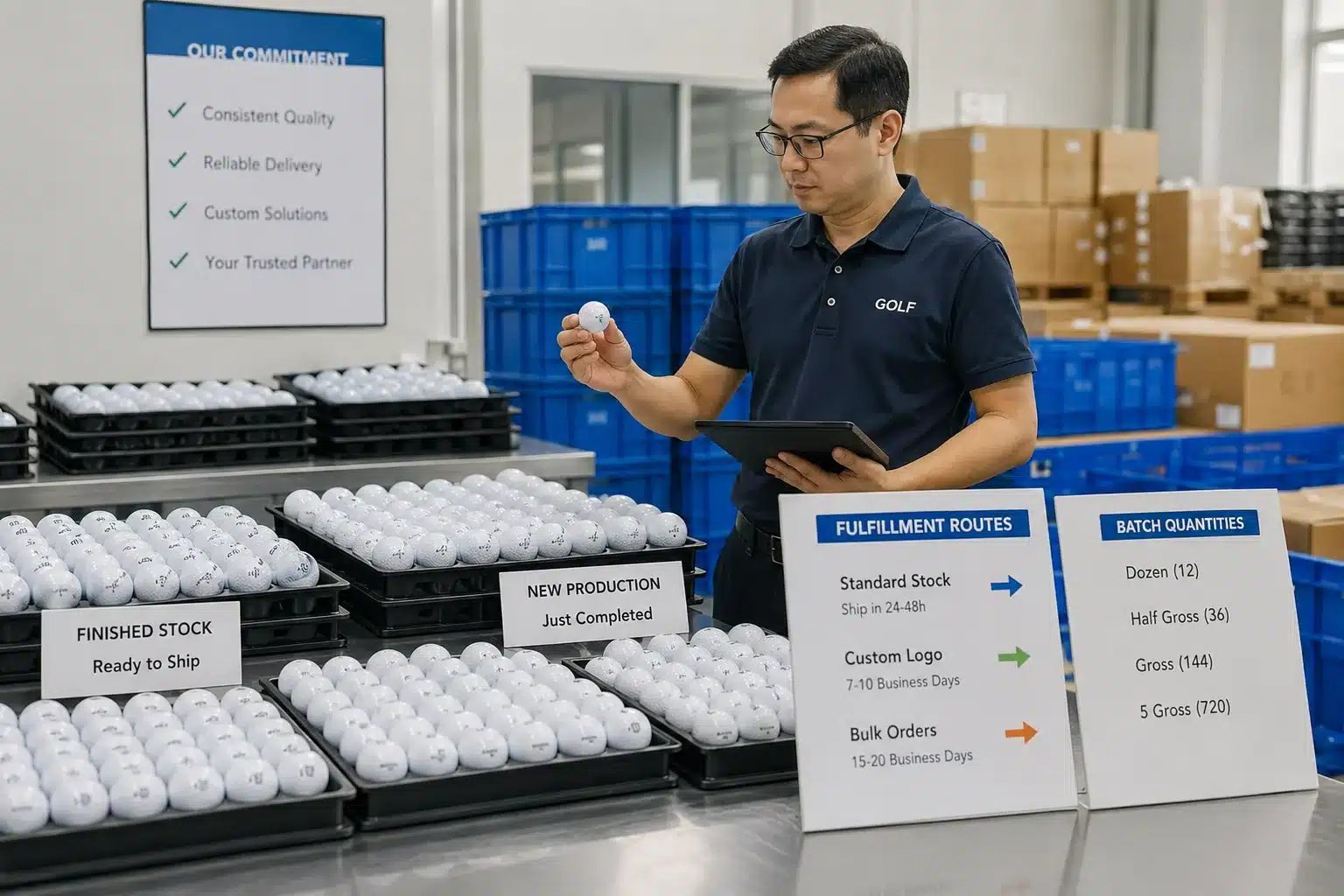
Golfara’s own workflow shows why the MOQ Stack matters. A standard 1-color, 1-position custom-logo project can start from 1,000 balls, while our current custom dozen-box supplier normally requires 500 box sets—enough packaging for 6,000 balls. In that configuration, the ball is not the binding constraint; the packaging can be.
That 1,000-ball figure is Golfara’s commercial baseline for a standard logo configuration, not an industry-wide custom logo golf ball minimum order.
Stock Ball or Fresh Production?
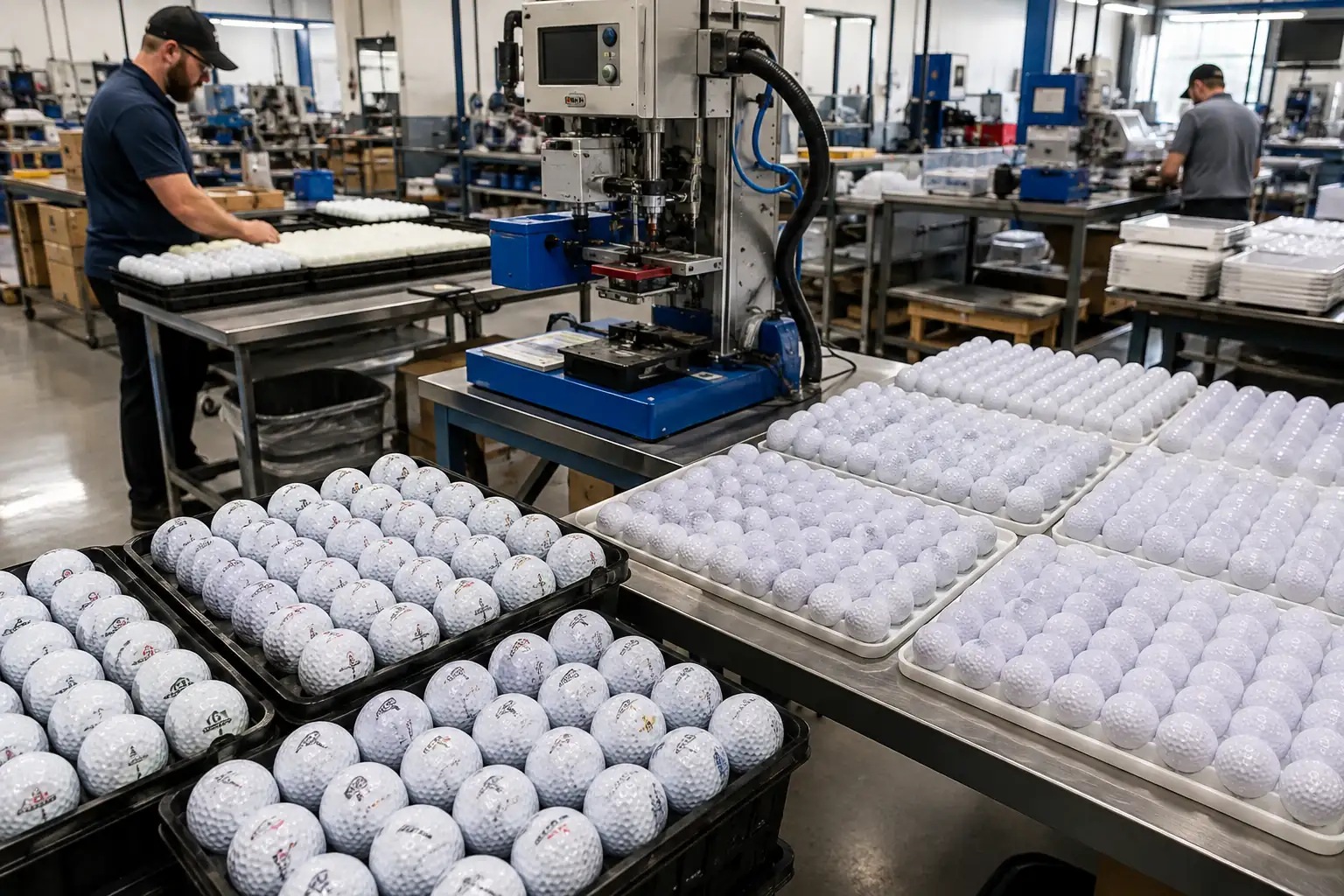
Personalizing finished inventory and scheduling fresh golf-ball production are different purchasing events. A stock route starts after the manufacturing batch already exists; fresh production can introduce batch, material, capacity, and scheduling constraints before logo printing even begins.
That is why a seller can offer a very small minimum for personalization while a manufacturer quotes a much larger minimum for what appears online to be the same “custom golf balls.”
A one-line MOQ with no scope is a failure signal. Require the supplier to state whether the quote is based on finished-stock personalization, fresh production, or new product development, then identify which minimum is binding for the exact configuration being approved.
Supplier shall state the minimum separately for ball supply, fresh production, logo printing, artwork/version, packaging, and tooling/development where applicable.
✔ True — Different production routes can legitimately create different MOQs
Two suppliers can receive the same logo and quote different minimums because one is decorating finished stock while the other is reserving capacity for fresh production.
✘ False — “Every custom-logo golf ball quote covers the same work”
Verify what is being supplied, manufactured, printed, packaged, and developed before you judge the number.
Why Do Suppliers Quote Different MOQs?
You can send nearly identical artwork to several suppliers and receive very different minimums. Treating the lowest number as “flexible” and the highest as “unreasonable” can eliminate the better operating fit.
Different MOQ quotes often reflect different supplier operating models, not one supplier breaking an industry rule. One seller may personalize finished inventory, another may schedule fresh production, and another may depend on separate printing or packaging partners.
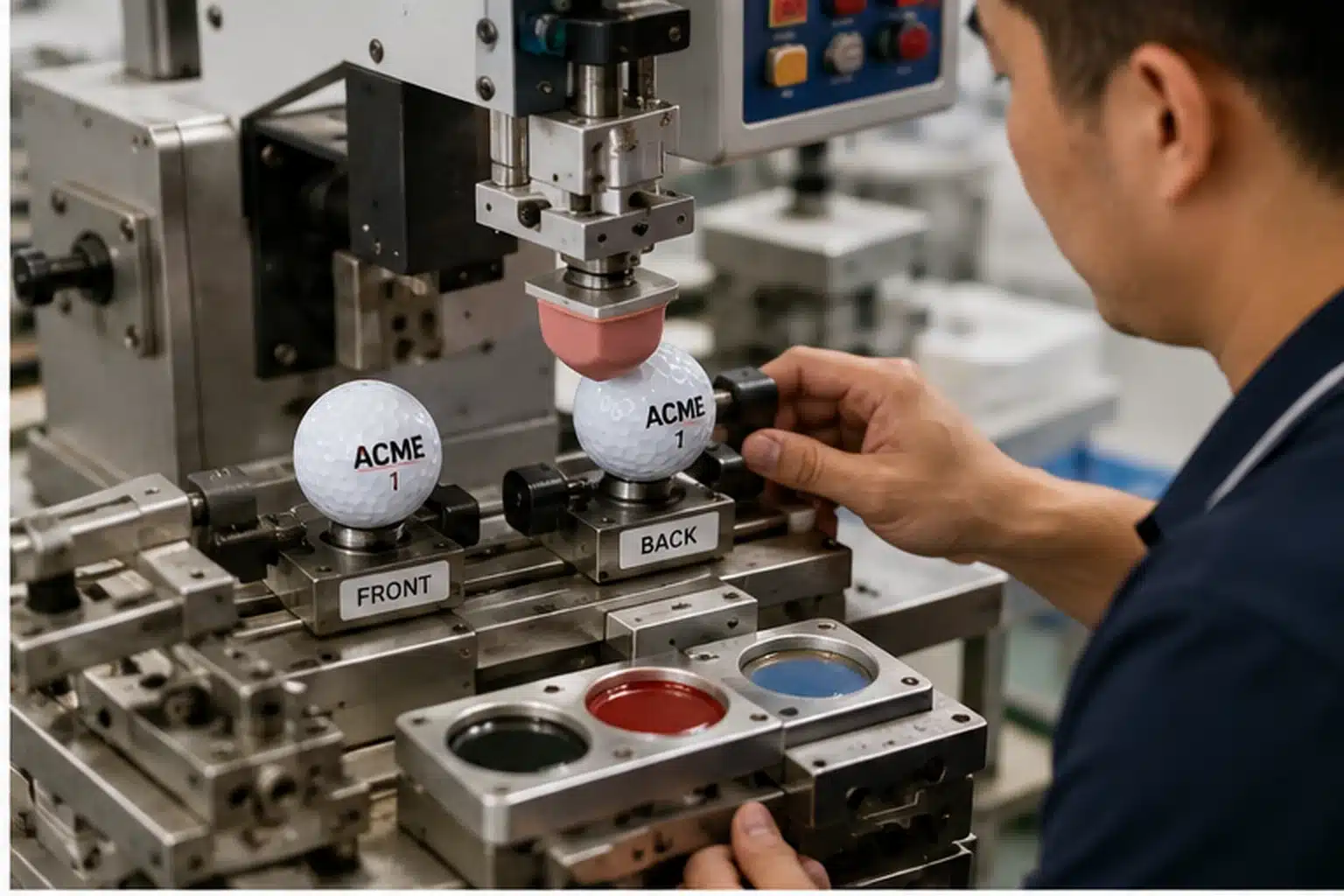
As of September 2026, public customization programs make this difference easy to see. Titleist’s Custom Logo Upload program requires six dozen per ball model and does not allow different ball models to be combined to reach that minimum. Bridgestone’s customized golf ball program currently requires 12 dozen for custom-logo orders but only 2 dozen for text personalization.
Those figures are not OEM benchmarks. They show that the applicable minimum can change with the fulfillment model, ball model, artwork route, and decoration scope.
The manufacturing side works the same way. In our China golf ball manufacturing and sourcing experience, a larger factory does not automatically offer a lower custom-logo MOQ. High-throughput plants may protect line utilization, prioritize larger production blocks, or use longer internal approval chains. Smaller specialists may deliberately structure their operations around more flexible logo and packaging programs.
Conversely, a specialist whose production schedule is designed around smaller programs may accept the same configuration within its normal operating model rather than treating it as an exception.
That is why your sourcing file should contain more than three MOQ numbers. Require each supplier to declare whether the offer uses finished stock, fresh production, or new development.
Your team should be able to explain why Supplier A quoted 500 while Supplier B quoted 3,000.
For most B2B programs, quote clarity and reversible inventory commitment are more useful than winning the lowest-MOQ headline.
How Does Logo Setup Change Your MOQ?
Your original quote covers one black logo. Marketing adds a second position or another color, and the revised price increases. The easy conclusion is “more colors caused a higher MOQ.” That is often too simplistic.
Logo complexity does not automatically mean a higher ball MOQ. At Golfara, extra colors, positions, or print actions more often change setup cost or unit printing price. Your supplier should explain printing workload separately from the quantity minimum.
Colors or Print Actions?
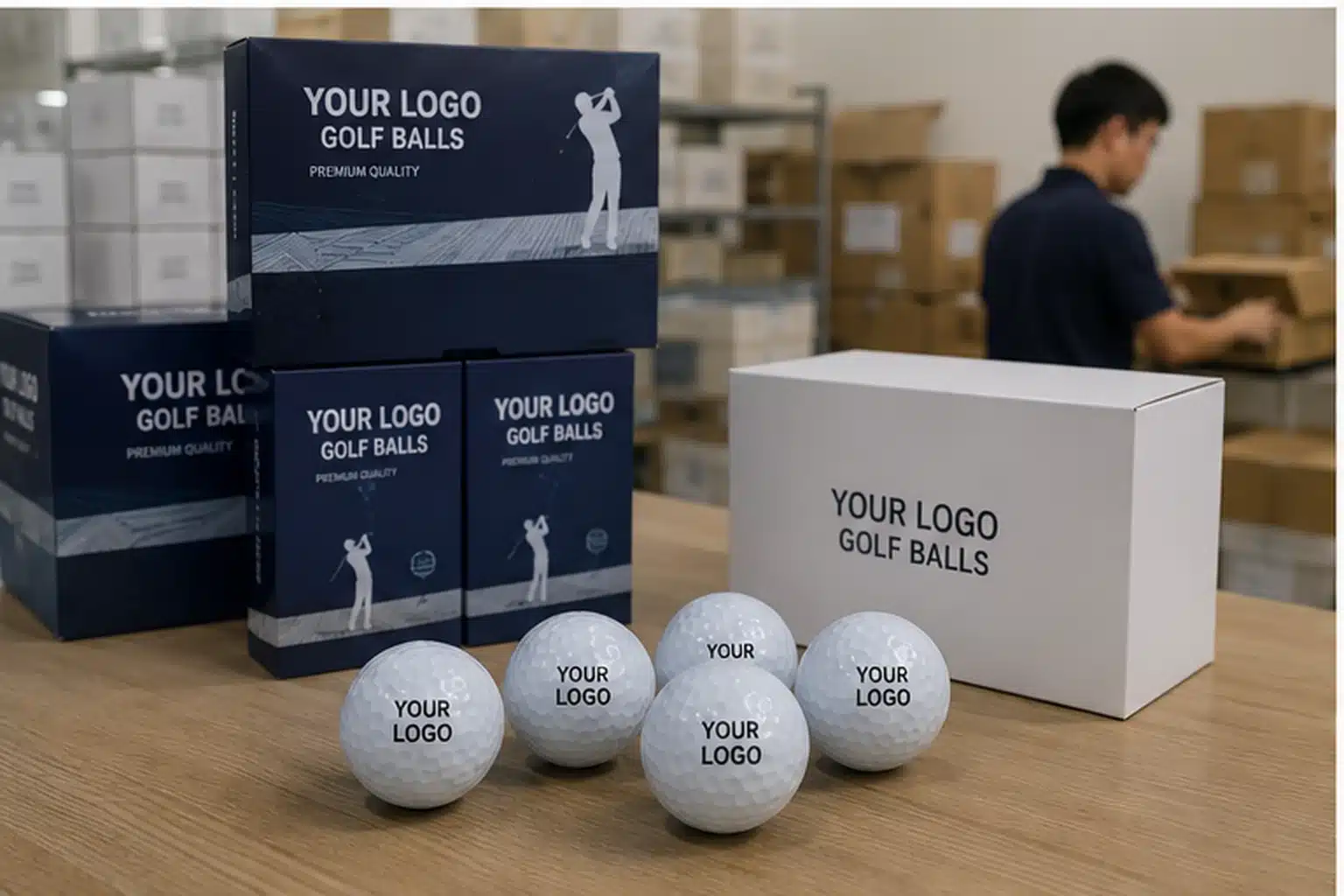
In Golfara’s current pad-printing workflow, a six-station setup is better understood in terms of independent print actions rather than simply “six colors.” Different logo positions can consume separate print actions even when the ink color remains the same.
One black logo in one position is roughly one print action. The same black logo in two positions is roughly two actions. One two-color logo in a single position can also require roughly two actions.
| Print configuration | Colors | Positions / sides | Approx. print actions | Buyer interpretation |
|---|---|---|---|---|
| One black logo | 1 | 1 | 1 | Establish base setup |
| Black logo front + back | 1 | 2 | 2 | Ask cost impact |
| Black + red logo, one side | 2 | 1 | 2 | Ask cost impact |
| Four separate black logos | 1 | 4 | 4 | Confirm setup workload |
These are Golfara production-workload examples, not a universal formula linking print actions directly to MOQ.
This distinction matters because your purchasing question is not merely, “Why did printing get more expensive?” It is:
“Did my minimum commitment change, or did only my decoration cost change?”
At Golfara, moving from 1-color / 1-position to 2-color / 1-position or 1-color / 2-position generally increases printing workload before it changes the standard ball MOQ. Additional artwork versions and harder registration can add setup burden as well.
Color-only printing logic is a failure signal. If a supplier tells you “two colors means higher MOQ,” ask whether the actual change came from color count, positions, sides, artwork versions, registration, or another independent print action.
Require a print-configuration sheet showing colors, positions, sides, artwork versions, and independent print actions where relevant. For every revision, have the supplier state whether it affects MOQ, setup charge, unit printing price, or a combination.
For the full technical comparison of decoration routes, keep the deeper engineering in Custom Golf Ball Printing Methods: Pad vs UV & Adhesion Standards.
✔ True — Two same-color logos can create more setup work than one
A second position can require another independent printing action even when the ink color never changes.
✘ False — “The number of ink colors alone determines printing MOQ”
More colors can increase workload and cost, but quantity changes only when another production or supply minimum becomes binding.
What Changes Can Reset Your MOQ?
Your supplier confirms 1,000 balls. Then you revise the artwork, add printed retail boxes, or change the product route. The commercial terms move, and without a reset framework the revision can look arbitrary.
Not every customization change resets your MOQ. Some changes only reset setup cost or unit price, while others introduce a new production or supplier minimum. At Golfara, added logo complexity usually changes printing cost first.
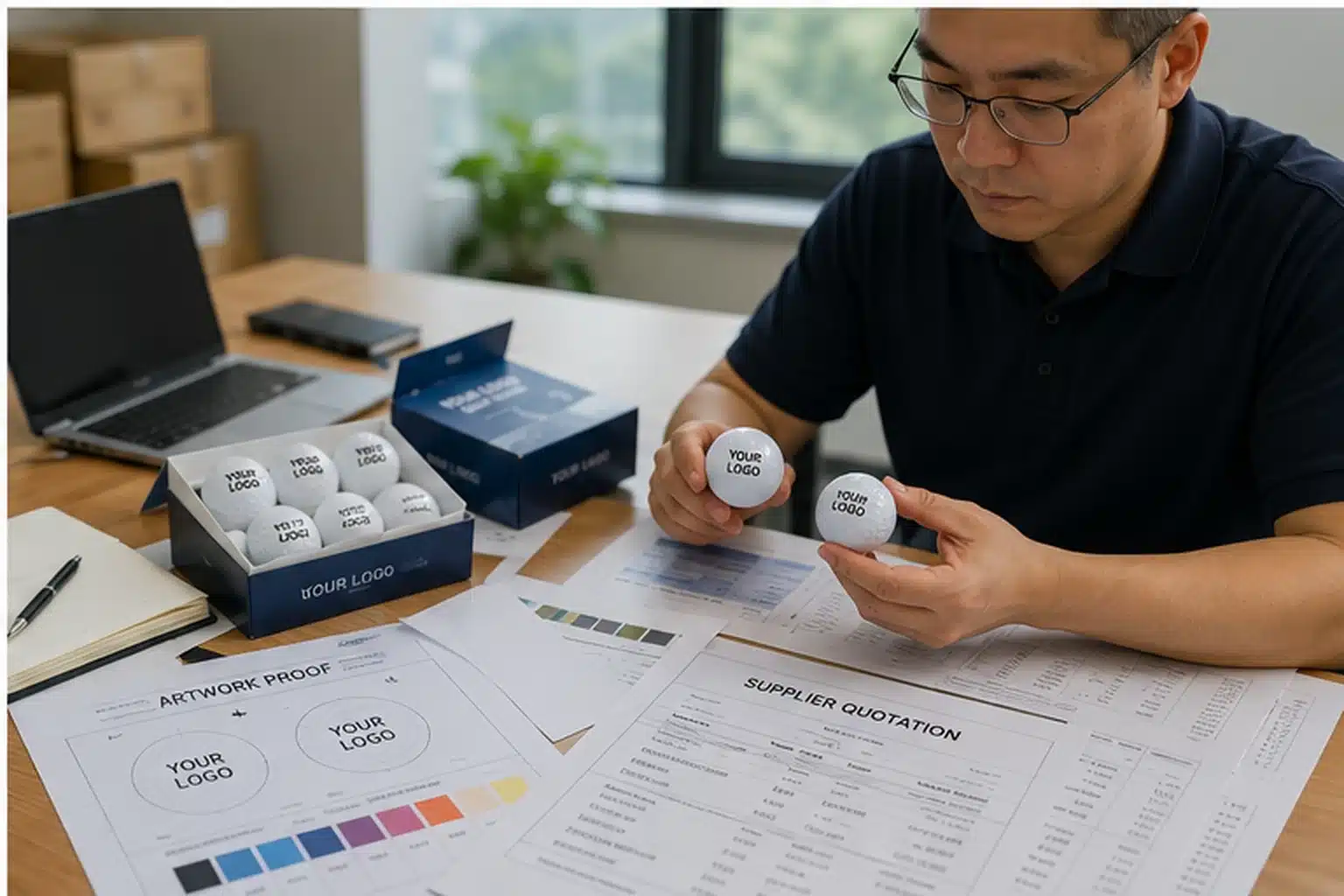
MOQ Reset or Cost Reset?
Ask one question before approving a revision: “Does this change reset the MOQ, or only the setup cost?” That separates a larger inventory commitment from a decoration-price change.
A second ink color, second position, double-sided printing, additional print actions, difficult registration, or extra artwork versions will often behave as a Cost Reset first. Your setup charge or unit printing price may move while the underlying ball minimum remains unchanged.
An MOQ Reset is more likely when the request introduces an independent production constraint: fresh manufacturing, another ball construction, new tooling, a dedicated body-color route, custom printed packaging, or another supplier-controlled process.
Golfara’s packaging workflow is a concrete example. The standard 1-color / 1-position logo baseline is 1,000 balls, while the current custom dozen-box supplier normally requires 500 box sets.
Each set holds 12 balls, so that packaging run represents 6,000-ball packaging capacity.
The project can therefore look like this:
Ball minimum: 1,000 balls
Standard logo printing: no higher binding minimum
Custom dozen-box minimum: 500 sets
Packaging capacity: 6,000 balls
Binding constraint: packaging
That does not automatically mean you must increase the ball order to 6,000 pieces. It means the packaging has created a separate purchase commitment. Depending on the supplier arrangement, you may order the full 500-box packaging run and hold unused boxes for reorders, request a small-run exception, or use standard packaging until your volume justifies the custom box.
For procurement, the important distinction is between a higher ball MOQ and a higher packaging commitment. They can affect working capital differently even when they appear under the same custom-logo project.
Below 500 box sets, Golfara’s current packaging-supplier experience indicates that the supplier may sometimes consider a smaller run with an additional handling charge of approximately US$180. This is not a fixed industry fee, and the packaging supplier may still decline the order when production capacity is tight.
Paying an extra fee may solve the economics of a short run, but it does not necessarily solve the capacity constraint.
That distinction matters to your launch plan. Paying more does not automatically create production capacity. A small-run surcharge may make the order commercially acceptable, but the packaging supplier still needs an available production window.
Require a written list of specification changes classified as MOQ Reset, setup-cost reset, or unit-price reset. Do not approve the revised specification until the commercial impact is clear.
The quoted MOQ shall apply only to the approved ball source, model or construction, logo configuration, packaging route, and development scope.
For packaging formats and material choices themselves, move the deeper discussion to What Are the Best Packaging Options for OEM Golf Balls?.
How Should You Compare MOQ Quotes?
Two quotations can both say “Custom Logo Golf Balls” while one covers existing stock with decoration and the other covers fresh ball production, pad printing, and custom packaging. Comparing unit price first creates false precision.
Do not compare two MOQ quotes until both suppliers are quoting the same production scope. Normalize ball source, model or construction, print configuration, artwork, packaging, and reset conditions before comparing unit price.
| Comparison field | Quote A | Quote B | Risk if different | Buyer action |
|---|---|---|---|---|
| Ball source | Stock vs fresh production | Normalize route | ||
| Model / construction | Different product | Match specification | ||
| Print configuration | Different setup workload | Match colors / positions | ||
| Artwork count | Per-version minimum | Confirm artwork rule | ||
| Packaging / pack MOQ | Upstream constraint | Quote separately | ||
| Binding MOQ / reset triggers | Commitment can change | Confirm in writing |
Keep the Incoterm or delivery basis on the comparison sheet so both suppliers are quoting the same commercial scope, but do not use freight to invent a universal custom golf ball order minimum.
“No setup fee” means there is no separately billed setup charge; it does not mean no production preparation is required. A pad-printed order can still involve plate preparation, color matching, fixture adjustment, test printing, ink preparation, curing, and cleaning.
Industrial pad-printing systems can also involve hardener-controlled inks and limited processing windows. Marabu’s Tampa Pur TPU technical data provides one industrial example.
The procurement point is straightforward: production preparation can be real even when the quotation contains no separate setup line.
Your supplier may recover that work through a setup charge, unit printing price, or another commercial mechanism. Ask how the quotation treats it instead of assuming that “no setup fee” means no setup work.
MOQ changes with no written trigger are a failure signal. If your quantity moves from 1,000 to 3,000 after a specification revision, the sourcing file should explain which constraint changed.
Before comparing unit price, your normalized supplier-comparison sheet should confirm the same product, production route, print configuration, artwork count, packaging basis, and delivery assumptions.
Use this RFQ verification request:
Please state the stock/ball minimum, fresh-production minimum, logo-printing minimum, minimum per artwork/version, packaging minimum, and tooling/development minimum where applicable. Identify which minimum is binding for this quotation, and state which specification changes would reset the MOQ versus only changing setup cost or unit price.
That gives your team a written deliverable it can approve, audit, and reuse when the artwork receives one last “tiny” revision.
✔ True — A higher MOQ quote can cover a more complete production scope
Fresh manufacturing, defined print setup, and custom packaging are not automatically comparable with a seller decorating finished stock.
✘ False — “The same custom-logo description makes two quotations comparable”
Normalize production, print, artwork, packaging, and reset conditions first. Only then does the price comparison become useful.
FAQ
Is MOQ per order, model, or artwork?
A custom golf ball MOQ may apply to the total order, each ball model, each artwork, or another configured SKU. Never treat “MOQ: 1,000 pcs” as complete unless the supplier states exactly what that number applies to.
The distinction matters because a total PO quantity can satisfy one rule while failing a per-model or per-artwork minimum.
- Confirm whether different ball models can be combined.
- Ask whether each artwork carries its own minimum.
- Confirm whether reorder rules use the same basis.
- Put the MOQ basis directly on the quotation.
Can I mix golf ball models to reach the MOQ?
Sometimes, but you should never assume quantities across different models can be combined. Finished-stock personalization and fresh production can follow completely different model-mixing rules, even when both offers are described as custom golf balls.
A mixed order may be one decoration job but two manufacturing batches, depending on what the supplier must actually produce.
- State the required quantity for each model.
- Ask whether models count toward one shared MOQ.
- Separate personalization rules from fresh-production rules.
- Require the aggregation rule in writing.
Can I split one order across different logos?
Possibly, but your total order quantity does not automatically allow unlimited artwork versions. Additional logos may change setup cost, per-version requirements, or—in some supplier models—the applicable per-design golf ball MOQ.
The ball supply can remain identical while the printing workload changes for every additional artwork.
- List each artwork and its quantity.
- Confirm the minimum per artwork or version.
- Ask whether the change is an MOQ Reset or Cost Reset.
- Approve each artwork version separately.
Does a reorder automatically get a lower MOQ?
Not necessarily. Existing artwork may reduce part of the preparation work, but production, model, artwork, and packaging minimums can still apply to a reorder. An old logo file does not remove current capacity or supplier constraints.
Treat reorder conditions as part of your first sourcing decision, especially if steady replenishment matters to your channel.
- Ask for first-order and reorder MOQ together.
- Confirm whether archived artwork changes setup cost.
- Recheck packaging minimums.
- Record what would make previous terms stop applying.
Does paying a small-order fee guarantee acceptance?
No. A small-order charge can compensate for inefficient economics, but it cannot guarantee available production capacity. A supplier can accept the commercial logic of your exception and still lack a workable production slot.
This is particularly important when packaging or another upstream process is controlled by a separate supplier.
- Ask whether the fee confirms acceptance or only allows review.
- Confirm current production load.
- Get the exception in writing.
- Do not schedule a launch until the small run is formally accepted.
Can I approve samples before committing to full MOQ?
Often yes, but sample approval and production MOQ are separate commercial issues. A decorated sample or artwork proof does not automatically change the minimum quantity required for the final production order.
Make sure the sample is evidence for the right thing: artwork, appearance, or the intended production route.
- Confirm what the sample represents.
- Verify whether it uses the intended ball and print route.
- Keep sample approval separate from MOQ negotiation.
- Use the dedicated low-MOQ OEM trial guide if your goal is a smaller first production run.
Conclusion
The useful custom logo golf ball MOQ is not the lowest number a supplier advertises. It is the minimum attached to the exact configuration your team intends to buy.
Separate ball, printing, artwork, packaging, and development minimums, then identify the binding MOQ. Before approving any specification revision, classify it as an MOQ Reset or a Cost Reset and require the effect in writing.
Once you know what created the minimum and what would make it stop applying, the next sourcing question is whether your configuration can support a realistic 1,000–3,000 pcs OEM trial without turning a controlled first order into an entirely new development program.
You might also like — Golf Ball OEM MOQ: Is a 1,000–3,000-Piece Trial Realistic?