When golfers complain that your launch monitor reads short, the problem may not be the radar. It may be the old balls in the bucket.
Yes, old range balls can affect launch monitor data when compression drift, surface wear, dimple damage, or mixed-bucket inventory changes ball speed, spin, carry, and smash factor. A launch monitor may be measuring correctly, but the ball population may no longer behave like one controlled input group.
| Data problem | Likely ball cause | Facility check | Buyer move |
|---|---|---|---|
| Short carry | Compression drift | Fresh vs worn A/B test | Set retirement trigger |
| Smash factor noise | Ball-speed instability | Same-bay test | Track spread |
| Spin inconsistency | Dimple or cover wear | Surface grading | Cull worn balls |
| Bay complaints | Mixed bucket | Lot separation | Use batch IDs |
| Reorder drift | Weak factory QC | 12-ball QC report | Request compression spread |
Use this guide to diagnose ball-related data noise in tech-enabled ranges, indoor golf centers, academies, and fitting studios, then build a range ball retirement policy and RFQ that controls compression spread, batch tracking, and replenishment quality.
Do Old Range Balls Really Affect Data?
Your customers may blame the radar, software, bay setup, or coach when carry distance looks short or smash factor jumps. But your monitor can only measure the physical ball it sees.
Old range balls can affect launch monitor data when wear, compression drift, and mixed inventory change the ball itself. Your facility should treat the ball population as an input source, then test it before assuming the radar, camera system, or software is wrong.
Modern launch-monitor customers watch ball speed, launch, spin, carry, and smash factor as if those numbers come only from the golfer. In reality, the ball is part of the test system. If the bucket contains new balls, old balls, scuffed balls, washer-worn balls, and multiple batches, your screen may be showing a real measurement of unstable inputs.
External launch-monitor guidance also warns that range balls may produce lower or less consistent numbers than premium balls because construction, surface wear, dirt buildup, age, and condition can affect measured distance, spin data, carry, and shot-to-shot variation. That does not mean your device is wrong. It means your facility should control the ball population before blaming the hardware. launch-monitor guidance on range balls
| Symptom | Possible ball issue | Facility check | Buyer move |
|---|---|---|---|
| Reads short | Compression drift | Fresh control lot | Run A/B test |
| Smash varies | Ball-speed spread | Same club and bay | Track standard deviation |
| Spin jumps | Cover or dimple wear | Surface grading | Cull worn balls |
| Guests complain | Mixed buckets | Batch separation | Create control lots |
| Reorder feels different | New batch drift | QC report | Request batch data |
Your first deliverable should be a radar baseline report comparing fresh control balls with daily-use balls. Run the same-bay comparison before opening a hardware complaint. Track average and spread for ball speed, spin, carry, and smash factor.
Facility blames the monitor before testing control balls is a failure signal. A stronger process keeps a fresh control lot available, separates daily-use balls by batch where possible, and links launch-monitor complaints to a ball-population check before service time is wasted.
✔ True — The monitor may be measuring unstable inputs
A calibrated radar or camera system can still show noisy data if your bucket contains balls with different ages, wear levels, surfaces, and compression states.
✘ False — “Short readings automatically mean the system is inaccurate”
Your team should control the ball population first. Only then can you judge setup, calibration, environment, coach interpretation, or hardware service needs.
Which Data Points Drift First?
Your team may see shorter carry, lower ball speed, noisy spin, or inconsistent smash factor, but each symptom points to a different diagnostic path.
The first warning sign is usually not one bad shot; it is a wider data window. Watch ball speed, smash factor, spin rate, carry distance, and carry dispersion over a controlled sample so your team can separate ball-condition drift from swing variation.
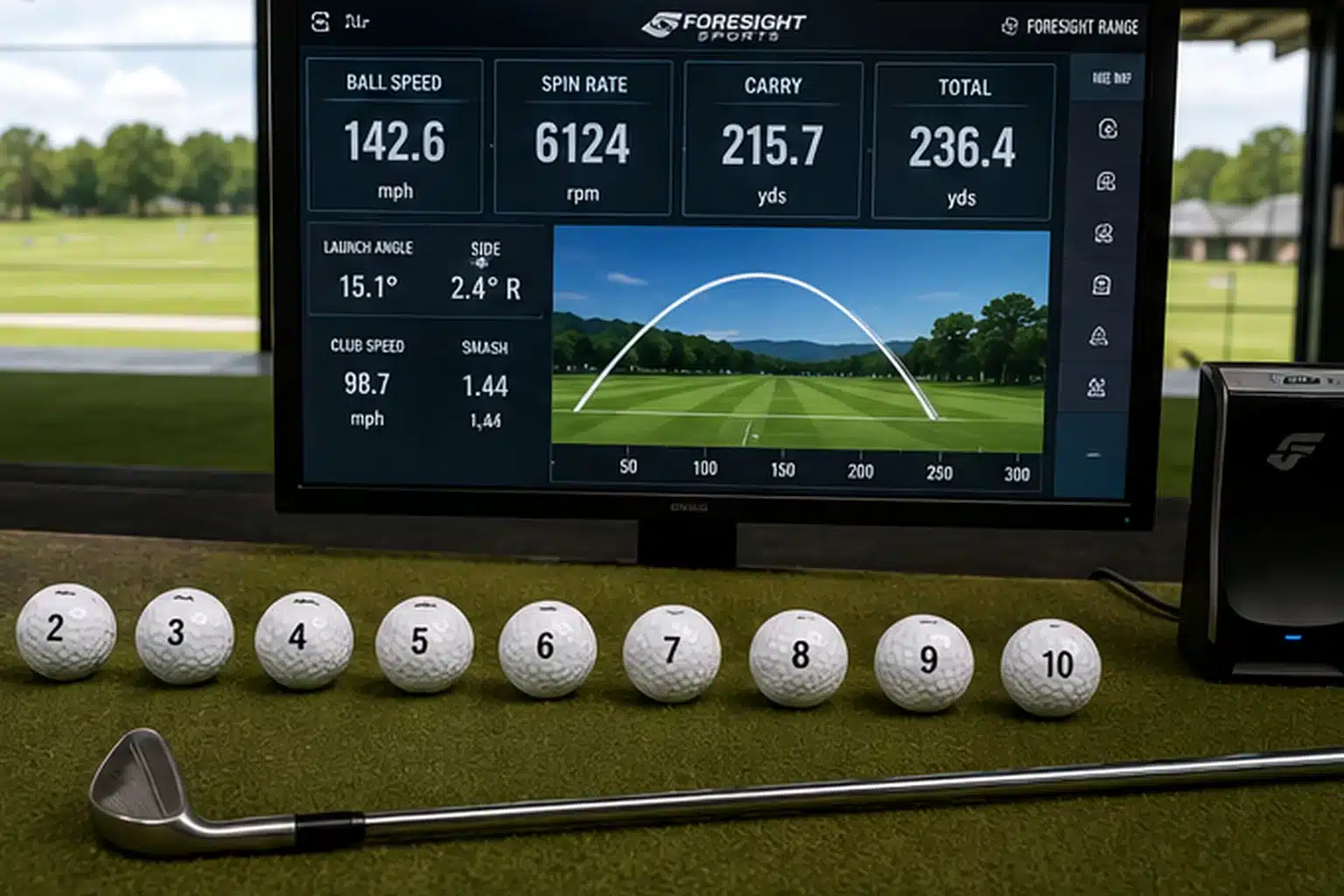
Ball Speed, Spin, Carry, or Smash?
Ball speed deserves special attention because customers often judge the whole bay by carry distance. Ball-speed guidance treats ball speed as a major factor in how far the ball carries and notes that gaining 1 mph can add up to about 2 yards of driver distance. Keep that in its proper driver context; do not turn it into a universal rule for every club. ball-speed guidance
For facility operations, the practical issue is spread. One short shot can come from contact, face angle, fatigue, wind, mat interaction, or player movement. A wider window across many controlled shots suggests the input group may be unstable.
| Metric | What drift may show | Ball-related cause | Buyer move |
|---|---|---|---|
| Ball speed | Lower energy return | Compression drift | Check compression spread |
| Smash factor | Efficiency noise | Mixed ball population | Separate control lot |
| Spin rate | Inconsistent readings | Cover or dimple wear | Grade surfaces |
| Carry | Shorter or wider window | Speed and spin change | Run A/B test |
| Dispersion | Unclear fitting result | Mixed buckets | Track lot identity |
Track average and standard deviation for each metric during fresh-lot versus daily-bucket testing. The average tells your team whether the bucket trends low. The standard deviation tells your team whether the bucket is too noisy for coaching, fitting, or paid practice interpretation.
Request incoming range-ball QC data before the next shipment becomes your new baseline. A useful report should include 12-ball raw compression, weight, and diameter values with mean, standard deviation, range, instrument ID, calibration date, and batch ID. New balls with wide spread can create noisy launch-monitor data before wear even begins.
What Is the Mixed Bucket Problem?
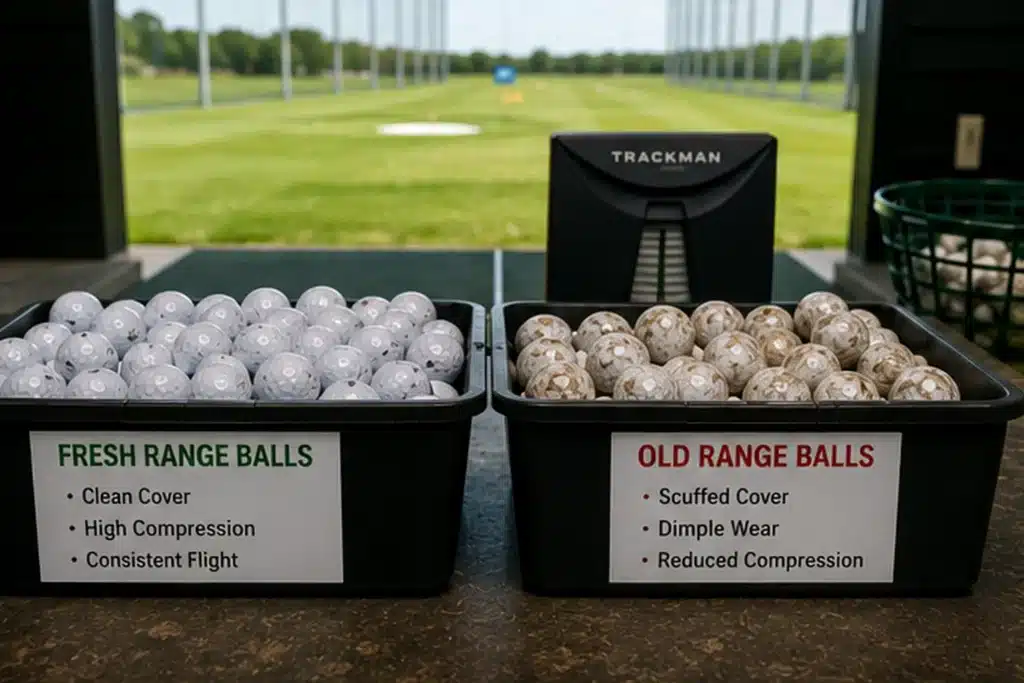
Your range may have new balls, old balls, different batches, washer-worn balls, surface-scuffed balls, and visually acceptable but internally tired balls in the same bucket.
The mixed bucket problem is when one bucket contains balls with different ages, wear levels, compression states, and batch histories. A coach can adjust for a known baseline, but random ball-to-ball variation can hide whether the golfer changed the swing or the ball changed the data.
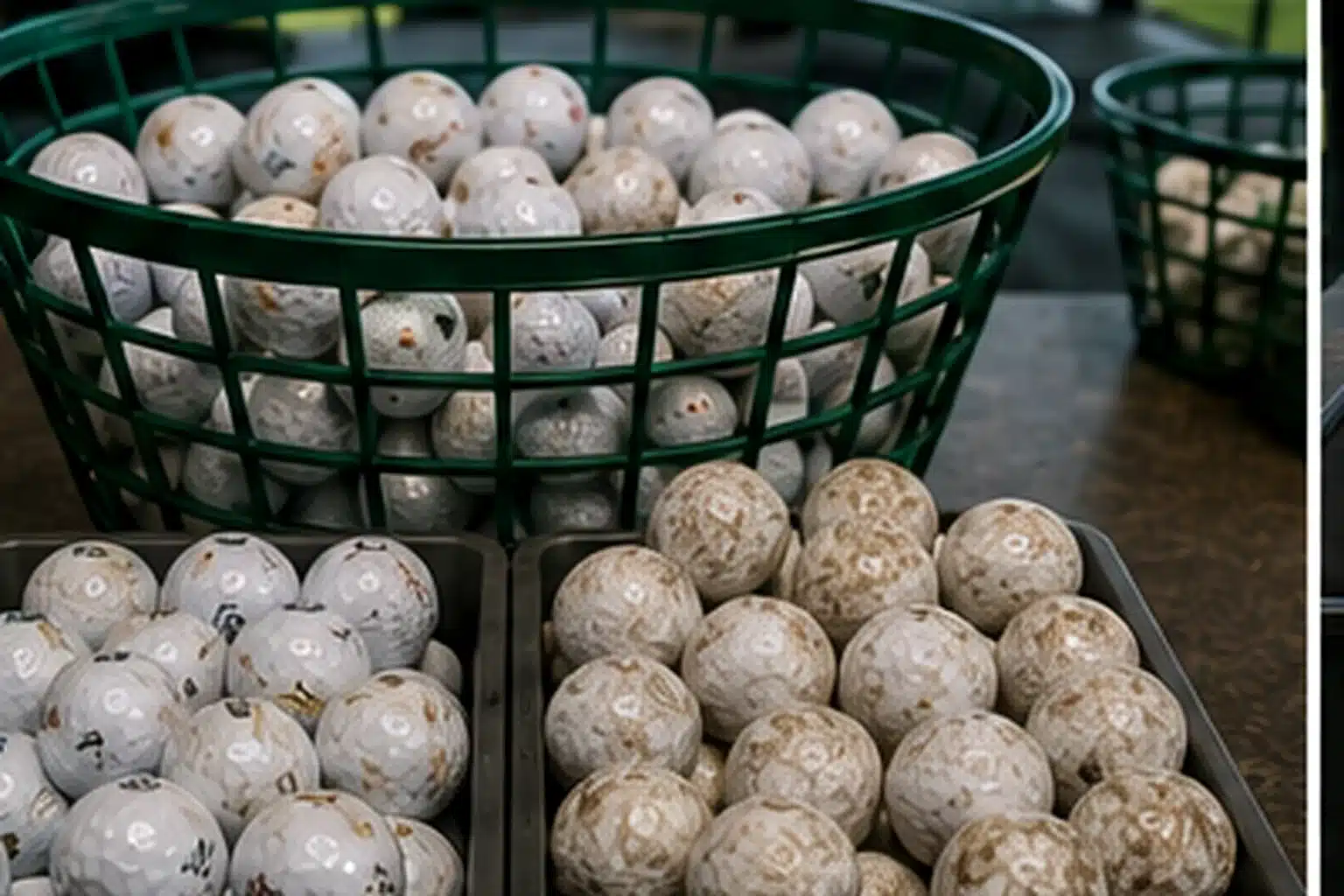
Why Is Consistency Worse Than Short Distance?
A uniform short ball population can be managed. Your coaches can explain the baseline, use a facility-specific adjustment, or reserve a better control lot for gapping and fitting. A uniform fresh lot can also be managed. The worst situation is a random bucket where one ball behaves like a newer range ball, the next behaves like a tired one, and the third comes from a different batch with a different surface condition.
That is mixed bucket launch monitor data at its most frustrating. The golfer thinks the swing changed. The coach thinks the strike changed. The fitting team wonders whether the club changed. Meanwhile, the ball population may be changing shot by shot.
Daily bucket has no batch separation is a failure signal. Sort a sample bucket by batch ID, visual grade, and surface condition before testing. Keep fresh control lots, daily-use lots, questionable lots, and retirement candidates separated. Your bucket segregation SOP should define which balls belong in lesson bays, fitting bays, general range circulation, and reject bins.
The deliverable is a bucket segregation SOP with batch-age and surface-grade categories. Staff should not need to make a judgment call every time they see an old ball. They should have clear rules for keep, test, segregate, and retire.
✔ True — Consistency beats raw distance for data facilities
A known, repeatable range-ball baseline can be explained. A mixed bucket creates random noise that makes coaching, fitting, and customer trust harder to protect.
✘ False — “Every bucket is acceptable as long as the balls look white”
A ball can look playable from a distance while still carrying surface wear, batch drift, washer damage, or compression spread that affects data consistency.
How Can Facilities Test Old Balls?
Your team needs a repeatable way to prove whether data noise comes from launch-monitor setup or from the range ball population.
A same-bay A/B test is the cleanest first step before blaming the monitor. Hit a controlled sample of fresh balls and a matched sample from your daily bucket under the same setup, then compare average and spread for ball speed, spin, carry, and smash factor.
Fresh Lot vs Daily Bucket?
Use one bay, one monitor, one club, and one tester where possible. Keep the environment as stable as your facility reasonably can. You are not trying to publish a laboratory study. You are trying to answer a practical operating question: does the daily bucket create more drift or spread than a fresh control lot?
| Test step | Control | Risk avoided | Output |
|---|---|---|---|
| Select bay | Same monitor | Setup change | Stable test environment |
| Select club | Same club | Club variable | Cleaner comparison |
| Use control lot | Fresh batch | No baseline | Reference data |
| Use daily bucket | Random sample | Cherry-picking | Real facility data |
| Compare spread | Average + SD | One-shot bias | Retirement signal |
Before hitting, inspect the balls. Grade cover condition, dimple smoothing, scuffs, washer wear, cracks, logo wear, and dirt buildup. Balls that look acceptable from a distance may still have surface wear that changes spin, aerodynamics, and consistency.
During the test, record ball speed average, ball speed standard deviation, smash-factor spread, spin variation, carry dispersion, rejected-ball rate, complaint frequency, and batch age. If the fresh control lot produces a tighter window while the daily bucket spreads out, your facility has a ball-population problem to manage.
Test records should link bay, monitor, club, control lot, daily bucket sample, date, tester, and test notes before conclusions are shared with coaches. The deliverable is an A/B test report showing average, spread, and facility-specific decision notes. Your team can then cull, segregate, retest, or replace a batch instead of guessing.
When Should Range Balls Be Retired?
Your range may keep old balls in circulation because they still look acceptable, or replace too many balls because the policy is based only on cosmetic wear.
Range balls should be retired when they no longer support your facility’s data and guest-experience standard, not only when they look broken. Combine visual grading, batch age, complaint trends, compression checks, and launch-monitor spread to decide whether to keep, segregate, or replace inventory.
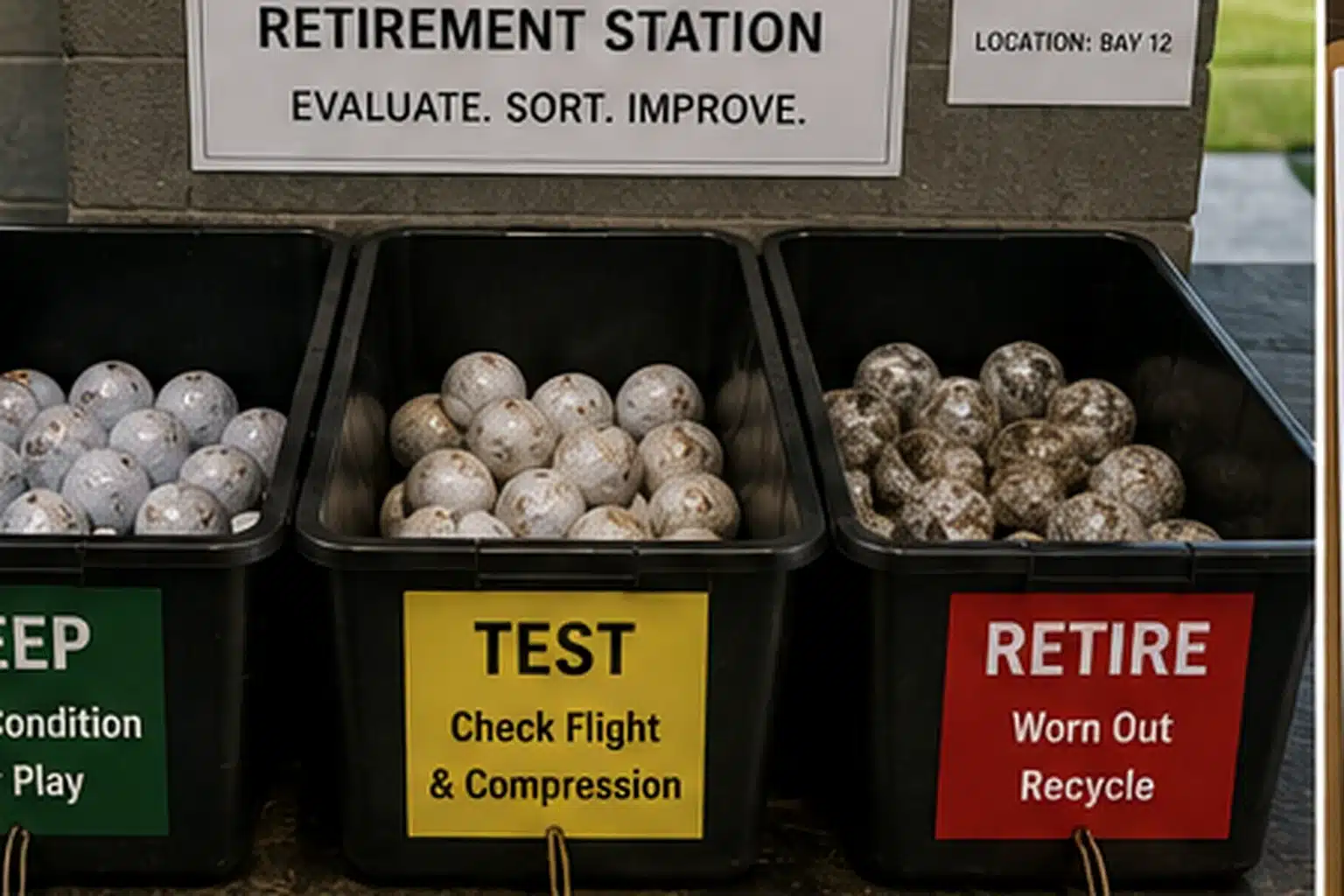
Visual Grade or Data Trigger?
Do not use one universal replacement interval. Outdoor ranges, indoor golf centers, academy bays, limited-flight venues, high-volume entertainment ranges, and fitting studios do not wear balls the same way. A better range ball retirement policy combines visible condition with data behavior.
| Policy trigger | What it catches | How to verify | Facility move |
|---|---|---|---|
| Surface grade fail | Scuffs or cracks | Visual standard | Cull |
| Compression spread expands | Core fatigue risk | Sample test | Segregate or retire |
| Carry spread widens | Data noise | A/B test | Set replacement batch |
| Complaint spike | Trust issue | Bay log | Run control test |
| Batch age concern | Unknown lifecycle | Batch ID | Review replacement plan |
| Washer damage | Cover wear | Surface audit | Adjust cleaning SOP |
Range-ball durability guidance treats performance and durability as important factors for practice-range purchasing because extending useful life can affect season-level cost. That supports a balanced policy: do not replace balls too early, but do not keep data-noisy balls just because they have not cracked. range-ball durability guidance
Use cull, segregate, control-lot, and replace categories. A visibly cracked ball leaves circulation. A questionable ball moves to a test group. A known stable batch remains in daily use. A fresh lot stays separated for baseline checks, fitting, or coaching.
Your retirement policy should state that a batch moves from daily-use to test or retirement when it fails the facility-defined visual or data trigger. Review ball-speed spread, carry dispersion, visible rejects, and complaint frequency by month. That makes replacement a data policy, not a panic purchase.
✔ True — Retirement is a data policy
A range ball can look acceptable but still create too much spread for your coaching or fitting standard. Visual grading and data triggers should work together.
✘ False — “Balls are fine until they crack or lose paint”
Visible damage is only one trigger. Compression spread, carry dispersion, complaints, washer wear, and batch age can all justify segregation or replacement.
What Should Your Next RFQ Require?
A low-price RFQ for range balls may ignore the evidence launch-monitor facilities need: compression target, batch spread, raw QC values, batch ID, durability proof, and tracking support.
Your next RFQ should ask for data consistency, not only durable range balls. Request compression target, acceptable batch spread, 12-ball QC data, weight and diameter values, batch ID, retained sample, durability method, carton tracking, and a replacement-cycle suggestion for launch-monitor facilities.
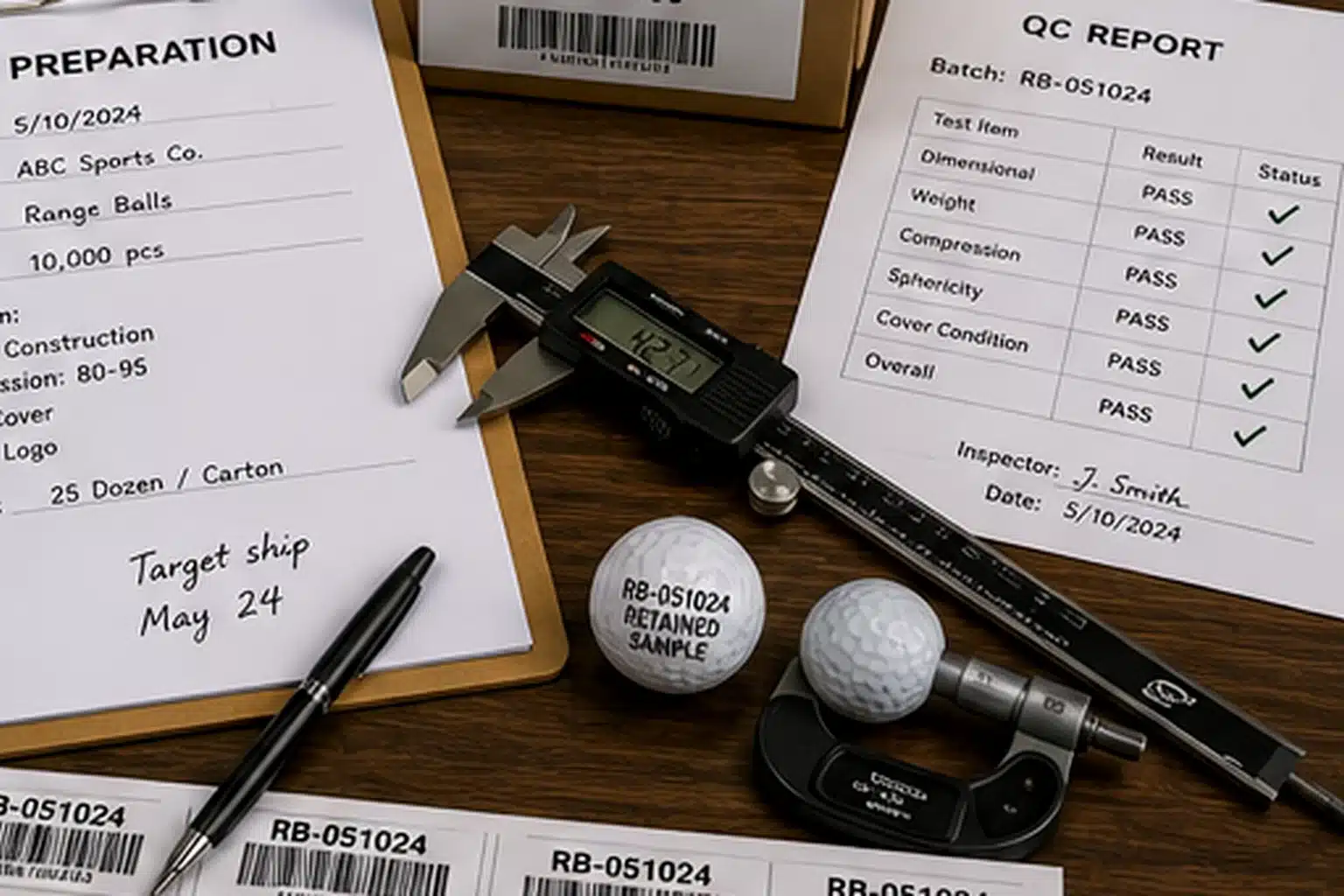
Compression Target or Batch Spread?
A target compression alone is weak if the batch spread is wide. For a launch-monitor facility, consistency across the ball population matters as much as the center number. Your RFQ should ask the supplier to show how tight the shipment is, not only where the average lands.
| RFQ item | Why it matters | What to request | Acceptance evidence |
|---|---|---|---|
| Compression target | Energy baseline | Target range | Supplier spec |
| Batch spread | Data consistency | Mean, SD, range | 12-ball QC report |
| Weight / diameter | Lot uniformity | Raw values | QC sheet |
| Durability method | Lifecycle planning | Impact / wear note | Test summary |
| Batch ID | Traceability | Carton label | Batch record |
| Retained sample | Dispute control | Sample retained | Reference sample |
| Replacement guidance | Budget planning | Suggested review cycle | Retirement policy input |
Use this RFQ wording:
“Please quote commercial range balls for a launch-monitor facility. Include compression target, acceptable batch compression spread, 12-ball raw QC data for compression, weight, and diameter, instrument and calibration details, durability test method, batch ID tracking, retained samples, carton labels, and replacement-cycle guidance. Do not quote only by lowest unit price.”
Supplier quotes compression target but no batch spread is a failure signal. Supplier shall link compression target, 12-ball QC raw values, batch ID, carton label, retained sample, durability method, and shipment lot under one proof version before dispatch.
Buyer acceptance requires batch ID match, retained sample match, QC report match, compression data within buyer-approved spread, and no severe cover, dimple, dimensional, or visual defects in inspected samples. If a supplier also provides Shore hardness, use that carefully. A recognized durometer hardness method can support cover or material consistency, but it does not replace whole-ball compression or actual launch-monitor testing.
FAQ
Do Old Range Balls Lose Distance?
Yes, old range balls can lose distance, but the amount is not universal. Your facility should test the daily bucket against a fresh control lot instead of using a fixed distance-loss number.
Distance can change because of range-ball design, compression drift, surface wear, dirt, dimple damage, or mixed batches. Track ball speed and carry spread, then separate compression-related drift from surface-related wear. A facility-specific trigger is safer than a generic yardage claim.
Do Range Balls Affect Launch Monitor Data?
Yes, range ball type, condition, age, and wear can affect launch monitor data. The issue becomes more serious when old, new, and mixed batches are used together in the same daily bucket.
Watch ball speed, spin, carry, and smash factor. Compare the daily bucket with a control lot before blaming the hardware. A launch monitor may measure correctly while the bucket behaves inconsistently.
Why Is My Launch Monitor Reading Short?
A launch monitor may read short because of strike quality, setup, environment, calibration, or ball condition. Old or mixed range balls are one controllable input your facility should test early.
Run a same-bay A/B test. Use the same club, same monitor, same setup, and a defined sample of fresh balls and daily-use balls. Record average and spread, not only the shortest shot.
How Much Distance Do You Lose With Range Balls?
There is no safe universal yardage number for every range ball, club, swing speed, and facility. The better answer is to measure your own fresh control lot against your daily mixed bucket.
Track ball speed drift, carry dispersion, spin variation, and rejected-ball rate. Your facility can then decide whether the issue is acceptable for general practice, too noisy for lessons, or unacceptable for fitting.
Does Ball Wear Affect TrackMan Numbers?
Ball wear can affect the ball data a launch monitor interprets, especially if wear changes speed, spin, or flight consistency. The monitor may be accurate while the ball population is inconsistent.
Check surface wear, dimple smoothing, dirt buildup, washer wear, and cracks. Compare spread, not only averages. Use a fresh control lot when you need cleaner data for coaching or fitting.
How Often Should a Driving Range Replace Golf Balls?
There is no universal replacement interval for every driving range. Use visible rejects, ball-speed spread, carry dispersion, compression sampling, complaint trends, batch age, and washer effects.
Cull visibly damaged balls. Segregate questionable batches. Replace when facility-defined visual or data triggers fail. A high-volume lesson bay may need different controls than a general outdoor range.
Are Range Balls Good for Club Fitting?
Range balls can support general practice, but precise club fitting requires a controlled ball population. Mixed or worn buckets can make gapping and spin interpretation less reliable.
Use a control lot for fitting. Keep fitting balls separate from daily-use buckets. Replace or retest them on a schedule tied to your facility’s data standard. The goal is not perfection; it is repeatability.
Can Dirty or Scuffed Golf Balls Affect Data?
Yes, dirty or scuffed golf balls can affect spin, aerodynamics, and shot-to-shot consistency. Do not rely only on whether the ball looks playable from a distance.
Grade surfaces closely. Watch washer-related wear. Cull balls with cracks, severe scuffs, abnormal finish, dimple smoothing, or dirt buildup that does not clean off consistently. Clean appearance and data stability are related, but not identical.
What Is Smash Factor in This Problem?
Smash factor is commonly understood as ball speed divided by club speed, so unstable ball speed can make efficiency interpretation noisier. For facilities, the issue is not one number; it is consistency.
If the club delivery is similar but ball speed spreads wider with the daily bucket than with the control lot, your coaches may be reading ball-population noise. Track the spread before changing lesson conclusions.
Should Ranges Use Premium Balls for Launch Monitors?
Not always. Commercial facilities need a balance of durability, data stability, replacement cost, and fleet control. Premium balls may help certain fitting tasks, but they are not a universal range solution.
A busy facility should control range-ball QC, keep baseline lots, and measure cost per reliable hit before assuming premium balls solve the operating problem. If your buying decision is broader than launch-monitor consistency, compare usable life, rejects, sorting, washer burden, loss, and replenishment with the same driving range ball cost model. The best answer may be a controlled range-ball program, not a fragile premium-ball fleet.
Conclusion
Your launch monitor may be accurate; your ball fleet may be uncontrolled. Old range balls do not only lose distance. They can create data noise when compression drift, surface wear, dimple damage, and mixed-bucket inventory widen the window for ball speed, spin, carry, and smash factor.
The safest range-ball program controls baseline, spread, batch identity, surface condition, and retirement timing before the daily bucket becomes a data-trust problem.
Build the system before the complaints pile up: fresh control lot, same-bay A/B test, bucket segregation, surface grading, 12-ball QC report, batch ID, retained sample, and a written retirement policy.
You might also like — Driving Range Ball Cost: What Is the Real Cost Per Usable Hit?