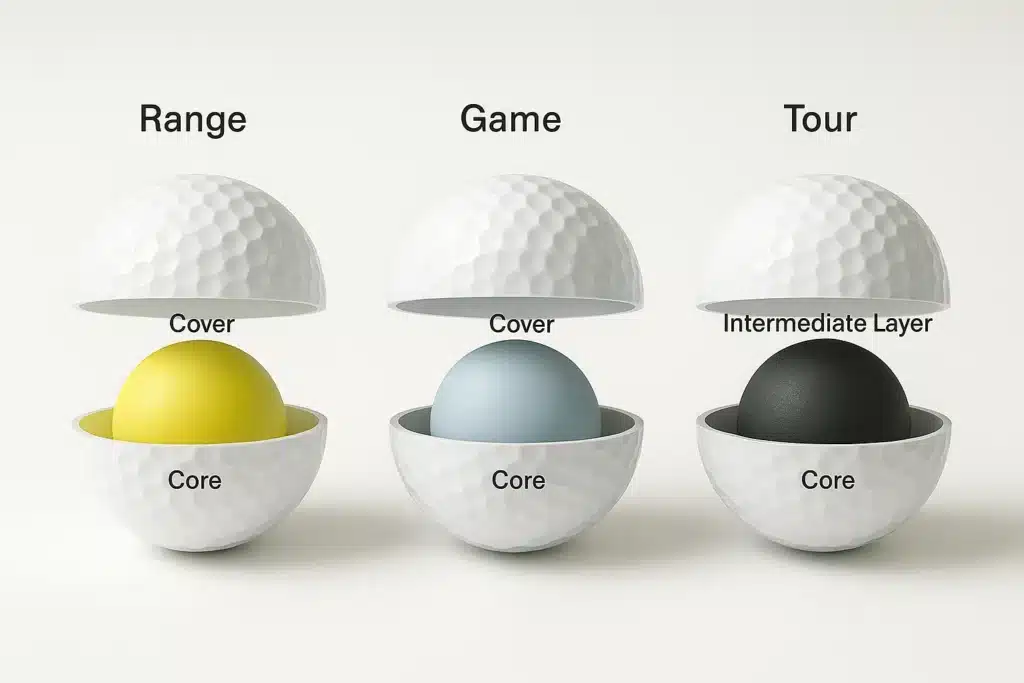
Range vs Game vs Tour golf balls is a sourcing decision, not only a player-choice question. The wrong category can make you overpay for range-ball conformance, underbuild a retail SKU, or use tour-level wording without enough factory proof.
Range balls are practice-first inventory built for durability and replacement cycles; Game balls are regular play models for retail, events, corporate gifts, DTC testing, and pro-shop programs; Tour balls are the premium urethane subset inside Game. For OEM sourcing, choose by use case, conformance need, margin, MOQ, lead time, and evidence—not by player-marketing language.
Use this guide to decide which category your business should source, what evidence belongs in the RFQ, and when a cheaper or more premium ball is actually the wrong SKU.
What are the B2B differences at a glance?
Your team may know these words from golf shops, but OEM sourcing needs a cleaner taxonomy: business use, conformance, construction, margin, and factory evidence.
Range, Game, and Tour are sourcing categories before they are player labels. Your team should define whether the SKU is for practice turnover, conforming retail play, or premium urethane control before discussing price, packaging, logo, MOQ, or factory origin.
Range balls are practice-first inventory. They may use thicker ionomer covers, tougher clear coats, high-visibility markings, or limited-flight tuning because the customer is a facility, not a golfer buying one dozen for a weekend round.
Game balls are regular retail models intended for play, resale, corporate gifts, DTC testing, or pro-shop programs. If you make conformance claims, the exact model and markings need current-list support. This is where many buyers get sloppy: “custom logo golf balls” can be a gift SKU, a retail SKU, or a competition-legal SKU, and those are not the same compliance conversation.
Tour balls are not a separate fourth universe. They are the high-performance urethane subset inside Game, where cover control, spin separation, and batch consistency matter more than marketing adjectives.
| Pain / decision | Range | Game | Tour |
|---|---|---|---|
| Main buyer | range / academy / entertainment venue | retail / DTC / corporate / pro shop | premium DTC / specialty / elite retail |
| Conformance need | usually not required | required for competition claims | required for competition claims |
| Typical cover | thick ionomer / hard clear | ionomer or urethane | urethane |
| Commercial role | turnover economics | mainstream margin | high-margin proof SKU |
| Evidence to request | durability / wash / scuff | current list / consistency | cover thickness / spin / QC |
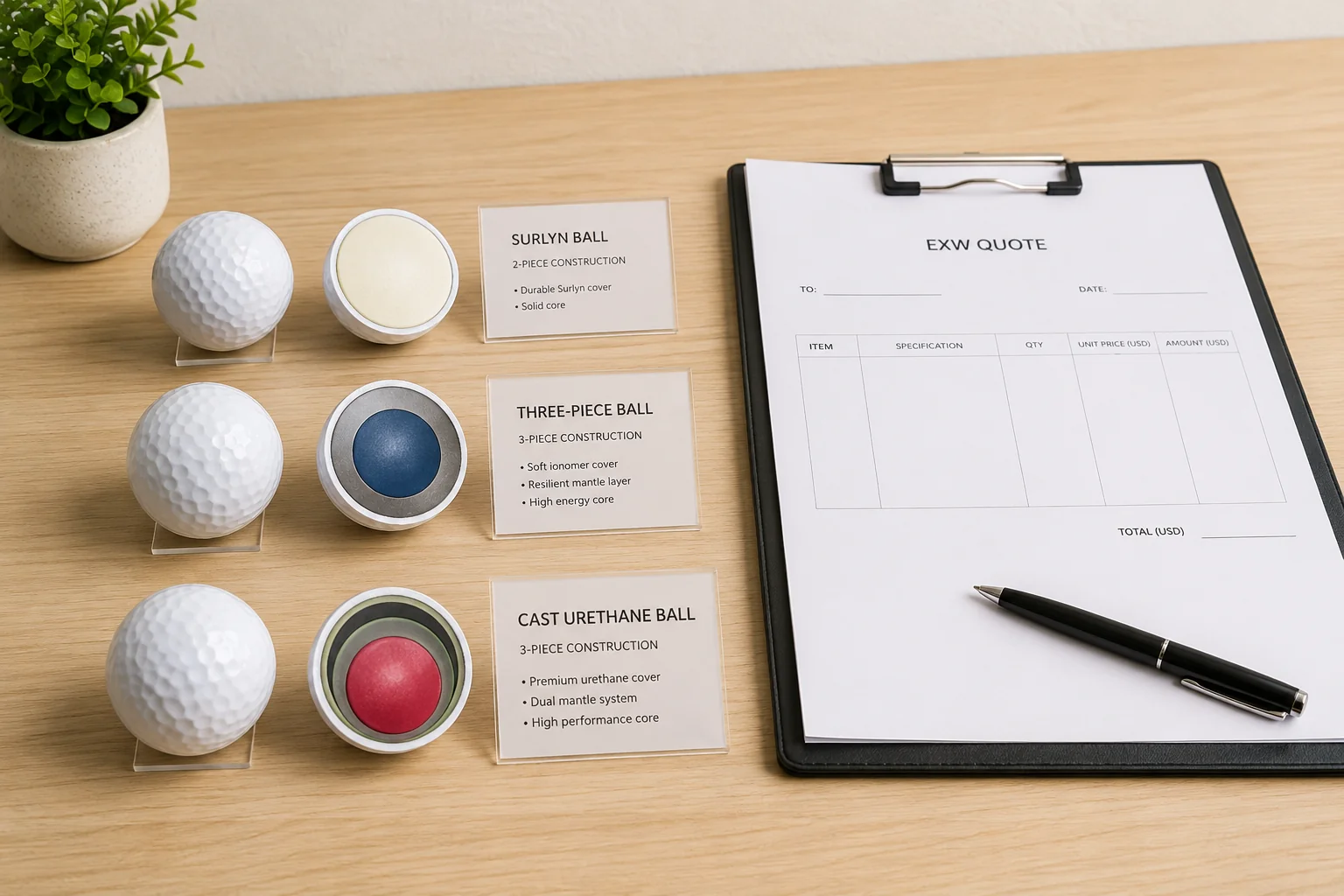
Request a category-labeled quote: Range, Game, or Tour, with conformance need, cover material, construction, MOQ, lead time, and proof package. Verify whether the supplier is using usage labels or only construction shorthand. A “2-piece ionomer” ball can be a durable Range ball or a conforming distance Game ball depending on tuning, marking, testing, and channel.
Do not compare quotes until every supplier uses the same category definition. Your category decision controls your margin, your compliance risk, and your supplier shortlist.
✔ True — Tour is a high-performance subset inside Game.
Tour balls still belong to the conforming play category. The difference is premium urethane construction, tighter control, higher proof burden, and a market willing to pay for that performance story.
✘ False — “Range, Game, and Tour can be judged by layer count alone.”
Layer count is only one engineering variable. Usage, conformance, cover material, tolerance control, and buyer channel decide the sourcing category.
When should you buy range balls?
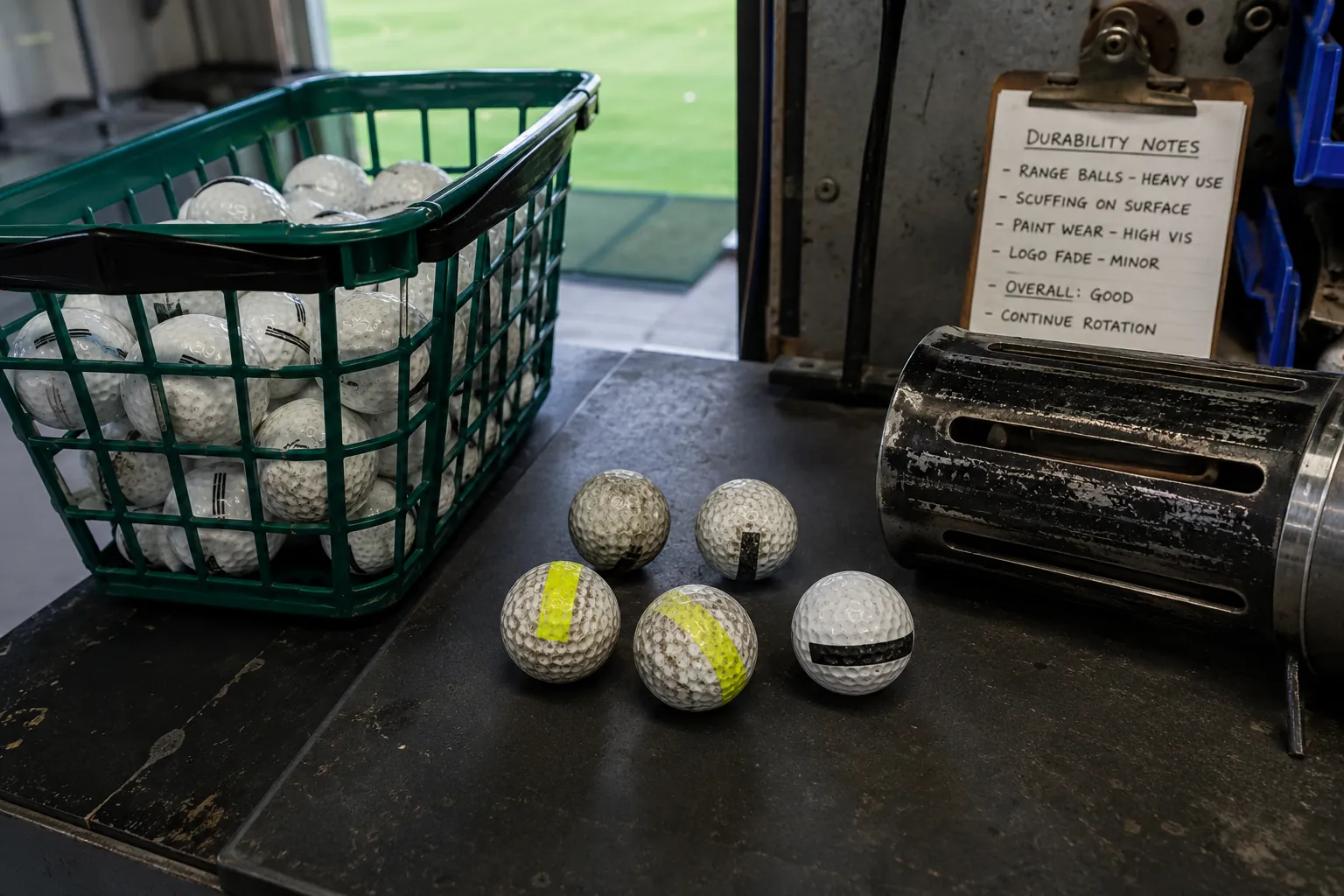
Range operators do not make money from prestige language. They make money when balls survive wash cycles, picker abuse, scuffs, and constant replacement pressure.
Buy Range balls for inventory turnover, not tournament prestige. Your best RFQ should ask how the cover, clear coat, markings, washer resistance, and picker-impact durability hold up—not whether the practice ball carries a conformance cost your facility may never monetize.
Durability beats conformance ROI
A Range ball is a consumable operating asset. The buyer is not trying to win a pro-shop beauty contest; your facility is trying to keep bays full, markings visible, covers intact, and replacement cost predictable. This is why “Is it on the current list?” is usually the wrong first question for custom driving range balls wholesale.
USGA conformance is not free branding. The 2026 USGA Golf Ball Conformance Submission Guidelines list new submission and annual resubmission at US$1,200 per ball type for 24 sample balls, and late submission at US$1,500 per ball type when accepted. Four ball types or colorways can therefore approach a near-US$5,000 annual compliance line before samples, courier, documentation, and internal QA time are counted. For a conforming retail Game or Tour ball, that may be justified. For a high-turnover Range ball, it is usually the wrong ROI question.
The turnover pressure is real, but it should be calculated from your own facility data. Annual range-ball demand ≈ active ball inventory × replacement cycles per year. Once you see the order this way, your RFQ changes. You stop overpaying for prestige language and start asking about washer resistance, picker impact, wedge scuffs, cover survival, marking visibility, and cost per usable cycle.
Annual range-ball demand ≈ active ball inventory × replacement cycles per year. Once you see the order this way, your RFQ changes. You stop overpaying for prestige language and start asking about washer resistance, picker impact, wedge scuffs, cover survival, marking visibility, and cost per usable cycle.
| Pain / decision | Wrong metric | Better metric | Buyer action |
|---|---|---|---|
| Range ROI | conformance status first | cost per usable cycle | request durability data |
| Washer damage | generic cover claim | wash-cycle resistance | request wash / abrasion test |
| Picker abuse | soft feel | impact / scuff survival | request cover and clear-coat proof |
| Visibility | retail cosmetics | high-visibility marking | confirm range marking |
| Replacement budget | one-time price | annual turnover model | calculate replenishment plan |
A failure signal appears when a Range-ball quote leads with conformance language but lacks wash, scuff, picker-impact, or clear-coat evidence. That quote may sound professional, but it is not answering the facility’s profit question.
Request wash-cycle, abrasion, picker-impact, clear-coat, and marking durability evidence. Verify whether the ball is practice-only or will carry competition or retail claims. Do not approve a Range-ball quote that leads with conformance status but lacks durability evidence.
Your facility earns profit from usable cycles, not from a certificate your customers never see.
When do game balls fit retail?
A buyer chasing premium tour language can easily overbuild a mainstream SKU, then lose margin to a product most customers were not asking for.
Game balls are the B2B sweet spot when you need conformity, margin, and repeatable retail value. Your buyer should use Game balls for corporate gifts, value retail, DTC testing, and mainstream distribution when Tour-ball cost is not justified by the customer profile.
Conforming retail baseline
Game balls are regular play models. They can be 2-piece ionomer / Surlyn, 3-piece ionomer, or selected urethane options, but the commercial idea is consistent: playable performance, stable cost, repeatable supply, and clear channel fit.
The conformance gate matters when you market the ball for competition, club events, or serious retail. The USGA Conforming Golf Ball List is updated monthly, and many high-level competitions using the relevant local rule require balls to appear on the current list. Avoid “USGA Approved” wording. Safer language is that an exact model “appears on the current Conforming Golf Ball List” or “Conforms with the Rules of Golf” when verified and permitted.
Most mainstream retail golfers are not Tour-speed players. TrackMan club speed benchmarks put male amateur driver speeds such as “Average Golfer” at 94 mph and “Bogey Golfer” at 92 mph, with female amateur reference speeds including 83 mph for 10 HCP and 79 mph for 15 HCP. That does not mean nobody should buy Tour balls. It means many retail programs are better served by low- or mid-compression Game balls that balance feel, durability, price, and repeat-order economics.
| Pain / decision | Game-ball route | Why it works | Buyer action |
|---|---|---|---|
| mainstream retail | 2-piece ionomer | durable, cost-stable | request current-list path |
| corporate gift | 2-piece or 3-piece ionomer | logo-friendly, repeatable | request sample + packaging |
| DTC test launch | standard Game formula | lower MOQ risk | request 1,000–3,000 pc path |
| pro-shop value line | 3-piece ionomer | better feel without Tour cost | request compression target |
| competition claim | conforming Game model | list status matters | verify current list |
China’s Game-ball supply chain is strong because many programs can use proven 2-piece or 3-piece Surlyn / ionomer constructions, existing tooling, mature logo printing, and integrated packaging. Under suitable line, material, artwork, and packaging conditions, a China 2-piece Surlyn program may fit a 1,000–3,000 piece pilot path and a 12–18 day production anchor. Treat that as a planning route, not a universal promise.
Request construction, conformance path, compression target, target market, logo method, packaging, MOQ, and lead-time options. Verify that the exact model and markings match any current-list or compliance claim. Do not approve “conforming” or “competition legal” wording unless current-list status is verified.
✔ True — Game balls are often the best commercial fit for mainstream buyers.
For retail, corporate, and DTC testing, a stable conforming Game ball can protect margin, repeatability, and customer fit better than an overbuilt premium SKU.
✘ False — “Every serious retail SKU must be Tour urethane.”
Tour urethane can be powerful when the market pays for it, but many mainstream channels need durability, price stability, and reorder confidence first.
When do tour balls justify the cost?
A premium DTC founder can love a sample, then discover that bulk production cannot repeat cover thickness, spin, coating, or feel.
Tour balls justify higher OEM cost only when the factory can prove the performance window. Your RFQ should ask for cover-thickness tolerance, urethane process evidence, compression distribution, spin data, retained samples, and batch-linked QC before you approve tour-level positioning.
Cover thickness and yield proof
Tour balls are the premium urethane subset inside Game. Titleist’s golf ball cover material guide describes ionomer covers as more durable, while urethane covers can support softer feel, increased short-game spin, and better control. For sourcing, “urethane cover” is a category clue, not proof that any factory’s sample is launch-ready.
Do not ask for “same as Pro V1.” That is weak sourcing language and creates IP, expectation, and proof problems. Ask for the intended performance window and the factory evidence behind it.
Golfara can use a 0.81mm / 0.0320in cover-thickness reference as an RFQ and QC benchmark for a high-end sample program, not as a universal industry law. The buyer-side question is simple: can the supplier state the cover-thickness target, tolerance method, sample ID, and batch-linked data? If not, “tour-level” is just a word with a nice hat.
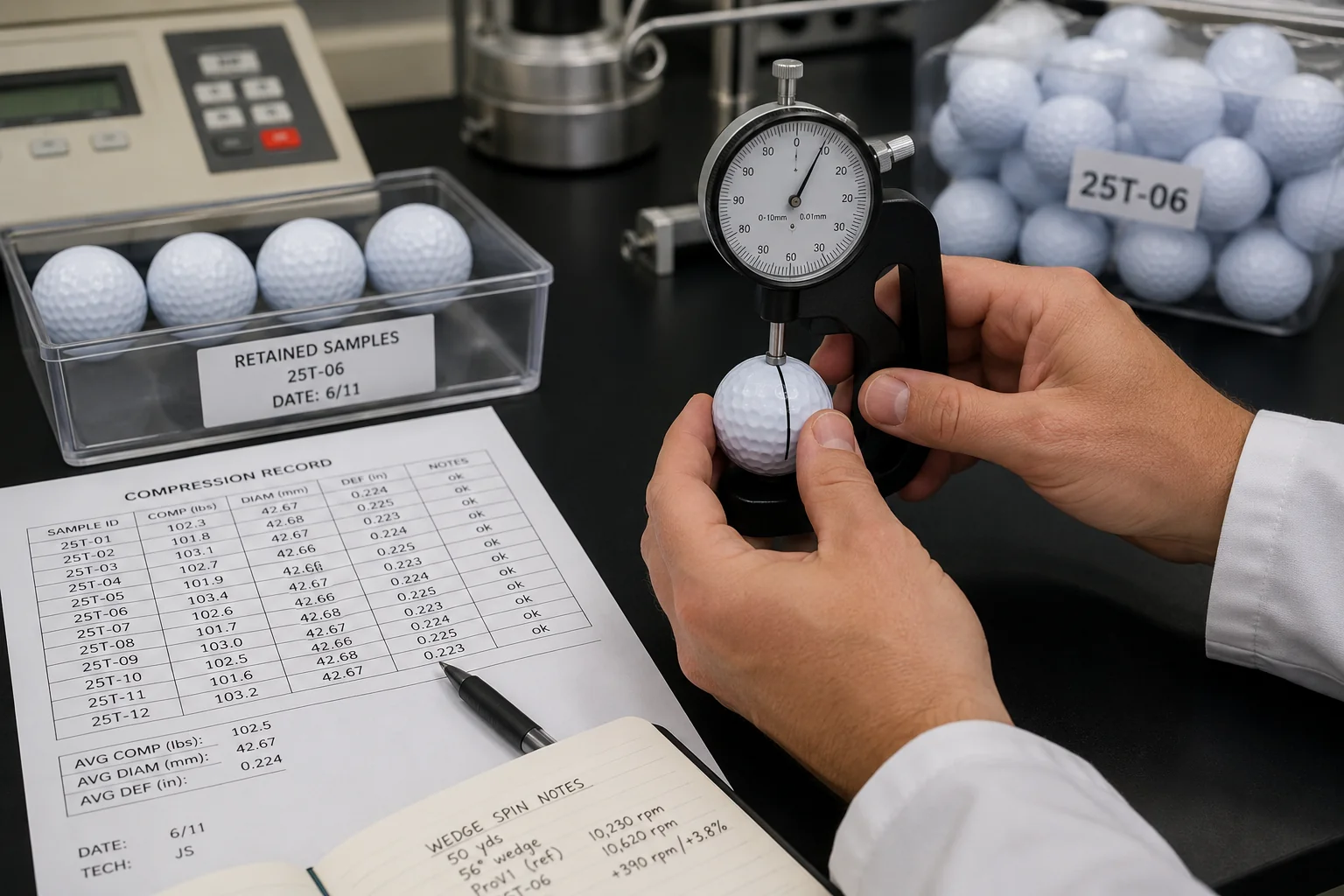
| Pain / decision | Weak supplier answer | Better evidence | Buyer action |
|---|---|---|---|
| tour-level claim | “same as Pro V1” | original performance window | reject clone wording |
| cover quality | urethane claim only | cover-thickness data | request tolerance map |
| short-game control | soft feel | wedge / iron spin data | request club-by-club data |
| batch stability | one good sample | batch-linked QC | compare pilot and bulk |
| cost premium | material explanation | yield and scrap evidence | request FPY / rework data |
Tour OEM costs more because the process is less forgiving. Thin urethane covers, coating consistency, eccentric layers, weight / diameter windows, compression distribution, and spin separation all tighten the quality gate. Scrap, sort, and rework are part of the cost. A cheap Tour quote that ignores yield is not a bargain; it is a delayed argument.
For Tour-positioned OEM balls, supplier shall provide cover-thickness target, cover-thickness tolerance, compression distribution, weight and diameter records, retained samples, and batch-linked spin or durability evidence before the buyer approves “tour-level” marketing language.
A failure signal appears when a Tour-ball supplier says “same as Pro V1” but cannot provide cover-thickness data, compression spread, spin windows, or retained samples. Request cover-thickness tolerance, compression distribution, spin window, retained samples, and decorated / blank batch equivalence. For a deeper capability discussion, review Can Chinese Factories Make Tour-Level Golf Balls?
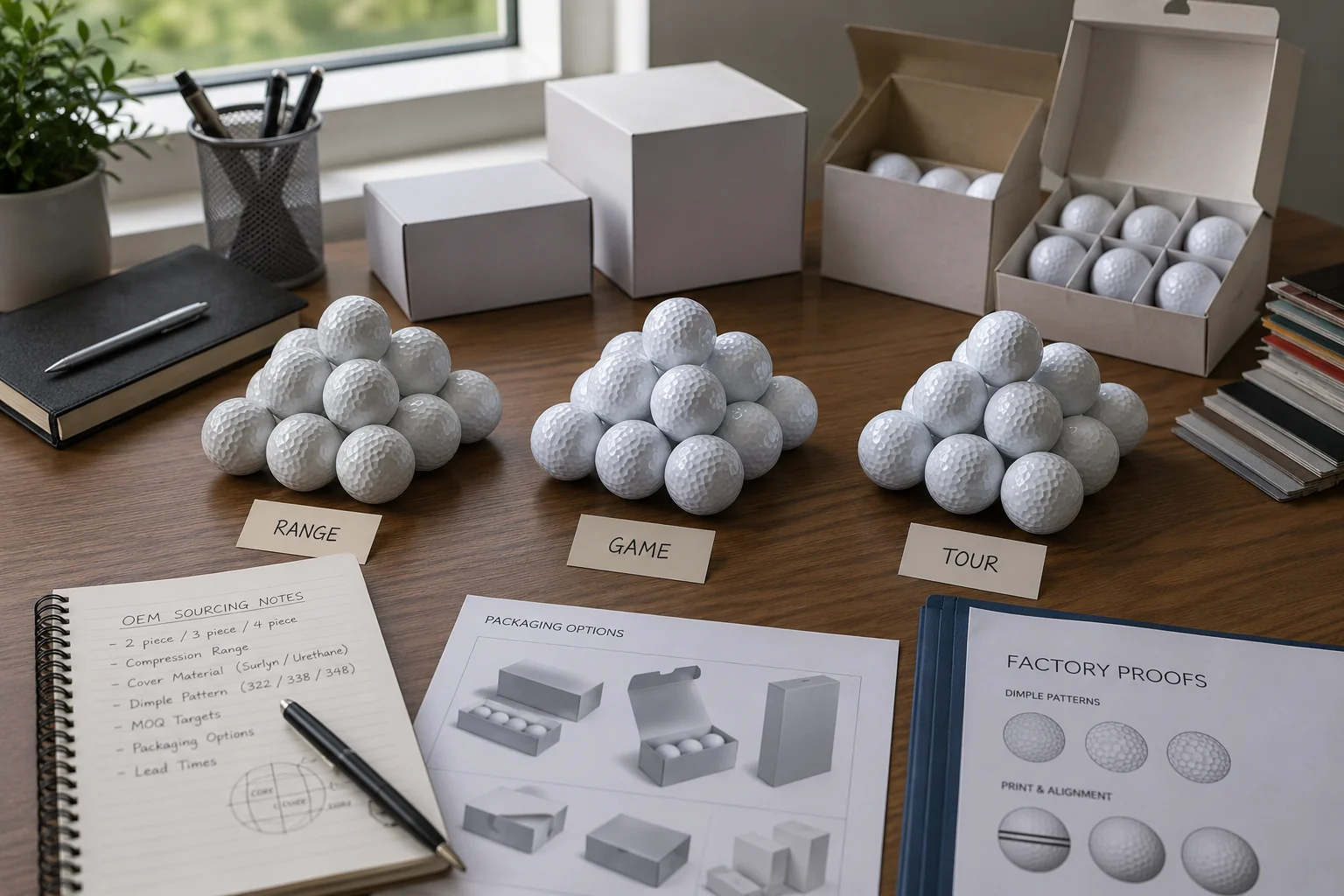
Which OEM path fits your launch?
The best ball is not always the most premium ball. The best ball is the one that fits your launch risk, budget, timing, and buyer promise.
Your OEM path should follow the product category and launch risk. Range programs need durability and replenishment planning; Game programs need conformance and flexible MOQ; Tour programs need proof-heavy sampling, tighter QC, and more realistic lead-time buffers.
China MOQ and lead-time fit
A launch plan should start with the commercial model. A driving range refill needs predictable replenishment, markings, wash resistance, and cost per usable cycle. A corporate logo order needs a reliable Game platform, clean print, packaging, and fast confirmation. A DTC value launch needs a standard formula, flexible MOQ, and repeatable supply. A premium DTC launch needs evidence-heavy Tour development and a buyer willing to fund validation.
China’s sourcing fit is strongest when your project benefits from flexible MOQ, integrated logo printing, packaging coordination, and fast sample-to-production communication. Zhejiang and Fujian can support strong Game-ball and customization paths under the right factory fit; Guangdong adds gift, logo, and packaging ecosystem advantages. That does not mean every Chinese factory can make every ball. It means your RFQ can move faster when the category is clear and the specification is realistic.
| Launch type | Better category | China sourcing fit | Buyer action |
|---|---|---|---|
| driving range refill | Range | durability + cost control | request turnover quote |
| corporate logo order | Game | flexible MOQ + print speed | request sample path |
| DTC value launch | Game | 1,000–3,000 pc pilot possible | use standard formula |
| premium DTC launch | Tour | possible with proof gates | request QC pack |
| retail expansion | Game or Tour | depends on margin and channel | model landed cost |
DTC brands win by matching category to customer speed and margin, not by forcing a Tour story into every SKU. Your first launch should protect cash, timing, and channel fit. A founder with no demand proof may be better served by a conforming Game-ball pilot than by a premium urethane build that burns budget before the market speaks.
Request category-based MOQ, lead time, sample cost, packaging, logo method, and QC deliverables. Verify whether the quoted MOQ applies to model, color, marking, packaging, or total order. Do not approve a launch plan until category, MOQ, lead time, and proof gates match the commercial goal. For EXW, BOM, and NRE cost modeling, use How Much Does It Cost to Manufacture Golf Balls?. For production-calendar details, use How Long Does It Take to Manufacture Golf Balls?.
✔ True — Launch model decides category.
A range refill, corporate logo order, DTC test launch, and premium retail SKU all need different proof, MOQ, lead-time, and cost logic.
✘ False — “The best ball is always the most premium construction.”
A premium construction can be commercially wrong if your buyer needs durability, low risk, faster replenishment, or a price point your channel will actually reorder.
How should your RFQ avoid factory silence?
Good factories ignore vague inquiries because vague inquiries create wasted sampling, fake volume games, and endless scope changes.
A serious RFQ gets a serious factory response. Your inquiry should state the category, construction, target market, first-order quantity, conformance need, logo and packaging scope, sample path, and QC evidence. Do not send vague mass emails or fake volume claims.
Write like a real buyer
The worst inquiry starts with “Dear Sir, best price golf balls.” The second-worst one claims a million-piece order with no spec, market, package, or sample plan. Serious technical factories see that every day. It does not make you look powerful; it makes you look expensive to serve.
Write like a buyer who has already made decisions. State whether the project is Range, Game, or Tour. State the construction target: 2-piece ionomer, 3-piece ionomer, urethane premium sample, or a specific performance window. State target market, first order, expected reorder path, logo method, packaging, conformance need, and the evidence you expect.
A realistic 1,000-piece pilot with a clear launch plan can earn more respect than a fake 500,000-piece forecast. Golfara and similar OEM factories can move faster when your team removes guesswork early.
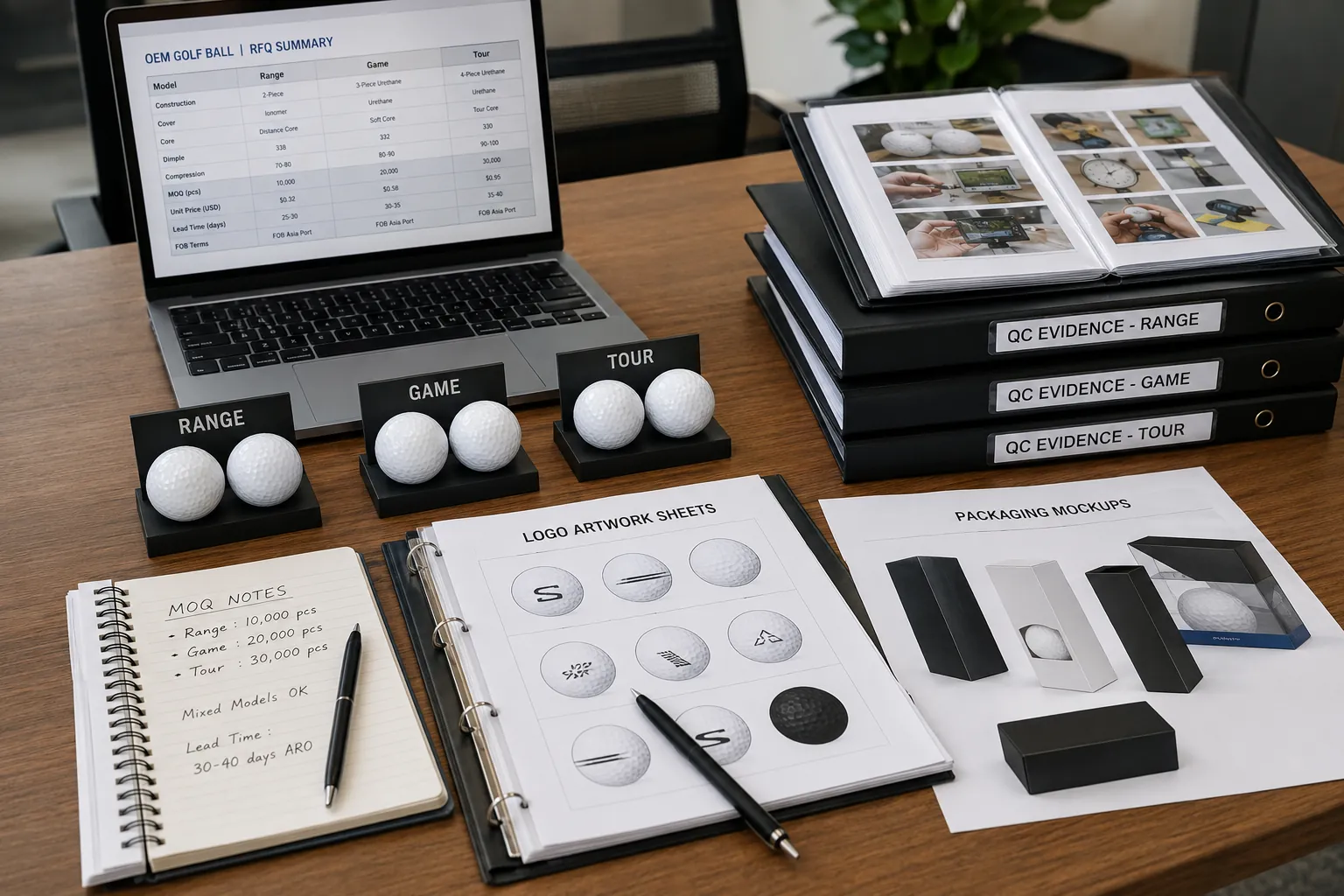
| RFQ mistake | What it signals | Better wording | Buyer action |
|---|---|---|---|
| Dear Sir mass email | low intent | category + target market | personalize RFQ |
| best price only | price shopper | spec + volume + proof | define scope |
| fake huge volume | credibility risk | realistic pilot + scale plan | state first order |
| “same as Pro V1” | IP / proof risk | target performance window | request data |
| no QC request | weak buyer | sample ID + batch proof | require evidence |
A failure signal appears when a factory ignores your RFQ fields and replies with only one low unit price. That may mean the supplier is a trader, does not understand the category, or does not want to expose process evidence.
Request a category-specific RFQ response that states whether the project is Range, Game, or Tour; includes construction, cover material, compression target, conformance need, cover-thickness target where relevant, MOQ, lead time, logo method, packaging, sample path, QC data, and the first-order quantity you are prepared to test.
Supplier shall identify the approved ball category as Range, Game, or Tour, and specify construction, cover material family, compression target, finish, marking, sample ID, batch ID, packaging version, and intended channel. Any change to construction, cover, finish, marking, or packaging requires written buyer approval.
For logo and packaging workflow, review How to Order Custom Golf Balls in Bulk with Your Logo? and Complete Guide to Custom Golf Ball Logo Printing Methods before sending artwork. Do not shortlist suppliers that cannot respond to category, evidence, and sample-path questions clearly.
FAQ
What is the difference between a range ball and a regular golf ball?
A Range ball is practice-first inventory built for durability, visibility, wash resistance, picker-impact survival, and cost per usable cycle. A regular Game ball is a conforming retail model intended for normal play, resale, events, or DTC channels.
Some Range balls are limited-flight, while others are full-distance practice balls with tougher covers and markings. The business difference matters more than the label. A range operator should ask for scuff, wash, clear-coat, and marking evidence. A retail or event buyer should ask whether the exact model and markings appear on the current Conforming Golf Ball List if competition claims matter.
Are custom logo golf balls USGA conforming?
Custom logo golf balls can be conforming, but only if the exact model and markings match a ball on the current Conforming Golf Ball List. Do not rely on generic “USGA approved” wording.
Logo printing alone does not create conformance. If your supplier changes markings, construction, finish, or model identity, confirm whether that affects submission status. Range logo balls often do not need competition claims. For corporate events, pro shops, or retail programs where the buyer may care about legality, use a Game or Tour model with verified current-list status.
Why are tour golf balls more expensive to manufacture?
Tour balls cost more because urethane cover control, cover thickness, spin separation, yield loss, coating consistency, and batch QC are more demanding than standard Game-ball production.
A supplier should prove the geometry, not just say “tour-level.” Ask for cover-thickness tolerance, compression distribution, weight / diameter records, spin data, retained samples, and batch-linked QC. A 0.81mm / 0.0320in cover-thickness reference can be useful as a Golfara RFQ benchmark or sample reference, but it should not be treated as an automatic industry rule.
Which golf ball fits most retail golfers?
For mainstream retail, 2-piece or 3-piece ionomer Game balls are often the better commercial fit than Tour urethane because they balance cost, durability, feel, and reorder margin.
Many retail golfers are not Tour-speed players. That does not make Tour balls unnecessary; it means your SKU should match your customer profile and price tier. A Game ball may generate better repeat sales in value retail, corporate gifting, and early DTC testing. Test samples with your target buyer profile, not with a tour-performance fantasy.
Should a driving range buy conforming golf balls?
Usually only if the range has a specific competition, fitting, or premium-practice reason. For normal range turnover, durability and replenishment economics matter more than conformance branding.
Conformance can be valuable in specialized settings, but it should not be the first spending line for a practice-only facility. Ask how the ball performs through wash cycles, picker impacts, mat abrasion, wedge scuffs, and marking wear. Calculate annual range-ball demand as active ball inventory multiplied by replacement cycles per year.
Can China OEM factories make Game and Tour balls?
Yes, but buyers should separate standard Game-ball production from proof-heavy Tour-ball development. China has strong 2-piece and 3-piece Game-ball flexibility; Tour projects need stricter QC evidence.
Do not judge only by country or only by low price. For Game balls, ask about existing tooling, standard formulas, MOQ, lead time, logo, packaging, and current-list path. For Tour balls, ask for cover-thickness control, spin windows, compression distribution, retained samples, and yield data. Factory proof matters more than origin stereotypes.
What should I include in a golf ball OEM RFQ?
Include category, construction, cover material, compression target, conformance need, target market, logo, packaging, sample path, MOQ, lead time, and QC evidence.
Avoid mass-template inquiries and fake volume claims. A clear first order, such as a realistic pilot quantity with a scale plan, often works better than an inflated forecast. Ask the supplier to confirm whether current tooling or formula exists, what can be sampled, which acceptance data can be provided, and whether the MOQ applies by model, color, marking, or packaging version.
Conclusion
Range, Game, and Tour balls should be sourced by business purpose. Your team should buy Range for turnover durability, Game for conforming retail margin, and Tour for premium proof-backed positioning—then write the RFQ so the factory can respond with evidence, not vague claims.
Request a final sourcing pack with category decision, conformance need, construction, MOQ, lead time, sample route, packaging, and QC evidence. Compare suppliers only after each quote uses the same category definition and proof requirements.
You might also like — Surlyn vs Urethane Golf Balls: Material Choice Guide