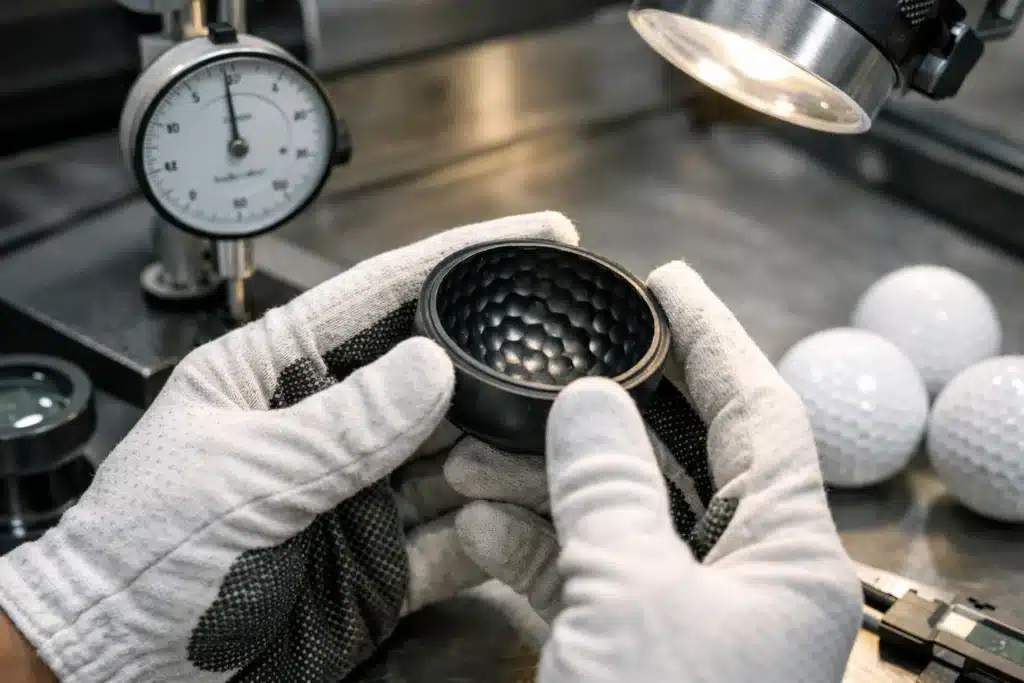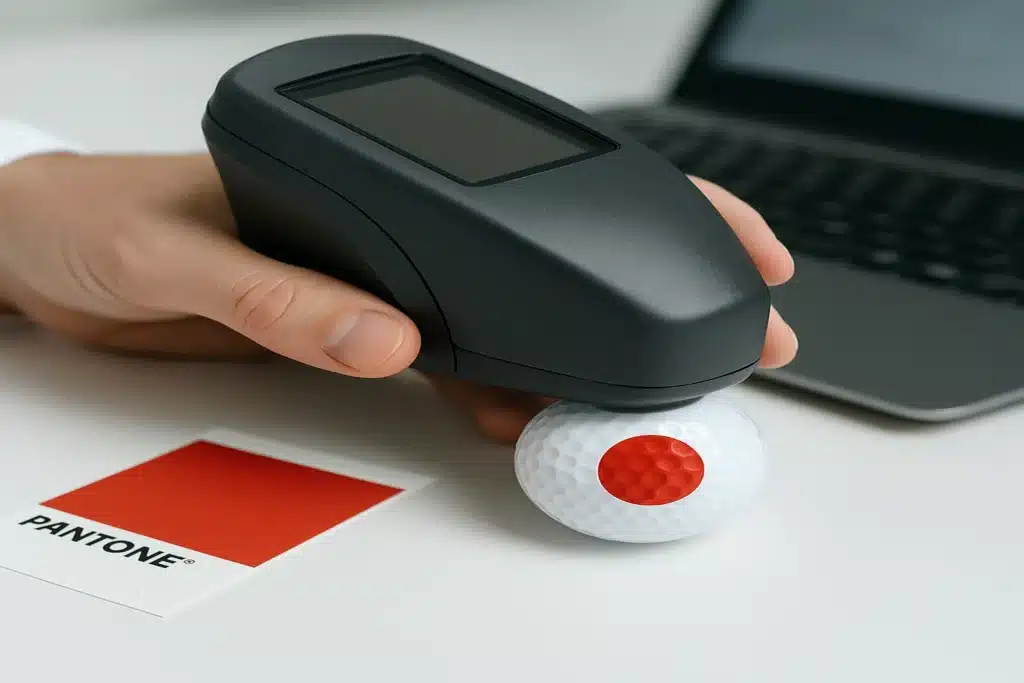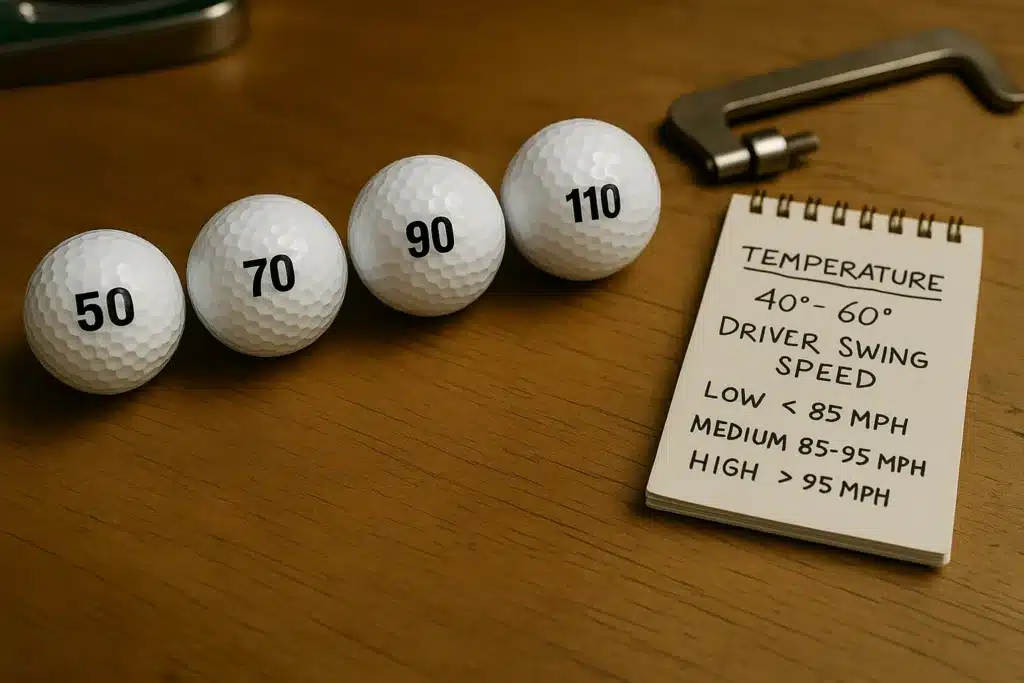
What Is Golf Ball Compression & How to Choose the Right One?
Most golfers hear “compression” and assume softer goes farther. In reality, compression quantifies deformation—useful, but only when matched to swing speed, temperature, and ball construction.
Golf ball compression measures how much a ball deforms under a specified load (not the same as “hardness” or “feel”). To pick the right one, match compression to your lowest typical driver speed and the day’s temperature, then validate with a short A/B test.
This guide clarifies what compression is—and isn’t—then gives a two-factor selection method, seasonal adjustments, and B2B testing/QC notes to ensure consistency from factory to fairway.
What exactly is golf ball compression—and what isn’t?
Confusion starts when “compression” gets mixed up with “hardness” or “feel.” Precision matters: compression is a quantified deformation response; feel is a multi-factor, human perception outcome.
Compression quantifies deformation under a specified load; lower values generally deform more and feel softer, higher values deform less and feel firmer. It is related to but not equal to hardness/feel, which also depend on cover material, layers, sound, rebound, and construction.
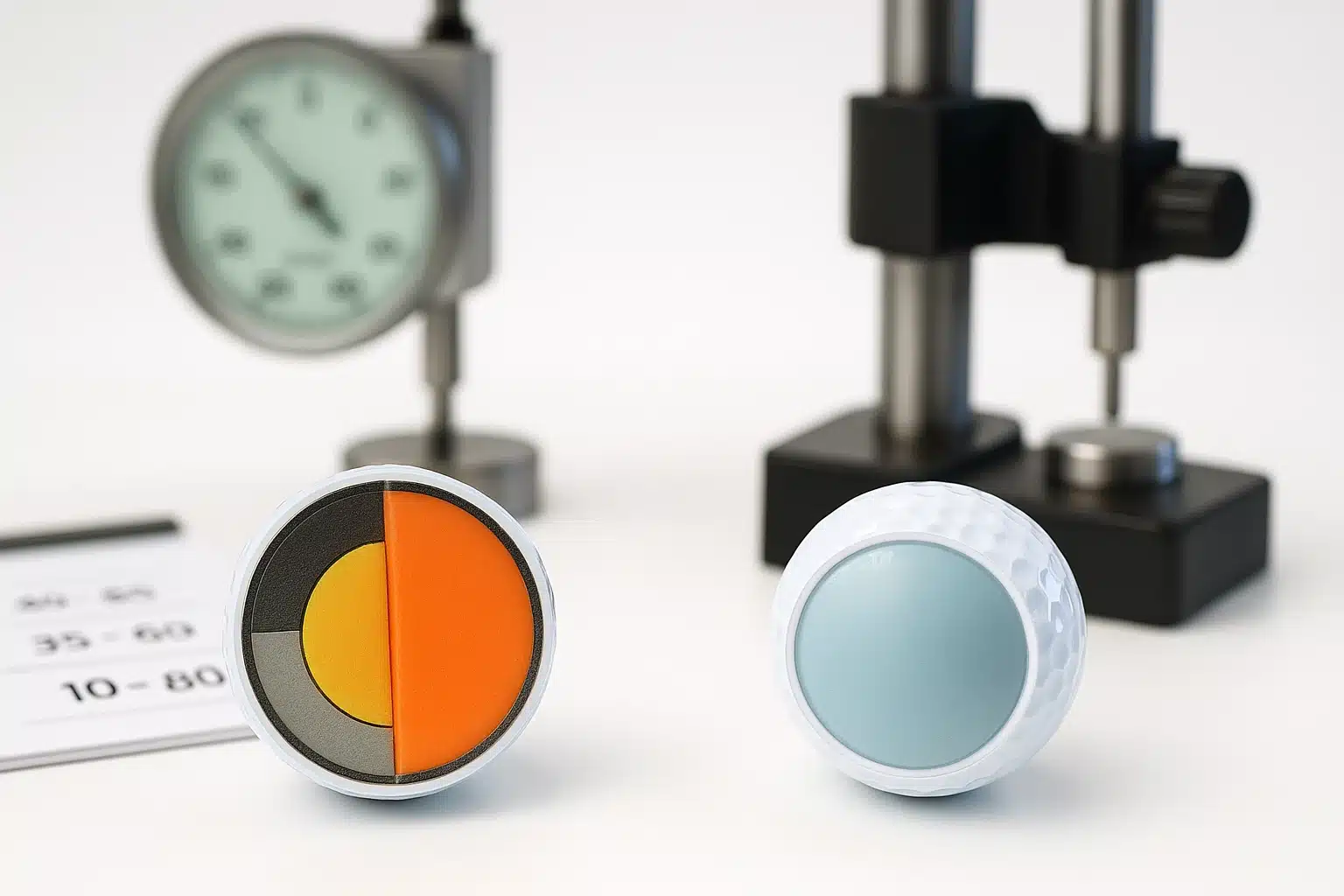
In practice, manufacturers report static or semi-dynamic compression—how much the ball (or core) “squishes” under a controlled load. The commonly observed market band is roughly 30–120, but there is no single universal, public standard for consumer labels. Compression interacts with many factors: core chemistry and diameter, mantle hardness, cover type (Surlyn vs. urethane), dimple and paint systems, and temperature conditioning before testing.
Relationships you’ll feel are indirect: compression can correlate with COR/ball speed, yet distance ultimately depends on launch + spin + speed; feel emerges from acoustics and cover friction as much as from deformation. Think of compression as a design parameter and a fitting clue—use your lowest typical driver speed as the baseline so you don’t under-activate the ball on average swings.
Why this distinction matters: it keeps you from chasing a single number when construction and conditions shape the final result.
| Term | What it measures | How measured | Affects most | Not equal to |
|---|---|---|---|---|
| Compression | Deformation under load | Force–displacement | Activation/energy transfer | Feel/hardness |
| Hardness | Material surface/durometer | Indentation tests | Cover durability/sound | Compression |
| Feel | Human perception | On-course experience | Confidence/tempo | A single lab metric |
✔ True — Compression is a deformation metric
It tells you how easily a ball compresses under a specified load. It’s useful for fitting and QC, but it’s only one part of performance.
✘ False — “Compression = hardness/feel”
Feel also depends on cover (urethane often softer), layer stack, acoustics, and rebound behavior; equal compression balls can feel different.
Why do compression numbers differ across scales?
One brand’s “90” rarely equals another’s “90.” Scales, fixtures, preload, dwell time, and temperature conditioning make cross-brand numbers non-interchangeable.
Compression ratings are scale-dependent (legacy Atti/PGA methods and brand-internal protocols). Numbers are not universally comparable. Only same-lab, same-protocol, same-temperature tests are comparable—and batch spread within a model is the quality mirror.
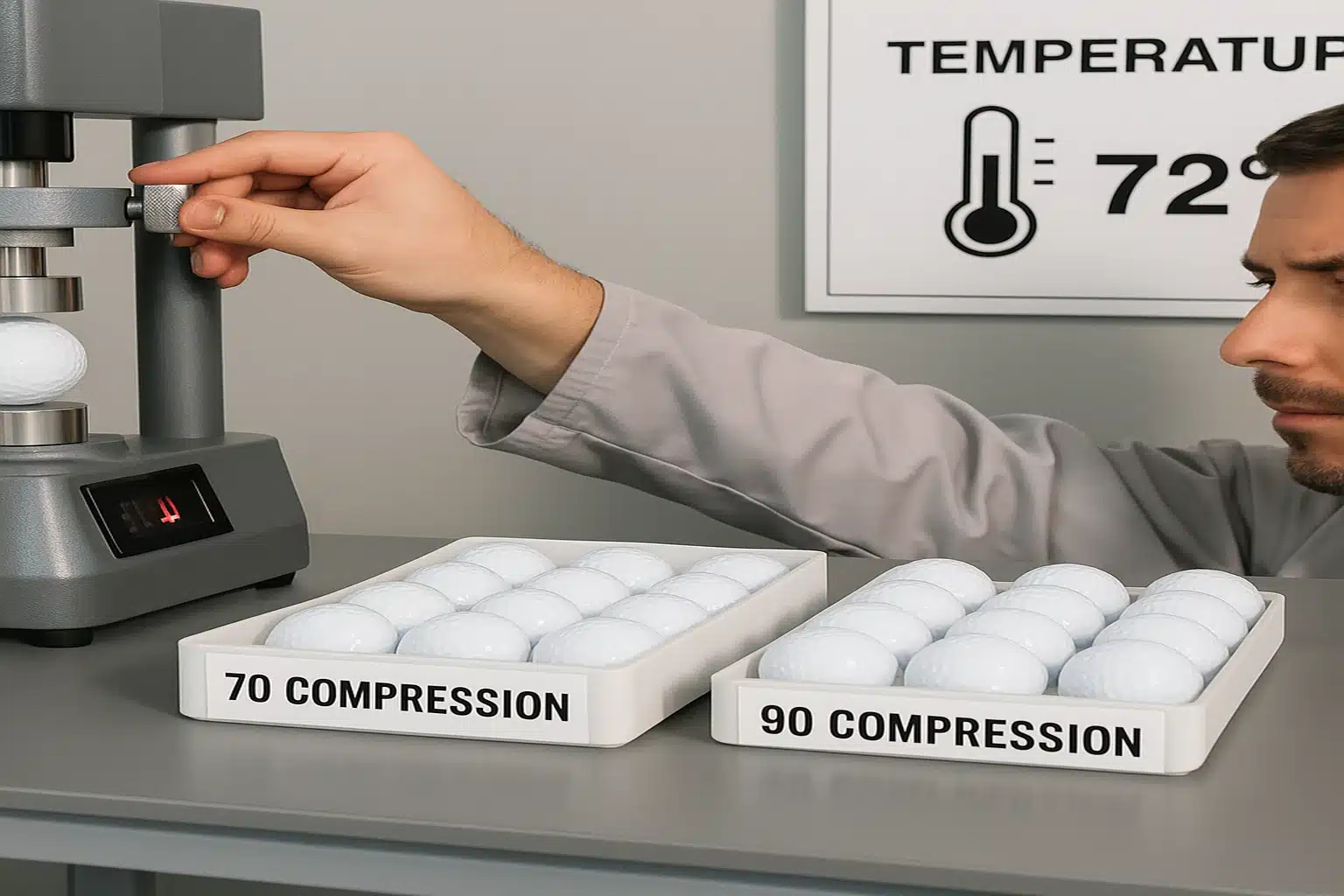
Why 70 vs. 90 can “move”: some methods compress the whole ball to a set deflection; others test cores or use different preload windows. Even the test temperature changes results. That’s why two balls labeled “90” can perform differently—and why batch consistency (Δ/compression spread) inside one model is a clearer signal of manufacturing quality. Many top-tier lines target tight internal spreads (for example, ±3–5 points within the same method). If you source across factories, align methods: fix fixtures and dwell time, run shared reference samples, and create conversion curves in one lab so numbers become apples-to-apples, and set a quarterly one-lab correlation across all supplying plants—repeat any time a new core or cover BOM is introduced.
| Scale | Readout | Who uses it | Caveat | How to align |
|---|---|---|---|---|
| Legacy Atti/PGA | Points | Historic/marketing | Not universal | Cross-test with refs |
| Whole-ball deflection | mm/points | Modern labs | Temp-sensitive | Fix temp/time |
| Core-only compression | points | R&D | Not final feel | Pair with whole-ball |
| Brand internal | proprietary | OEM/brands | Non-comparable | One-lab retest |
✔ True — Batch spread is your quality mirror
Within-model Δ shows how consistently a line is made; smaller spreads stabilize speed, spin, and feel from ball to ball.
✘ False — “Two 90 labels are equivalent”
Unless tested on the same method and temperature, labels don’t equal performance. Validate on one rig or via a trusted lab.
How do I choose compression by swing speed and temperature?
A one-number rule fails. The reliable shortcut: match compression to your swing speed and the day’s temperature, then verify with a brief on-course A/B.
Two-factor rule: Use your lowest typical driver speed to pick a base band, then adjust one band softer in cold conditions. Validate by A/B two candidates across three holes, tracking ball speed, side spin, and landing window—not just one heroic drive.
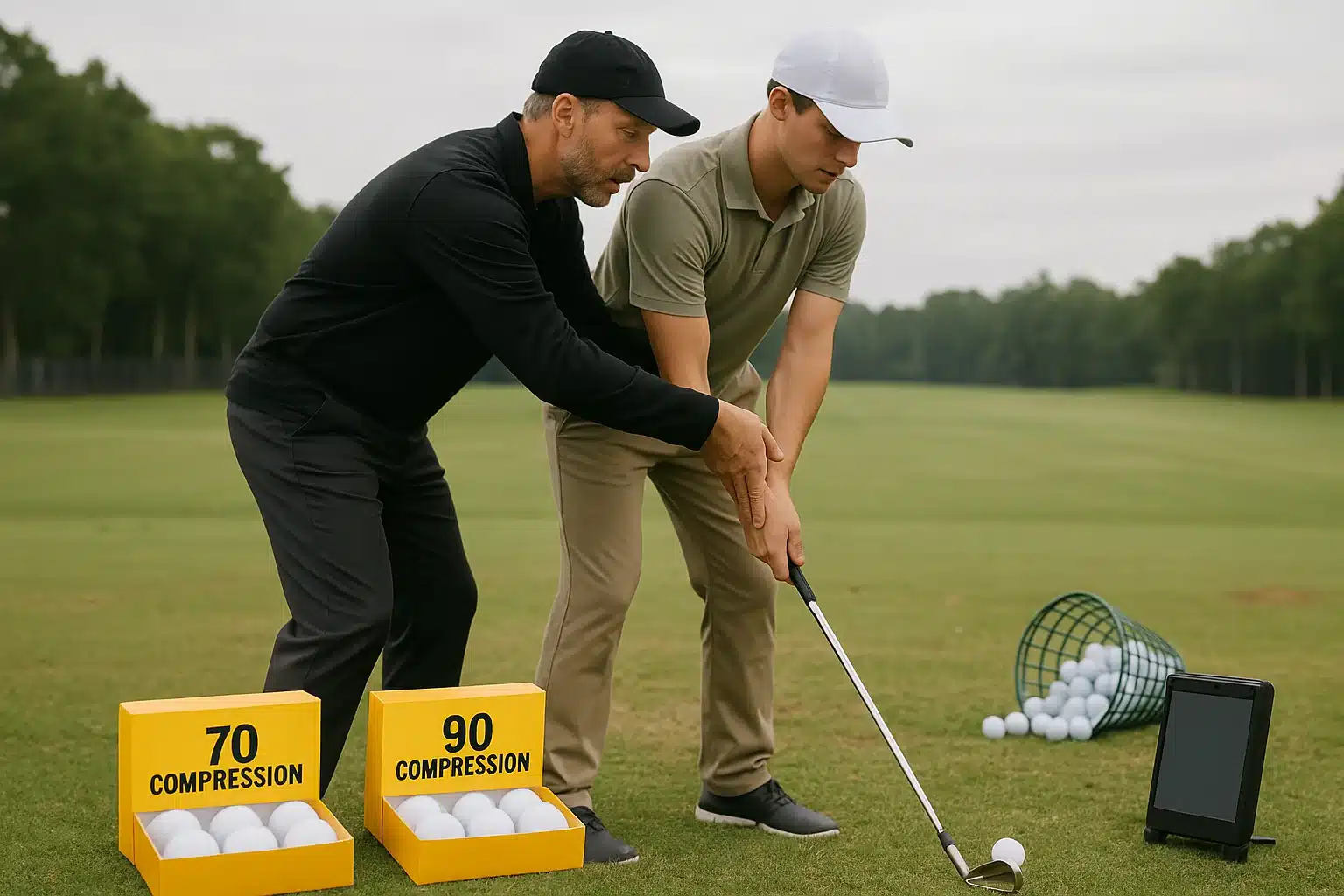
Base mapping (use lowest typical speed):
| Driver mph | Suggested band | Primary goal | Temp tip |
|---|---|---|---|
| <80 | Low (≈≤70) | Easier activation/launch | Cold: stay low |
| 80–100 | Mid (≈70–95) | Balance speed/control | Cold: drop one model softer |
| >100 | High (≈95+) | Energy return/flight stability | Cold: consider mid-high if feel harsh |
Why lowest typical? Because that’s where most of your strikes live; using peak speed risks under-compression on average swings, hurting launch and feel. For juniors/seniors/women, pick by speed and weather, not demographics.
- Track ball speed averages (not one bomb).
- Check side spin / dispersion (tighter is better).
- Confirm landing window and short-game feel across holes.
✔ True — Fit to your slowest typical speed
That’s the speed most shots see. Matching to it prevents under-activating the core on average swings and stabilizes launch.
✘ False — “Use your peak speed to choose”
Picking by best-day speed often lands you in too-firm designs that feel harsh and launch low on normal days.
Does compression really change distance, spin, and feel?
Compression can matter, but design dominates. Ball speed, spin, and launch conditions dictate distance; feel is emergent from cover, layers, acoustics, and rebound.
At high speeds, higher compression designs can return efficient energy; at lower speeds, softer balls can help deformation. Distance outcomes depend on ball speed + launch + spin—not compression alone. Feel changes with cover and construction, even at equal compression.
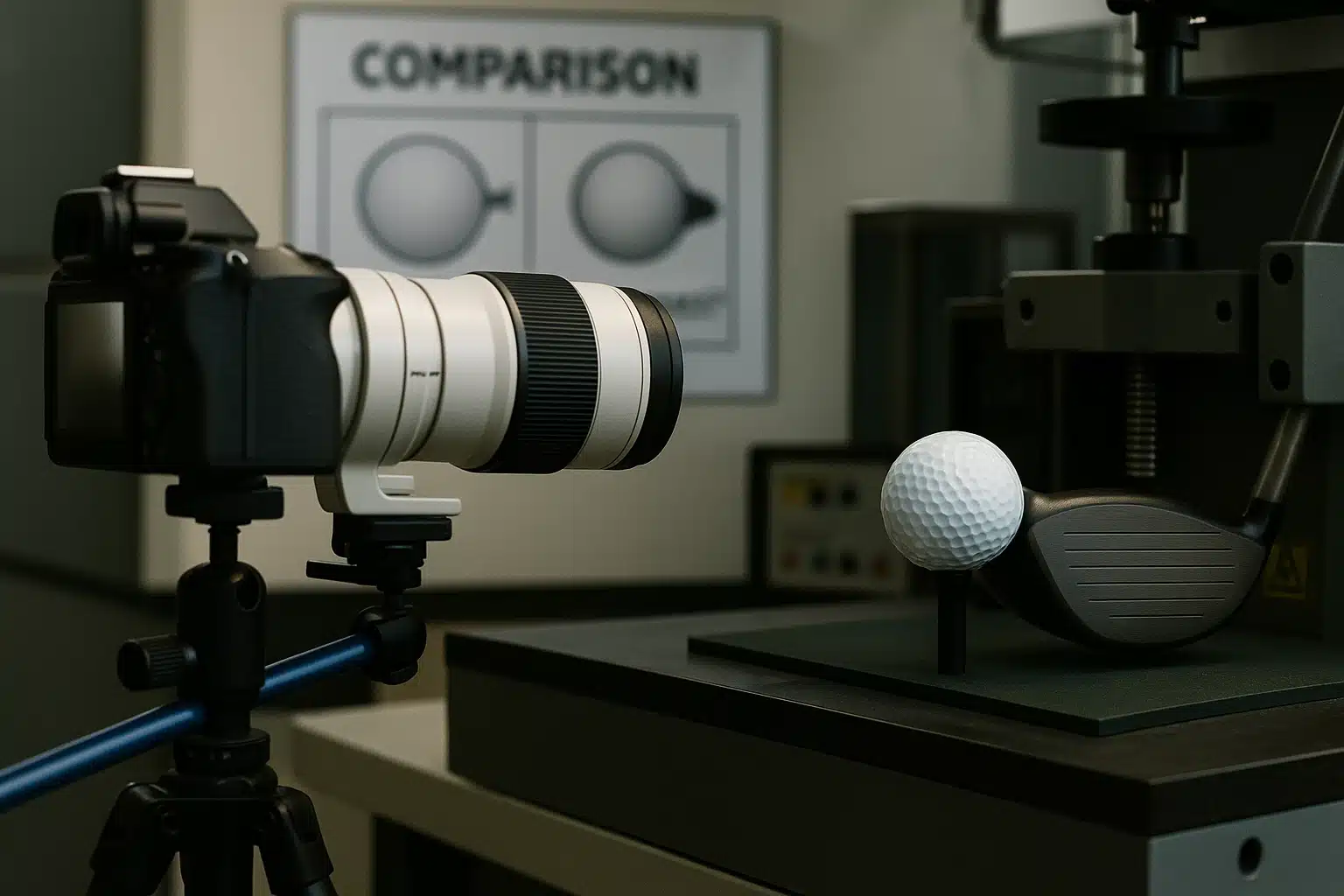
Scenario view: <80 mph players often benefit from low-compression designs that help achieve useful deformation and launch. 80–95 mph golfers typically live best in mid-compression, choosing models by spin/flight windows. >100 mph hitters can activate high-compression, multi-layer tour balls without over-squishing them. But diminishing returns apply; distance is a product of delivery (centeredness, launch, spin) more than any single spec. In the short game, urethane covers change frictional spin and acoustics; two balls at similar compression can feel very different on chips and putts. Practical approach: get into the right compression band, then refine the model for spin (driver/iron/wedge), launch height, and green-side sound/feel.
| Speed band | Likely benefit | Risk if mismatched | What to test |
|---|---|---|---|
| <80 mph | Easier launch | Floaty/loss if too soft | Ball speed, peak height |
| 80–95 mph | Balance | Over/under-spin | Driver/iron spin windows |
| >100 mph | Stability/energy return | Harsh feel if too firm | Ball speed + dispersion |
When should I adjust for seasons or altitude?
Cold hardens materials and thickens air; altitude thins air and alters flight/roll. Small band shifts can keep feel and distance consistent across seasons and venues.
Cold (<10 °C/50 °F): shift one band softer; pre-warm balls legally before tee-off. Heat/high altitude: consider staying in band, adjusting model for spin/launch. Always validate on-course—conditions change feel and rollout beyond compression alone.
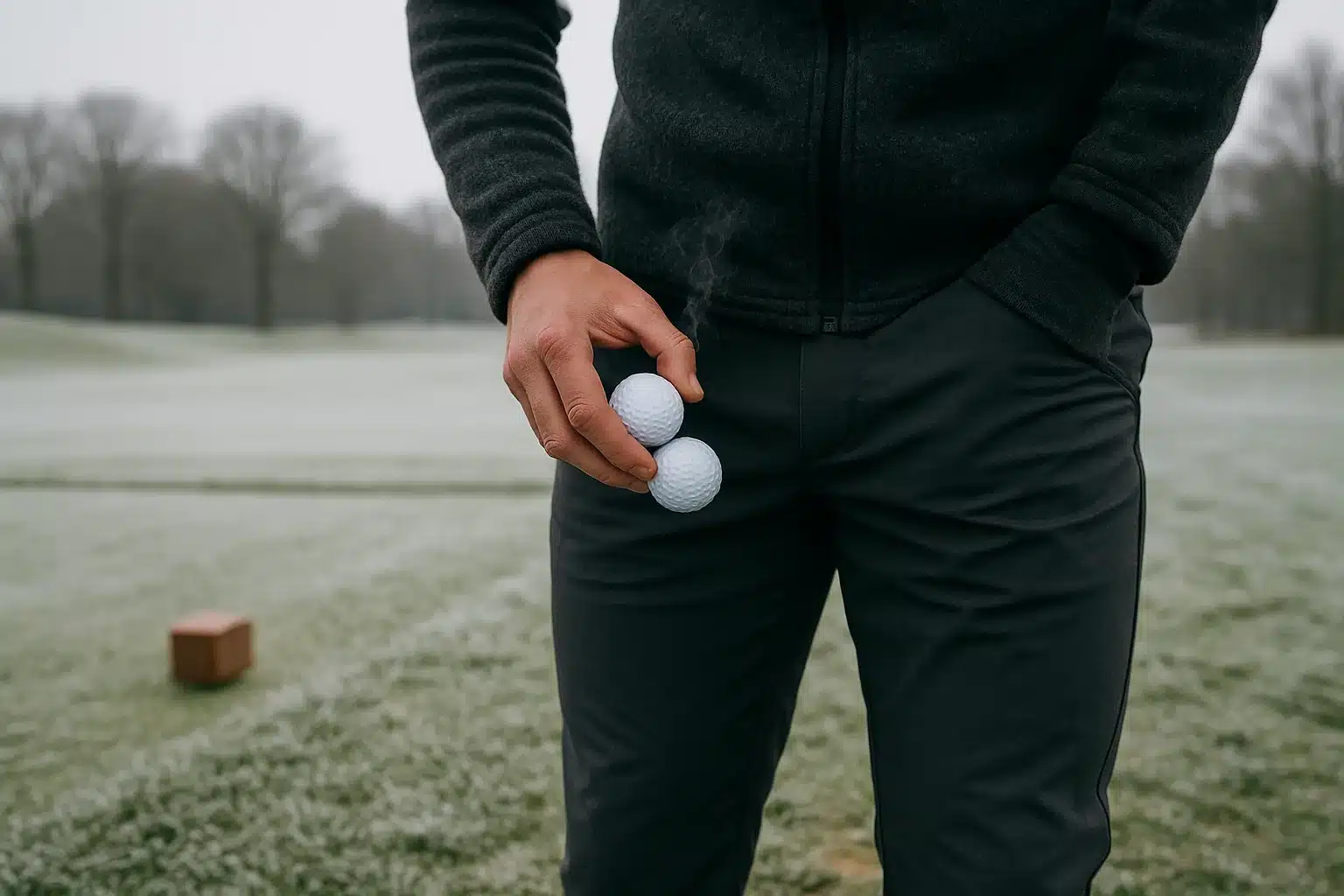
Temperature effects: in cold, polymers stiffen and COR drops; air is denser, reducing carry and roll. A softer band helps activation and feel. Pre-round: store balls indoors, avoid trunk-freeze, and rotate two sleeves in your pocket before tee-off. Hot/high altitude: the ball already flies; maintain your band but tweak spin profile (some players prefer a touch more spin to hold greens). For indoor domes or sim work, keep your normal fit—environment is controlled.
| Condition | What changes | Band shift | Extra tip |
|---|---|---|---|
| Cold (<10 °C/50 °F) | Stiffer ball, denser air | One band softer | Warm balls pre-round |
| Temperate | Baseline behavior | No change | Fit by speed |
| Hot (>30 °C/86 °F) | Softer response | No change | Watch wedge spin |
| High altitude | Lower drag | No change | Choose higher-spin model |
✔ True — Winter loss isn’t just compression
Air density and ball temperature both reduce speed and carry. A softer band helps, but launch and spin tuning matter too.
✘ False — “Cold problems = ball too hard only”
Even low-compression balls slow down when cold. Keep balls warm and re-fit your model for the conditions.
For OEM buyers, how is compression tested and controlled?
B2B choices hinge on data credibility: method, environment, and batch spread. Good factories publish a target ± tolerance and keep Δ tight via SPC.
Factory playbook: lock test protocol (fixture, load, dwell, temperature), define a target (e.g., 90) with a tolerance (e.g., ±3–5 within method), and monitor batch spread (Δ). Align cross-factory readings via shared reference samples and one-lab retests.
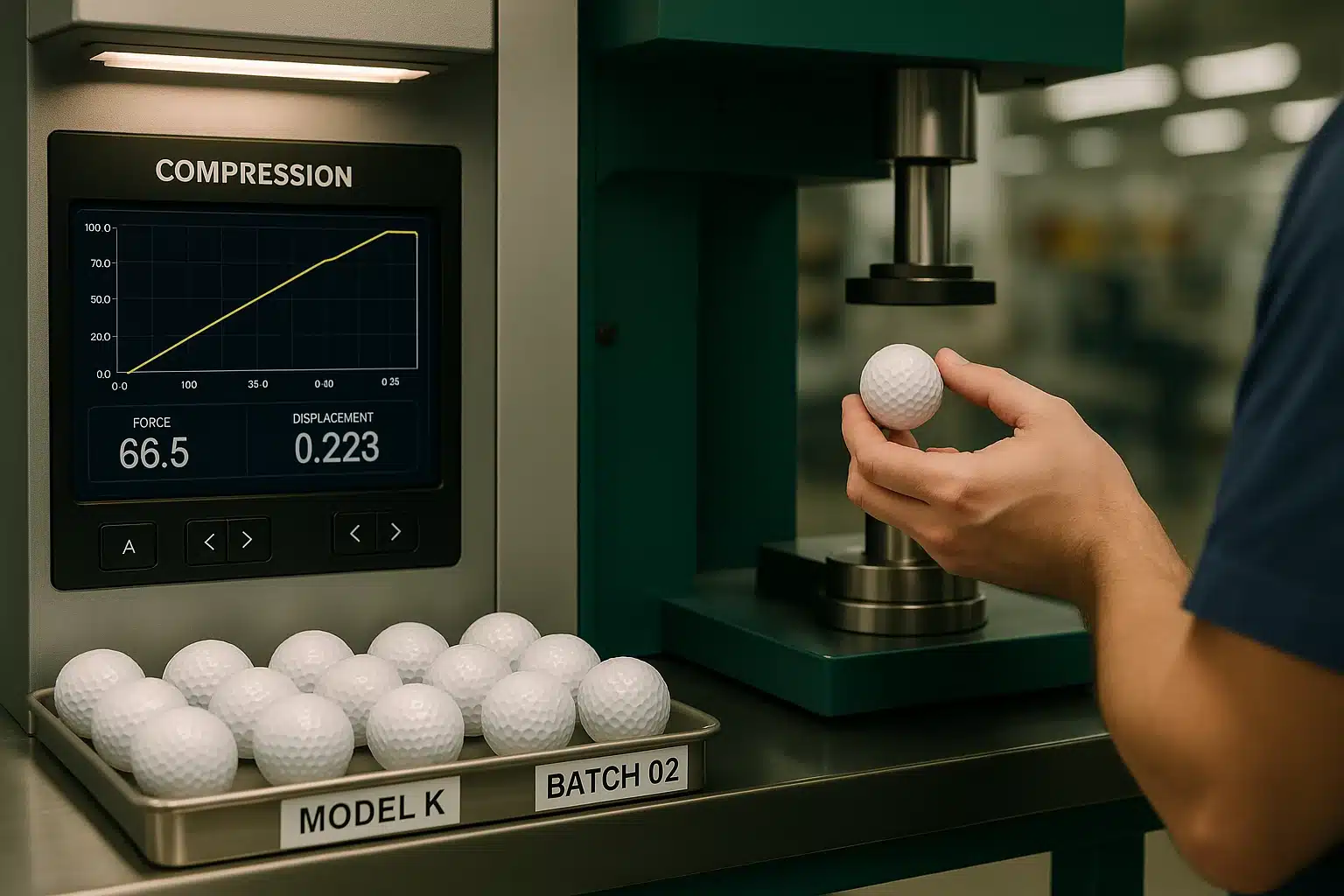
Lab setup: condition balls at a fixed temperature, record force–displacement on a calibrated rig, and log whole-ball compression. Use sampling plans (e.g., N≥32) to estimate spread and set reject rules. Indicative construction bands (method-dependent): 2-piece Surlyn ≈ 30–70; 3-piece urethane ≈ 70–90+; 4–5-piece tour ≈ 90–110+. Regional strengths snapshot: Thailand/Taiwan excel in tour-grade urethane scale-ups; Vietnam/China offer volume 2–3-piece and selective PU with strong cost agility. Ramp tolerances from ±6–7 during line start-up to ≤5 once stable. SOW checklist below aligns all parties:
| Item | Spec | How to control | Gate | Cadence |
|---|---|---|---|---|
| Method & fixtures | Whole-ball, load, dwell | SOP + photo | Method/fixture photo audit | Onboarding + yearly |
| Conditioning | Temp & time | Log + sticker | Temp/time spot check | Each lot |
| Target & tolerance | e.g., 90 ±3–5 | SPC chart | SPC rule breach (e.g., 2/3 beyond 2σ) | Weekly |
| Δ (spread) gate | Model-specific | N≥32 sampling | Sorting + 100% re-test | Each lot |
| One-lab correlation | Shared refs | Same lab rerun | Δ ≤ model limit (e.g., 5 pts) | Quarterly / BOM change |
FAQ
Does lower compression always go farther?
No. Lower compression can help slower swings deform the ball, but distance comes from ball speed, launch and spin together. A softer ball isn’t a guaranteed yardage gain across players or conditions—fit within a band, then test models.
Ads and anecdotes often highlight a single long drive, not repeatable averages. If a low-compression ball launches too high with excess spin, you can lose carry or roll. Conversely, if the ball is too firm for your speed, it may feel harsh and launch low. Use the two-factor method (speed + temperature), then A/B two models and track ball speed and dispersion to see what’s actually longer for you.
Why do two “90” balls feel different?
Because “90” can be measured on different scales, with different fixtures and temperatures, and feel is shaped by cover and acoustics. Two equal labels can deliver very different spin, sound, and short-game touch.
One brand may publish a whole-ball compression; another references the core or a legacy scale. Even within the same compression, urethane often feels softer than Surlyn around the green. This is why batch consistency (Δ) within a model matters more than across-brand label matching. Compare like-for-like methods—or ignore labels and let ball speed, spin windows, and feel guide you.
How should I choose if my speed varies day to day?
Use your lowest typical driver speed to set the band, then confirm with an on-course A/B over three holes per candidate. This avoids under-compression on average days and keeps feel predictable.
Many golfers swing faster after warm-ups or on adrenaline holes, but most shots occur at a lower speed. If you fit to peaks, you risk a ball that feels clicky and launches low when you’re not “on.” Fit to your baseline, then pick the model that maintains stability—tight dispersion and consistent landing—across your range. In cold weather, slide one model softer.
Should women/juniors always play low compression?
No. Choose by speed and conditions, not by age or gender. Some women and juniors swing in the mid or high bands and benefit from mid/high compression models.
Stereotypes lead to mis-fitting. A junior with >100 mph speed can activate tour-grade balls; a senior at 85–90 mph may thrive in mid-compression urethane for better control. The mph number, temperature, and short-game needs dictate the choice. If you don’t know your speed, make a conservative estimate and refine via A/B and launch-monitor checks.
What’s a reasonable batch tolerance for OEM production?
For premium lines, many buyers target compression spreads within ±3–5 points (same method, controlled temperature). New lines may start wider and tighten with SPC and tooling stabilization.
Define the test protocol up front. Set a Δ gate for each lot, specify sampling (e.g., N≥32), and include corrective actions for out-of-control signals. Tie compression gates to performance audits (speed/spin checks) so you protect what players feel on course. Keep a one-lab correlation plan if multiple factories supply the same SKU.
How do I adjust in winter or at altitude?
In winter (<10 °C/50 °F), shift one band softer and pre-warm balls. At altitude, stay in band but consider a spinnier model to hold greens. Always validate on course.
Cold shrinks carry by reducing COR and increasing air density. Warmer storage and pocket-warming before tee-off are legal and effective. At 5,000+ ft, the ball flies farther and may run more; maintaining your compression band but nudging to a model with slightly higher spin helps control approach shots.
Is compression the same as hardness or feel?
No. Compression is a deformation metric; hardness is a material property; feel is your perception shaped by cover, layers, acoustics, and rebound. Similar compression balls can feel very different.
If you prefer a muted sound around the green, urethane covers in the mid-compression band often deliver. If you want durability and a livelier “click,” Surlyn may suit you even at similar compression. Treat compression as a fit guide, not a promise of specific feel.
Conclusion
Compression is a powerful supporting parameter—not a magic number. Get the band right by speed and temperature; then pick models that deliver your spin, launch, and feel.
Start with your lowest typical driver speed, adjust for temperature, and confirm with a quick A/B. For buyers, specify the test method and tolerance, and monitor batch spread. Right band + right design beats chasing any single compression number.
In practice, the two-factor method gets you within the correct band fast; the model choice (cover, layers, spin profile) finishes the fit. For OEMs, lock the test protocol, tolerance, and Δ in the SOW and maintain one-lab correlations. Seasonally, re-check feel and flight; let short-game needs guide final tweaks.
You might also like — 2-Piece Surlyn vs 3-Piece Urethane: Best for Beginners?