Hidden Cost of "Cheap" Commercial Range Balls | B2B Guide
Cheap commercial range balls often cost more in total cost of ownership (TCO) than they save in purchase price. The hidden cost usually includes faster replenishment, washer stoppages, hand-sorting labor, cosmetic deterioration, and player complaints once covers begin to fade, crack, or fly inconsistently.
The range ball that looked cheapest on the PO often becomes the ball you buy twice.
You are not really buying a white sphere. You are buying a maintenance cycle, a guest impression, and a replacement schedule. For US and EU clubs, ranges, and golf entertainment venues, that means the smart question is not “What is the lowest quote?” but “What will this ball cost once it lives in our operation?”
This article shifts the decision from opening price to operating risk. It also shows how to verify durability before a 1,000+ ball order, so you can judge the build before the build starts judging your maintenance team.
What Is the Real TCO of Cheap Range Balls?
The real total cost of cheap range balls is not the carton price on day one. It includes replacement cadence, washer stoppages, hand-sorting labor, cosmetic downgrade, guest complaints, and avoidable reordering once covers fade, crack, or begin flying inconsistently in use.
A low quote feels efficient because it is easy to compare. The harder part is that operations, not purchasing, usually discovers whether the “savings” were real. An unusually low price can reflect tradeoffs in material choice, finish system, or QC depth, and those tradeoffs often reappear later as reject volume, extra labor, or earlier replenishment.
That is why the cheapest range ball is often the one that gets bought twice. The first purchase looks good on paper. The second purchase shows up because the first one did not last in a way your venue could live with.
For high-use venues, especially golf entertainment venues, TCO is usually driven by four things. First, how often the ball needs to be replaced. Second, how much labor gets absorbed into sorting, pulling rejects, and managing appearance drift. Third, how much washer disruption or handling friction the ball creates. Fourth, what the bucket says about your facility before a guest hits a single shot.
Country clubs feel this differently from public-volume ranges, but the cost is still real. A busy public facility may feel the pain through reject handling and replenishment events. A club may feel it through image erosion, member comments, and the quiet downgrade that happens when the range starts looking cheaper than the rest of the property.
A useful TCO comparison looks like this:
| Decision area | What looks cheap | Hidden risk | How buyer verifies | Next step |
|---|---|---|---|---|
| Initial price | Low unit quote | Faster replenishment | Review last-year PO cadence | Estimate annual replacement events |
| Washer exposure | No testing disclosed | Stoppage and jam risk | Run side-by-side wash comparison | Request raw-vs-finished sample pair |
| Labor | Looks acceptable at receipt | Hand-sorting faded or cracked balls | Check coating wear after wash cycle | Request coating and print durability proof |
| Guest perception | Usable but visibly tired | Club or range image erosion | Compare appearance retention after use | Write appearance acceptance into the PO |
This table matters because “usable” and “acceptable” are not the same thing. A ball can remain physically hit-able while becoming expensive in other ways. That is especially true when appearance retention drops faster than the quote implied.
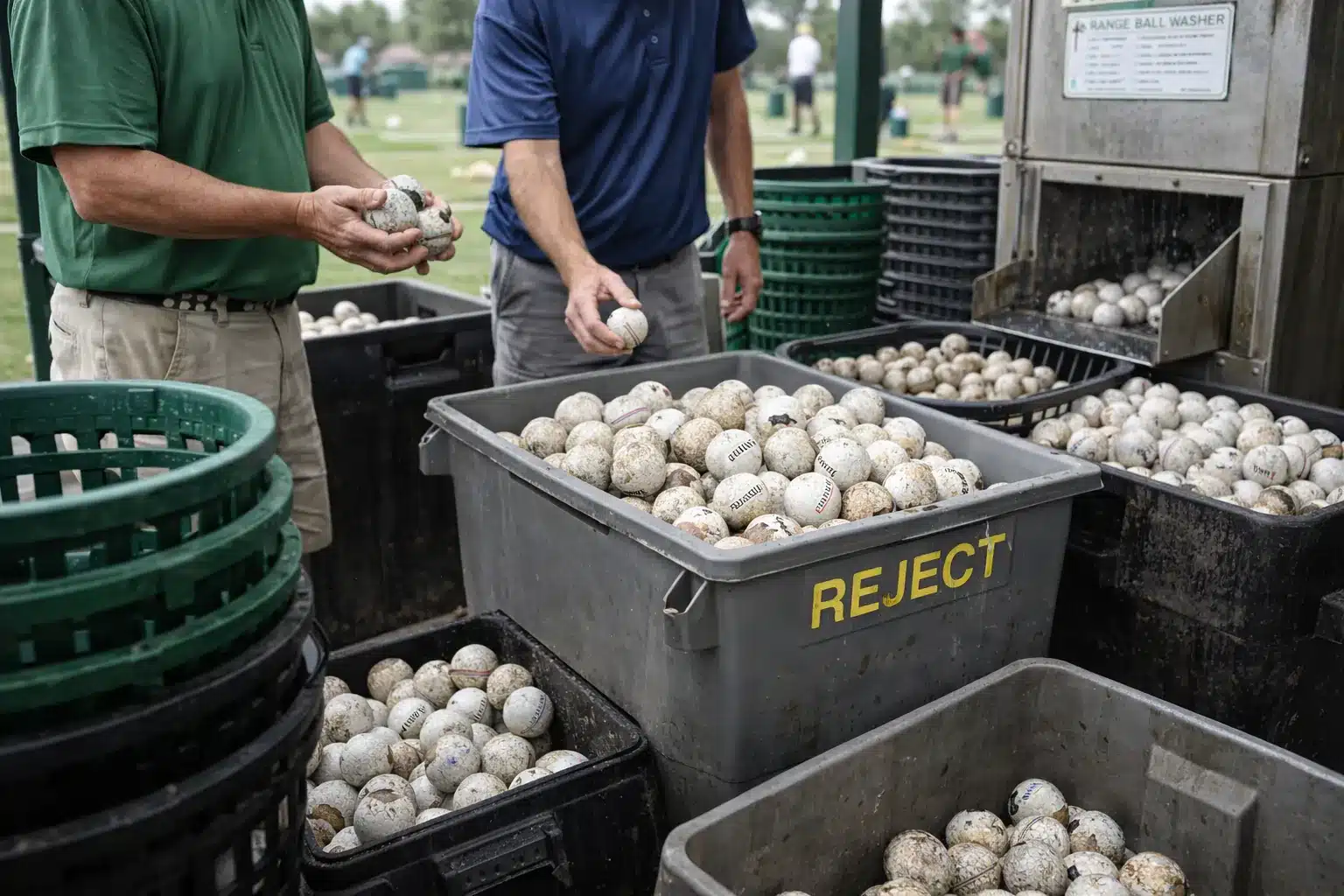
One red flag commonly observed in high-use environments is that the logo can dull before the cover actually fails. When that happens, the ball may still be structurally serviceable, but labor and image costs can begin earlier than buyers expect.
If you already track reject counts, replacement timing, or washer interruption notes, compare those records against the quote before you compare suppliers against each other. That is the point where the buying conversation becomes operational instead of theoretical.
Write this into your PO: define appearance failure as an acceptance issue once dull logos, abnormal coating loss, or visibly mixed finish exceeds your agreed threshold for circulation.
✔ True — The lowest opening quote is rarely the lowest operating cost.
For busy facilities, replacement cadence, labor drag, and washer-related disruption usually decide the real spend. The more heavily the balls are washed, hit, and guest-exposed, the less useful the starting price becomes on its own.
✘ False — “If the ball still looks playable, it is still cheap enough.”
Playable is not the same as acceptable. Once staff start sorting by appearance, or the bucket starts looking tired, the hidden cost has already begun.
Why Do Some Range Balls Crack So Fast?
Some range balls fail fast not because the washer suddenly breaks a good ball, but because weak cover chemistry, thin or uneven cover, poor adhesion, or unstable finishing are exposed quickly under repeated washing, drying, and high-volume impact cycles.
When the washer reveals, not creates, failure
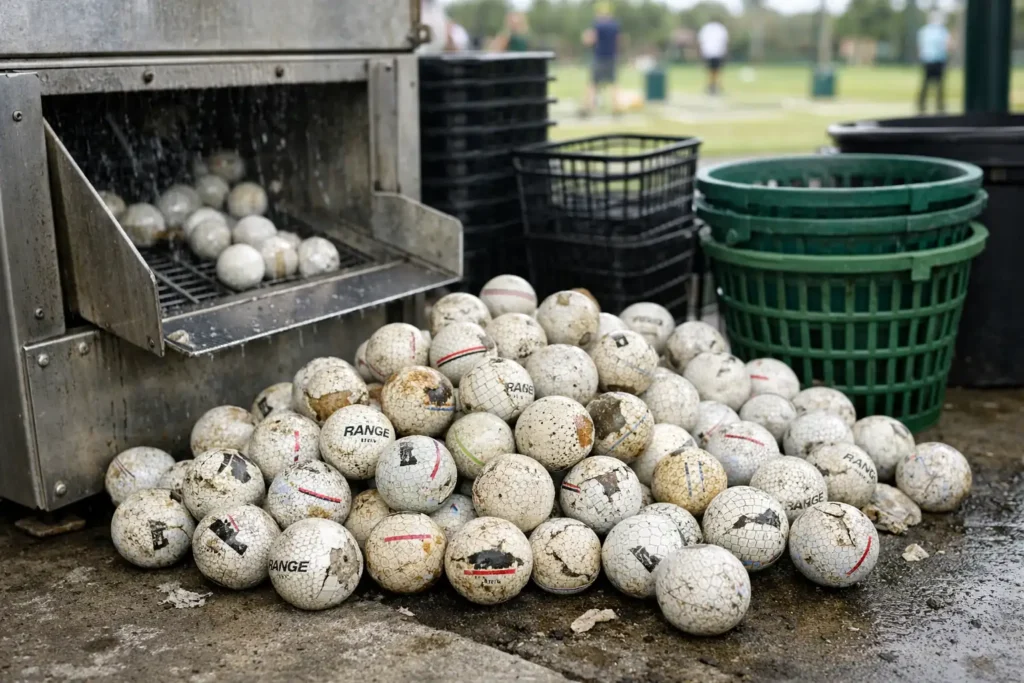
Buyers often notice damage at the washer exit and assume the machine is the whole problem. The machine is usually the exposure point, not the only cause. A commercial washer adds friction, brush contact, water, handling movement, and repeated cycling. If the cover system is already vulnerable, the washer tends to reveal that weakness faster.
That is why the useful technical frame is engineered cover system plus process control, not a simplistic “one material always wins” argument. Cover blend thickness matters. Centeredness matters. Concentricity matters. Coating uniformity matters. Clear-coat adhesion matters. A decent formula with weak process discipline can still become a poor commercial range program.
Cosmetic breakdown also should not be treated as irrelevant just because it appears before a hard crack. In high-use environments, finish loss often shows up first and can become an operations problem before the ball becomes a structural reject. Staff start sorting earlier. Buckets start looking mixed earlier. Customer perception changes earlier.
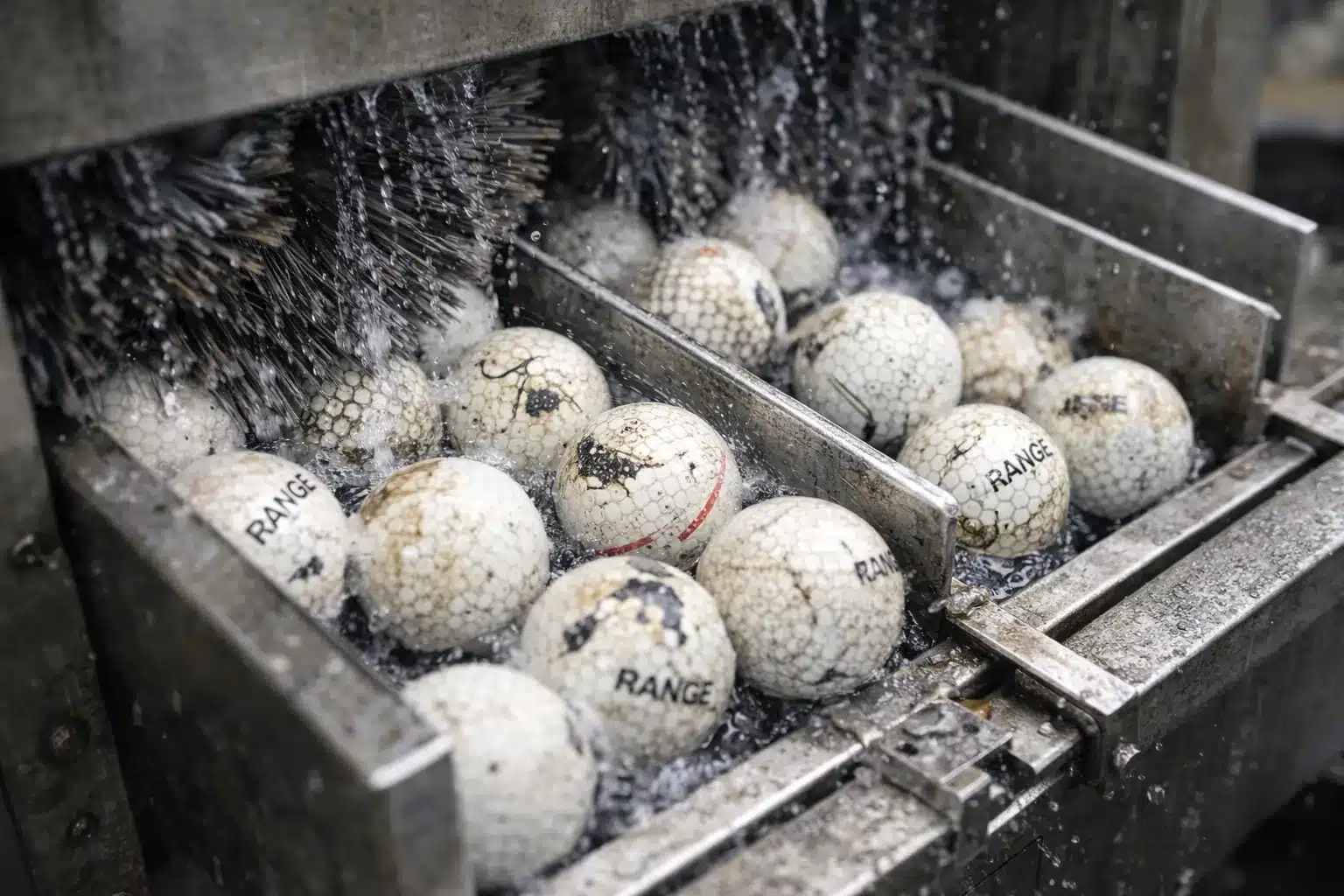
Indoor and simulator-heavy environments deserve extra caution because repeated impact can be stacked with repeated cleaning. A ball that looks fine after a few swings may still begin showing wear quickly once impact stress and wash exposure are combined. That is one reason buyers should judge the build after use simulation, not just at unboxing.
Ask whether the supplier can show cover-thickness checks, centeredness control, and wash-exposure comparison from the intended build. That is a much better indicator than a broad statement that the cover is “durable.”
For physical proof, request three items before you blame only your washer: a bisected sample, a raw ball, and a finished ball from the intended build. Comparing those before and after wash exposure helps reveal whether the issue is structural, finishing-related, or both.
One telltale sign is that cracks commonly cluster near the seam after wash-cycle exposure. When that pattern appears, buyers should look more closely at thickness control, adhesion, and finish consistency rather than assuming the washer created damage from zero.
Your acceptance standard should separate visible crack, tactile cut, logo loss, and abnormal coating wear into different failure events. Those are different problems, and they should not be buried under one vague “durability” claim.
How Can You Test Durability Before Bulk Buying?
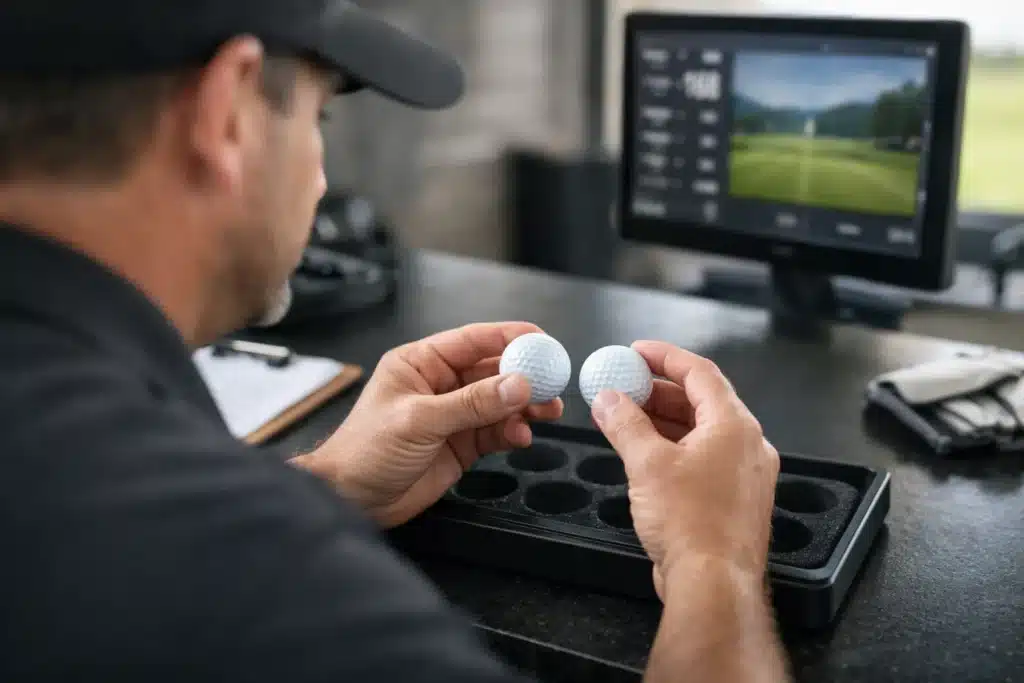
A durable range-ball sample should be tested three ways before bulk buying: cut it, wash it, and hit it repeatedly. The point is not theoretical lifespan, but the moment visible damage begins changing flight, appearance, screen safety, or daily operating reliability.
- Cut it. Inspect more than one sample for core centering, cover thickness, and structural uniformity.
- Wash it. Run the new sample beside your current ball set and compare finish loss, seam wear, and early crack behavior.
- Hit it. Use a controlled impact routine and record the first scuff, first cut, first crack, and first obvious flight instability.
This sequence matters because one attractive sample proves almost nothing. A display ball can be prepared to sell. A sample set with a failure log is designed to verify. That is why buyers should treat the approved sample as an operating benchmark, not as a courtesy item that gets admired and forgotten.
The test does not need to be fancy, but it does need to be disciplined. A simple log sheet should record sample ID, lot reference, test setup, club used, cycle count, first scuff, first cut, first crack, visible coating loss, and rejection point. That turns the conversation from “it felt okay” into “this is where the build started drifting.”
Use this as a working protocol:
| Test step | What buyer does | What failure looks like | Evidence to keep | Next step |
|---|---|---|---|---|
| 1. Cross-section check | Cut and inspect multiple samples | Off-center core or uneven cover | Bisected sample photos | Reject or request revised build |
| 2. Wash-cycle comparison | Run new sample beside current ball set | Fast coating loss, seam wear, cracking | Before/after comparison set | Request coating or process explanation |
| 3. Repeated-impact check | Use simulator or controlled hitting cycle | First scuff, first cut, first crack, unstable flight | Damage log sheet | Approve only the build that holds shape and appearance longer |
The best deliverable is not a brochure. It is a destructive evaluation kit with a bisected sample, a raw-vs-finished pair, blind batch samples, and a lot-linked log sheet. That combination lets you inspect structure, finish, and consistency instead of listening to general claims about them.
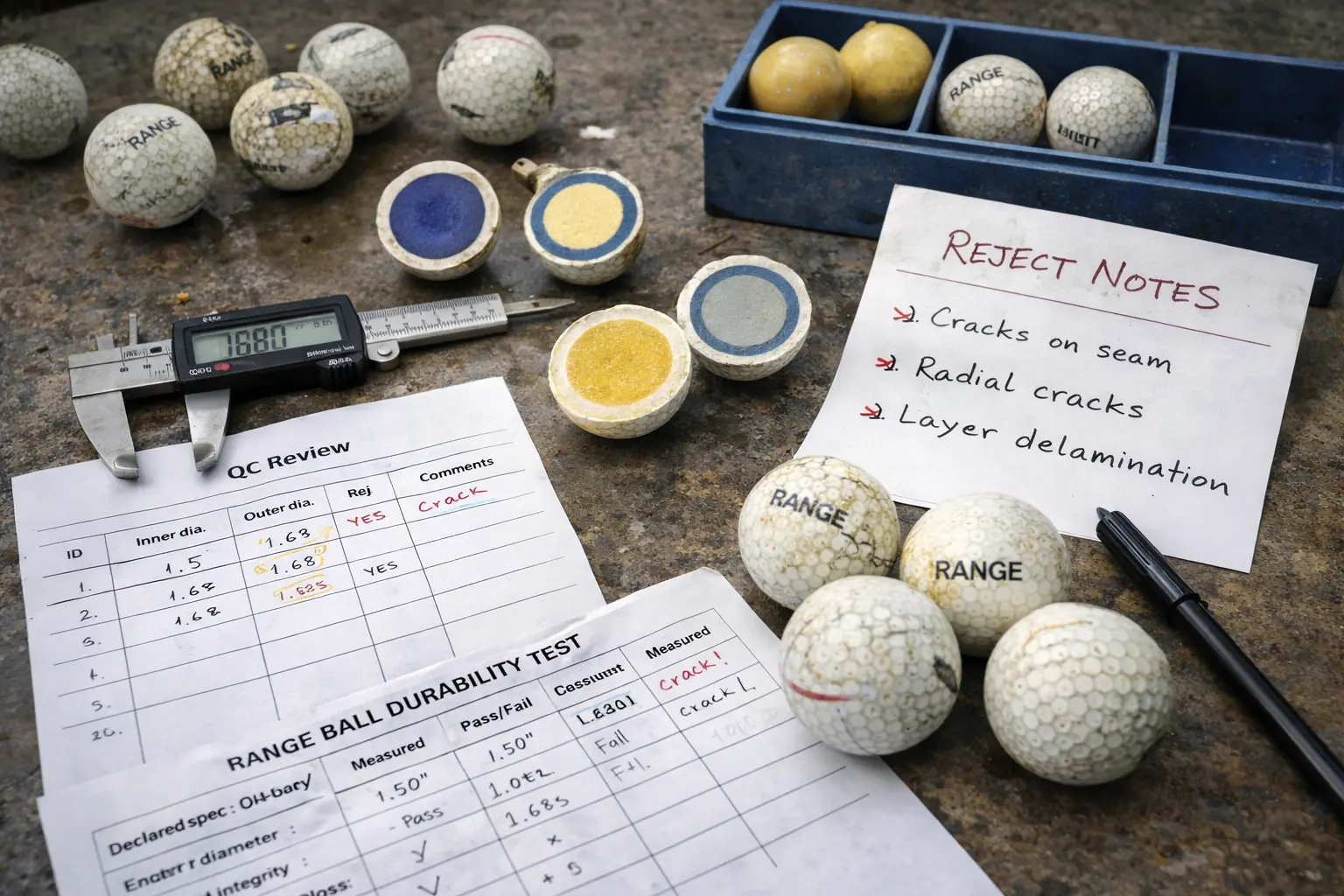
Request one destructive evaluation kit with a bisected sample, one raw-vs-finished pair, blind batch samples from the intended lot, and the matching lot-linked QC sheet.
Define fail points before the test starts. If you wait until after damage appears, every weak sample suddenly becomes “still acceptable.” Buyers should decide in advance what counts as failure for crack, coating loss, screen marking, and flight instability.
Write this acceptance clause into the order file: approved sample and blind batch samples must remain visually consistent after the agreed wash-cycle comparison and repeated-impact check. Any lot showing visible cracking, abnormal coating loss, or logo failure outside the agreed acceptance standard may be held for review.
✔ True — A sample set and a failure log prove more than one perfect-looking ball.
The buyer’s job is not to find the nicest sample. It is to identify when structure, finish, or flight starts drifting under the kind of use the venue actually creates.
✘ False — “If the sample survived a few swings, the lot is probably fine.”
A few swings prove that a ball can be hit. They do not prove when it becomes operationally annoying, cosmetically unacceptable, or too inconsistent for your program.
How Do You Verify Sample-to-Bulk Consistency?
Sample-to-bulk consistency is proven with records, not reassurance. Buyers should match the approved sample to blind batch samples, lot identifiers, centeredness and concentricity checks, cover-thickness uniformity, and pre-shipment QC records from the intended lot before approving a bulk release.
Most buyers are not afraid of a bad sample. They are afraid of a good sample followed by a weaker shipment. That is the real consistency problem in commercial range buying: not obvious failure, but quiet drift.
The most useful proof is not a reassurance email but a lot-linked trail showing centeredness, concentricity, cover-thickness uniformity, and retained-sample match. Those checks matter because visible similarity alone can hide meaningful differences in structure, finish behavior, or feel.
The practical method is straightforward. Keep one numbered retained sample from the approved build. Request blind batch samples from the intended production lot before release. Compare them side by side under identical lighting and handling, then review a concise QC sheet covering dimensions, weight, hardness or compression, and any structural or coating checks tied to that lot.
Consistency is a paper trail plus a test trail. If the approved sample and the shipped lot cannot be connected through lot ID, retained sample logic, and pre-shipment records, you do not really have consistency. You have hope.
A mature supplier should also be able to show enough process discipline to make the quote believable. Not every factory shares internal limits, but a serious supplier can usually show how it thinks about testing capability, calibration habits, and structured quoting. If the quote is detailed but the QC trail is vague, or the sample is strong but the batch proof is missing, slow the program down.
One telltale sign is tactile rather than visual: the approved sample feels firmer than the blind batch. That does not automatically reject the lot, but it should stop release until structure, finish, and records are reconciled.
Use the same retained sample and lot reference at receiving that you used during approval. That continuity is what turns procurement work into an operational control instead of a one-time pre-shipment ritual.
Write this traceability clause into your PO: each shipment shall show lot number, production date, and retained-sample reference on outer cartons and the packing list. Supplier shall provide the matching pre-shipment QC record for the shipped lot.
Does Factory-Direct Add Risk for US/EU Buyers?
Factory-direct sourcing is not the risk; vague promises are. US and EU buyers reduce program risk when suppliers separate production lead time, export handling, transit, customs, and final-mile delivery, then show which documents, checkpoints, and responsibility splits prove each stage.
How to quote ETA without one vague promise
As of 2026, buyers get into trouble when they ask for one delivery number instead of one delivery map. Production lead time is not export handling. Export handling is not international transit. Transit is not customs. Customs is not final-mile appointment. When those stages get blended together, every delay becomes mysterious, which usually means nobody owned the schedule clearly enough.
For a first direct-factory order, the safer mindset is to treat it as a validation order rather than a price-maximization order. Standard white builds, simpler packaging, and disciplined sample proof often reduce risk more effectively than pushing for the most aggressive ETA on paper.
This lane-based view keeps the discussion useful:
| Destination lane | What changes ETA most | What buyer should ask | Evidence/checkpoint | Next step |
|---|---|---|---|---|
| US West | Cargo-ready date, booking, port congestion, final-mile slot | Production-ready date plus milestone plan | Milestone tracker | Quote ETA as a range with checkpoints |
| US East | Routing length, customs exam, rail or truck handoff | Handoff visibility | Routing and customs checkpoint list | Separate ocean ETA from inland ETA |
| UK | Deconsolidation, customs release, truck slot | Responsibility split | Document checklist | Confirm who owns clearance risk |
| Germany/North Europe | Port rotation, inland trucking, peak season | Historic lane examples plus milestones | Redacted shipment proof | Lock lane assumptions before PO |
| Express samples | Pickup cutoff, courier capacity, customs paperwork | Dispatch date and courier method | Tracking and invoice copy | Use samples to validate cadence early |
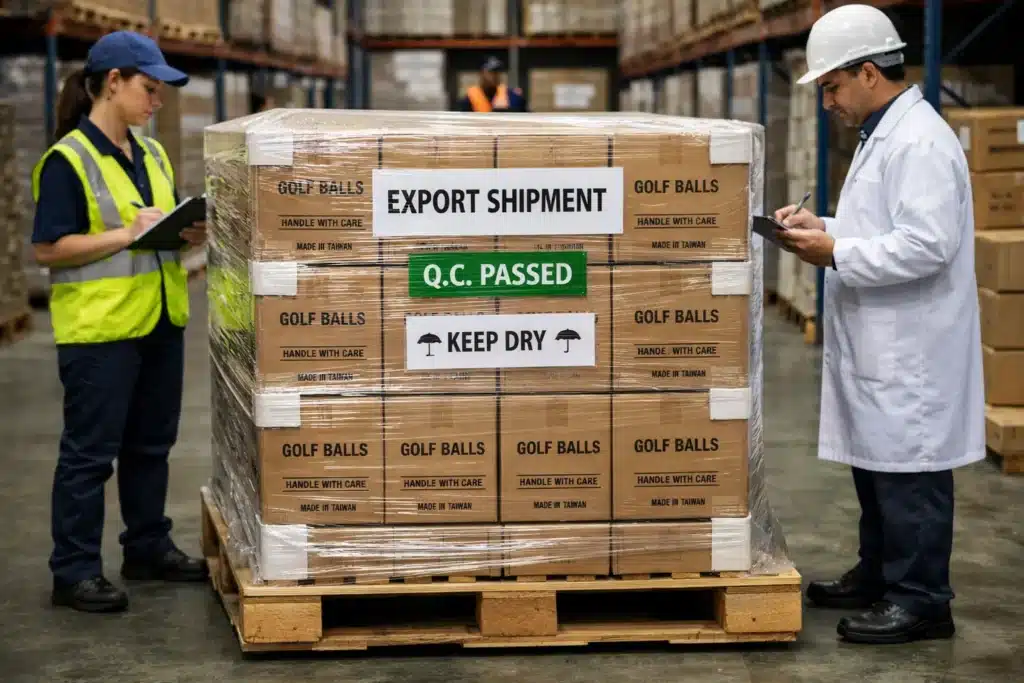
Ask for an order-to-door milestone map, a redacted shipment history, and a document checklist that shows who owns customs, clearance, and final-mile failure points. That is what makes factory-direct manageable. Not the promise. The checkpoints.
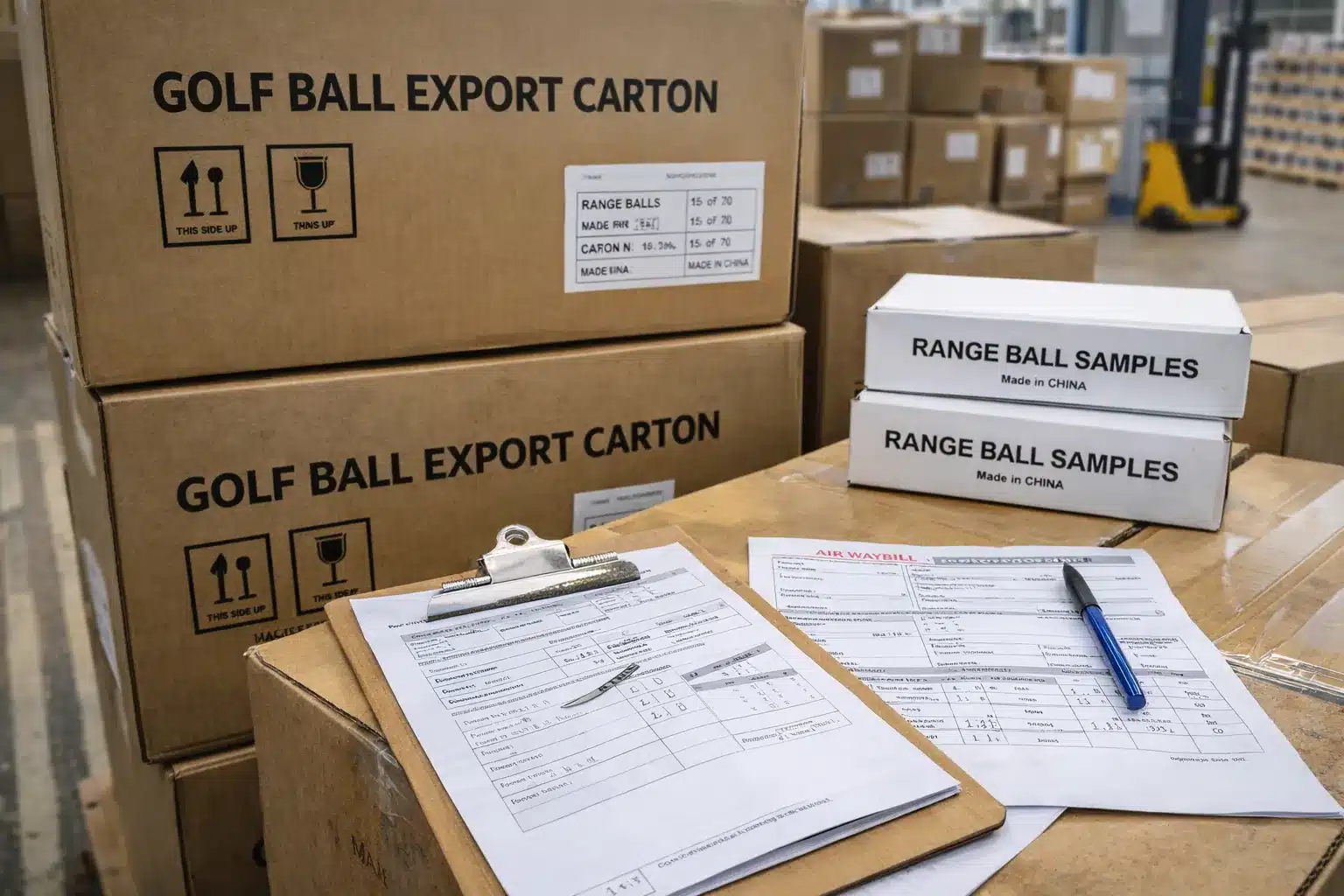
Factory-direct also needs to be judged as a packaging and documentation program, not only as a manufacturing program. International transit does not care how good the cover recipe is if the cartons arrive crushed, the lot references are unclear, or receiving cannot tell which shipment matches which approved build.
Golf entertainment venues usually care more about washer tolerance and appearance retention than brochure-level feel. Country clubs usually care just as much about bucket presentation as about physical durability. In both cases, the buyer action is the same: write appearance, packaging protection, milestone visibility, and document handoff into the buying process, not just quantity and unit price.
✔ True — Factory-direct works when milestone ownership is visible.
A buyer does not need a magical ETA. A buyer needs a realistic schedule broken into checkpoints, document handoffs, and clear responsibility when something slips.
✘ False — “Factory-direct is automatically riskier than buying local stock.”
Factory-direct becomes risky when the process is opaque. A transparent program with sample proof, lot traceability, and milestone visibility is often safer than a fast local quote with no real evidence behind it.
FAQ
Do visibly scuffed balls matter even before they crack?
Yes. Visible scuffing can become a performance, labor, and brand-perception problem before the ball reaches obvious structural failure.
Guests notice visible wear before they understand the cause, and staff usually start sorting before the ball officially “fails.” That matters for country clubs, simulator programs, and entertainment venues where consistency and presentation are part of the product. Your reject rule should include visible wear thresholds, not only open cracks. The safest way to set those thresholds is a side-by-side comparison against your current acceptable ball, then a simple written receiving standard for future lots.
What lot documents should I request on every reorder?
Request lot number, production date, retained-sample reference, pre-shipment QC summary, and a shipment milestone snapshot on every reorder.
That document set keeps a reorder from turning into a trust exercise. Lot number and production date connect the cartons to the manufacturing record. The retained-sample reference connects the order back to the approved benchmark. The pre-shipment QC summary gives receiving something concrete to compare. The milestone snapshot helps your team understand where the shipment actually is, rather than where everyone hopes it is.
Is double clear coat worth asking about for logo balls?
Often, yes. Double clear coat is usually an appearance-retention and labor decision, not a cosmetic luxury.
If you run logo-heavy buckets, dull surfaces and fading marks can force early hand-sorting even while the ball is still structurally playable. That makes finish performance worth testing, especially for club environments where the bucket is part of the brand presentation. Ask for a before-and-after wash or rub comparison and judge it like any other retention variable. The right question is not whether a supplier offers the finish, but what measurable difference the finish shows after repeated wash exposure.
Should I reject a supplier that lacks a current conforming-ball listing?
Not automatically. Range-ball procurement is usually a different decision from tournament-ball conformity, so your actual use case should decide the priority.
If your program requires listed conformity, then yes, that belongs in qualification. But many range and facility programs are really buying for durability, consistency, and lot proof rather than formal tournament status. In that case, do not let listing status replace real verification work on structure, finish, and batch consistency. The smarter question is whether your program needs that listing and whether the supplier can prove the build you will actually receive.
What MOQ is realistic for a first direct-factory trial order?
A first trial order should be treated as a validation order tied to sample proof, not as a volume-maximization exercise.
A realistic MOQ depends on how custom the build is. Existing molds, standard color, ordinary packaging, and simple print programs are usually easier to launch than highly customized builds. The first order is there to confirm sample truth, communication rhythm, QC discipline, and logistics behavior. Buyers should ask which parts of the build are fixed and which are flexible at lower volume, then decide whether the trial is big enough to learn from without becoming a painful commitment.
What should receiving staff inspect before balls enter circulation?
Receiving should inspect the same failure points purchasing defined earlier: appearance consistency, logo or finish condition, early seam wear, visible cracks, and retained-sample match.
This is where procurement either becomes operational discipline or gets forgotten at the loading dock. Keep a small reference sample from the approved lot, then spot-check the delivered lot under consistent lighting. Compare finish, logo sharpness, color consistency, seam condition, and any obvious early cracking. If the shipment includes a lot-linked QC record, use it there. The goal is not laboratory perfection. It is catching drift before the lot gets mixed into circulation.
Conclusion
Cheap range balls rarely stay cheap for long. The real cost shows up in reject bins, washer interruptions, hand-sorting time, appearance complaints, and earlier replenishment than the quote ever hinted at.
A better buying rule is simple: stop judging the ball only at receipt and start judging the program over one operating cycle. Compare sample sets, define failure points, tie the lot to records, and make suppliers prove the build before the bulk PO. That is how you stop buying the same “cheap” mistake twice.
You might also like — How to Ensure Your OEM Golf Ball Logos Survive 300+ Hits?