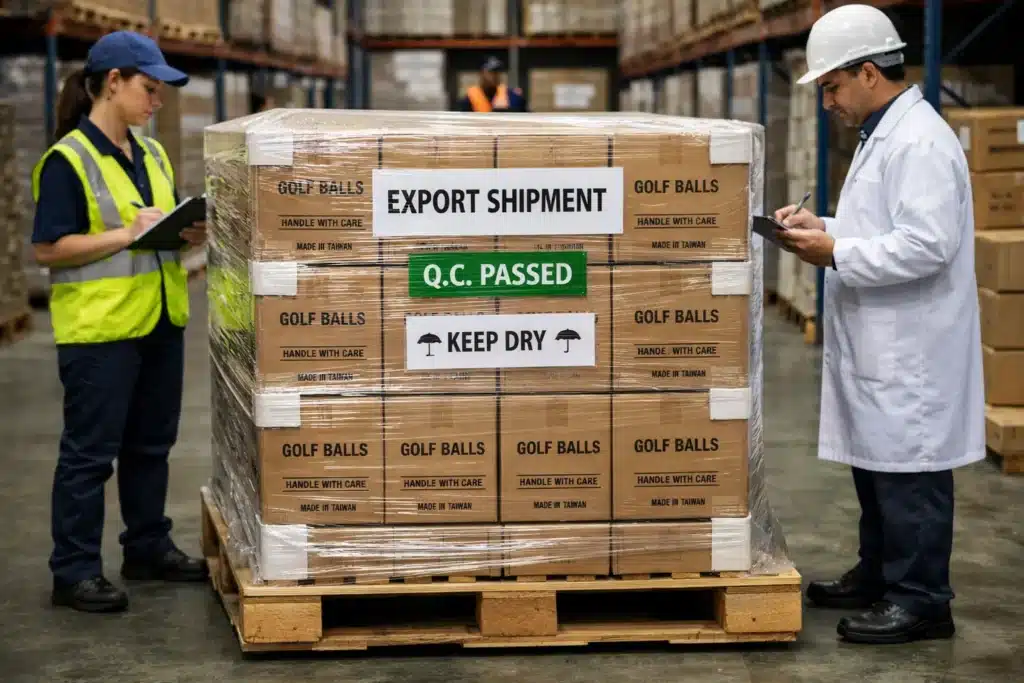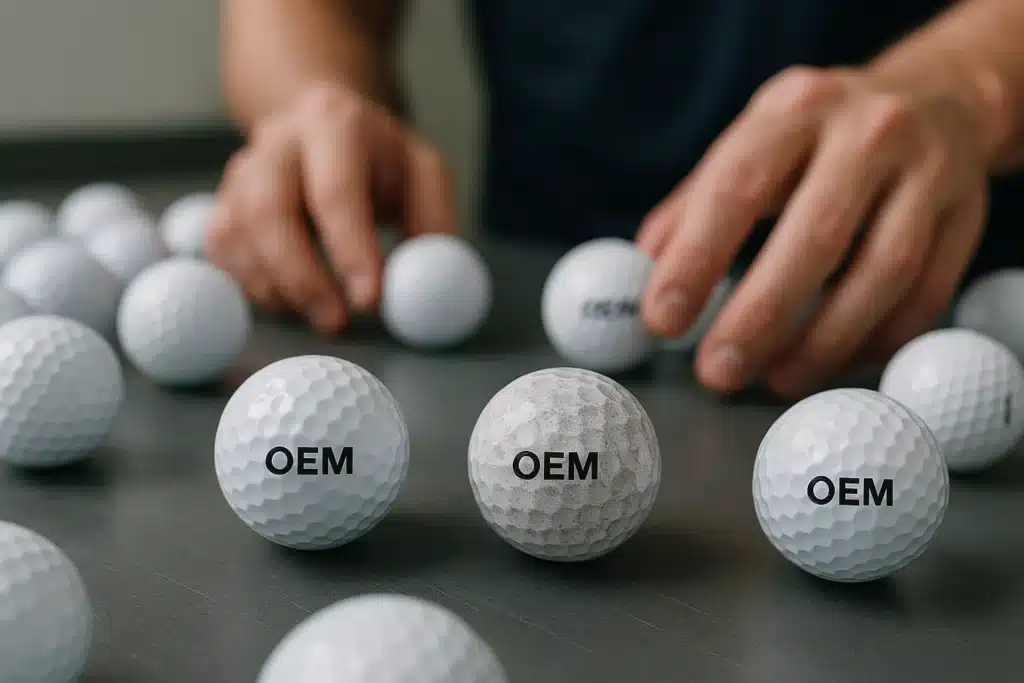
B2B buyers are tired of promo balls whose logos peel after a few buckets. This guide shows how to spec, test, and buy OEM golf balls that keep your brand visible.
To make golf ball logos survive 300+ hits, treat them like a coating system, not just “ink on a ball”. Combine two-component pad printing ink, proper surface treatment, controlled curing, a clear-coat varnish, and lab tests for adhesion, abrasion, water and impact to reach industrial-grade durability.
After you understand why cheap gift balls fail, you can start engineering durability from the inside out: structure, ink system, clear coat and test protocol. The sections below walk through each decision from a B2B buyer’s point of view so you can spec real golf ball logo durability, not wishful thinking.
How can OEM golf ball logos survive 300+ hits?
Many buyers ask “Will the logo wear off?” but get vague answers like “Don’t worry, it’s fine.” To guarantee 300+ hits, you need a clear spec, not empty promises.
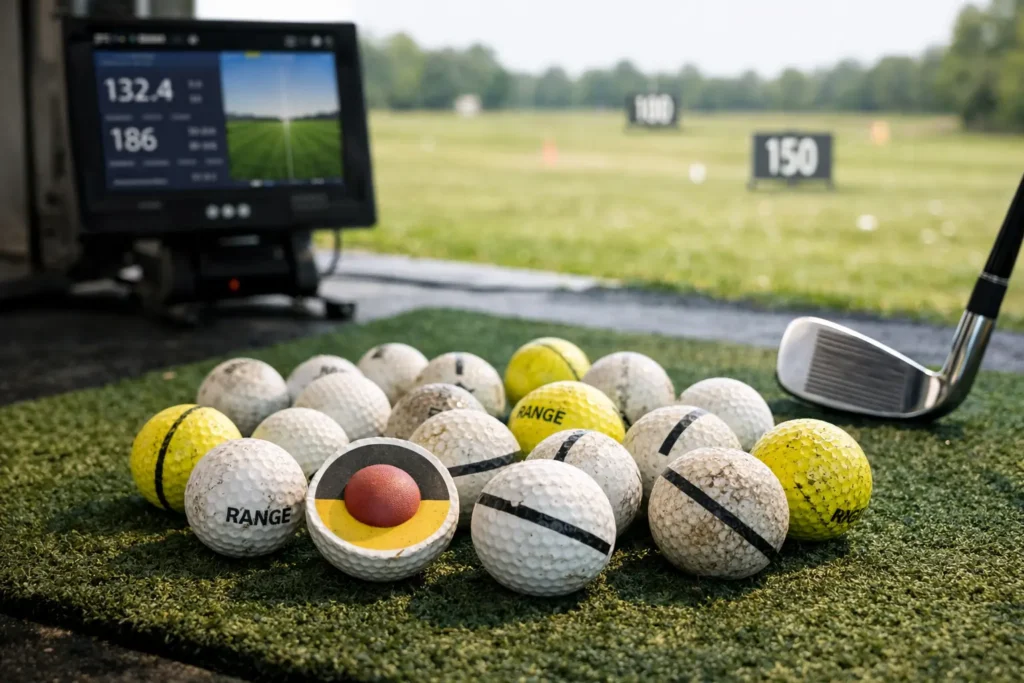
Logo survival starts with realistic expectations: promo balls use single-layer ink for short campaigns, while OEM brand balls use multi-layer coatings, two-component inks and clear coats. When you define logo life in hits and test methods, your supplier can design a stack that absorbs impact instead of peeling at the first scuff.
The core question is not “Will it ever peel?” but “Under which conditions will the logo remain legible?” A ball hit occasionally on soft grass does not need the same protection as a range ball hit hundreds of times off mats. Once you define logo life in hits, lies and failure modes, you can match process and budget.
Three levers control logo durability:
-
Structure tier – low-cost 2-piece Surlyn balls with a single pad print vs OEM-grade balls with primer, logo and clear coat plus tighter QC.
-
Ink & coating system – two-component pad printing ink (with hardener) and clear coat tuned to cover hardness and elastic deformation.
-
Test protocol – ASTM D3359 Cross-hatch adhesion test, MEK rub test and a 300-hit impact test instead of vague “six months” promises.
You can summarise promo vs OEM logo balls like this:
| Decision dimension | Promotional logo ball | OEM brand ball with full stack | Recommendation |
|---|---|---|---|
| Tier | Low-cost promo / giveaway | Range, academy, long-term brand program | Choose by campaign length and risk |
| Coating stack | Single ink, maybe thin clear | Primer + 2K pad ink + clear coat varnish | Use full stack for 300+ hit projects |
| Expected logo life | Tens–hundreds of light-use hits | Hundreds–thousands of normal-play hits | Base SLAs on hits, not months |
| Custom golf ball printing wear resistance | Limited, cosmetic focus | Industrial-grade adhesion, scuff resistance | Upgrade when complaints are expensive |
| Typical FOB | Lowest | Mid–high, includes process and testing | “Too cheap” often means no real testing |
✔ True — Logo durability must be tied to defined usage and tests
When you specify hits, surfaces and failure modes, suppliers can design a coating stack to match. It also makes disputes easier to resolve based on data.
✘ False — “Our logos never fade, no matter how you use them”
No system survives infinite hits or concrete. Replace “never fades” with conditions: normal range use, defined hit counts and agreed appearance limits.
What really happens to the logo during a 100 mph impact?
Every drive flattens the ball dramatically. If the ink film can’t stretch and recover with the cover, it fractures like dry mud and starts flaking along the logo edges.
Logo failure happens when the ink film’s elasticity and adhesion can’t keep up with the ball’s compression. At impact, the cover squashes and rebounds. If the ink is too brittle, under-cured or poorly anchored, micro-cracks form, the bond breaks and you see peeling or flaking around the logo.
In a slow-motion impact, the core and cover compress, the surface under the logo flattens, then everything springs back in milliseconds. That sequence repeats hundreds of times across a ball’s life, especially under wedges. If the coating system is too brittle, it behaves like glass glued to rubber: cracks start at dimple edges, grow into flakes and cause obvious logo peeling and ink flaking. If it is too soft, it may not peel but will smear, glaze and lose edge sharpness.
Two-component inks with flexible binders and hardeners let you tune this balance. They must match the cover’s hardness (often around Shore D 50–60 for Surlyn, softer for urethane) and pass basic scuff resistance checks. Refurbished balls often perform worse because stiff repaint layers sit on top of old, weakened coatings and crack quickly when the ball flexes.
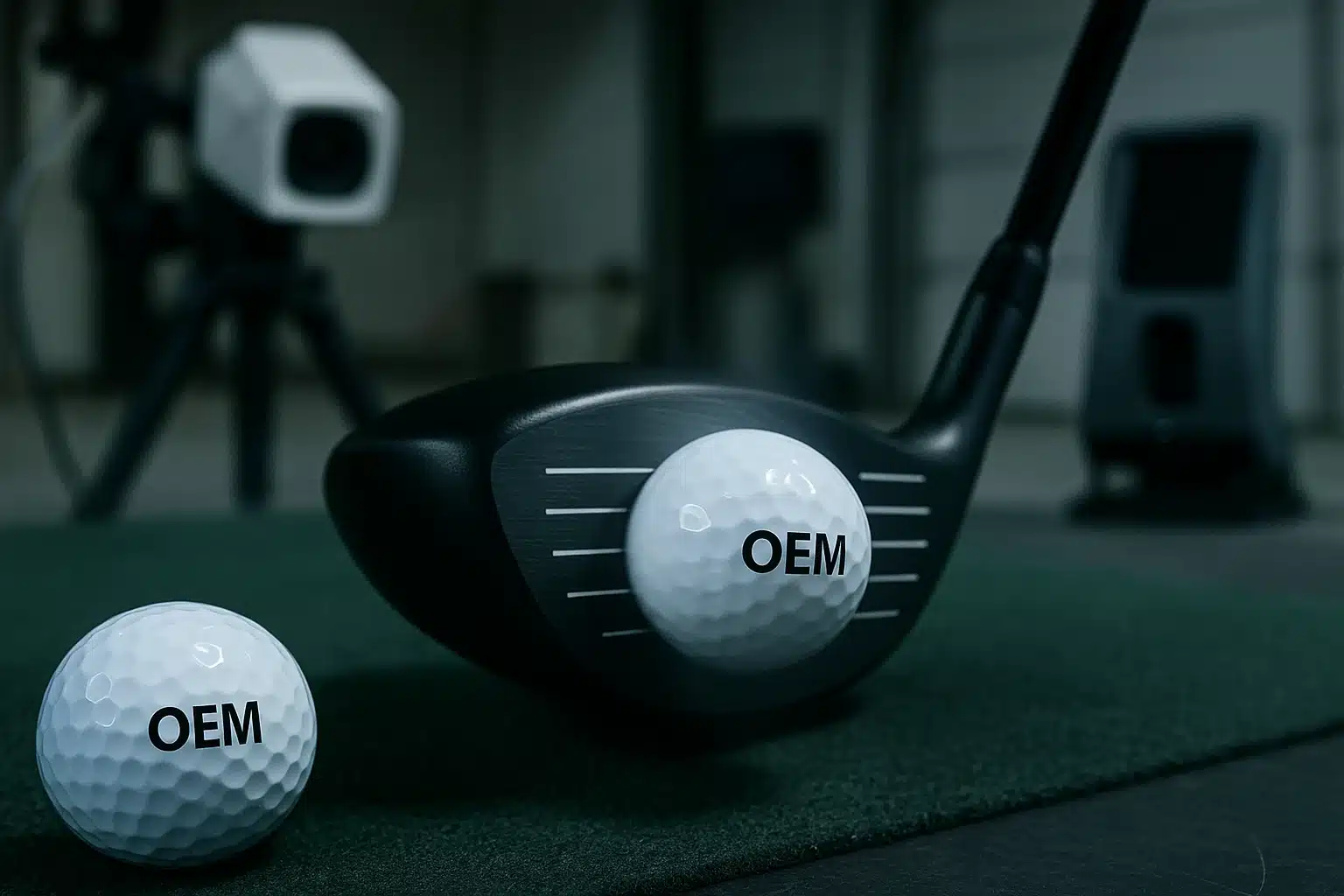
Understanding elastic deformation at 100 mph
Use a simple ball cross-section story: core and cover compress, then rebound in milliseconds. The logo ink has to flex with a cover that’s typically around Shore D 50–60, not sit like rigid glass on top.
Think of three ink/clear coat behaviours:
| Ink / clear coat balance | Failure signs | Action |
|---|---|---|
| Too brittle | Edge cracking, flakes after few wedges | Increase flexibility, adjust hardener |
| Too soft | Smearing, glossy burnish, print fading | Increase crosslinking, cure more fully |
| Well-balanced | Gradual scuffing, logo still readable | Lock recipe; keep curing discipline |
✔ True — “300 hits” should mean defined speed and pass/fail limits
A useful spec might say: 300 driver-equivalent impacts at 100 mph, no large-area peeling, logo legible from address. That’s clear enough to test.
✘ False — “Logos last six months” without usage assumptions
Two balls used for six months can see totally different hit counts. Always translate time into hits and use environment.
Pad printing vs UV digital: which lasts longer?
Suppliers love to sell “full-color UV digital logos”, but you need to know when classic pad printing with hardener and clear coat will outlast UV prints in real practice use.
For long-term logo durability, two-component pad printing ink with hardener, on a treated cover and under a clear coat, is usually the safest OEM choice. UV digital excels at complex, photo-style artwork but tends to be less flexible and more prone to edge chipping under repeated high-speed hits and abrasive lies.
Pad printing uses a steel plate, silicone pad and two-component ink (2K). The ink is mixed with a pad printing hardener, transferred to the dimpled surface, flashed and cured. Correct mix ratio, pot life and curing schedule give strong OEM golf ball ink adhesion, passing Cross-hatch adhesion tests and the MEK rub test. UV digital jets ink and cures instantly, enabling CMYK+white and gradients, but typically creates a thicker, slightly more brittle film that relies heavily on a good clear coat varnish.
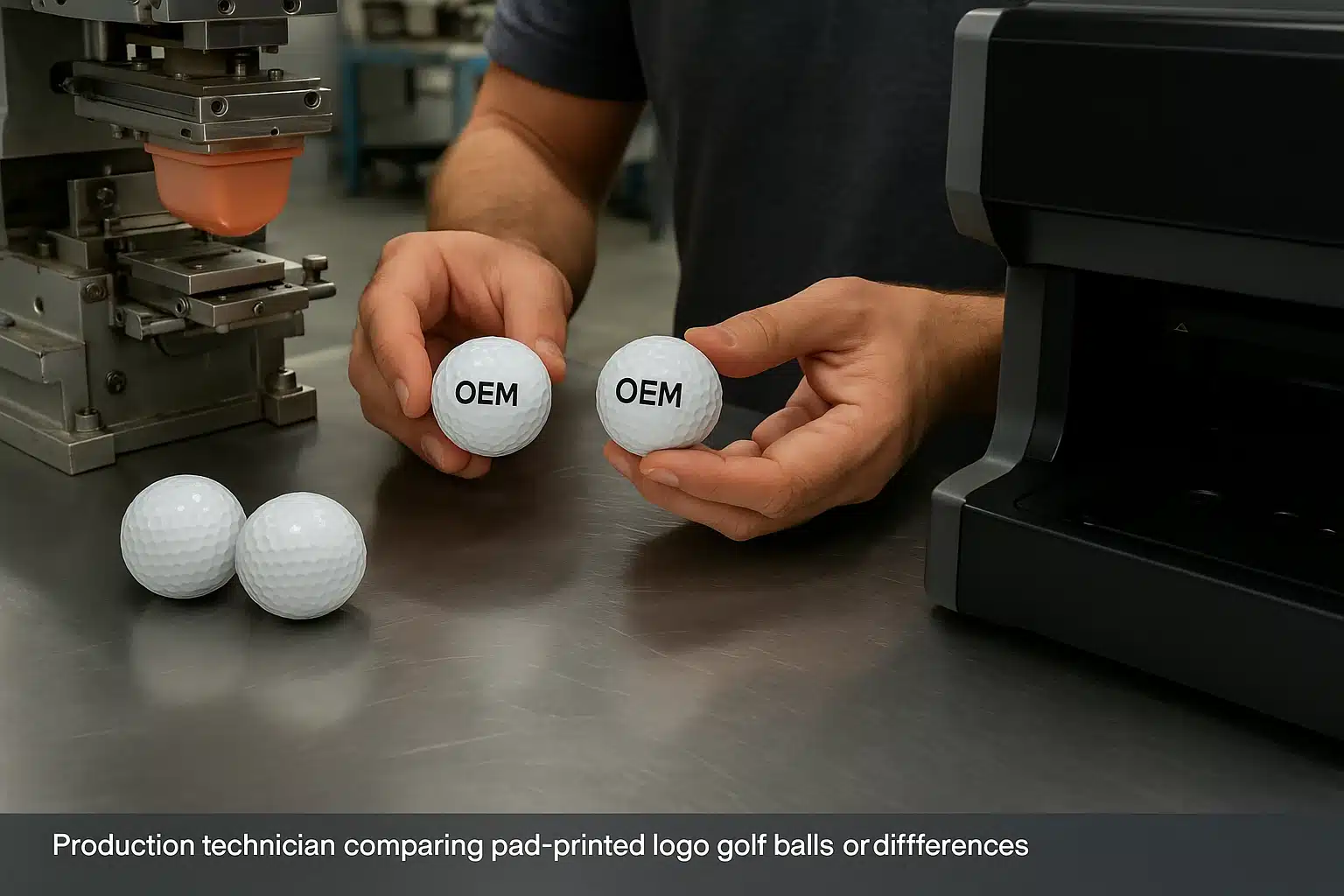
How do hardeners in pad printing ink boost durability?
Explain that pad printing hardeners chemically crosslink the ink, turning it from a soft film into a tougher network. Proper mixing ratio and curing time are crucial to get both flexibility and scuff resistance.
From a buyer’s perspective:
| Process | Artwork complexity | Typical durability (with clear) | Best use-case |
|---|---|---|---|
| Pad printing | Solid logos, spot colours | Excellent when 2K + clear are tuned | Range balls, academies, long OEM runs |
| UV digital | Photos, gradients, many SKUs | Good but needs validation and clear | Gifts, VIP packs, short promo runs |
In RFQs, you can write: “Pad printing with two-component ink + hardener + clear coat for long-term range use; UV digital only on gift SKUs, backed by MEK rub and abrasion data.”
Does clear coat really protect golf ball logos?
Clear coat sounds like optional cosmetics, but on serious OEM balls it is a working protective layer that separates “wipes off in a week” from “still legible after months of range abuse”.
A good clear coat does more than make the ball shiny. It shields the logo from direct abrasion, moisture and chemicals, and helps distribute impact stress across the surface. High-end balls usually place the logo under a cured clear coat, turning the logo into part of the coating system, not a fragile surface print.
On a durable ball, the stack is usually: cover → primer/under-coat → logo ink → clear coat varnish. The primer promotes adhesion and colour control. The clear coat adds scuff resistance, controls feel and protects the ink from sweat, sunscreen and cleaners. Skipping clear or using a very thin decorative layer saves some cost but usually shortens logo life dramatically.
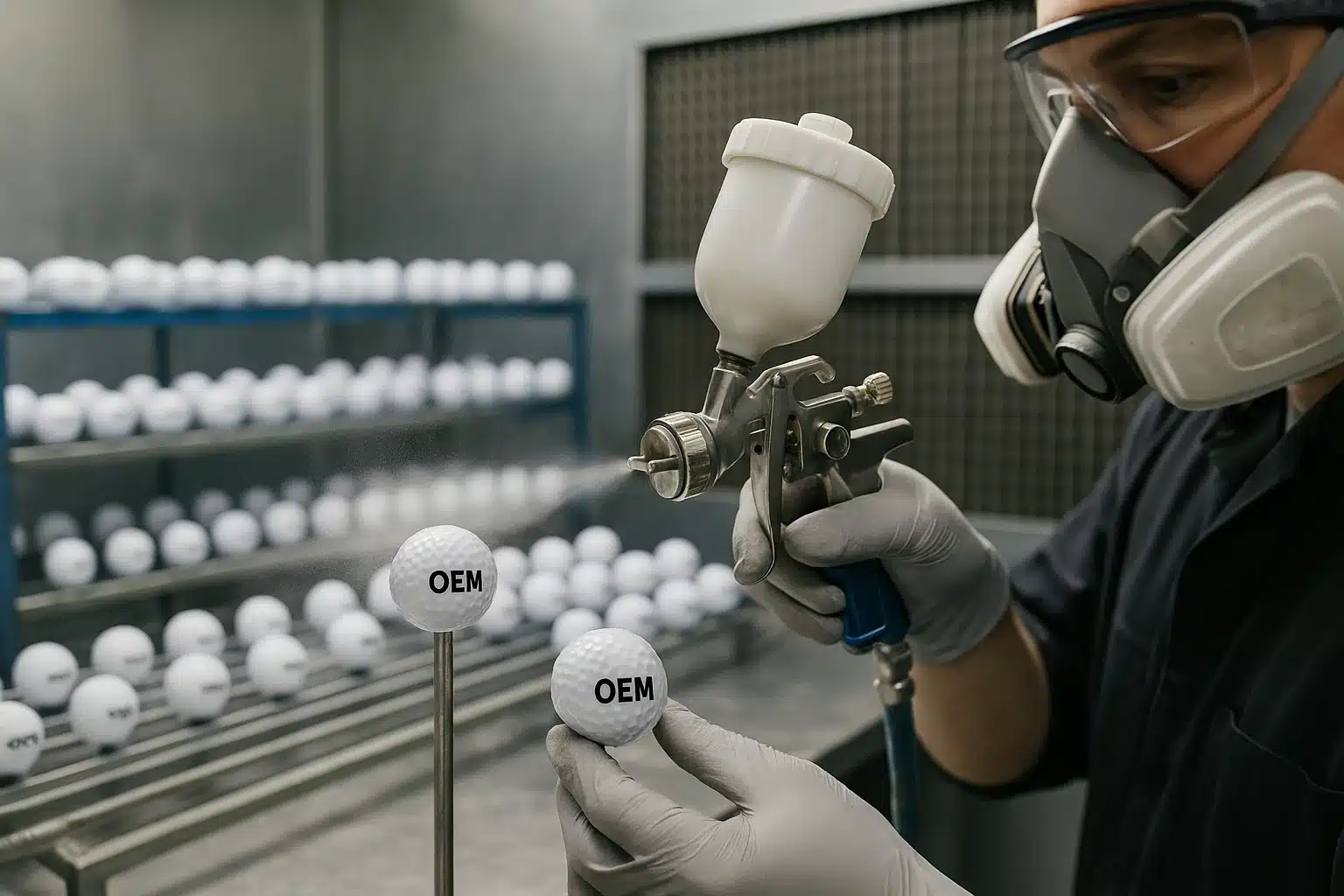
Under-coat vs over-coat: where does the logo sit?
Walk through a typical stack: cover → primer/under-coat → logo ink → clear coat. Show that tournament-grade balls often bury the logo under the clear, while cheap promo balls print on top or even skip clear coat entirely.
Clear coats are often urethane or acrylic systems cured in ovens. Thicker, harder films improve scuff resistance but can slightly change sound or feel; too thin or under-cured films chip and take the logo with them. “Sealing the paint” therefore means: allow the 2K logo ink to cure fully, then apply and cure a compatible clear coat.
You can think in three options:
| Clear level | Stack example | Expected logo life | Recommended use |
|---|---|---|---|
| No clear coat | Cover → logo only | Very low, easy print fading | One-off promos, very light use |
| Thin decorative clear | Cover → logo → light clear | Medium, cosmetic focus | Gifts, corporate outings |
| OEM protective clear | Cover → primer → logo → robust clear | High, 300+ hits under normal play | Ranges, academies, serious OEM programs |
How does ink adhesion differ on urethane vs Surlyn covers?
You can’t copy-paste an ink recipe from one ball to another and expect the same result. Urethane and Surlyn covers have very different surface energy and adhesion behaviour.
Ink adhesion depends on surface energy, cleanliness and pre-treatment. Urethane covers are slick and often require corona or plasma treatment, while Surlyn can be easier but still needs degreasing and dyne control. Mature factories aim for around 38–42 dynes/cm before printing so ink can wet out and “bite” into the surface.
If surface energy is too low, ink beads up like rain on wax and never forms a uniform film. That’s why serious factories talk about dyne level when they discuss custom golf ball printing wear resistance. They wash covers to remove mold-release agents, then use corona discharge treatment or plasma to raise surface energy. Dyne pens (e.g. 38, 40, 42 dynes/cm) confirm the surface is print-ready.
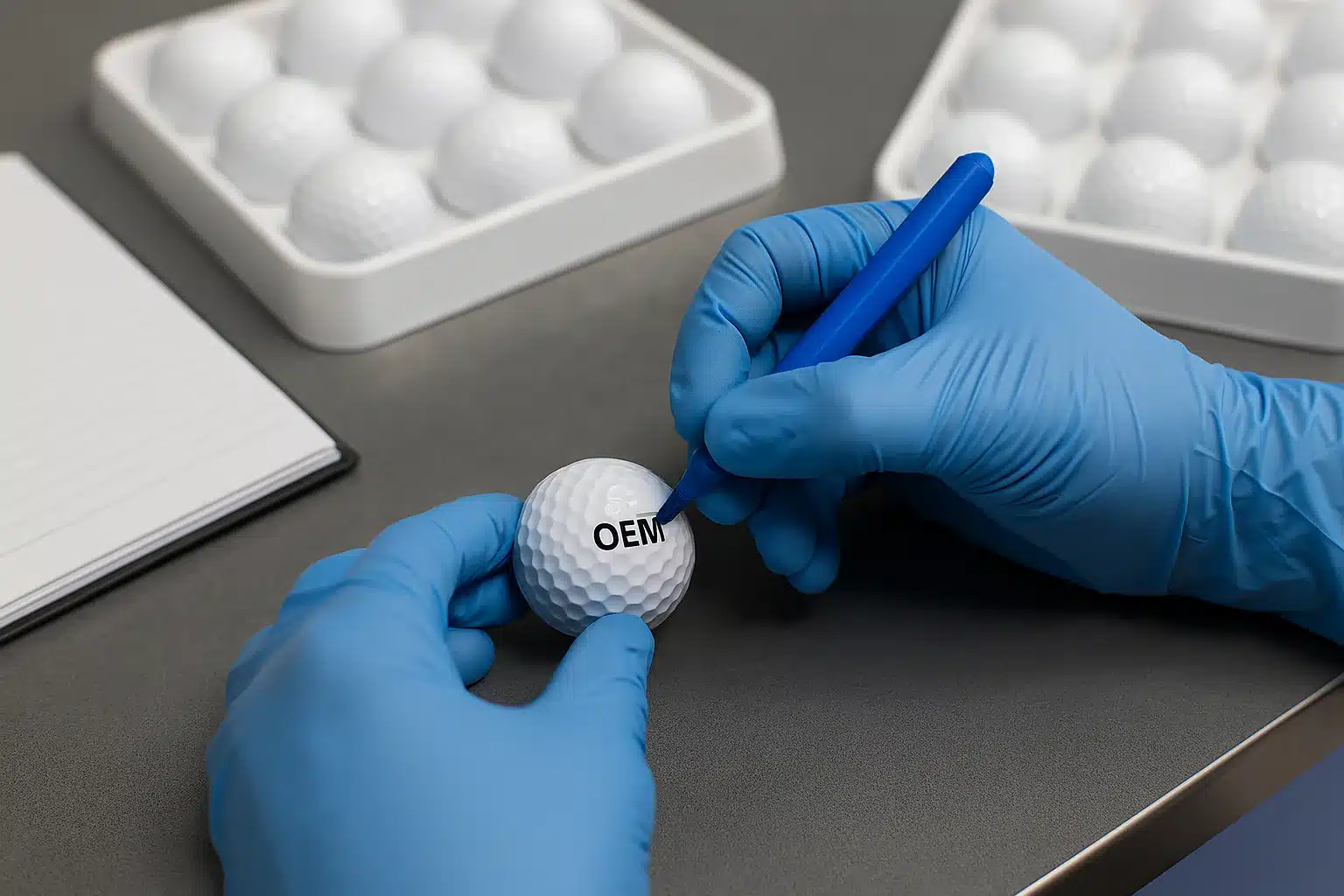
Surface energy and pre-treatment: why dyne level matters
Use simple language to explain dyne level: if the surface energy is too low, ink beads up and sits like raindrops on wax. Corona/plasma or flame treatment raises dyne so ink can form a continuous film.
Different cover types need different approaches:
| Cover type | Dyne / pre-treatment focus | Recommended ink system | Buyer checklist |
|---|---|---|---|
| 2-piece Surlyn | Clean + ≥38 dynes/cm | 2K pad ink + hardener + clear | Ask for dyne logs + Cross-hatch adhesion |
| 3-piece urethane / TPU | Strong cleaning + corona/plasma | Flexible 2K ink + clear | Confirm MEK rub + scuff resistance |
| Cast urethane tour | Stable dyne range, tight control | High-end 2K + primer + robust clear | Use full 300-hit + adhesion protocol |
Refurbished balls often peel because new paint is sprayed over chalky, low-energy old coatings. The new ink adheres to weak material, so once the ball flexes, whole islands of coating can detach.
How can you test golf ball logo durability in the factory?
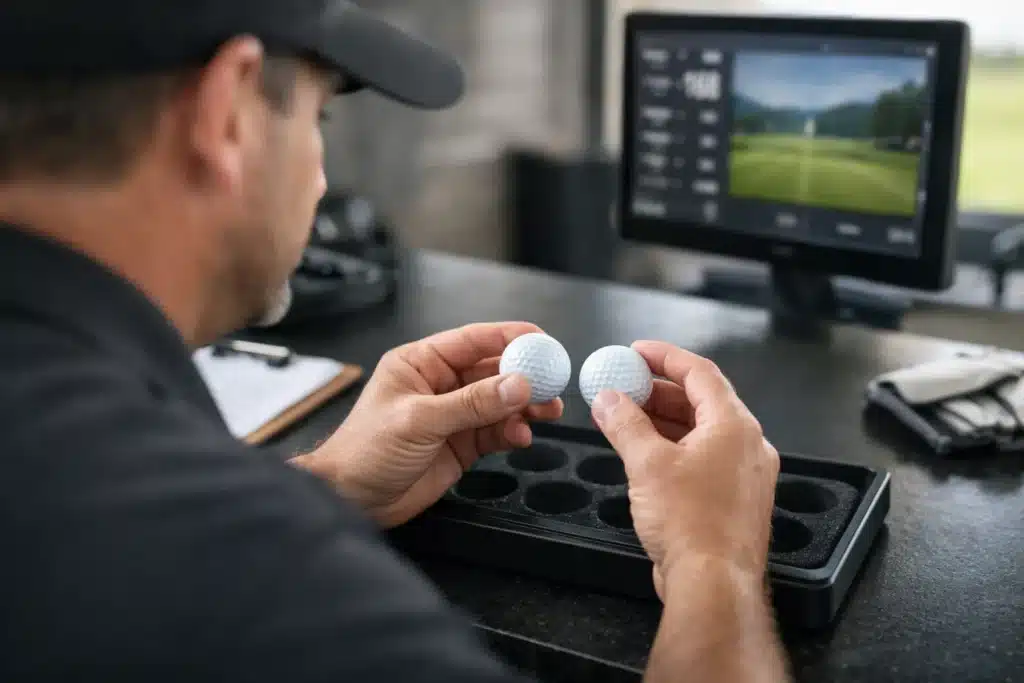
You can’t fly to every factory, but you can standardise how logo durability is tested. A clear test list makes suppliers more serious and gives you data instead of guesswork.
To test logo durability in the factory, combine adhesion and abuse tests: an ASTM D3359 cross-cut tape test, a MEK solvent rub test, a 300-hit impact cannon test, a water-submersion ageing test, and an abrasion tumbler test that simulates cart paths and range mats.
-
The Cross-Cut Tape Test (ASTM D3359) – Use Method B Cross-hatch adhesion test on sacrificial areas; aim for 4B–5B with minimal flaking.
-
The Solvent Rub Test (MEK Test) – Rub with MEK or similar solvent for a fixed count to confirm full cure and chemical resistance.
-
The Impact Cannon Test (300 hits) – Fire balls at a plate at defined speed; after 300+ hits, logos should be readable with no large-area peeling.
-
The Water Submersion Test – Soak balls (e.g. 24–72 hours), then re-check for blistering, ink lifting or print fading.
-
The Abrasion Tumbler Test – Rotate balls with abrasive media to simulate mats, cart paths and bag wear; score scuff resistance and logo edge integrity.
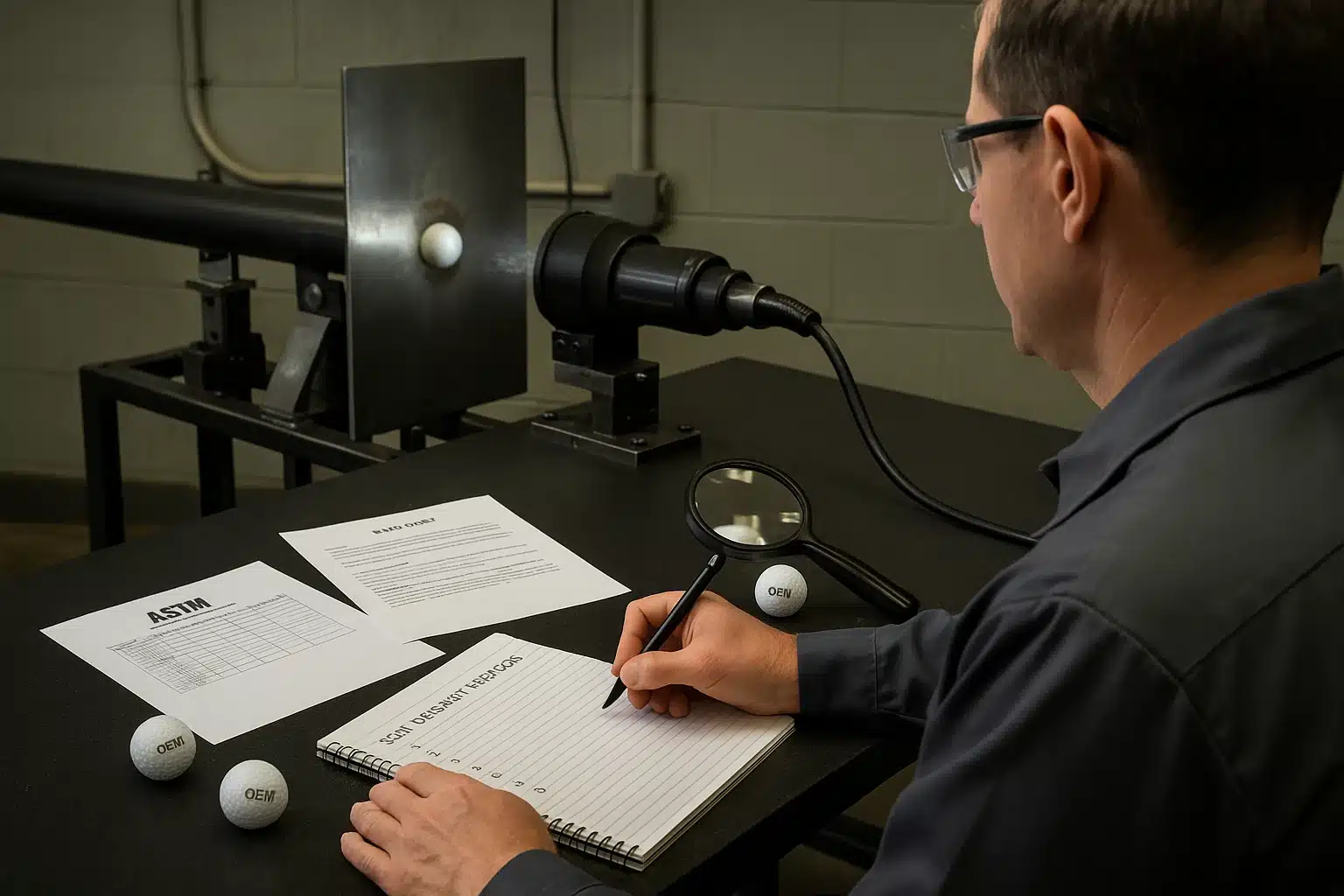
What should a 300-hit durability protocol include?
Buyers hear “we tested 300 hits” but rarely see the details. Explain what you should ask for: speed, impact surface, hit count, sampling size and pass/fail criteria for logo peeling and cover damage.
A simple protocol might specify:
-
Ball or clubhead speed (e.g. cannon at driver-equivalent speed).
-
Impact surface and angle (steel or composite, normal impact).
-
Number of balls tested and hits per ball.
-
Inspection intervals (e.g. every 50 hits) and a 0–5 peeling scale.
Ask suppliers to provide before/after photos plus a short QC sheet summarising ASTM D3359 and MEK rub results together with the 300-hit outcome.
You can turn the test list into a compact buyer matrix:
| Test | What it checks | Typical OEM target | Buyer action |
|---|---|---|---|
| ASTM D3359 tape test | Adhesion | 4B–5B, very little or no flaking | Request with each new logo/ball spec |
| MEK rub test | Curing, chemical resistance | No breakthrough after set rubs | Require at first article approval |
| 300-hit impact cannon | Impact + coating + logo system | Logo legible, no large peeling | Make part of logo durability protocol |
| Water submersion test | Moisture-related failures | No blistering, no adhesion loss | Use for range/academy contracts |
| Abrasion tumbler test | Abrasion and scuff resistance | Logo still clearly visible | Apply to heavy-use or rough-lie programs |
✔ True — Lab numbers and field complaints should drive each other
If a model passes your test matrix but ranges still complain, tighten criteria. If it passes easily in the field, you may not need extremely harsh tests for that tier.
✘ False — “We test everything, so there’s no need to log complaints”
Complaint photos, dates and lot numbers are vital feedback. Ignoring them breaks the loop that keeps your spec realistic and effective.
FAQ
Do printed logos on golf balls wear off?
Yes, printed logos eventually show wear, but OEM logo balls are built so logos scuff gradually and stay readable for hundreds of normal hits, while cheap promo balls may peel or flake much earlier.
Every logo will age under wedges, sand and ball washers; the question is how. On well-specified OEM balls with 2K pad ink, surface treatment and clear coat, you mainly see normal scuffing and soft gloss over time. On low-cost gift balls with single-layer prints and minimal testing, you may see chunks of ink lifting or logos disappearing after a few hard sessions. When you brief your sales team, explain this difference clearly so end customers don’t judge a promo-tier ball using OEM expectations.
Does the clear coat go over the custom logo on golf balls?
On most serious OEM logo balls, yes—the clear coat is applied over the logo so it becomes part of the coating system and is protected from direct abrasion and chemicals.
The standard OEM stack is cover → primer → logo → clear. That clear coat helps spread impact stresses, improve scuff resistance and keep sweat or cleaners away from the ink. Some cheaper processes print logos on top of an existing clear or skip clear entirely to save cost. Those options are acceptable for one-day events but not for long-term range contracts. Always ask suppliers where the logo sits in the stack and match the solution to your usage scenario.
How do you seal paint on a golf ball?
You seal paint by fully curing the two-component logo ink and then applying a compatible clear coat that is also properly cured, so the whole system acts as a single, durable film.
In practice, the factory mixes 2K ink, prints the logo and cures it—often with heat plus time—to build adhesion and MEK rub resistance. Only after this curing does a clear coat varnish go on, followed by its own cure. Packing balls too soon or rushing either step can trap solvents and weaken the structure, leading to early peeling or soft, smear-prone prints. When auditing a supplier, ask about curing temperatures, dwell times and minimum hours before boxing and shipment.
What kind of ink is used on golf balls?
Serious OEM factories use two-component pad printing inks or validated UV inks designed for plastics, often with hardeners and additives that balance elasticity, hardness and chemical resistance.
Two-component pad printing inks mix a resin with a hardener shortly before use. They can be tuned to the ball’s cover hardness so the film flexes instead of cracking. UV inks cure instantly and allow photo-style artwork, but must still pass Cross-hatch adhesion and MEK rub tests. In RFQs, look for wording such as “two-component pad printing ink with hardener plus clear coat” and require basic lab data; it’s an easy way to filter out low-end gift suppliers using hobby-grade ink.
Why do refurbished golf balls peel so easily?
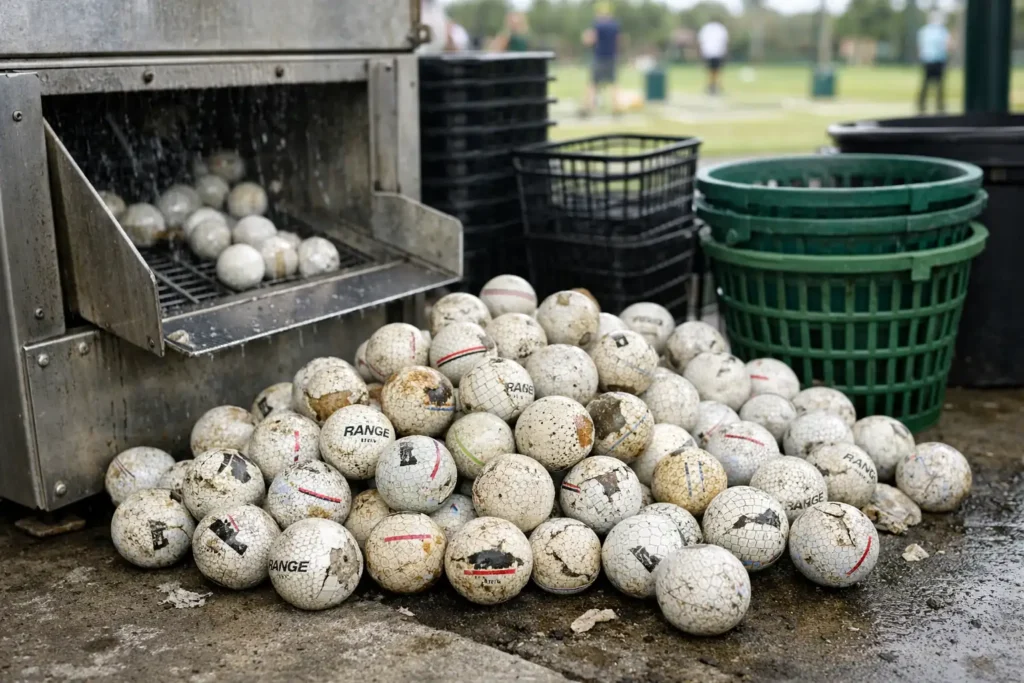
Refurbished balls often peel because new coatings and logos are applied over old, degraded clear coats or poorly prepared surfaces, so the fresh ink is bonded to weak material that fails when the ball flexes.
Unlike new OEM balls, refurbished ones start with unknown history: water damage, UV exposure, heavy scuffs. Many refurbishment lines sand or overcoat the surface and reprint logos, but they rarely control dyne level, surface energy or layer compatibility as tightly as an OEM factory. The result can look bright initially yet crack or flake quickly under wedges, cart paths or ball washers. If you use refurbished balls, restrict them to lower-risk promotions and test heavily before putting core brand programs on them.
Can custom logos still be USGA/R&A conforming?
Yes. Custom logos do not affect USGA/R&A conformity as long as the underlying ball model is unchanged; conformity is tested on performance and construction, not artwork.
USGA and R&A certify ball models for size, weight and performance. Once a model is on the conforming list, manufacturers can add club or sponsor logos without retesting, provided they do not modify the core, cover or coating structure. However, some factories let certifications lapse for cost reasons even if the design stays the same. When conformity matters for your program, check that the model you buy is currently listed and clarify which party will maintain future certifications if needed.
How long should an OEM logo last in normal range or academy use?
As a practical benchmark, a well-specified OEM logo ball should stay clearly legible for at least a few hundred normal hits per ball, with only gradual scuffing instead of large-area peeling.
Exact life depends on who is hitting, what lies they use and how balls are cleaned. The best approach is to link expectations to your test matrix: for example, logos must pass ASTM D3359 at 4B–5B, survive a 300-hit impact protocol, and remain readable after an abrasion tumbler test. Then run a small field trial at your range or academy and compare real wear to lab results. Over time, adjust hit counts or coating recipes until customer complaints are rare and predictable.
Conclusion
If you want OEM golf ball logos that genuinely survive 300+ hits, you need more than a pretty sample; you need a written spec. Start by choosing the right tier—promo vs OEM—and the right process: two-component pad printing with clear coat for long-term use, UV digital only where artwork demands and usage is limited.
Next, engineer adhesion: manage surface energy and dyne level, specify corona discharge treatment where needed, insist on two-component ink with the right hardener ratio and treat clear coat varnish as a functional layer. Then verify everything with a simple, named protocol: ASTM D3359 tape test, MEK rub test, a defined 300-hit impact test, plus water and abrasion checks appropriate for your program.
You might also like — Which Golf Ball to Use: Lessons, Range, Indoor, Greens