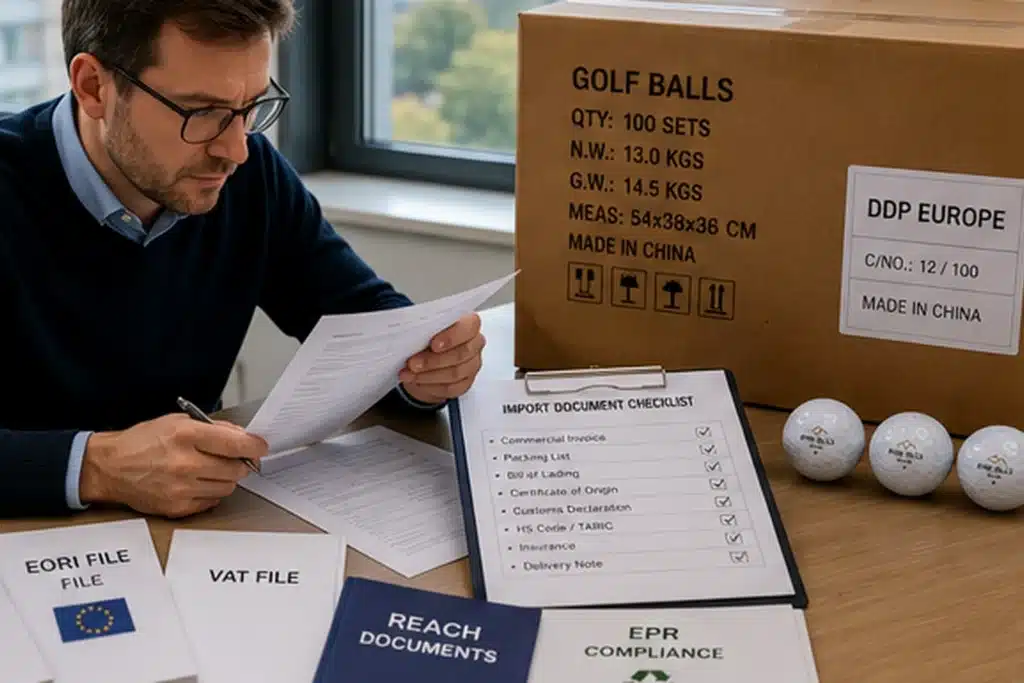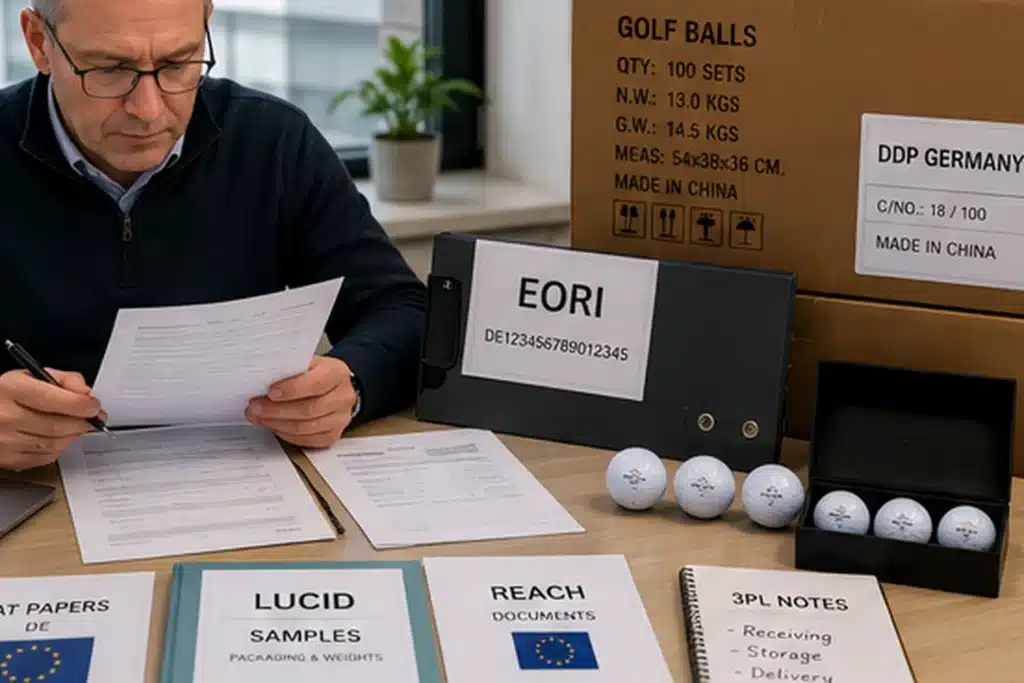
To import golf balls from China to Germany, verify the import file before accepting DDP, DAP, or door-to-warehouse terms.
Your shipment should be VAT-ready, LUCID-ready, REACH-ready, and warehouse-ready before it leaves China. Confirm EORI role, import VAT handling, TARIC / CN 9506 32 00 review, LUCID / VerpackG packaging responsibility, REACH / SVHC documents, invoice split, and German 3PL receiving rules.
| German import check | Buyer risk | What to request | Buyer action |
|---|---|---|---|
| EORI role | Unclear importer | Buyer / forwarder role | Confirm early |
| Import VAT | Weak reclaim path | VAT file route | Ask accountant |
| TARIC line | Wrong duty basis | 9506 32 00 review | Broker check |
| LUCID / VerpackG | Packaging data gap | Material weight split | Register / report |
| REACH / SVHC | Chemical proof gap | MSDS / declaration | Approve before bulk |
| German 3PL | Delivery rejection | Carton / pallet SOP | Send before packing |
Use this guide to check whether your China golf ball shipment is Germany-ready before cargo leaves China, not after VAT, packaging, chemical, or warehouse issues appear.
What Should German Buyers Check First?
Your team may ask how to import golf balls from China to Germany and expect a simple shipping workflow. The real first decision is whether the shipment file is Germany-ready.
Your first Germany import check is not the cheapest DDP quote; it is whether the file can support VAT, packaging, chemical, customs, and warehouse review. Before shipment, your team should request EORI role, VAT handling, TARIC review, LUCID data, REACH documents, and 3PL receiving proof.
A Germany-bound golf ball shipment needs more than a supplier promise of “DDP included.” Your file should show who is identified in the import process, how Einfuhrumsatzsteuer is handled, which TARIC line is proposed, whether packaging responsibility has been reviewed, and whether custom logo inks, coatings, and printed packaging can be documented.
| First check | Why it matters | What to request | Buyer move |
|---|---|---|---|
| EORI role | Import identity | Buyer / forwarder role | Confirm early |
| VAT handling | Reclaim path | Tax file structure | Ask accountant |
| TARIC line | Duty basis | Proposed code | Broker review |
| LUCID data | Packaging reporting | Weight breakdown | Register / report |
| REACH proof | Chemical file | MSDS / declaration | Approve before bulk |
| 3PL receiving | Delivery success | Label / pallet SOP | Send supplier |
As of 2026, verify again at shipment date. EORI route, import VAT handling, TARIC treatment, LUCID / VerpackG responsibility, REACH / SVHC review, and warehouse receiving rules can vary by buyer role, product mix, packaging, and sales channel.
Build a Germany Import Verification Pack before shipment approval. Match the supplier quote against EORI role, VAT route, TARIC review, LUCID packaging data, REACH proof, invoice split, and German receiving scope. Shipment approval should require a Germany-ready file, not only a DDP price.
✔ True — Germany imports need a local compliance file
DDP can simplify delivery, but your team still needs EORI, VAT, TARIC, LUCID, REACH, invoice, and receiving evidence before shipment.
✘ False — “DDP Germany means your team has no VAT, packaging, or warehouse checks”
A convenient DDP total does not prove that the VAT file, packaging reporting data, chemical documents, or warehouse delivery rules are ready.
Is Standard DDP Safe for Germany?
Your supplier may offer DDP Germany and say customs, tax, and delivery are included. That can be useful, but your finance team may ask a sharper question: can this VAT file be used?
Standard DDP is safe only when your team can verify the VAT and importer file behind it. Before accepting DDP Germany, confirm whose EORI is used, who receives the import VAT documents, whether the tax file supports your accounting process, and what proof you receive after clearance.
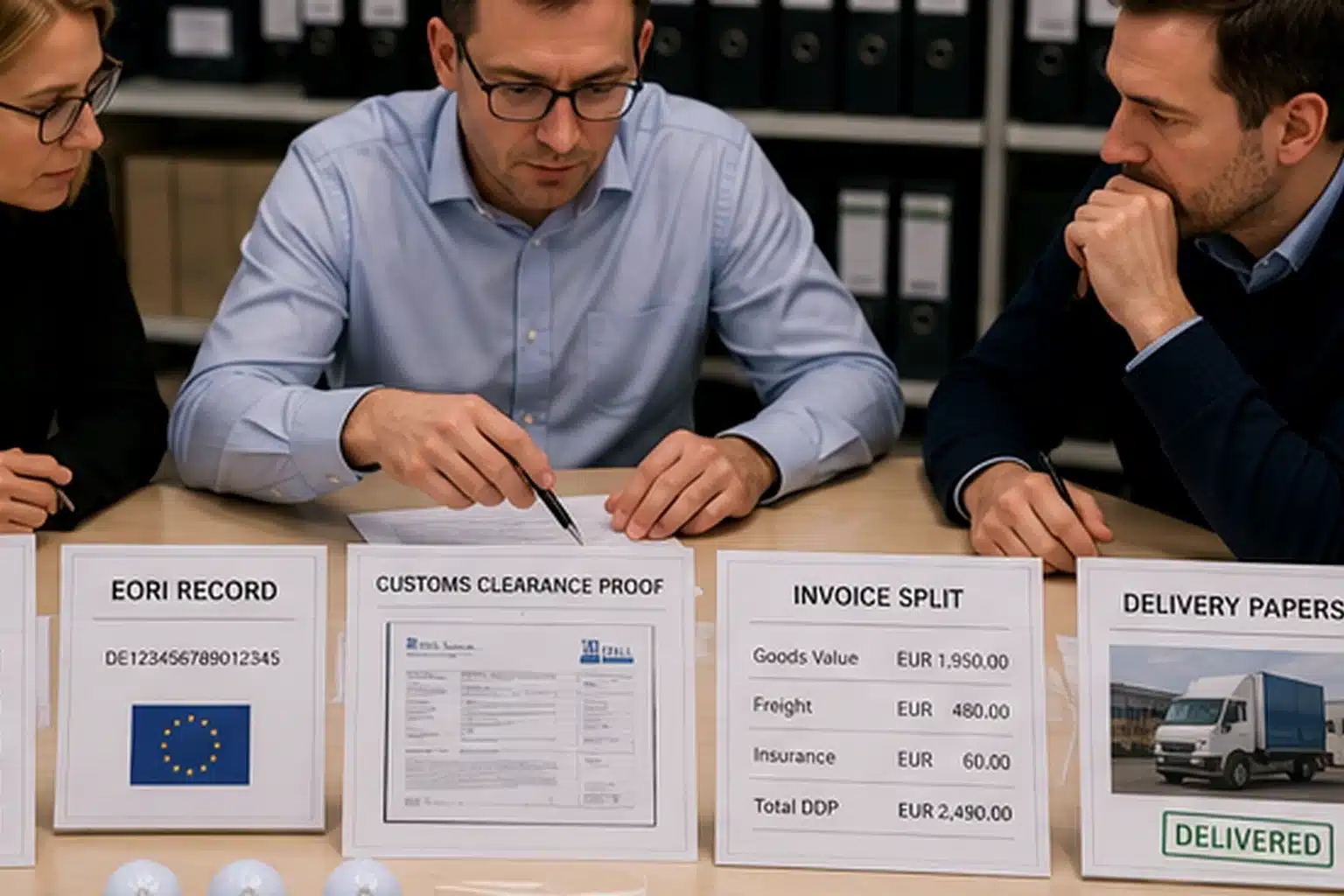
VAT reclaim or convenience?
DDP is not automatically bad. VAT-blind DDP is the problem. If your company cannot identify the importer role, tax document path, import VAT amount, commercial invoice split, or post-clearance proof, the quote may be convenient operationally but weak for accounting review.
German customs explains that an EORI number identifies operators in customs processes, especially when customs declarations and entry or exit summary declarations are lodged. official EORI guidance German customs also states that the import VAT rate is currently 19%, with a reduced 7% rate for selected goods. official import VAT guidance
| DDP question | Hidden risk | What to verify | Buyer move |
|---|---|---|---|
| Whose EORI? | Unknown importer | EORI role | Confirm in quote |
| Who pays VAT? | Reclaim gap | VAT handling | Ask accountant |
| What proof exists? | No audit trail | Tax notice / file | Request template |
| What is included? | One-line DDP | Cost split | Check invoice |
| Who handles issues? | Weak recovery | Escalation path | Name contact |
Supplier offers DDP Germany but cannot explain the VAT document path is a failure signal. Request EORI / VAT Handling Confirmation before accepting DDP terms. DDP approval requires written VAT handling and import-file visibility, including who acts as importer, who receives import tax documents, and what evidence your finance team can retain.
Your PO should state that DDP Germany acceptance depends on written EORI role, VAT document route, invoice split, and post-clearance proof path, not only a door-to-door delivery promise.
What Do EORI and TARIC Change?
Your supplier may provide a customs code or say the forwarder will handle it. Your team still needs to know whose EORI is used and whether the full product mix was reviewed.
EORI controls the importer identity, while TARIC controls the customs classification review. Your team should confirm whose EORI appears in the import process and ask a broker to verify whether finished balls, gift sets, accessories, or mixed promotional items need separate TARIC treatment.
Importer role or tariff code?
Finished golf balls can start from TARIC / CN 9506 32 00 00 for review, but that starting point does not cover every shipment detail forever. A custom golf ball order may include tees, towels, divot tools, ball markers, printed inserts, retail sleeves, gift boxes, or mixed promotional items. Those should not disappear under a vague “sports goods” invoice line.
| Review item | Common mistake | What to request | Buyer move |
|---|---|---|---|
| EORI role | Forwarder handles all | Named importer role | Confirm responsibility |
| Finished balls | Old code copied | Proposed TARIC line | Broker review |
| Gift set | Accessories ignored | Item breakdown | Review separately |
| Packaging bundle | Hidden components | Material list | Check scope |
| Duty basis | Fixed assumption | Shipment-date review | Save memo |
The EU’s tariff system uses the Combined Nomenclature and TARIC to classify goods and apply tariff and trade measures across member states. official TARIC resource Use official or broker-confirmed treatment before shipment, especially for kits or accessories.
Your deliverable is a TARIC Review Memo plus EORI Role Statement. The shipment should not be approved until the product list, accessory list, proposed TARIC line, importer role, and current classification basis are clear. A clean customs file says what is being imported, not just where it is going.
Does LUCID Apply to Golf Ball Packaging?
Your team may focus on the golf balls but overlook everything entering Germany with them: sleeves, retail boxes, PET windows, EVA inserts, polybags, master cartons, tape, labels, and gift packaging.
LUCID risk starts with packaging data your supplier may not include in a normal quote. Your team should request separate weights for paper boxes, PET windows, EVA inserts, polybags, retail packaging, and master cartons so your Germany packaging reporting can be reviewed before import.
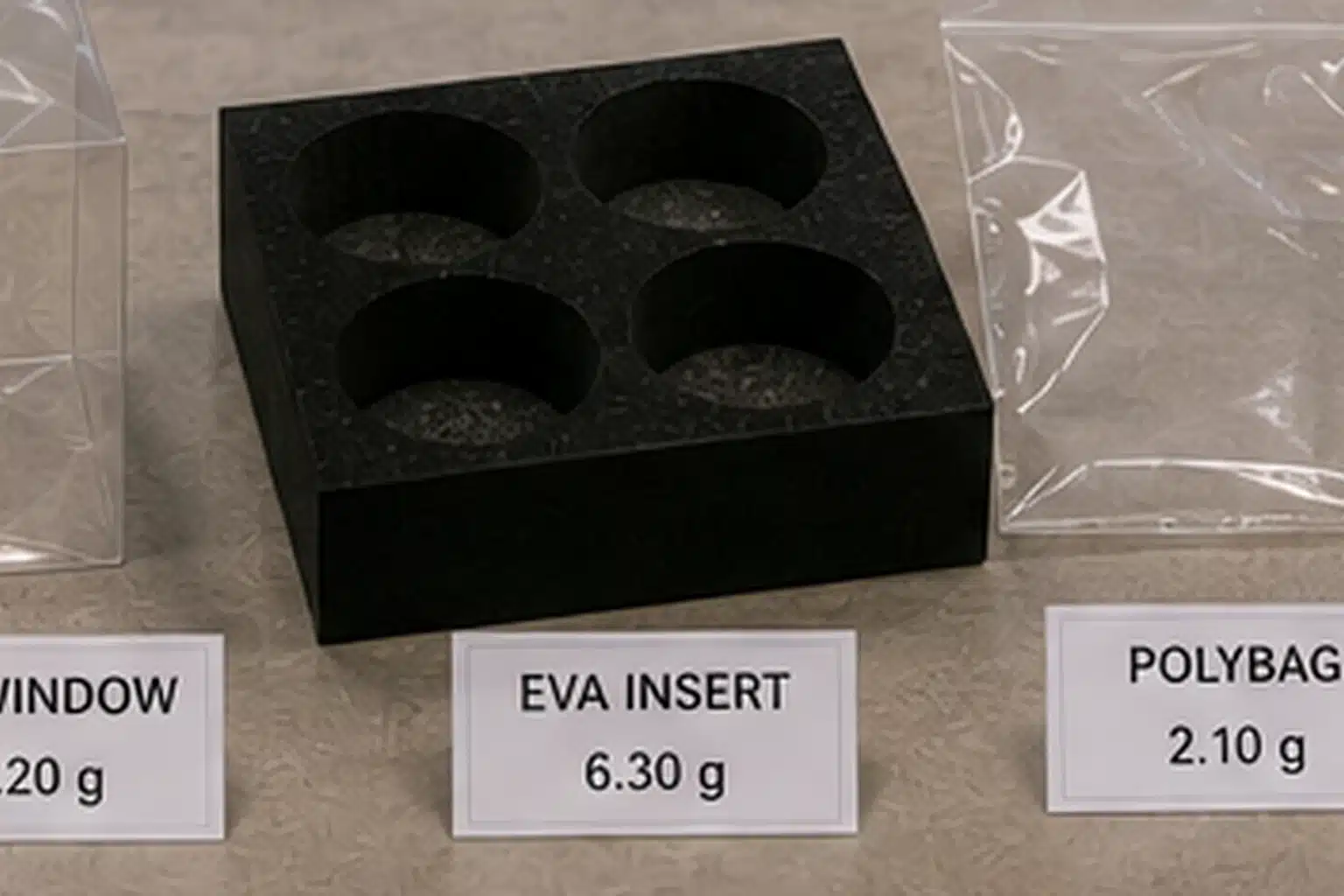
Paper, plastic, or gift box?
LUCID / VerpackG is not a generic EU footnote; it is a Germany-specific packaging responsibility issue. Packaging data matters because a custom golf ball order may include product packaging, grouped packaging, shipment packaging, and display packaging. A premium gift box can increase both freight volume and reportable packaging materials.
ZSVR states that companies distributing packaged goods commercially in Germany or importing packaged goods into Germany have to register with the LUCID Packaging Register. Packaging subject to system participation also requires system participation and packaging-volume reporting. official LUCID import guidance
| Packaging item | LUCID data needed | Buyer risk | Buyer move |
|---|---|---|---|
| Paper sleeve | Paper weight | Under-reporting | Request per-unit weight |
| PET window | Plastic weight | Missing material split | Separate PET line |
| EVA insert | Foam / plastic weight | Gift-box blind spot | Weigh insert |
| Polybag | Plastic weight | Small items missed | Count per carton |
| Master carton | Paper weight | Bulk packaging gap | Add carton weight |
| Gift box | Multi-material weight | Higher reporting load | Split by material |
Factory provides gross weight but no packaging material split is a failure signal. Gross weight cannot tell your compliance team how much paper, plastic, PET, EVA, or carton material entered the German market. Ask for a LUCID-ready packaging weight breakdown before PO release or packaging approval.
Supplier shall provide material-level packaging weights by component, including paper sleeve, retail box, PET window, EVA insert, polybag, inner carton, master carton, tape, label, filler, and pallet wrap where used, before packaging approval.
ZSVR also describes legal consequences for breaches, including distribution bans and potential fines depending on the obligation breached. Treat those figures as potential maximums, not automatic outcomes. official VerpackG monitoring guidance
✔ True — Your supplier may not own the German obligation, but it must provide packaging data
The German responsible party depends on the role and sales channel, but the supplier should still provide paper, plastic, PET, EVA, and carton weights.
✘ False — “Gross weight is enough for LUCID / VerpackG review”
Gross weight mixes product, packaging, cartons, and filler. LUCID-ready data needs material-level packaging weights.
Can Ink and Coating Pass REACH Review?
Your custom golf balls may use logo printing, clearcoat, surface coating, and printed retail packaging. A promise of “EU compliant” is not a document file.
A supplier promise is not enough for German chemical review. Before bulk production, your team should request MSDS, REACH / SVHC declarations, and ink / coating material records for logo printing, clearcoat, surface treatment, and printed packaging used in your custom golf ball order.
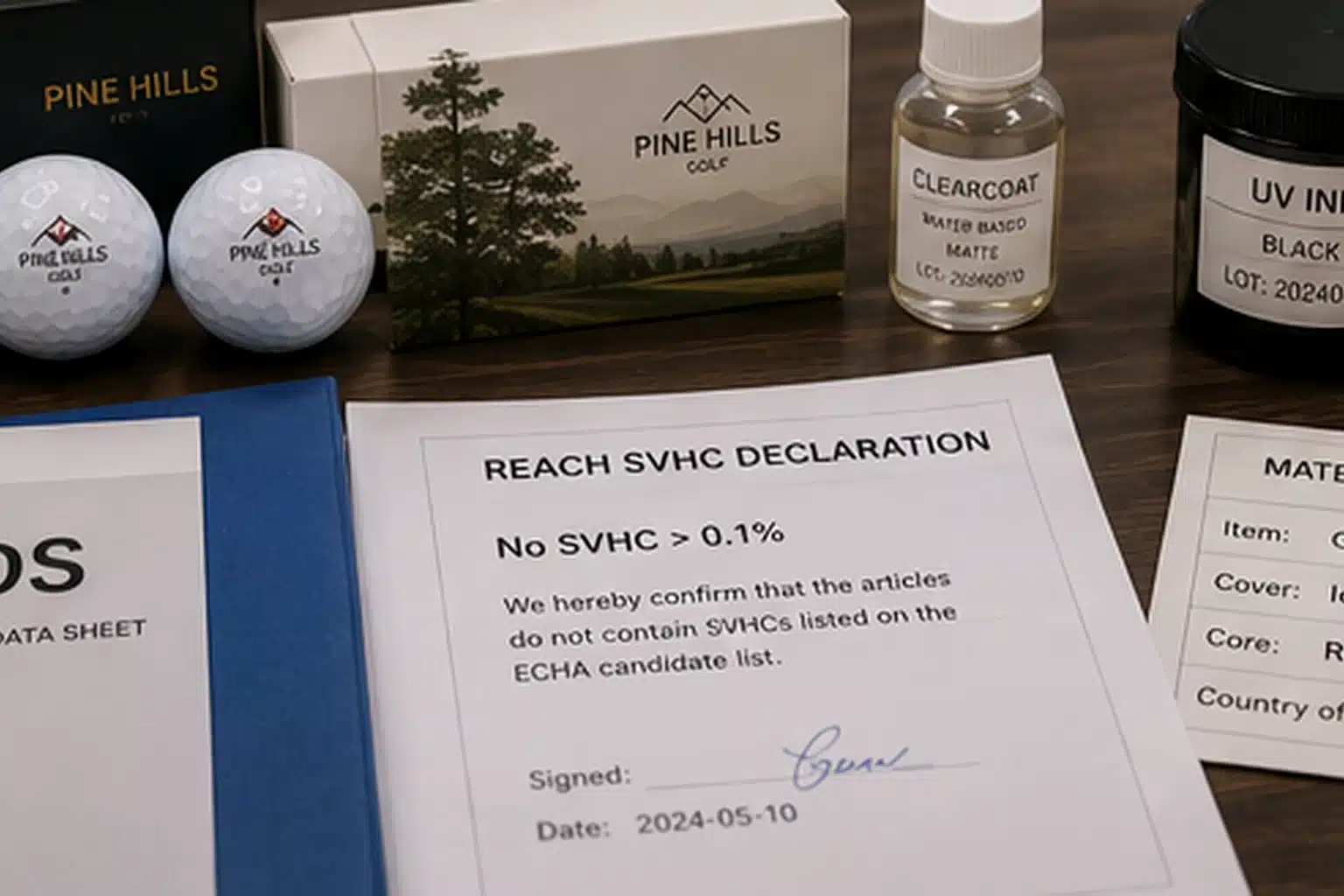
MSDS, SVHC, or supplier promise?
REACH / SVHC documentation matters because custom golf balls are not just white spheres in a carton. They may include logo inks, UV or pad-printing systems, clearcoats, surface coatings, packaging inks, varnishes, adhesives, PET windows, EVA inserts, and printed sleeves.
The Candidate List identifies substances of very high concern, and EU REACH guidance explains that consumers may request information about SVHC presence in articles. official SVHC Candidate List official REACH guidance
| Material area | Compliance concern | What to request | Buyer move |
|---|---|---|---|
| Logo ink | Restricted substances | MSDS | Review before bulk |
| Clearcoat | Surface chemistry | Material declaration | Match sample |
| Ball surface | Coating consistency | Supplier record | Keep file |
| Printed box | Packaging ink | Ink statement | Review artwork |
| Adhesive / insert | Material chemistry | Material sheet | Ask when used |
Ink and coating proof requested only after bulk production is a failure signal. Do not wait until German customs, a retailer, a marketplace, or a corporate buyer asks for chemical proof. Request an Ink / Coating Compliance Pack before bulk production.
Match MSDS and REACH / SVHC declarations to the specific ink, coating, and packaging materials used in the order. Naming a premium ink or coating brand is not proof by itself; document traceability is the proof your team can actually file.
✔ True — REACH-ready documentation matters before production
Your supplier should connect MSDS, SVHC declarations, ink records, coating records, and packaging material notes to the exact order.
✘ False — “Naming a premium ink brand automatically proves German compliance”
Brand names may support sourcing discipline, but Germany-ready evidence still depends on documents matched to the materials used.
What Should Your Germany RFQ Require?
Your RFQ may ask for price, logo printing, packaging, and DDP Germany delivery, while missing the data that protects VAT, LUCID, REACH, and receiving.
Your Germany RFQ should ask for import proof, not only product price. Require EORI role, VAT handling, TARIC review, LUCID packaging weights, REACH / SVHC documents, MSDS, commercial invoice split, packaging material breakdown, and German 3PL receiving proof before shipment approval.
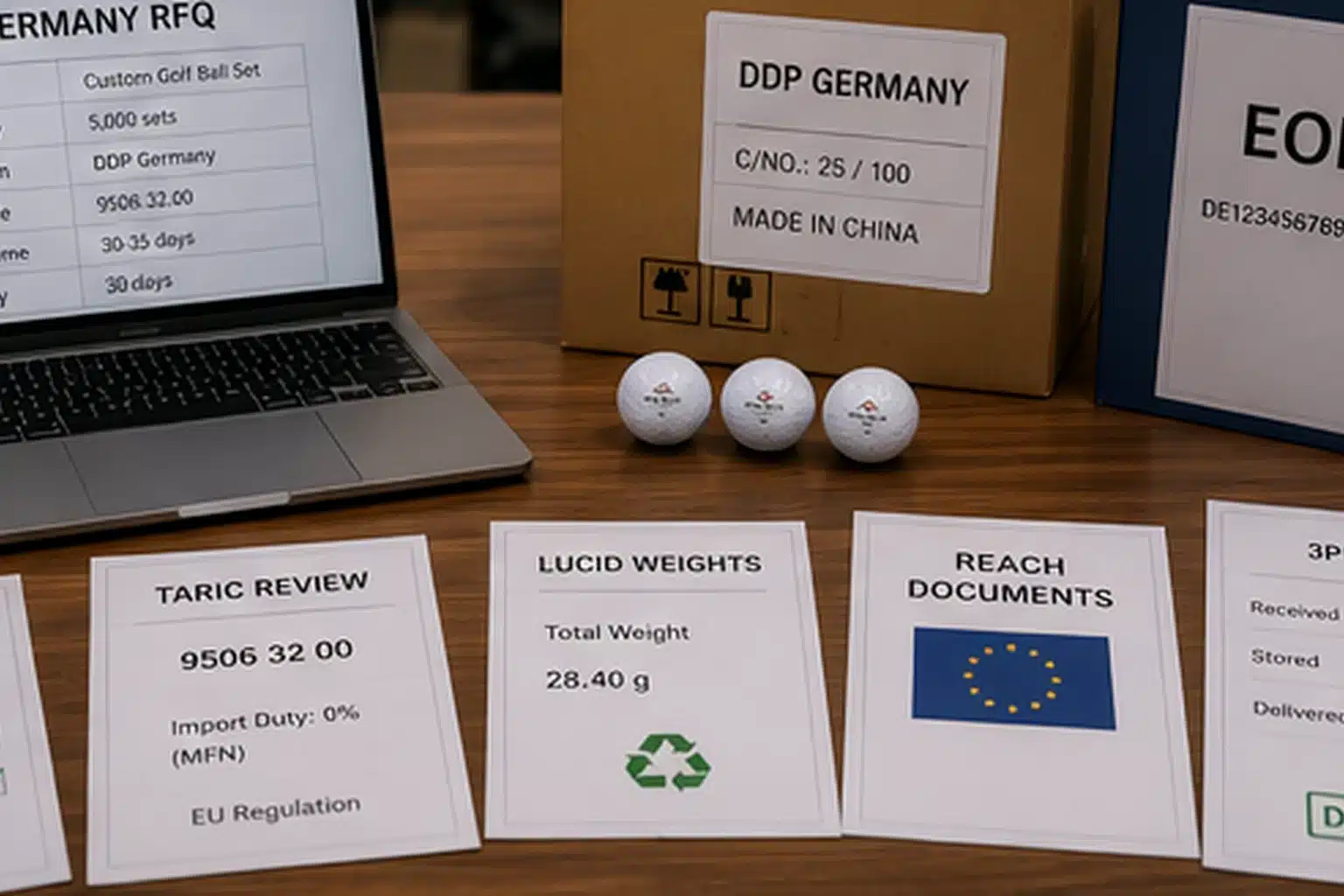
EORI, LUCID, REACH, or 3PL?
A Germany-ready RFQ forces the supplier to prepare the shipment file before the goods move. It should cover customs identity, VAT documentation, classification, packaging responsibility, chemical evidence, invoice structure, and warehouse receiving.
| RFQ item | Why it matters | What to request | Acceptance evidence |
|---|---|---|---|
| EORI role | Import identity | Buyer / forwarder role | Written confirmation |
| VAT handling | Reclaim review | Tax file route | Accountant check |
| TARIC review | Duty basis | Product breakdown | Broker memo |
| LUCID data | Packaging report | Material weights | Weight sheet |
| REACH proof | Chemical review | MSDS / declaration | Compliance pack |
| Invoice split | Accounting clarity | Value / freight split | Itemized invoice |
| 3PL SOP | Delivery success | Labels / pallet plan | Photo proof |
Supplier shall provide a shipment-level Germany import file before release, including EORI / importer role confirmation, proposed TARIC line, item-level product and accessory breakdown, import VAT handling statement, commercial invoice split, LUCID-ready packaging material weight breakdown, MSDS, REACH / SVHC declarations, packing list, carton labels, pallet plan, and German 3PL receiving proof.
Buyer approval of Germany-bound shipment requires written confirmation that the quote is based on the final product mix, shipment-date TARIC review, verified EORI / VAT route, approved packaging material weights for LUCID / VerpackG review, documented ink and coating compliance, transparent invoice structure, and receiving-ready carton / pallet documentation.
Use this RFQ wording:
“Please quote shipment to Germany with a Germany-ready import file. Confirm EORI / importer role, import VAT handling, proposed TARIC line, item-level product and accessory breakdown, LUCID / VerpackG packaging responsibility, paper / plastic / PET / EVA / master carton weight breakdown, MSDS and REACH / SVHC declarations for inks and coatings, itemized commercial invoice split, DDP or DAP delivery scope, German 3PL / marketplace receiving requirements, carton labels, pallet plan, and photo proof before shipment approval.”
German DTC and marketplace sellers often care about launch timing, but LUCID data and 3PL receiving proof must be prepared before cartons are sealed. Send compliance and warehouse SOPs to the supplier before packaging approval, not after the shipment is booked.
FAQ
Do I need an EORI number to import to Germany?
If your company is involved as the economic operator or importer in the customs process, EORI role should be reviewed before shipment.
Confirm whose EORI is used, who receives import documents, and who can provide customs and tax records after clearance. Keep written EORI / importer role confirmation in your import file. If your DDP or DAP setup uses a logistics partner, still confirm the document path before approving the quote.
How much is import VAT in Germany?
Germany’s standard import VAT is commonly handled at 19%, but your team should verify the treatment with your broker or accountant at shipment date.
Ask for VAT handling in writing, confirm the tax document path, and do not rely on a vague DDP total. For VAT-registered buyers, the key question is not only the rate; it is whether the file supports the accounting and reclaim process.
Can I reclaim import VAT on DDP Germany?
You may only have a practical reclaim path when the import role, tax assessment, and accounting file support it.
Ask your accountant before accepting DDP. Confirm EORI role, importer identity, tax document availability, and invoice structure. DDP may work when the file is visible; VAT-blind DDP creates risk when nobody can show the documents your finance team needs.
What is LUCID in Germany?
LUCID is Germany’s packaging register system connected with VerpackG obligations for packaged goods placed on the German market.
Review whether your company must register, participate in a system, and report packaging volumes. Ask the supplier for material-level packaging weights. Keep paper, cardboard, plastic, PET, EVA, and other packaging materials separated so your reporting is not built on guesses.
Who is responsible for VerpackG packaging duties?
Responsibility depends on your role, sales channel, and how packaged goods enter the German market.
Do not assume the factory handles it automatically. Request supplier data and confirm responsibility with your compliance advisor. The supplier can provide packaging weights, material breakdown, and photos, but your contract should define who owns the German packaging-law role.
Do golf balls need REACH compliance?
Custom golf balls may need chemical documentation for inks, coatings, and some packaging materials when buyers, customs, retailers, or marketplaces ask for proof.
Request MSDS, REACH / SVHC declarations, and material records for logo ink, clearcoat, surface coating, packaging inks, adhesives, and inserts where relevant. Match documents to the exact materials used in your order.
What is the TARIC code for golf balls?
Finished golf balls can start from TARIC / CN 9506 32 00 00 for review, but gift kits, tees, towels, tools, and mixed items need separate checking.
Ask for an item-level product breakdown and request broker review at shipment date. Do not let mixed promotional kits enter the file as generic “sports goods.” Classification should reflect the actual product mix being imported.
Can I ship golf balls directly to a German 3PL?
You can plan direct delivery when labels, palletization, packing list, delivery appointment, importer details, and receiving SOP are confirmed before dispatch.
Send the German 3PL or marketplace SOP to the supplier before cartons are packed. Request label photos, pallet photos, carton counts, packing-list match, and delivery appointment confirmation. Customs clearance alone does not guarantee warehouse acceptance.
Conclusion
The safest Germany import is not the simplest DDP quote. It is the shipment file your team can verify for VAT, packaging, chemical, customs, and receiving requirements.
Before importing golf balls from China to Germany, confirm EORI role, import VAT handling, TARIC review, LUCID / VerpackG packaging data, REACH / SVHC documents, invoice split, and German 3PL receiving proof.
If the supplier cannot provide those documents before shipment, your team does not yet have a Germany-ready import process. The golf balls may be ready, but the file is still in the rough. the file is still in the rough.
You might also like — How Much Does It Cost to Import Golf Balls from China?