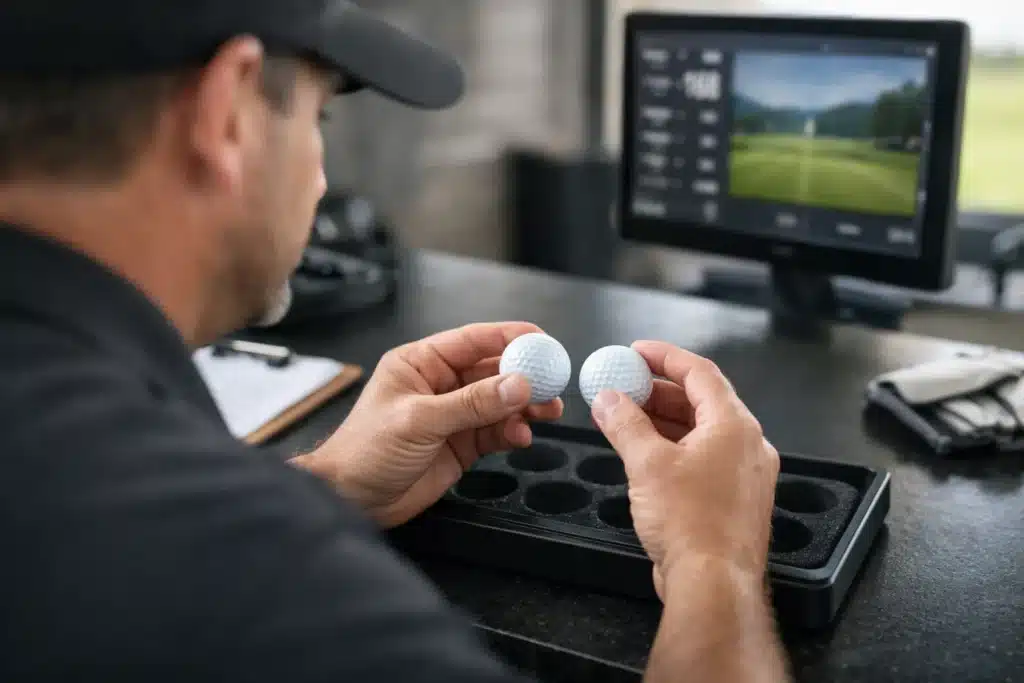
A “mint” bucket can look cheap on paper and still become your most expensive range decision.
Refurbished range balls fail as a consistency purchase more often than a cosmetic one. When moisture history, dimple geometry, and repaint QA cannot be verified, clubs can pay more in complaints, labor, and unreliable shot data.
This is not really a used-versus-new debate. It is a verifiable-versus-unverifiable procurement decision. In 2026, premium ranges are buying consistency twice—once for the player experience, and again for the credibility of radar-based practice data.
If you buy range inventory for a private club, public facility, academy, or radar-equipped driving range, that distinction matters more than the sales sheet makes it seem. A bucket of reclaimed balls can arrive bright white, sorted, and labeled “mint,” yet still fail where it hurts most: member trust, coaching credibility, washer uptime, and hidden labor. Once your range sells feedback, not just buckets, ball consistency becomes part of the product.
The smarter procurement question is not “How white does it look?” It is “What can my team verify before this lot hits the washer, the bay, and the member?” Once you frame the decision that way, the category changes. You are no longer comparing old against new. You are comparing documented batch history against cosmetic guesswork.
Are refurbished golf balls the same as recycled?
When buyers see “lake,” “practice,” “mint,” “recycled,” and “refurbished” presented side by side, it is easy to assume they all belong in one value bucket. That shortcut is exactly where the procurement risk starts.
No. Recycled balls are cleaned; refurbished balls are altered. Once a ball has been stripped, sanded, or repainted, you are no longer buying the original cover condition—you are buying an aftermarket surface with its own unverified aerodynamics and coating quality.
That distinction matters because a golf ball’s surface is not just there to look clean in a hopper. The cover, dimple edges, and coating all contribute to how the ball launches, holds line, and repeats from shot to shot. A washed-only recovered ball may still carry risk because its prior use and moisture history are incomplete, but at least its original surface architecture is still in play. A refinished ball is different. Once it has been chemically stripped, abraded, or repainted, the original surface condition is no longer what you are purchasing.
That is why “mint” is a dangerous buying word. It sounds like condition. In practice, it is often just a cosmetic label. It does not tell you whether the ball was washed only, whether it was refinished, whether the dimples were softened by aggressive processing, or whether the coating now sitting on the outside has anything close to controlled thickness or cure. To a procurement manager, that is not a detail. That is the product definition.
Your first job is to separate categories before you compare prices. Ask for a written statement declaring whether the lot is washed-only, refinished, or repainted. Ask for lot photos from the actual shipment sample, not generic website pictures. Ask for close-up dimple images under side lighting so your team can see whether the edges look crisp and consistent or softened and flooded. Ask whether the shipment is a single lot or a mixed sort from multiple recovery streams.
A receiving team should also be trained to distrust false uniformity and false cleanliness. One of the easiest failure signals to spot is Mixed gloss and shade in one “white” bucket. That often suggests mixed histories, mixed coatings, or mixed generations of balls gathered into one cosmetic grade. It may still be saleable as a reclaimed assortment. It is not the same thing as a controlled range lot.
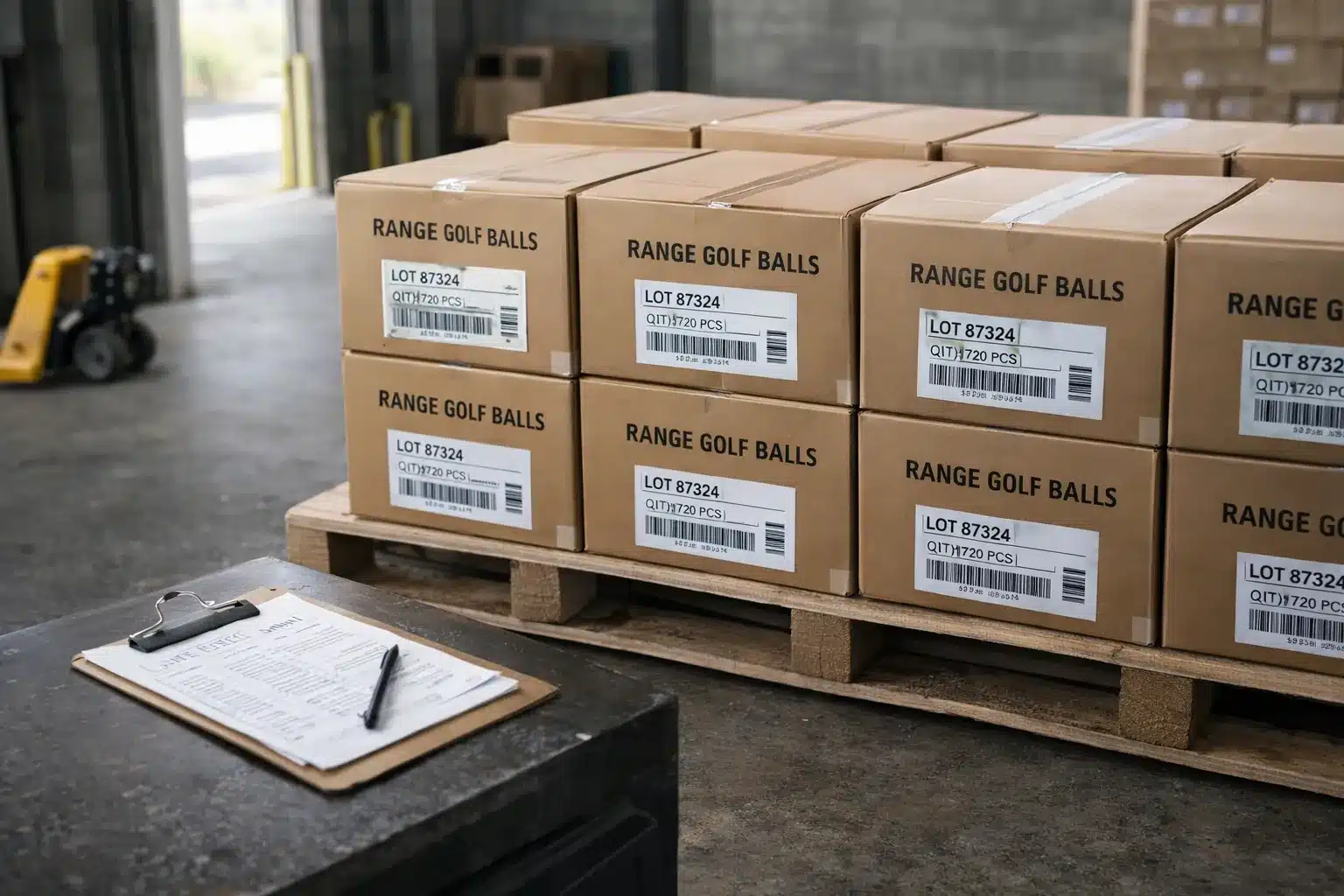
Write this into the PO: Supplier shall identify each shipment by batch ID, production date, and packing date, and provide a matching lot-level QC report and retained-sample reference for each delivered batch.
At receiving, quarantine any lot with mixed gloss, mixed shade, or unexplained finish variation until the supplier confirms process history.
The larger lesson is simple. White is a color. It is not a specification. If your document trail cannot tell you what process created that white finish, then your club is being asked to trust appearance where it should be demanding process disclosure.
✔ True — “White” is not a specification
A bright white finish can hide washed-only stock, chemically stripped stock, mixed generations, and repainted stock. Buyers should classify by process history first and color second.
✘ False — “If it looks new, it will play like new”
A golf ball can look clean while carrying an altered surface, an unknown moisture history, or both. That becomes expensive fastest in premium bays and lesson environments.
Do lake balls lose distance?
This is the question that creates the most heat and the most bad buying decisions, because buyers want a clean yes-or-no answer while the real decision is about uncertainty.
Sometimes yes, sometimes no—and that is exactly the procurement problem. Modern balls can resist water better than older generations, but reclaimed balls still carry an untraceable moisture history that makes consistency impossible to buy with confidence.
The professional mistake is to turn a nuanced engineering issue into a purchasing myth. On one side, modern premium balls are more water-resistant than older generations, and not every pond-recovered ball is automatically “dead.” On the other side, golf-ball materials do absorb moisture over time, and no buyer standing at receiving can look at a reclaimed lot and know which balls sat wet for a short period, which sat much longer, which had prior cover damage, and which came from mixed generations with different construction.
Public evidence on modern balls is mixed: one pond-submergence study found no significant loss in a modern premium model, while OEM guidance still warns that unknown water history can prevent a ball from performing as designed.
That is the real risk. You are not just buying an old ball. You are buying an unknown moisture history. That unknown history matters because consistency is what a club is really purchasing. Even if a portion of the lot performs acceptably, the batch may still fail as a range product if you cannot predict how the next ball will behave.
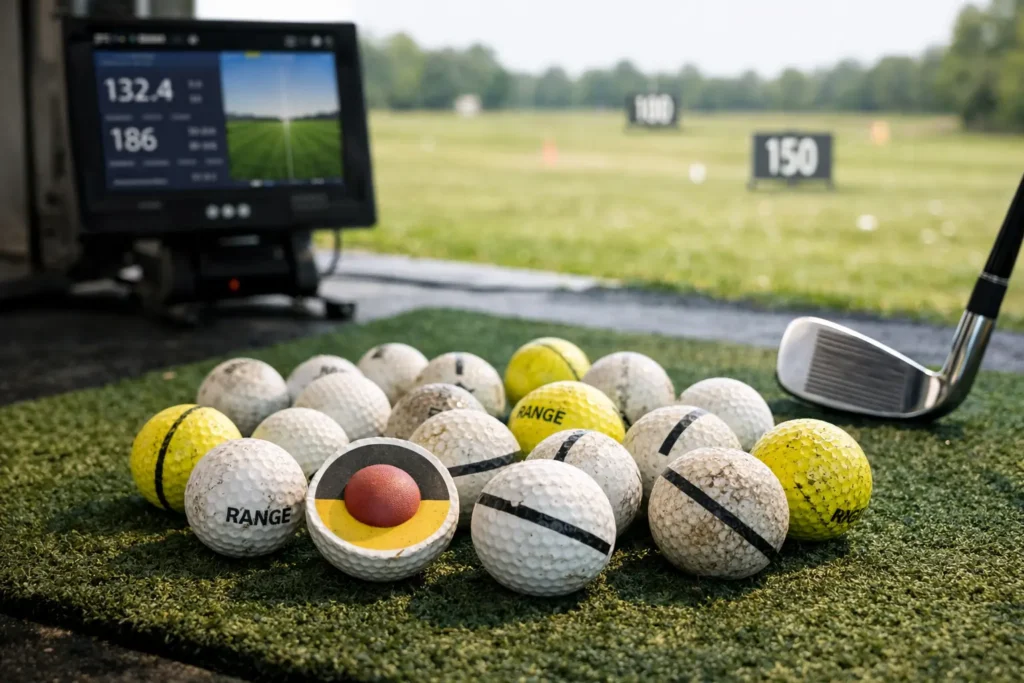
This matters much more in a radar-enabled practice environment than it did in a simple bucket-and-mat range. Once your facility uses ball-tracking systems, lesson bays, or member performance feedback as part of the experience, the ball stops being a disposable commodity. It becomes part of the measurement system. A ball that looks normal but behaves inconsistently does not just frustrate the player. It undermines trust in the bay itself.

How does moisture history distort radar trust?
A radar bay reports what the ball actually did, not what the bucket promised. When two visually similar reclaimed balls carry different soak histories or prior cover damage, your members see the inconsistency immediately in carry windows, shot patterns, and lesson feedback.
That is why clubs should stop asking whether all lake balls are bad and start asking whether any specific lot can be verified. In practice, the answer is often no. Cosmetic grade tells you very little. The words “mint” and “practice” tell you almost nothing about soak duration, prior cart-path strikes, prior range use, cover integrity, or how many different generations have been blended into the lot.
A decision table makes the problem easier to manage:
| Decision point | What can be verified | What stays unknowable | Operational risk | Next step |
|---|---|---|---|---|
| Factory-fresh batch | Production lot and QC | Prior damage history is low | Lowest consistency risk | Use as control group |
| Recovered washed balls | Cosmetic grade and rough source | Actual soak time and impact history | Medium to high variance risk | Restrict to non-radar trial only |
| Lake balls sold as “mint” | Surface appearance only | Moisture history and prior handling | Highest trust risk | Reject for premium bays |
If you run a radar-equipped range, prioritize batch consistency proof over cosmetic appearance. The most practical evidence action is a same-bay A/B trial. Put a fresh control lot and the candidate lot through the same bay, same club type, and similar strike conditions. Log carry, offline dispersion, and simple strike-feel notes from staff or teaching pros. You are not trying to prove a universal law of physics. You are trying to answer a club-level buying question: does this lot behave tightly enough to protect member trust?
When your team starts noticing Same strike, different carry window on radar, treat that as a procurement signal, not a mystery. Ask the supplier for batch traceability and a sample-lot declaration of source and use history. If they cannot provide it, the lot may still belong in a very low-sensitivity environment, but it does not belong in premium bays where data credibility is part of the service.
Can refinishing ruin ball-flight consistency?
A surprising number of buyers assume that because a golf ball is small, subtle surface changes cannot matter very much. In reality, that is exactly backward.
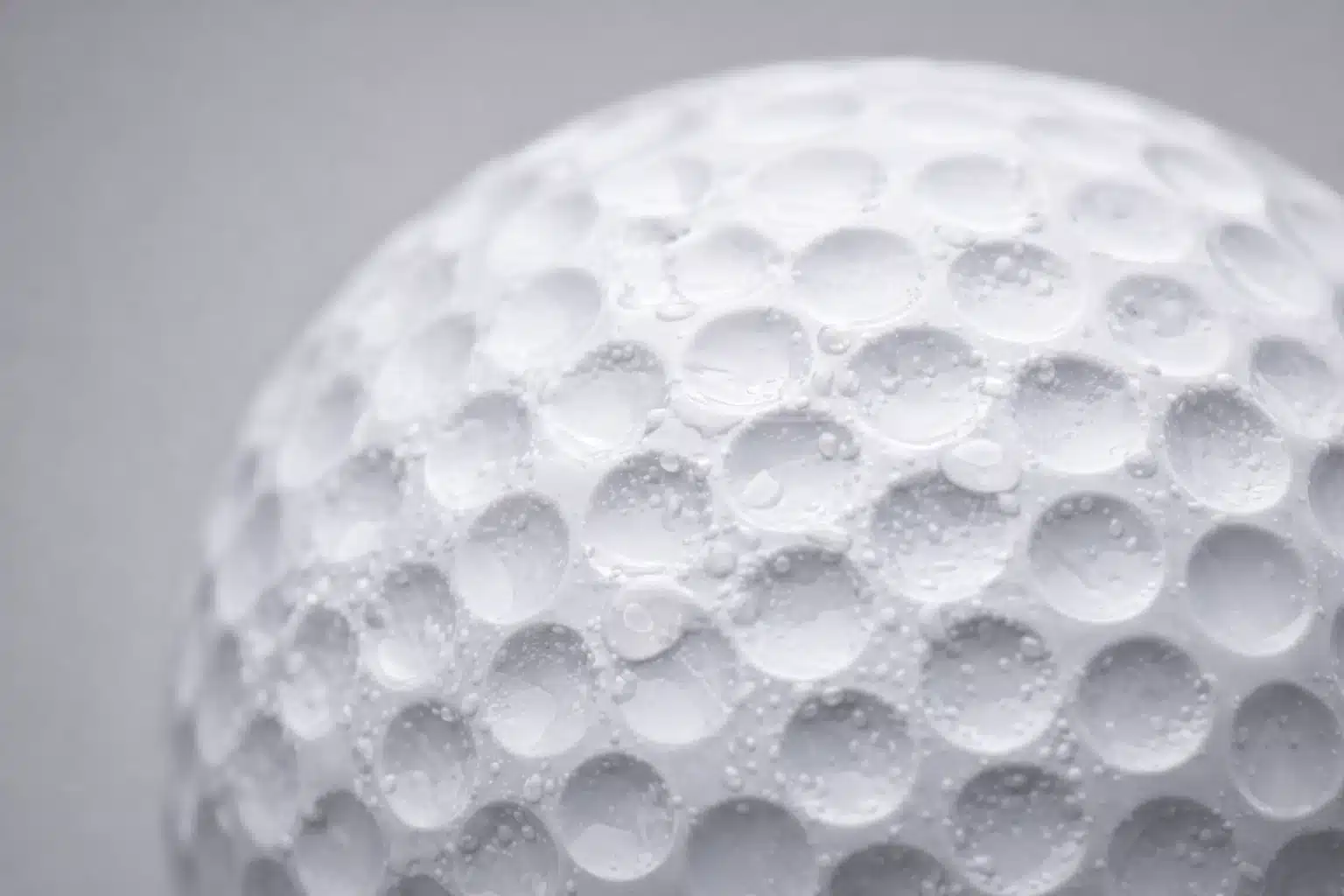
Golf-ball aerodynamics are tuned in microns, not millimeters. If refinishing changes dimple edges or creates uneven paint buildup, consistency is usually the first thing to disappear—even before golfers can see a problem with the naked eye.
The old logo is not the problem. The altered geometry is. OEM testing has shown that uneven paint application can create inconsistent dimple depths, and excess paint pooling can make dimples effectively shallower—enough to change flight consistency.
A controlled original mark applied within a known process is one thing. A stripped, sanded, or repainted surface is something else entirely. Once the refinishing process changes dimple edges, fills part of the dimple, or leaves uneven coating thickness across the surface, the ball may no longer present a repeatable aerodynamic profile.
This is where buyers should think like operators, not bargain hunters. A range ball does not have to be perfect to be useful. It does have to be consistent enough that one bucket behaves like the next bucket, and one strike behaves like the next strike within a tolerable window. Refurbishing threatens that standard because it often changes the surface in ways that are hard to see but easy to feel over time.
That becomes especially important in radar bays, lesson lanes, and club-fitting environments. In those settings, the ball is not just there to survive impact. It is there to support a believable stream of feedback. A player who sees one shot fly normally and the next one fall short or curve oddly on what felt like a comparable strike will not blame procurement first. They will blame the bay, the software, the coach, or themselves. All of those outcomes are operationally expensive.
The right buying question, then, is not “Can refinishing affect flight?” It is “How would my team verify that this refinished lot did not?” If the seller has no meaningful answer, the burden of risk falls on the club.
Ask for close-up microscope or profilometer images of the actual sample-lot dimples before shipment. Ask whether dimple consistency and coating thickness are measured, or merely assumed. Ask for a 12-ball QC report that covers weight, diameter, compression, hardness, and any documented check on dimple or coating consistency. A supplier measuring only appearance is not measuring what matters most.
For premium-bay supply, a reasonable acceptance position is simple: no refinishing or repainting unless dimple and coating consistency proof is provided. That may sound strict, but it is less strict than asking your members to absorb the inconsistency later.
✔ True — The problem is altered geometry, not the old logo
A visible prior logo is not what ruins flight. What ruins flight is a surface that no longer matches the intended dimple geometry because of stripping, sanding, or uneven repaint.
✘ False — “A little refinishing cannot affect a ball this small”
Golf-ball performance lives in tiny tolerances. Once the surface changes unpredictably, the buyer stops purchasing consistency and starts purchasing variance.
Why do refurbished balls fail in washers?
This is where the cosmetic story usually collapses under real operating conditions.
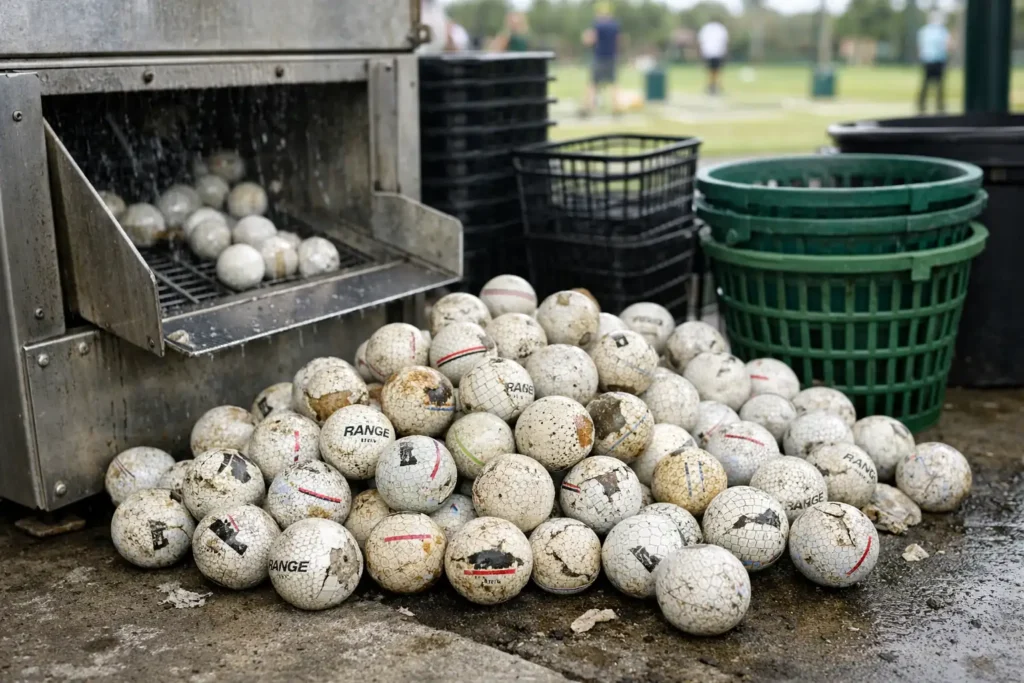
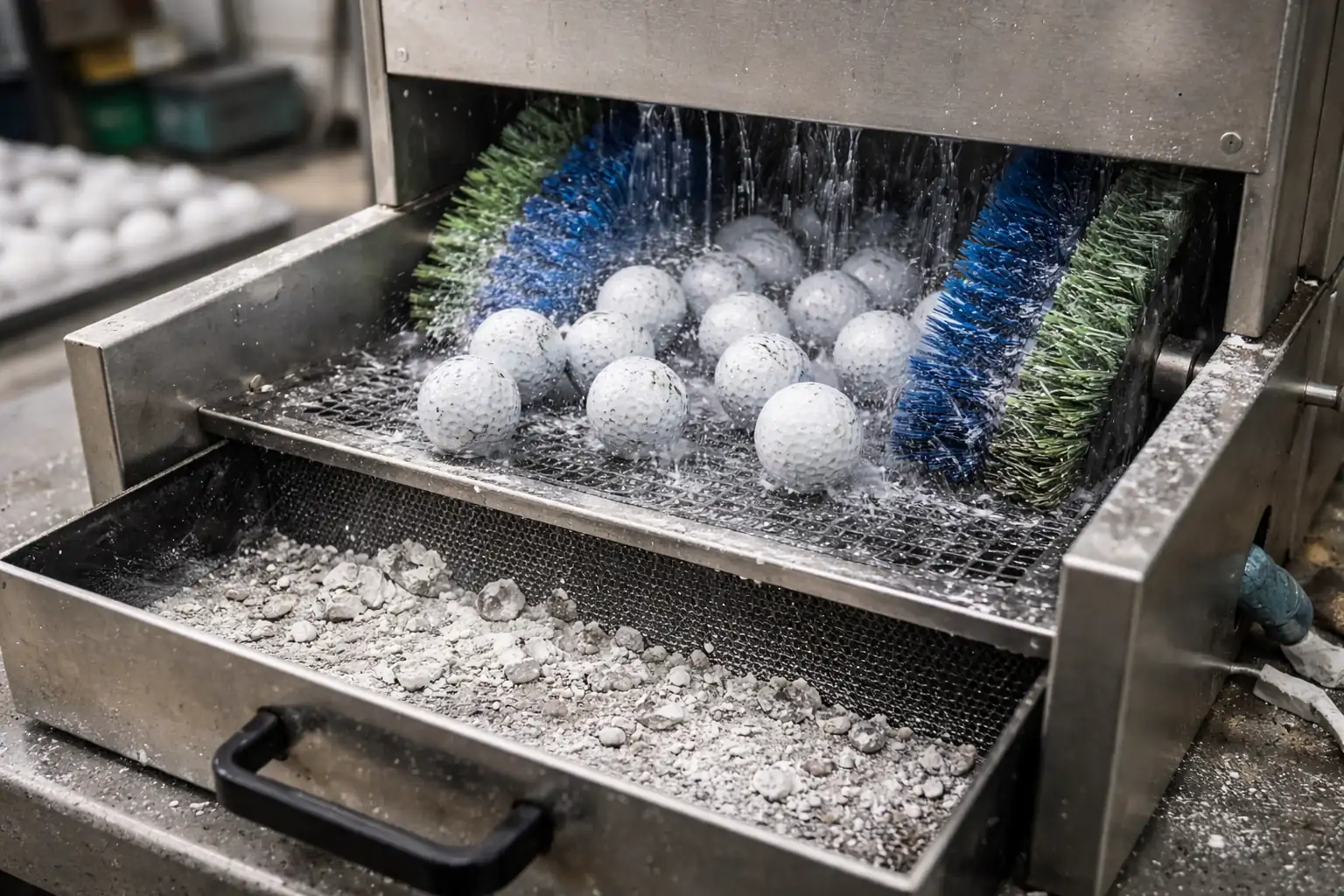
Weak repaint systems are exposed fast in commercial washers. The issue is not a magical seven-day clock; it is repeated high-throughput brush contact on a coating system that rarely discloses OEM-grade adhesion, cure method, or abrasion QA.
Operations teams sometimes inherit a shallow buying standard: if the balls still look white after washing, the stock must be working. That is not enough. A commercial range washer is not a beauty tool. It is a stress machine. Repeated brush contact, water exposure, debris, chemistry, and throughput all work together to expose weak coating systems quickly.
That matters because commercial washers are built for high duty cycles, with published capacities ranging from roughly 12,000 balls per hour into the tens of thousands.
That is why it is smarter to avoid fake precision. A serious buyer should not rely on dramatic claims like “seven days” or “48 washer-hours” unless the club or the supplier owns a documented test under defined conditions. The more credible phrasing is “within weeks under high-throughput washer duty,” followed by an acceptance method your own team can repeat.
Think through the mechanism. An OEM-style coating stack is usually a controlled process with defined layers, cure conditions, and QA targets. A repainted reclaimed ball, by contrast, often arrives with very little disclosure about what the coating system actually is, how it was cured, how adhesion was checked, or whether the final surface was evaluated under washer-like abrasion. That missing information is not academic. It becomes labor.
When the repaint starts failing, the visible symptom may look minor at first: roughness, flecking, slight breakup, logo breakthrough, inconsistent gloss. But the operational consequences stack up fast. Staff spend more time sorting ugly balls. Filters collect debris. Washer maintenance interrupts routines. Members notice flaking and start reading the bucket as “cheap.” A decision that was supposed to save cents per ball quietly begins spending dollars per labor hour.
A practical buyer does not need a lab to screen this. Use a controlled washer-cycle sample test with the same machine, same chemistry, and same cycle count for both the candidate lot and a fresh control lot. Photograph before and after. Check the brush chamber. Check the filter. Log visible coating transfer and any color or logo breakthrough. Require a washer-test log and coating description from the supplier if they claim durability.
Watch for Paint dust in the washer filter. That is not just cosmetic shedding. It is hidden labor, downtime risk, and evidence that the surface system may not survive commercial duty.
Write this into the PO: Buyer acceptance requires delivered balls to remain within the agreed weight, diameter, and compression windows and to complete the agreed washer-cycle evaluation without visible coating flake transfer or filter-clogging debris.
When does factory-fresh cost less overall?
The answer is usually earlier than the quote sheet suggests, because the cheapest opening price often carries the weakest operating discipline behind it.
The purchase price is lower. The operating cost often is not. Once scrap, replenishment, sorting, washer interruptions, and complaint risk are counted, “mint” lake balls can lose the TCO argument much faster than buyers expect.
This is the section where procurement should stop comparing line-item prices in isolation and start modeling six-month behavior. A used or reclaimed lot may win the opening quote because the unit price is lower. That does not mean the range program is cheaper. Once monthly scrap, replenishment, sorting, filter cleaning, and premium-bay inconsistency are included, the math can flip hard.
This is especially important in labor-tight operations. When staff time is expensive and range turnover is high, the hidden handling cost of inconsistent stock matters more than it used to. Every extra pass of manual sorting, every washer interruption, every customer-facing conversation about odd flight windows, and every emergency top-up order is part of the cost of that “cheap” decision.
A six-month TCO model is the cleanest way to make the point. Keep the assumptions explicit. Do not pretend one example is a universal benchmark. Use it as a disciplined comparison framework.
| Cost line | Refurbished/lake model | Factory-fresh model | What buyer must verify | Next step |
|---|---|---|---|---|
| Initial buy | Lower unit price | Higher unit price | Actual delivered unit cost | Normalize to same ball count |
| Replenishment | Recurs if scrap is high | Lower if stock is consistent | Monthly scrap and reorder pattern | Model 6 months |
| Sorting labor | Often hidden | Lower if batch is uniform | Hours/day and wage | Add labor line |
| Washer impact | Possible debris and maintenance | Lower unknowns | Filter cleaning and downtime logs | Add ops line |
| Player-data credibility | High variance risk in premium bays | Better control lot | Radar complaints and lesson use | Protect premium bays first |
This is an illustrative operating scenario, not a market-wide average; buyers should swap in their own scrap, labor, washer, and replenishment data.
One conservative worked example makes the tradeoff obvious. Assume 10,000 balls in service. Assume a reclaimed or used lot at about $0.50 per ball and a fresh range-ball lot at about $0.67 per ball. Assume the reclaimed lot needs 20% monthly replenishment and creates only half an hour per day of extra sorting labor at $20 per hour. Over six months, the used model reaches roughly $11,799.83, while the fresh model stays around $6,666.58. Even if you cut the scrap rate for the used lot to 10% per month, the used option still stays higher.
The deeper lesson is not that every reclaimed lot will always lose by exactly that amount. It is that the buying frame has to change. If your team compares only purchase price, you are measuring the smallest part of the decision.
Can MOQ 1,000 replace the used-ball market?
Often yes—especially for 2-piece Surlyn routes if you keep the first program operationally simple. Standard molds, simple print, split shipment, and piggyback production can turn factory-fresh buying from a giant jump into a manageable micro-batch decision.
A lot of clubs stay in the used-ball market because they assume fresh supply is operationally harder than it really is. They hear “factory direct” and imagine giant MOQs, long lead times, custom packaging, and too much cash tied up in one decision. Sometimes that is true. Often it is partly self-created because the first order tries to do too much at once.
A simpler first move usually works better. Standard mold. Plain white ball. Minimal print. White-box packing. Split shipment over several months if needed. That turns the question from “Can we afford a giant leap?” into “Can we manage a traceable lot rhythm with better consistency?” Those are very different decisions.
This is also where supplier evaluation matters. A useful RFQ is not just a price request. It is a process test. If the supplier can quote clearly, document batch traceability, provide a 12-ball QC report, offer a washer-cycle sample set, and separate lead time from delivery date, they are already behaving more like an operations partner than a commodity flipper.
Use this RFQ language: Quote 2-piece Surlyn range balls with batch ID traceability, 12-ball QC report, washer-cycle sample set, Incoterm-specific lead time, and delivery date stated separately.
Do not stop there. Ask for a six-month TCO worksheet. Ask whether split shipment or piggyback production is available. Ask whether the supplier will define both lead time and delivery date in the PI or PO rather than hiding the schedule inside vague sales language. Compare the used option against one fresh control lot in the same washer and the same radar bay. That is how factory-fresh becomes a measured operational decision instead of a scary abstract upgrade.
✔ True — MOQ is often a negotiation variable
For range programs, standard molds, simpler print, white-box packing, split shipment, and piggyback production can lower the jump to fresh supply. The real comparison is operational rhythm, not just opening order size.
✘ False — “New range balls only make sense for giant facilities”
A smaller club can still buy better if it buys a traceable, testable lot cadence instead of a large vague promise wrapped in cosmetic grade names.
FAQ
Do range balls need to appear on the conforming list?
Usually not for ordinary range use; it matters when a competition has adopted the List of Conforming Golf Balls local rule.
Procurement teams often overuse conformity as a shortcut because it feels official. For everyday range operations, that is usually the wrong first filter. Conforming status answers a rules question. It does not tell you whether the lot is traceable, whether the coating will survive your washer, or whether the batch behaves consistently in a radar bay. Start by defining intended use. Lessons, member practice, event prep, and tournament preparation do not all require the same proof package. If your club does need conforming proof, request it for the exact model and marking rather than treating the concept as a general proxy for quality.
Can a club use reclaimed balls only in beginner bays and fresh balls in radar bays?
Yes, that is often the cleanest transitional decision. Treat premium bays as consistency-critical and lower-sensitivity zones as controlled test space.
This approach works best when you keep the categories physically separate and operationally separate. Do not mix reclaimed and fresh lots in the same hopper and then try to diagnose complaints later. Keep one fresh control lot for radar bays, lessons, or other premium use. Use reclaimed stock only in zones where variance is less damaging. Then review complaints, carry windows, washer debris, and staff observations by zone. That gives procurement evidence instead of opinions.
What is the fastest washer-durability test before a full switch?
Use a controlled, documented sample test instead of waiting for complaints. The point is to check flaking and debris, not just cleanliness.
Use the same washer, chemistry, cycle count, and drying routine for both the candidate lot and a fresh control lot. Photograph before and after. Inspect the filter and note visible flakes or powdery transfer. Log any logo breakup, color breakthrough, or roughened surface. This is a fast, practical test because it answers the exact question operations cares about: how will this coating behave in our machine under our duty cycle?
What documents belong in the PO for range balls?
The PO should define the ball more precisely than “white range ball.” Good buying starts with measurable acceptance, not sales adjectives.
At minimum, specify ball type, cover material, color standard, whether refinishing or repainting is permitted, batch ID, production date, packing date, and a lot-level QC report. Add a retained-sample reference. For consistency-sensitive use, require a 12-ball raw-data QC report covering weight, diameter, compression window, and any documented coating or dimple consistency checks. The goal is to buy a measurable lot standard, not a vague promise.
Is MOQ 1,000 realistic for factory-fresh range balls?
Often yes for certain 2-piece Surlyn routes, especially if you use standard molds, simple print, or piggyback production. The real question is not only MOQ but total landed rhythm.
A thousand-ball program becomes more realistic when you remove unnecessary complexity from the first order. Ask for standard-mold options first. Compare white-box packaging with custom packaging. Explore split shipments across several months. Put lead time and delivery date in writing. Many clubs assume MOQ is fixed because they never test which parts of the request are actually driving the minimum.
What should a first sample evaluation include besides appearance?
Appearance is only the gatekeeper. The buying decision should also test consistency, washer behavior, and receiving documentation.
A strong first evaluation has four parts: radar-bay A/B comparison against a fresh control lot, washer-cycle observation, random checks on weight and diameter with compression if available, and document review. The paperwork matters as much as the sample itself. If the supplier cannot support the lot with batch record, QC data, and retained-sample reference, the club is being asked to trust a one-time visual impression instead of a controlled supply process.
Conclusion
The refurbished range-ball trap is not really about whether every used ball is bad or whether every pond ball loses distance. It is about whether your club is buying a ball standard that can be verified.
Once moisture history, surface geometry, and coating quality become unknowable, the cheap bucket stops being a product and starts being a liability. The stronger buying standard is simple: define the lot, test the lot, document the lot, and let “mint” go back to being a color word instead of a procurement strategy.
You might also like — How to Choose a Reliable Golf Ball Manufacturer in China?