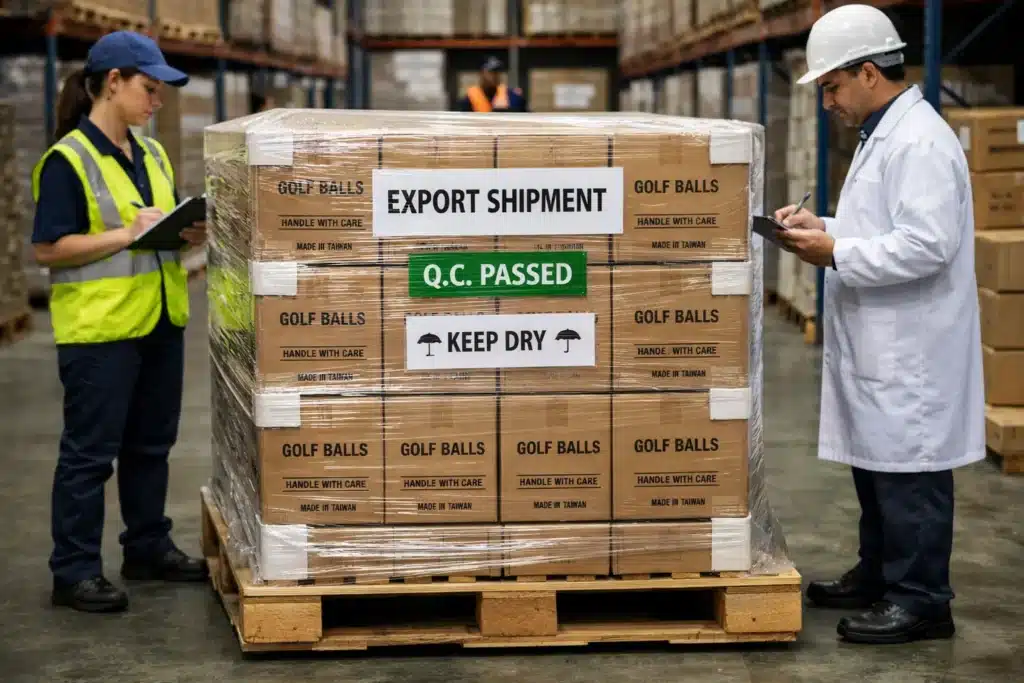
In 2023, Thailand ranked No. 2 by golf ball export value (≈ US$169M), tied with the United States. In practice, Thailand’s verified golf ball capacity centers on Titleist Ball Plant IV for tour-level urethane, supported by a few local OEMs—Toppoint and Nova Teknika—for 2-piece Surlyn balls. As a buyer, you need a truthful map, then a clear route among Thailand, China, and Vietnam for OEM.
Which manufacturers truly make golf balls in Thailand?
Only a handful have verifiable ball-making lines in Thailand: Titleist Thailand at Rayong for multi-layer cast-urethane tour balls, and Toppoint/Nova Teknika for 2-piece Surlyn categories.
What do they make?
Tour urethane at Titleist Ball Plant IV (Rayong), and 2-piece Surlyn practice/logo ranges at Toppoint (Bangkok/Rayong) and Nova Teknika (Ayutthaya).
| Factory Name | Location | Primary Ball Types | Main Export Regions |
|---|---|---|---|
| Acushnet Titleist (Thailand) Ltd. | Rayong, Hemaraj Eastern Seaboard Industrial Estate (ESIE) Free Zone | Multi-layer cast urethane (Pro V1, Pro V1x, AVX) | United States, Europe, Asia |
| Toppoint Corporation Ltd. | Bangkok (HQ) / Rayong (Factory) | 2-piece Surlyn practice/logo balls | Japan, South Korea, Southeast Asia |
| Nova Teknika Co., Ltd. | Wang Noi, Ayutthaya | 2-piece Surlyn colored/range balls | Europe, Oceania, Southeast Asia |
Can you place OEM orders with each Thai manufacturer?
Treat Titleist Thailand as a benchmark; it’s brand-owned and no public third-party OEM program is disclosed. Real OEM options in Thailand are local 2-piece Surlyn makers (Toppoint, Nova Teknika); open urethane OEM slots for new brands are limited in Thailand today.
If you need cast-urethane under your own brand, use Vietnam as the primary OEM path for US-bound retail, and keep China as your rapid development/packaging hub plus non-US allocation base.
| Factory | OEM availability (2025) | Best-fit constructions | Typical use-cases | Caveats |
|---|---|---|---|---|
| Titleist Thailand (Rayong) | Brand-owned; not open to 3rd-party OEM | Multi-layer cast-urethane (tour) | Global parity for Pro-class SKUs | Benchmark only; not bookable capacity |
| Toppoint (Bangkok/Rayong) | Accepts OEM | 2PC Surlyn (white/colors) | Practice, logo, promo, range packs | Confirm paint/print specs & color fastness |
| Nova Teknika (Ayutthaya) | Accepts OEM | 2PC Surlyn (colored/range) | Driving range, corporate gifting | Validate coating durability & pack options |
Where are these plants and how do they move goods?
Manufacturing clusters along the Eastern Seaboard and the central corridor: Rayong (WHA Hemaraj ESIE Free Zone) for tour urethane, Bangkok/Rayong for Toppoint, and Ayutthaya (Wang Noi) for Nova Teknika—shipping via Laem Chabang deep-water port to US/EU/JP/KR lanes with predictable schedules.
For planning, assume stable allocations on tour urethane (brand-controlled) and order-by-order flexibility on 2PC Surlyn. If origin must be non-China for US retail, pair VN for 3-piece lines with TH for flagship story; keep CN for high-mix kitting and fast seasonal variants where origin is flexible.
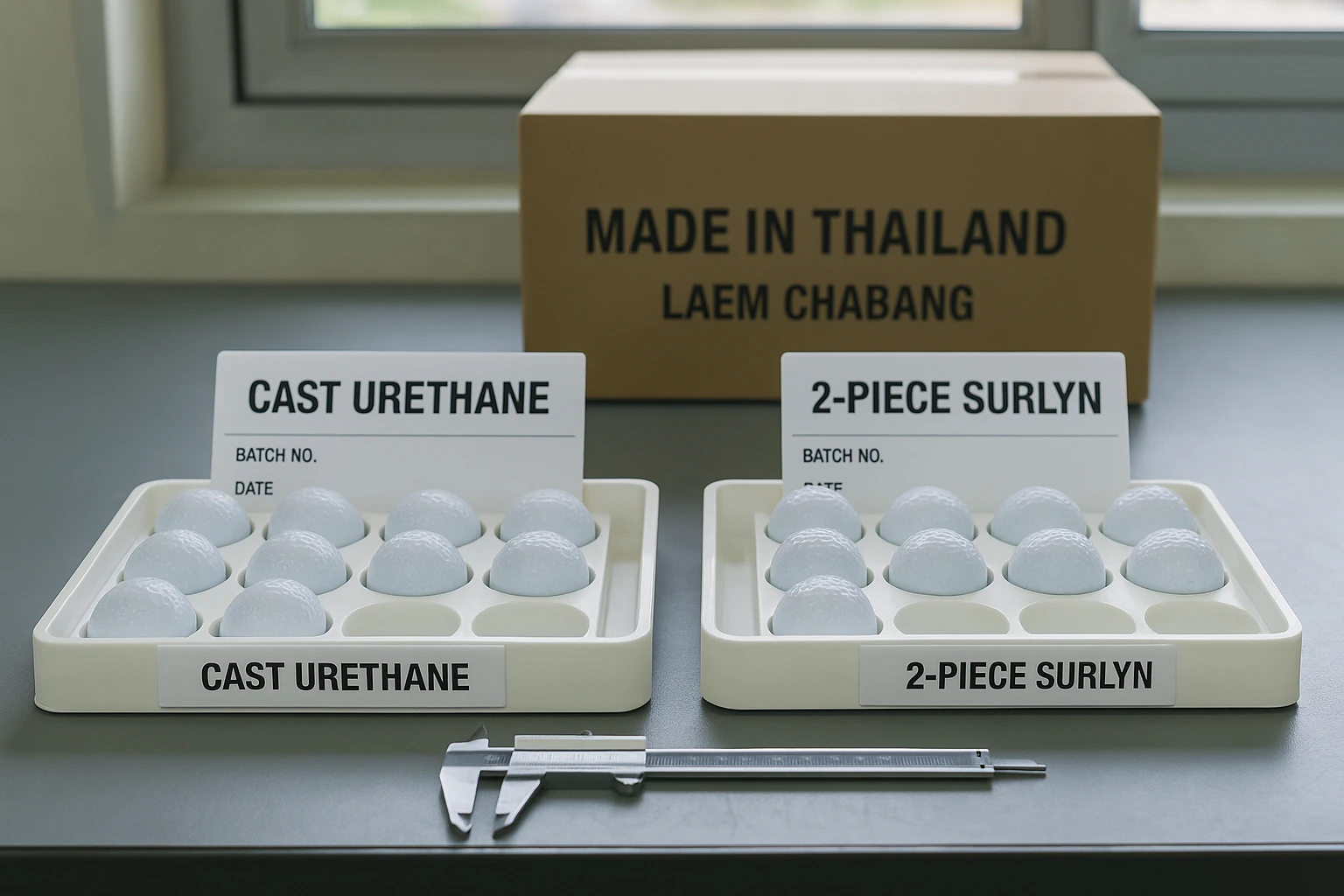
What is the real size and structure of Thailand’s golf ball industry?
Thailand ranks No. 2 by export value (≈US$169M, 2023). Factory count is small but output is concentrated and disciplined: tour-level urethane is led by Titleist Ball Plant IV, while local OEMs supply 2-piece Surlyn practice/logo balls. Main lanes ship to the US, Korea, Japan, and the EU/UK.
Why so big with so few factories?
A few plants power most of the volume. That “few but strong” profile reflects high first-pass yield, steady takt, and global allocation discipline—especially on tour urethane. For planning, assume stable flagship capacity and limited third-party OEM slots; engage early to secure windows.
Thailand’s Eastern Seaboard (Rayong/Chonburi) sits near Laem Chabang deep-water port and mature petrochemicals (PU/ionomer). The ecosystem shortens logistics for urethane and supports consistent paint/print performance. That’s how a short plant list still generates outsized exports year after year.
Which product types dominate?
Two lanes matter: (1) tour-level multi-layer cast-urethane (Pro V1/V1x/AVX class) from Rayong; (2) 2-piece Surlyn for practice/logo/range from local OEMs.
If dispersion control and thin urethane matter, Rayong’s route is proven. If you need durable practice balls or marketing colors with fast variant turns, many brands still route large, multi-SKU programs to China for speed and unit economics.
What common spec myths trip up first-time buyers?
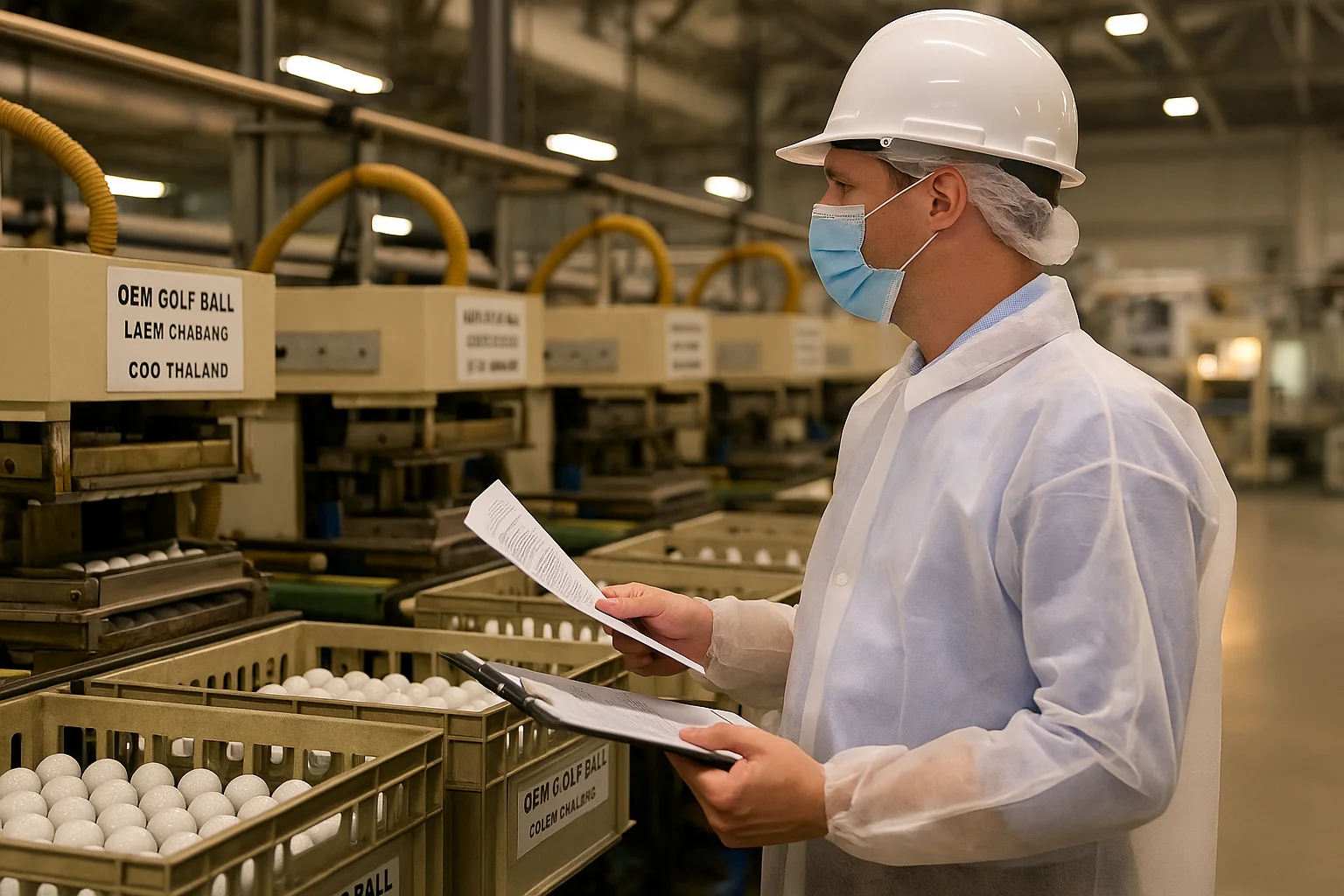
Same spec ≠ same quality. Execution—materials control, thickness tolerance, concentricity/OOR, cure/paint discipline—decides your field results and warranty noise. Put repeatability into your PO: freeze materials/process, then require batch-level checks, not just a one-time report.
✔ True — Test reports only cover a specific sample
Lab reports validate one batch, not entire production. Each shipment needs batch-level quality control and possibly third-party verification to ensure ongoing compliance.
✘ False — “They sent a report, so the whole shipment is fine”
Relying blindly on test certificates can be misleading. Real quality requires ongoing vigilance, not just one report.
Are Thailand-made golf balls actually cheaper than China-made?
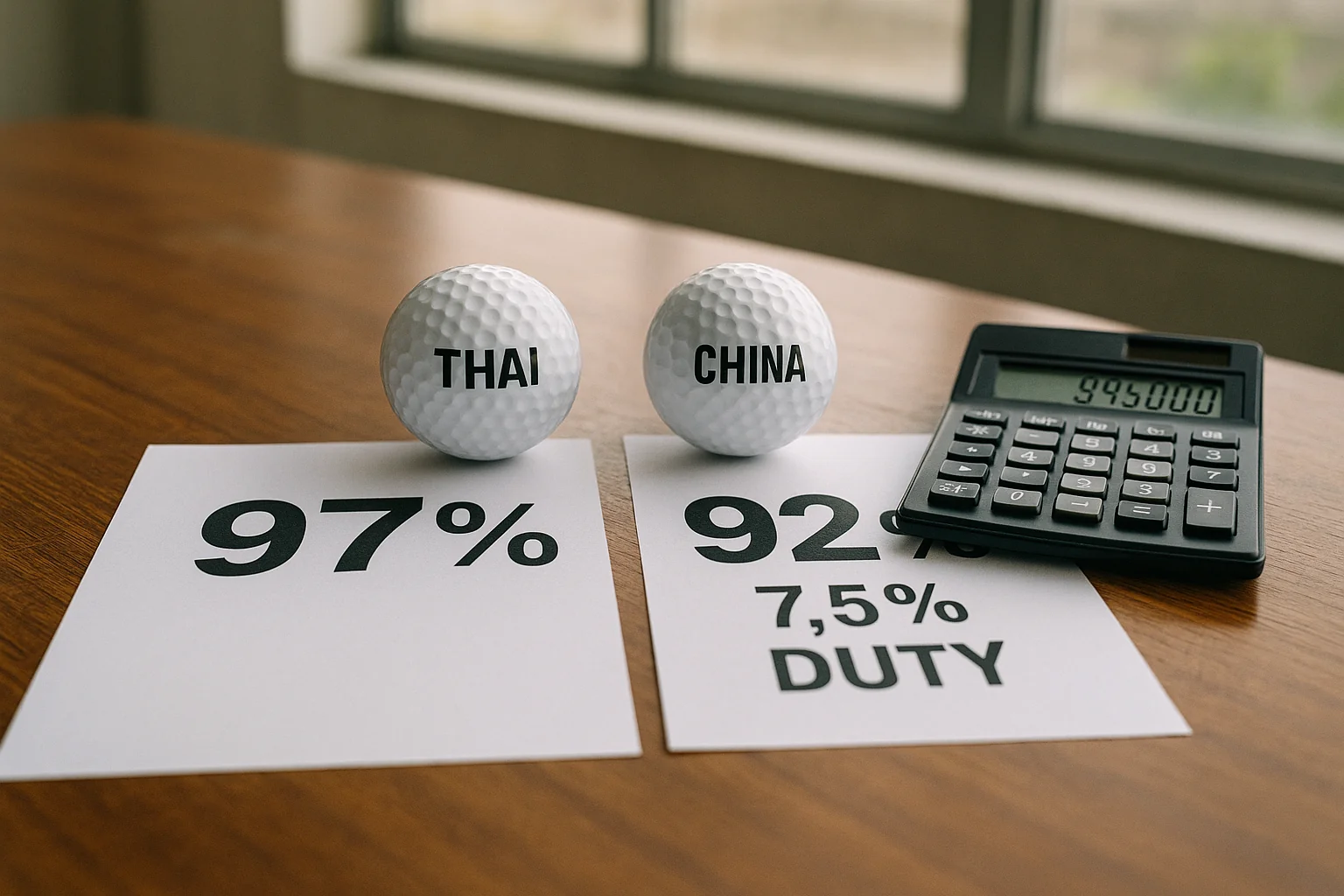
Short answer: not on pure manufacturing cost. For 3-piece cast-urethane, Thailand isn’t inherently cheaper—labor isn’t markedly lower and electricity is often higher. Thailand wins on unit cost when two levers kick in: very high yield/throughput at scale, and BOI/EEC incentives that dilute depreciation/duties. To the US, Thailand often lands cheaper because China origin adds 7.5% Section-301—policy, not physics.
What do the core cost drivers look like (labor, power, materials, tax)?
Wages: Thailand ≈ South China in practice; Power: Thailand often higher per kWh; Materials: both strong, with Thailand’s petrochem cluster aiding urethane logistics; Policy: BOI/EEC can exempt machinery/material duties and grant CIT holidays—lowering fully-loaded unit cost.
In China, VAT rebates and dense packaging/printing supply chains offset costs through scale and speed. Net-net, Thailand’s inputs are not “naturally cheaper”; the effective advantage appears when yield/scale plus incentives compress overhead per good ball.
Where do yield and takt time flip the COGS math?
Thin cast-urethane is unforgiving. A 3–5-point yield gap dominates economics. If a China PU line matches ≥97% first-pass yield, China’s lower power and downstream density can beat Thailand on COGS; if not, Rayong-class lines “win by yield” even with higher power.
Illustrative math buyers use for negotiation (not a quote):
| Illustrative COGS (per ball) | China line | Thailand line |
|---|---|---|
| Materials (core/mantle/PU/solvents) | $0.60 | $0.58 |
| Direct labor | $0.12 | $0.13 |
| Energy (cure/dry/paint) | $0.03 | $0.04 |
| Depreciation/fixtures | $0.06 | $0.05 |
| Subtotal before yield | $0.81 | $0.80 |
| Assumed first-pass yield | 92% | 97% |
| COGS = Subtotal ÷ Yield | $0.881 | $0.825 |
✔ True — Unit price must be weighed with risk and service
A lower quote may hide weaker QC, slower communication, or tighter payment terms. Evaluate total cost, not just unit price, for real value.
✘ False — “Cheaper per unit always means a better deal”
Focusing only on price often leads to hidden costs later. Real procurement is about balancing risk, reliability, and service—not just price tags.
Where should you manufacture each ball type in 2025 — Thailand, China, or Vietnam?
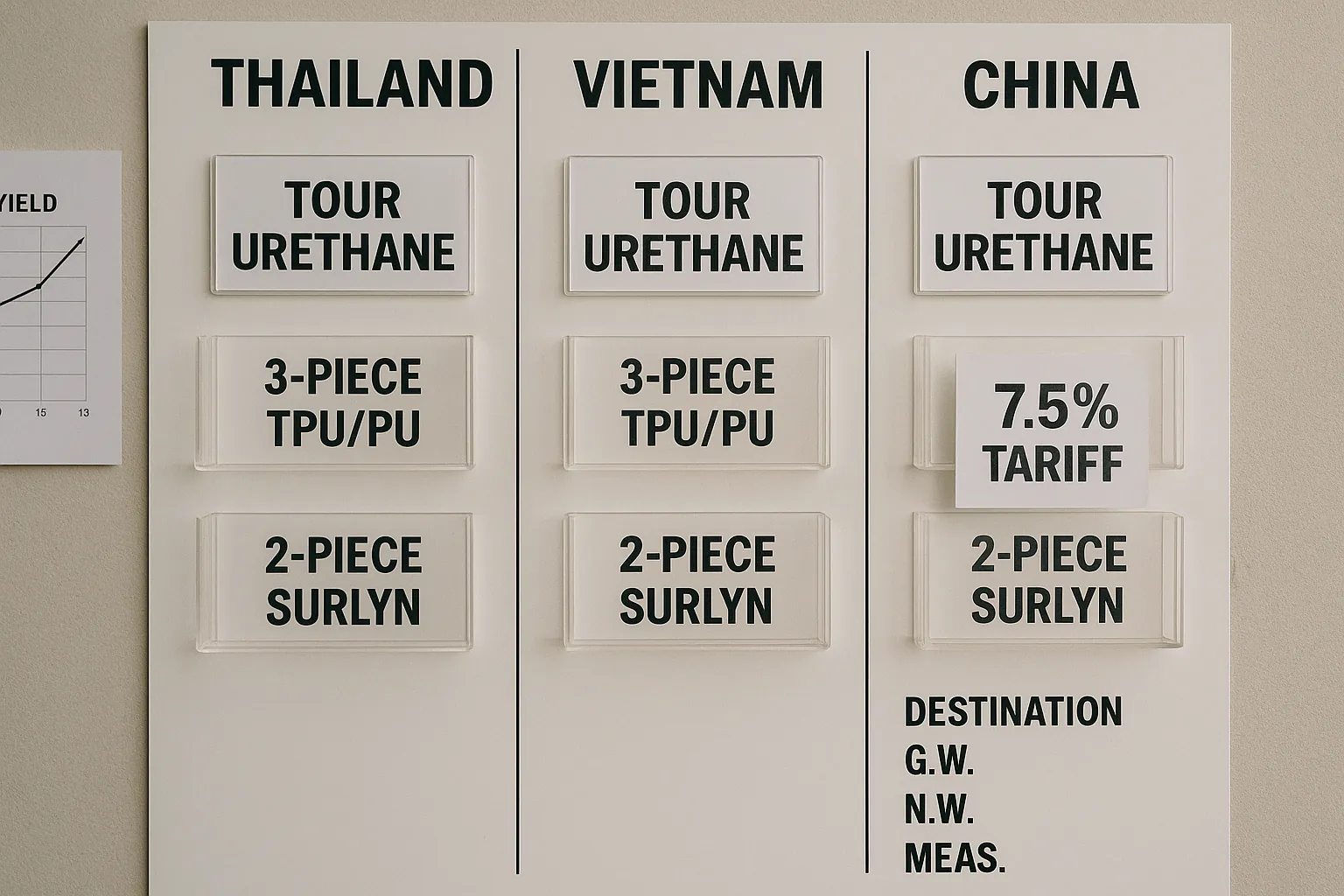
Route each SKU to the origin that best fits tariffs, yield, and speed. Thailand anchors flagship cast-urethane with global consistency; Vietnam is the clean path for US retail to avoid Section-301; China is your high-mix engine for 2-piece Surlyn and rapid iterations. Here’s the exact split you can act on.
Tour-level cast-urethane (3–4 piece): where to build?
Thailand first for flagship parity and brand halo; Vietnam as the alternate for US retail; China case-by-case if origin is flexible and you need packaging agility.
If dispersion control and thin cast urethane are core to your story, Thailand’s tour lines deliver tight compression windows and repeatability. When the channel is US big-box, Vietnam’s 0%-301 math keeps shelf prices competitive without sacrificing consistency. Use China if you’re launching limited editions or seasonal bundles that need fast kitting and late art changes.
3-piece TPU/PU (value/performance retail): who executes best?
Vietnam leads for US-bound value/performance; Thailand works if you can access capacity; China wins outside the US or when you need rapid variant turns.
US retailers care about landed price and on-time allocations; Vietnam’s tariff profile helps both. If you can secure Thai slots, you gain reputational comfort and stable lots. For Japan/Korea/EU (no 301), China’s scale and ECO speed often deliver the lowest real cost with smoother seasonal refresh.
2-piece Surlyn practice/logo balls: where do you win margin?
China. Thailand or Vietnam only when origin mandates or brand positioning require it.
Two-piece Surlyn is about durability, color options, pad-print capacity, and packaging density. China’s ecosystem compresses both unit cost and lead time—ideal for corporate gifting, driving-range consumption, and multi-SKU campaigns. If you must avoid China origin, lock Thailand/Vietnam earlier and simplify variants to keep rhythm.
| SKU-to-Origin Playbook (2025) | Thailand 🇹🇭 | Vietnam 🇻🇳 | China 🇨🇳 |
|---|---|---|---|
| Tour-level urethane (3–4 pc) | ★★★★☆ Primary | ★★★★☆ Alt (US retail) | ★★☆☆☆ Case-by-case |
| 3-piece TPU/PU (value retail) | ★★★☆☆ If capacity | ★★★★☆ Primary (US) | ★★★★☆ Primary (non-US) |
| 2-piece Surlyn practice/logo | ★★☆☆☆ Selective | ★★☆☆☆ Selective | ★★★★★ Primary |
| Multi-SKU, rapid ECO cycles | ★★☆☆☆ Limited | ★★☆☆☆ Book early | ★★★★★ Primary |
| Non-China origin (US mandate) | ★★★★☆ Good | ★★★★★ Best | ☆☆☆☆☆ Not applicable |
| Flagship branding/halo effect | ★★★★★ Best | ★★★★☆ Strong | ★★★☆☆ Good with speed |
FAQ
Can Thailand supply tour-level urethane with global parity?
Yes. Thailand’s Rayong lines prove parity at scale—thin cast urethane over multi-layer cores with tight SPC. For premium positioning in US/EU/JP, that consistency reduces warranty noise and supports higher price bands.
If you need resilience, mirror specs with Vietnamese near-tour capacity and keep China for packaging agility or non-US allocations. That split keeps launches on time if seasons shift.
Is Thailand cheaper than China for practice balls?
Usually no. China’s ecosystem wins on 2-piece Surlyn for cost and speed—especially for multi-SKU, seasonal programs and e-commerce gift sets.
If the destination is the US and origin rules out China, plan earlier with Thailand/Vietnam and simplify variants. For JP/KR/EU/ASEAN, China’s total landed cost often still comes out best.
Should US-bound private labels prioritize Vietnam?
Often yes—if margin hinges on avoiding the 7.5% Section-301 on China origin. Vietnam’s 3-piece and near-tour capability plus retailer familiarity check key boxes for big-box and club-store programs.
Capacity booking is crucial in Q2–Q3. Keep specs stable across cycles to prevent resets and protect slot allocations.
Are there enough Thai OEMs to absorb new custom projects?
Not many. Real Thai ball factories are few. Third-party slots suit clear specs with stable volume.
If you need agile iterations or many variants, route development to China and reserve Thailand for flagship SKUs. That hedge balances speed with brand defense.
Key Takeaway
Thailand is fantastic for flagship urethane and reputation; Vietnam is a strong pick for US-bound retail without 301; China is unmatched for speed, cost, and multi-SKU campaigns.
You might also like: Top 4 golf ball manufacturers in Vietnam for OEM