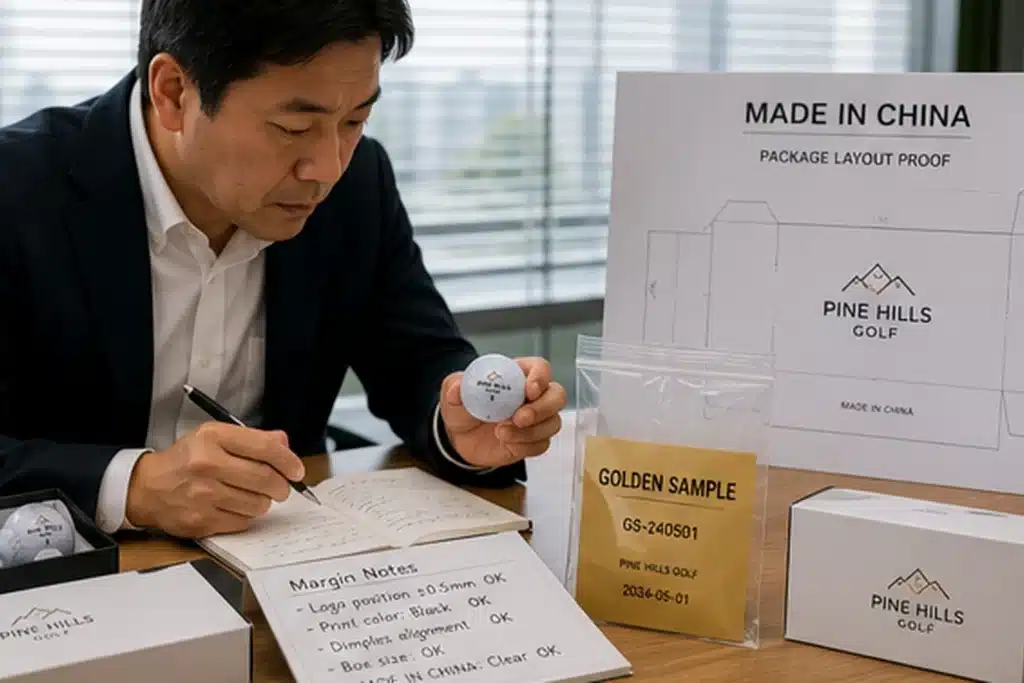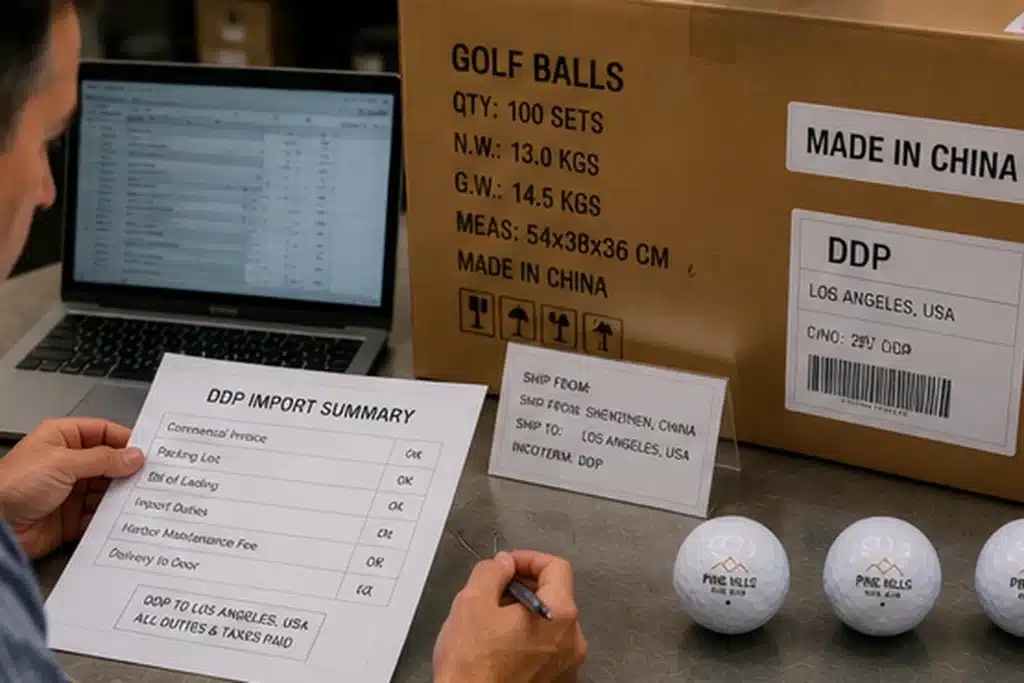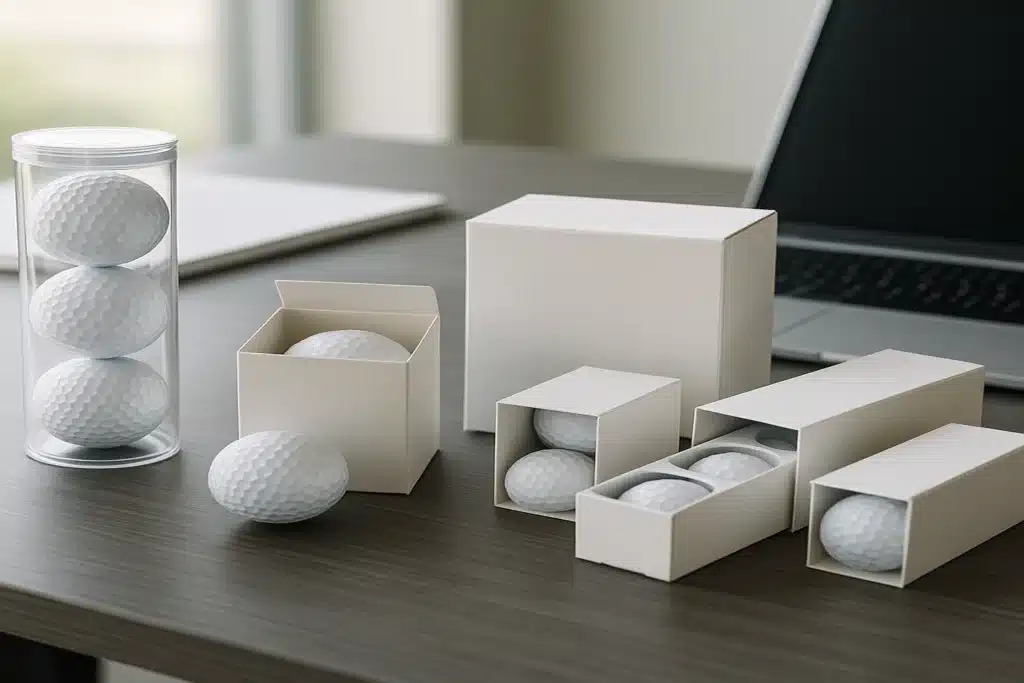
The best packaging options for OEM golf balls are not chosen by appearance first. They are chosen by channel fit, CBM, board strength, drop readiness, barcode scanability, and whether the same supplier controls the ball-to-box fit.
For most retail, distributor, and e-commerce orders, the safest OEM golf ball packaging is a flat-packed 3-ball sleeve plus a dozen box made from 350–400gsm SBS paperboard. This structure protects a dense half-kilo dozen, reduces freight volume, supports clean branding, and gives FBA sellers a stronger starting point for drop-ready, scannable packaging.
The expensive mistakes usually happen when packaging is treated like decoration. PET tubes and rigid boxes can make you pay ocean freight for air; thin paperboard can crush under golf ball weight; glossy barcode zones can fail warehouse scans; and split-sourced boxes can arrive 2mm too tight for the balls.
Which packaging option fits your sales channel?
A package can look premium in a render and still fail the channel: too much CBM, weak board, poor barcode placement, or bad packout fit.
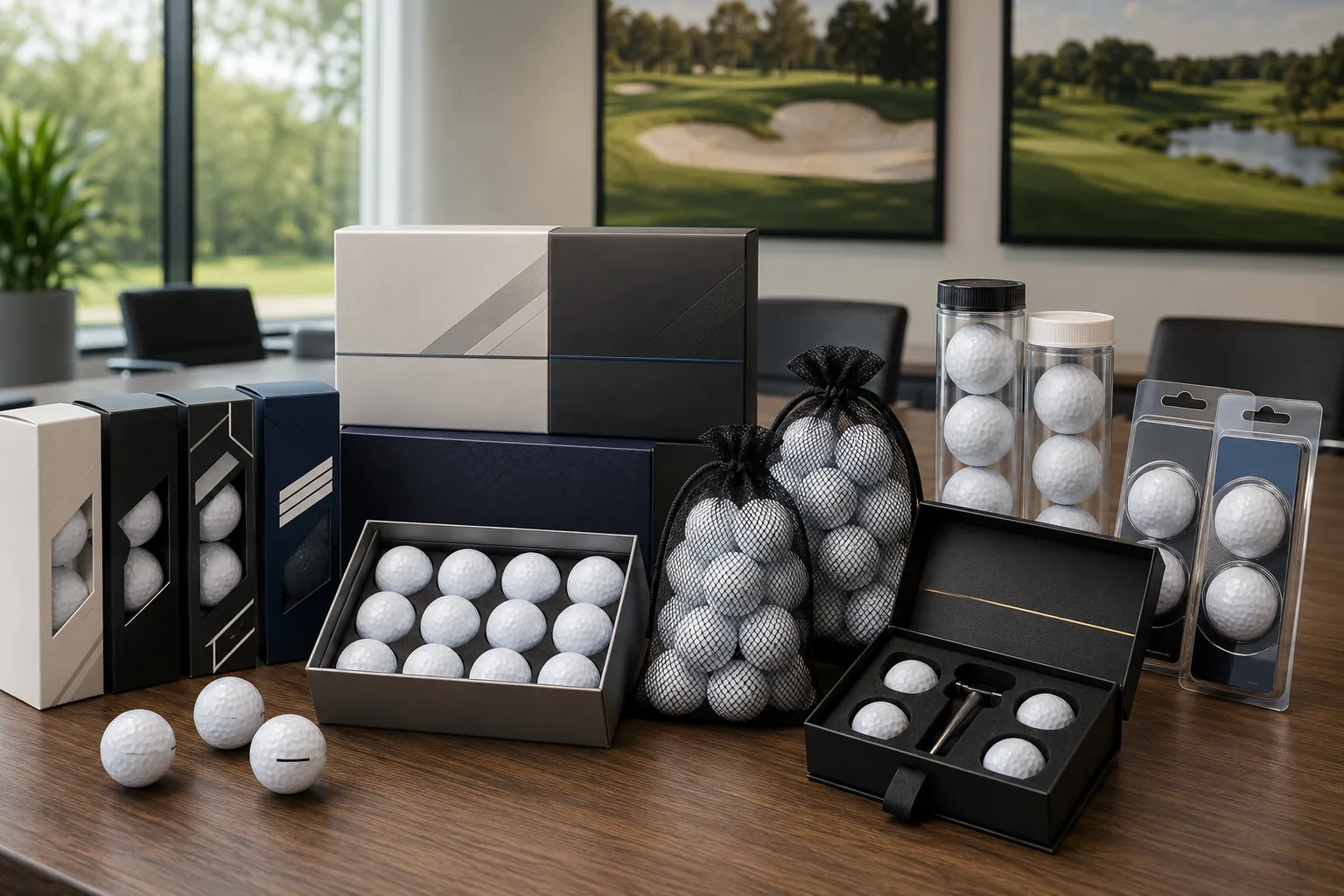
Choose OEM golf ball packaging by channel first, not by appearance. Your safest retail and e-commerce core is 3-ball sleeves plus a dozen box; bulk programs can use nylon or OPP; warehouse retail may need blister or tray; VIP gifts can justify rigid, wood, or PU boxes.
For OEM golf balls with custom packaging, every format has a job. A 3-ball sleeve plus dozen box is familiar, stackable, and efficient for retail and distributor programs. A dozen box plus ship-ready mailer is the cleaner starting point for e-commerce. Nylon mesh and OPP/PE bags work when cost and handling speed matter more than shelf presence.
PET or rPET tubes show the balls clearly, but the freight model changes because the tube cannot fold flat. Blister packs and 12-ball trays can support warehouse-style display and tamper evidence, but they add tooling, sealing, and CBM risk. Premium boxes can be worth it when the channel pays for unboxing, yet they should not become the default for freight-sensitive B2B or FBA launches.
| Pain / decision | Best packaging lane | CBM behavior | Buyer action |
|---|---|---|---|
| Retail / distributor | 3-ball sleeve + dozen box | Low, fold-flat | Request board grade and drop proof. |
| FBA / e-commerce | Dozen box + ship-ready mailer | Low to mid | Request scan and drop-readiness proof. |
| Lowest-cost bulk | Nylon mesh or OPP/PE | Low | Confirm branding limits. |
| Warehouse club | Blister or 12-ball tray | High | Request seal and display proof. |
| Visual promo | PET / rPET tube | High | Compare CBM before approval. |
| VIP gift | Rigid / wood / PU + EVA | Mid to high | Request fit and odor checks. |
Ask each supplier for a packaging matrix quote that shows material, foldability, CBM, carton count, channel fit, drop-readiness proof, barcode plan, and packout method. Verify whether the packaging ships flat, pre-assembled, or partly assembled before you compare landed cost.
Serious distributors and FBA sellers are moving away from “which package looks better?” toward “which package remains sellable after freight, handling, receiving, scanning, and storage?” For packaging MOQ and cost-per-unit math, route that separate decision to What’s the Real MOQ for Custom Logo Golf Balls in Bulk?.
✔ True — The best format depends on channel and logistics.
Retail, FBA, warehouse club, range, and VIP gift programs all create different packaging stress. Pick the format after you know how the product will be stored, shipped, scanned, and sold.
✘ False — “The best-looking package is automatically the best OEM choice.”
A beautiful PET tube or rigid box can still inflate CBM, scuff in transit, delay packout, or fail the receiving workflow.
Why is Sleeve + Dozen the e-commerce core?
Many buyers treat 3-ball sleeves and dozen boxes as traditional retail packaging. For golf balls, they are also a freight and damage-control system.
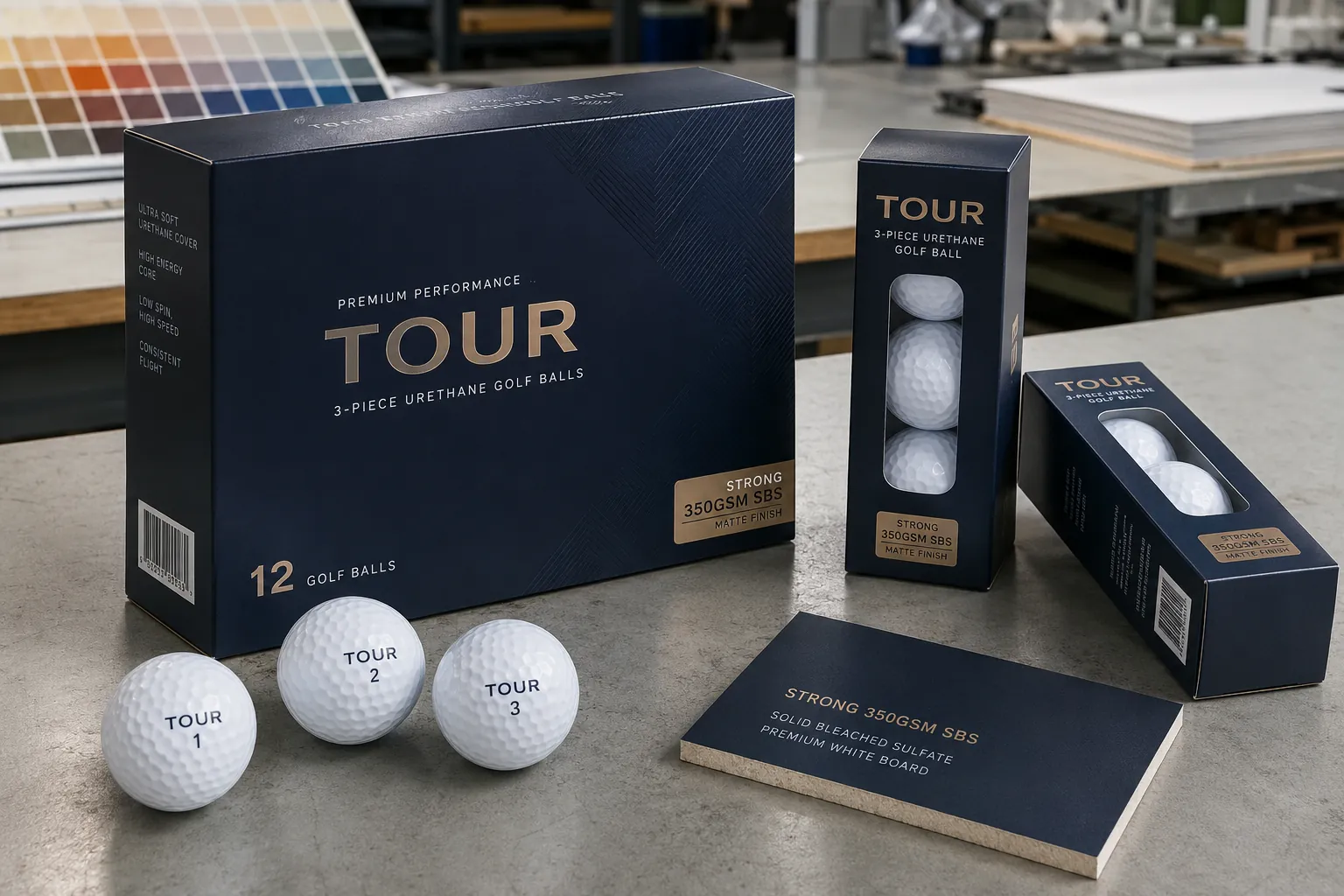
A dozen golf balls is a half-kilo payload, not a light gift box. Your 3-ball sleeves and dozen box should use high-stiffness paperboard such as 350gsm SBS, with 400gsm or reinforced mailers when e-commerce handling, box geometry, or route risk requires it.
The Half-Kilo Rule
Under the USGA/R&A equipment rules, one conforming golf ball may weigh up to 45.93g. That means 12 balls can reach about 551g before sleeves, dozen box, inserts, mailer, labels, or master cartons. This is why golf ball packaging cannot be specified like packaging for socks, cables, or earbuds.
The sleeve and dozen box must control dense rolling weight. Thin board can look acceptable when empty, then buckle once the balls are loaded and the carton hits humidity, vibration, compression, and conveyor handling. Golfara treats 350gsm SBS as a practical engineering baseline for serious retail and e-commerce golf ball packaging. For harsher routes, heavier box geometry, or premium presentation, quote 400gsm paperboard, reinforced mailers, edge protection, or tighter inner fit.
| Pain / decision | Weak spec | Better spec | Buyer action |
|---|---|---|---|
| Crushed dozen box | thin board | 350gsm SBS baseline | Request board grade. |
| FBA route risk | standard retail box only | 400gsm / reinforced mailer option | Quote upgrade path. |
| Ball rattling | loose sleeve fit | snug cavity and fit check | Test with production balls. |
| Moisture / long transit | no barrier plan | master carton + PE / moisture plan | Request packout spec. |
| Retail color drift | PDF-only approval | physical swatch on board | Approve substrate proof. |
This does not mean Amazon or any retail channel officially requires 350gsm. It means the payload demands a stronger packaging starting point. Your PO should define board grade, paper type, sleeve fit, dozen-box compression plan, mailer spec, and sample photos with production balls inside. Empty-box samples are not enough because they do not show point pressure, rattle, lid lift, sleeve crush, or corner fatigue.
For e-commerce or FBA programs, packaging shall be validated on the final sellable configuration with production balls inside. Acceptance shall include board grade, snug fit, barcode scan check, carton photo, drop-readiness evidence, and no visible crush, rattle, flap tear, barcode reflection, or sleeve deformation.
The quiet enemy is looseness. A box that gives balls room to move becomes a small damage machine during transit. Your acceptance rule should be simple: approve the sleeve and dozen box only after the final sellable unit is checked with real balls, real inserts, real mailer, and real carton orientation.
How do you avoid shipping air?
A PET tube, blister, or rigid box can win the presentation meeting and then lose the freight budget once cartons are measured.
Your packaging can make you pay ocean freight for air. Foldable paper sleeves and dozen boxes can move flat, while PET tubes, blisters, and assembled rigid boxes often carry empty volume. Before PO approval, request flat-packed and pre-assembled CBM side by side.
Flat-Packed vs Pre-Assembled CBM
The flat-packed rule is simple: for mass B2B, retail, and FBA programs, foldable paperboard should be your default unless the channel truly requires an assembled display format. A 3-ball sleeve and dozen box can be printed, die-cut, packed flat, and assembled later during packout. That protects carton density before the product reaches final assembly.
PET tubes, blister packs, formed trays, assembled rigid boxes, wood boxes, and PU leather boxes behave differently. They may improve display or gift value, but they ship shape. Shape creates CBM. CBM creates freight cost. The carton does not care that the design looked premium in a PDF; it charges you for occupied space.
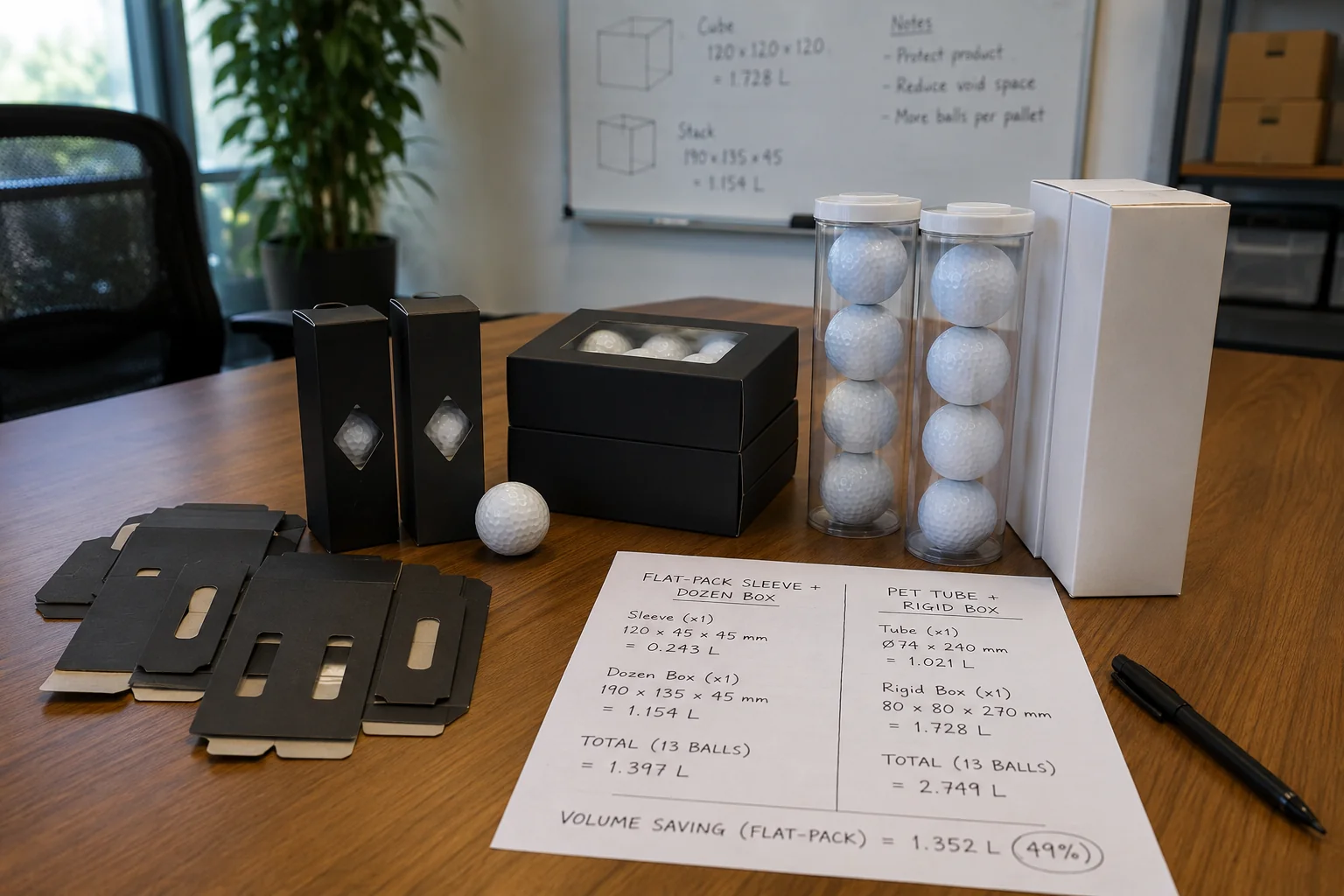
| Pain / decision | Packaging route | CBM risk | Buyer action |
|---|---|---|---|
| Mass B2B retail | flat-packed sleeve + dozen | low | Request flat-pack carton plan. |
| PET visual promo | pre-formed tube | high | Compare CBM and scuff proof. |
| Blister / tray | formed plastic | high | Use only for retail need. |
| Rigid magnetic box | assembled box | mid-high | Quote assembled and flat-pack options. |
| VIP wood / PU | heavy / bulky | high | Confirm freight and compliance. |
A failure signal appears when PET tubes, blisters, or rigid boxes are quoted without a CBM comparison. Ask for flat-packed CBM, pre-assembled CBM, carton count, packout labor, and landed-cost impact. Verify carton dimensions and packout method before you compare supplier quotes.
This article should not become a full landed-cost calculator. Use CBM here as a packaging decision filter. If you need freight, customs, duty, DDP, and warehouse math, use What’s the True Landed Cost When Importing Golf Balls from China?.
PET or rPET tubes can still make sense for pro-shop counter displays, corporate promos, or small gift sets where visibility matters. Blister trays can make sense for warehouse club and anti-tamper display. Rigid boxes can make sense for premium gifts. The mistake is using a high-CBM format when the channel does not pay for that extra volume. Your freight bill follows the carton, not the render.
✔ True — CBM can outweigh material savings.
A low-cost package can become expensive if it ships pre-formed, wastes carton volume, or forces more master cartons per order. Flat-packed paperboard often protects margin in mass B2B programs.
✘ False — “Lowest EXW packaging price means lowest delivered cost.”
EXW ignores the space your package occupies in freight, storage, and final-mile handling. Packaging must be compared by delivered behavior, not only unit price.
What makes packaging FBA-ready?
FBA readiness is not a barcode stuck on a nice box. It is a dense-product receiving system that must survive drops and scan cleanly.
FBA-ready golf ball packaging must survive handling and scan cleanly. Your spec should cover board strength, mailer structure, sleeve fit, barcode resolution, matte scan zone, carton marks, and factory scan checks. A premium-looking box can still fail if the FNSKU reflects or the dozen box crushes.
Drops, Barcodes, and Scan Zones
Amazon-style packaging readiness is physical, not decorative. Amazon’s current SIPP packaging guidance frames packaging around safe shipment, product protection, testing, scannable labels, and sellable-unit handling. The exact test path depends on the package, program, marketplace, and certification route, so do not treat one shortcut as universal. Treat drop readiness as a design requirement.
For golf balls, the dense 551g dozen payload creates repeated point pressure inside the sellable unit. A dozen box has to survive more than showroom handling: drops, belt handling, vibration, humidity, carton compression, and receiving scans. A “Fragile” sticker is not a packaging spec. It is a polite wish with adhesive.
Barcode scanability deserves the same discipline. An FNSKU is warehouse infrastructure, not artwork. For FBA barcode control, use 300 DPI or greater print output as your internal acceptance standard, keep the barcode black on a flat matte white zone, and perform a scan check before shipment. For golf ball packaging, reserve a flat, white, matte, non-reflective barcode zone and avoid glossy lamination over the FNSKU area.
| Pain / decision | FBA risk | Better spec | Acceptance evidence |
|---|---|---|---|
| Box crush | dense 551g dozen payload | 350gsm SBS / 400gsm upgrade | drop-readiness photos |
| Barcode fail | glossy or curved zone | flat matte white area | scan test |
| Relabel fee | low DPI / pale print | 300 DPI+ black barcode | barcode proof |
| Sleeve damage | rattling | snug fit | production-ball fit check |
| Inbound confusion | unclear carton marks | readable master carton label | carton photo before shipment |
A failure signal appears when an FNSKU is placed under glossy lamination, across a fold, on a curved surface, or on a dark print area. The problem may not show in a PDF. It appears when the receiving scanner cannot read the code and the inventory gets delayed, relabeled, or misrouted.
Request drop-readiness evidence, FNSKU artwork proof, barcode scan photo, carton mark photo, and final sellable-configuration sample. Verify FNSKU placement on the actual dieline before mass printing. Approve FBA packaging only after scanability and drop-readiness are checked on the final configuration.
FNSKU barcode shall use 300 DPI or greater print output as the buyer’s internal acceptance standard. It should be printed in black on a flat, white, matte, non-reflective barcode zone. Supplier shall perform scan checks before shipment and provide unit-label and master-carton photos before release.
✔ True — Barcode and drop readiness are packaging specs.
A package is not e-commerce ready until the sellable unit survives route stress and the receiving barcode scans consistently on the real printed surface.
✘ False — “A ‘Fragile’ sticker makes e-commerce packaging safe.”
Carriers and warehouse conveyors do not redesign their handling because a sticker asks nicely. Structure, fit, board grade, and scanability do the work.
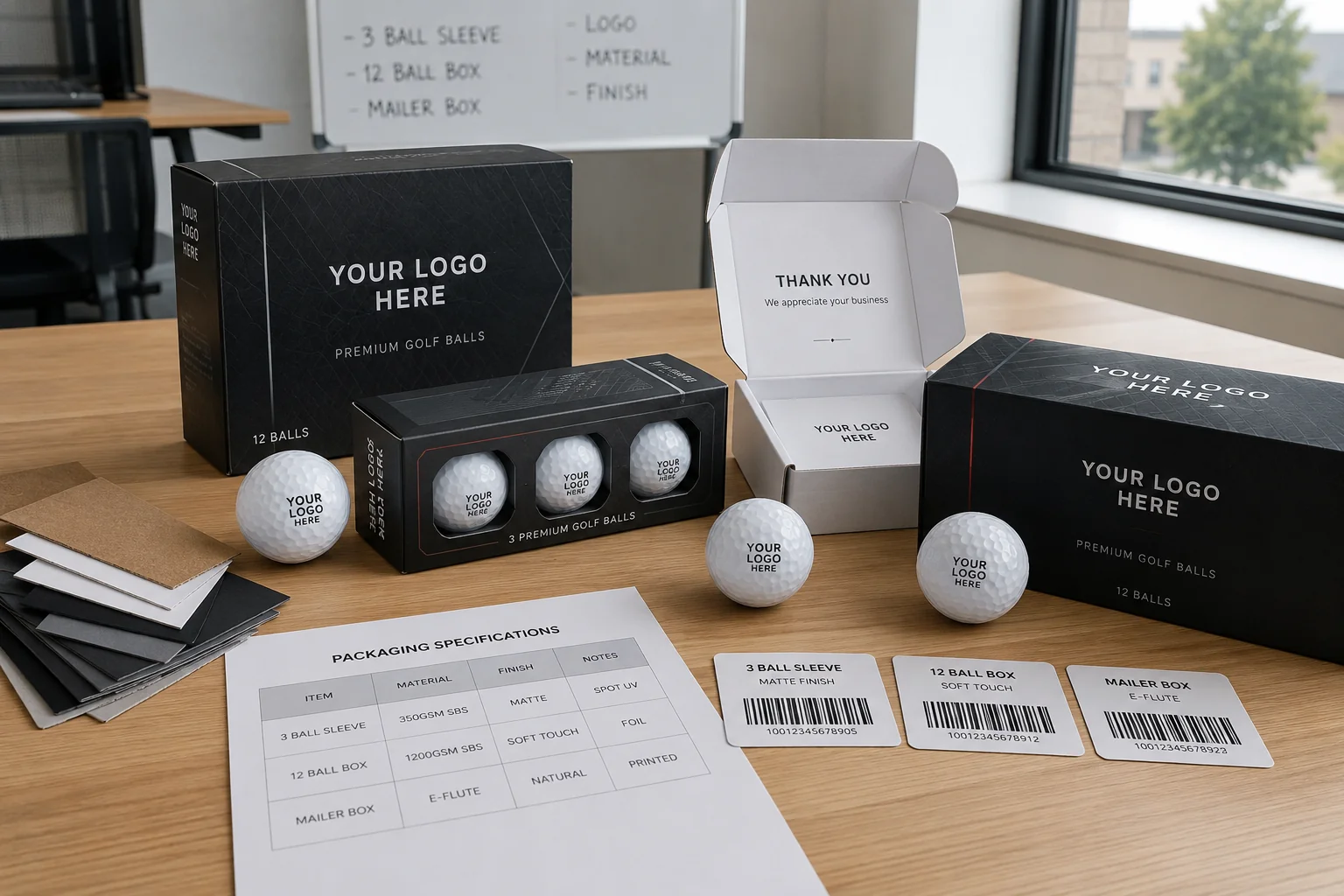
Premium packaging can increase perceived value, but it also brings weight, volume, odor, scuff, tooling, and compliance risk.
Premium packaging is worth it only when the channel pays for presence. Rigid boxes, PET tubes, blisters, wooden boxes, and PU leather sets can improve display or gifting value, but they also raise CBM, assembly time, scuff risk, odor risk, and compliance burden.
Rigid, PET, Blister, Wood, and PU
Rigid magnetic boxes with EVA work well for clubs, corporate gifts, membership kits, and tournament programs where unboxing is part of the value. The risk is not only cost. EVA pockets must fit actual production balls without squeezing printed logos or allowing rattle. The lid must close without ball contact. The board wrap cannot crack at corners after freight. This needs first-article fit proof, not only an empty display sample.
PET or rPET tubes can make sense for visual promos because customers can see the balls. They also scratch, inflate CBM, and need adhesion checks if printed. rPET is preferable when a buyer needs a more responsible plastic direction, but recycled content does not remove the need for scuff and haze checks.
Blister packs and 12-ball trays work for warehouse club or high-touch retail when tamper evidence and shelf durability matter. The seal must be engineered with heat, dwell, and peel behavior; a formed plastic shell is not automatically tamper-evident.
| Pain / decision | Premium format | Hidden risk | Buyer action |
|---|---|---|---|
| VIP gift | rigid + EVA | CBM and fit tolerance | Request EVA fit proof. |
| visual promo | PET / rPET tube | scuff and high CBM | Request scratch proof and CBM. |
| warehouse club | blister / tray | tooling and seal variation | Request seal-strength evidence. |
| collectible | wooden box | species / fumigation / moisture | Request compliance check. |
| membership gift | PU leather box | VOC / odor / wrap defects | Request odor and wrap checks. |
| deep-color retail | matte black / navy box | white scuff marks | Quote anti-scratch matte. |
Wooden boxes belong in limited editions, commemorative sets, and high-end gifting. They also need species, moisture, hardware, finish, and fumigation review. If the wood or packaging material triggers import checks, a beautiful box can become a customs delay.
PU leather boxes can create a modern premium look, but adhesive, edge paint, magnet pull, corner wrap, and odor must be controlled. Do not accept “odor will air out in shipping” as a plan. Sealed cartons trap smell.
Anti-scratch matte lamination is worth quoting for deep-color B2B packaging such as matte black, navy, or dark green. Standard matte film can show white scuff marks fast, especially when boxes rub during packing or freight. For detailed decoration and logo-printing process choices, route that decision to the Complete Guide to Custom Golf Ball Logo Printing Methods. Here, the buyer decision is material risk: the premium format should earn its freight, storage, and compliance cost.
✔ True — Premium formats need evidence because they add hidden risks.
Rigid boxes, PET tubes, blisters, wood, and PU can work well, but only when CBM, fit, odor, scuff, sealing, and compliance are verified with production balls.
✘ False — “Rigid or PET packaging is automatically better than foldable paperboard.”
Premium presence is useful only when the channel values it enough to cover higher freight, slower assembly, and extra acceptance checks.
How do you prevent split-sourcing failures?
Your ball factory, box supplier, mailer supplier, and FNSKU prep provider may all be good. The launch can still fail between them.
Golf ball packaging is a tolerance stack, not a separate paper-box order. Your ball diameter, sleeve width, dozen-box clearance, EVA pocket, mailer compression, barcode zone, and master carton must work together. One PO and one engineering owner reduce launch risk.
One PO for Ball, Box, and FNSKU
Split-sourcing can look cheaper during quoting and become expensive during launch. The ball factory makes the product. A separate paper-box factory prints the sleeve. Another supplier cuts EVA. A prep provider applies labels. Then the first production packout finds the sleeve is 2mm too tight, the EVA pocket rubs the logo, the mailer crushes the dozen box, or the barcode sits on a glossy curve. Everyone did a job, but nobody owned the system.
Packaging schedule is another quiet risk. Golf balls may be ready while printed boxes, EVA inserts, or premium cartons are still in proofing. That makes packaging the critical path. For production-calendar planning, connect the schedule to How Long Does It Take to Manufacture Golf Balls?, then keep this article focused on material and packout acceptance.
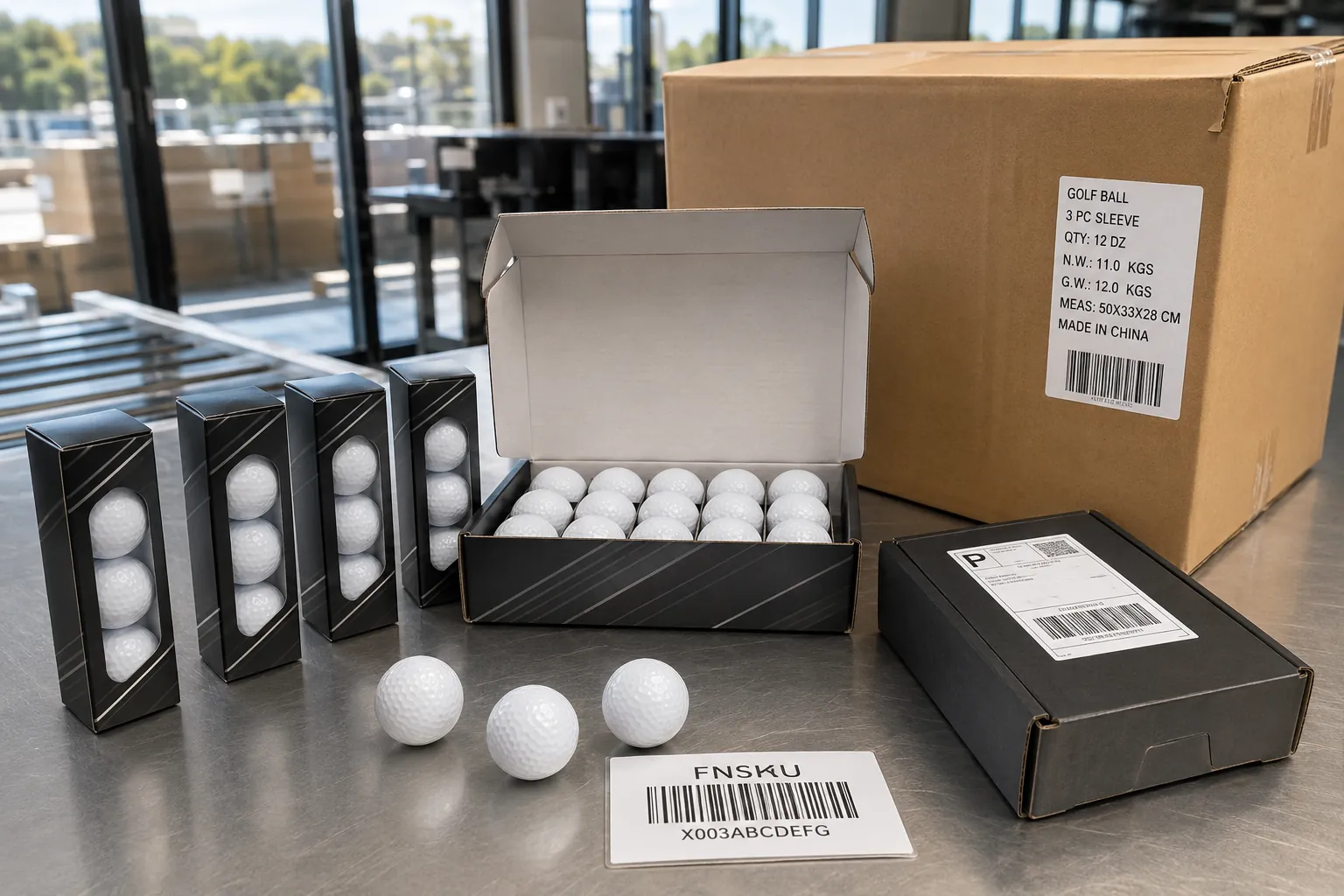
| Pain / decision | Split-sourcing risk | Turnkey control | Acceptance evidence |
|---|---|---|---|
| box too tight | ball and box made separately | fit test with production balls | photo / video proof |
| late packaging | box supplier not synced | shared production calendar | packaging freeze date |
| FNSKU fails | design not checked | barcode zone review | scan test |
| rattling / crush | insert tolerance wrong | cavity drawing + physical fit | final sample |
| carton mismatch | packout not controlled | master carton spec | carton photo and packing list |
A failure signal appears when the ball factory and box factory cannot confirm physical fit before mass printing. Do not let your first fit test happen after thousands of sleeves are printed.
Request one turnkey packaging quote covering ball model, sleeve, dozen box, insert or EVA, mailer, FNSKU barcode zone, master carton, flat-packed versus pre-assembled CBM, board grade, lamination, drop-readiness evidence, barcode scan check, packout method, and receiving photos before shipment.
Supplier shall control ball, sleeve, dozen box, insert, mailer, FNSKU label, master carton, and packout under one approved packaging version. The approved dieline, material grade, lamination, barcode zone, cavity fit, carton mark, and packout method shall be referenced on the proof, QC report, and packing list.
Verify fit using actual production balls before mass printing and packout. Do not approve split-sourced packaging unless one party owns final fit, barcode scanability, packout, carton marks, and receiving evidence. Your launch does not fail because the box is ugly; it fails because nobody owned the full ball-to-box system.
FAQ
What is the best OEM golf ball packaging for retail?
For standard retail and distributor programs, 4×3-ball sleeves inside one dozen box is usually the most familiar and efficient OEM golf ball packaging format.
The sleeve creates a clean 3-ball selling unit, while the dozen box protects four sleeves and gives your brand a larger display panel. This structure stacks well, ships efficiently, and fits how many golf customers expect to buy balls. Board grade, sleeve fit, color control, and master-carton strength still matter. If the same SKU will ship direct to consumers, add a mailer and drop-readiness check.
Why should golf ball boxes use 350gsm paperboard?
A dozen golf balls can weigh about 551g before packaging, so the box is carrying a dense payload. Golfara treats 350gsm SBS as a practical baseline, not an Amazon law.
The goal is to protect sellable inventory through packing, storage, freight, and handling. A 300gsm cost-focused box may work in some light retail settings, but FBA or e-commerce routes often need stronger board, reinforced mailers, tighter sleeves, or 400gsm upgrade options. Always test the final configuration with production balls inside.
Are PET tubes good for OEM golf ball packaging?
PET or rPET tubes can work for visual promo and display, but they usually increase CBM and can scuff, so they should not be the default freight-sensitive format.
Use tubes when visibility matters enough to justify the freight and scratch-control risk. Ask for rPET options when relevant, plus wall thickness, haze, scratch, and print-adhesion evidence. Compare tube CBM against flat-packed sleeves and dozen boxes before approval. Tubes can look good on a counter; they just need to earn the space they occupy.
What packaging is best for Amazon FBA golf balls?
A dozen box plus reinforced mailer is often the safest starting point for Amazon FBA golf balls because it protects the dense payload and keeps the barcode area scannable.
Your spec should include 350gsm SBS or a stronger upgrade where needed, snug sleeve fit, clear carton marks, a flat matte FNSKU zone, black barcode print, scan check, and drop-readiness evidence. A box that looks premium can still fail if the FNSKU reflects, the barcode sits on a curved surface, or the dozen box crushes inside the mailer.
How do I avoid FNSKU barcode problems?
Treat the FNSKU as a machine-readable receiving spec, not a design element. Reserve a flat, white, matte, non-reflective zone and test scanability before shipment.
Avoid glossy lamination over the barcode. Avoid placing the code across folds, curves, seams, or dark artwork. Use black print on a white background, set 300 DPI or greater print output as your internal acceptance standard, and ask for a scan photo or short video before cartons leave the factory. Confirm both unit labels and master-carton labels because FBA receiving depends on both.
When should I choose rigid, wood, or PU boxes?
Choose rigid, wooden, or PU boxes when the channel pays for unboxing: VIP gifts, membership kits, corporate programs, limited editions, or club events.
Do not use them by default for freight-sensitive B2B or FBA launches. Quote CBM and weight separately. For rigid boxes, request EVA fit proof. For wood, check species, moisture, finish, and fumigation needs. For PU, check odor, VOC risk, edge wrap, and magnet pull. Premium packaging should be approved with production balls, not empty samples.
Should ball and packaging come from the same supplier?
For serious OEM or FBA launches, one turnkey owner reduces fit, timing, barcode, and packout risk. Separate suppliers can work only when one party owns final assembly and verification.
Golf ball packaging depends on ball diameter, sleeve clearance, dozen-box fit, EVA cavity size, mailer compression, barcode placement, and master-carton layout. If these pieces come from different suppliers, require one proof version, one fit check with production balls, one packing list, and one responsible owner before mass printing begins.
Conclusion
The best OEM golf ball packaging is the format that protects sellable inventory and landed margin. Your team should start with channel fit, then verify board grade, CBM, drop readiness, barcode scanability, material finish, and final ball-to-box fit before PO approval.
A strong packaging decision pack should include the 9-option matrix, material spec, flat-pack CBM, FBA prep proof, barcode scan check, premium-format risk check, and turnkey packout plan. Compare packaging quotes only after every supplier uses the same ball count, fit requirement, carton plan, and packout method.
You might also like — 2-Piece vs 3-Piece Golf Balls: The Ultimate B2B Bulk Sourcing & QC Guide