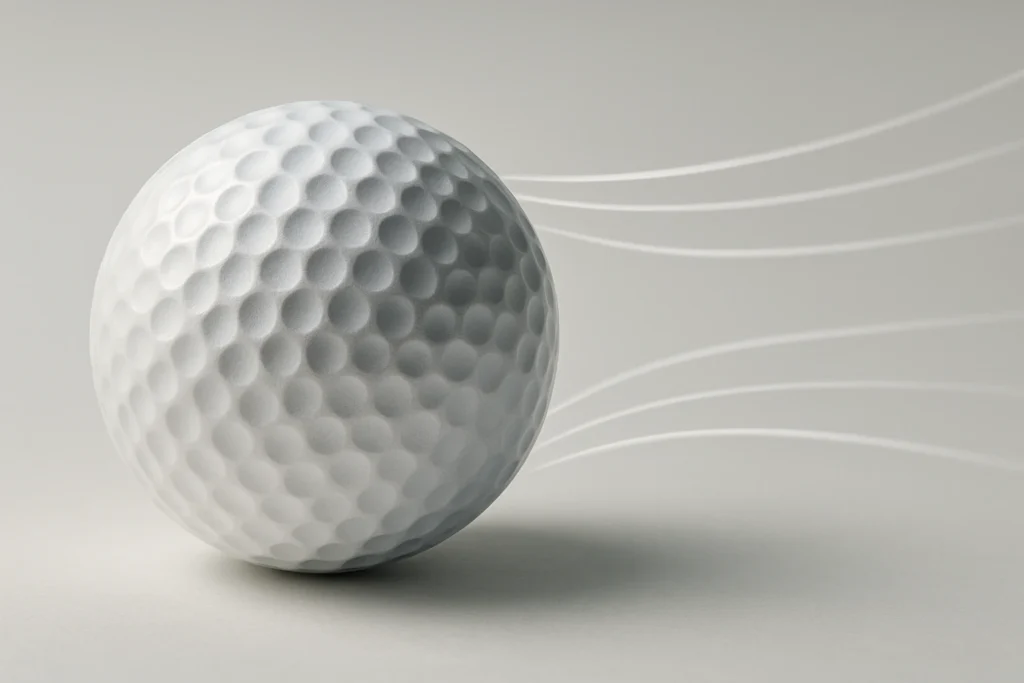
Golf ball dimple count means the number of visible indentations on a golf ball surface. For OEM buyers, that number is only the starting point—not a complete aerodynamic specification. Dimples help shape lift, drag, peak height, wind stability, carry, and dispersion, but the count alone cannot prove how the ball will fly in bulk production.
Dimple count is the number buyers see. Dimple geometry is the proof buyers should request. Two balls can both have 336 dimples and still fly differently if their depth, diameter, edge shape, layout symmetry, coating thickness, mold ID, or tooling version is different.
For OEM and private-label golf ball buyers, a useful dimple review should answer five questions:
-
What is the dimple count, and which mold ID does it belong to?
-
What are the dimple depth, diameter, edge shape, layout symmetry, and surface coverage?
-
Does the coating or finish change the effective dimple depth?
-
Does the dimple system support the target flight window: launch, peak height, wind behavior, carry, and dispersion?
-
Can the supplier repeat the same dimple system from approved sample to mass production and reorder?
Use this guide to move from a simple “how many dimples are on a golf ball?” question to a repeatable dimple system specification that protects your RFQ, sample approval, retained sample, batch inspection, and change-control process.
What does dimple count actually tell you?
You may ask how many dimples are on a golf ball because the number is easy to compare, but that number only identifies visible surface indentations.
Dimple count tells you how many indentations are on the golf ball surface, but it does not define the full aerodynamic system. For OEM buyers, the count is only the first clue; geometry, coating, tooling, and batch repeatability decide whether the flight window can be repeated.
Many buyers start with “how many dimples are on a golf ball?” because the number is easy to ask for and compare. But for OEM sourcing, dimple count only identifies the visible pattern family; it does not prove depth, diameter, edge shape, layout symmetry, coating thickness, mold ID, or bulk repeatability. Many modern golf balls use a few hundred dimples, and public model descriptions often mention a visible count. But for procurement, the count alone is thin evidence.
A dimple count does not tell you whether the cups are deep or shallow, large or small, sharp-edged or softened, symmetric or seam-sensitive, protected by a thin clearcoat or buried under a heavy finish. It also does not tell you whether the same tooling will be used when your reorder goes into production six months later.
| Buyer question | What the count tells you | What it does not tell you | Evidence to request | Buyer move |
|---|---|---|---|---|
| How many dimples? | Visible indentation count | Depth, diameter, edge shape | Geometry file | Do not stop at count |
| Is 336 enough? | A pattern family clue | Flight window | Mold ID + layout | Ask for drawing |
| Is higher better? | Surface-count direction | Distance or stability proof | Flight data | Test the system |
| Can I compare brands? | Public number only | Tooling and coating process | Approved sample | Avoid copycat logic |
| Can supplier repeat it? | Nothing by itself | Batch repeatability | QC and retained sample | Lock in PO |
Ask your supplier for dimple count plus geometry file, not count alone. Check whether the count is linked to a mold ID, tooling version, approved sample, and retained sample. Do not approve a dimple system from a number alone.
Why is dimple count alone not enough?
You may assume more dimples mean more distance or straighter flight, but actual performance depends on the full surface system.
More dimples do not automatically mean more distance. Dimple depth, diameter, edge shape, layout symmetry, surface coverage, coating thickness, and mold repeatability decide whether the ball reaches the intended flight window.
What else changes lift and drag?
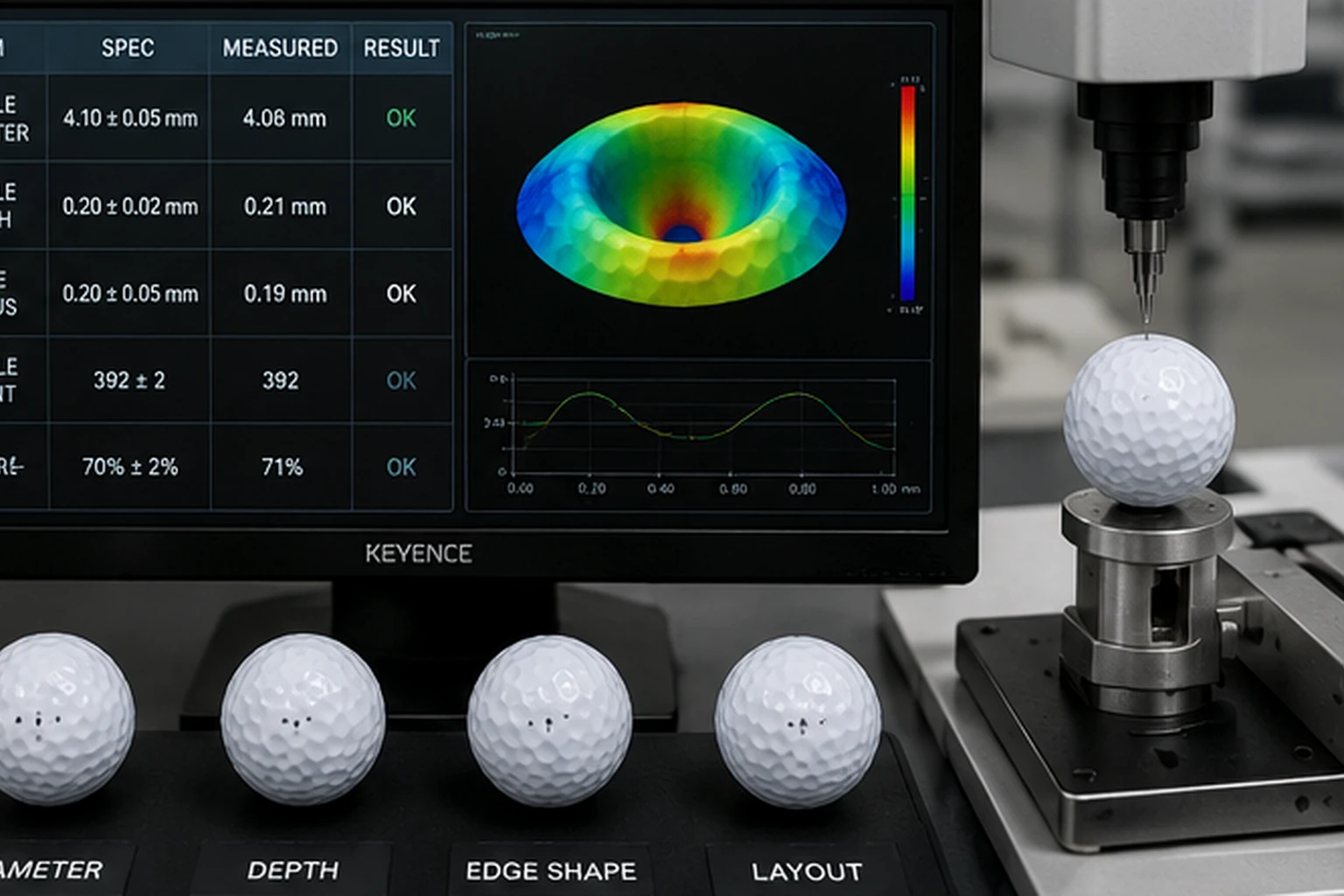
Dimples influence airflow, but count is only one lever. The final flight comes from how the whole surface interacts with launch, spin, lift, drag, peak height, and wind.
Dimples help manage airflow around the golf ball. In plain language, the textured surface changes how air separates from the ball, reducing drag and helping the ball hold a usable trajectory. Titleist’s guide to golf ball dimples explains that dimples come in different depths, shapes, patterns, and edge angles to create different flight characteristics and optimize trajectory. But buyers should not turn that into “more dimples equal more distance.” That is a consumer shortcut, not an OEM specification.
Two golf balls can both have 336 dimples and fly differently. One may use deeper cups, another may use smaller diameters, another may have a sharper edge, and another may use a different layout symmetry. If the coating is thicker on one production lot, the effective dimple depth can also change after the mold has already done its job.
| Variable | What it changes | Risk if ignored | Evidence to request | Buyer move |
|---|---|---|---|---|
| Depth | Effective lift/drag behavior | Apex or carry changes | Depth tolerance | Verify measurement |
| Diameter | Surface coverage and airflow trip | Different trajectory | Diameter tolerance | Compare drawing |
| Edge shape | Separation behavior | Wind instability | Edge radius/shape note | Ask for geometry |
| Layout symmetry | Directional repeatability | Seam or orientation bias | Pattern layout | Check symmetry |
| Surface coverage | Aerodynamic balance | Unexpected flight window | Coverage data | Review system |
| Coating thickness | Effective dimple depth | Sample-to-bulk drift | Coating target | Lock finish |
| Mold wear | Geometry drift over time | Reorder flight change | Tooling version | Control maintenance |
Request depth, diameter, edge, layout, coating, and mold information together. Compare same-count samples only after geometry and finish are confirmed. Reject any supplier claim that treats count alone as performance proof.
✔ True — Dimple geometry and flight window matter more than count
Depth, diameter, edge shape, layout, coating, and mold repeatability decide whether the dimple pattern can deliver the intended flight window in production.
✘ False — “More dimples always mean more distance”
A higher count can change surface coverage and airflow, but it does not automatically create better carry, lower drag, or tighter dispersion.
Which dimple specs should buyers verify?
You may receive a quote saying “336 dimples” or “same as popular design,” but that does not prove the supplier can reproduce the intended flight.
A supplier’s “336 dimples” answer is incomplete unless it is tied to geometry and tooling proof. Ask for dimple depth, diameter, edge shape, pattern layout, surface coverage, mold ID, tooling version, approved sample, inspection method, and batch comparison.
What should a geometry file include?
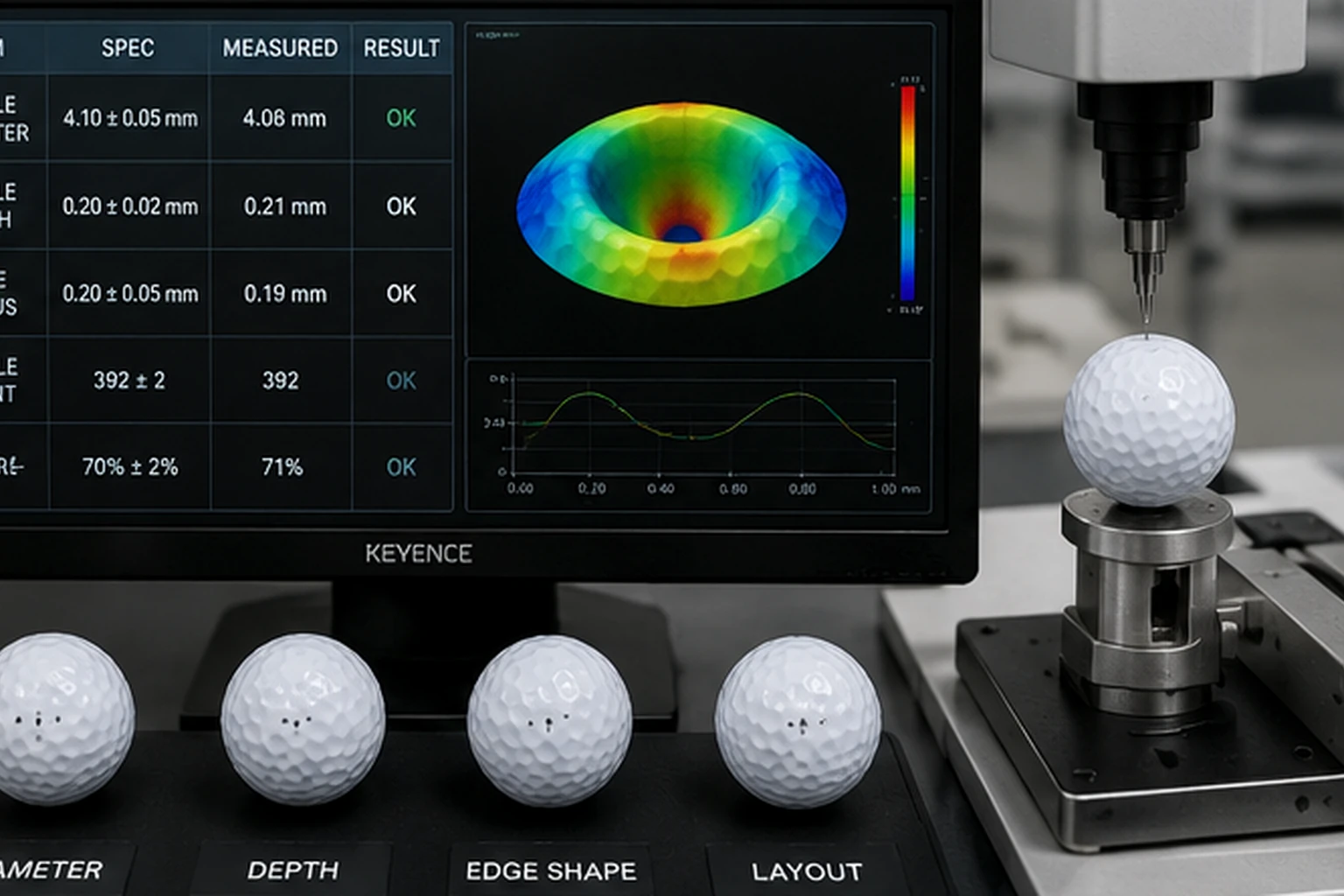
A geometry file should turn the dimple system into a repeatable manufacturing reference. It should define the pattern clearly enough for sampling, inspection, mass production, and reorder control.
The weak answer is “we also have 336 dimples.” The useful answer is “this mold ID uses this dimple count, depth, diameter, edge shape, layout, surface coverage, tooling version, and coating target.” That difference matters because same-count golf balls can behave differently when the mold, coating, or finish changes.
Dimple geometry can be checked with methods such as 3D optical profiling or white-light interferometry for depth, diameter, spacing, and surface density. You do not need to turn your RFQ into a laboratory paper. You do need enough inspection method detail to know whether the supplier can compare the approved sample, pilot lot, and production lot.
| Buyer question | Weak answer | Better evidence | Risk controlled | Buyer move |
|---|---|---|---|---|
| How many dimples? | 336 dimples | Count + geometry file | Count-only confusion | Request file |
| What is the mold? | Standard mold | Mold ID + tooling version | Reorder drift | Lock mold |
| What is the depth? | Normal depth | Depth tolerance | Apex change | Verify method |
| What is the diameter? | Same as sample | Diameter tolerance | Coverage change | Compare drawing |
| What is the edge shape? | Not specified | Edge radius / edge note | Wind instability | Ask for detail |
| What is the layout? | Same pattern | Pattern drawing | Orientation bias | Check symmetry |
| How is it inspected? | Visual check | 3D profile / optical method | Unseen drift | Request method |
| What is retained? | Sample photo | Retained sample ID | Dispute risk | Store sample |
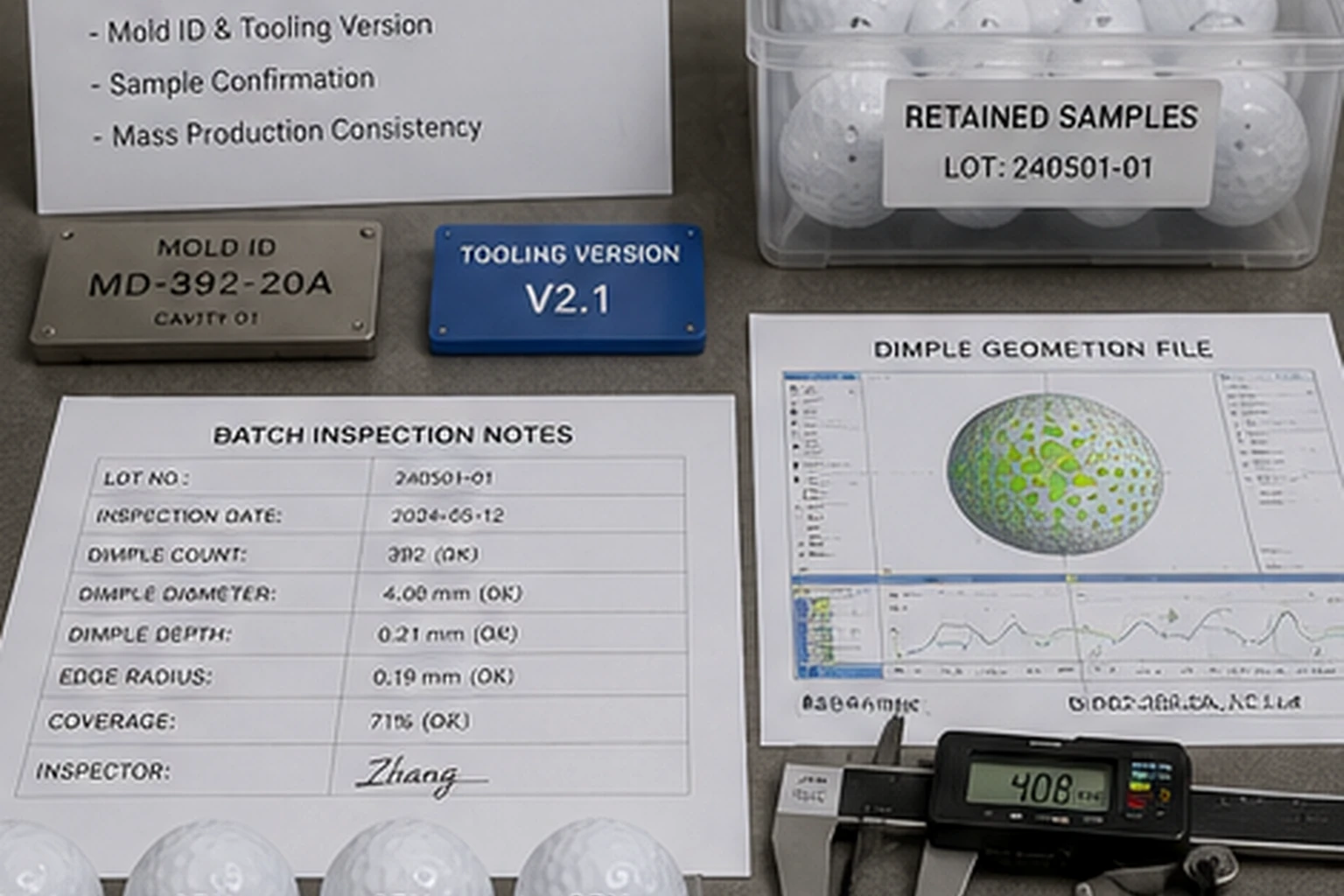
A failure signal is a supplier saying “same dimple count” but failing to provide a geometry drawing. Each production lot should link the approved dimple mold ID, tooling version, dimple geometry drawing, coating thickness target, finish system, approved sample, retained sample, batch inspection record, and shipment record to the lot ID.
Ask your supplier for a dimple geometry file, mold ID, tooling version, and approved sample. Check whether the inspection method can measure depth, diameter, spacing, and surface density. Do not approve a quote that only lists dimple count without geometry and tooling proof.
Can coating change dimple performance?
You may think the dimple system is fixed once the mold is fixed, but coating, clearcoat, finish type, and paint thickness can change effective dimple depth.
Coating is part of the aerodynamic system. If clearcoat is too thick, finish changes from gloss to matte, or coating thickness becomes uneven, the effective dimple depth and surface behavior can change even when the mold stays the same.
When can paint thickness distort flight?
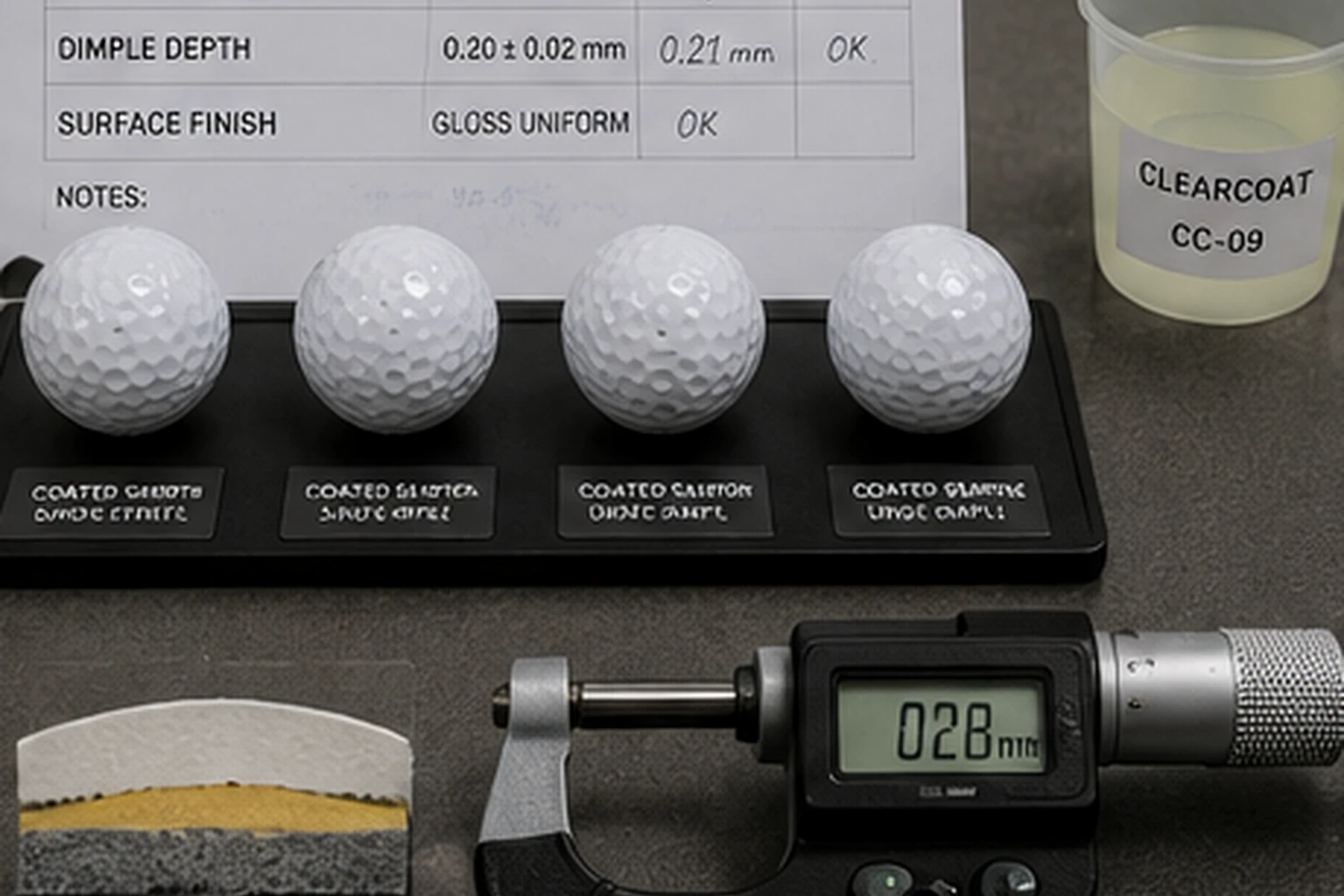
Paint and clearcoat can change the surface the air actually sees. That makes coating control from one area to another.a dimple-performance issue, not only an appearance issue.
The molded dimple is not the final aerodynamic surface. After molding, the ball may be painted, clear-coated, finished as matte or gloss, printed, and protected. If the clearcoat is too thick, it can reduce effective dimple depth. If coating thickness is uneven, the surface may behave differently from one area to another. Golf Monthly’s dimple-depth testing feature shows why very small surface differences can create large flight differences, which is why coating control belongs in an OEM dimple specification. If the finish changes between sample and bulk, the approved flight window may not be fully protected.
This is especially important for private-label golf balls where appearance changes are common. A buyer may approve a glossy white sample, then ask for matte color, heavier clearcoat, or stronger logo protection. Those changes may improve shelf appeal, but they should not bypass dimple and flight validation.
| Coating variable | What can change | Buyer risk | Evidence to request | Buyer move |
|---|---|---|---|---|
| Clearcoat thickness | Effective dimple depth | Flight window shift | Thickness target | Lock range |
| Uneven coating | Surface airflow behavior | Batch variation | Thickness inspection | Check lot |
| Matte finish | Surface roughness/appearance | Unvalidated flight shift | Finish validation | Re-test |
| Gloss finish | Surface and visual consistency | Sample/bulk mismatch | Approved sample | Retain sample |
| Logo protection coat | Local surface change | Promo ball flight drift | Coating note | Inspect area |
| Coating supplier change | Cure and thickness behavior | Reorder difference | Change-control note | Require approval |
A failure signal is a finish change from gloss to matte without coating-thickness validation. Ask for coating thickness target, finish system, approved sample, retained sample, and change-control notice. Compare sample and bulk coating thickness or finish records when flight consistency matters. Do not accept finish or clearcoat changes without revalidating the dimple system.
✔ True — Coating thickness can change effective dimple behavior
The air does not interact with the mold drawing. It interacts with the finished surface, including paint, clearcoat, and finish texture.
✘ False — “Mold unchanged means flight unchanged”
If coating thickness, finish type, or clearcoat system changes, the effective dimple system may change even when the mold ID stays the same.
Which flight window should your SKU target?
You may ask for a dimple number before defining whether your SKU needs stable distance, flatter wind flight, premium control, or simple promotional reliability.
Choose the flight window first, then verify whether the dimple system supports it. A value SKU, range SKU, wind-stable SKU, premium control SKU, and corporate gift ball do not need the same aerodynamic proof level.
Dimple count should follow product intent. A range or practice SKU needs repeatable direction, durability, and batch stability more than a highly differentiated flight story. A value SKU usually benefits from a proven existing mold that can be repeated. A wind-stable SKU needs stronger evidence around peak height, crosswind behavior, coating control, and finish consistency. A premium flight story needs the most careful validation because the customer is paying for a performance difference, not a hidden number.
This keeps the article away from a common trap: choosing dimples like a consumer fitting shortcut. Your team should not say “we need 336 dimples” before defining launch, peak height, spin stability, wind behavior, carry, and dispersion.
| SKU goal | Flight window need | Dimple proof level | Main risk | Buyer move |
|---|---|---|---|---|
| Value SKU | Stable, easy flight | Existing mold + basic proof | Overbuilding cost | Use proven mold |
| Range / practice SKU | Repeatable direction and durability | Batch dimple/coating consistency | Training noise | Lock lot control |
| Promotional SKU | No abnormal flight, clean surface | Basic mold + coating proof | Visual-only approval | Inspect finish |
| Wind-stable SKU | Flatter peak and crosswind control | Full geometry + wind validation | Claim not proven | Request flight proof |
| Distance-control SKU | Carry, peak height, dispersion control | Geometry + coating + flight data | Distance article overlap | Keep aero-specific |
| Premium flight story | Defensible trajectory difference | Stronger validation and retained samples | Unsupported marketing | Validate before launch |
Ask your team to define target flight behavior before requesting dimple count. Compare the chosen mold or dimple system against the intended SKU use case. Approve the dimple route only when it supports the target flight window and commercial channel.
What proof should you request?
You may see a good sample flight, but a good sample does not prove a repeatable dimple system in bulk production.
A good sample does not prove a repeatable dimple system. Your RFQ should lock mold ID, geometry file, dimple depth and diameter tolerances, coating thickness target, finish system, retained samples, batch inspection, flight comparison, and change-control terms.
What should your RFQ request?
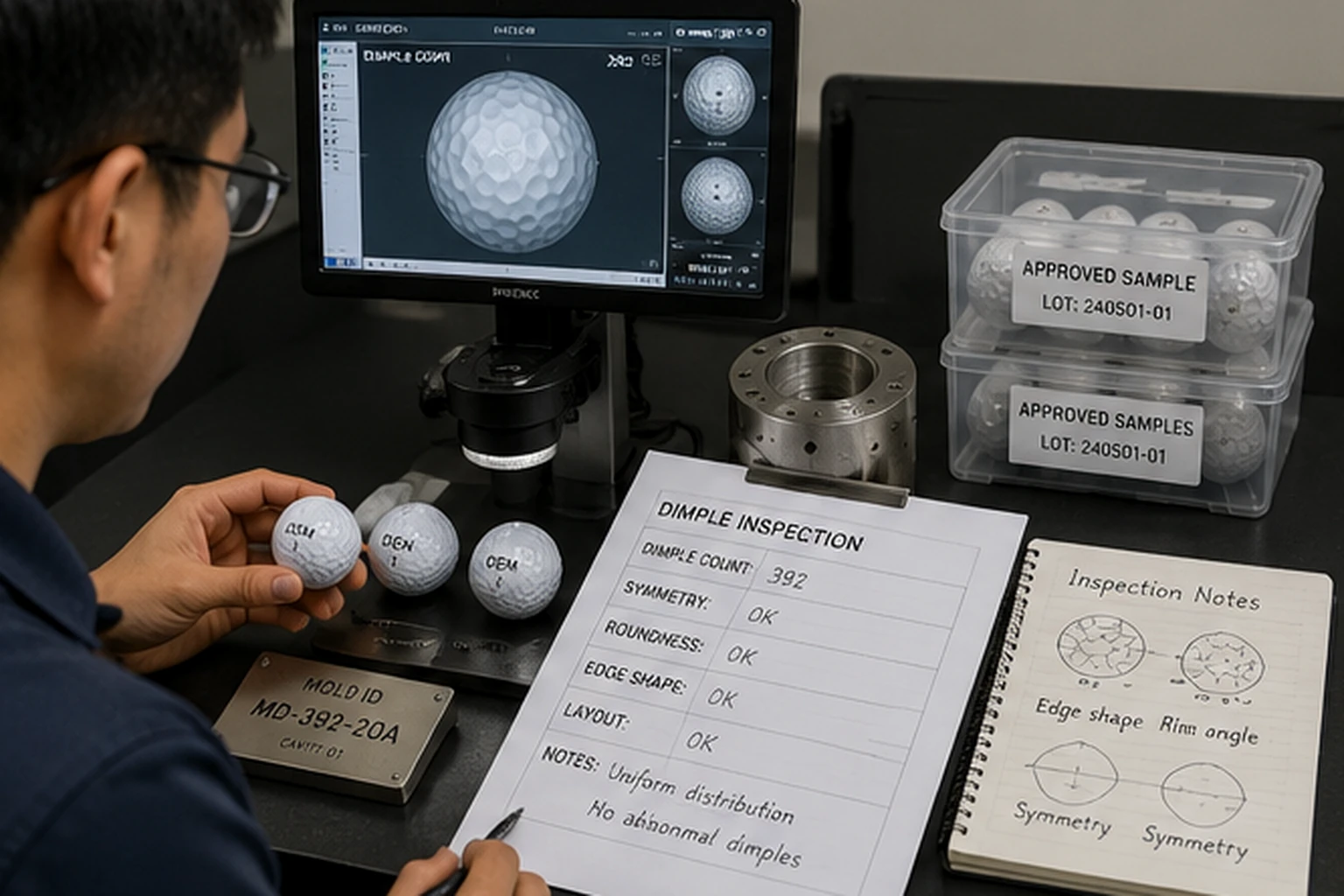
Your RFQ should turn dimple performance into a written proof pack. The approved sample, geometry file, coating record, and batch inspection should all point to the same production lot.
For dimple-specific proof, ask for dimple geometry file, mold ID, tooling version, approved sample, coating thickness record, 3D profile or optical measurement summary, batch inspection record, weight/diameter/compression data, flight test notes, retained sample, and change-control note. Mature suppliers should be able to turn “same flight” into specifications your team can verify.
A 12-ball QC report can support the dimple decision when it includes raw records, statistics, equipment or method notes, and calibration status. This should not become a full compliance article; it is a production-repeatability safeguard. For tournament-facing or conforming programs, the R&A Equipment Rules on conforming golf balls are also a useful reminder that symmetry and repeatable ball behavior matter beyond the visible dimple count.
| Proof item | Why it matters | Weak evidence | Better evidence | Buyer move |
|---|---|---|---|---|
| Dimple count | Basic identification | Number only | Count + drawing | Use as first clue |
| Geometry file | Defines depth/diameter/edge/layout | Sample photo | Drawing + tolerance | Attach to RFQ |
| Mold ID / tooling | Protects repeatability | Standard mold | Mold ID + tooling record | Lock in PO |
| Coating / finish | Protects effective depth | Looks same | Thickness target/record | Set range |
| Inspection method | Proves measurement | Visual check | 3D optical / profile method | Request summary |
| Batch QC | Protects sample-to-bulk | One sleeve | 12-ball QC + raw data | Compare lots |
| Retained sample | Supports dispute/reorder | Photo only | Sample ID + lot ID | Store reference |
| Flight / change control | Validates window and blocks drift | Supplier claim | A/B notes + written approval rule | Verify before scale |
Supplier shall keep the approved dimple mold ID, dimple count, dimple depth, dimple diameter, edge shape, pattern layout, coating thickness target, finish system, approved sample, retained sample, and batch inspection method unchanged unless buyer approves a written change-control notice before mass production or reorder.
A failure signal is a sample that flies well but has no locked mold ID, retained sample, or batch inspection method. Request a dimple proof pack before approving mass production. Compare pre-production, mass-production, and retained samples using batch-linked dimple and coating records. Supplier cannot change mold, geometry, coating, finish, or inspection method without written approval and revalidation.
✔ True — Dimple proof belongs in the RFQ and PO
Mold ID, geometry file, coating target, retained sample, batch inspection, and change-control terms protect the approved flight window.
✘ False — “A good sample flight guarantees bulk repeatability”
One strong sample can hide later mold wear, coating changes, finish shifts, or batch drift. Repeatability has to be documented.
FAQ
How many dimples are on a golf ball?
Most golf balls use a few hundred dimples, but the exact count varies by model. The number is useful as a search entry point, not as a complete aerodynamic specification.
For OEM buyers, the number should lead to better questions. Ask for the dimple geometry file, mold ID, tooling version, coating thickness target, approved sample, and retained sample. Count helps you identify a pattern family, but it does not prove lift, drag, wind stability, or sample-to-bulk repeatability.
Why do golf balls have dimples?
Golf balls have dimples to help manage airflow around the ball by influencing lift, drag, wake behavior, and flight stability. The effect depends on geometry, not count alone.
A smooth ball does not manage airflow the same way as a dimpled ball. Dimples help shape the air interaction around the surface, which affects trajectory and stability. For OEM buyers, the lesson is practical: treat dimples as an aerodynamic system that must be specified, inspected, and repeated in production.
Do more dimples make a golf ball go farther?
No. More dimples do not automatically mean more distance. Depth, diameter, edge shape, layout, coating thickness, and target flight window matter more than the number.
A higher count can change surface coverage and airflow behavior, but it does not guarantee better carry, lower drag, or tighter dispersion. A lower-count system with the right geometry may outperform a higher-count system for a specific SKU. Compare the flight window and geometry proof, not the count alone.
What is the best dimple count for a golf ball?
There is no universal best dimple count. The best dimple system depends on target flight, speed band, cover system, mold quality, coating control, and repeatability.
A value SKU, range SKU, wind-stable SKU, premium control SKU, and promotional ball may all need different proof levels. Start with the commercial use case and flight window. Validate an existing mold first when possible, and use new dimple tooling only when the channel can support the added test burden.
Do golf ball dimples affect spin?
Yes, but not alone. Dimples interact with cover material, surface finish, launch conditions, spin rate, and overall aerodynamic design to shape the final flight.
Spin is not controlled by dimple count alone. A ball’s cover, compression, launch conditions, and surface finish all matter. OEM buyers should avoid isolating one visible number and instead verify the full dimple system, including geometry, coating, flight notes, and batch consistency.
Can coating thickness affect dimple performance?
Yes. Thick or uneven coating can reduce effective dimple depth and change surface behavior, which may affect flight consistency from sample to bulk.
The molded dimple is only the starting point. Paint, clearcoat, matte finish, gloss finish, and logo protection can change the finished surface. Lock the coating thickness target, retain approved samples, and revalidate finish changes before mass production or reorder.
What dimple proof should OEM buyers request?
Request dimple count, depth, diameter, pattern drawing, mold ID, tooling version, coating thickness target, geometry inspection method, retained samples, batch inspection, and change-control terms.
A strong proof pack should connect the approved sample, production lot, geometry file, coating record, inspection method, and retained sample. Ask for batch-linked records and raw measurement data when the SKU depends on a consistent flight window. A supplier that only provides a number has not provided enough proof.
Should buyers copy a famous brand’s dimple count?
No. Copying a famous brand’s dimple count will not copy its flight without the full geometry, tooling, cover system, coating process, mold precision, and flight validation.
A public number is only the part buyers can see. The hidden system includes depth, diameter, edge shape, layout symmetry, surface coverage, finish behavior, tooling control, and batch repeatability. Build and validate your own SKU window instead of copying a visible count.
Conclusion
Dimple count is the number buyers see; dimple geometry is the proof buyers should request. Before approving a golf ball, verify the full dimple system: depth, diameter, edge shape, layout, mold ID, coating thickness, flight window, retained samples, and batch repeatability.
A useful dimple count can help start the conversation, but it is not the specification that protects your OEM order. Your RFQ should lock the geometry, tooling, coating, retained sample, batch inspection, and change-control process that keep the approved flight window repeatable.
You might also like — How Long Does It Take to Manufacture Golf Balls? (OEM Production Timeline)