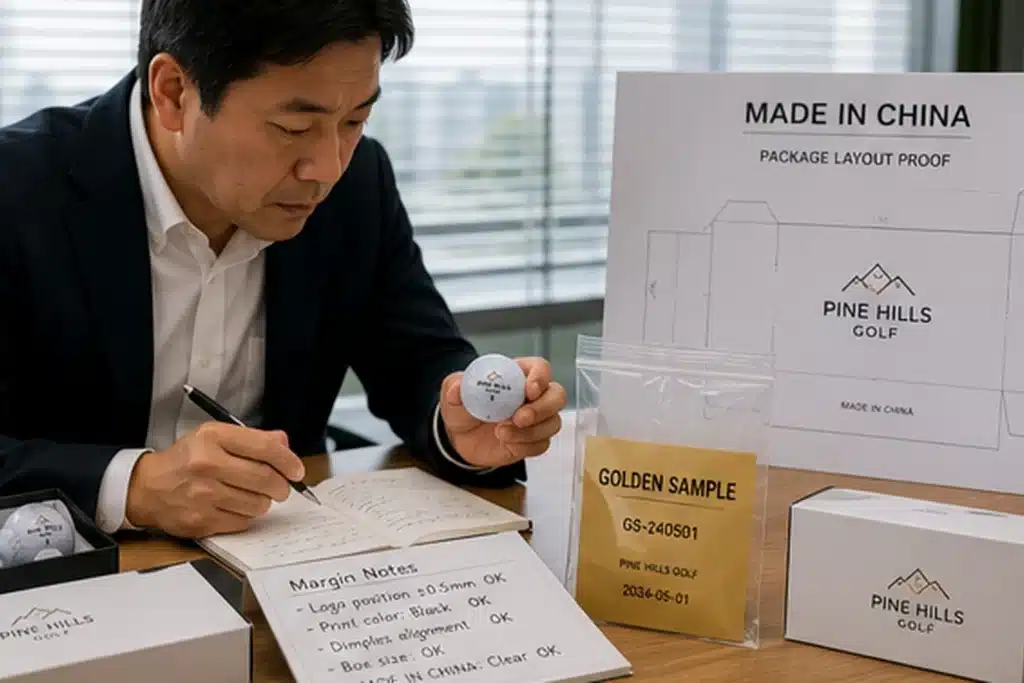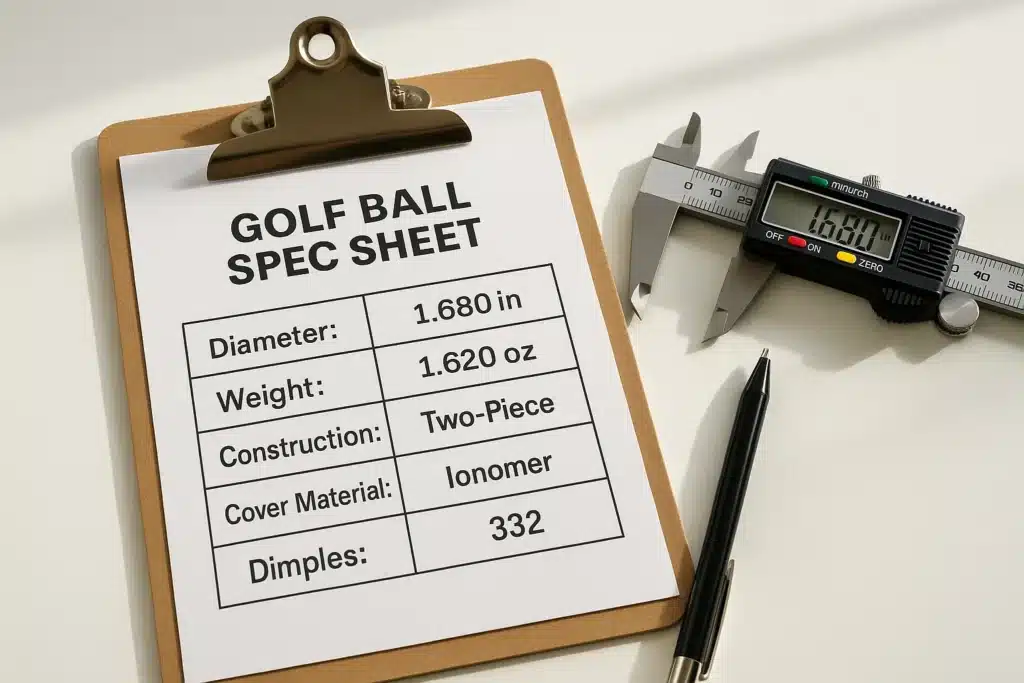
A golf ball spec sheet can look professional while the bulk order still feels harsh, flies inconsistently, or fails your buyer’s market expectations.
For OEM sourcing, golf ball specs should be read as a control system, not a list of impressive numbers. Compression controls whole-ball deformation, Shore hardness controls cover feel, COR explains energy return, IV protects legality, dimple geometry controls drag, and tolerances decide whether the approved sample can be repeated in production.
The real buying risk is spec cloning. A supplier can copy a famous ball’s compression number, dimple count, and cover description on paper, then still fail in real play because curing control, dimple edge radius, coating thickness, concentricity, and climate response were never controlled.
Use this guide to read a golf ball specification sheet before approving an OEM sample, RFQ, or bulk production target.
Why don’t golf ball specs guarantee performance?
A clean PDF can hide a weak product if the factory copies numbers but cannot control process, tolerance, coating, and repeatability.
A spec sheet is not a performance guarantee; it is a map of variables that must be measured and controlled. Your team should ask what each number measures, how it is tested, what tolerance applies, and which on-course risk it actually controls.
Spec cloning is the quiet failure mode in golf ball OEM. A buyer sends a premium-ball benchmark and asks a factory to “make the same specs.” The supplier replies with a neat table: compression, dimple count, diameter, weight, cover type. It looks professional. Then the ball flies high in one batch, knuckles in wind in another, and feels like a range ball on a cold morning.
That happens because golf ball specs interact. Compression without clean aerodynamics can still lose carry. A fast core with poor coating can blunt dimple shoulders. A legal weight and diameter do not prove roll stability. A soft cover number without the Shore scale tells you almost nothing.
Advanced buyers do not ask factories to clone famous specs. They ask which variables are controllable, measurable, and repeatable. Keep construction-family comparisons in a separate guide such as Range vs Game vs Tour golf balls; this article is about reading the physics inside the data sheet.
| Spec decision | What buyers misread | Real meaning | Buyer evidence |
|---|---|---|---|
| Compression | One magic feel number | Whole-ball deformation under load | Ask for target, tolerance, method, sample size, and batch spread. |
| Shore hardness | A simple softness score | Surface or layer hardness, depending on scale | Require Shore scale, test method, target, and tolerance. |
| COR / IV | Unlimited distance potential | Energy return and legal speed control | Request model-specific IV evidence before using speed or distance claims. |
| Dimple count | More dimples equals better flight | Geometry, depth, edge radius, and coating fidelity matter more than count | Ask for dimple drawing, depth tolerance, edge-radius control, and coating notes. |
| OOR / seam | A tiny cosmetic detail | Roundness, seam control, and roll or flight stability | Ask for OOR limit, seam tolerance, concentricity check, and batch QC record. |
✔ True — Specs are system variables
Compression, Shore hardness, dimple geometry, coating thickness, roundness, and climate response work together. A serious spec sheet explains relationships, not only values.
✘ False — “One hero number guarantees better performance”
A single impressive number can distract from weak process control. Your team should compare methods, tolerances, and repeatability before comparing claims.
Which numbers are decision variables?
Decision variables connect physics, measurement method, tolerance, and buyer risk.
Ask the supplier to provide a spec dictionary with metric name, unit, test method, target value, tolerance band, sample count, and buyer meaning. Check whether each value is a conformance limit, design target, or batch-control metric.
Do not compare two spec sheets unless the method and tolerance behind each number are visible. Your goal is to stop approving copied numbers and start approving controlled variables.
How do compression and hardness differ?
You may see “Compression 85” and “Hardness 60” and assume both describe softness. That is how bad specs slip through.
Compression describes how the whole ball deforms under load; Shore hardness describes how a surface or layer resists indentation. If a supplier writes only “Hardness 60” or “Compression 85” without scale, method, and tolerance, your team still does not know what will happen at impact.
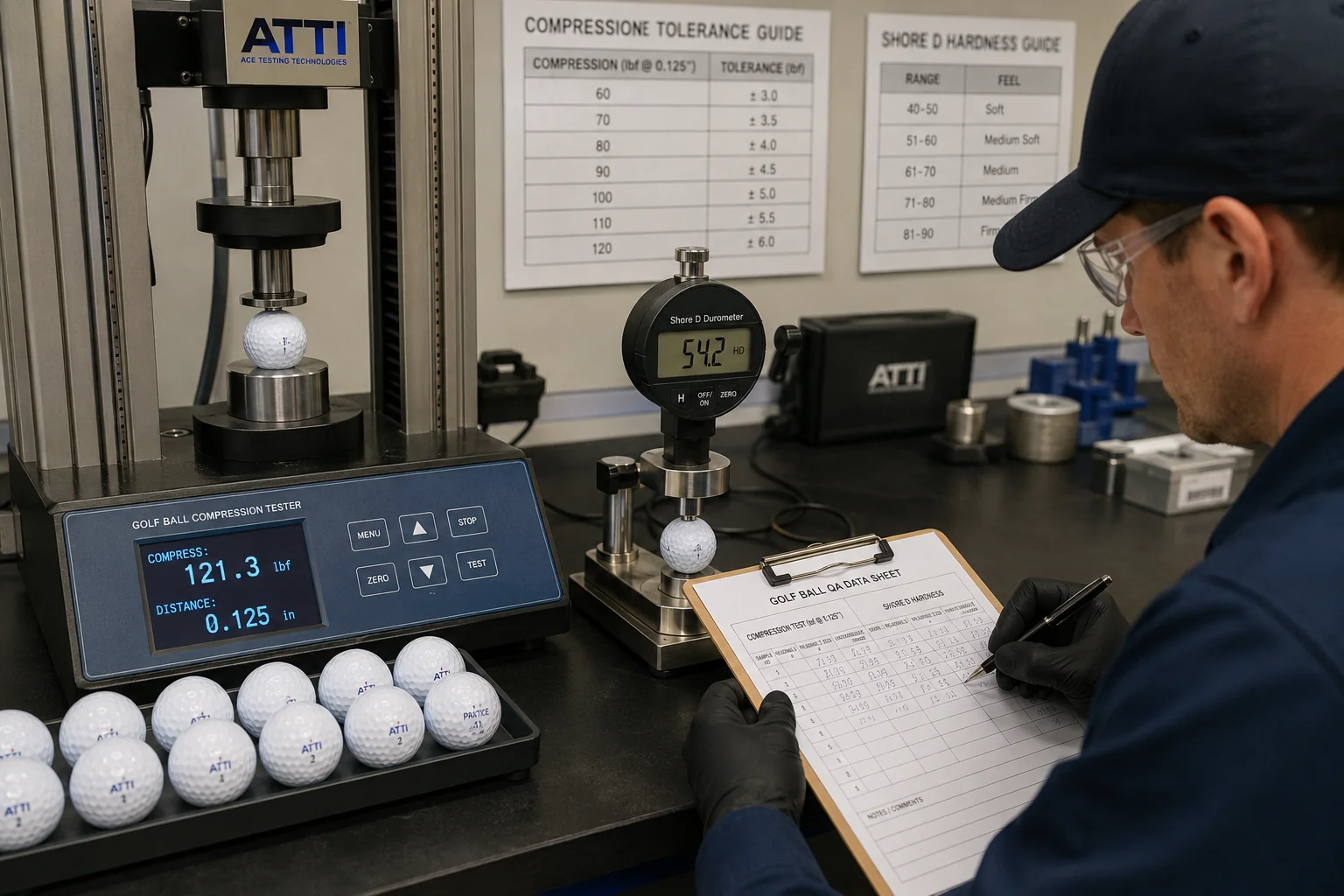
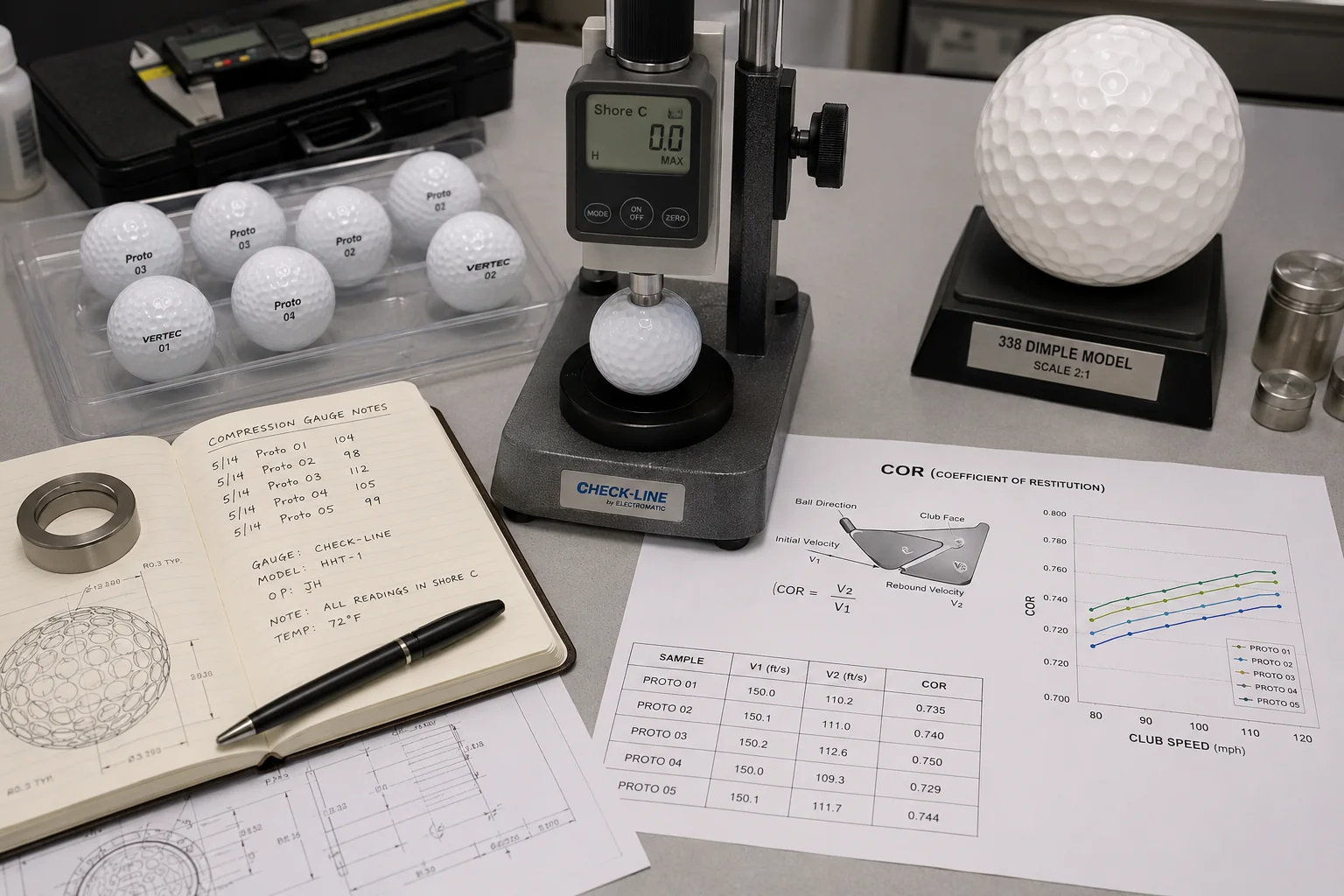
Atti compression is a whole-ball deformation reading. It helps you predict how firm the ball feels at impact and how easily the core activates for different swing speeds. A firmer ball can work well for faster or more aggressive players. A slower player may feel the same ball as hard because the core is not compressed enough to return energy efficiently.
The number is not absolute. Golf ball cores come from rubber compounding, mixing, molding, and curing. Cure time, temperature, dispersion, and post-cure conditioning all move the distribution. A B2B spec that says only “Compression 85” is incomplete. A better spec says something like “Atti compression target 85, tolerance ±3 or ±5 points, method stated, sample size stated, average/range/SD reported.”
Shore hardness answers a different question. It measures surface or layer hardness and affects cover feel, wedge bite, scuff resistance, and durability. The letter scale matters. “60 Shore D” is not the same world as “60 Shore C.” If the supplier omits the scale, your team is not reading a spec; you are reading a guess.
ISO 3302-1:2014 is useful here as a manufacturing mindset, not as a golf-ball compression rule. It specifies dimensional tolerance classes for moulded, extruded, and calendared solid rubber products. Use it to understand tolerance-band thinking for rubber manufacturing, not to claim that ISO defines golf-ball compression windows.
| Buyer decision | Compression | Shore hardness | Action/evidence |
|---|---|---|---|
| Main meaning | Whole-ball deformation | Surface/layer hardness | Separate both specs |
| Main effect | Feel and speed activation | Wedge grip and durability | Match use case |
| Scale risk | ATTI/equivalent method needed | C vs D changes meaning | Require scale |
| Factory risk | Cure variation | Cover recipe variation | Ask tolerance band |
| Spec format | 85 ± target points | Scale + target + method | Reject vague values |
What does Atti compression actually measure?
Atti compression measures whole-ball deformation under load, not surface softness and not wedge spin by itself.
Ask for compression method, target, tolerance, raw-value distribution, and Shore scale/method. Check whether compression is reported as average plus spread, not one decorative number.
Supplier gives compression as one number with no tolerance band is a failure signal. Reject any hardness value that lacks a Shore scale and any compression value that lacks tolerance. These two numbers support different buyer promises: tee-shot feel versus cover interaction.
How do COR and IV limit speed claims?
A supplier can sell “high COR” or “400-yard” language, but conforming golf balls face official speed and distance boundaries.
COR explains energy return, but IV decides whether a speed claim belongs inside conforming-ball territory. Your team should ask for an IV report tied to the exact model and lot instead of accepting generic “high COR,” “hot core,” or “extra distance” claims.
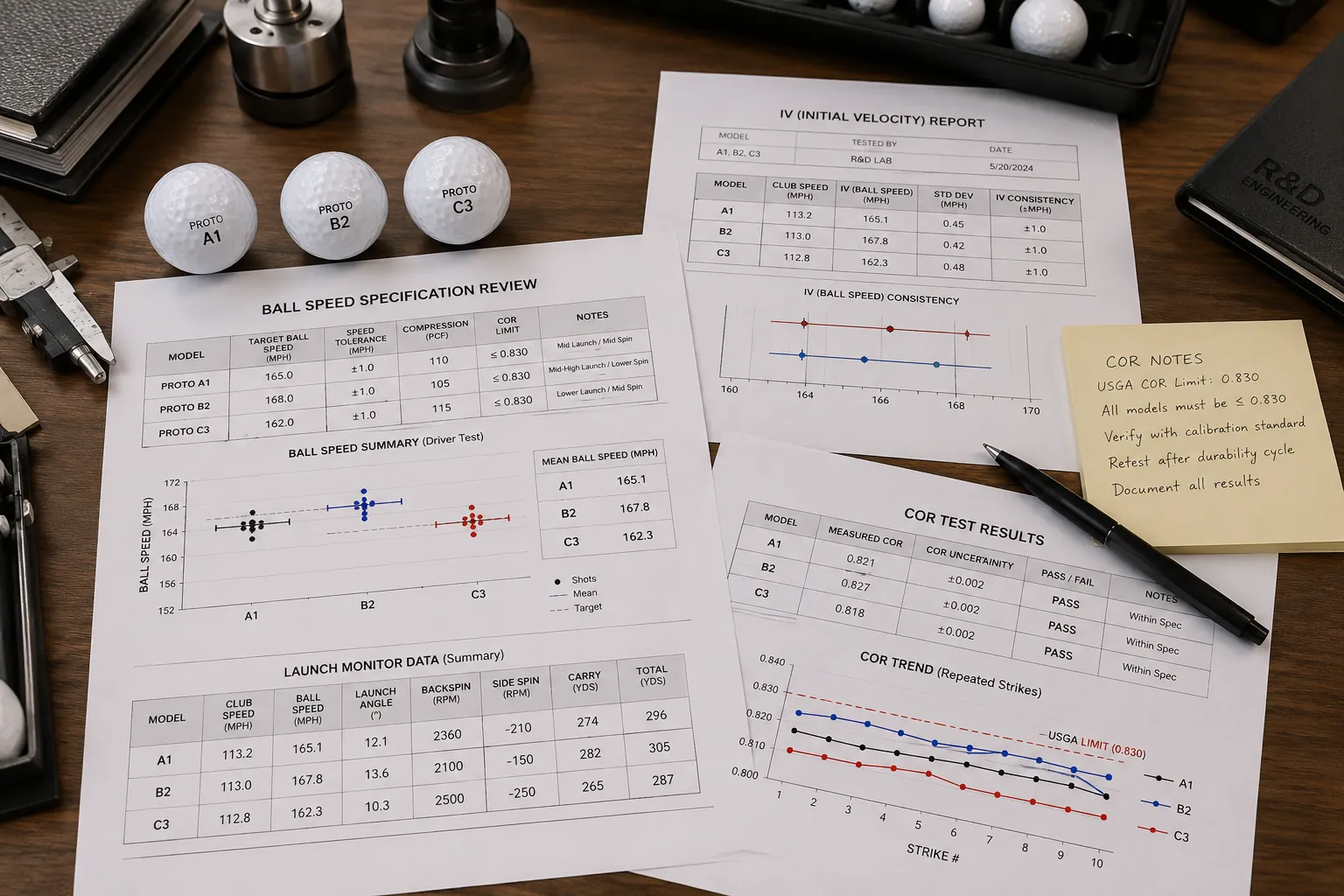
COR, or Coefficient of Restitution, describes energy return in a collision system. It is useful for R&D because it connects core chemistry, curing, mantle behavior, and rebound efficiency. But COR is not the same as ball speed, and it is not a free pass for distance claims.
Ball speed is the launch result after impact. It depends on the ball, clubhead speed, strike quality, launch condition, and test setup. IV, or Initial Velocity, is the conformance speed metric your team should request when legality matters. The USGA/R&A Initial Velocity Test Protocol compares each ball against 250.0 ft/s plus a 2% tolerance, or 255.0 ft/s; in a 24-ball sample, four or more balls above 255.0 ft/s make the sample nonconforming under that protocol.
ODS adds the distance boundary. The Overall Distance Standard is 317 yards with a 3-yard tolerance under official test conditions. Under the announced update beginning with the 2028 testing cycle, the ODS limit remains 317 yards plus 3 yards, while the test conditions move to 125 mph clubhead speed, 11° launch angle, and 2200 rpm backspin. USGA’s 2028 ODS testing conditions also state the current conditions as 120 mph clubhead speed, 10° launch angle, and 2520 rpm spin.
Distance is regulated. Repeatability is engineered. Supplier claims 400-yard conforming distance without IV/ODS evidence is a failure signal.
| Speed metric | Meaning | Buyer trap | Action/evidence |
|---|---|---|---|
| COR | Energy return physics | Used as vague marketing | Ask only with test method |
| Ball speed | Launch result | Depends on strike and club | Use launch data carefully |
| IV | Conformance speed metric | Generic report reused | Request model/lot report |
| ODS | Distance conformance boundary | 400-yard fantasy | Ask ODS context |
| 2028 conditions | Test protocol change | Confused with consumer swing | Anchor claims precisely |
✔ True — Distance is regulated and repeatability is engineered
A conforming golf ball must live inside speed and distance rules. Your buying advantage comes from controlling consistency near the legal window, not chasing impossible claims.
✘ False — “High COR means unlimited legal distance”
COR helps explain energy return, but IV and ODS evidence protect legality. A speed claim without a model-specific report should not enter your marketing copy.
Why does USGA legality cap IV?
Legality caps IV because golf ball distance must stay inside the rules, not only inside a factory’s sales pitch.
Request a current IV report, model/lot link, and clarification on whether the supplier is discussing conforming balls or non-conforming novelty balls. Also check the basic conformance gates: under Appendix III – The Ball, weight must not exceed 1.620 oz / 45.93 g, diameter must not be less than 1.680 in / 42.67 mm, and the size test uses a metal ring gauge.
For conformance-related speed claims, ask the supplier to provide the applicable IV/ODS method reference, tested model name, sample ID, lot link, measured result, and current conformance status before your team uses legality or distance language in marketing.
Why does dimple geometry beat count?
You may compare dimple counts and assume the higher count is better. That is spec-sheet theater, not aerodynamic reading.
A copied dimple count does not clone aerodynamics. Your team should ask for dimple depth, edge radius, layout, coating thickness, and dimple-fidelity controls because paint intrusion and rounded shoulders can change drag even when the count looks premium.
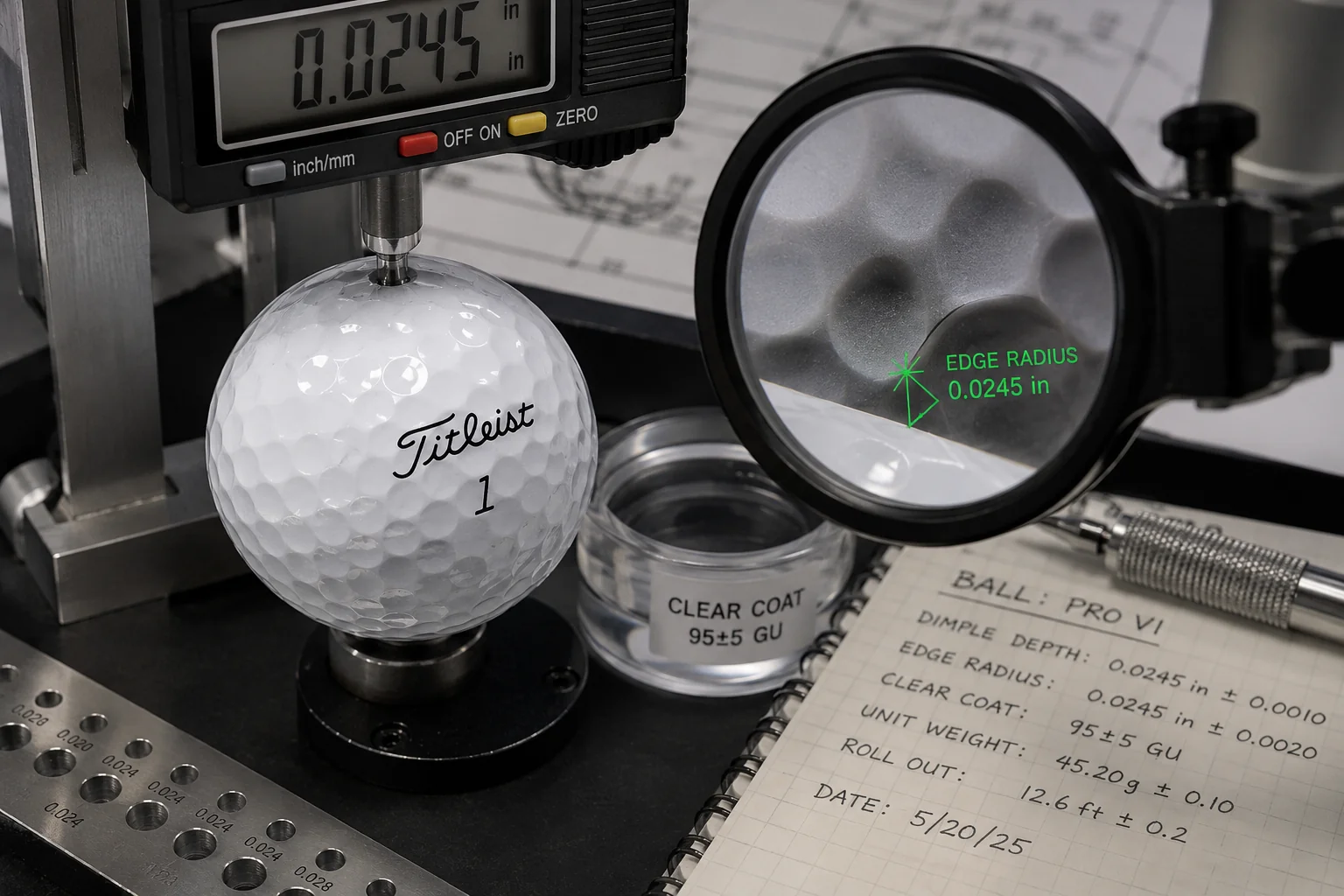
Dimple count is a design result, not a performance guarantee. A spec sheet that says “332 dimples” or “336 dimples” gives you almost none of the aerodynamic story. What matters is depth, diameter mix, edge radius, shoulder shape, layout symmetry, surface coverage, and replication fidelity.
Sports-engineering research supports this. In the wind-tunnel study A Study of Dimple Characteristics on Golf Ball Drag, Chowdhury and co-authors examined golf-ball models with varied dimple depth and found that drag coefficient varied significantly due to dimple geometry. For buyers, the practical lesson is sharp: if the spec sheet only lists count, it is not an aerodynamic spec sheet. It is a catalog line.
Clear coat can ruin the paper design. A controlled clear-coat window may be around 10–25 μm for a given product stack, but the universal number is less important than uniformity. Poor spraying, pooling, or over-thick clear can fill the dimple bottom, blunt the edge radius, and alter airflow. This is the “parameter cloning” trap: the drawing looks premium, but the finished ball behaves like a different geometry.
Spec sheet lists dimple count but no depth, edge radius, or coating μm control is a failure signal. Your buyer risk is not whether the catalog says 332 dimples; it is whether the airflow survives production.
| Aero spec | What it controls | Spec-cloning trap | Action/evidence |
|---|---|---|---|
| Dimple count | Coverage/layout result | Count-only comparison | Ask geometry |
| Depth | Lift/drag behavior | No tolerance listed | Ask depth window |
| Edge radius | Flow separation | Ignored in PDF | Ask drawing/tolerance |
| Clear coat μm | Dimple fidelity | Pooling/clogging | Ask μm map |
| Layout symmetry | Wind stability | Pretty pattern only | Ask robot/wind curves |
How do edge radius and clear coat change drag?
Edge radius and clear coat change drag by shaping how air separates from the ball surface.
Request dimple drawing, depth tolerance, edge-radius tolerance, coating μm map, and dimple-fidelity notes. Check whether the supplier can explain how coating avoids filling or blunting dimple geometry.
Do not approve premium aerodynamic claims from dimple count alone. If a supplier cannot explain depth, edge, coating, and fidelity, it is not cloning a premium flight window; it is copying a number.
Which tolerances prevent mystery wobble?
A ball can pass basic weight and diameter limits while still wobbling, rolling off-line, or showing biased flight.
Legal size and weight do not guarantee stable roll or neutral flight. Your team should look for OOR, seam tolerance, concentricity, symmetry, coating uniformity, and specific-gravity logic because tiny geometry or mass-balance errors can become mystery wobble.
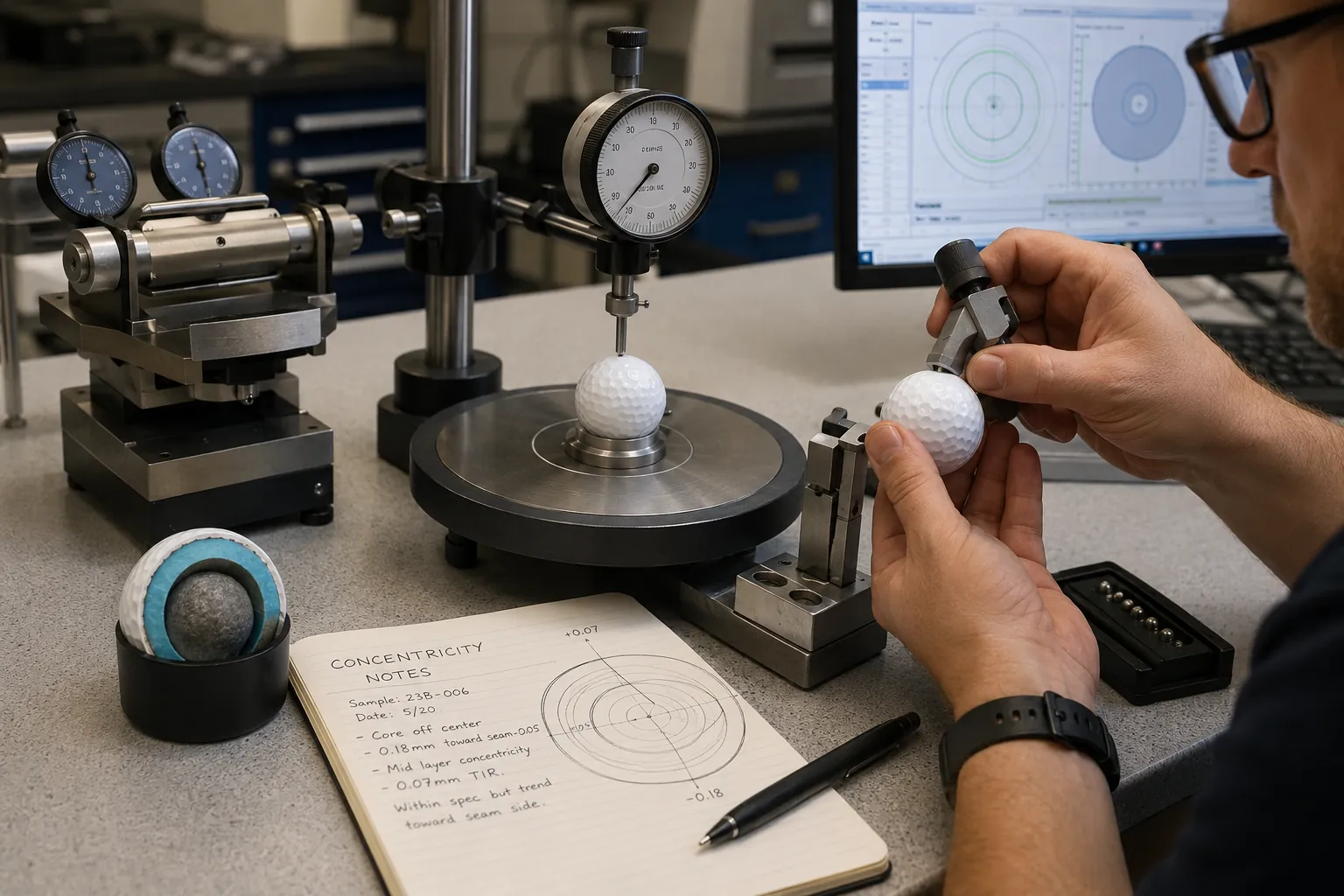
A legal ball can still feel wrong on the green. Weight and diameter protect the basic conformance floor, but they do not fully describe roundness, seam smoothness, layer centering, or mass balance. If the ball has an uneven parting line, a biased cover, or an off-center core, your customer may describe the result as a “mystery wobble.” Your supplier should treat it as geometry and mass-balance control.
OOR, or out-of-roundness, belongs in high-control spec conversations. OOR is not the same as the official spherical symmetry requirement, and it should not be presented as USGA law. It is a buyer acceptance metric. For demanding OEM programs, an OOR benchmark such as ≤0.15 mm can be used as a practical RFQ target when the supplier can measure and support it.
Seam tolerance matters because every molded ball has a parting line. If the mold is worn, the trimming is poor, or the finishing process is uneven, that equator can become an aerodynamic and roll-quality problem. Concentricity matters even more for multi-layer balls because an off-center layer changes mass distribution and spin-axis behavior.
Specific Gravity can reveal design intent. If layer SG values are visible and credible, they may help explain center-of-gravity and MOI strategy. Do not overclaim SG without supplier data. Ask how mass is distributed and what that means for stability.
Ask the supplier to provide a spec sheet with metric name, test scale, target value, tolerance band, sample count, equipment/method, lot link, and whether each value is a design target, conformance limit, or batch-control metric.
| Hidden spec | What it predicts | Buyer pain | Action/evidence |
|---|---|---|---|
| OOR | Roundness stability | Mystery wobble | Ask max tolerance |
| Seam tolerance | Equator smoothness | Biased roll/drag | Ask parting-line limit |
| Concentricity | Centered layers | Side bias | Ask X-ray summary |
| Symmetry | Orientation neutrality | Odd flight | Ask test summary |
| Specific gravity | Mass distribution/MOI intent | Unclear design claim | Ask layer SG logic |
✔ True — Hidden tolerances predict stability
OOR, seam height, concentricity, symmetry, and coating uniformity explain problems that headline specs often miss. They are small numbers with large customer consequences.
✘ False — “Passing weight and diameter means flight and roll are solved”
A ball can meet basic size and weight limits while still suffering from biased mass, uneven coating, or poor seam control.
What do OOR, seam, and concentricity reveal?
They reveal whether the factory controls shape, mass balance, and layer alignment, not only legal dimensions.
Request hidden-tolerance lines for OOR, seam height, concentricity, symmetry, and coating uniformity. Check whether these values are design targets or batch-measured controls.
For high-control programs, write OOR, seam, and concentricity as measurable RFQ benchmarks, not vague quality promises. Your customer calls it a wobble; your supplier should know which tolerance creates it.
How do climate conditions shift specs?
A ball approved in warm factory conditions can feel too hard, launch differently, or lose distance when used in colder markets.
A spec approved at one temperature may not feel the same in your selling market. If your buyers play in cold UK autumns, Canadian spring rounds, or hot summer regions, your team should read compression and cover hardness through target-market climate.
Cold conditions can make elastomeric systems feel firmer and can increase air density. Heat can soften feel, reduce air density, and create different durability, spin, or scuffing concerns. That means your sample approval temperature matters. A ball that feels ideal during a warm South China sample review may feel like a rock at 10°C in the UK.
Temperature control also matters in official testing. The USGA/R&A Initial Velocity Test Protocol requires test balls to be conditioned at 75°F ±1°F / 23.9°C ±0.6°C for at least three hours before testing. Your commercial sourcing process should use the same mindset: control the test condition before interpreting the number.
For cold markets, consider a lower Atti compression target and softer cover-feel direction. For hot markets, validate scuffing, spin, and feel at elevated temperature. For windy markets, prioritize dimple geometry robustness. For wet courses, cover interaction and wedge spin become more important.
Do not overpromise exact yardage loss without market-specific data. Use climate as a spec-selection lens. Your market conditions should shape your target spec before the first bulk order.
| Market condition | Spec shift risk | Buyer decision | Action/evidence |
|---|---|---|---|
| Cold climate | Core feels firmer | Lower compression target | Ask cold-condition check |
| Hot climate | Softer feel/scuff risk | Check durability/spin | Validate elevated temp |
| High altitude | Lower drag effect | Spin window changes | Ask launch scenario |
| Windy market | Aero sensitivity | Dimple robustness | Ask wind-curve logic |
| Wet course | Groove friction drops | Cover/spin priority | Test wedge behavior |
Why can a cold market need softer targets?
A cold market can need softer targets because the same elastomeric core may feel firmer at lower playing temperatures.
Request target-market validation notes for compression, cover hardness, scuffing, spin, and flight under expected climate. Check whether the supplier tested or can simulate conditions relevant to your market.
Do not approve a single compression target without considering target-market temperature and playing conditions. Your factory sample room is not your customer’s golf course.
FAQ
What does an Atti compression of 90 mean?
An Atti compression around 90 generally means the ball has a firmer whole-ball deformation profile. It may suit faster or more aggressive swings better than slower swings, but the useful buying number is the target plus tolerance, range, and standard deviation.
Do not treat “90” as the entire feel profile. Ask for the method, average, range, and spread across the sampled lot. Then compare it with Shore hardness separately. Compression explains whole-ball deformation; Shore hardness explains cover or layer surface response. A ball can be high-compression with a softer cover feel, or lower-compression with a firmer cover.
How much does golf ball weight affect distance?
Golf ball weight affects inertia and wind behavior, but conforming balls must not exceed 45.93 g. Buyers should avoid overweight distance promises and ask how close the design runs to the legal limit with batch-level weight control.
A heavier ball within the legal window can feel steadier and may resist wind better, but overweight balls create conformance risk. Ask for the weight distribution, not just the average. A strong supplier should show whether the batch clusters safely below the legal ceiling, instead of hiding outliers behind one nice mean value.
What is the difference between COR and ball speed?
COR describes energy-return physics inside the collision system; ball speed is the launch result after impact. IV is the conformance speed metric buyers should request when legality or official distance claims are involved.
COR is usually more R&D-facing. Ball speed depends on club speed, strike quality, launch condition, and the ball’s energy response. IV belongs to conformance reporting. For OEM sourcing, do not accept “high COR” as a substitute for model-specific IV evidence, especially if the supplier wants you to use distance claims in marketing.
Can a factory make a 400-yard conforming ball?
No serious OEM should present a 400-yard ball as a normal conforming claim. Official speed and distance standards limit conforming-ball performance under defined test conditions, so a “400-yard” promise needs immediate clarification and IV/ODS evidence.
Ask whether the claim refers to a conforming ball, a non-conforming novelty ball, a long-drive scenario, or pure marketing language. Request current IV and ODS evidence before using any distance claim. A supplier that promises unlimited legal distance is not helping your brand; it is creating compliance and credibility risk.
Why does dimple depth matter more than count?
Dimple depth matters because it changes airflow, lift, drag, and trajectory. Count alone does not explain edge radius, shoulder shape, layout, paint intrusion, coating thickness, or whether the finished ball preserves the intended aerodynamic geometry.
Ask for dimple drawings, depth window, edge-radius tolerance, and coating μm control. A ball with a copied count but poor paint control can lose the aerodynamic shape that the original design depends on. That is why “336 dimples” is a weak spec unless geometry and production fidelity are also visible.
How does temperature affect golf ball compression?
Cold conditions can make elastomeric cores feel firmer, while heat can soften feel and change scuffing, spin, or durability behavior. Choose compression and cover hardness for the market where the ball will actually be played, not only for factory-room approval.
Cold markets may need a lower compression target or softer feel direction. Hot markets need durability and spin checks. Do not approve only by warm factory samples, especially if your end customers play in the UK, Canada, Northern Europe, or shoulder-season climates.
Conclusion
A strong golf-ball spec sheet is not a list of impressive numbers. It is a controlled physics map: compression with tolerance, Shore scale with method, COR explained through IV, dimple geometry protected by coating control, hidden OOR/seam/concentricity lines, and climate assumptions that match your real market.
Your team should not ask a factory to clone famous specs. Ask which variables are controllable, measurable, and repeatable. That is how you separate real engineering from a copied marketing table.
You might also like — USGA Conforming Golf Balls: 2026 Compliance Costs in China OEM