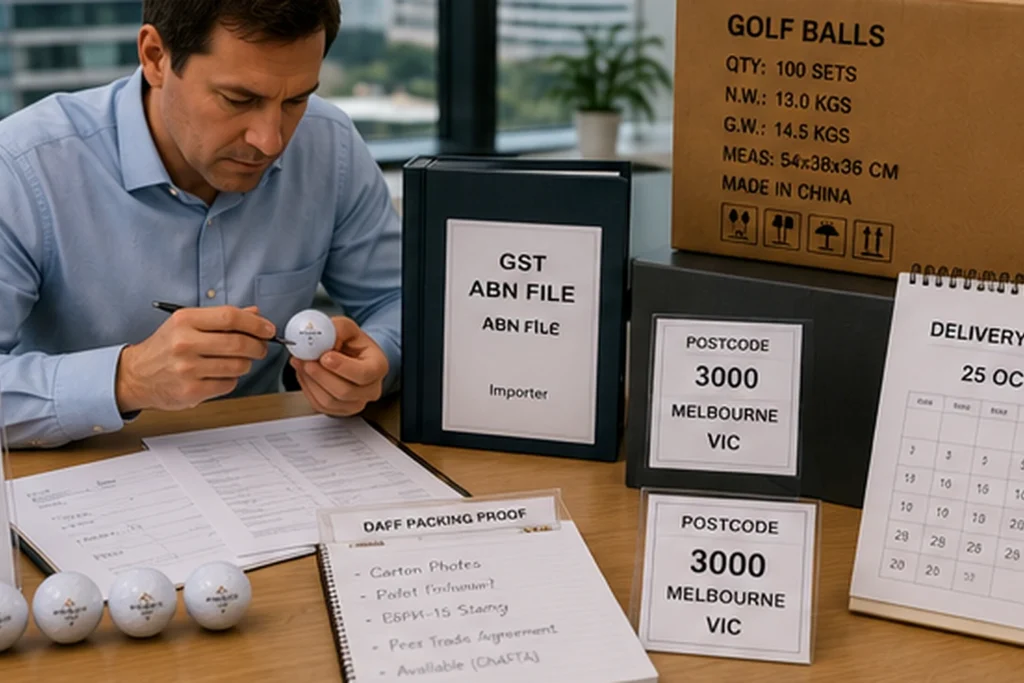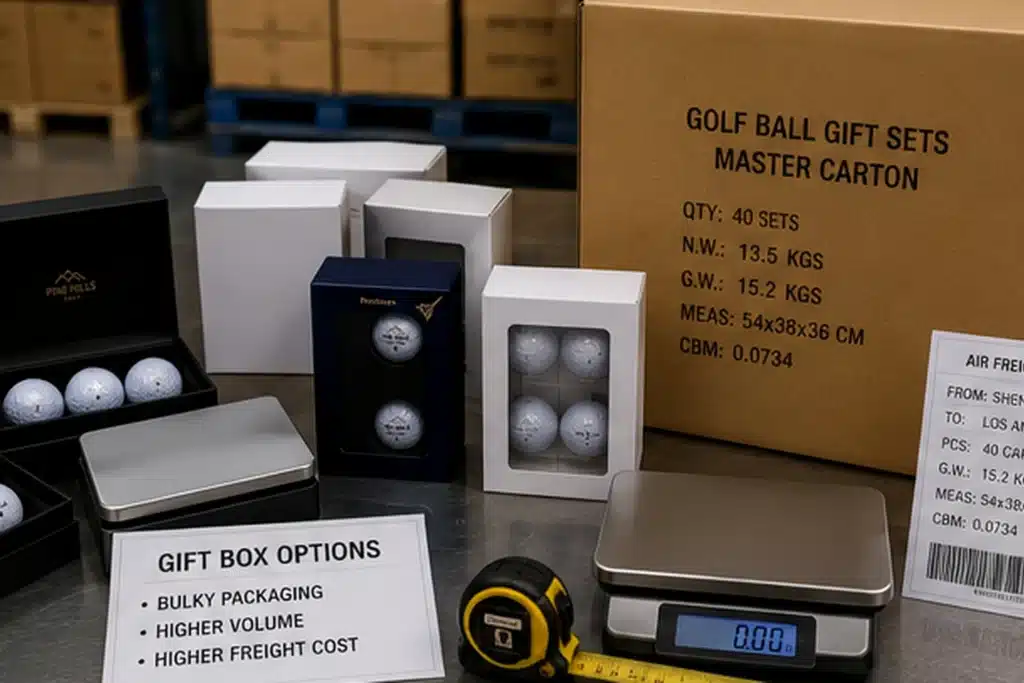
You can approve a golf ball gift box that looks only slightly larger on the dieline, then discover that it holds fewer sets per master carton and creates a much larger shipment.
Golf ball gift box dimensions affect air freight when they change units per master carton, carton count, total CBM, gross weight, volumetric weight, or chargeable weight. Compare the final packed shipment for each packaging version—not the unit box alone—before approving the dieline or freight plan.
The expensive mistake is comparing unit boxes instead of complete shipments. The same golf ball quantity can create a different freight basis when the insert, box depth, or packout changes.
The better purchasing question is:
What changed in the total shipment when you changed the packaging version—and what freight delta did that change create?
If you have not chosen the packaging format yet, first choose the right OEM golf ball packaging format. This page begins one decision later, when your team needs to trace that packaging version through the final packout and freight approval.
How Much Freight Exposure Can Packaging Add?
You can hold product quantity constant and still create a materially different shipment simply by changing how those products are packed.
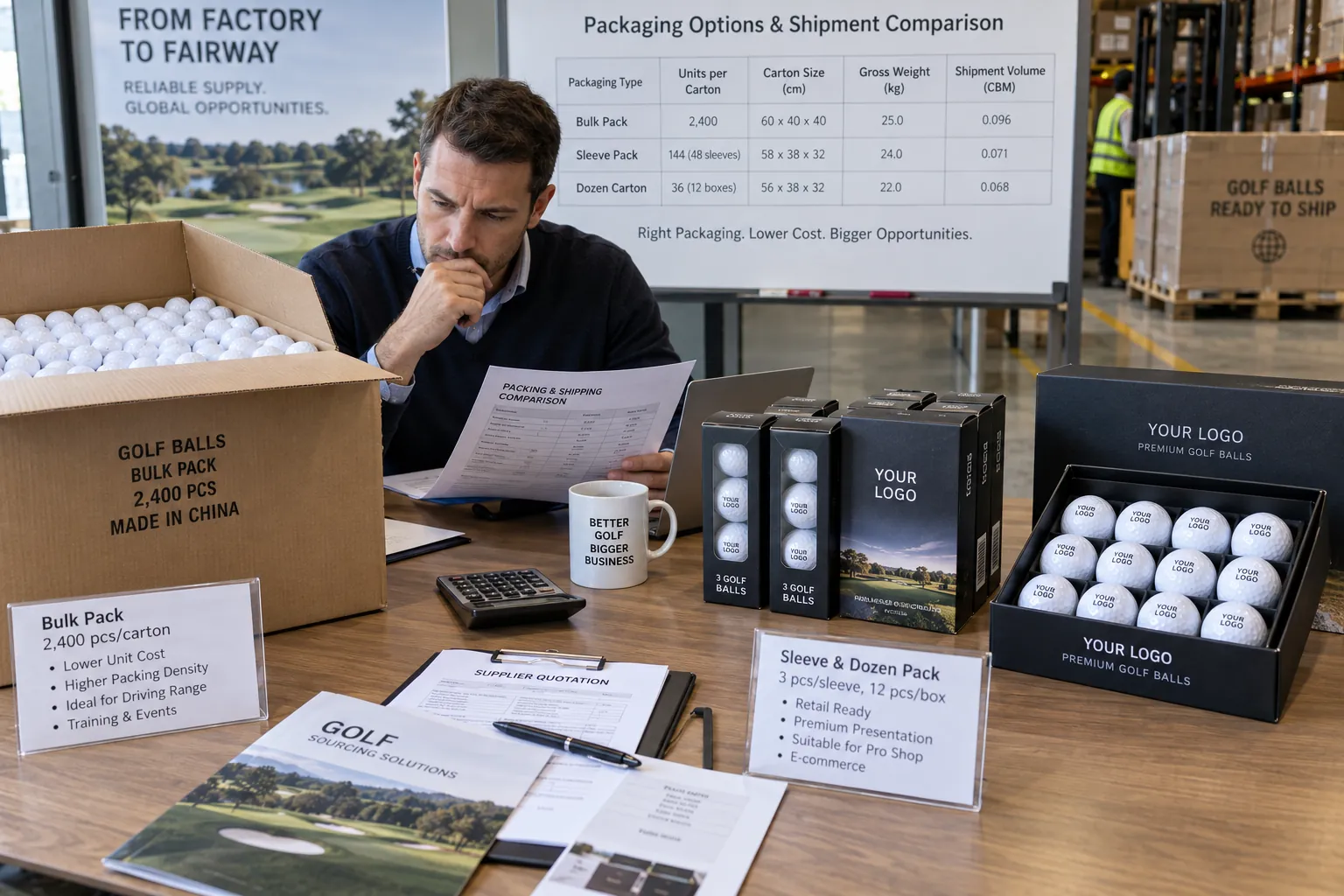
The same golf ball order can produce very different carton counts, total CBM, and gross-weight exposure. In one 2,400-ball trial for an Australian indoor-golf customer, sleeve-and-dozen packaging increased total shipment volume from about 0.199 CBM to 0.336 CBM before any freight rate was applied.
Hold your ball quantity constant first. Then measure what the packaging changed.
| Decision | Bulk Pack | Sleeve + Dozen | Buyer Action |
|---|---|---|---|
| Balls ordered | 2,400 | 2,400 | Hold quantity constant |
| Balls/carton | 300 | 240 | Compare packing density |
| Carton dimensions | 39×29×22 cm | 40×30×28 cm | Verify packed carton |
| Gross weight/carton | 14.5 kg | 14 kg | Record stated carton weight |
| Cartons required | 8 | 10 | Count total cartons |
| CBM/carton | ~0.0249 | 0.0336 | Calculate from dimensions |
| Total shipment CBM | ~0.199 | 0.336 | Compare shipment geometry |
| Modeled shipment GW | ~116 kg | ~140 kg | Carry into freight model |
An Australian indoor-golf customer ordered a 2,400-ball trial and originally wanted custom three-ball sleeves, with four sleeves packed into each dozen box. Before approval, we compared the real packout. Bulk packing required eight 39×29×22 cm cartons at 300 balls each; the retail version required ten 40×30×28 cm cartons at 240 balls each. Total shipment volume moved from about 0.199 CBM to 0.336 CBM, so the customer chose bulk packing for the trial rather than ordering the branded retail pack for that shipment.
The packaging was not wrong; it was premature for that shipment.
Based on the confirmed carton dimensions and stated carton gross weights, the branded version created about 68.8% more shipment volume and approximately 24 kg more modeled gross shipment weight.
That does not mean air freight increased by 68.8%.
The retail version also required a 500-set custom-packaging order—enough for 6,000 balls—while the 2,400-ball trial needed only 200 sets. Although we could store the unused packaging for six months, bulk packing also avoided an approximately US$500 upfront custom-packaging purchase. That is a packaging-cost result, not a claimed freight saving.
This project illustrates a useful lesson for pilot programs: branding can be commercially valuable and still be premature for the first urgent shipment.
A dieline approved before carton count, total shipment CBM, and gross-weight exposure are known is a failure signal. Your Packaging Version Shipment Comparison should show the branded option beside a simpler baseline before the dieline is frozen.
✔ True — Packaging can materially change shipment geometry even when ball quantity stays fixed.
The Australian order stayed at 2,400 balls, yet the packaging change increased carton count, shipment volume, and modeled gross shipment weight.
✘ False — “If the order still contains 2,400 balls, freight exposure should be almost unchanged.”
Air freight sees the packed shipment. Product quantity alone does not describe that shipment.
Which Carton Data Actually Drives Air Cost?
You may know the golf ball gift box dimensions perfectly and still be unable to model the shipment because a forwarder does not transport one unit-box dieline.
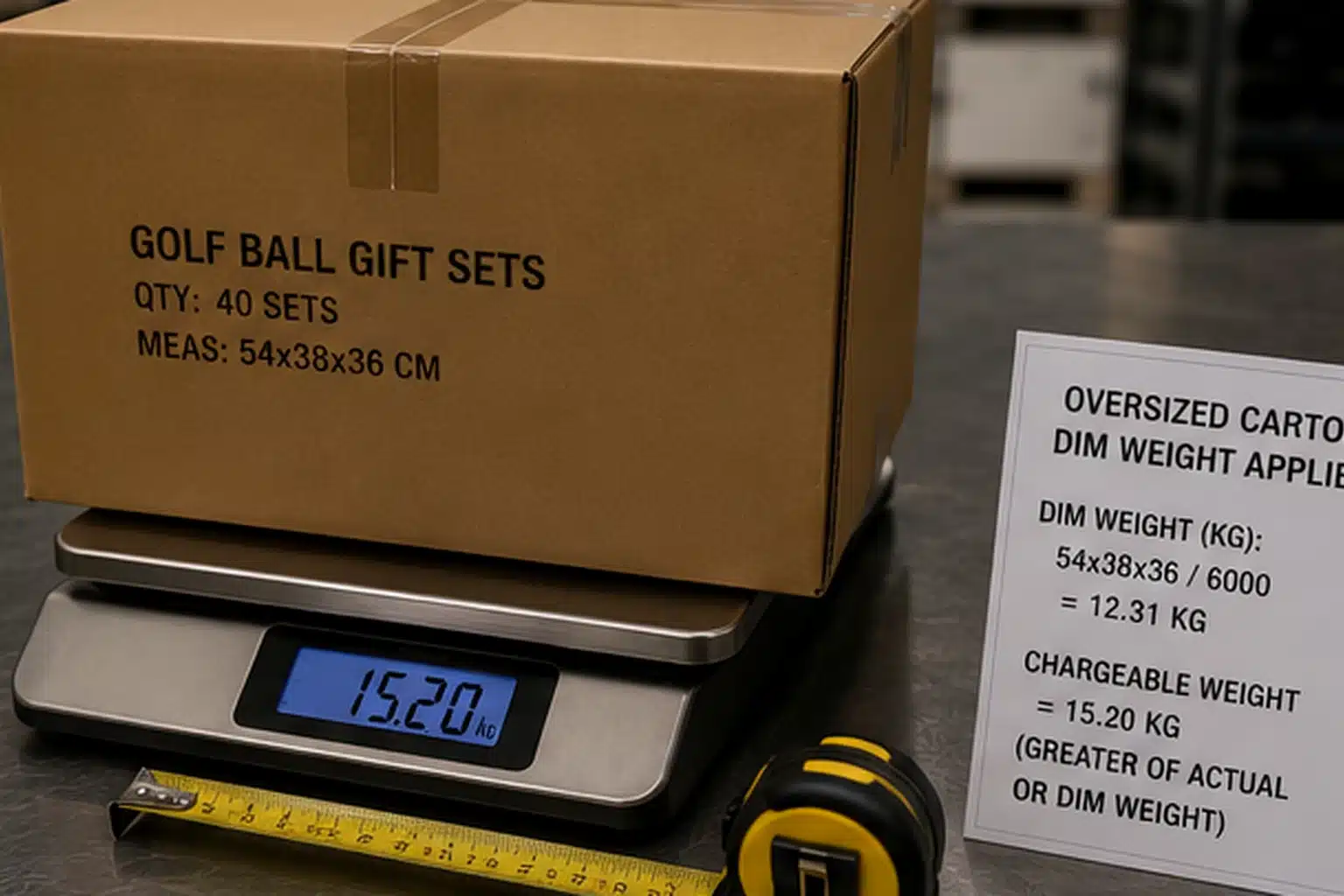
Your golf ball box dimensions are only the first freight input. You also need final master-carton dimensions, units per carton, carton count, and gross weight before you can determine total shipment CBM or whether the shipment is driven by actual or volumetric weight.
The conversion from packaging design to freight begins with the packed master carton.
Your Packed-Carton Data Sheet should record the Packaging Version ID, packed-unit dimensions, units per master carton, master-carton L×W×H, stated gross weight per carton, carton count, calculated shipment gross weight, CBM per carton, and total shipment CBM.
The shipment-level relationship is straightforward:
Total Shipment CBM = Master Carton CBM × Total Cartons
This distinction matters because CBM per carton can mislead you. A smaller carton is not automatically a smaller shipment if that packout holds fewer units and forces the same order into more cartons.
DHL Global Forwarding’s chargeable-weight guidance explains that all packages must be included when calculating shipment volumetric weight. Its air-freight educational example uses a 1:6 density ratio, expressed as (L × W × H in cm) ÷ 6,000 × number of packages.
That is a useful DHL air-freight example, not a universal divisor for every carrier, service, or quote.
Using that example with our Australian project:
-
Bulk:
39 × 29 × 22 ÷ 6000 × 8 ≈ 33.2 kgvolumetric weight. -
Sleeve + dozen:
40 × 30 × 28 ÷ 6000 × 10 = 56 kgvolumetric weight.
Using the stated carton gross weights, the two packouts model to about 116 kg and 140 kg gross respectively. Both remain above their volumetric weights under DHL Global Forwarding’s /6000 educational example.
That creates an important procurement insight: the branded version increased shipment CBM sharply, yet under this example both packouts would still be actual-weight driven.
This is why a 68.8% increase in CBM should never be converted directly into a 68.8% increase in freight cost.
Supplier shall identify each packaging option by packaging version, packed unit dimensions, units per master carton, master-carton dimensions, carton count for the quoted order quantity, gross weight, and carton-loading plan so the freight calculation can be traced to the approved packout.
No freight calculation should be accepted from unit-box dimensions alone.

How Should You Compare Two Box Versions?
A supplier can quote a cheaper gift box without showing whether that box creates a more expensive shipment. Another version can cost more to manufacture yet use the master carton more efficiently.
Compare packaging versions using the same order quantity and the same freight basis. The useful result is not which box costs less; it is how much chargeable weight and incremental freight Version B creates compared with the approved baseline.
Keep three terms separate.
Actual gross weight is the physical weight of the packed shipment.
Volumetric or dimensional weight converts occupied space into a weight basis.
Chargeable weight is the weight basis used for freight billing under the applicable quote.
UPS Supply Chain’s chargeable-weight guidance explains that chargeable weight is generally the greater of actual and dimensional weight, while the dimensional calculation can vary by carrier, mode, or trade lane.
That gives you the correct sequence:
Packaging Version → Actual + Volumetric Weight → Chargeable Weight → Freight Delta
| Decision Input | Bulk Version | Sleeve + Dozen | Delta | Buyer Action |
|---|---|---|---|---|
| Cartons | 8 | 10 | +2 | Hold order quantity constant |
| Total CBM | ~0.199 | 0.336 | +~68.8% | Do not call this freight % |
| Modeled gross weight | ~116 kg | ~140 kg | +~24 kg | Compare weight basis |
| Volumetric weight* | ~33.2 kg | 56 kg | +~22.8 kg | Confirm quote method |
| Chargeable weight* | ~116 kg | ~140 kg | +~24 kg | Replace with quote result |
| Freight/comparison unit | Quote required | Quote required | Quote required | Use current quote |
*Using DHL Global Forwarding’s /6000 educational air-freight example only. Final approval must use the actual quote basis.
Under that example, both versions remain actual-weight driven. The approximately 69% increase in total CBM therefore does not become a 69% increase in modeled chargeable weight.
For a like-for-like quote where the same rate-per-kilogram basis applies, estimate the base freight delta as:
Δ Base Freight = (Chargeable Weight B – Chargeable Weight A) × Current Quoted Rate
If the quote changes rate breaks, minimum charges, rounding, surcharges, or another pricing condition between versions, use the forwarder’s quoted totals rather than this simplified rate-per-kilogram model.
To translate the result into a normalized purchasing metric:
Incremental Freight per Comparison Unit = Δ Freight ÷ Equivalent Units
For a dozen-based comparison, for example, use the same number of 12-ball equivalents for both versions. The denominator must stay normalized just as the order quantity does.
A supplier quoting only the gift-box unit price without packed-carton data is a failure signal.
Please provide a side-by-side comparison of Packaging Versions A and B using the same order quantity and confirmed freight basis. Include packed-unit dimensions, units per master carton, master-carton dimensions, carton count, gross weight, total shipment CBM, carton-loading plan, and calculated chargeable weight.
Your deliverable is a Freight Delta Sheet, not another box-price comparison.

Working Rate or Approval Rate?
A Working Rate helps your team compare scenarios during packaging development. An Approval Rate is the current route-specific quote used to decide whether the final packaging version can be released.
In our July 2026 internal working freight model, we used illustrative air-freight inputs of approximately US$8.5/kg to the U.S., US$9.2/kg to Europe, and US$6/kg to Japan.
These were modeling inputs, not market benchmarks. Replace them with the current forwarder quote for the actual route, service, cargo dimensions, calculation basis, and quote-validity window before approving the packaging version.
✔ True — Packaging versions must be compared on the same freight basis.
Hold quantity, route, service, dimensional method, and rate source constant before attributing a freight difference to the packaging itself.
✘ False — “A working freight rate is good enough for final packaging approval.”
Planning rates help screen options. Final approval requires the current quote that actually applies to the shipment.
Can You Cut Volume Without Looking Cheaper?
Freight optimization often gets framed as a branding sacrifice: smaller box, less foam, less premium. That creates a false choice.
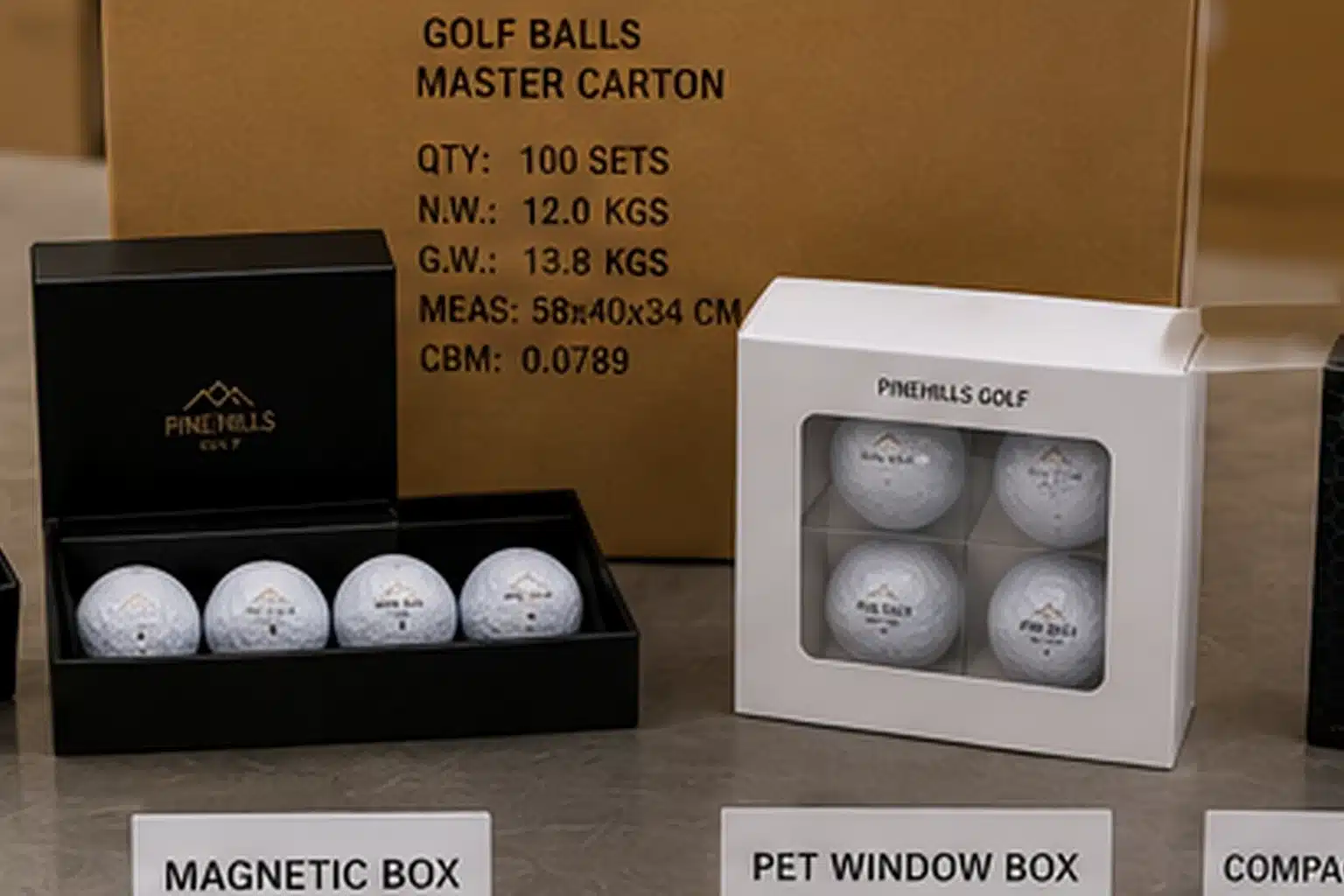
You can reduce packaging volume without making the product look cheaper. Focus on space that adds neither protection nor customer value, then improve insert geometry, exterior margins, carton orientation, or the timing of the branded packaging rollout.
| Design Choice | Volume Consequence | Brand Risk | Verification | Action |
|---|---|---|---|---|
| Tighter insert | Less internal void | Low if fit stays clean | Loaded sample | Reduce excess cavity |
| Reduced void | Smaller structure | Low | Physical fit check | Remove unused space |
| Smaller exterior margin | Smaller footprint | Low–medium | Presentation review | Tighten carefully |
| Better carton orientation | More units/carton | None | Loading diagram | Improve layout |
| Compact trial version | Lower shipment burden | Some presentation loss | Use-case review | Use for pilot |
| Full branded reorder | Higher packout burden | None if justified | Freight Gate | Approve after scale |
The useful question is not simply, “Can we make the box smaller?”
Ask: Which space is doing useful work?
An insert may be necessary because it organizes and protects a gift set. Excess cavity around that insert may not be. A premium exterior may create genuine customer value. An inefficient master-carton orientation is invisible to the customer and much harder to justify.
The Australian project also demonstrates a useful third purchasing decision.
You do not always need to choose only between Approve and Reject.
Sometimes the correct answer is Not Yet.
A branded retail pack can make commercial sense after a pilot validates the program. It does not need to be forced into the first urgent shipment simply because the brand eventually wants retail presentation.
Not now does not mean never.
This matters for private-label launches, first orders, and programs still validating demand. Your largest packaging-freight lever may not be negotiating another few cents from the freight rate. It may be removing avoidable shipment weight or volume before your forwarder prices the cargo.
Request one compact alternative using the same product quantity. Compare total shipment CBM—not only the appearance of the unit box—and remove space only when protection, presentation, and product organization remain acceptable.
What Must Be Locked Before Final Approval?
A freight worksheet can be mathematically correct and still become obsolete before production finishes if the insert, dieline, unit count, carton orientation, or master-carton dimensions change.
Your freight model is valid only for the packaging version it measured. Recalculate whenever a change affects packed dimensions, carton density, gross weight, or carton count, and do not release mass packing until the freight record matches the final packaging version.
Your Freight Approval Record should link the Packaging Version and Carton Data Version to the order quantity, packed-unit dimensions, units per carton, final master-carton dimensions, carton count, stated or final gross weight, total shipment CBM, dimensional method, volumetric weight, chargeable weight, route, service, quote reference, quote date, valid-through date, rate basis, and approval status.
The control sequence should be explicit:
Packaging Revision Change → Packed-Carton Data Refresh → Chargeable Weight Refresh → Freight Re-Quote or Revalidation
Before release, ask:
Which packaging version did your forwarder actually quote?
Then ask:
Did anything change after that quote?
A current-looking rate attached to an obsolete carton configuration is still the wrong freight model. Treating a Working Rate as the final Approval Rate is another failure signal.
Final packaging approval shall require a freight comparison based on the buyer’s approved packaging version and current forwarder quote basis. Any change to packed dimensions, units per carton, carton count, or master-carton layout that affects shipment geometry or chargeable weight shall trigger recalculation before shipment release.
Mass packing should remain blocked until your packaging record and freight record describe the same physical shipment.
✔ True — Freight approval belongs to a specific packaging version.
The calculation has value only when its dimensions, carton count, weight data, and quote basis still describe the shipment production will release.
✘ False — “Small packaging changes do not require another freight check.”
A small unit-pack change can alter units per carton or master-carton geometry. If shipment geometry changes, refresh the freight model.
FAQ
What Volumetric Divisor Should You Use?
Use the dimensional factor stated in your actual carrier or forwarder quote rather than assuming /5000, /6000, or another divisor is universally correct.
DHL Global Forwarding uses /6000 in its air-freight educational example, but calculation bases can vary. Keep the DIM factor, service, and calculation method with your freight worksheet, and reconfirm them before final packaging approval.
Does 69% More CBM Mean 69% More Air Freight?
No. In our Australian trial, the sleeve-and-dozen version created about 69% more total shipment CBM, but that percentage describes shipment volume—not the percentage increase in air-freight cost.
Compare gross weight with volumetric weight, identify the applicable chargeable weight, and apply the actual quote basis. Under DHL’s /6000 educational example, both project packouts remain actual-weight driven.
Can You Use Working Air-Freight Rates for Budgeting?
Yes. Working rates can help you compare packaging scenarios when they are dated and clearly treated as temporary planning inputs rather than current market benchmarks.
Before final approval, replace the working input with the current forwarder quote and record the route, service, calculation method, rate basis, quote date, and validity.
Can Similar Gift Boxes Ship at Different Costs?
Yes. Similar unit-box dimensions can create different shipment economics when units per carton, carton orientation, gross weight, master-carton dimensions, or total carton count differ.
Compare the final packed cartons at the same order quantity. A loading diagram and total shipment CBM tell you more than two gift-box dielines viewed side by side.
Should You Buy Extra Packaging for Future Reorders?
Sometimes. Future reuse can justify extra packaging when artwork is stable, storage is available, and a reorder is reasonably expected.
In our Australian project, 500 packaging sets were feasible even though the trial required only 200. The decision was still Not Yet because the first shipment needed market validation more than branded retail presentation.
Does an Artwork-Only Change Require a New Freight Check?
Not necessarily. If the artwork revision does not change packaging dimensions, material, unit count, carton layout, gross weight, or another physical freight input, the existing freight model may remain usable.
Verify and record that the physical packout is unchanged. If the artwork change also changes material, structure, labels, inserts, or carton configuration, refresh the packed-carton data before relying on the previous freight approval.
Conclusion
A packaging version is not freight-approved because the gift box looks good, its unit price is acceptable, or its CBM seems reasonable. It is approved when the final packed shipment and the current quote basis show that the incremental freight is acceptable for your program.
Use the full decision chain:
Packaging Version → Carton Count → Total CBM → Chargeable Weight → Freight Delta → Approval
The Australian trial captures the principle well: a branded packaging concept can be commercially sound and still be premature for an urgent first shipment. Sometimes the correct decision is Not Yet.
You might also like — How Do You Calculate Golf Ball Shipping Cost from China?