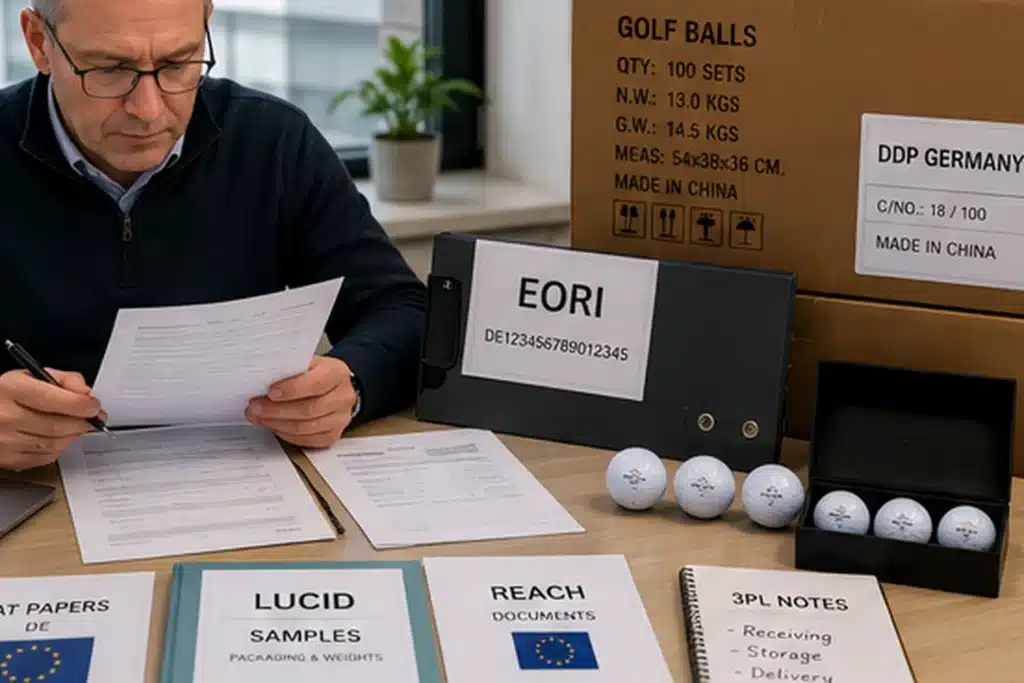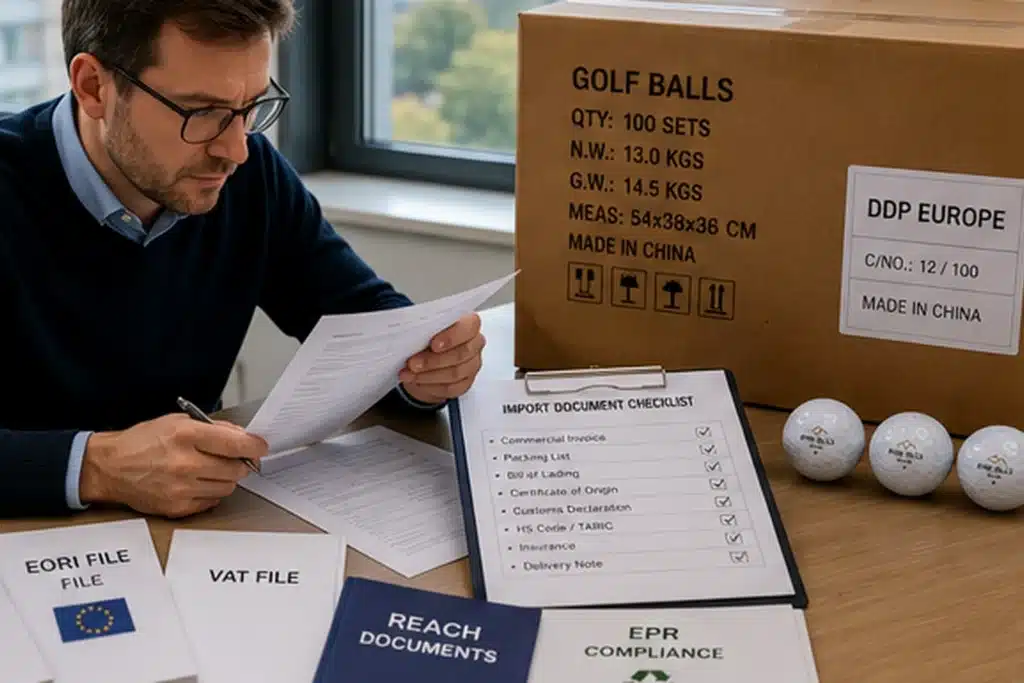
To import golf balls from China to the EU, verify the regional shipment file before accepting DDP, DAP, or EU warehouse routing.
Your EU import file should be TARIC-ready, VAT-ready, REACH-ready, EPR-ready, and warehouse-route-ready before cargo leaves China. Confirm TARIC / CN 9506 32 00 review, EORI role, VAT route, REACH / SVHC documents, packaging material weights, invoice split, port of entry, destination countries, and EU 3PL receiving rules.
| EU import check | Buyer risk | What to request | Buyer action |
|---|---|---|---|
| TARIC line | Wrong duty basis | 9506 32 00 review | Broker check |
| EORI role | Unclear importer | Importer / fiscal role | Confirm early |
| VAT handling | Weak reclaim path | VAT file route | Accountant review |
| REACH / SVHC | Chemical proof gap | MSDS / declaration | Approve before bulk |
| EPR packaging | Country mismatch | Material weight split | Map each market |
| EU routing | Wrong entry model | Port + warehouse plan | Choose route early |
| DDP scope | One-line black box | Invoice split | Audit before PO |
Use this guide to check whether your China golf ball shipment is EU-ready before cargo leaves China, not after VAT, EPR, REACH, or warehouse-routing problems appear.
What Should EU Buyers Check First?
Your team may ask how to import golf balls from China to the EU and expect a simple shipping workflow. The real first decision is whether your shipment file can support regional review.
Your first EU import check is not the cheapest freight or DDP quote; it is whether the shipment file supports customs, VAT, chemical, packaging, and warehouse review. Before shipment, request TARIC review, EORI role, VAT route, REACH documents, EPR packaging data, and routing proof.
Importing into the EU is not the same as selling across the EU. A shipment may enter through one port, move to one warehouse, and then sell into Germany, France, Spain, the Netherlands, Italy, or other member states. If the import file does not connect the port of entry, importer role, VAT handling, destination countries, EPR obligations, and warehouse route, the shipment may clear customs while still creating accounting or compliance gaps.
| First check | Why it matters | What to request | Buyer action |
|---|---|---|---|
| TARIC line | Duty basis | Proposed code | Broker review |
| EORI role | Import identity | Named role | Confirm importer |
| VAT route | Accounting impact | VAT file path | Ask accountant |
| REACH proof | Chemical file | MSDS / declaration | Approve before bulk |
| EPR data | Packaging reporting | Material weights | Map destination |
| Warehouse route | Delivery success | 3PL SOP | Confirm before packing |
As of 2026, verify again at shipment date. VAT rates, TARIC measures, EPR packaging obligations, fiscal representation options, REACH / SVHC lists, and warehouse receiving rules can vary by member state, route, buyer role, product mix, and sales model. Shipment approval should require an EU Import File Review Pack, not only a DDP price.
✔ True — EU imports need a regional compliance and routing file
One entry point can support a wider EU plan only when customs, VAT, EPR, REACH, and warehouse routing are visible before shipment.
✘ False — “One DDP Europe quote proves the shipment is ready for all EU markets”
A bundled price does not prove that VAT, packaging responsibility, chemical documents, and destination-country delivery rules are aligned.
Is Standard DDP Enough for the EU?
Your supplier may offer DDP Europe and say customs, VAT, and delivery are included. That may work for one controlled destination, but it can break down when stock moves across borders.
Standard DDP is enough only when it fits your actual EU route. If your team imports into one country and sells into several, verify importer role, VAT handling, invoice split, fiscal representation if used, warehouse delivery scope, and destination-country compliance before accepting DDP.
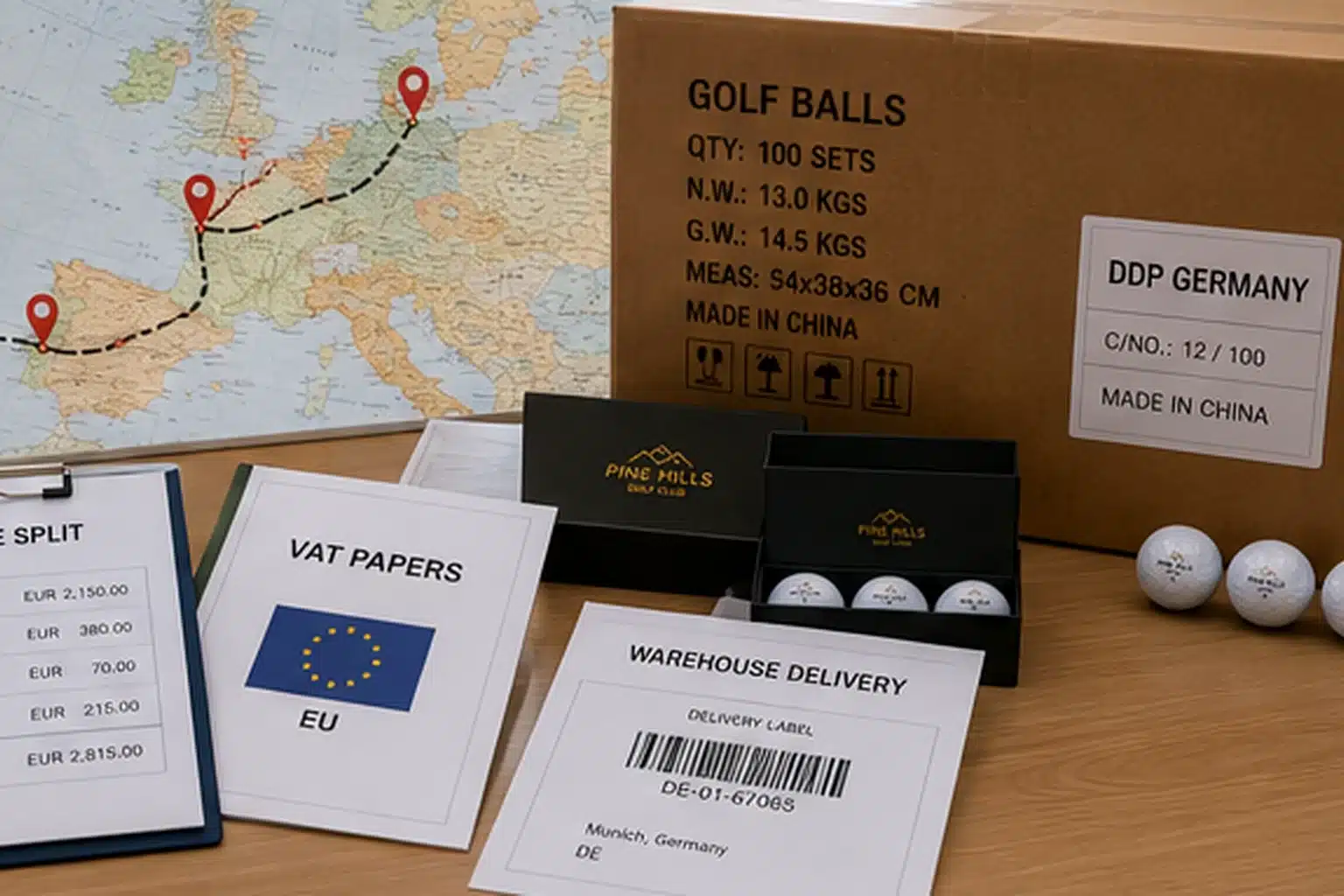
One country or multi-country distribution?
A DDP quote to a single EU address is not the same as a multi-country distribution plan. Your goods might enter through one port, move to one 3PL, then sell into several member states. Each step can affect VAT visibility, EPR packaging responsibility, marketplace files, and warehouse handling.
| DDP question | Multi-country risk | What to verify | Buyer action |
|---|---|---|---|
| Entry country | Wrong route | Port of entry | Choose early |
| Importer role | VAT file gap | EORI / importer | Confirm in quote |
| VAT handling | Reclaim issue | VAT route | Accountant review |
| Fiscal rep | Wrong assumption | If used / not used | Verify model |
| Warehouse scope | Delivery mismatch | EU 3PL plan | Send SOP |
| Invoice split | No audit trail | Value / freight split | Request file |
Supplier offers DDP Europe but cannot explain the VAT route is a failure signal. DDP can simplify delivery, but VAT-blind DDP hides the file your finance team may later need. Before accepting terms, confirm entry country, warehouse route, importer role, VAT handling, invoice split, and destination-country responsibilities.
Your deliverable is EU DDP Route and VAT Handling Confirmation. If destination countries, first warehouse, product mix, or packaging changes after the quote, the routing file should be revised before PO release or shipment booking.
Which TARIC and EORI Details Matter?
Your supplier may quote a generic customs code or describe the goods as “sports goods.” That is not enough for EU customs review, especially when custom kits are involved.
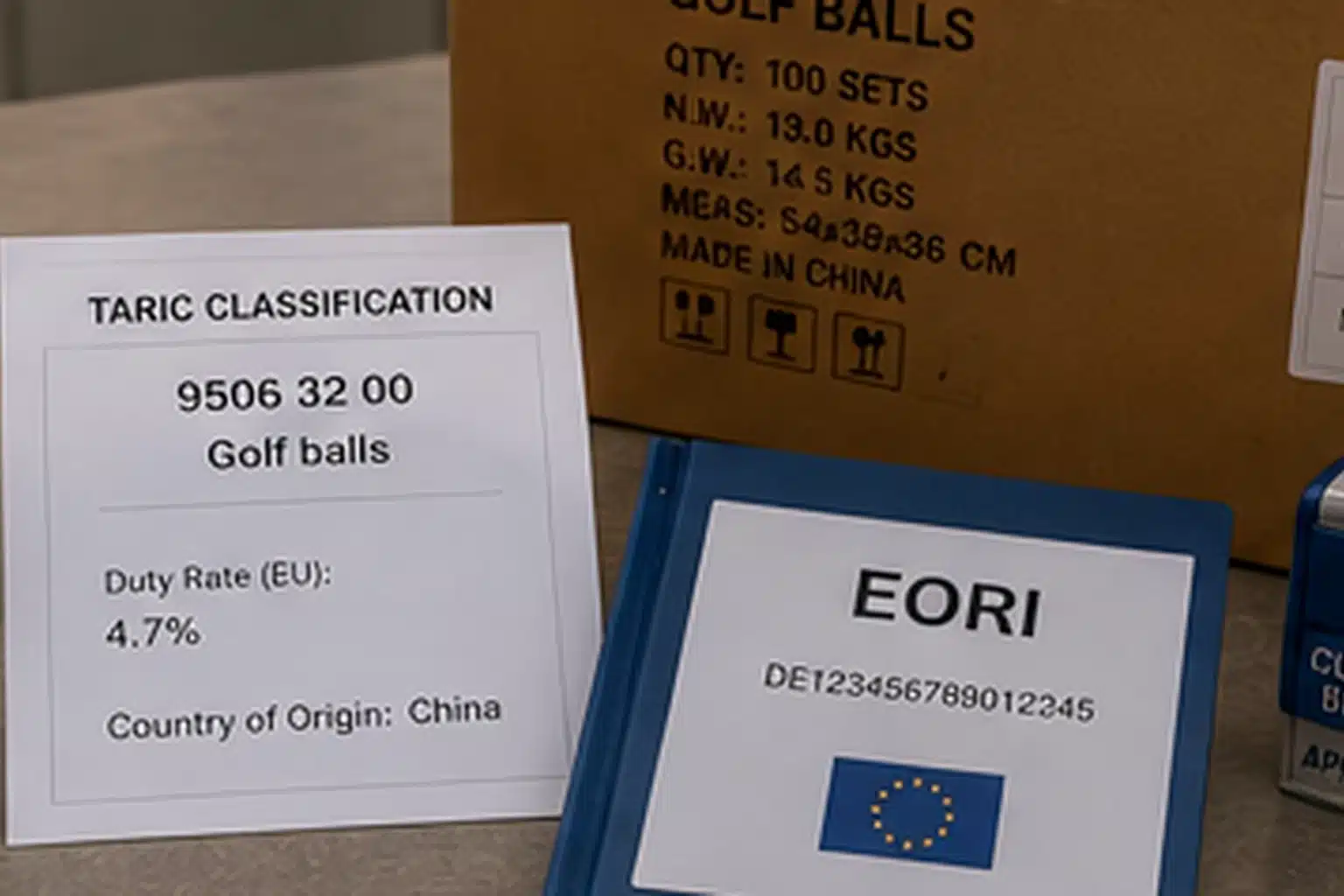
TARIC controls the classification review, while EORI controls the customs identity path. Your team should ask for the proposed TARIC line, item-level product breakdown, importer role, EORI route, and broker confirmation before importing custom golf balls or mixed promotional kits into the EU.
Code, importer, or product mix?
Finished golf balls can start from TARIC / CN 9506 32 00 for review, but that starting point does not cover every shipment detail. Gift sets, tees, towels, divot tools, repair accessories, ball markers, printed inserts, display packaging, and mixed promotional items should be listed separately for broker review.
| Review item | Common mistake | What to request | Buyer action |
|---|---|---|---|
| Finished balls | Old code copied | Proposed TARIC | Broker review |
| Gift set | Accessories ignored | Item list | Classify separately |
| Packaging bundle | Components hidden | Material list | Check scope |
| EORI role | Forwarder handles all | Named importer | Confirm responsibility |
| Duty basis | Fixed assumption | Shipment-date review | Save memo |
A clean import file should identify what is being imported, who is importing it, and how the classification was reviewed. The official TARIC resource explains TARIC as the integrated tariff database for EU customs and trade measures, while the official EORI guidance explains why EORI matters in EU customs clearance.
Do not let a supplier hide accessories inside a broad description such as “sports goods.” That wording may feel harmless, but it weakens the file when a broker, accountant, platform, or downstream distributor asks for item-level detail.
Your deliverable is a TARIC Review Memo plus EORI Role Statement. Shipment approval requires item-level product breakdown, importer-role clarity, and current classification review. The PO should state that any added accessory, kit component, or packaging bundle triggers a classification review before shipment.
✔ True — TARIC and EORI should match the actual product mix and route
The customs file should show finished balls, accessories, importer role, EORI path, and shipment-date review basis.
✘ False — “One old golf ball code covers every custom EU shipment forever”
Mixed kits, accessories, and changing trade measures make broker review safer than copying a past code.
How Should VAT Work Across EU Markets?
Your team may treat the EU as one VAT market, but VAT handling depends on member-state rules, importer role, fiscal structure, invoice trail, warehouse route, and sales model.
VAT visibility is the reason EU DDP needs review before shipment. Your team should confirm the importer role, VAT document path, fiscal representation if used, commercial invoice split, and destination-country sales model so the import file supports accounting instead of hiding tax inside one DDP total.
Reclaim, defer, or lose visibility?
EU VAT is not one uniform rate for every destination. The EU sets a framework, but member states apply their own standard VAT rates. The official VAT rules reference explains that EU countries apply a standard rate for most goods and services, and that standard rate must not be below 15%. That means your EU route should be reviewed by destination country, not only by first warehouse address.
| VAT factor | Why it matters | What to request | Buyer action |
|---|---|---|---|
| Importer role | File ownership | Named importer | Confirm in writing |
| VAT route | Accounting review | VAT handling note | Ask accountant |
| Fiscal rep | Route option | If used / not used | Verify fit |
| Invoice split | Audit trail | Value / freight / VAT | Review before PO |
| Sales countries | VAT obligations | Destination list | Map market |
| Warehouse route | Stock movement | EU 3PL plan | Confirm route |
Do not assume one solution fits every buyer. Article 23, fiscal representation, deferment, local clearance, and direct delivery can all be useful in the right situation, but none should be treated as the default answer without accountant and broker review. The safer path is to define route before quote.
Ask for VAT Route Confirmation and DDP Invoice Split. The invoice should separate product value, freight, insurance, duty, VAT, brokerage, and final delivery where applicable. Import approval requires a visible VAT file path and itemized invoice structure.
Do REACH and EPR Apply After Customs?
Your goods may clear customs, but EU compliance does not stop there. Custom printing, coatings, and packaging can still create document requests from retailers, marketplaces, corporate buyers, or national systems.
REACH and EPR risks continue after customs clearance. Your team should request MSDS and REACH / SVHC declarations for inks, coatings, and materials, then map packaging responsibility by destination country using material-level paper, plastic, PET, EVA, carton, and filler weights.
Chemical file or packaging map?
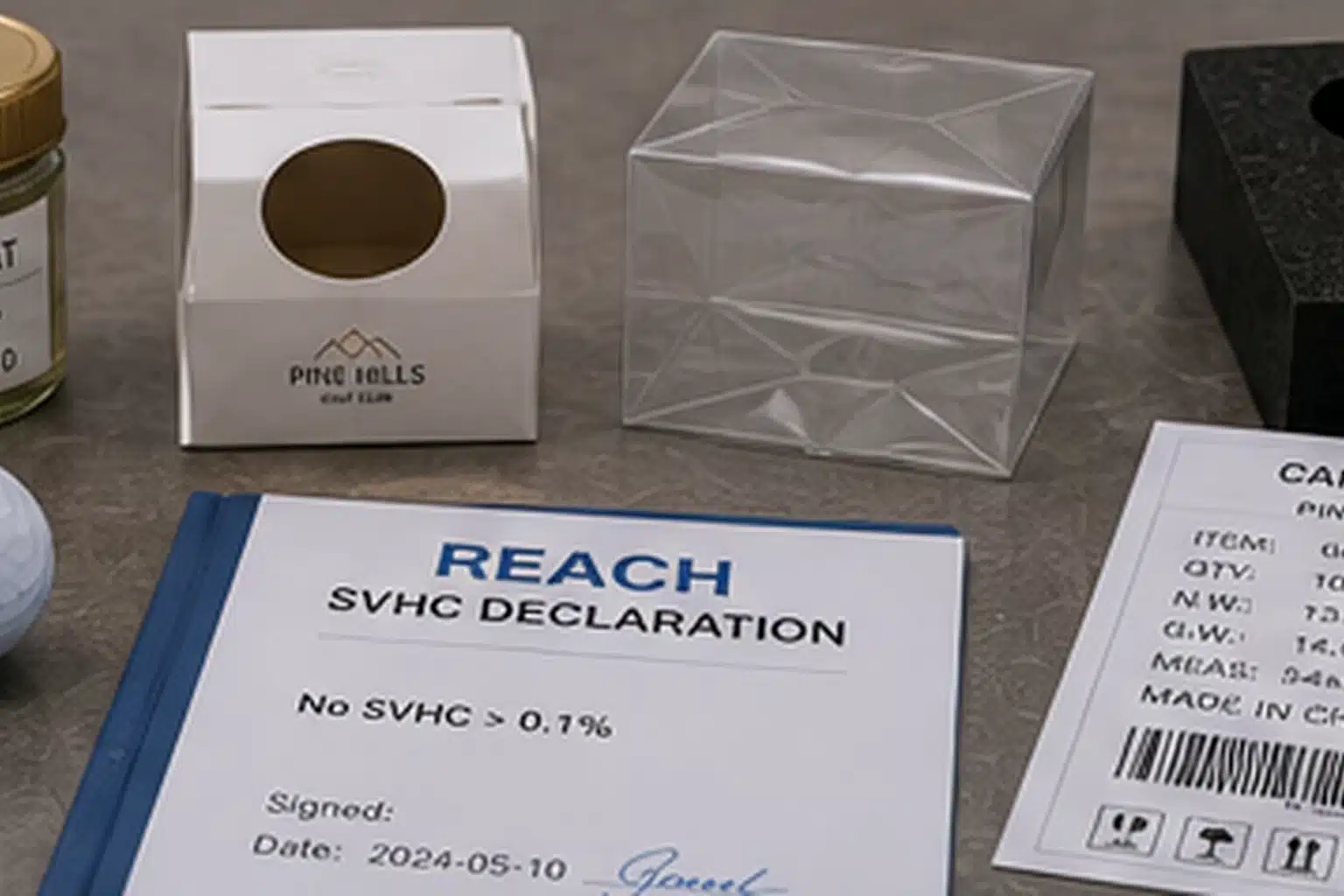
Custom golf balls may include logo ink, clearcoat, surface coating, packaging ink, adhesives, PET windows, EVA inserts, printed sleeves, polybags, cartons, labels, and pallet wrap. A one-line “EU compliant” supplier promise does not give your team enough evidence for chemical or packaging review.
| Compliance area | Buyer risk | Supplier data needed | Buyer action |
|---|---|---|---|
| Logo ink | Chemical proof gap | MSDS / SVHC declaration | Approve before bulk |
| Clearcoat | Coating document gap | Material record | Match sample |
| PET window | Material reporting | PET weight | Add EPR line |
| EVA insert | Foam / plastic data | Insert weight | Split by material |
| Retail box | Paper reporting | Paper weight | Map destination |
| Master carton | Shipment packaging | Carton weight | Include in EPR map |
| Multi-country sales | Wrong EPR assumption | Destination list | Check each market |
Factory provides packaging gross weight but no material split is a failure signal. EPR-ready data needs material-level packaging weights, not only carton gross weight. The buyer should request paper, cardboard, plastic, PET, EVA, polybag, label, filler, master carton, and pallet-wrap weights where used.
The official SVHC Candidate List should be part of your REACH / SVHC review path, especially for custom logo inks, clearcoats, coatings, adhesives, PET windows, and printed packaging. The official REACH overview is also useful when your team builds a chemical-document request for suppliers.
For packaging, the official packaging waste and PPWR resource supports the broader EU packaging framework. That does not mean one registration covers every EU sales market. Your team still needs a destination-country EPR map and supplier-provided material weights.
Request a Chemical Compliance Pack and EU EPR Packaging Weight Map before bulk production and shipment approval. Match chemical documents to the exact materials used, then map packaging weights to target sales countries. Customs clearance may move the cargo, but REACH and EPR documents help keep the commercial route open.
✔ True — EU compliance needs chemical documents and country-specific packaging mapping
REACH files and EPR packaging data should be prepared before production and shipment, especially for custom printing and multi-country sales.
✘ False — “Clearing customs means REACH and EPR questions are finished”
Retailers, marketplaces, corporate buyers, and national packaging systems may still ask for documents after customs clearance.
What Should Your EU RFQ Require?
Your RFQ may ask for custom logo balls, packaging, unit price, and DDP Europe. That is not enough for an EU-wide import and distribution plan.
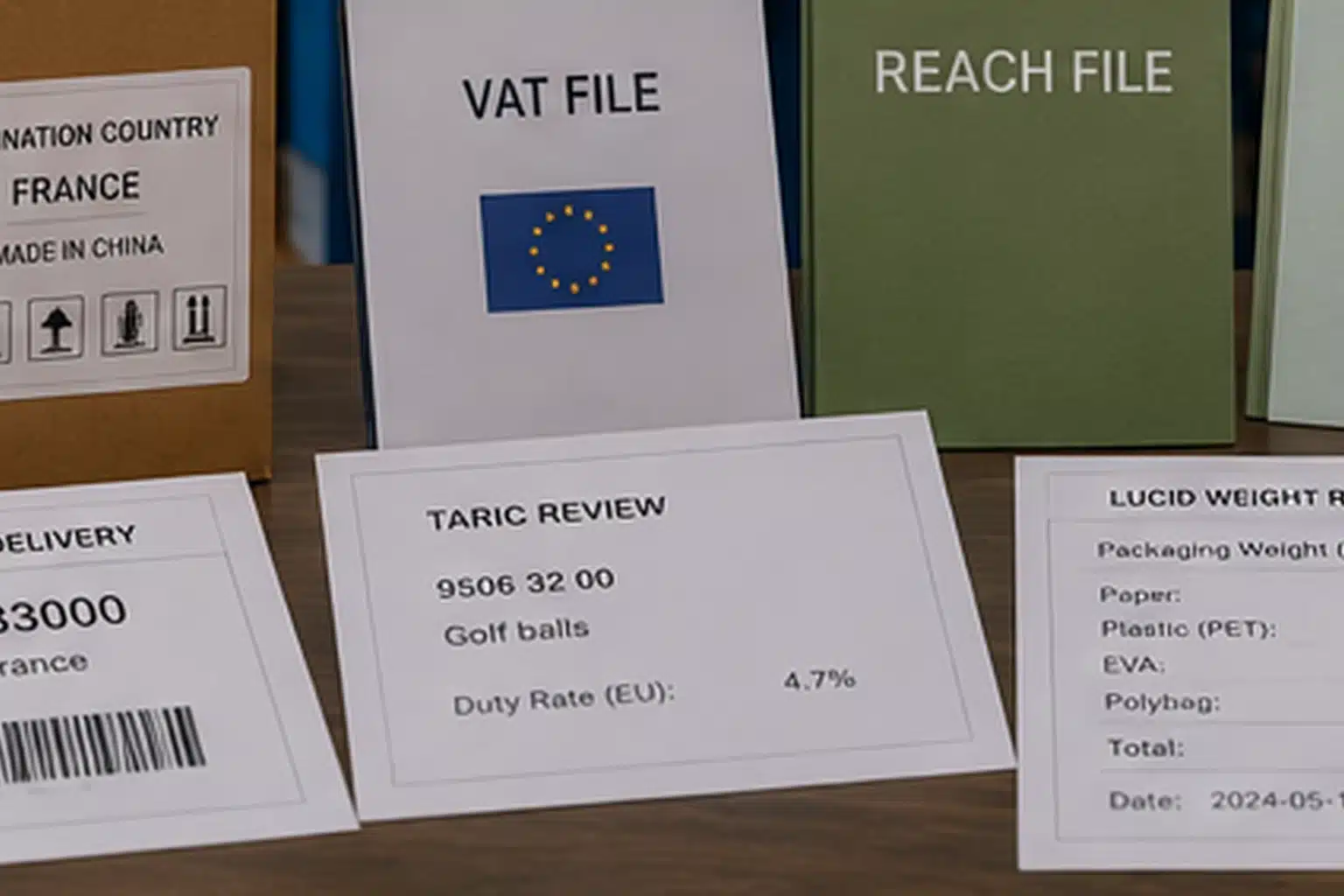
Your EU RFQ should define destination countries before it asks for a DDP quote. Require port of entry, importer role, EORI, VAT handling route, TARIC review, REACH / SVHC documents, EPR packaging weights by material, commercial invoice split, and EU warehouse delivery scope.
Destination, VAT, EPR, or warehouse?
The supplier must provide data that lets your team verify customs, VAT, chemical, packaging, and warehouse routing before shipment. This matters most when one EU entry point supports stock movement into several member states.
| RFQ item | Why it matters | What to request | Acceptance evidence |
|---|---|---|---|
| Destination countries | EPR / VAT scope | Market list | Compliance map |
| Port of entry | VAT / routing | Entry country | Route memo |
| EORI role | Import identity | Named role | Written confirmation |
| VAT handling | Accounting file | VAT route | Accountant check |
| TARIC review | Duty basis | Product breakdown | Broker memo |
| REACH proof | Chemical review | MSDS / declaration | Compliance pack |
| EPR data | Packaging duties | Material weights | Packaging map |
| Warehouse scope | Delivery success | 3PL SOP | Photo proof |
Supplier shall provide a shipment-level EU import file before release, including destination countries, port of entry, importer / EORI role, proposed TARIC line, item-level product and accessory breakdown, VAT handling route, commercial invoice split, MSDS, REACH / SVHC declarations, EPR-ready packaging material weight breakdown, packing list, carton labels, pallet plan, and EU warehouse receiving proof.
Buyer approval of EU-bound shipment requires written confirmation that the quote is based on the final destination-country list, shipment-date TARIC review, verified EORI / VAT route, approved REACH / SVHC material documentation, destination-country EPR packaging data, transparent invoice structure, and receiving-ready carton / pallet documentation.
Please quote EU shipment based on the final destination countries and warehouse route. Confirm port of entry, importer role, EORI, VAT handling route, fiscal representative if used, proposed TARIC line, item-level product and accessory breakdown, REACH / SVHC declarations, MSDS for inks and coatings, EPR packaging responsibility by destination country, paper / plastic / PET / EVA / master carton weight breakdown, commercial invoice split, DDP or DAP delivery scope, EU warehouse / marketplace receiving requirements, carton labels, pallet plan, and photo proof before shipment approval.
EU destination countries confirmed after the shipment is booked is a failure signal. Route first, quote second. Your supplier cannot prepare a good EU file if your team has not defined where the stock enters, where it sits, and where it will be sold.
FAQ
Do I need an EORI number to import into the EU?
If your company is involved in EU customs clearance, the EORI role should be confirmed before shipment.
Confirm whose EORI is used, who appears as importer, and who can provide customs documents after clearance. Keep written role confirmation in your import file. For DDP, DAP, or fiscal-representation models, EORI visibility is part of the route review, not a detail to fix later.
What is the TARIC code for golf balls?
Finished golf balls can start from TARIC / CN 9506 32 00 for review, but gift sets, tees, towels, tools, and mixed promotional items need separate checking.
Ask for item-level breakdown and broker review at shipment date. Do not let the invoice describe a mixed kit only as “sports goods.” The TARIC file should reflect the actual product mix, not just the main item.
What is the import duty on golf balls in Europe?
Duty treatment should be checked through TARIC or broker confirmation at shipment date.
Do not rely on old quotes or permanent-rate assumptions. Confirm product mix, origin, trade measures, and any current TARIC measures before shipment. Keep the review memo with the import file so your finance and operations teams can see the basis.
How does DDP work for EU imports?
DDP can simplify delivery when importer role, VAT route, invoice split, EPR scope, and warehouse delivery are visible.
Avoid one-line black-box quotes. Confirm VAT handling, fiscal representation if used, route, entry country, destination markets, and delivery scope by warehouse. DDP Europe is not automatically a multi-country compliance plan.
Can I use one packaging registration for all EU countries?
Do not assume one packaging registration covers every EU sales market. Packaging obligations and reporting can differ by destination country.
Map target countries first. Request material-level packaging weights from the supplier. Then confirm EPR responsibility by market with your compliance advisor or local scheme partner. One EU route can still require several national packaging checks.
Are custom printed golf balls subject to REACH?
Custom printed golf balls may need chemical documents for inks, coatings, adhesives, PET windows, printed packaging, or related materials.
Request MSDS, REACH / SVHC declarations, ink records, and coating records before bulk production. Match documents to the exact order. A general “EU compliant” statement is weaker than material-specific documentation.
Can I clear goods in one EU country and sell in another?
You can plan cross-border distribution, but VAT route, stock movement, EPR obligations, warehouse routing, and destination-country rules should be reviewed first.
Confirm port of entry, first EU warehouse, destination countries, VAT handling, EPR map, and 3PL receiving rules before shipment. Ask your accountant and broker before assuming the first-entry model supports every sales market.
What should a China supplier provide for EU DDP?
A supplier should provide destination countries, port of entry, EORI role, VAT route, TARIC review, invoice split, REACH documents, EPR packaging weights, and warehouse delivery proof.
Request documents before PO approval. Recheck when packaging, destination countries, product mix, or warehouse route changes. Keep the import file with the shipment so the DDP quote can be audited later.
Conclusion
The safest EU import is not the simplest DDP Europe quote. It is the shipment file your team can use across customs, VAT, REACH, EPR, and warehouse routing.
Before importing golf balls from China to the EU, confirm TARIC review, EORI role, VAT handling, REACH / SVHC documents, destination-country EPR packaging data, invoice split, and EU warehouse delivery scope.
If the supplier cannot provide those documents before shipment, your team does not yet have an EU-ready import and distribution process. The golf balls may clear customs, but your route can still land in the rough.
You might also like — How Much Does It Cost to Import Golf Balls from China?