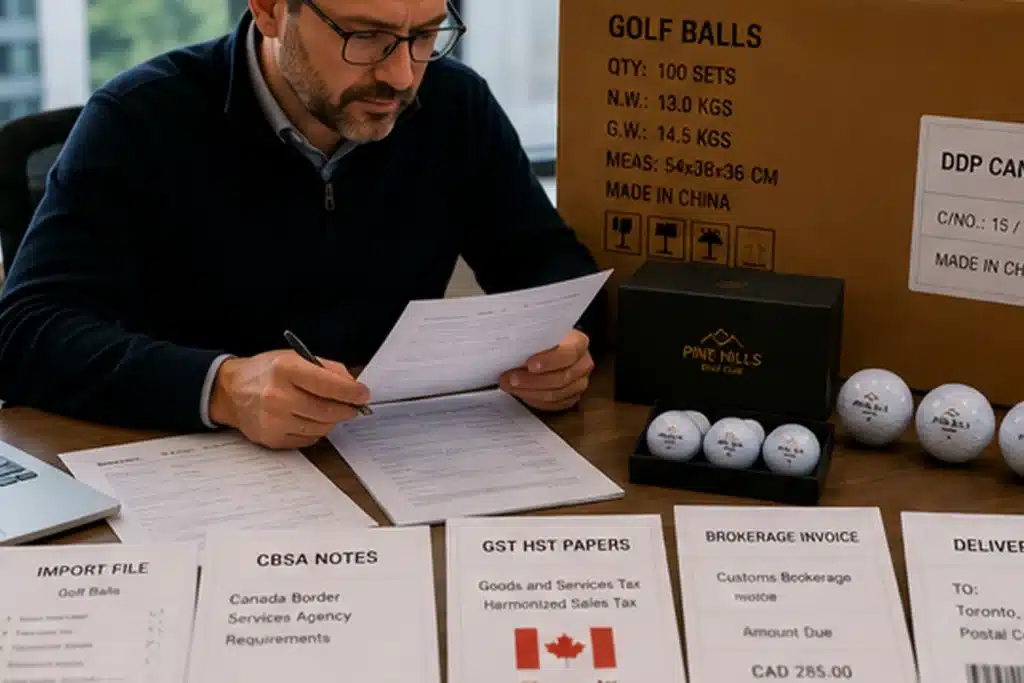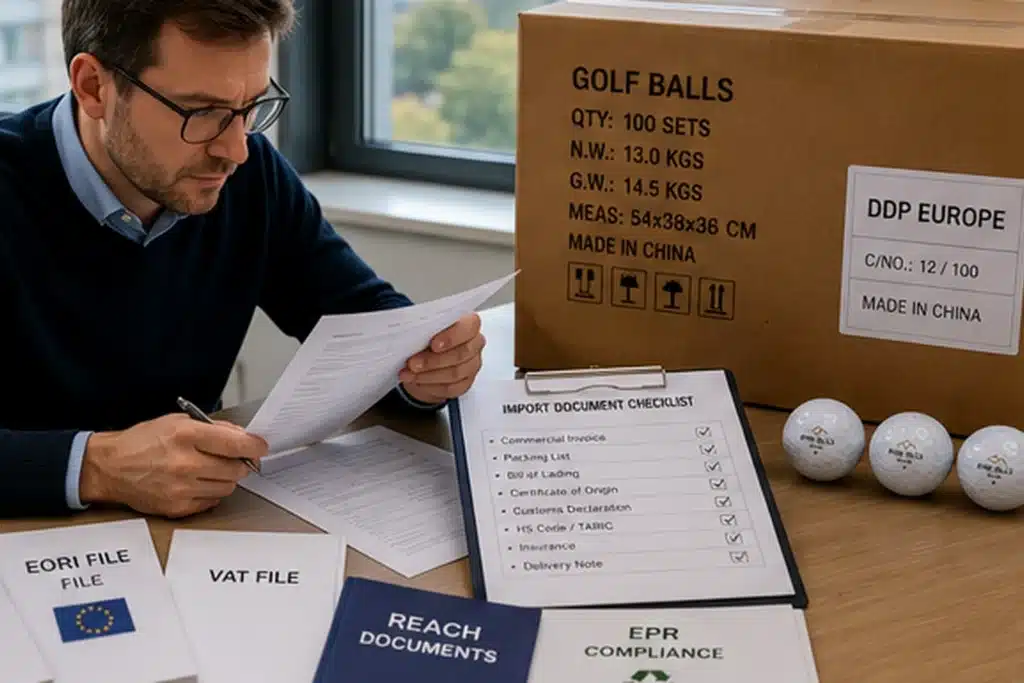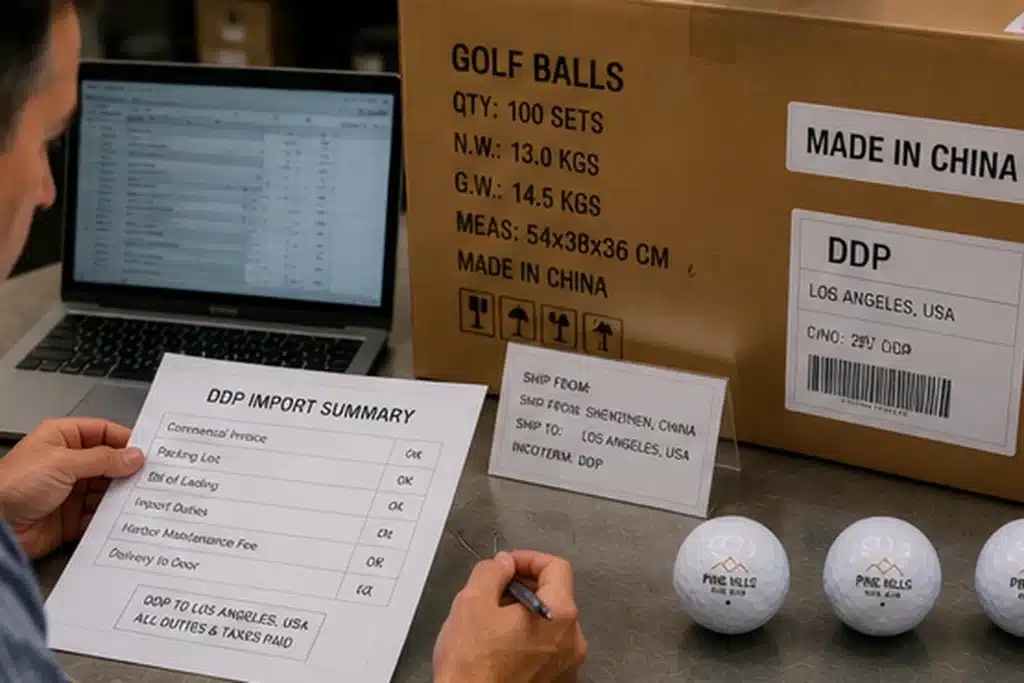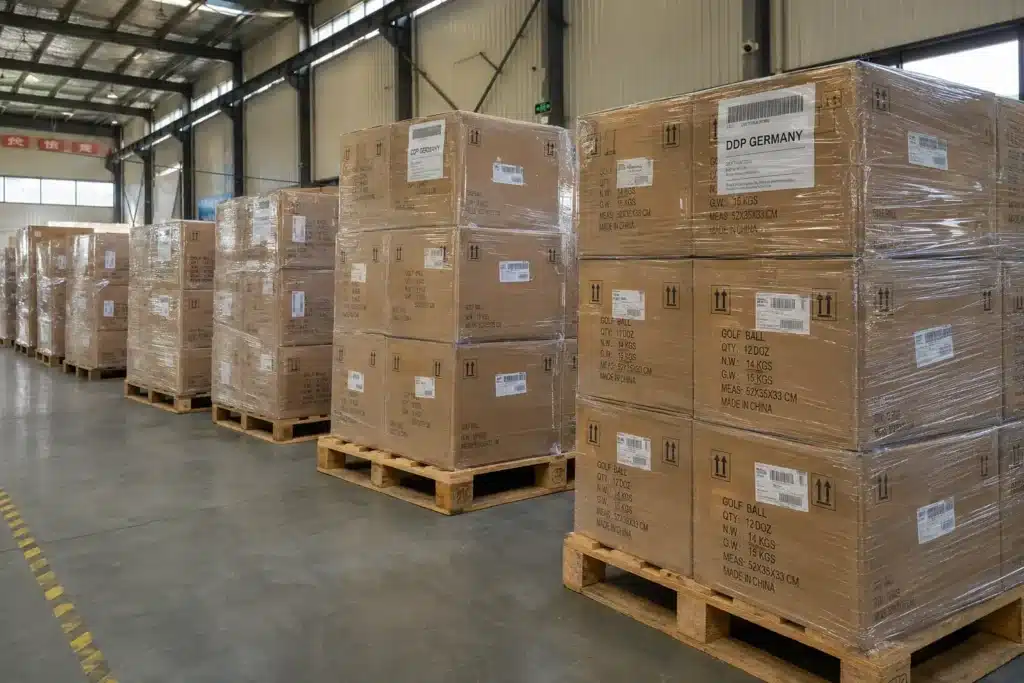
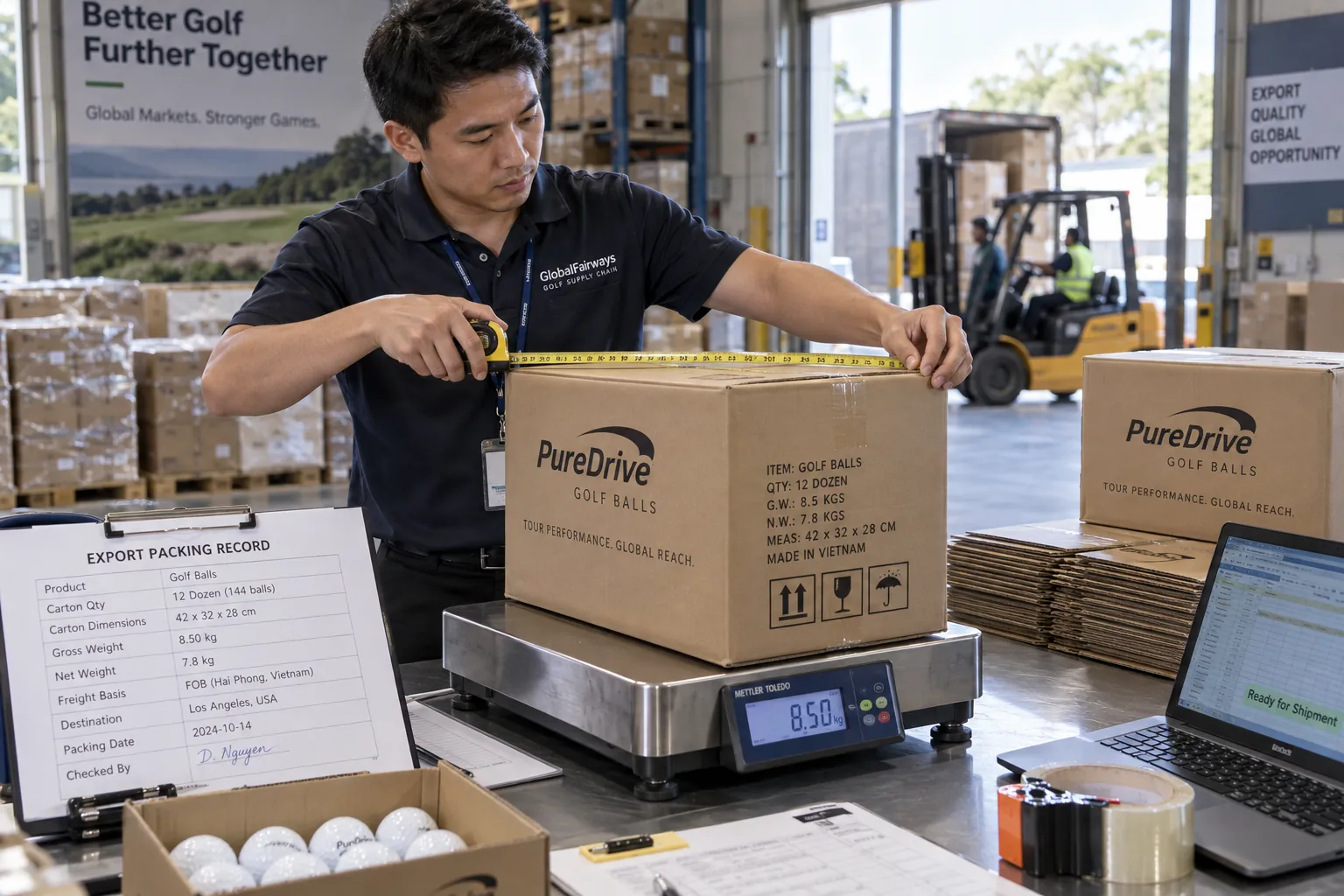
To calculate golf ball shipping cost from China, convert the final packing data into carton count, gross weight, CBM, and chargeable weight, then compare freight quotes using the same route and delivery scope. For planning, 5,000 balls packed 240 per carton equal about 21 cartons, 294 kg gross, and 0.71 CBM.
This calculation is only reliable when the freight quote uses the final approved packing revision. A change in master-carton size, pcs/carton, retail pack-out, gross weight, or palletization can change CBM or chargeable weight even when the golf-ball quantity stays the same.
Use this procurement control sequence:
Pack → Measure → Calculate → Compare → Verify → Release
A freight quote is not decision-ready until you can trace the number to the same packing revision, carrier or forwarder chargeable-weight basis, route, named destination, included scope, and valid-through date.
You are not trying to memorize freight formulas. You are proving that the number entering your PO, launch budget, or replenishment plan still belongs to the shipment your supplier will actually pack and ship.
How Do You Verify a Golf Ball Freight Quote?
A supplier may send you “shipping: $800” while the retail box, master carton, pallet plan, or destination scope is still changing. The problem is not whether $800 sounds high or low. The problem is that you cannot yet prove what shipment the number describes.
A golf-ball freight quote is verifiable only when you can trace the price to the final packing revision, chargeable-weight basis, route, named destination, and included scope. A one-line shipping number is not sufficient for procurement approval when those assumptions remain invisible.
Your first control should be a version-controlled Final Packing Data Sheet.
It should identify:
-
packing revision ID;
-
product revision where relevant;
-
pieces per master carton;
-
final master-carton dimensions;
-
net and gross weight per carton;
-
total carton count;
-
total CBM;
-
palletized or non-palletized status;
-
pallet dimensions and weight where applicable;
-
date the packing data was confirmed;
-
linked freight-quote revision.
This prevents a surprisingly common sourcing problem:
Packing Rev.05 ships while Freight Quote Rev.01 was calculated from Packing Rev.02.
Using a freight price for final approval before the final pack-out is frozen is a failure signal. The supplier may have quoted in good faith, but your team should treat that number as provisional until the physical basis matches production.
| Pain / Decision | Required Evidence | Why It Matters | Buyer Action |
|---|---|---|---|
| Freight shown as one number | Packing + quote revision | Prevents version mismatch | Match revisions |
| Destination unclear | Named delivery point | Final mile changes scope | Confirm exact destination |
| Scope unclear | Included / excluded matrix | Prevents false comparison | Normalize quotes |
| Quote may expire | Valid-through date | Rates change by lane and time | Reconfirm before booking |
| Local charges unresolved | Known / Estimated / Open list | Exposes remaining uncertainty | Record open exposure |
What Must the Quote Scope Show?
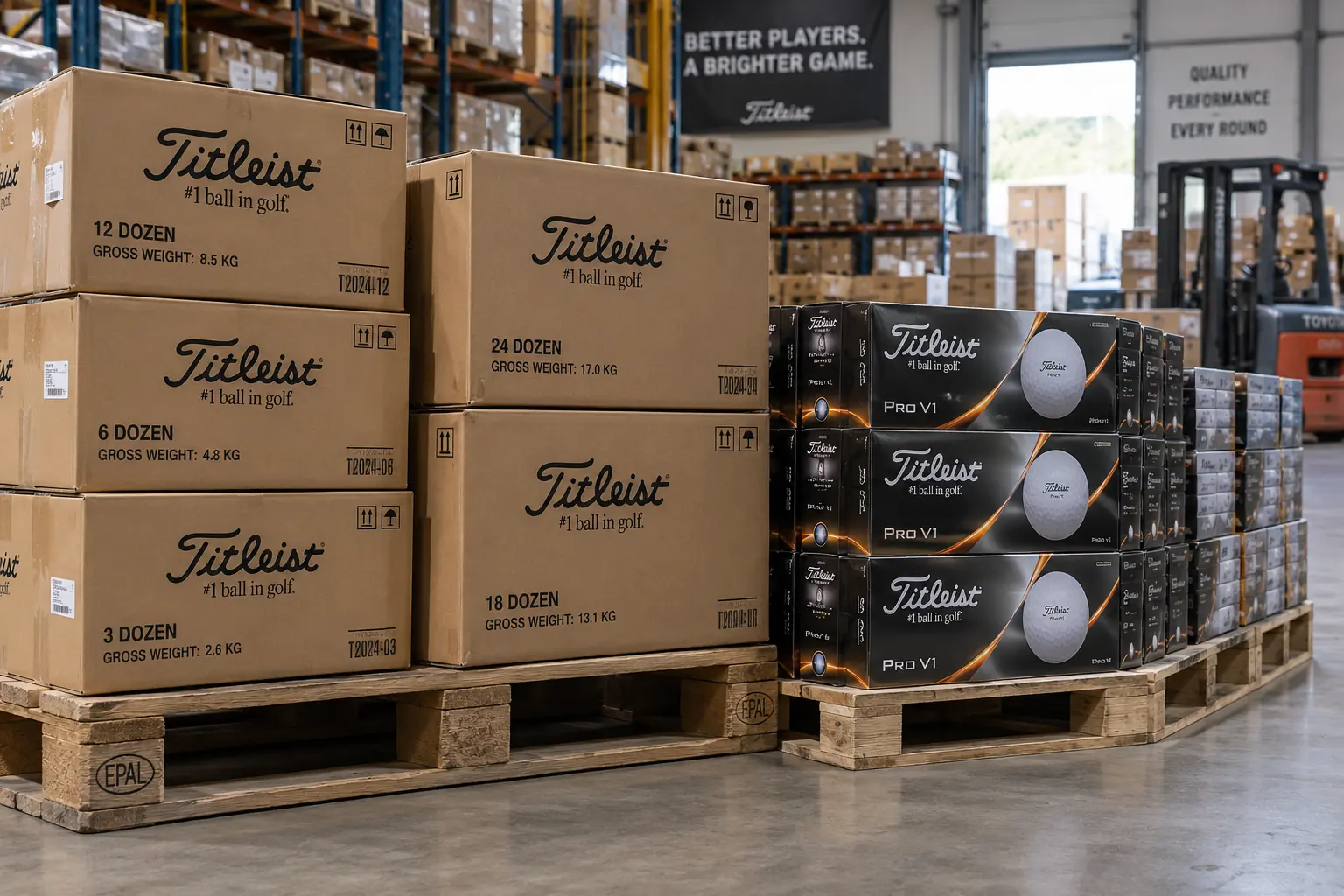
The freight number should also tell you what you are actually buying.
Separate the scope into buyer-auditable lines:
-
origin trucking;
-
origin handling or CFS where applicable;
-
main freight;
-
known destination handling or CFS;
-
final delivery to the named destination;
-
palletization;
-
cargo insurance.
Not every destination-side cost can be known when the first quote is issued. Storage, waiting time, re-delivery, special handling, or other event-driven charges may depend on what actually happens.
Do not force those items into an unrealistic “everything included” promise. Mark them Known, Estimated, or Open.
That makes two freight quotes genuinely comparable. A lower headline number may simply exclude more services.
Please provide the freight quote using the final approved packing revision, including master-carton dimensions, pcs/carton, carton count, gross weight, total CBM, palletization status, actual weight, dimensional weight, chargeable weight, DIM divisor and rounding basis, route/service, included and excluded charges, named destination, quote date, and valid-through date.
If a sea-DDP offer raises questions about duties, customs value, or Importer of Record responsibility, move those questions to the separate guide to verify DDP import cost assumptions. This page stays focused on the physical freight number and freight scope.
✔ True — Freight becomes decision-grade when the physical basis and commercial scope can be audited
Your team should be able to connect the quoted number to one packing revision, one route, one destination, and one defined scope before using it in a PO or launch budget.
✘ False — “A door-to-door number is automatically a complete freight quote”
Door-to-door describes the commercial promise. It does not prove that the price still matches the final cartons, chargeable-weight basis, destination, or rate window.
How Do Carton Data and CBM Set Freight Cost?
You may order 5,000 or 12,000 golf balls, but a forwarder does not price an abstract ball count. Your shipment becomes a freight calculation only after those balls become cartons, kilograms, cube, and sometimes pallets.
Your golf-ball quantity does not determine freight until it is converted into final cartons. Two orders containing the same number of balls can create very different CBM and gross weight when pack-out changes, so freight approval should follow production-pack approval rather than an early packing estimate.
For your initial freight estimate, you can use this planning baseline:
240 balls/carton → 40 × 30 × 28 cm → approximately 14 kg gross → 0.0336 CBM/carton
Using this pack-out, 5,000 balls require approximately 21 cartons, with about 294 kg gross weight and 0.71 CBM.
Use these figures as a planning reference only. Your final freight calculation should always use the actual carton dimensions, pieces per carton, gross weight, and packing revision approved for your order.
The physical calculation is straightforward:
CBM = carton length × width × height in meters × carton count
The more useful B2B insight appears when you compare equal order quantities under two real pack-outs.
| Pack-out | Carton Basis | Cartons at 12,000 | Total CBM / Gross kg | Buyer Action |
|---|---|---|---|---|
| Bulk | 300 pcs; 39 × 29 × 22 cm | 40 | ≈0.995 CBM / 580 kg | Use bulk packing basis |
| Retail | 240 pcs; 40 × 30 × 28 cm | 50 | ≈1.68 CBM / 700 kg | Recalculate after retail approval |
In our two pack-out examples, retail packing increases CBM per ball by about 68.8% and gross kg per ball by about 20.7% compared with bulk packing.
Those percentages are not a universal retail-packaging penalty. They show how the same 12,000 golf balls changed as a physical shipment when the pack-out changed.
That is the commercial point:
Packaging approval is already a freight decision.
What Does the 240-Ball Baseline Prove?
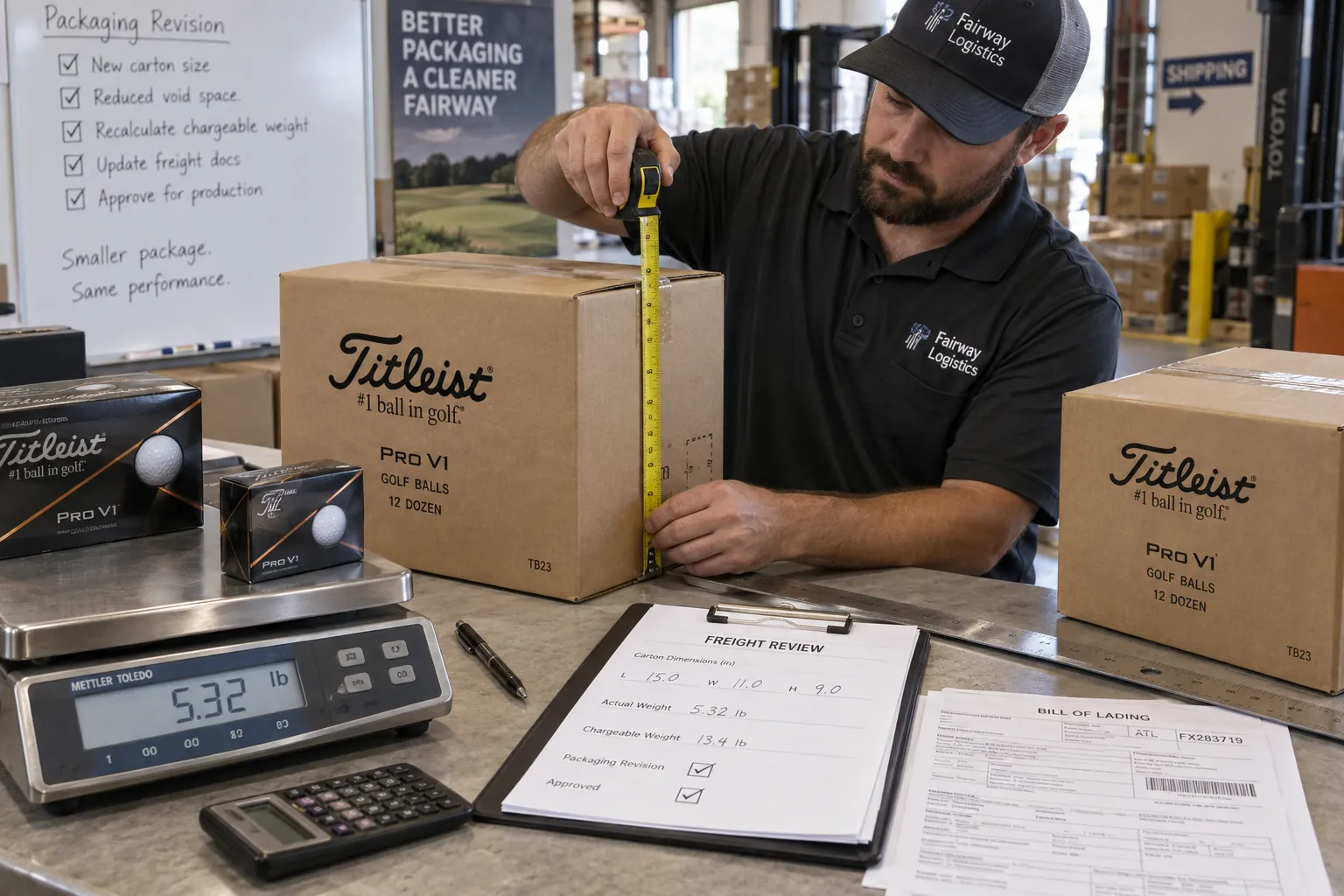
The 240-ball baseline is useful because it gives you something concrete to audit—not because every golf-ball supplier should use the same carton.
Under the USGA Equipment Rules, a conforming golf ball cannot weigh more than 45.93 g.
At that maximum, 240 balls would weigh approximately 11.02 kg before packaging.
Compare that with the roughly 14 kg gross planning carton. The difference can include sleeves, dozen boxes, inserts, labels, the master carton, and protective packing.
This is why:
ball count × ball weight
is not the same as:
shipping weight
Before booking, request a Final Packing Data Sheet showing the packing revision ID, master-carton dimensions, pcs/carton, carton count, net and gross weight, total CBM, palletization status, and linked freight-quote revision. If carton size, carton count, gross weight, retail pack-out, or palletization changes, reopen the freight calculation.
Your product specification can stay identical while your logistics cost changes materially. That is why final freight approval should sit downstream of final pack-out approval.
When Does Packaging Change Chargeable Weight?
A sample may ship in a plain carton. Bulk production may later add sleeves, dozen boxes, PET windows, EVA inserts, presentation boxes, larger master cartons, or pallets. Once those changes alter the physical shipment, the original freight quote may describe cargo that no longer exists.
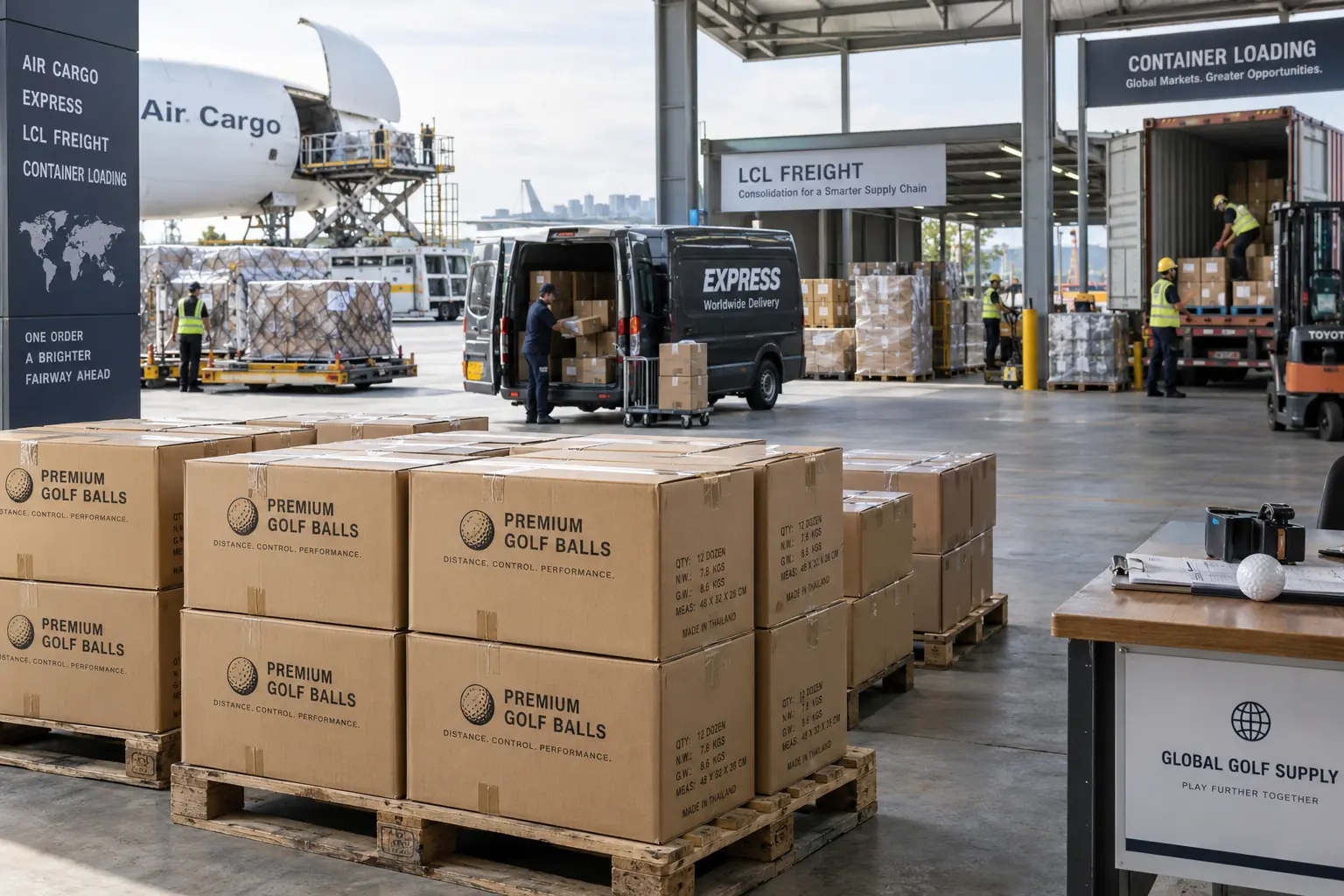
Packaging should trigger a freight re-quote whenever it changes carton dimensions, carton count, gross weight, pack-out density, or palletization. Do not assume /5000 or /6000 is a universal rule; verify the divisor, measurement convention, rounding rule, and final chargeable weight used by the actual carrier or service.
Your freight worksheet should show five separate fields:
Actual Gross Weight — what the packed shipment physically weighs.
Dimensional / Volumetric Weight — the shipment’s occupied space translated into a weight basis.
Chargeable Weight — the weight the carrier or forwarder actually uses for rating.
DIM Factor / Divisor — the conversion factor attached to the carrier, service, or rate basis.
Measurement / Rounding Rule — how carton dimensions and fractional weights are treated.
This distinction matters because /5000 and /6000 are common freight shortcuts, not golf-ball rules.
Current UPS dimensional-weight guidance shows that one carrier can use different divisors by rate type, including 139 in³/lb for Daily Rates and 166 in³/lb for Retail Rates.
FedEx dimensional-weight guidance likewise illustrates that the billing method belongs to the carrier and service rather than to the product itself.
There is no golf-ball-specific dimensional divisor.
Using /5000 or /6000 without recording the carrier or service basis is therefore a failure signal.
When Should Packaging Trigger a Re-Quote?
Use one procurement rule:
Packing Revision Change → Freight Basis Check → Re-Quote if Physical Inputs Changed
This is not only an internal control. Flexport’s cargo remeasurement guidance explains that LCL cargo can be remeasured at the CFS and that packaging or palletization can add weight and volume; for air freight, changes can also affect chargeable weight and the final invoice.
| Packing Change | Freight Variable Affected | Re-Quote? | Buyer Action |
|---|---|---|---|
| Master-carton size | CBM / DIM weight | Yes | Recalculate |
| Pcs/carton | Carton count / density | Yes | Update data sheet |
| Gift box or insert | Cube / gross weight | Yes | Recheck chargeable weight |
| Palletization | Dimensions / weight | Yes | Add pallet data |
| Artwork only, same physical pack | Usually none | Verify first | Confirm dimensions unchanged |
A plain sample carton and the final retail pack-out are not interchangeable freight bases simply because both contain the same golf ball.
If your project uses EVA inserts, magnetic boxes, PET windows, or other presentation packaging, compare the packaging-specific freight impact in How Does Gift Box Packaging Affect Golf Ball Air Freight Cost? before approving the final pack-out.
Freight approval requires written confirmation of actual gross weight, dimensional weight, chargeable weight, DIM divisor, measurement and rounding basis, route/service, included and excluded charges, named destination, and quote-validity date. Shipment booking is released only when the freight quote matches the final approved packing revision.
✔ True — Chargeable weight belongs to the actual carrier and service basis
Actual weight, dimensional weight, divisor, rounding method, and final chargeable weight should appear together so your team can reproduce the billing logic.
✘ False — “Express always means /5000 and air always means /6000”
Those ratios can be useful for simulations, but the approved freight model should use the method stated in the actual carrier or forwarder quote.

Which Freight Mode Fits Your Golf Ball Order?
You can receive several attractive shipping prices for the same order and still have no valid comparison if one uses sample cartons, another excludes final delivery, and a third hides destination-side charges.
Compare express, air, LCL, FCL, or a sea-DDP offer using the same final pack-out, route, destination, and quote scope. LCL and FCL describe shipment formats, while DDP under Incoterms® 2020 is a delivery term that allocates seller and buyer obligations, costs, and risks to a named destination. Compare a DDP offer by its included scope rather than treating DDP as a transport mode by itself.
Express can fit samples, replacements, and urgent low-volume shipments, but dimensional billing can change the apparent economics quickly.
Air freight can support tighter launch or replenishment windows, but the useful number is still the chargeable-weight-based quote for the final pack-out.
LCL can suit smaller ocean shipments, although minimum charges and destination handling may make freight per ball relatively high on a small pilot.
FCL becomes worth modeling as shipment volume grows, especially for dense cargo such as golf balls. But a fixed CBM crossover should not decide the booking.
A sea-DDP offer can simplify the delivered commercial scope. What matters here is whether its freight and delivery scope can be compared with the other quotes on the same pack-out and destination.
| Freight / Delivery Option | Typical Decision Context | Main Quote Risk | Evidence to Request |
|---|---|---|---|
| Express | Small / urgent | DIM billing | Carrier/service basis |
| Air | Urgent commercial cargo | Chargeable weight | Air quote worksheet |
| LCL | Smaller ocean cargo | Destination charges | Local-charge estimate |
| FCL | Larger / dense cargo | Cube vs payload | Lane-specific quote |
| Sea DDP offer | Broader delivered scope | Included-scope opacity | Scope matrix |
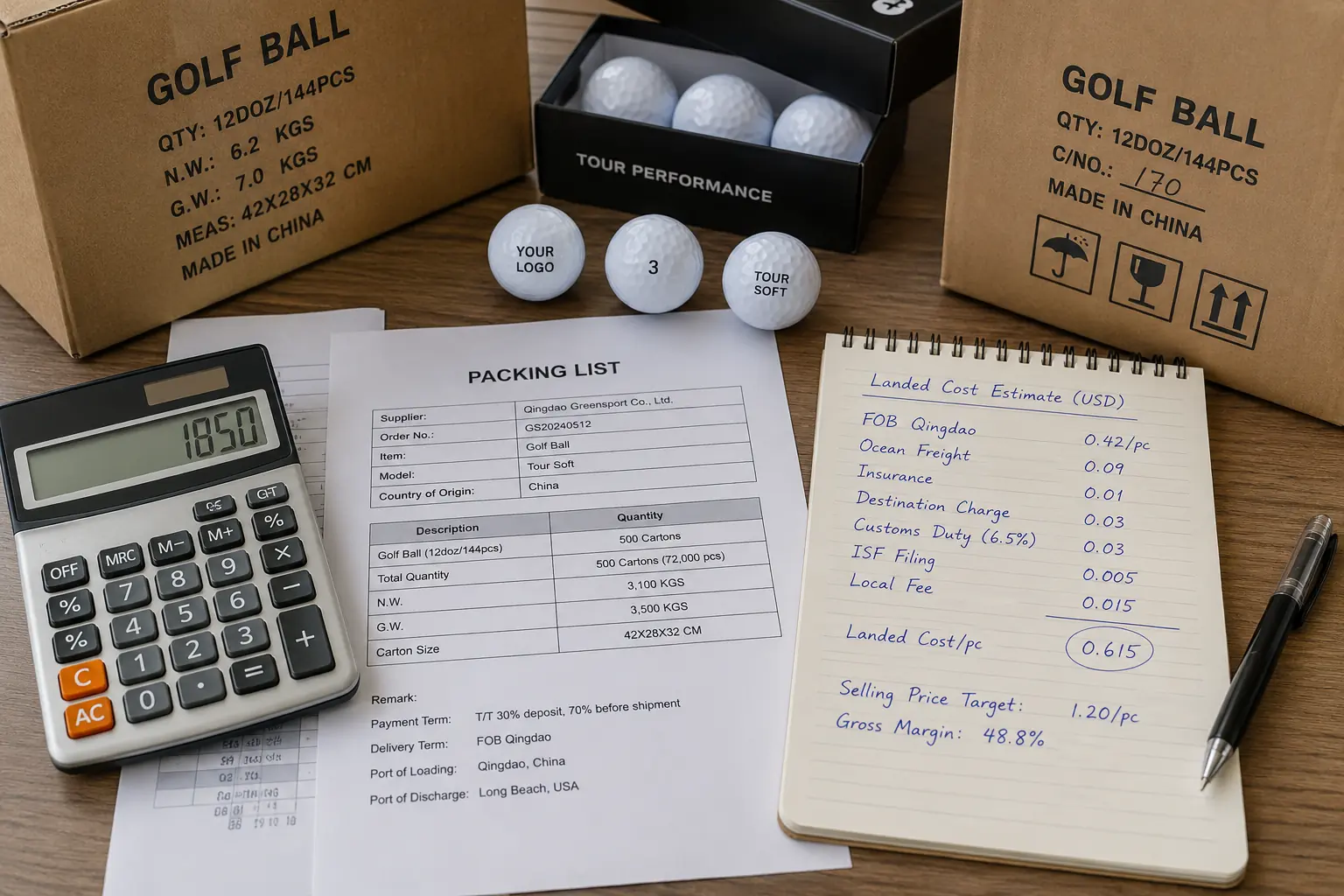
Why Is an LCL Origin Quote Incomplete?
An LCL shipment involves more than the ocean line.
The physical flow is closer to:
Origin handling → consolidation → ocean freight → destination deconsolidation → final delivery
That creates two procurement controls.
First, ask for known destination-side charges or a reasonable local-charge estimate before booking. Classify uncertain event-driven amounts separately as Open rather than pretending every possible charge can be predicted.
Second, recognize why small LCL orders can show surprisingly high freight per ball. Minimum weight-or-measure charges, CFS handling, documentation, booking, trucking, and destination handling are spread across fewer saleable units.
A low LCL origin quote with no destination-charge visibility is therefore a failure signal.
For LCL versus FCL, Flexport’s LCL/FCL guidance notes that the break-even point varies with origin and the ocean freight market.
Do not let a permanent “13–15 CBM” rule make the purchasing decision.
Once shipment cube becomes material, obtain paired LCL and FCL quotes on the actual lane.
FCL planning also needs a density check. Maersk container guidance lists a 20-foot standard container at about 33.2 m³ nominal capacity and 28,300 kg maximum payload, while also noting that specific limits can vary by country.
For dense golf-ball cargo, check both:
usable cube + permitted payload
—not just the number of cartons that mathematically fit inside nominal container volume.
As of September 10, 2026, Drewry’s World Container Index assessment placed Shanghai–Los Angeles at $7,352 per 40-foot container and Shanghai–New York at $9,726, a difference of more than $2,300 on the same assessment date. Freight is lane- and time-specific, so every quote should carry both a route and a validity date.
When the physical freight mode and scope are approved, use the separate guide on how to import golf balls from China if your team needs the broker, documentation, receiving, and operational import workflow.
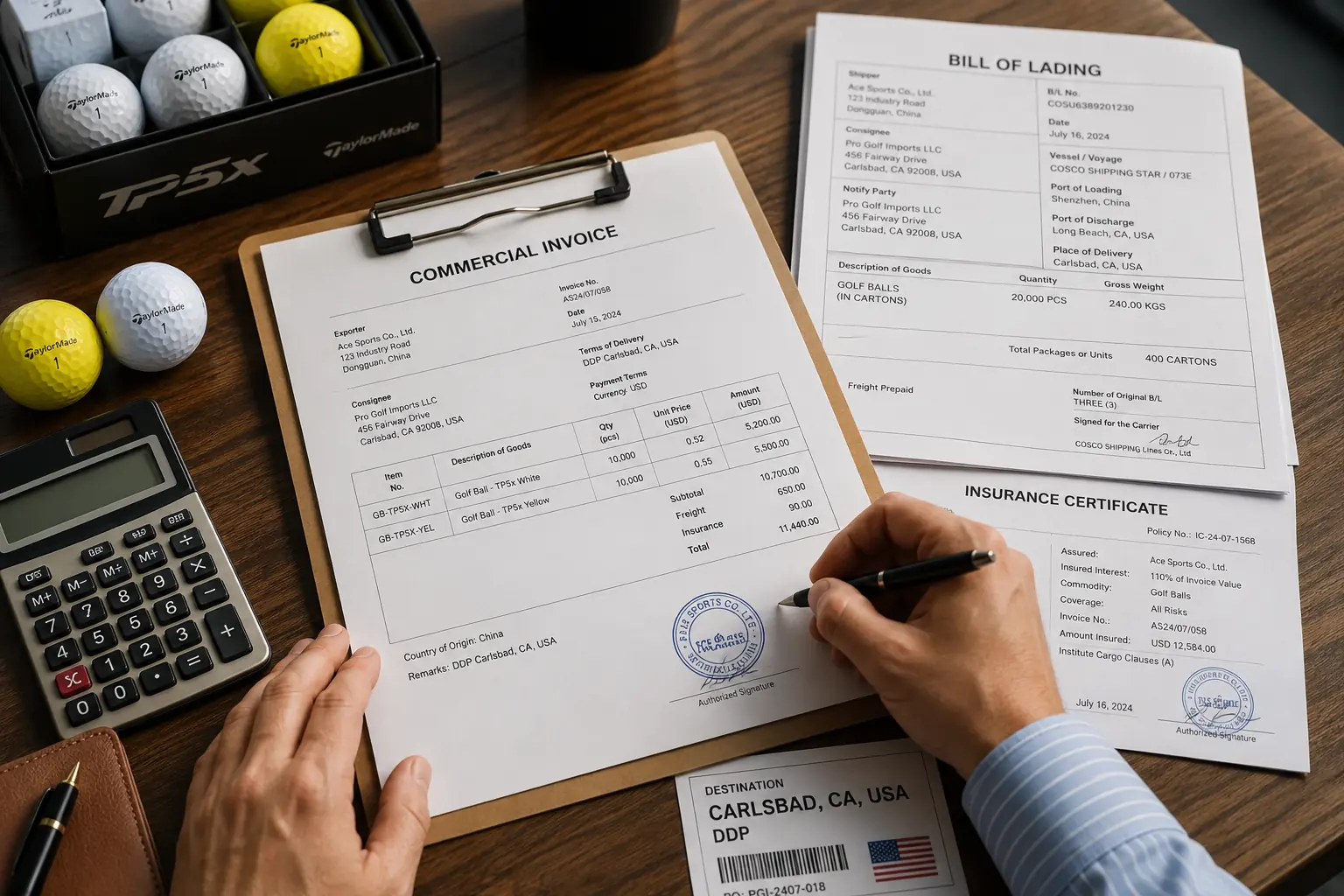
How Do You Protect Pallets and Retail Packaging?
The balls can arrive perfectly playable while the master cartons are crushed, retail boxes are wet, labels are torn, or an unstable pallet creates rework before your customer ever sees the product.
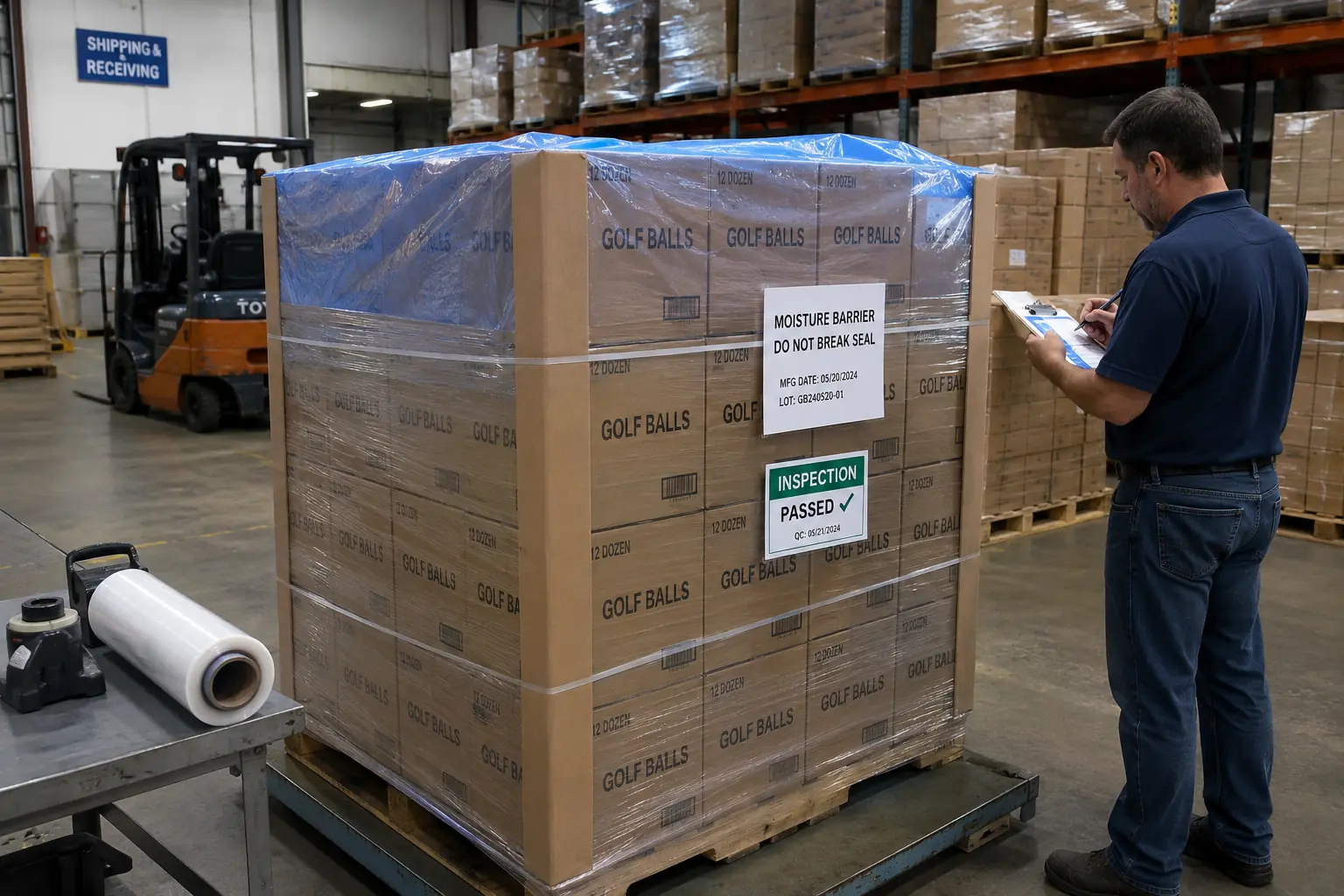
Your freight decision is incomplete if the golf balls arrive safely but the retail cartons do not. Approve pallet footprint, carton condition, stack height, edge protection, moisture control, wrap or banding, labels, and release photos so receiving can verify the same unit load your supplier actually shipped.
A pallet of golf balls places meaningful weight on a relatively compact footprint. Lower-carton pressure, pallet overhang, load shifting, and moisture exposure can therefore damage the commercial presentation even when the balls themselves remain intact.
The right control is not one universal board grade or one fixed number of stretch-wrap layers.
It is a Pallet Release Pack matched to the actual shipment.
The pack should include:
-
packing list;
-
pallet dimensions;
-
pallet gross weight;
-
final carton count;
-
stack pattern;
-
buyer-approved carton specification;
-
pallet condition;
-
edge or corner protection where required;
-
moisture-control method;
-
approved wrap or banding method;
-
pallet labels;
-
four-side pallet photos;
-
loading photo where practical.
Current FedEx pallet-packing guidance supports the same functional principles: match the pallet and bracing to the load, avoid overhang, use load and edge protection where needed, and secure the unit load against shifting.
| Cargo Risk | Control | Evidence | Acceptance |
|---|---|---|---|
| Bottom-carton crush | Stack / carton plan | Pack-out photo | No visible collapse |
| Pallet overhang | Footprint control | Four-side photos | Within approved footprint |
| Corner damage | Edge protection | Pallet photos | Protected corners |
| Moisture exposure | Moisture control | Pack-out record | Dry, intact packaging |
| Load shift | Wrap / banding plan | Release photo | Stable unit load |
What Evidence Should You Approve Before Release?
Match the Pallet Release Pack to the same packing revision used for the freight quote.
That closes the procurement-control loop:
Final Packing Data Sheet → Freight Quote Revision → Pallet Release Pack
If final palletization adds weight or changes the external dimensions after the quote was calculated, reopen the freight basis before release.
This is also why there is no permanent answer to “how many golf balls fit on a pallet?” The safe number depends on carton dimensions, pallet footprint, carton strength, stack height, total gross weight, handling conditions, route, and warehouse requirements.
Your receiving team should be able to compare the arriving pallet with the release evidence—not rely on a verbal promise that it was “packed normally.”
✔ True — Pallet requirements should match the actual load and receiving environment
Your release criteria should control footprint, stack stability, carton condition, protection, labels, and evidence rather than copying one packaging prescription across every shipment.
✘ False — “One carton grade and one wrap standard works for every golf-ball shipment”
Load density, carton construction, carrier handling, route, and buyer receiving requirements all affect the appropriate pallet standard.
FAQ
How Much Does a Carton of Golf Balls Weigh?
There is no universal golf-ball carton weight because pieces per carton, retail packaging, inserts, master-carton material, and protective packing vary. As a Golfara planning baseline, a 240-ball master carton is approximately 14 kg gross, but procurement should use the final production packing record.
Confirm pieces per carton, net weight, gross weight, and carton dimensions together. If the order changes from bulk packing to sleeves, dozen boxes, gift packs, or another physical configuration, both total carton count and shipment weight can change even when the number of golf balls stays identical. Match the weight to the approved packing revision before accepting the freight quote.
How Many Golf Balls Fit on One Pallet?
There is no universal balls-per-pallet number because master-carton dimensions, pallet footprint, carton strength, permitted stack height, total gross weight, handling conditions, and warehouse receiving requirements determine the safe unit load. Build the quantity from the approved carton and pallet plan.
Start with cartons per layer and the permitted number of layers, then calculate total carton count and pallet gross weight. Check for unacceptable overhang and whether lower cartons can support the planned load. Keep the final pallet plan or four-side release photos with the shipping record instead of storing a permanent balls-per-pallet assumption.
Why Can Small LCL Orders Cost More per Ball?
Small LCL shipments can have higher freight per ball because minimum and shipment-level charges are allocated across fewer saleable units. CFS handling, documentation, booking, trucking, and destination handling do not necessarily decrease in direct proportion to the number of golf balls shipped.
Separate the freight lines before concluding that the supplier or forwarder quoted too high. Compare the same route and scope across order sizes. That shows which costs scale mainly with cube or weight and which remain closer to shipment-level charges. This is a freight-side fixed-cost effect, not a complete landed-cost calculation.
Does Palletization Change Chargeable Weight?
Yes, it can. Palletization adds physical weight and can increase the shipment’s external dimensions, so air, express, and other weight-or-volume-based calculations may need to be rerun after the final unit load is known.
Record pallet dimensions, pallet weight, total palletized gross weight, and number of pallets. Then apply the carrier or forwarder’s actual method again. Palletization may improve handling protection while adding cube or weight, so it should be treated as a controlled freight input rather than a free operational detail.
How Long Should a Freight Quote Stay Valid?
There is no universal freight-quote validity period. The supplier or forwarder should state both an issue date and a valid-through date because freight rates, surcharges, capacity, route conditions, and available services can change while your golf balls are still in production.
Reconfirm before booking, particularly when production or packaging approval takes several weeks. A material change in carton dimensions, palletization, service, route, or destination should also trigger review even if the original validity period has not expired. A usable quote must remain valid both in time and in physical shipment basis.
Can You Reuse a Freight Quote for a Reorder?
Only when the packing revision, route, service, named destination, chargeable-weight basis, scope, and current freight conditions still match. Reordering the same golf-ball SKU does not automatically recreate the same physical shipment or the same carrier pricing environment.
Use the previous quote as a comparison record rather than automatic approval. Recheck master-carton dimensions, pieces per carton, carton count, gross weight, CBM, palletization, carrier or service basis, route, and valid-through date. If a material freight input changed, request a refreshed quote before committing the reorder.
Conclusion
Your safest golf-ball freight number is not the lowest quote. It is the number your team can recalculate and defend from final pack-out through booking.
Control four things: the final packing revision, the chargeable-weight basis, the included and excluded freight scope, and the quote validity plus re-quote triggers. Those controls turn freight from a supplier promise into a procurement record.
Once the physical freight number is verified, the next question is how that freight fits into the complete.
You might also like — How Much Does It Cost to Import Golf Balls from China?