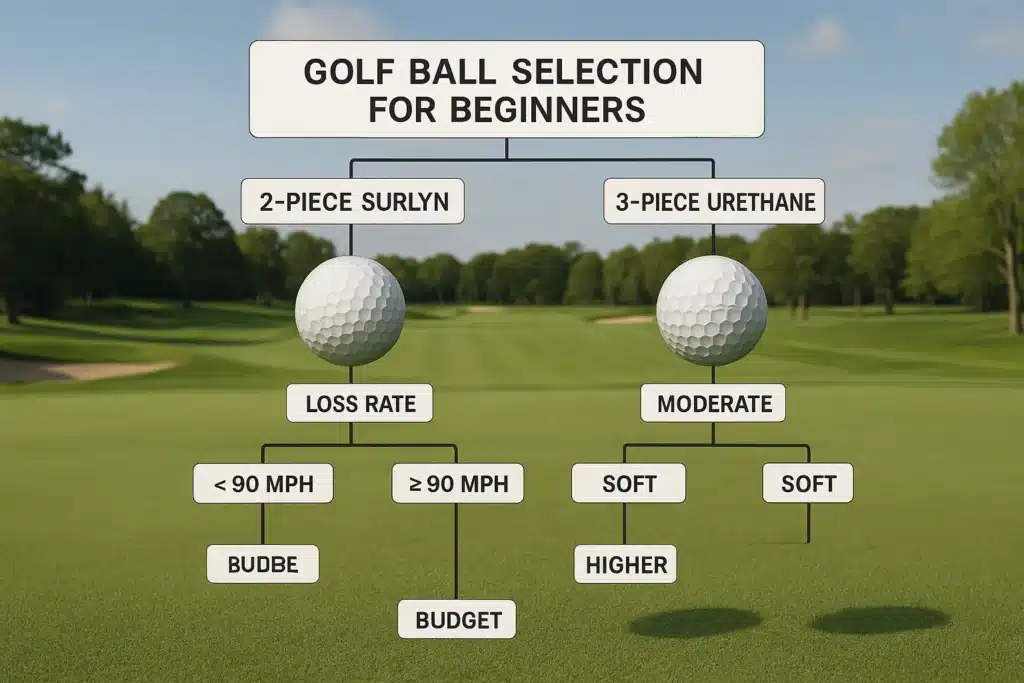
Beginner rule: pick by loss rate, driver speed, greens, budget. ≥2 lost/round → 2-piece Surlyn. ≤1 on firm/fast → test 3-piece (start Surlyn; upgrade to 3-piece urethane if more bite). Prove it with a 30-minute on-course A/B.
What actually decides between 2-piece Surlyn and 3-piece urethane for beginners?
Decide by four levers: loss rate, swing speed, green speed/firmness, and budget. Loss ≥2/round → 2-piece Surlyn. Loss ≤1/round on firm/fast greens with short-game practice → test 3-piece (start with 3-piece Surlyn; move to urethane only if you need extra greenside spin).
The 4-lever model · Break-even logic (budget × loss) · Typical beginner profiles
Use this matrix to make a fast, defensible first pick:
| Lever | Threshold | Pick | Why |
|---|---|---|---|
| Loss rate (balls/18) | ≥2 | 2-piece Surlyn | Straighter, tougher cover → lower CPR (cost per round) |
| Loss rate (balls/18) | ≤1 | Test 3-piece | Greenside gains can outscore added cost |
| Driver swing speed | <85 mph | Low-compression ionomer | Easier energy transfer; stable launch |
| Driver swing speed | 85–100 mph | Either | Choose by greens and budget; verify on grass |
| Driver swing speed | >100 mph | Usually urethane | In strong wind/penalty-heavy setups, consider low-spin ionomer |
| Greens (firm/fast) | Stimp ≥10.5–11.5; firm | 3-piece (Surlyn→Urethane) | Extra wedge spin to hold tight pins |
| Greens (soft/slow) | Stimp ≤9.5–10; receptive | 2-piece Surlyn | Spin less critical; value/durability win |
| Budget (USD/doz) | $20–30 | 2-piece Surlyn | Reliable windy golf ball options at low CPR |
| Budget (USD/doz) | $36–45 | 3-piece urethane | Greenside spin + feel; confirm with test |
✔ True — More layers ≠ automatic distance
Layer count shifts spin windows and control. Distance is mostly fit (speed↔compression), aerodynamics, and strike quality.
✘ False — “Soft feel means low compression”
Cover chemistry dominates feel; **surlyn vs urethane feel** differs even at similar compression.
Do course and weather conditions change the pick?
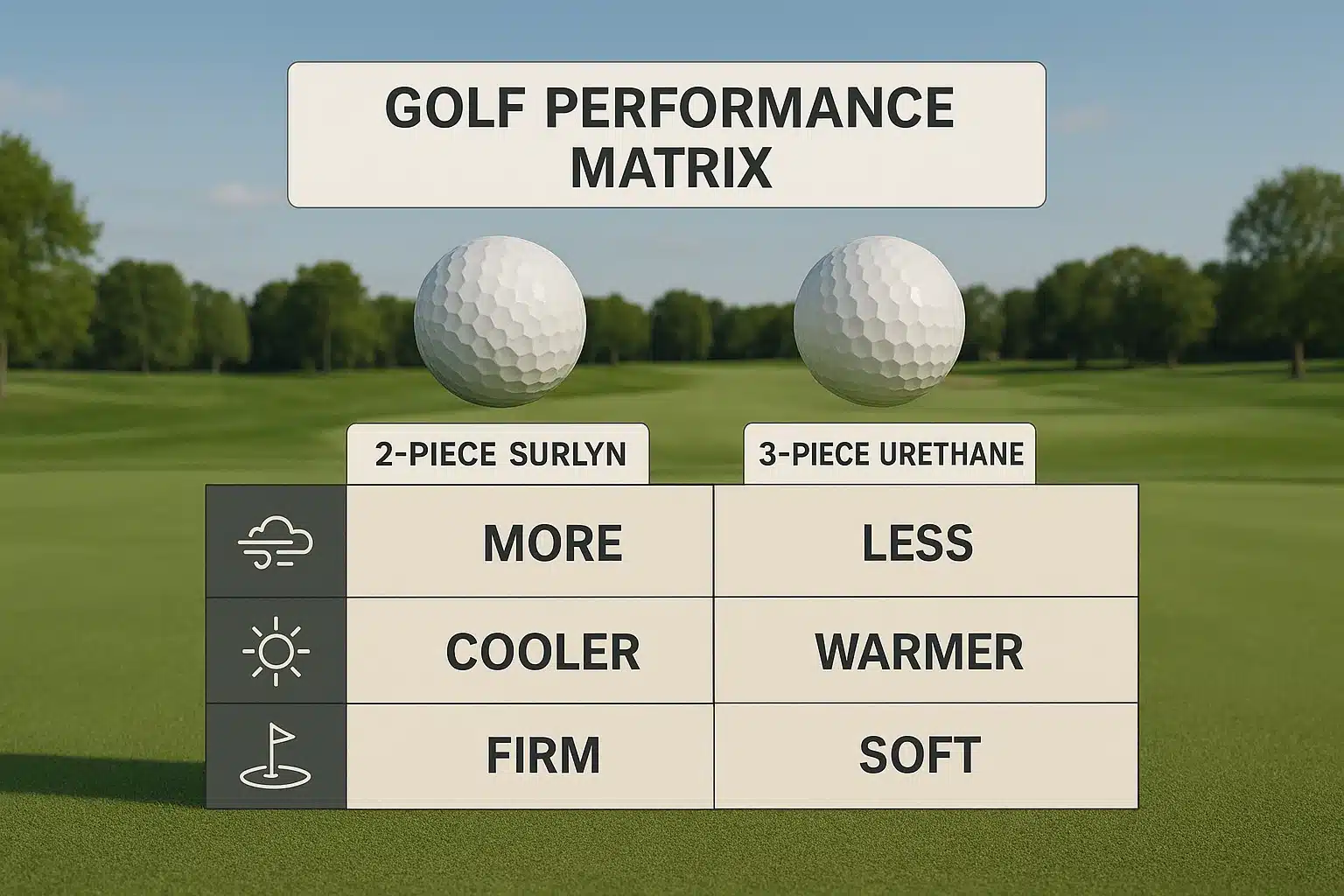
Yes. Windy/cold favors lower-spin and lower/mid compression; firm/fast greens favor higher wedge spin. Rule-of-thumb: ~2 yards per 10°F (Driver); short irons are less affected. Wind amplifies spin axis tilt, so control beats “extra-soft.”
Wind & spin-axis risk · Cold-weather compression shift · Green firmness & stopping needs
| Condition | Risk | Bias (2-piece / 3-piece) | Action |
|---|---|---|---|
| Strong head/crosswind | Curve + ballooning | 2-piece Surlyn or low-spin 3-piece | Lower long-game spin; keep launch in window |
| Cold (≤50°F / ≤10°C) | Denser air + stiffer feel | Lower/mid compression | Expect ~2 yds/10°F (Driver); club up; don’t chase “ultra-soft” alone |
| Firm/fast greens | Skid/through-roll | 3-piece (Surlyn→Urethane) | Add greenside spin to stop inside 10 ft |
| Soft/slow greens | Easy stopping | 2-piece Surlyn | Save budget; prioritize durability |
| New course / heavy rough | Lost-ball risk | 2-piece Surlyn | Lower CPR while learning lines |
| High altitude | More carry, flatter land | Decide by greens | Distance rises; stopping still rules |
How should beginners map swing speed to compression and cover?
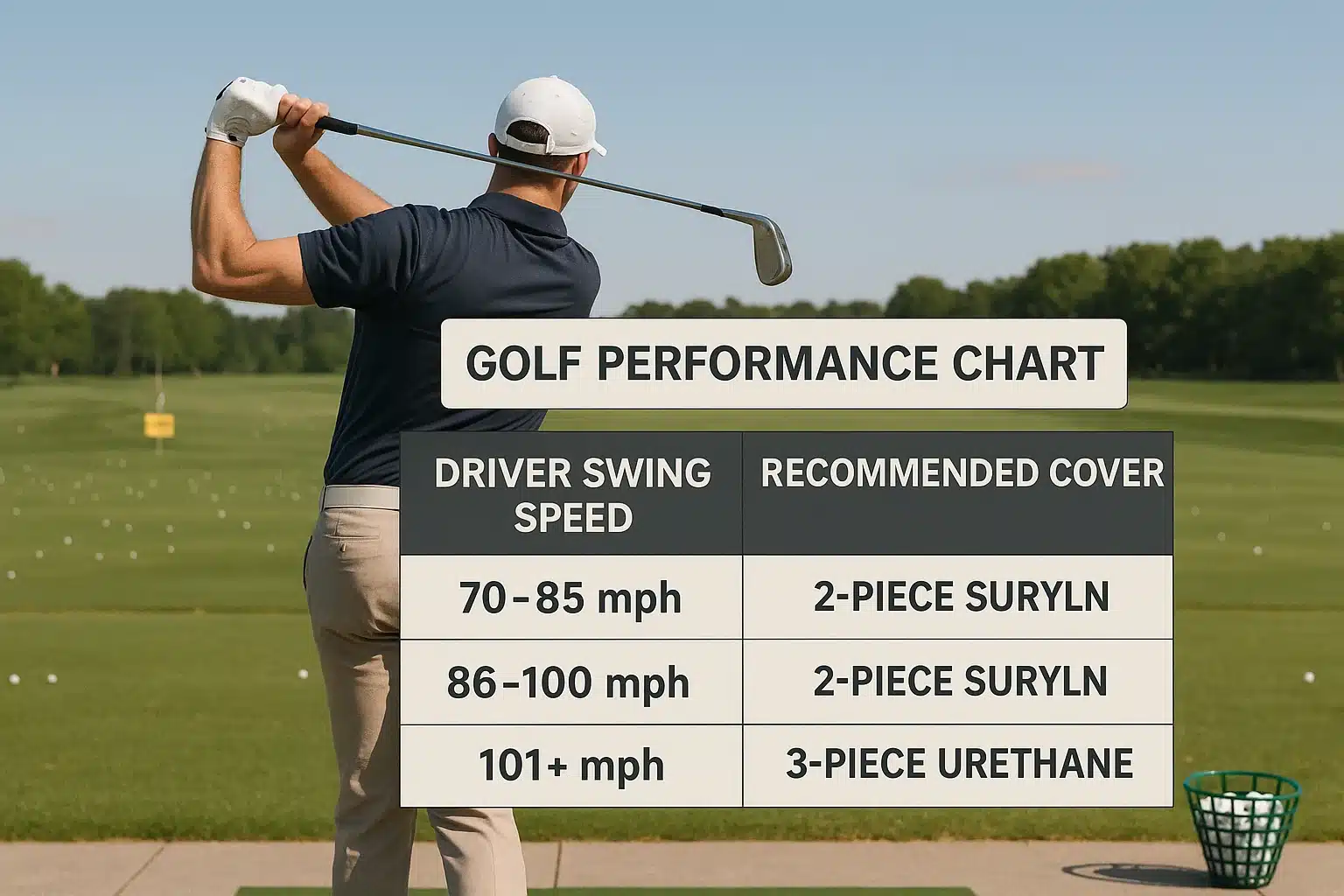
Use three bands: <85 mph → low compression (40–60), mostly ionomer; 85–100 → mid (60–85), ionomer or low-comp urethane; >100 → mid-high (85–100+), usually urethane, but low-spin ionomer can help in heavy wind. Validate by flight window and carry-to-front gap.
Speed bands & “good-enough” launch · Carry checks without a monitor · When fitter data matters
| Driver mph | Compression band | Cover | Expected feel |
|---|---|---|---|
| <85 | 40–60 | Ionomer (Surlyn/soft ionomer) | Softer off face, straighter flight, tough cover |
| 85–100 | 60–85 | Ionomer or cast urethane (low-comp) | Balanced spin; choose by greens/budget |
| >100 | 85–100+ | Cast urethane or low-spin ionomer | Control windows; wind may favor ionomer |
Carry check (no monitor): On a calm day, hit 5 drivers per model. Mark carry-to-front at the landing zone. If one model balloons above your window or trails by >~5 yards on similar strikes, adjust compression/cover.
When should you switch to 3-piece urethane?
Switch only when testing shows ≥2 strokes gained per 18, chip-and-stop rate up ≥10% or 3-putts down ≥1/round, and loss ≤1/round—then reconfirm over ≥36 holes on the same course/tees. If only one KPI improves, retry 3-piece Surlyn or stay ionomer.
KPI set (FIR/GIR/3-putts/stop-rate) · Sample scorecard · When to revert
| KPI | Threshold | Ball Choice | Next Action |
|---|---|---|---|
| Strokes gained (net) | ≥2 per 18 | 3-piece urethane | Confirm across ≥36 holes on same course/tees |
| Chip “stop-inside-10-ft” | +10% absolute | 3-piece urethane | Keep if penalties unchanged |
| 3-putts / round | −1 or better | 3-piece urethane | Keep if repeatable |
| FIR | If drops | Re-evaluate | Try low-spin ionomer or 3-piece Surlyn |
| GIR | +2 per 18 | Either | Keep with lower CPR |
| Loss rate | ≤1 per 18 | Open to urethane | If >1, prioritize 2-piece Surlyn |
Quick recap (for easy capture):
-
Switch when net score improves by ≥2 shots/18 and loss rate is ≤1 ball/round.
-
Short game wins: chip-and-stop rate +10% or 3-putts −1/round.
-
Confirm repeatability across ≥36 holes, same course and tees.
-
If penalties rise or FIR drops, revert to low-spin ionomer or 3-piece Surlyn.
-
Prefer the model with lower CPR (cost per round) when KPIs tie.
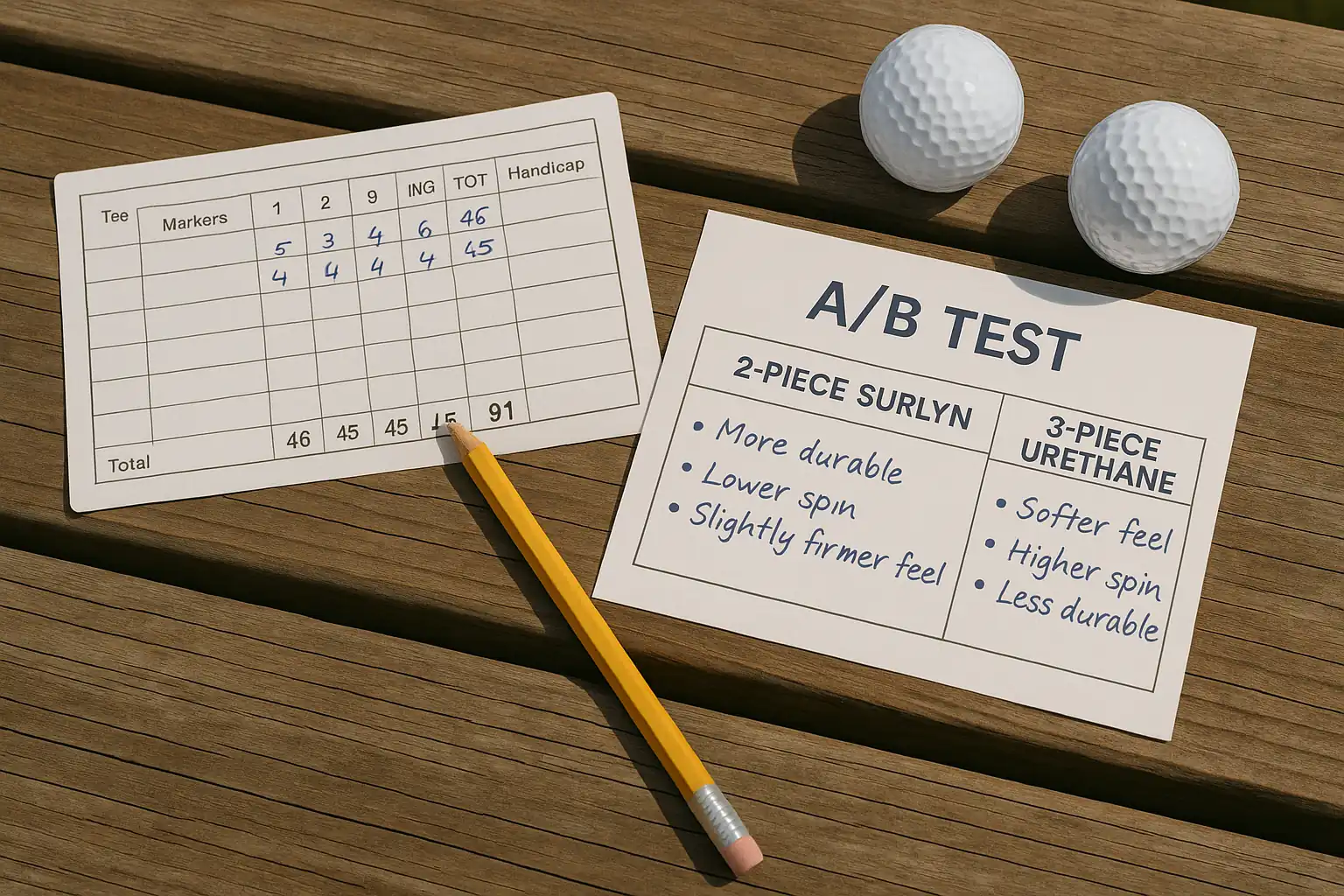
How to run a 30-minute on-course A/B test?
Bring two sleeves and a scoresheet. Prefer two-ball from the same lie (allowed in casual play); if not possible, alternate by hole rather than by shot. Track fairway hit, carry-to-front, rollout, chip stop distance, and first-putt length. Reconfirm over ≥36 holes.
Test kit & scoresheet · Shot sequence · +1/0/−1 scoring rubric
Sequence (repeat for two or three holes):
Driver → mid-iron approach → 10–30-yd chip → first putt. Score +1 if B clearly wins, −1 if worse, 0 if tie. Sum by category.
| Shot | Metric | Ball A / B | Result | Keep/Switch |
|---|---|---|---|---|
| Driver | Fairway hit · Carry-to-front | A=Y, B=Y · A=221, B=223 | B +1 | If repeatable, Switch |
| Approach | Front carry · Height window | A=OK · B=High | A +1 | Keep A if B balloons |
| Chip (10–30 yd) | Stop distance (ft) | A=14, B=8 | B +1 | Switch if no extra penalties |
| First putt | Starting length (ft) | A=22, B=17 | B +1 | Switch if consistent |
For B2B buyers, how do pricing & margins differ—and how to choose what to stock?
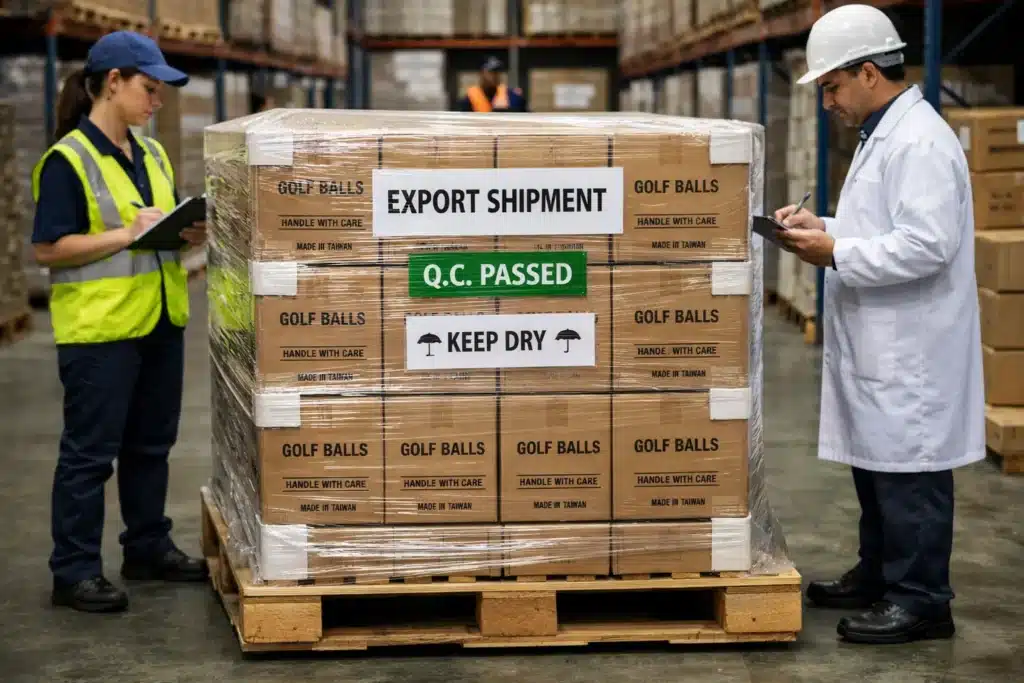
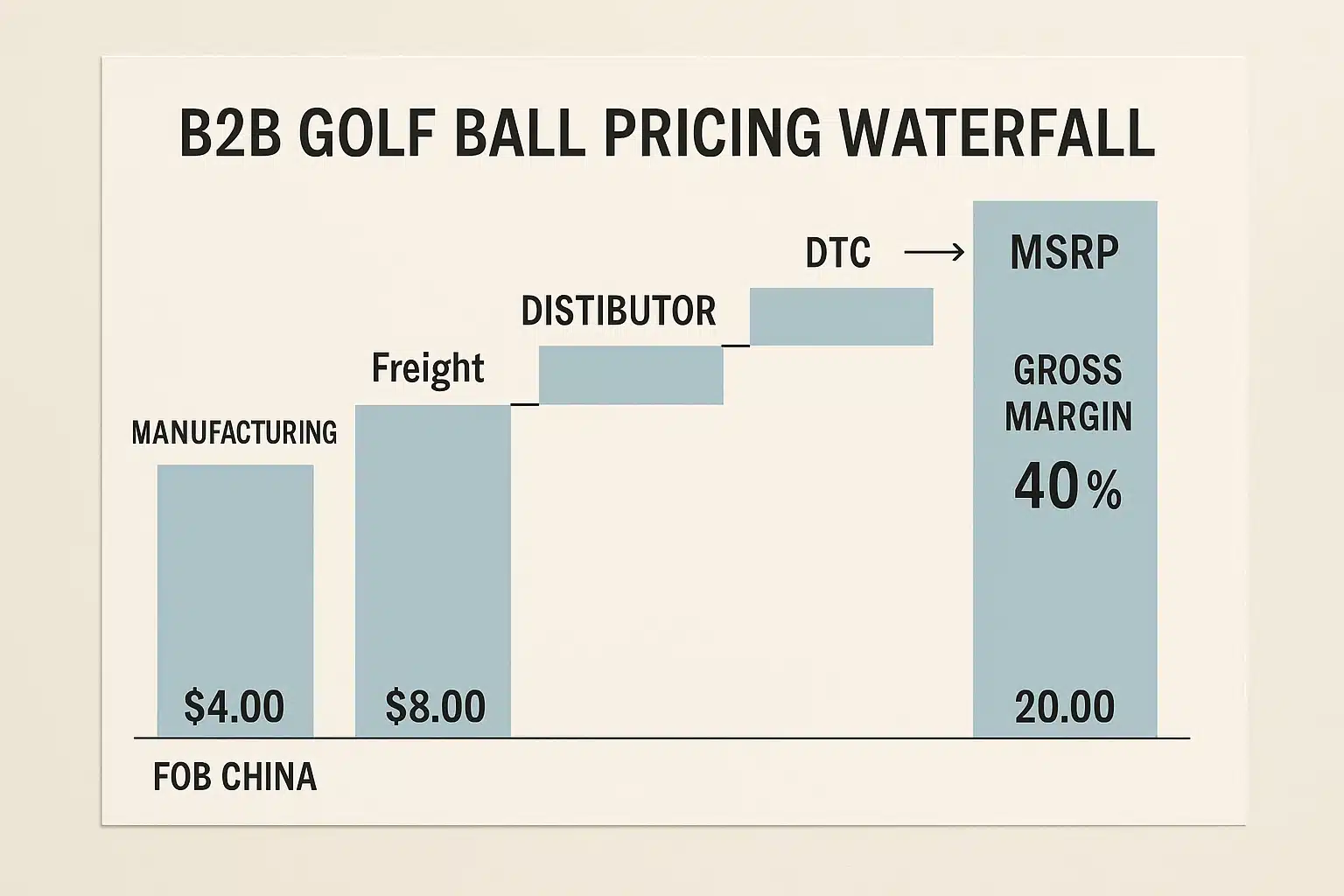
Directional ranges; evidence required. FOB China per dozen (directional): 2-piece Surlyn ~$6–9; 3-piece Surlyn ~$9–12; cast-urethane 3-piece ~$12–18. U.S. retail bands often $20–30 vs $36–45. Typical DTC net GM: Surlyn ~15–25%, urethane ~10–20% (mix and promo dependent). As of 2025-10; verify via RFQs/public sources before committing. HTS data and lead times are variable—reconfirm before PO.
Cost stack → Landed cost → Channel waterfall · 70/20/10 trial mix · Risk controls in PO/QA
| Type | FOB/doz (USD) | MOQ (balls) | Lead time (FOB CN) | MSRP window (US) | DTC GM range |
|---|---|---|---|---|---|
| 2-piece Surlyn | 6–9 | 1,000–3,000 | 25–40 d | $20–30/doz | 15–25% |
| 3-piece Surlyn | 9–12 | 2,000–4,000 | 30–50 d | $30–36/doz | 12–22% |
| 3-piece urethane (cast) | 12–18 | 3,000–5,000 | 35–60 d | $36–45/doz | 10–20% |
Tariff anchor: As of 2025-10, HTS 9506.32.0000 (golf balls) shows General rate: Free; reconfirm before PO.
Examples are for verification only; always factory-audit, pilot, and use third-party inspection.
Supplier examples
| Company | Location | Capabilities | MOQ |
|---|---|---|---|
| Hangzhou Grasbird | Hangzhou, Zhejiang | Specializes in 2-piece Surlyn; also produces 3-piece | 3,000–5,000 pcs |
| Ningbo Golfara | Ningbo, Zhejiang | OEM for 2/3/4-piece, incl. urethane | from 1,000 pcs |
| MLG Sports | Xiamen, Fujian | 2/3-piece (Surlyn & Urethane) | 2,000–3,000 pcs |
| Shenzhen Xinjintian | Shenzhen, Guangdong | 2/3/4-piece; in-house molds/lines | 2,000–3,000 pcs |
| Chengsheng Golf | Xiamen, Fujian | 2-piece Surlyn and 3-piece urethane | from 2,000 pcs |
Retail price context (examples; checked 2025-10, promos vary by region/retailer):
Titleist TruFeel ~ $25/doz; Callaway Warbird often ~$20–25; TaylorMade Tour Response commonly ~$39–45 with multi-dozen promos (e.g., 2 for $75); Costco Kirkland 3-piece urethane: $34.99 for 24 balls. Use these to sanity-check MSRP windows.
FAQ
Does soft feel mean low compression?
No. Feel is driven primarily by the cover and coating chemistry, not just compression.
Cast urethane often feels softer than ionomer at similar compression. Treat compression as a speed-fit tool; judge feel and greenside spin on grass. Consider cast urethane vs TPU urethane differences when comparing durability and sound.
Do used/refinished balls affect testing?
Yes—performance variance is larger. Use them for practice; for decisions, test with new sleeves.
Refinished/“lake” balls can alter spin, compression, and aerodynamic consistency, clouding A/B results. Run your beginner golf ball test with fresh sleeves, then recheck CPR.
Is a 3-piece Surlyn a good bridge before urethane?
Yes. It’s a mid-spin, lower-price step that can add control without urethane cost or scuff sensitivity.
If your stop-rate KPI still lags after practice, move to cast urethane and re-test on firm/fast greens.
Does urethane scuff more on range mats?
Relatively yes—urethane covers are more prone to cosmetic scuffs.
Mats and sandy range balls can mark cast urethane faster than ionomer. It rarely ruins flight, but it can alter greenside spin; keep gamer sleeves for the course.
How should I choose for a consistently windy course?
Favor low-spin ionomer or low-spin urethane; prove it with a simple crosswind test.
In ≥10 mph crosswind, hit 5 balls each for two models. Record lateral deviation and peak height. Pick the ball with smaller deviation and acceptable launch window, then reconfirm over ≥36 holes.
Can I mix balls within a casual round?
For tournaments: no. For testing: yes—use a two-ball method or alternate by hole.
Prefer same-lie two-ball strikes when allowed; otherwise alternate by hole to reduce noise and weather drift.
How do I choose if I don’t know my swing speed?
Use flight as your proxy: too-high/ballooning → raise compression; too-low/boardy → lower compression.
Confirm with carry-to-front and dispersion over ≥36 holes on the same course/tees.
What loss-rate threshold justifies trying urethane?
Loss ≤1/round opens the door; above that, CPR usually favors 2-piece Surlyn.
Once penalties are rare, urethane’s proximity gains can outweigh cost—verify over ≥36 holes.
Will urethane exaggerate my slice?
It can if driver spin is high.
If penalties rise, try low-spin urethane or a straight-flight ionomer while you work on face-to-path.
What KPIs prove a premium ball is helping?
Any two: −2 strokes/18, +10% chip stop-rate, −1 three-putt/round, +8-pt FIR, +2 GIR—reconfirmed over ≥36 holes on the same course/tees.
When KPIs tie, default to lower CPR (cost per round).
Conclusion
Pick with four levers, bias by wind/temperature/greens, and map speed→compression→cover without overthinking. Switch to 3-piece urethane only when KPI gains beat CPR risk, and reconfirm over ≥36 holes. For B2B, use directional FOB ranges and As of 2025-10 tariff guidance, but reconfirm before PO.
You might also like — Are Chinese Golf Balls Any Good? (Quality, Standards & Real OEM Insights)