Are Chinese golf balls any good? Yes—for B2B sourcing, they can be good when the construction fits the use case and the supplier can prove quality with batch-linked QC data, retained samples, conformity checks, and change control.
Buyers should verify Chinese golf ball quality by checking the ball route, 12-ball QC report, raw values, equipment/calibration notes, exact-model USGA/R&A conformity when needed, retained sample ID, and sample-to-production controls. Do not judge golf balls made in China by origin alone, and do not accept “high quality” without batch evidence.
A low quote feels safe until the first production batch drifts, the logo wears early, the cover scuffs too fast, or your customer questions why the reorder feels different.
Use this guide to match the right Chinese OEM golf ball to your range, academy, DTC, retail, custom-logo, or tournament-use program—and to decide what proof to request before mass production.
Are Chinese golf balls good enough to source?
Your buyer may ask whether Chinese golf balls are any good, but your real risk is approving a ball without defining what “good” means for the channel.
Chinese golf balls are good enough to source when the construction, QC method, batch records, and use case match your program. Your team should judge Chinese golf ball quality by data, retained samples, conformity status where needed, and supplier discipline—not by country of origin alone.
The cleanest answer is this: quality follows engineering, consistency, and proof, not origin.
For a DTC golf ball founder, “good” may mean a value-driven retail SKU with stable feel, reliable distance, and honest positioning. For a range operator, it may mean impact durability, washer resistance, and repeatable reorder quality. For an academy, it may mean consistent compression and flight feel at a controlled cost. For a tournament-facing buyer, it may mean exact-model conformity and a locked production build.
That is why a general question like “Are Chinese golf balls good?” needs a buyer-specific answer. A two-piece ionomer practice ball, custom logo gift ball, premium urethane SKU, and tournament-use model should not be judged by one standard. The buyer has to define the job before judging the ball.
B2B buyers should match the ball to the use case before judging Chinese golf ball quality.
Create a use-case and proof brief before requesting a quote. Check target user, construction, material route, conformity need, QC proof, retained sample, and reorder risk.
Do not approve a Chinese golf ball program until your team defines what “good” means for that buyer and channel.
✔ True — Use case and proof decide quality
A Chinese OEM ball can be a smart purchase when the construction, QC data, and supplier controls match the program. The same ball can be wrong if the buyer expects a different performance level.
✘ False — “Country of origin alone tells you whether the ball is good”
Origin may explain supply-chain context, but it does not replace testing, retained samples, conformity checks, or batch records.
Match the ball to the buyer first?
Do not judge a Chinese golf ball before you define the job it needs to do. A range ball, academy ball, custom logo ball, DTC retail ball, and tournament-use ball all need different proof.
For range use, your team may care most about impact life, washer durability, and reorder consistency. For a DTC retail SKU, the risk may be feel drift, cover scuffing, poor reviews, or batch inconsistency. For tournament use, the key question is whether the exact model and markings match the current conforming-list requirement.
That is why “Chinese golf balls quality” should be judged by use case first. Once the use case is clear, your team can ask for the right construction, QC fields, supplier response, retained sample, and control plan before the first order scales.
Which China OEM ball fits your use case?
Your program may fail if you judge every Chinese OEM ball by one standard instead of matching construction to range, retail, custom logo, academy, or tournament needs.
A Chinese OEM range ball, junior training ball, DTC distance ball, custom logo ball, and premium urethane SKU should not be judged by the same standard. Your team should match construction to use case first, then verify durability, spin, logo quality, conformity, and batch consistency.
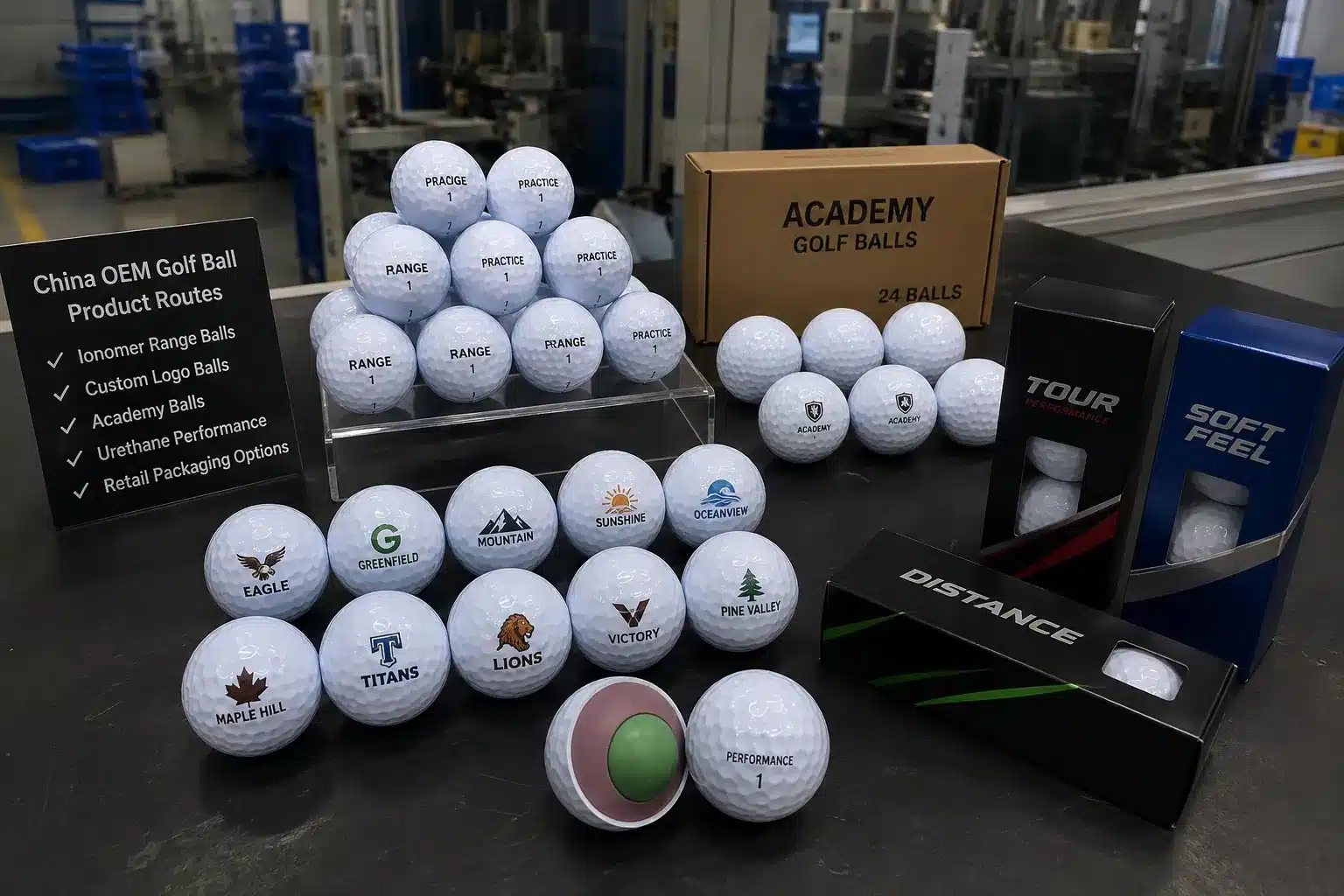
China OEM programs often make the most sense when the product route is clear from the start. A two-piece ionomer ball may be right for durability, range use, entry-level retail, academy practice, or price-sensitive DTC programs. It can offer predictable cost, stable production, and a practical feel profile for buyers who do not need tour-level greenside control.
A custom logo ball has different risks. Your buyer may care more about logo adhesion, print durability, color control, sleeve presentation, and packaging consistency than wedge spin. A range operator may care about washer cycles, impact life, color retention, and whether repeat orders feel the same to players.
A premium urethane SKU needs a higher proof stack. The buyer should not approve the ball just because the cover is labeled “urethane.” Ask which cover route is used, then verify spin, scuff resistance, cover thickness, and batch consistency. A tournament SKU adds another layer: exact model, current list status where required, visible markings, and locked build.
| Pain/decision | Best-fit route | Main risk | Evidence to request |
|---|---|---|---|
| Range program | 2-piece ionomer | Impact / washer wear | Durability screen |
| Academy use | Stable practice ball | Feel drift | Compression data |
| Custom logo | Logo OEM ball | Print wear | Rub / cleaning test |
| DTC value | 2/3-piece build | Review risk | Batch validation |
| Premium SKU | Urethane route | Spin/scuff gap | Cover declaration |
| Tournament use | Listed model | Legal claim risk | Current list check |
China’s supply chain can support flexible customization, packaging integration, and small-to-mid batch responsiveness, especially across mature OEM clusters. Still, supply-chain scale is not a quality certificate. The specific SKU must prove itself.
Request a construction-to-use-case recommendation from the supplier. Check whether the recommended ball type matches your target player, channel, durability need, spin expectation, logo need, and conformity need.
Do not choose a ball only because it is cheaper if the construction does not fit your use case.
Ionomer, range, logo, and urethane paths?
Your best Chinese OEM route is the one that matches your customer, not the one with the most impressive label.
A range operator does not need the same proof as a DTC tour-style challenger brand. A corporate gift buyer should not overpay for short-game spin the recipient will never evaluate. A retail buyer should not under-test a SKU that will face public reviews. Match the route first; then negotiate price.
Can Chinese balls meet tournament rules?
Your buyer may ask for “USGA-approved Chinese golf balls,” but the safer question is whether the exact model and markings meet the current requirement for the intended use.
Chinese golf balls can meet tournament rules when the exact model, markings, and current conforming-list status match the event requirement. Your team should verify the listed model and locked build instead of accepting old certificates, old screenshots, or broad country-based claims.
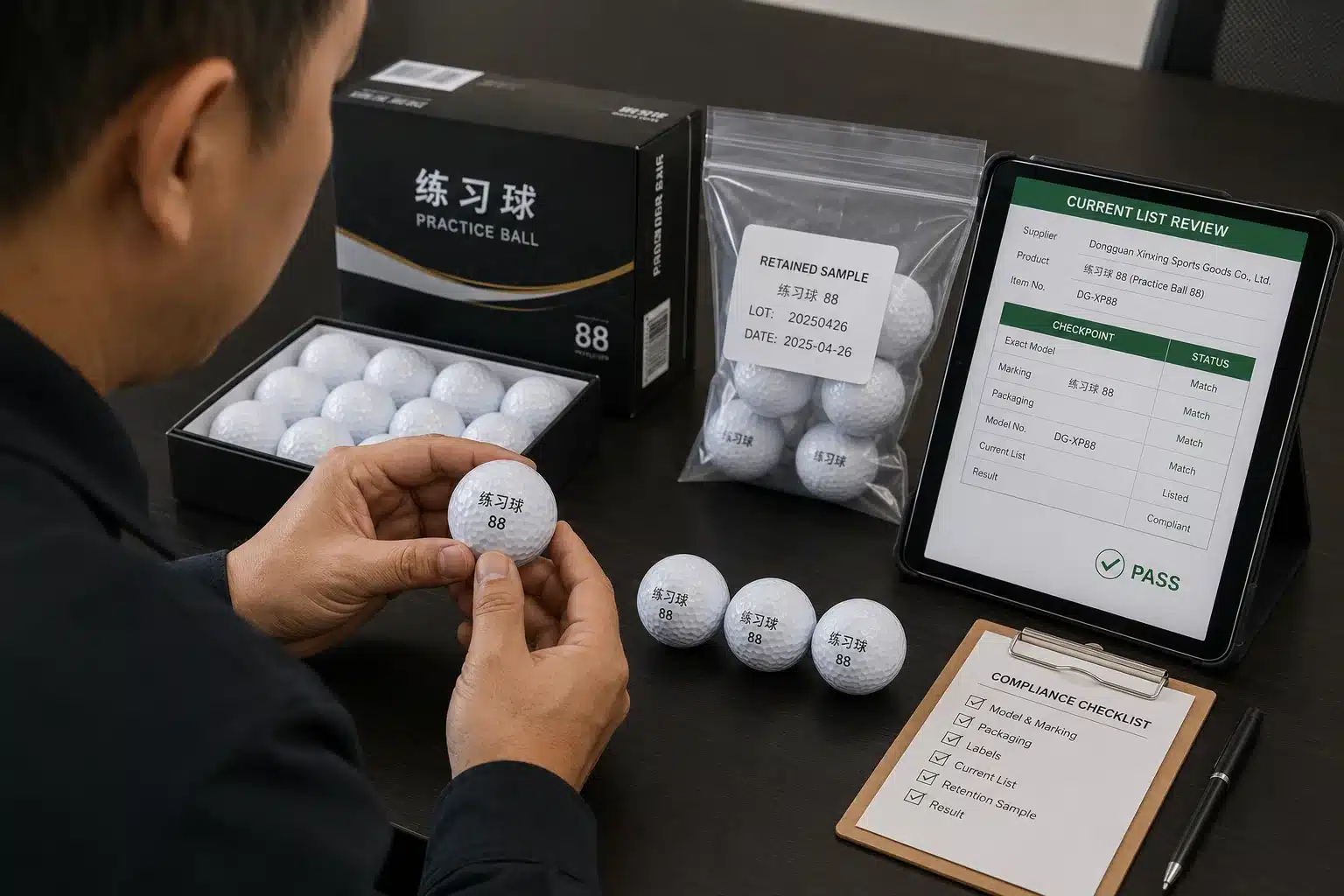
Tournament legality is model-specific, not country-specific. A conforming golf ball claim should point to the exact ball model, visible markings, color or version where relevant, packaging reference, and the build that will actually be produced.
For tournament-use claims, check the official list rather than relying on supplier wording. The USGA Conforming Golf Ball List identifies balls tested and found to conform to the Rules of Golf, is updated monthly, and is used as a current-list requirement for many high-level competitions. That supports a simple buyer rule: match the exact model, markings, and current list status before making event-use claims.
The R&A Conforming Ball List follows the same exact-model logic. It covers balls submitted within the relevant listing period and ruled to conform; if a ball needs to remain on the list after that period, additional samples are required. A lapsed listing is not automatically a quality verdict, but it can be a tournament-use problem when your buyer needs current-list status.
This distinction matters because buyers often confuse three different things: technical capability, current list status, and retail quality. A factory may have produced conforming models before. Another model may have an old report or a lapsed listing. That does not automatically mean poor quality, but it does mean your team should verify the current exact model before making a tournament claim.
Old conformity screenshot with no exact current model check is a failure signal.
Conformity also does not prove premium feel, wedge spin, cover durability, logo adhesion, color stability, or reorder consistency. It proves rule conformity for that exact listed model under the relevant context. It is a gate, not the whole quality story.
Buyer acceptance should reference the exact model name, visible pole/seam markings, color/version where relevant, packaging reference, current USGA/R&A list status where required, retained sample, and any submission or re-submission plan.
Request an exact-model conformity check or submission plan. Check current list status, model marking, color/version, packaging reference, retained sample, and whether tournament use actually requires listing.
Do not make tournament-use claims unless the exact current model and production build are verified.
✔ True — Conformity follows exact model and current list status
A Chinese OEM factory can show technical capability, but your tournament claim still needs the exact model, markings, and current requirement checked for the event use case.
✘ False — “An old certificate is enough for tournament-use claims”
An old certificate may support capability context, but it does not replace current-model verification when a buyer needs list-required legality.
Exact model, current list, locked build?
Your compliance risk is not the country; it is the model your customer will actually use.
If the project is a practice, academy, retail value, or promotional SKU, formal tournament listing may not be necessary. If your buyer will make tournament-use claims, it matters immediately. Define the use case first, then check the exact model and lock the production build.
What proof should buyers request?
Your supplier may say “high quality,” but that does not help your team judge compression spread, weight tolerance, diameter consistency, hardness, concentricity, or batch stability.
Do not ask whether a Chinese golf ball is “good” in general; ask whether the supplier can show batch-linked data. Your team should request a 12-ball QC pack with raw values, statistics, equipment notes, calibration records, retained sample ID, and acceptance criteria.
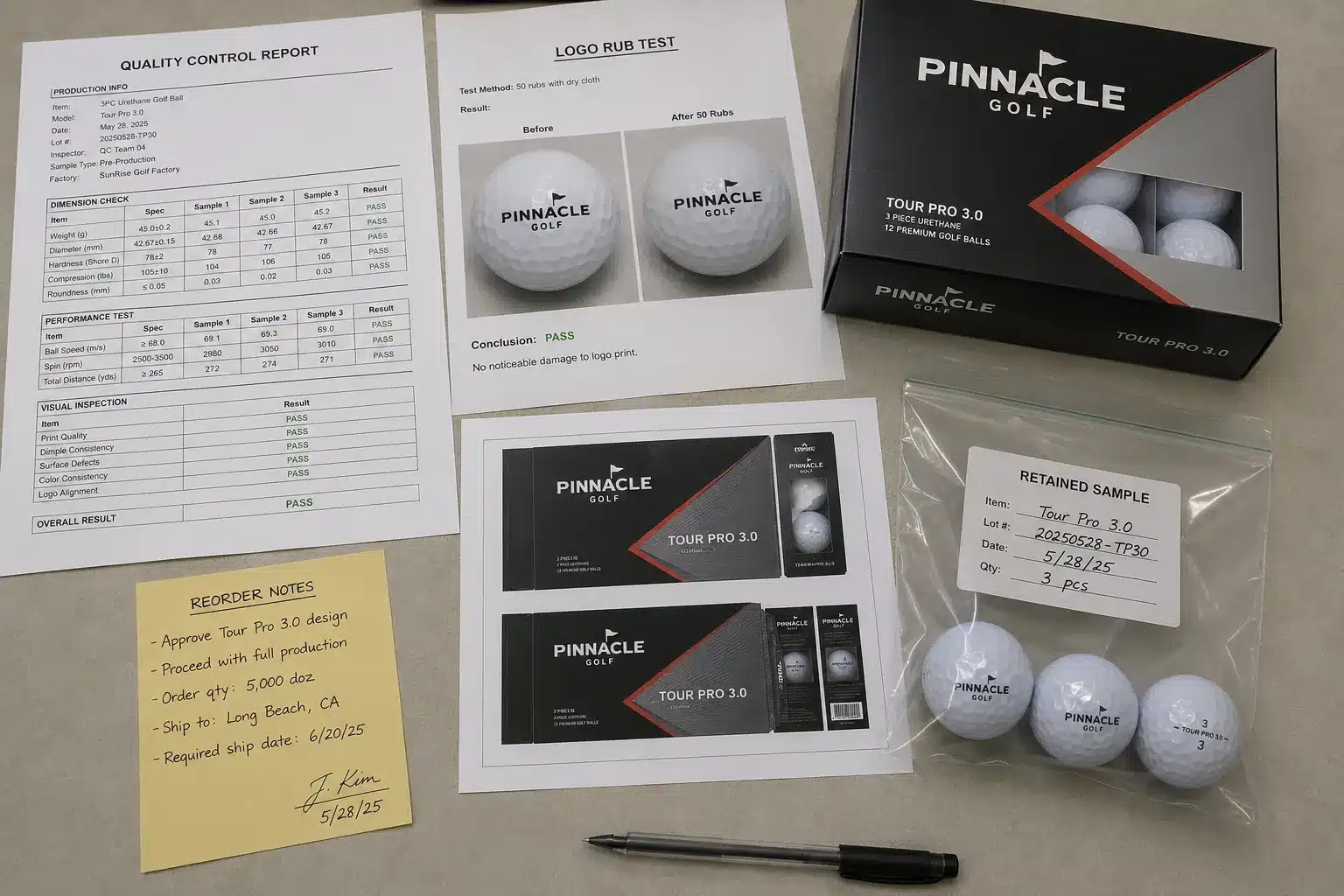
Quality should be proven with comparable data, not adjectives. “QC passed” is not enough if the buyer cannot see what was checked, how many balls were tested, which equipment was used, and how the result links to the batch being sold.
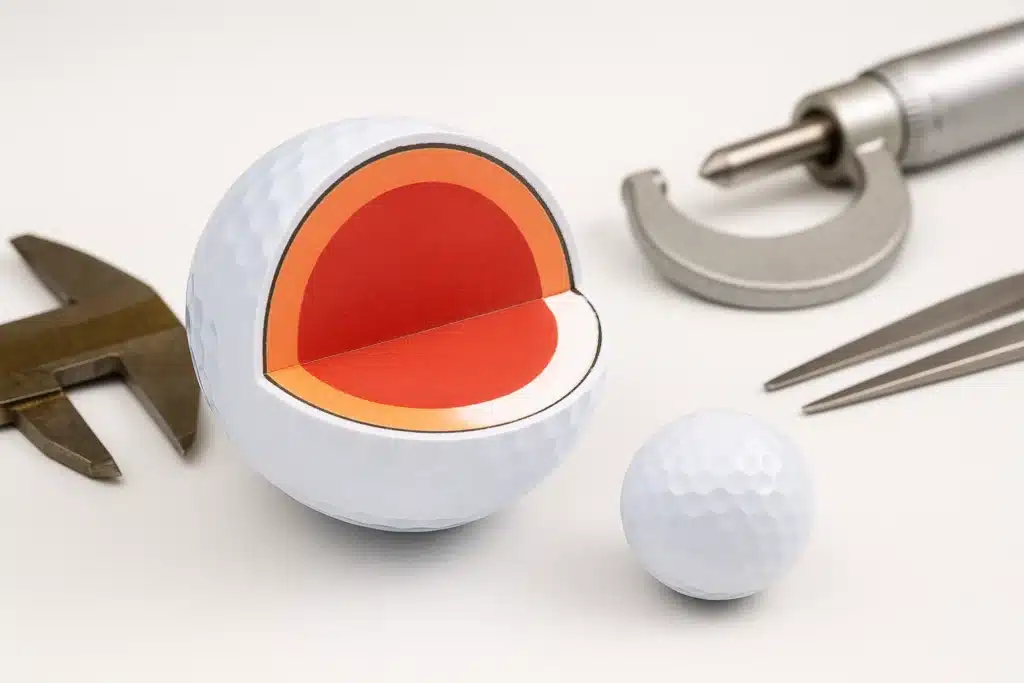
Ask the supplier to provide one batch-linked 12-ball QC pack with weight, diameter, compression, hardness, concentricity or X-ray/CT where relevant, cover or coating thickness, raw values, average, range, standard deviation, equipment notes, calibration records, retained sample ID, and batch COA.
For performance SKUs, add driver, iron, and wedge comparison against an approved control. For retail or custom-logo SKUs, add scuff, coating, visual defect, print durability, and packaging checks where relevant. For higher-complexity multilayer balls, X-ray or CT evidence can help verify layer alignment and core concentricity.
| Pain/decision | QC field | Why it matters | Evidence to request |
|---|---|---|---|
| Feel drift | Compression | Feel/speed window | Raw values |
| Rule screen | Weight/diameter | Lot consistency | Spread data |
| Material drift | Shore hardness | Cover/core control | Method note |
| Hidden imbalance | Concentricity | Flight/roll stability | X-ray / CT |
| Retail complaint | Scuff/logo wear | Durability risk | Wear screen |
| Weak proof | Calibration | Data trust | Records |
High-quality claim with no 12-ball raw data is a failure signal.
Reference methods can help turn vague quality language into buyer-operable checks. Shore hardness methods can support hardness consistency. Abrasion methods can support relative coating comparison. AQL-style sampling can support receiving inspection and hold/reject rules. These are useful buyer references, not golf-ball-specific performance certifications.
Supplier shall identify the approved ball construction, model/version, material route, retained sample ID, batch ID, 12-ball QC report, equipment notes, calibration records, conformity status where required, packing list, and receiving inspection file for every production lot.
Request a batch-linked 12-ball QC report before approving samples or bulk. Check raw values, average, range, standard deviation, equipment model, calibration date, sample IDs, retained sample ID, and batch COA.
Do not accept a supplier quality claim without data tied to the same batch you plan to buy.
12-ball data, equipment, and calibration?
Your supplier should answer like a quality team, not only like a salesperson.
A professional answer includes what was measured, how it was measured, how many samples were checked, what the spread looked like, and whether the equipment was controlled. A weak answer sounds polished but stops at “high quality,” “export standard,” or “don’t worry.”
How do samples become stable production?
Your first sample may look and feel good, but the bulk order can still drift if the approved build is not locked and traceable.
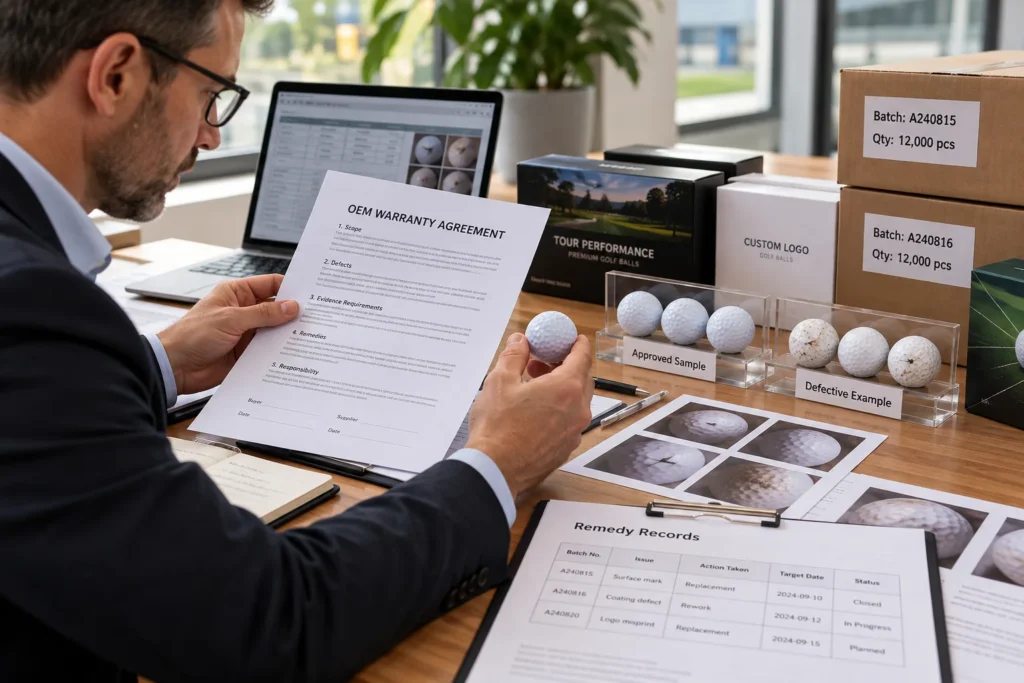
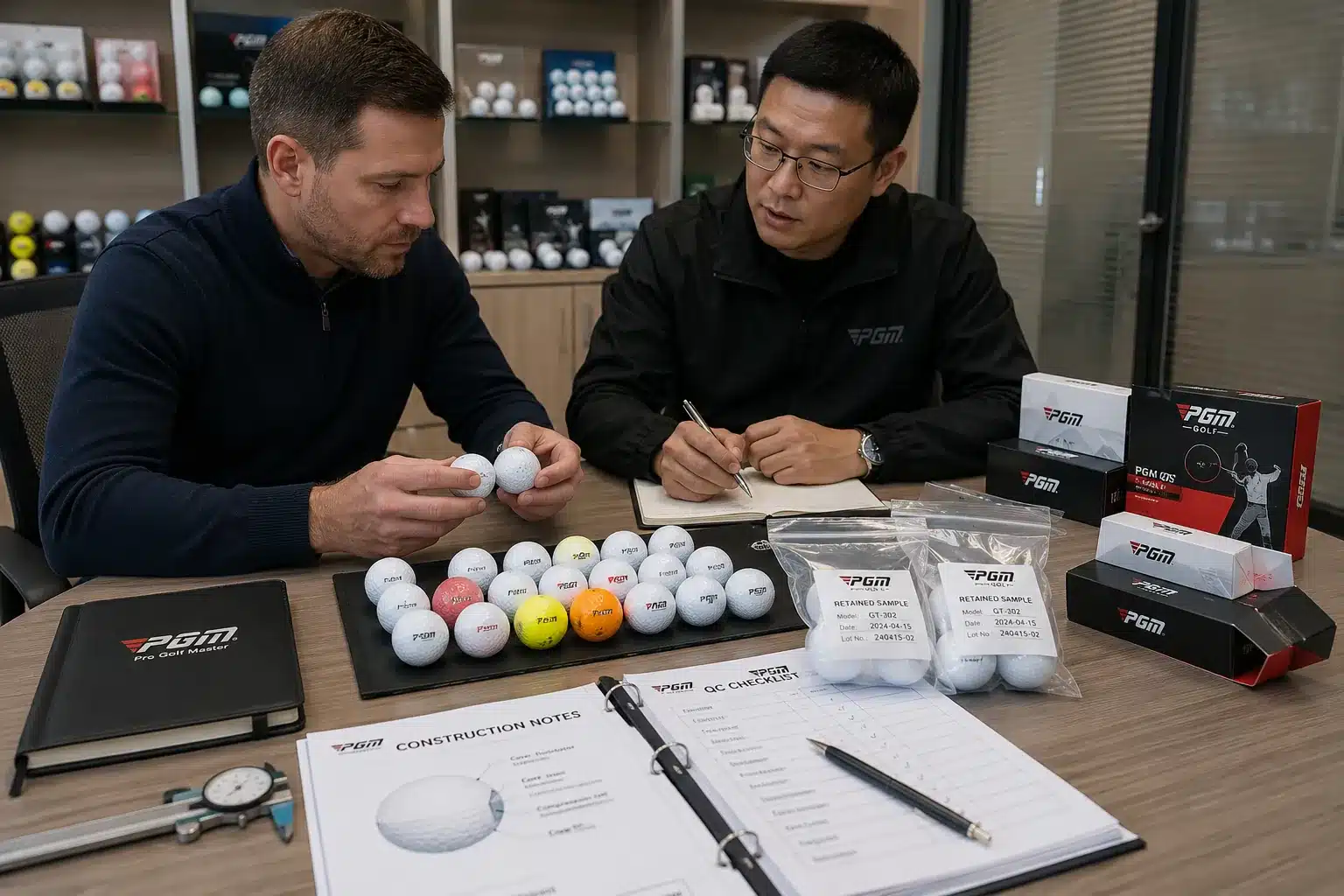
A good Chinese golf ball sample does not prove stable production until the approved build is locked. Your team should keep retained samples, write specs into the PO, require batch COA, define AQL receiving rules, and block material or process changes without written approval.
The sample-to-production path should be controlled: brief, sample, testing, revision, pilot, mass production, receiving. Each step should narrow the risk, not create a new argument.
The approved sample should be numbered, sealed, and kept by both buyer and supplier. Your spec annex should define construction, material route, compression window, weight and diameter requirements, color or logo requirements, packaging, QC fields, and defect rules. If the ball is a custom logo SKU, the approved artwork, print position, print durability expectation, and packaging version should also be locked.
The phrase “mass production will improve” is not a control plan. If the sample fails, retest after correction. If the sample passes, lock it. Bulk production should match the approved version unless your team gives written approval for a change.
✔ True — Sample approval must become a controlled production version
A good sample is only useful if both sides can trace the bulk order back to the same construction, process, retained sample, and QC standard.
✘ False — “Mass production will automatically improve a good sample”
If the proof is not written, sealed, and linked to the batch, a good sample can become a weak production dispute later.
Buyer acceptance requires batch-linked raw QC values with average, range, and standard deviation; retained sample match; declared construction and cover route; current exact-model conformity status where required; AQL-based receiving rule; and written approval before any material, mold, compression, cover, coating, print, packaging, or process change.
Create a sample-to-production control pack. Check retained samples, spec annex, batch COA, AQL receiving rule, defect handling, and written change-control terms.
Do not scale production if the supplier cannot tie the bulk lot to the approved sample and locked specification.
Retained samples and change control?
Your risk is not only the first sample; it is whether the second and third orders stay the same.
This is where supplier discipline becomes visible. A professional Chinese golf ball supplier should answer lead time, certification, quality, packaging, and defect questions in a structured way. Fast replies are helpful. Structured replies with data are safer.
When are China OEM balls worth sourcing?
A low quote can be useful, but your team needs to know whether the savings come from a smarter route or stripped material, testing, packaging, or QC coverage.
China OEM balls are worth sourcing when cost, customization, launch speed, and verified quality fit your market. Your team should separate unit price from construction, cover route, QC coverage, packaging, conformity, lead time, and change-control cost before approving the lowest quote.
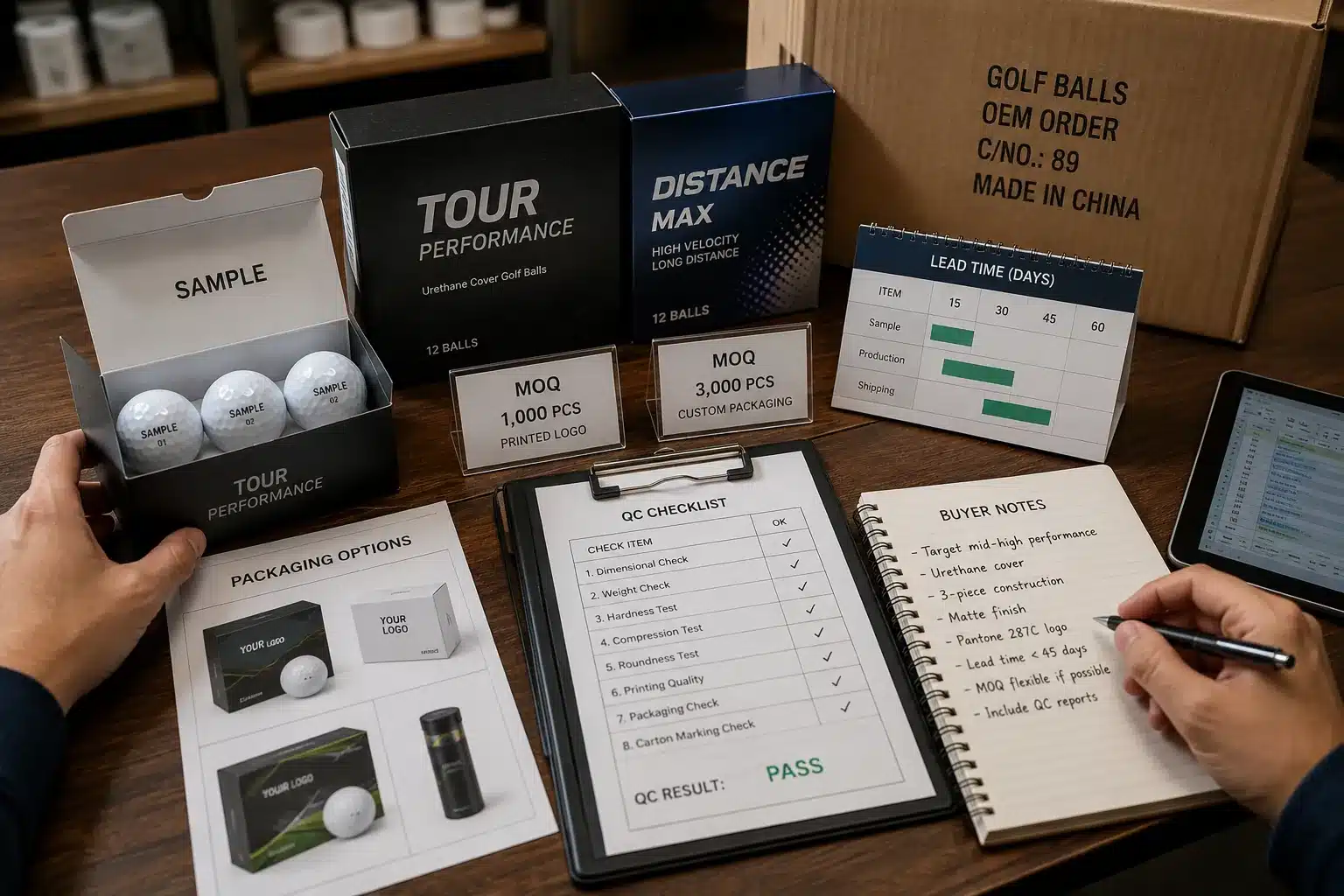
Chinese OEM golf balls often make sense for DTC launches, private label programs, range operators, academies, custom logo projects, and retail value SKUs. The best projects use China’s strengths honestly: flexible customization, packaging options, cost control, export experience, and responsive product development.
The risk is when the quote looks low because something important has been removed. Lower cost may come from simpler construction, cheaper cover material, thinner coating, lower inspection coverage, skipped testing, simplified packaging, or formula substitution. Some of those choices are fine for promo balls. They are dangerous for review-driven retail products.
Startup and private-label buyers should buy batch proof before chasing the lowest first-order price.
| Pain/decision | Low-price lever | Possible risk | Evidence to request |
|---|---|---|---|
| Cheap quote | Simpler cover | Scuff/spin loss | Cover route |
| Fast sample | Lower QC | Bulk drift | 12-ball QC |
| Low packaging cost | Transit damage | Weak retail look | Carton spec |
| No testing fee | Hidden risk | Late complaints | Pre-shipment test |
| Reorder surprise | Formula change | Different feel | Change-control clause |
| MOQ pressure | Wrong route | Misfit inventory | Use-case check |
Fast low quote with vague construction and no change control is a failure signal.
Request a quote that separates construction, cover route, QC scope, packaging, testing, conformity support, MOQ, lead time, and change control. Check whether the supplier explains what is included, what is optional, what affects price, and what will be locked before production.
Do not treat a lower quote as safe until you know what proof, materials, inspection, and packaging it includes.
✔ True — A low quote can be good if scope is clear
Lower cost can come from efficient construction, simpler packaging, direct sourcing, or a route that fits the buyer. The quote becomes risky only when the missing scope is hidden.
✘ False — “Low price alone proves a smart sourcing decision”
A smart quote explains what is included, what is not included, and what proof protects the buyer after the first sample.
Margin, speed, customization, and risk fit?
Your best sourcing decision is the one that protects margin without exposing your customer to avoidable quality drift.
Send the supplier your use case, target construction, channel, performance expectation, logo or packaging needs, conformity requirement, QC fields, launch timeline, and reorder plan. A serious quote should respond to those variables, not just a unit price.
FAQ
Are Chinese golf balls any good for B2B sourcing?
Yes, Chinese golf balls can be good for B2B sourcing when construction, QC data, supplier discipline, and use case fit are verified. Your team should judge proof, not origin.
Define the use case first. A range ball, academy ball, custom logo ball, DTC value SKU, and tournament-facing model need different standards. Then check construction, material route, batch-linked QC, retained samples, and conformity status where needed. A low price is useful only when the proof supports the buyer’s risk.
How can buyers verify Chinese golf ball quality?
Buyers can verify Chinese golf ball quality by asking for batch-linked 12-ball QC data, raw values, statistics, equipment notes, calibration records, retained samples, and receiving criteria.
Check weight, diameter, compression, hardness, visual defects, and batch spread. For higher-performance or multilayer balls, ask for concentricity, cover thickness, spin comparison, dispersion, scuff testing, and X-ray or CT evidence where relevant. The goal is not a perfect-looking report; it is a report that helps your team accept, hold, reject, or retest.
Can Chinese golf balls be USGA/R&A conforming?
Yes, Chinese golf balls can be USGA/R&A conforming if the exact model is submitted and appears on the current conforming-list path required by the buyer’s use case.
Check exact model name, markings, color or version where relevant, packaging reference, and current status. Do not rely on broad claims such as “our factory has conforming balls.” A lapsed listing is not automatically a quality verdict, but it is not enough for list-required tournament claims.
Can Chinese OEM balls be used in tournaments?
Chinese OEM balls can be used in tournaments only when the event rules allow that exact listed model and the production batch matches the submitted build. Country of origin is not the deciding factor.
Confirm the event requirement before sourcing. Match the ball markings, packaging reference, and retained sample to the listed or submitted model. If the ball is private label, decide early whether you need submission under your own brand. Keep retained samples so the tournament-use claim stays traceable.
Which golf ball types fit China OEM programs?
China OEM programs often fit 2-piece ionomer, range, academy, custom logo, DTC value, and selected urethane SKUs. Each route needs its own proof standard.
Do not judge all balls by one standard. A durable range ball needs impact and washer durability. A custom logo ball needs print durability and packaging control. A DTC retail ball needs repeatable feel, compression, and complaint-resistant quality. A premium urethane SKU needs deeper spin, scuff, and batch proof.
Does a lower OEM price mean lower quality?
Not always. Lower OEM cost can come from efficient construction, simpler packaging, direct sourcing, or a route that fits the buyer, but your team should check what scope is included.
Separate unit price from QC scope. Ask what changes with cover route, coating, inspection coverage, packaging, testing, MOQ, and reorder conditions. A low quote can be smart for the right use case. It becomes risky when the supplier cannot explain what is included.
What should a Chinese golf ball QC report include?
A useful Chinese golf ball QC report should include raw values and statistics for the same batch you plan to buy, plus equipment, calibration, and retained-sample references.
Ask for weight, diameter, compression, hardness, visual defects, and sample IDs. Add concentricity, cover thickness, dimple or coating checks, spin, scuff, logo durability, or X-ray/CT where relevant. The report should include retained sample reference, batch ID, release decision, and any hold/reject rule.
Conclusion
Chinese golf balls should not be judged by country of origin, and they should not be trusted by claims alone.
The safe buying path is to match the ball to your use case, verify construction and batch data, check conformity only when it matters, and lock the approved sample before mass production.
If your supplier can connect the sample, 12-ball QC report, retained sample, batch COA, conformity status, and change-control rule into one traceable file, you are no longer buying a claim. You are buying a controlled program.
You might also like — How to Choose a Reliable Golf Ball Manufacturer in China?