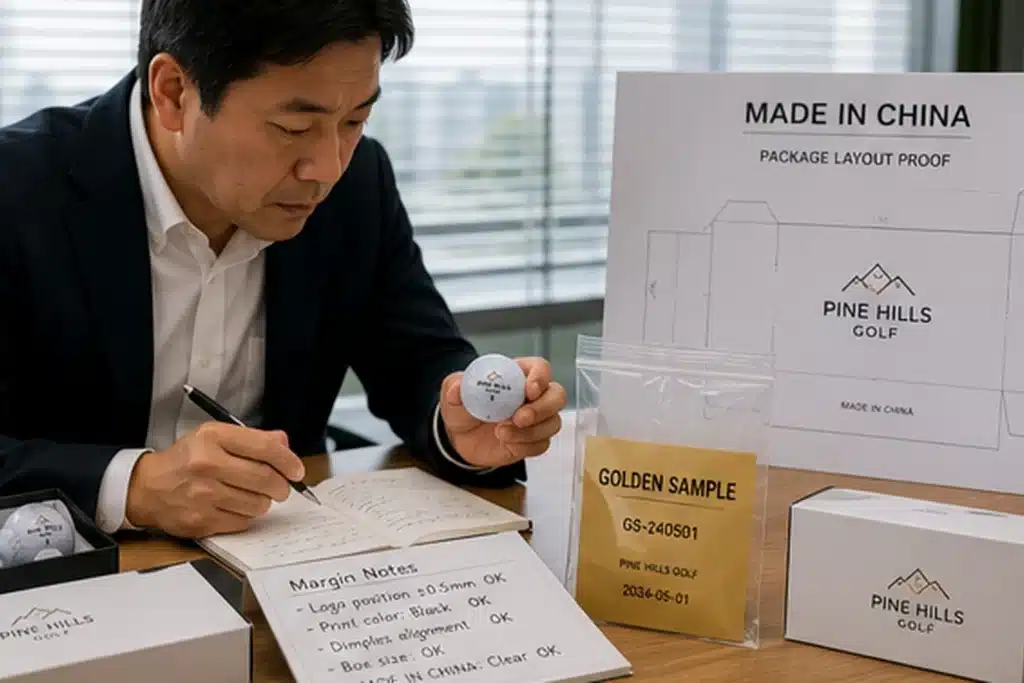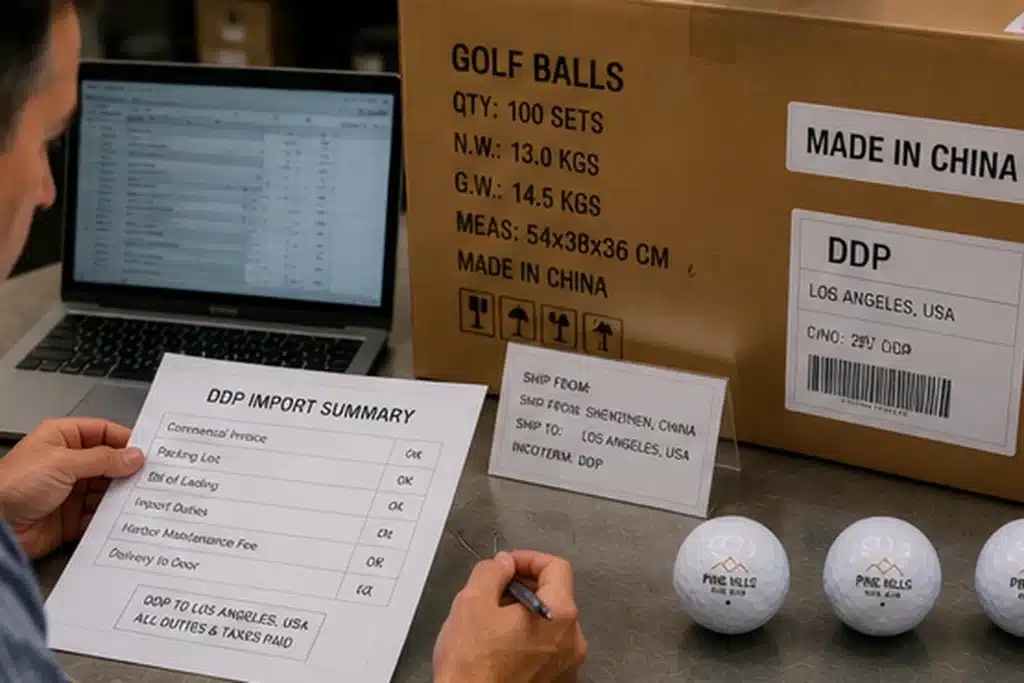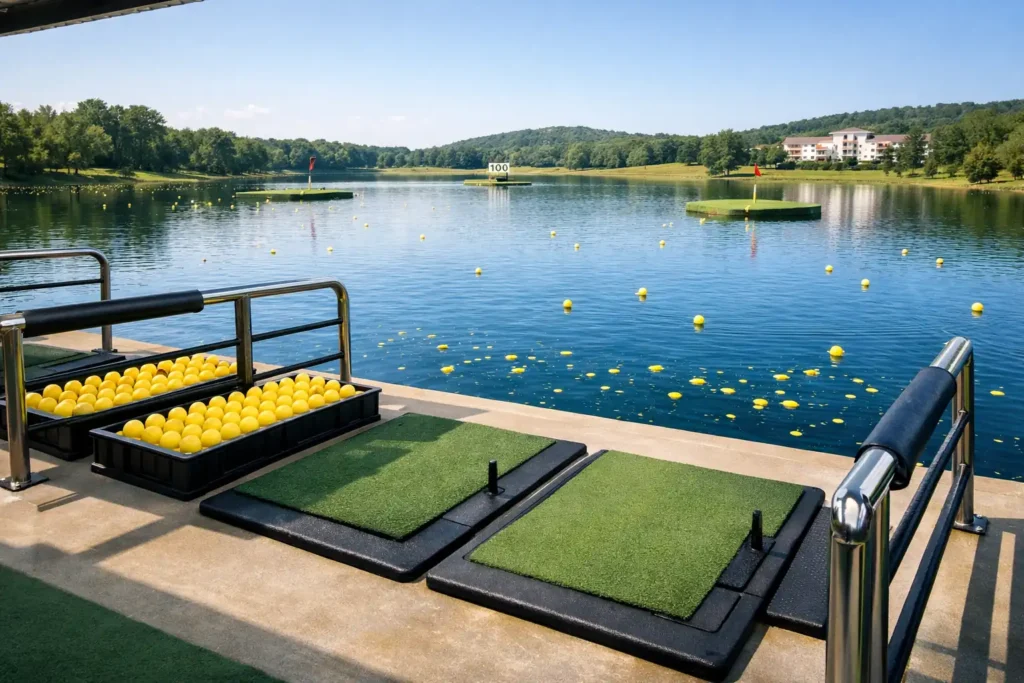
Aqua ranges should verify player acceptance, specific gravity, post-damage flotation, recovery loss, and lot-level QC before buying floating range balls. A commercial floating range ball is not approved because it floats when new; it is approved when players accept the feel, damaged balls remain retrievable, and the shipped lot matches the tested sample.
An aqua range can look profitable while losing money through weak strike feel, sinking inventory, shoreline recovery gaps, and replacement cycles that were never priced into the quote. If stronger players describe the ball as dead or sponge-like, your range may protect retrieval while quietly weakening practice credibility.
Use this guide to separate float-first novelty balls from commercial aqua-range inventory that players accept, staff can recover after damage, and procurement can verify at lot level.
Why do cheap floaters feel wrong?
You may solve retrieval with a cheap floater, but your range can still lose repeat visits if stronger players call the strike dead, sponge-like, or unserious.
Cheap floating range balls feel wrong when float-first design removes too much believable mass from the strike. Your team should test multiple samples with mixed-player hitting and request sample weight range plus SG target before treating new-ball buoyancy as commercial proof.
This is the Marshmallow Trap. A ball floats beautifully in the water tank, but the first driver strike feels soft, muted, or hollow. The operator sees retrieval. The player feels a toy.
That matters because an aqua range is not only selling novelty. Resorts, clubs, and destination practice venues also sell credibility. Better players may not represent every bucket sold, but they influence range reputation, lesson bookings, guest recommendations, member confidence, and repeat use. If the ball feels too far from serious practice, your lake range risks becoming a “fun once” attraction instead of a training venue people return to.
Do not frame player acceptance as a vague opinion. Treat it as a commercial metric. A floating practice golf ball should be judged by whether average guests enjoy it and stronger players still trust the strike enough to practice.
Public product pages often show that floating golf balls can vary meaningfully in weight. Some ultra-light floaters are listed around 30 g, while heavier floating range balls may be listed around 38–39 g or about 39 g. Those figures are not universal standards, but the spread is large enough to remind buyers that floating golf ball weight affects feel, not just buoyancy.
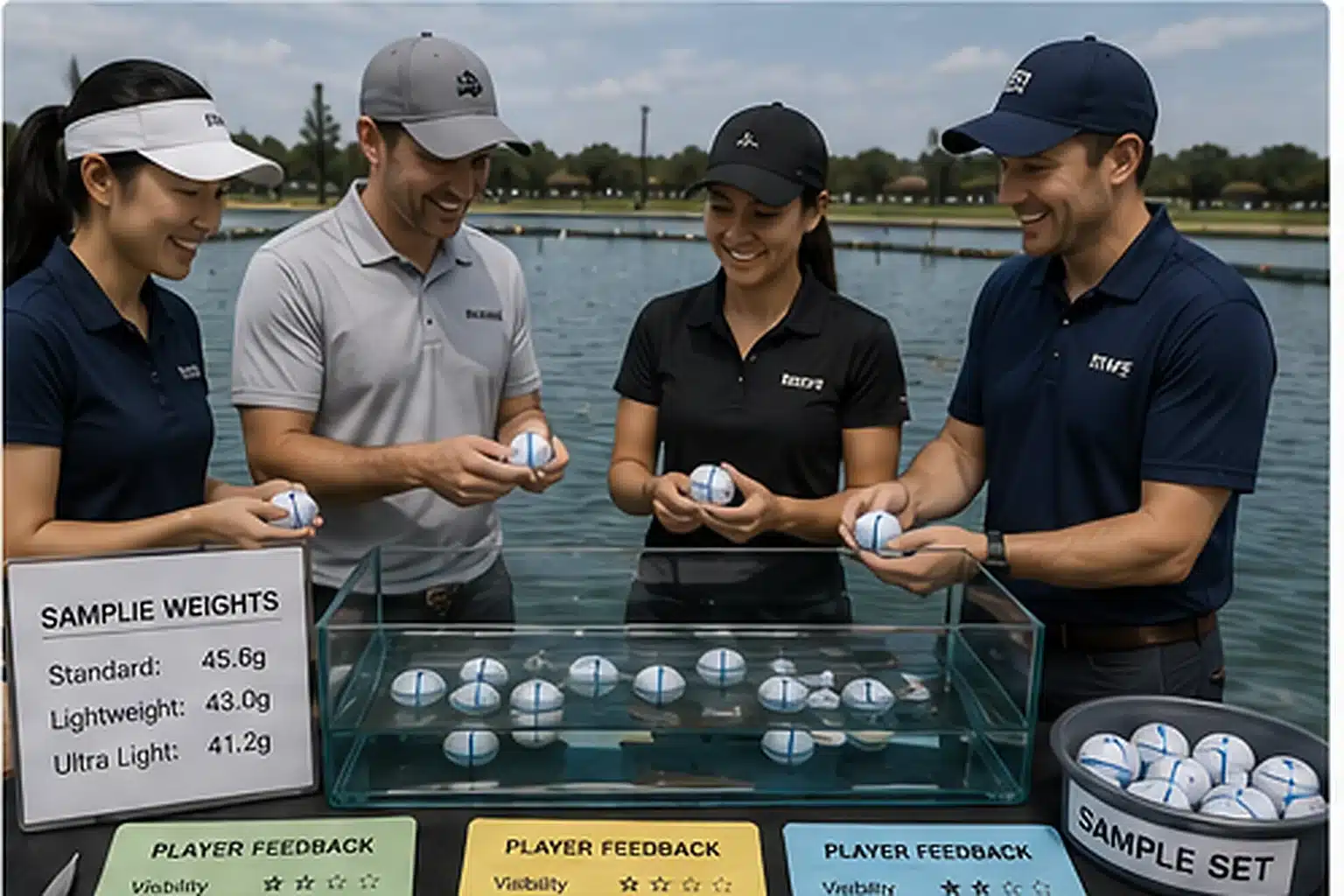
For procurement, the safer move is not to chase one public number. Ask your supplier for the sample weight range, SG target, lot-level SG record, and mixed-player hitting feedback for the exact floating range ball being quoted.
| Pain/decision | Cheap floater pattern | What players notice | Action/evidence |
|---|---|---|---|
| Weak strike feel | Ultra-light build | Dead or sponge-like impact | Run mixed-player test |
| Poor practice trust | Float-first tuning | Odd launch impression | Ask weight spread |
| VIP churn risk | Novelty feel | Less serious practice | Track repeat visits |
| Procurement shortcut | Float demo only | No feel proof | Request SG target |
| Sample bias | One good sample | No spread shown | Test multiple balls |
Request a mixed-player sample test pack with sample weight range and SG target. Have better players, average guests, and staff hit multiple samples and score feel, launch credibility, sound, and willingness to return.
Do not approve a floating ball for commercial range use unless player acceptance and recoverability are both validated.
✔ True — A ball can float and still be the wrong buy
Buoyancy solves retrieval only if the player still accepts the strike. Your aqua range is selling credible practice, not just floating inventory.
✘ False — “If it floats, it is good enough for an aqua range”
A new-ball float test does not prove believable feel, repeat visits, post-damage recovery, or lot consistency.
Player trust vs float-first design?
Your aqua range is selling credible practice, not just floating inventory.
If the product brief only says “floats well,” your team is missing half the decision. The stronger question is whether the ball can float without feeling like a marshmallow. That takes sample weights, SG logic, and real hitting feedback.
Why do damaged floaters sink?
You may see a new ball floating in a tank, but your real cost appears after small cover damage pushes balls out of the recovery lane.
Floating balls sink after damage when a small cover breach lets water ingress destroy buoyancy. Your team should require split-cover or breached-cover flotation proof, because a clean new-ball tank demo does not prove damaged inventory will remain recoverable.
The expensive failure is usually not dramatic. A floating range ball does not need to split in half to become a cost problem. A small cover breach, cut, crack, or worn area can create a path for water ingress. Once water enters the wrong structure, buoyancy can slowly disappear. The ball leaves the visible surface, leaves the recovery lane, and leaves your usable inventory count.
That is why “cut-resistant cover” is useful but incomplete. A cover claim describes surface resistance. It does not prove what happens after realistic cover damage from repeated hits, irons, hard edges, shoreline contact, or handling. New-ball flotation only proves the ball floats before the aqua range has done anything to it.
Construction matters, but it should be discussed carefully. A hollow or air-dependent route may be more vulnerable if the shell is compromised. A solid closed-cell structure can be a credible route because the recovery logic is not only protected by an intact outer skin. Still, no construction label should win the order without proof.
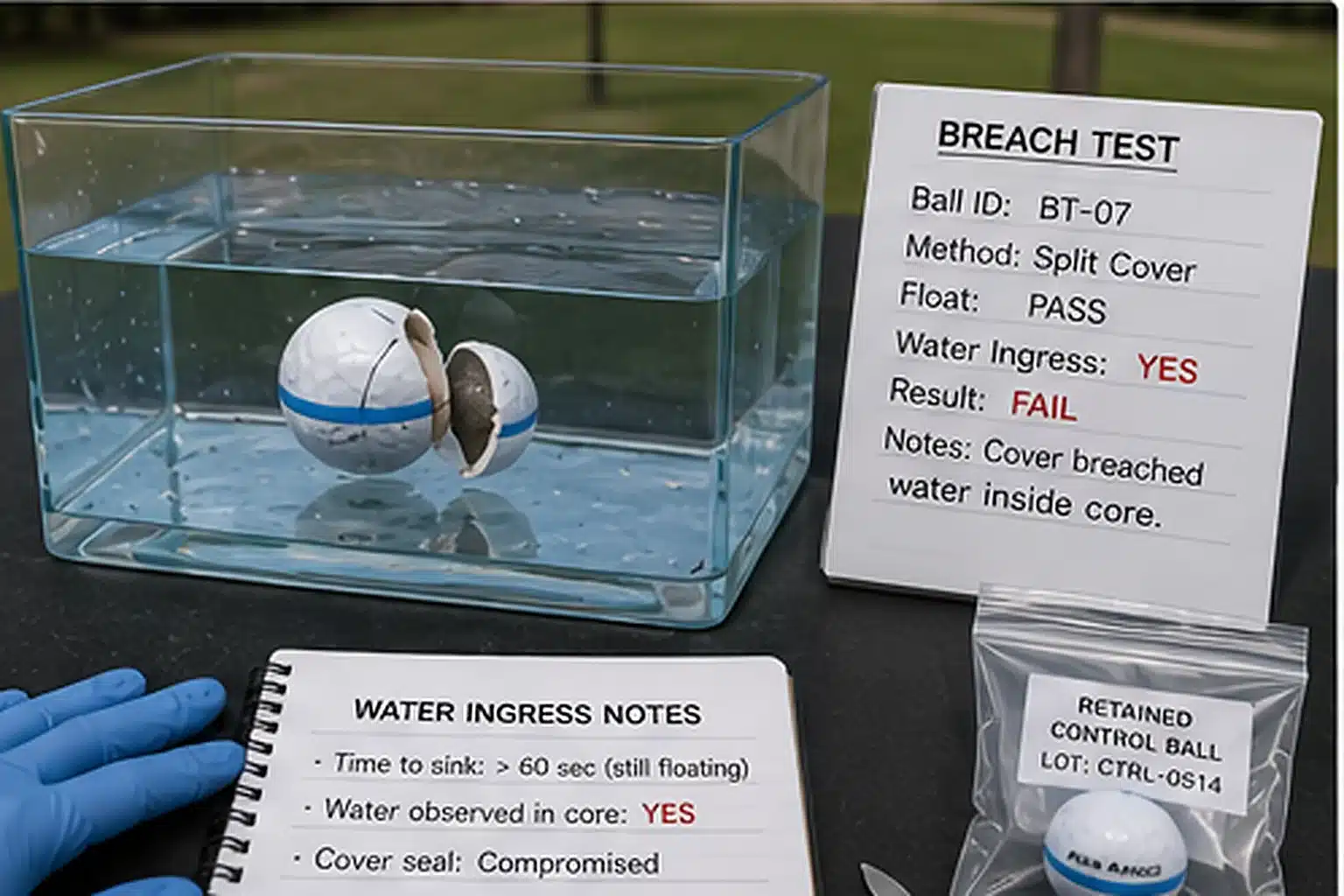
Supplier only shows a clean new ball floating is a failure signal.
Request a split-cover or breached-cover flotation video tied to the quoted lot or retained sample. Confirm the video shows sample ID, visible cover breach, immediate water placement, and continued flotation observation.
Do not approve a volume order if damaged-ball buoyancy is not shown on the same construction being quoted.
Water ingress after cover damage?
Your retrieval system can only recover the balls that still float.
Aqua ranges should treat post-damage flotation as a buying gate, not a bonus test. If the ball becomes bottom loss after minor damage, the float feature did not protect the inventory economics.
How should you use specific gravity?
You may hear “floats well” or “heavier floater,” but those phrases do not prove the relationship between buoyancy, mass, strike feel, and batch consistency.
Specific gravity helps aqua-range buyers connect buoyancy, weight, and strike feel. Your team should ask for SG target, lot SG record, sample weight spread, and post-damage flotation proof instead of accepting “floats well” as a complete specification.
Specific gravity is the ratio between a sample’s density and water’s density. A sample with SG below 1 is less dense than water and floats; a sample above 1 sinks. That simple idea turns a vague promise into measurable procurement language. specific gravity definition
For floating range balls, the goal is not “as light as possible.” The goal is enough buoyancy to recover the ball while keeping enough mass and structure for believable practice. A ball pushed far below the float threshold may float easily but feel too light. A threshold-float design can preserve more believable impact while still remaining recoverable.
SG 0.98 can be discussed as threshold-float screening logic, not an official industry standard. At the normal golf-ball diameter reference, a ball near that density sits closer to conventional feel than many ultra-light float-first builds. But the number alone does not approve anything. It must connect to weight spread, diameter spread, hardness, construction route, hitting feedback, and post-damage flotation.
Use tournament-ball rules only as a normal-ball reference. R&A rules state that a ball must not weigh more than 45.93 g and must not be smaller than 42.67 mm, with official size testing using a metal ring gauge. That helps buyers understand how much lighter 30 g or 39 g floaters are compared with a normal golf ball, but it does not mean aqua-range floaters must be tournament-conforming balls. normal-ball reference
| Pain/decision | SG / weight route | Buyer interpretation | Action/evidence |
|---|---|---|---|
| Ultra-light feel | Very low mass | Float-first risk | Test better-player feel |
| Threshold design | Near-float SG | More believable mass | Request SG record |
| Heavier floater | Higher weight claim | Not enough proof | Ask lot spread |
| Closed-cell route | Ingress resistance | Better recovery logic | Run breach test |
| Normal-ball reference | Rules context only | Not aqua standard | Avoid conformity trap |
“Heavier floater” claim with no lot SG record is a failure signal.
Supplier shall identify the SG target, lot SG method, recorded readings, sample weight spread, diameter spread, construction route, and retained control sample before buyer approval.
Request lot-level SG target, SG method, raw readings, sample weight spread, and diameter spread. Compare SG records to mixed-player hitting and split-cover flotation results.
Do not treat SG 0.98 or any weight claim as approval unless it is tied to lot data and field testing.
✔ True — SG is a useful buyer-side screen
Specific gravity helps your team discuss buoyancy, mass, and feel in one measurable language. It becomes useful when tied to lot records and field tests.
✘ False — “Heavier floater tells you enough”
A heavier claim points in a direction, but it does not prove SG control, post-damage flotation, or whether the shipped lot matches the sample.
SG, mass, and closed-cell structure?
Your team should use SG to balance feel and flotation, not to chase the lowest-density ball.
A credible commercial floater needs more than a physics explanation. It needs a repeatable build. That means the same SG target, same weight window, same construction route, same retained sample, and same post-damage flotation evidence must follow the order into production.
What does sinking cost your range?
You may treat sunken balls as replacement cost, but your range also absorbs recovery failure, cleanup burden, documentation gaps, and reputation pressure.
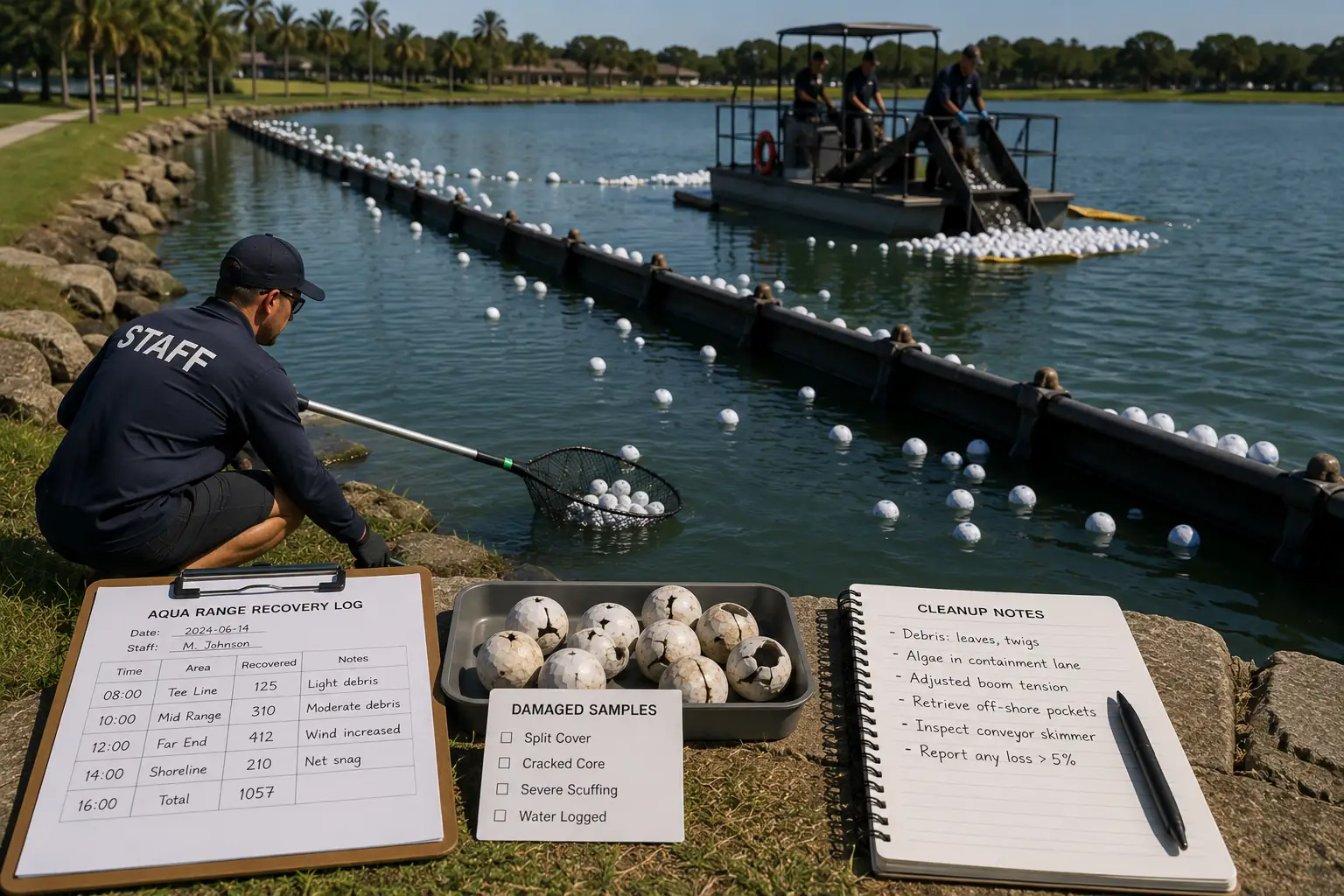
Sinking costs your aqua range more than replacement balls. Your team should track recovery-loss rate, retrieval cadence, cleanup burden, containment performance, and documentation readiness because a ball that sinks leaves both the inventory count and the recovery system.
Floating-ball procurement is a recovery-system decision, not a loose-ball decision. Ball design, retrieval lane, containment, staff access, shoreline drift, and monthly recovery logs all belong in the same operating file.
Recovery-system pages show why this matters. One aqua-range retriever system describes returning floating balls from the water back to shore with a pump mounted on a floating device. A containment system page describes protecting inventory from washing away or disappearing in weeds, while reducing labor involved in shoreline pickup. The point is simple: recovery hardware can only collect what still floats and remains inside the recovery plan. aqua-range retriever example containment system example
Lost golf balls in water can also become a debris story, not just an inventory story. A Marine Pollution Bulletin study from coastal golf-course environments near Carmel, California reported the retrieval of 50,681 balls, about 2.5 tons of debris, and noted that degradation and microplastic loss may be of concern. That is a marine case, not a direct proxy for every freshwater aqua range. Still, it supports the buyer-side logic: unrecovered balls can create cleanup burden, documentation pressure, and reputation risk in addition to replacement cost. golf-ball debris study
| Pain/decision | Risk area | What it means | Action/evidence |
|---|---|---|---|
| Lost stock | Recovery loss | Inventory leaves system | Track monthly loss |
| Unrecovered balls | Lake-bottom debris | Cleanup burden grows | Document baseline |
| Weak containment | Drift / weeds | Manual recovery rises | Review lane |
| No records | Audit readiness | Harder explanation | Build file |
| False savings | Replacement cost only | TCO understated | Add recovery cost |
Create a monthly recovery-loss baseline and cleanup-readiness file. Compare shipped count, recovered count, visible damaged floaters, shoreline drift, and sunken-loss estimates.
Do not approve a floater only on unit price if recovery loss and cleanup exposure are unpriced.
Loss rate, cleanup, and audit readiness?
Your range should know what disappears, not only what was purchased.
No headline fine is needed for the risk to matter. Once floating balls sink, the operator is managing missing inventory, lake-bottom debris, cleanup questions, and a weaker explanation file. That belongs in procurement before the problem grows.
How should you test floating balls?
You may test one ball in water and hit a few shots, but commercial aqua ranges need feel, flotation, damage, logo appearance, and recovery behavior tested together.
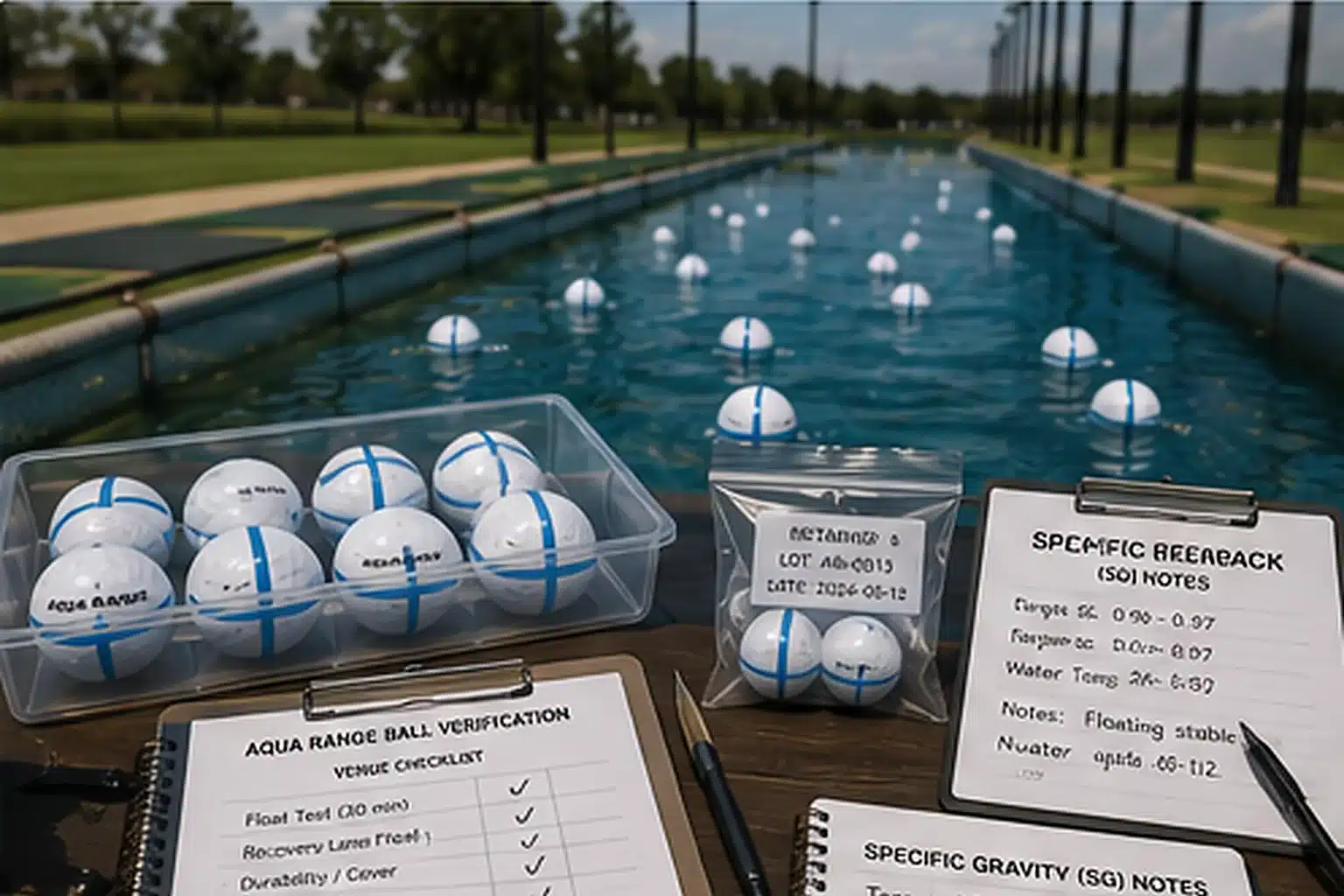
Aqua ranges should test floating balls with field hitting and breached-cover flotation, not a tank demo alone. Your team should compare player feel, new-ball buoyancy, post-damage flotation, water-soak appearance, logo legibility, and recovery workflow on the same candidate.
A commercial sample trial should start on the mat and continue in the water. First, run mixed-player hitting: better player, average guest, staff member, and coach if available. Score feel, sound, launch impression, and willingness to practice with the ball again. Then run new-ball flotation. After that, run the breached-cover flotation test.
Do not test only one or two balls. A single good floater may hide spread. Multiple samples show whether the lot direction is stable enough for commercial use.
For resort-facing and branded aqua ranges, appearance also matters. If the floating balls carry a venue logo, recovery mark, or event identification, test legibility after water soak, surface rubbing, cleaning, and sunlight or yellowing exposure. The point is not to turn this into a printing article. The point is that a floating ball can be functionally recoverable but visually tired too early.
Your practical trial can use six checks:
-
Mixed-player hitting feedback
-
New-ball flotation
-
Breached-cover flotation
-
Water-soak appearance and swelling check
-
Logo or mark rub check, if applicable
-
Recovery-lane observation and staff collection notes
Create a sample trial log covering mixed-player hitting, new-ball float, breached-cover float, water soak, logo/rub check, and retrieval workflow. Run the trial on the same production candidate that will be quoted, retained, and shipped.
Do not move to bulk until player acceptance and damaged-ball recoverability pass on the same candidate.
✔ True — Sample testing should combine feel and recoverability
Your aqua range needs a ball that players accept and staff can recover. Testing only new-ball buoyancy misses half the commercial decision.
✘ False — “One floating sample proves the order”
One clean sample in a tank does not prove mixed-player feel, post-damage flotation, logo durability, or production-lot consistency.
Field hitting plus breach-float test?
Your team should test the range experience and recovery system, not just the sample tank.
The best trial is practical. Hit the balls. Damage-test them. Soak them. Rub the mark. Watch how they move through your recovery lane. Then decide whether the same candidate deserves bulk approval.
What proof should your PO require?
You may approve a good sample, but the order is protected only when lot SG records, split-cover proof, QC data, packaging photos, and receiving rules all point to the same shipped lot.
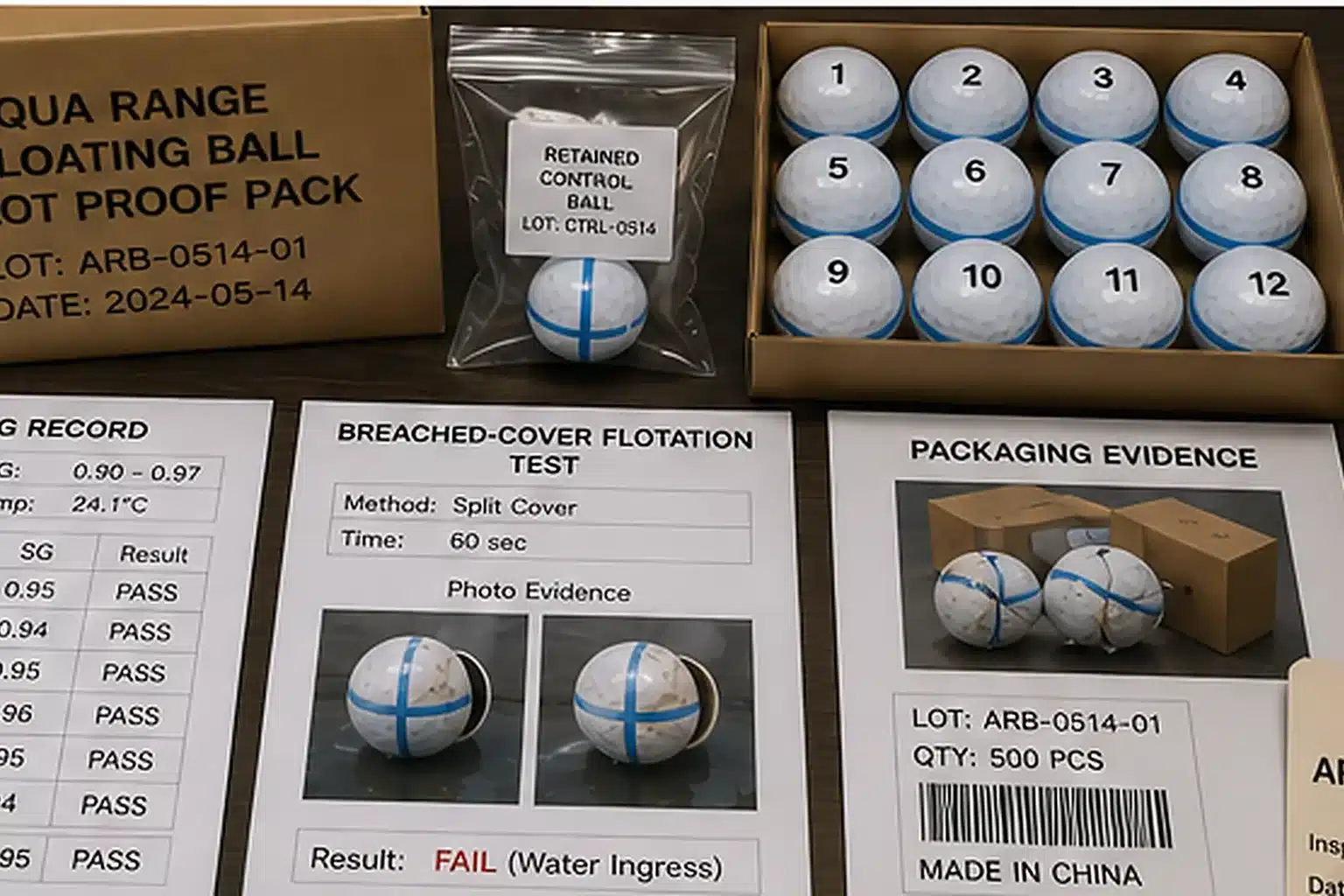
Do not approve floating range balls from a new-ball float demo alone. Your PO should require lot-level SG record, split-cover flotation video, 12-ball QC, water-soak/rub evidence, retained control sample, packaging photos, and AQL receiving rules.
Good sample, no retained control sample or receiving rule is a failure signal.
Ask the supplier to quote one commercial aqua-range floating ball platform with sample weight range, lot-level SG record, retained control sample, split-cover flotation video, 12-ball QC report, water-soak / rub evidence, packaging photos, and AQL receiving rules.
Your acceptance pack should include:
-
lot-level SG record with target, method, and raw readings
-
weight and diameter spread report
-
12-ball QC report with raw values, average, range or SD, equipment model, calibration status where available, and environmental conditions where relevant
-
compression, hardness, coating thickness, concentricity, or visual-defect fields where applicable
-
split-cover flotation video tied to the same lot or retained sample
-
water-soak, rub, and yellowing evidence for logoed or resort-facing balls
-
packaging photos showing moisture and crush protection
-
retained control sample held by buyer and supplier
-
AQL receiving rules for sinking, severe damage, wrong batch, missing SG proof, logo failure, or untraceable samples
Use standards as reference methods, not fake “aqua range certification.” ASTM D2240 can support Shore or durometer hardness as a material-consistency field. ASTM D4060 can support relative coating-abrasion comparison, but its scope is organic coatings on a plane, rigid surface, so it should not be copied as a finished water-range ball standard. ISO 2859-1 supports AQL-indexed acceptance sampling for inspection by attributes. ASTM D2240 ASTM D4060 ISO 2859-1
| Pain/decision | Proof item | What it verifies | Action/evidence |
|---|---|---|---|
| Float demo only | Split-cover video | Post-damage recovery | Tie to lot |
| Vague SG | Lot SG record | Buoyancy control | Review readings |
| Sample drift | Weight/diameter spread | Batch consistency | Check report |
| Hero sample | 12-ball QC | Lot variation | Review raw data |
| Logo fade | Water-soak/rub check | Presentation durability | Inspect mark |
| Receiving dispute | Retained sample | Physical baseline | Seal samples |
| Damaged shipment | Packaging photos | Moisture/crush risk | Check cartons |
Supplier shall link approved floating-ball sample, lot-level SG record, weight/diameter spread report, split-cover flotation video, 12-ball QC report, packaging photos, retained control sample, batch ID, packing list, and receiving inspection record under one traceable proof version.
Buyer acceptance requires believable mixed-player hitting feedback, agreed SG target and weight window, new-ball and breached-cover flotation proof, water-soak / rub evidence for marks if applicable, 12-ball QC raw data, retained sample match, packaging condition, and AQL-based receiving rules for sinking, severe damage, wrong batch, missing SG proof, or untraceable samples.
Separate production completion, shipping lead time, and arrival timing for seasonal replenishment. A good floater that arrives after the peak aqua-range window does not protect the season.
Request a floating range ball acceptance pack with SG record, breached-cover flotation proof, 12-ball QC, retained sample, water-soak/rub evidence, packaging photos, and receiving checklist. Check whether the sample, SG record, breach-float video, QC report, packing list, and retained sample reference the same lot or proof version.
Hold shipment if SG record, split-cover flotation proof, QC data, retained sample, packaging evidence, or batch traceability is missing.
Lot SG, retained sample, receiving checks?
Your PO should protect the lot you receive, not the sample you remember.
Do not accept “mass production will improve” unless the final proof version is retested and reapproved. If construction, SG target, cover route, coating, logo method, packaging, or batch ID changes, your team should require written approval before shipment.
FAQ
Do floating golf balls really float after damage?
New-ball flotation is not enough. Your team should verify whether a breached or split-cover sample still floats long enough to remain recoverable.
Ask for breached-cover video. Tie the proof to the quoted lot. Reject new-ball-only demos. The recovery economics depend on damaged balls staying on the surface, not only on perfect samples floating in a clean tank.
Do floating range balls feel like regular golf balls?
Not always. Weight, SG, construction, cover feel, and compression can make some floaters feel dead or sponge-like, especially to stronger players.
Run mixed-player hitting. Ask for weight range. Track better-player acceptance. Aqua range balls do not have to feel identical to premium on-course balls, but they should feel credible enough for the range experience your venue is selling.
What weight should floating range balls have?
There is no single universal answer. Your team should compare sample weight range, SG target, strike feedback, and post-damage flotation rather than chasing one number.
Use normal ball weight only as context. Ask for lot data. Avoid ultra-light novelty feel. A 30 g floater and a 39 g floater can create very different strike impressions, so weight should be tested with players, not read in isolation.
Why do floating balls sink after cover damage?
Small cover damage can allow water ingress. If the construction depends too heavily on an intact shell or air pocket, flotation can fail after realistic wear.
Test damaged samples. Check cover and core route. Require post-damage flotation proof. The ball does not need to split dramatically to become bottom loss; a small breach can be enough to change the recovery outcome.
How should aqua ranges retrieve balls efficiently?
Efficient retrieval depends on both the ball and the recovery lane. Hardware cannot collect balls that no longer float.
Map recovery cadence. Track monthly recovery loss. Use containment and retrieval planning. The best recovery system still depends on the ball remaining buoyant, visible, and within the collection path long enough for staff or equipment to retrieve it.
Do floating range balls need tournament conformity?
Usually not for ordinary aqua-range use. Focus on feel, recoverability, post-damage flotation, lot evidence, and recovery efficiency unless your venue has a specific competition requirement.
Use rules as normal-ball context. Do not confuse conformity with aqua fit. Verify the exact model only for formal use. For most commercial aqua ranges, the operational question is not tournament status; it is whether players accept the ball and staff can recover it.
What proof should a supplier provide before bulk?
Ask for lot-level SG record, sample weight and diameter spread, split-cover flotation video, 12-ball QC, retained sample, packaging photos, and AQL receiving rules.
Reject brochure-only claims. Tie proof to the shipped lot. Keep buyer and supplier retained samples. The sample, QC report, SG record, breach-float video, packing list, and receiving inspection should all point to the same proof version.
Do logoed floating balls fade after water exposure?
They can, so resort-facing or branded aqua ranges should test logo legibility after water soak, rubbing, cleaning, and UV or yellowing exposure.
Check the same commercial SKU. Do not rely on a dry presentation sample. Define logo and cover defects at receiving. A ball that still floats but looks yellowed, faded, or poorly marked can still hurt the venue impression.
Conclusion
The right floating range ball is not approved because it floats when new. It is approved when players accept the feel, damaged balls remain retrievable, and the supplier can prove the same result at lot level.
Your aqua range should buy believable player acceptance and recoverable inventory, not just a clean tank demo.
When SG records, mixed-player feedback, split-cover flotation proof, retained samples, packaging evidence, and receiving rules all point to the same lot, floating range balls stop being a risky novelty and become a controlled commercial inventory system.
You might also like — Glow Golf Balls for Night Golf: What Should Venues Verify?