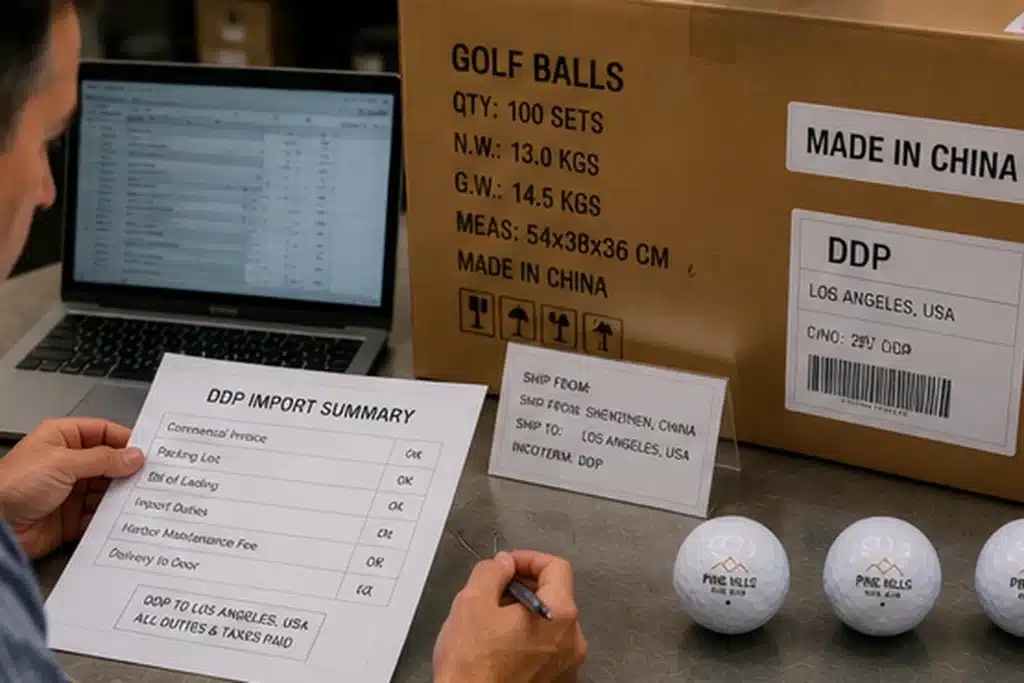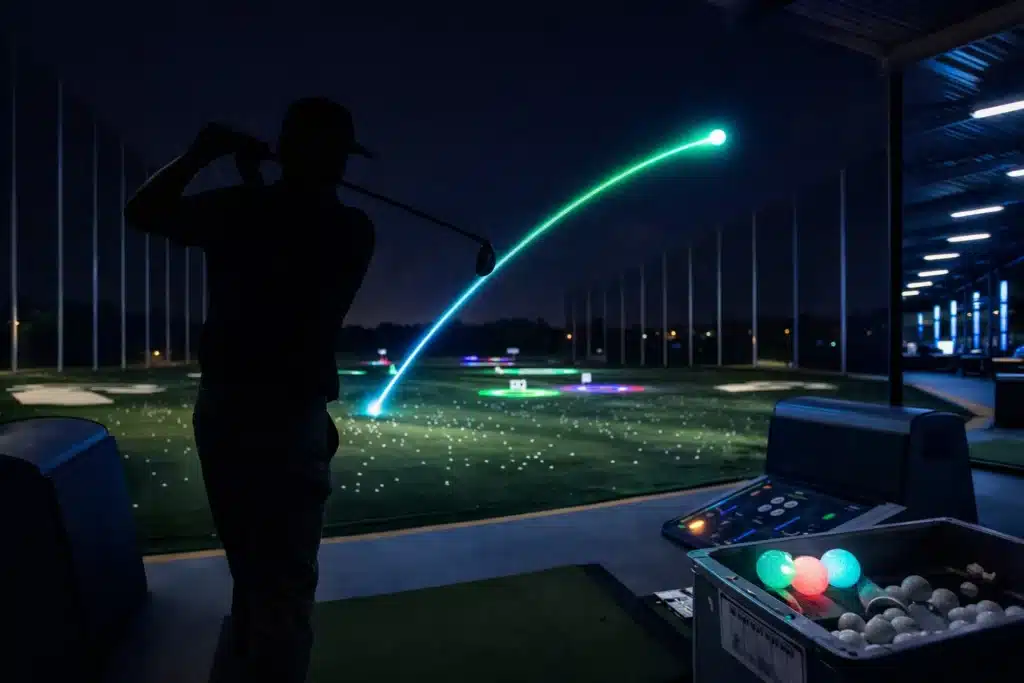
Venues should verify usable brightness, activation reliability, impact durability, club compatibility, and batch proof before buying glow golf balls for night golf. A commercial-use glow ball should stay visible after impact, trigger predictably, avoid false activation in storage, feel acceptable with guest clubs, and ship as the same locked final SKU that passed testing.
A glow ball that dies mid-flight does not just disappear; it breaks the paid night-golf experience. Guests lose the shot, staff may need to recover or replace the ball, pace slows, and the venue pays through lost inventory, replay friction, complaints, and replacement-cycle cost.
Do not approve LED golf balls from a bright sample or a “40 hours” claim alone. Your team should ask what the hour claim means: total battery life, light time per activation, or usable brightness after impact under real venue conditions.
Use this guide to separate novelty-grade glow balls from commercial-use programs before your team approves bulk inventory for night leagues, resort events, corporate outings, teaching sessions, or after-dark range play.
Why do glow balls fail during night golf?
You may see one ball vanish mid-flight, but your venue feels the operating loss through guest frustration, staff recovery, replay friction, and lost inventory.
Glow balls fail commercial night golf when they go dark, fail to activate, or lose usable brightness after impact. Your venue should verify impact light continuity, activation behavior, and final-SKU reliability before treating a bright box sample as event-ready inventory.
A glow ball that dies mid-flight does not just disappoint one player. It interrupts the rhythm of the night event. The guest loses the shot. Staff may need to search. The group may replay. The ball may disappear into a dark fairway, rough, or recovery area. A small product failure becomes pace-of-play friction, inventory loss, and a weaker memory of the event.
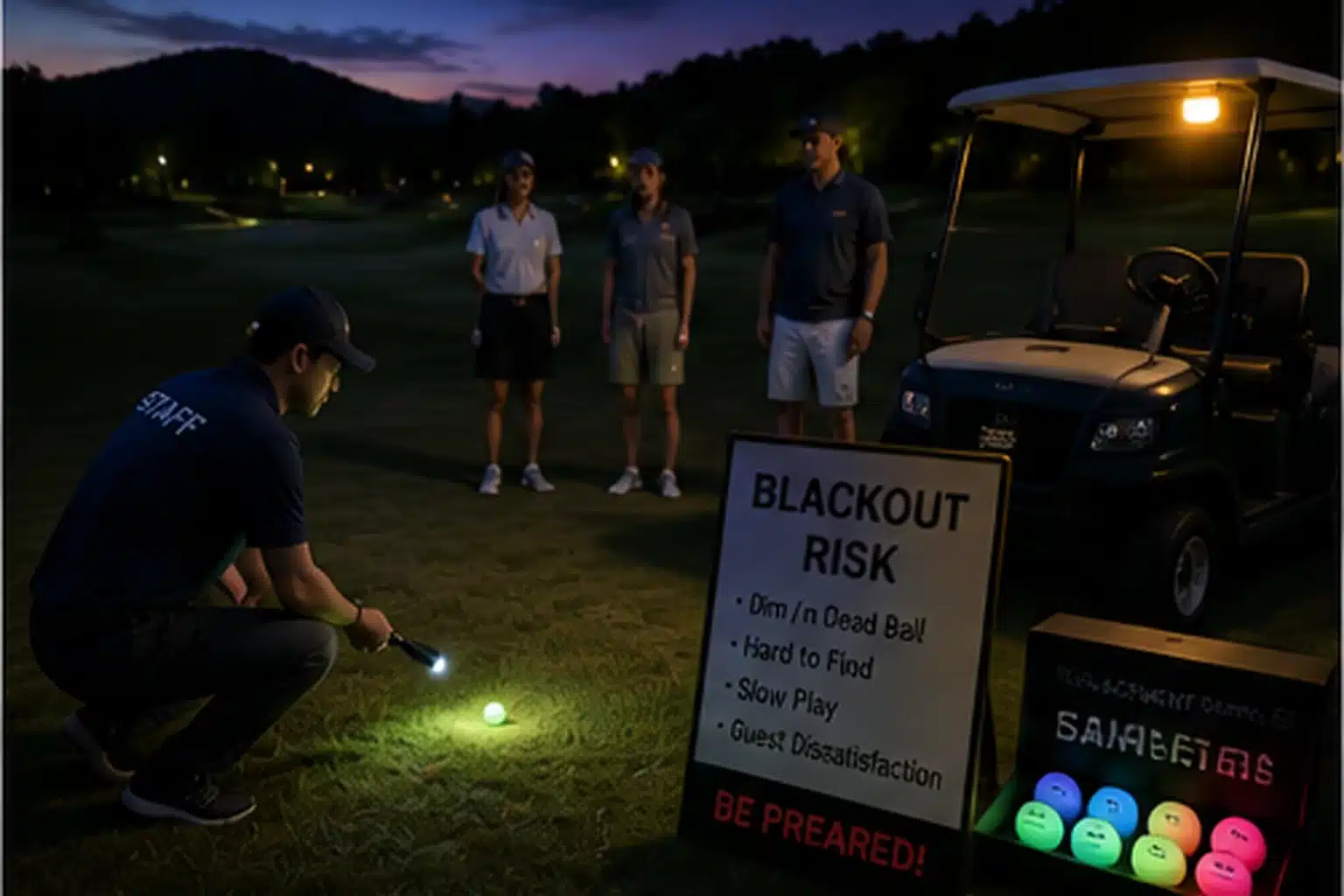
That is why commercial venues should separate toy-grade performance from commercial-use reliability. A backyard player may tolerate one dud. A resort night league, club outing, corporate event, or after-dark range session cannot build the guest experience around hope.
Three failure modes deserve buyer attention:
-
Mid-air blackout means the ball lights at launch, then disappears after impact shock or power interruption.
-
False non-activation means the ball fails to light on strike, creating re-hit confusion and staff explanation.
-
Random in-bag activation means the ball burns battery before the event even begins.
Ball lights in the box but fails after impact is a failure signal.
A venue should request an impact-reliability report tied to the final SKU. Check repeated full-swing strikes, post-impact light continuity, and visible pass/fail threshold. Do not approve commercial night use unless the final SKU proves light continuity after repeated impact.
✔ True — Blackout is an operating failure
In a paid night-golf setting, a ball that goes dark can affect pace, recovery work, guest confidence, and replacement-cycle cost.
✘ False — “If it lights in the box, it is venue-ready”
Commercial reliability begins after impact, handling, storage, and repeat use. One bright demo sample proves very little by itself.
Toy-grade vs commercial-use failure?
Your guests do not judge the ball in the box; they judge whether they can track it after the swing.
For venue buying, the product is the full operating behavior: activation, brightness, impact survival, recovery visibility, feel, and lot consistency. If those are not tested together on the same final SKU, your team is still buying a promise.
What does “40 hours” really mean?
You may read “40 hours” as a clear promise, but the claim may refer to total battery life, timed activations, or barely visible light.
“40 hours” is not a complete specification unless the supplier defines trigger logic, temperature, timer behavior, brightness threshold, and failure definition. Your venue should buy usable trackability, not a claim that the ball is technically still glowing.
At the time of review, public product pages show why hour claims need careful reading. One LED golf ball page promotes up to 40 hours of glow time, another LED product page describes a no-timer design, and a timer-based product page describes impact activation with a 10-minute timer. A buyer guide also separates glow products into LED, battery-powered, and UV light balls. Those are different operating models, even when all of them sound like “night golf balls.” 40-hour glow-time example no-timer LED example 10-minute timer example glow-ball category guide
Your procurement team should split every hours claim into three questions:
-
What is the total battery life?
-
What is the light time per activation?
-
What is the usable brightness threshold for guest trackability?
A ball that technically emits light is not necessarily venue-usable. A portable-lighting runtime framework uses a brightness-drop threshold to avoid unrealistic runtime claims based on very dim output. Do not treat that as a golf-ball standard. Use it as a useful analogy: runtime should be tied to a defined brightness threshold, not “it still glows a little.” runtime threshold concept
A venue comparison works best when the first column names the buying decision, not the marketing claim.
| Pain/decision | Claim type | What it may mean | Action/evidence |
|---|---|---|---|
| Headline hours | 40 hours glow time | Total visible glow or battery life | Ask threshold |
| Continuous claim | Battery life | Continuous illumination until drain | Ask conditions |
| Timer claim | 10-minute timer | Light per activation | Check search time |
| No timer | Always-on or light-triggered | Drain or false-trigger risk | Ask logic |
| UV glow | Charged glow | Depends on charging workflow | Test venue process |
Supplier sells “40 hours” with no brightness threshold is a failure signal.
Request a brightness-retention log with test condition, temperature, duration, timer logic, and usable-brightness threshold. Compare initial brightness, post-activation brightness, post-impact brightness, and late-stage visibility under venue-like darkness.
Reject hour claims that do not define what counted as failure.
Battery life vs usable brightness?
Your team should ask what the guest can still see, not what the battery technically still does.
Cold evening play, hot storage, repeated activation, and timer behavior can all change the operating result. Avoid fixed assumptions unless your supplier provides data. A strong supplier can explain the test condition; a weak one only repeats the headline hours.
Can activation logic handle real operations?
You may buy based on “impact activated,” “light activated,” “timer,” or “timerless” wording, but your staff pays for every misfire.
Activation reliability decides whether glow balls support or disrupt the event workflow. Your team should test bag vibration, drop behavior, strike-trigger success, false activation, timer reset, cold evening response, and visible pass/fail logic before bulk buying.
Activation is not just a feature. It is workflow control.
A false trigger in a bag quietly drains battery before guests tee off. A failed trigger on impact creates replay friction. A timer that turns off too early can send guests searching in the dark. A trigger that is too sensitive or too stubborn turns your staff into the quality-control department during a paid event.
Activation logic also changes replacement-cycle economics. If balls light too easily during transport, your unused inventory may already be aging. If they do not light after a full swing, your team absorbs guest frustration. If the timer is shorter than normal search and walking time, the battery-life claim does not protect the event.
A practical activation matrix should include:
-
bag vibration and cart transport
-
drop from table or cart height
-
normal putt and short chip
-
full-swing impact
-
false-trigger behavior
-
strike-trigger success
-
timer duration and reset logic
-
cold evening activation
-
storage drain before event use
Request an activation matrix for the final SKU. Check false-trigger behavior, strike-trigger success, timer duration, reset logic, storage drain, and cold-evening activation.
Do not approve a glow-ball lot unless activation behavior is predictable across handling and strike scenarios.
✔ True — Activation is workflow control
A night event depends on predictable handling, strike response, visibility, and recovery time. Activation logic touches all of those steps.
✘ False — “Impact activated alone proves venue reliability”
Impact activated is a label. Venue reliability requires trigger-success data, false-trigger checks, timer behavior, and post-impact visibility proof.
False triggers, failed strikes, and timers?
Your staff should not become the supplier’s quality-control team during a paid night event.
The best test is not complicated. Put the ball through the normal abuses of an event: bag movement, cart handling, drops, short shots, full swings, search time, and storage. Then record whether the final SKU behaves predictably.
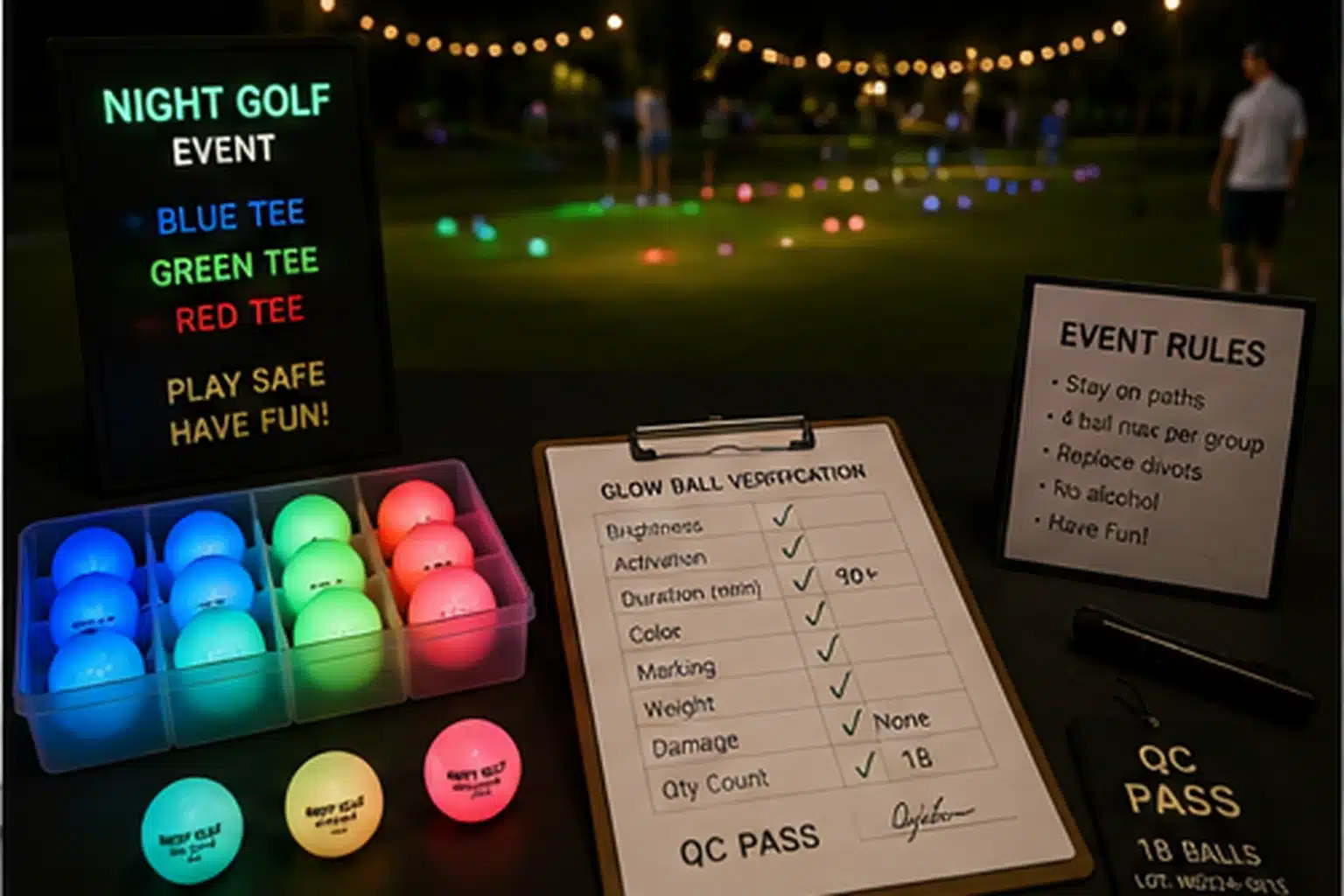
You may assume standard size or bright visibility means the ball is safe for all clubs, but compatibility and harsh feel are separate complaint risks.
Club compatibility is not automatic in glow golf balls. Your venue should require a written compatibility disclosure, cover or shell construction, hardness or compression notes, and any driver-use limits before guests use premium clubs with the final SKU.
Guests do not always bring cheap clubs to a night event. Many drivers sit in the several-hundred-dollar range; one official driver launch listed MAP at $649 and $849 Premium, while a current driver product page shows hundreds of dollars even on sale. The point is not to scare buyers. The point is to price complaint exposure honestly. premium driver MAP example current driver price example
Do not write this as “LED balls damage drivers.” That is too broad. Also do not assume every LED or glow ball is safe for every club. The safer buying rule is simple: no compatibility statement, no approval for premium-driver venue use.
Your supplier should disclose intended club use. Driver, iron, wedge, putting, and short-hole event use may not carry the same risk profile. Ask whether the ball has use limits. Ask for cover or shell construction. Ask for hardness or compression notes. Ask whether the compatibility statement applies to the exact final SKU being quoted.
| Pain/decision | Buyer shortcut | Hidden risk | Action/evidence |
|---|---|---|---|
| Standard size | Assumes safety | No feel proof | Ask compatibility |
| Bright shell | Looks venue-ready | Harsh impact | Ask hardness |
| Safe claim | No basis shown | Complaint dispute | Require statement |
| Rental vs guest clubs | Same use rule | Premium-driver exposure | Define limits |
| One sample | No batch proof | Feel drift | Check QC |
Shore hardness can be useful as a consistency field when measured with a defined method. ASTM D2240 supports durometer hardness testing, but hardness data should not be treated as a universal safety guarantee. It is one part of the cover and feel control file. Shore hardness method
Request written club-compatibility disclosure and cover/feel specification. Check driver-use limits, cover or shell route, hardness or compression notes, and impact-feel observations on the final SKU.
No compatibility statement, no approval for premium-driver venue use.
Compatibility disclosure and feel risk?
Your event should not discover club-compatibility boundaries through a guest complaint.
For resort events, private clubs, corporate outings, and teaching venues, this is especially important. The venue is selling confidence. If the ball feels harsh, sounds wrong, or leaves compatibility unclear, the complaint may be about a driver even when the real issue started in procurement.
How should venues test before buying?
You may test one or two bright samples indoors, but night venues need a field trial that reflects guest handling, weather, impact, search time, and staff workflow.
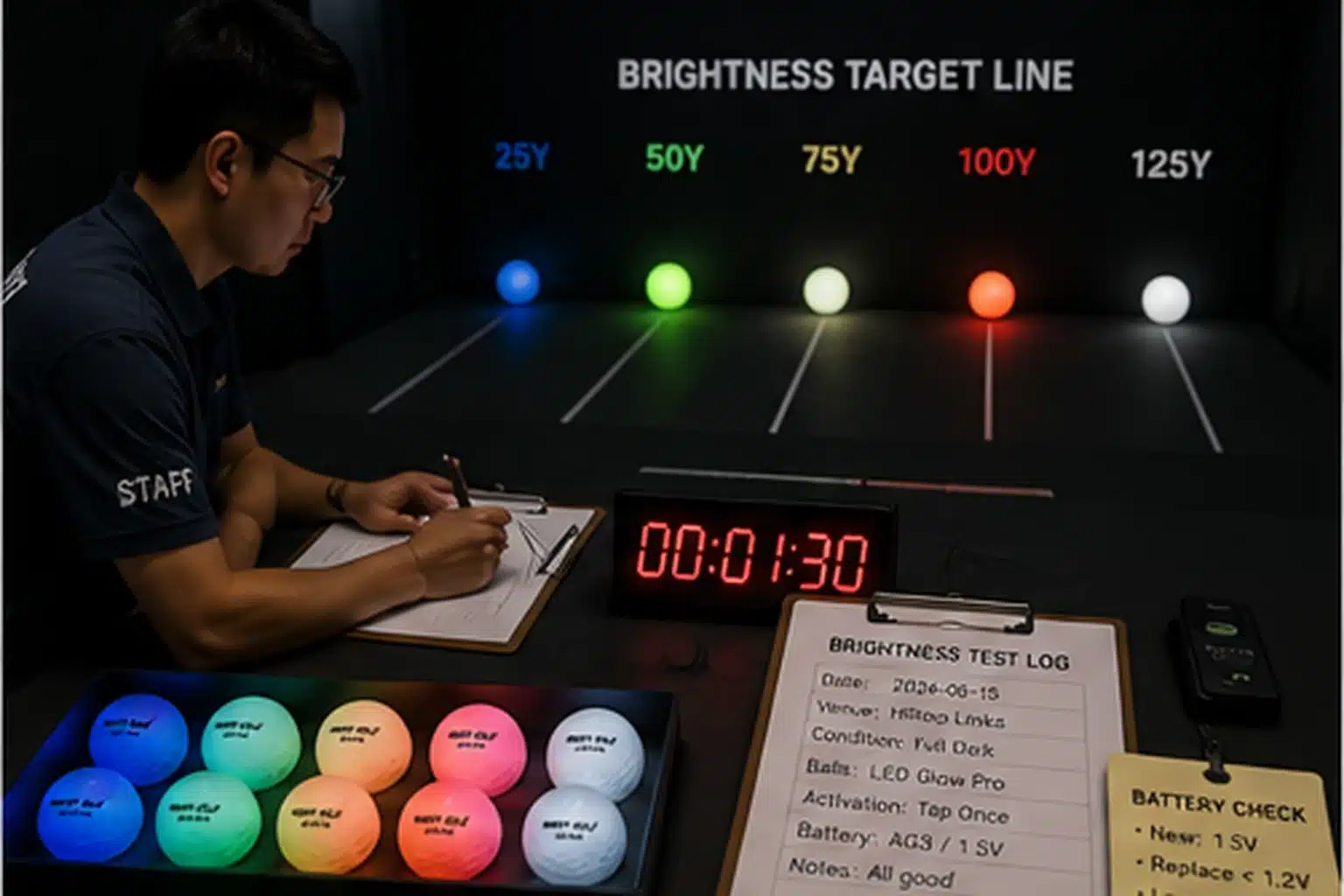
Venues should test glow balls under event-like conditions before bulk buying. Your team should compare brightness, activation, impact continuity, search visibility, storage drain, staff handling, and guest feel on multiple final-SKU samples, not one bright demo ball.
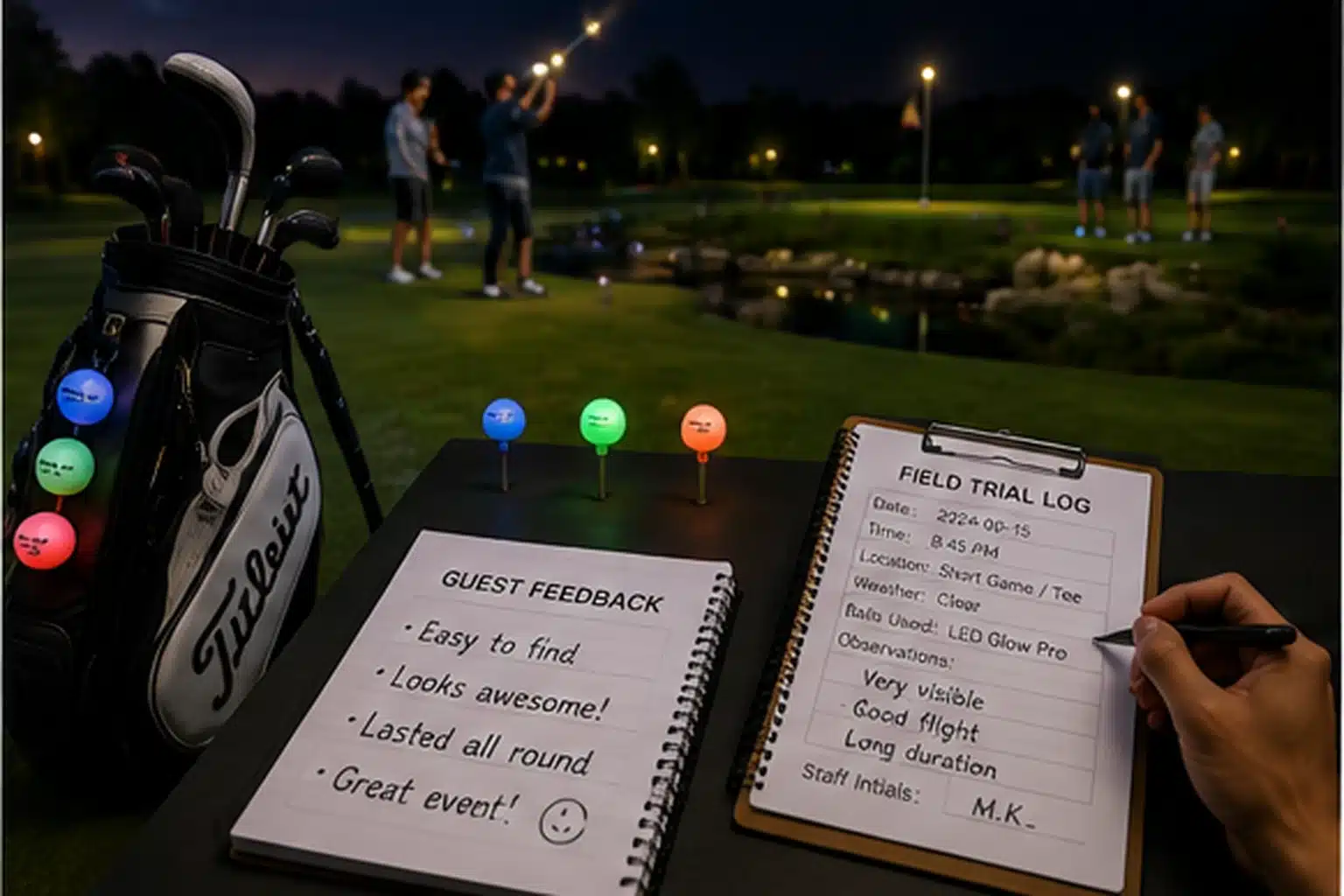
A commercial sample pack is not a color preview. It is a risk filter.
Start with a dark-room brightness check, but do not stop there. Move into outdoor darkness. Hit full shots. Test short shots. Put balls in a bag and cart. Drop a few from normal handling height. Let staff retrieve them. Observe whether guests can track the ball long enough to matter. Record any misfire, early shutoff, harsh feel, shell damage, or strange activation.
Test multiple balls, not one or two. A single good ball may be a hero sample. A small set can reveal spread: one ball activates perfectly, another triggers in storage, another dims too soon, another feels too hard. That spread is exactly what a commercial venue needs to know before bulk approval.
Replacement-cycle economics belong in the trial. Log lost ball rate, staff recovery time, guest replay, battery drain, defect replacements, and any ball that becomes unfit for use before its claimed life. If the event has printed venue marks, event logos, or numbering, check whether the mark stays readable on the same final SKU. Do not turn the trial into a printing article. Just make sure the mark survives enough handling to prevent receiving and branding disputes.
Create a venue field-trial log for brightness, activation, impact, search time, guest feel, and replacement triggers. Run the trial on the same final candidate that will be quoted and shipped.
Do not move to bulk until the field trial and supplier proof pack reference the same version.
✔ True — The sample pack is a commercial-risk filter
A good sample pack helps your team judge usable brightness, activation behavior, impact survival, feel, and replacement risk on the same final candidate.
✘ False — “One bright demo sample proves the program”
One sample only proves that one sample lit up. It does not prove batch consistency, post-impact reliability, or shipment traceability.
Field trial under event conditions?
Your team should test the night event, not just the product box.
The cleanest trial is practical: dark room, outdoor tee, short-game area, bag handling, impact, retrieval, storage, and staff notes. Treat it like a dress rehearsal for the event your guests will actually experience.
What proof should your PO require?
You may receive impressive claims from different samples, but your PO must make all proof point to one final production version.
Do not approve commercial glow balls from hours, colors, or slogans alone. Your PO should require one locked final SKU with burn-in log, activation matrix, impact proof, compatibility disclosure, 12-ball QC, retained sample, AQL receiving rule, and written change control.
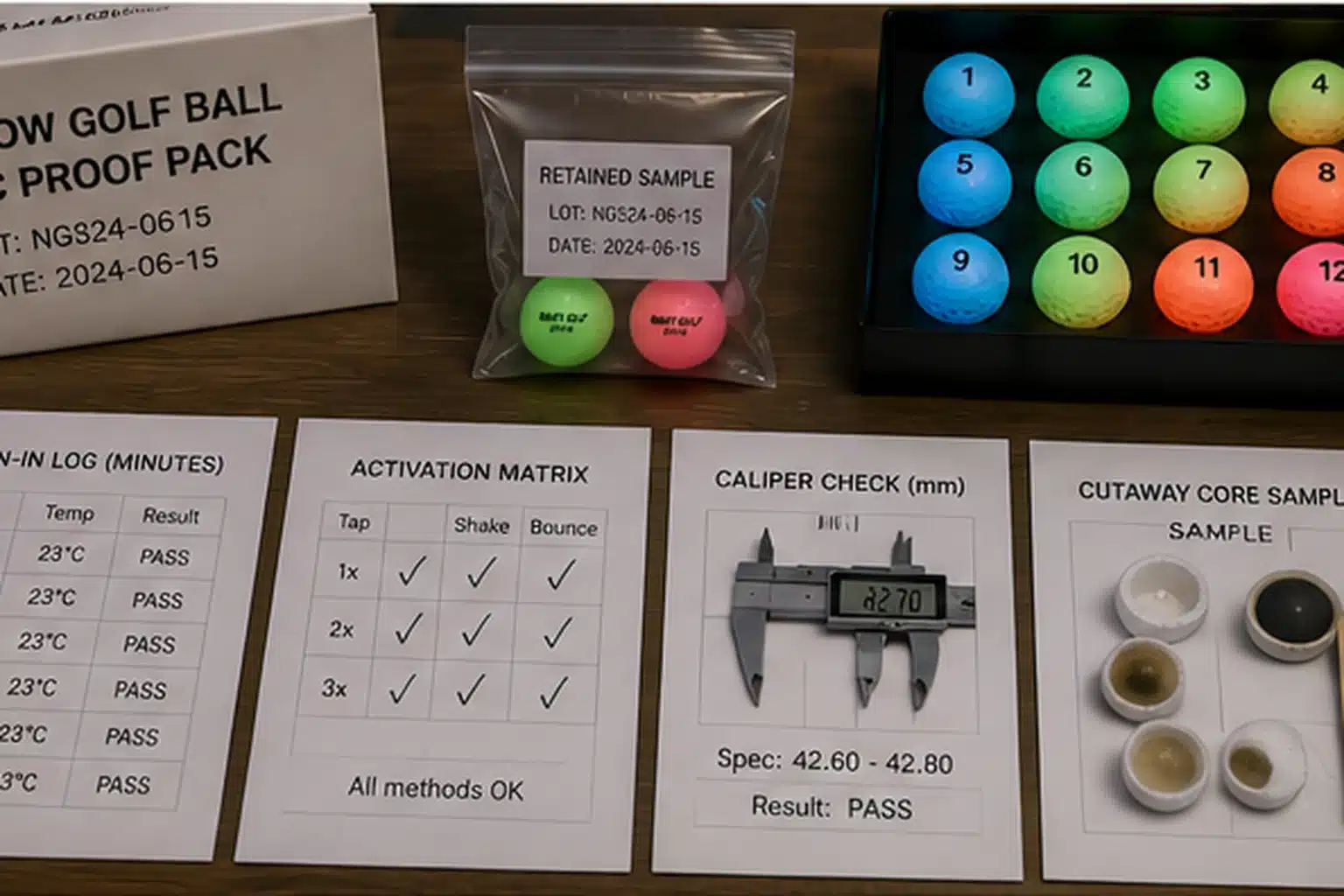
Proof items that do not reference the same final SKU are a failure signal.
Ask the supplier to quote one locked commercial glow-ball SKU with battery architecture, activation logic, burn-in method, usable-brightness threshold, impact-test method, club-compatibility disclosure, 12-ball QC pack, retained sample, AQL receiving rule, and written change-control terms.
Your commercial glow-ball acceptance pack should include:
-
burn-in log with test condition, temperature, duration, and brightness threshold
-
activation matrix for bag, drop, strike, timer, and false trigger
-
repeated-impact proof and shell integrity observation
-
written club-compatibility disclosure and use limits
-
12-ball QC pack with raw data, average, range or SD, device list, calibration status where available, weight, diameter, compression, Shore hardness, and visual defects
-
retained sample held against the approved production version
-
AQL receiving rules for dark, misfiring, damaged, wrong-version, or untraceable balls
Use standards as reference methods, not fake “LED golf ball certification.” ASTM D2240 can support Shore hardness control. ASTM D4060 can support relative coating-abrasion comparison, but its scope is organic coatings on a plane, rigid surface, so it should not be copy-pasted as a finished-ball impact standard. IEC 60529 supports IP-style thinking for dust and liquid ingress protection of electronic enclosures when waterproof or weather-exposure claims are made. ISO 2859-1 supports AQL-based lot inspection by attributes. coating abrasion reference IP rating framework AQL inspection framework
| Pain/decision | Proof item | What it verifies | Action/evidence |
|---|---|---|---|
| Undefined hours | Burn-in log | Usable brightness | Set threshold |
| Misfire risk | Activation matrix | Trigger reliability | Test scenarios |
| Blackout risk | Impact proof | Light continuity | Compare final SKU |
| Driver complaints | Compatibility disclosure | Use limits | Require statement |
| Hero sample | 12-ball QC | Batch spread | Review raw data |
| Version drift | Locked proof | Sample-to-lot trace | Hold if broken |
Supplier shall issue one locked commercial glow-ball proof version and reference that version on burn-in report, activation matrix, impact-test summary, club-compatibility disclosure, 12-ball QC report, retained sample, batch record, packing list, and receiving inspection file.
Buyer acceptance requires agreed usable-brightness threshold, strike-trigger success evidence, false-trigger checks, repeated-impact light continuity, written club-compatibility disclosure, 12-ball QC raw data, retained sample match, and AQL-based receiving rules for dark, misfiring, damaged, wrong-version, or untraceable balls.
For seasonal night events, write lead time and delivery date as separate PO fields. A shipment that arrives after the night league or corporate event window opens is not just late; it can miss the revenue window.
Request a commercial glow-ball acceptance pack with burn-in, activation, impact, compatibility, 12-ball QC, retained sample, and AQL receiving rule. Check whether every report references the same final SKU, proof version, batch ID, and packing list.
Hold shipment if brightness threshold, activation logic, impact proof, compatibility disclosure, QC data, retained sample, or version traceability is missing.
Locked SKU, QC pack, and pass matrix?
Your PO should stop uncertainty before it reaches the night event.
Do not accept “mass production will improve” unless the final proof version is retested and reapproved. Any change to battery architecture, activation method, timer logic, shell construction, cover formula, compatibility guidance, packaging, or production version should require written buyer approval before shipment.
FAQ
How long do LED golf balls really last?
LED golf ball life depends on the definition of “last”: total battery life, light time per activation, or usable brightness after impact. A commercial venue should verify all three before trusting any hour claim.
Ask for test temperature and conditions. Ask what counted as failure. Ask whether the claim describes continuous illumination, timed activation, or total battery capacity. A ball that technically still glows may not be bright enough for commercial night-golf tracking.
Do LED golf balls turn off by timer or trigger?
Some LED golf balls use timers, some use impact activation, some use light activation, and some behave more like timerless systems. The operating risk depends on trigger reliability and shutoff behavior.
Ask for timer duration. Ask for false-trigger data. Test bag, drop, and strike scenarios. A timer can help preserve battery, but it may also turn off before a guest reaches the ball. Timerless or light-triggered logic can help pace, but it needs storage and false-trigger checks.
Can LED golf balls damage a premium driver?
Do not make a universal assumption. The safer buying rule is to request written club compatibility, cover or shell construction, hardness or compression notes, and use limits for the final SKU.
Do not rely on size alone. Check final SKU, not a generic sample. Hold approval if compatibility is unclear. Your venue should not learn about driver-use boundaries from a complaint after guests have already played.
Are glow balls suitable for commercial night golf?
Glow balls can be suitable for commercial night golf, but commercial use requires more proof than casual backyard play. Your venue should verify brightness, activation, impact continuity, feel, and batch control.
Test multiple balls. Use event-like conditions. Tie proof to the final SKU. The commercial question is not whether a ball glows once; it is whether the ball supports the full event workflow predictably.
Should venues choose LED, UV, or glow-in-the-dark balls?
Each route changes the workflow. LED usually solves visibility strongly, UV or light-charged balls may require charging steps, and timer or battery systems need replacement-cycle planning.
Map the event workflow first. Check charging or activation needs. Avoid treating all glow balls as one category. A UV-style ball may feel closer to ordinary play for some uses, while LED routes may offer stronger visibility but require better battery and activation control.
Why do some glow balls stop lighting during play?
Common causes include impact shock, weak circuitry, trigger failure, early timer shutoff, battery drain, or brightness falling below venue-usable visibility.
Ask for impact proof. Ask for activation matrix. Ask for brightness-retention data. A commercial venue should not approve a product merely because it can light up before play. The key is staying visible after real handling and impact.
Are glow golf balls suitable for tournaments?
Treat glow or LED events as recreational unless the exact model and markings are verified against current conforming-ball requirements. For formal competition, verify the current model before use.
The conforming-ball list is model-specific and updated regularly, so category-wide assumptions are risky. For formal competition, check exact model and markings. For most night-golf events, position the product as recreational unless the exact ball is verified. conforming ball list conforming equipment lists
What belongs in a commercial glow-ball sample pack?
A useful commercial glow-ball sample pack should prove one final candidate, not disconnected samples. It should include burn-in log, activation matrix, impact proof, compatibility disclosure, 12-ball QC, retained sample, and AQL receiving rule.
Reject bright-sample-only approval. Tie every proof to the same SKU. Save the locked proof version. The sample, test reports, QC pack, packing list, and receiving record should all point to the same approved production candidate.
Conclusion
A commercial glow ball is not approved because it lights up in the box. It is approved when the final SKU stays visible, activates predictably, survives impact, feels acceptable, and ships with batch proof.
Your venue should buy usable trackability, not headline glow time. It should buy predictable activation, not a trigger label. It should buy compatibility disclosure, not an assumption.
When brightness, activation, impact, feel, and QC all point to the same locked version, glow balls stop being novelty inventory and become a controlled part of the night-golf experience.
You might also like — Golf Ball QC in China: The 4 Must-Have Testing Processes