A supplier can correctly identify the cover as Injection TPU or Cast Thermoset Urethane and still leave you exposed if the approved sample, pilot, bulk lot, and reorder are not tied to the same controlled route and approved build.
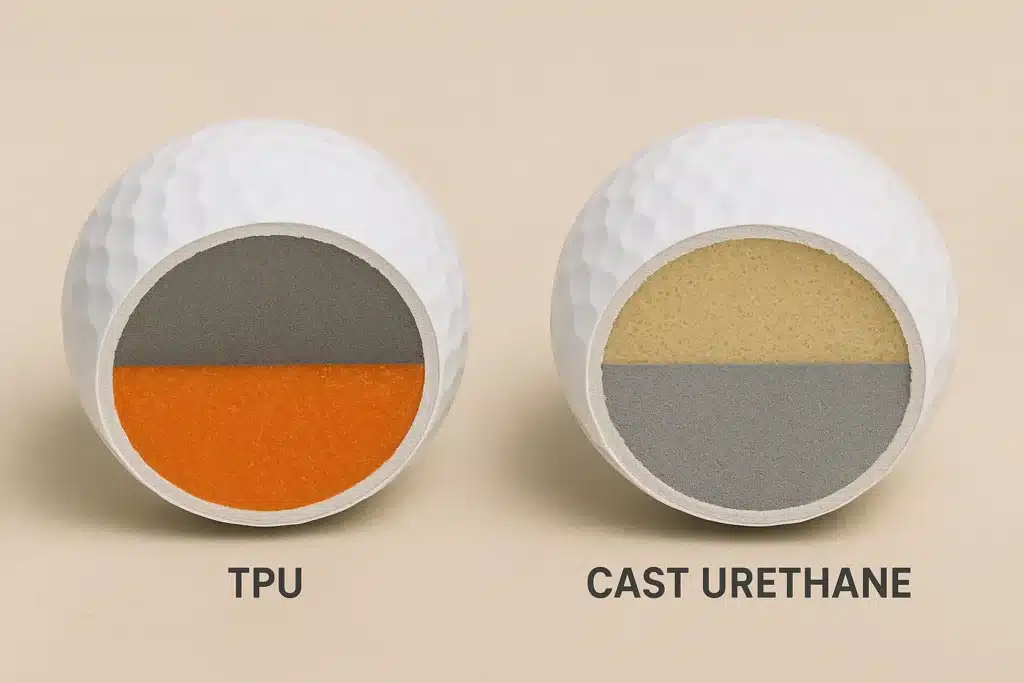
For TPU vs Cast Urethane Golf Balls, TPU uses a thermoplastic molding route, while Cast Thermoset Urethane uses a reactive casting-and-curing route. Neither route by itself proves finished-ball performance, so specify the route, verify the exact SKU, validate the pilot, and lock the approved material and surface-system identity through bulk and reorder.
If your program has not yet decided whether it should use ionomer or urethane, resolve the Surlyn vs urethane cover decision first. Once urethane wins, the buyer question is no longer simply “TPU or Cast?” It becomes: Which route supports the performance promise, what exact-SKU evidence proves it, and how will you prevent that approved build from changing later?
That distinction matters because a route name tells you how the urethane cover is manufactured—it does not, by itself, tell you how the finished golf ball will spin, feel, wear, or perform. Your sourcing decision should therefore follow a tighter chain: Declare the Route → Verify the Exact SKU → Compare Fairly → Validate the Pilot → Lock Bulk → Control the Reorder.
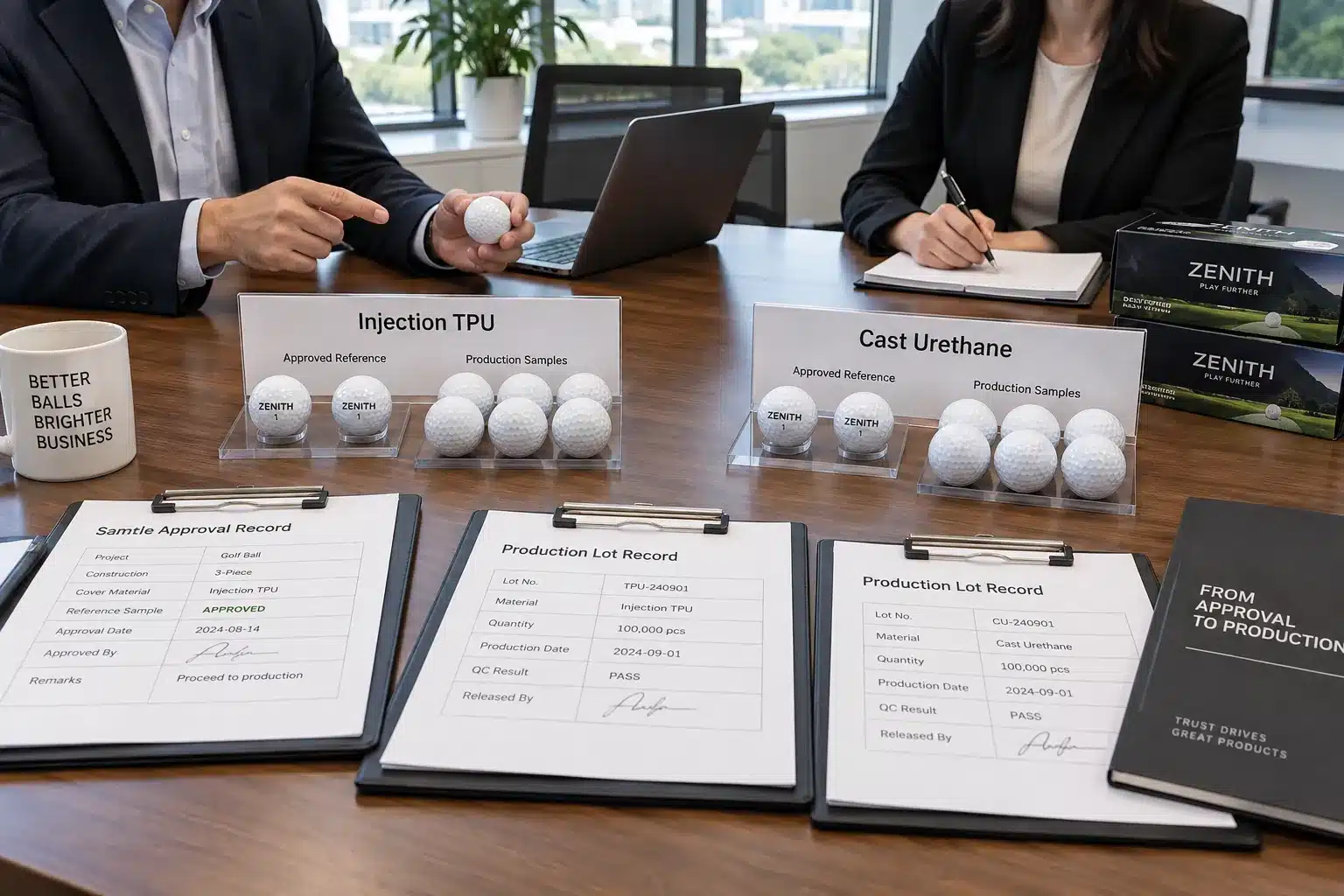
What does the urethane route actually change?
A quote that says “urethane cover” is incomplete. Even “Injection TPU” or “Cast Thermoset Urethane” only tells you how the cover is formed—not whether the final SKU will meet your performance and consistency requirements.
TPU and Cast Urethane change how the cover is formed and controlled: TPU follows a thermoplastic molding route, while Cast Thermoset Urethane depends on reactive casting and curing. Your supplier should declare the route, but route declaration alone does not prove exact-SKU performance or bulk consistency.
Public manufacturing evidence supports the same route distinction. Acushnet patent literature on thermoplastic polyurethane golf-ball covers documents TPU cover manufacturing and identifies injection molding as a conventional method for forming thermoplastic polyurethane golf-ball covers. Titleist’s official Media Center describes its Cast Thermoset Urethane process as mixing two separate components, casting the liquid urethane into cover cavities, and controlling cure timing and temperature.
For an injection-molded TPU golf ball, the manufacturing system must control material condition and the applicable molding parameters—such as temperature, pressure or flow behavior, mold conditions, and cooling—within the supplier’s validated process window.
Cast production creates a different control problem involving reactive-component handling, mixing, casting, cure behavior, centering, demolding, and finishing within its validated process window.
Those differences matter because they change how the process must be controlled. They do not automatically tell you which finished ball spins more, feels softer, lasts longer, or deserves a premium position.
| Buyer Decision | What Route Changes | What Route Does Not Prove | Evidence to Request | Buyer Action |
|---|---|---|---|---|
| “Urethane” quote | Forming route | Finished performance | Route declaration | Name route |
| Premium claim | Process burden | Spin or feel level | Exact-SKU proof | Verify SKU |
| Replenishment | Scaling tendency | Current capacity | Pilot/bulk record | Confirm route |
| Scuff/durability | Surface-system risk | Actual usable life | Route-linked evidence | Test build |
| Custom logo | Finish compatibility | Adhesion result | Same-system sample | Validate finish |
| Reorder | Version identity | Same approved state | Change record | Lock changes |
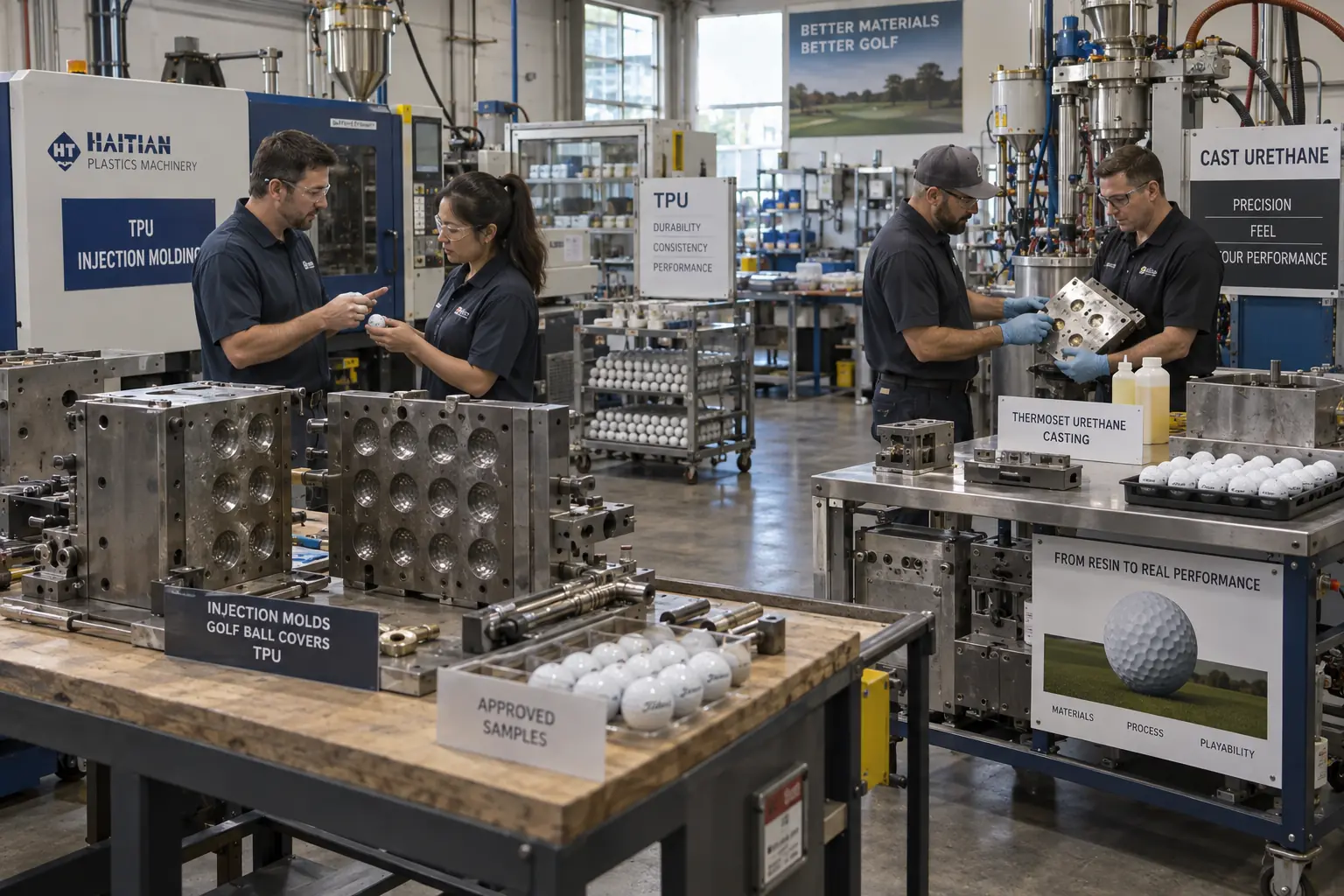
What should the supplier declare?
Your first goal is not to decide whether TPU or Cast sounds more premium. Your first goal is to create a manufacturing identity that can still be verified when the sample becomes a pilot and the pilot becomes a purchase order.
The declaration should identify Injection TPU, compression-molded TPU where applicable, or Cast Thermoset Urethane, plus a controlled material or formulation reference and the approved sample/reference identity.
You do not normally need proprietary formulation percentages. A controlled internal material code or formulation revision can be enough to establish whether the same approved material state reaches production.
The cover route also continues into the surface system. Acushnet patent literature on coatings for thermoplastic polyurethane-covered golf balls describes finishing after molding that can include surface treatment, primer coatings, printed indicia, polyurethane top-coatings, and curing steps.
That matters to an OEM buyer because correct cover molding can still be followed by a changed or poorly controlled surface system.
A supplier that declares “Cast” or “Injection TPU” but cannot connect that route to the approved sample, pilot, and production record is showing a failure signal.
Ask for a Urethane Route Declaration containing the declared route, controlled material reference, approved sample identity, and relevant surface/finish reference. Check that the quote, sample, and pilot documentation all describe the same route.
✔ True — A route declaration is necessary because “urethane” does not identify one manufacturing process
Injection TPU, compression-molded TPU, and Cast Thermoset Urethane create different production-control requirements. Naming the route gives your team an identity it can verify.
✘ False — “Once the supplier writes ‘Cast Urethane,’ the finished-ball specification is proven”
You have identified the process family. You still need exact-SKU evidence tied to the product your team intends to buy.
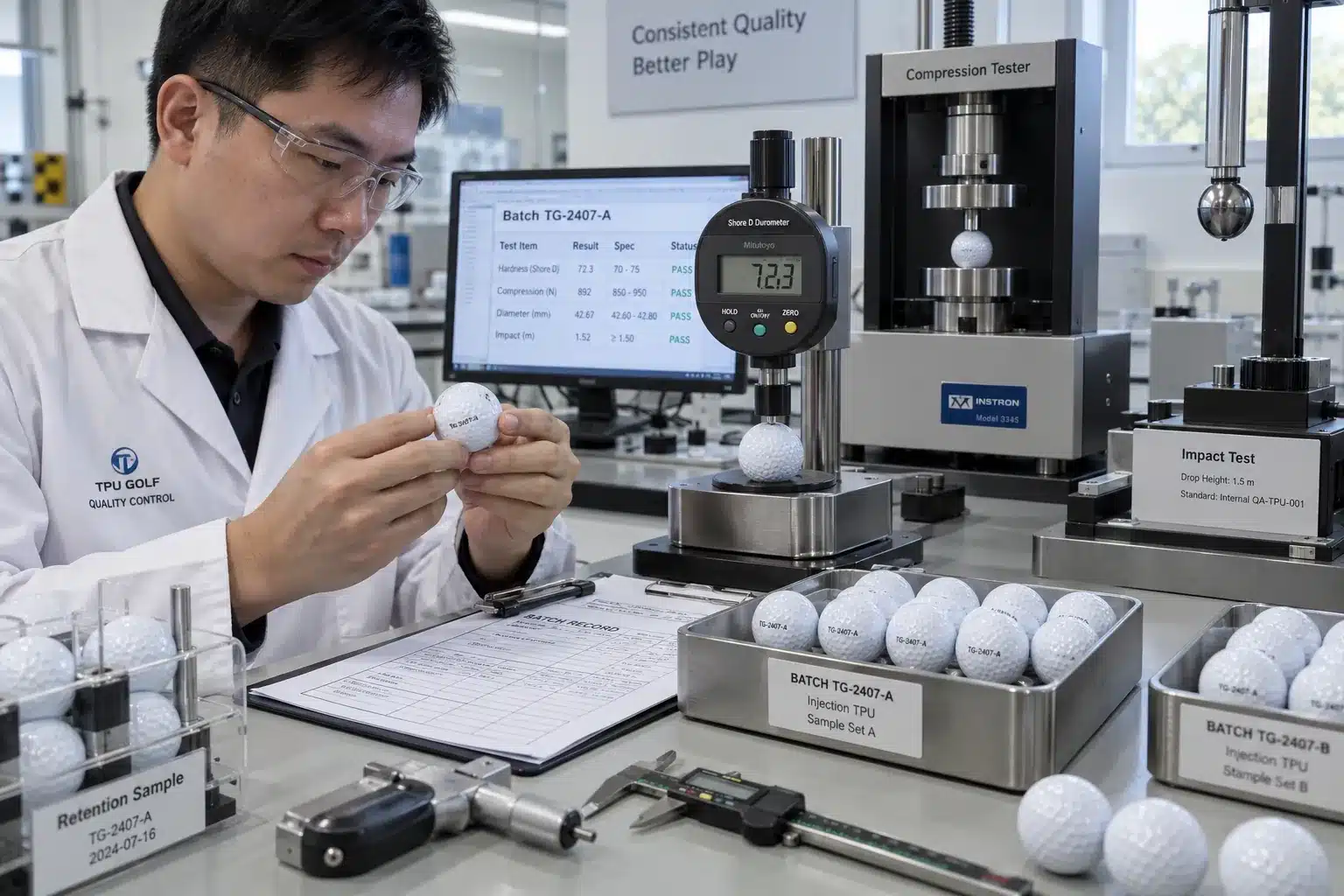
Does the route prove finished-ball performance?
You can correctly establish that a ball uses Injection TPU or Cast Urethane and still make a second sourcing error: treating that route as shorthand for quality, spin, softness, compression, or market tier.
No—TPU or Cast identifies the cover process, not the finished performance grade. Two balls using the same route can still produce different measured profiles, so verify the exact SKU instead of buying a performance assumption from the route name.
Finished-ball behavior can also depend on core design, mantle system, layer count, whole-ball compression, cover formulation, cover hardness and thickness, COR, dimple geometry, coating, clearcoat, and the overall construction target.
Our own QC records provide a useful example. We have two specific constructions that both use Injection TPU, yet their finished-ball measurements are clearly different.
| Metric | 3-Piece Injection TPU | 4-Piece Injection TPU | Buyer Interpretation / Action |
|---|---|---|---|
| Average compression | 86.92 | 105.17 | Verify exact SKU |
| Average COR | 0.790 | 0.775 | Do not infer from route |
| Average Shore D | 57.75 | 50.25 | Record method/reference |
| Out-of-roundness | ≤0.002 in | ≤0.003 in | Review SKU tolerance |
| Normal impact test | 185 ft/s × 50 — PASS | 185 ft/s × 50 — PASS | Compare protocol |
| Low-temp impact | 160 ft/s × 20 — PASS | 170 ft/s × 20 — PASS | Keep SKU-specific |
These are our internal QC results for two specific tested constructions. They are not universal Injection TPU specifications, an industry standard, or proof that one layer count is superior to another.
The Shore D values above are the values recorded in our internal QC file for these specific samples. We are not claiming that those internal measurements were performed to ASTM D2240 unless the applicable original test record establishes that method.
Both balls use Injection TPU, yet their measured profiles differ. TPU is a process route, not a performance grade.
The same principle is visible on the Cast side. Titleist’s official 2025 Pro V1 and Pro V1x release identifies both models as using soft cast urethane covers, yet the two finished balls are designed with different flight, spin, feel, and construction profiles.
The sourcing lesson is simple: same route does not mean same finished-ball performance.
That is why “TPU means lower quality” and “Cast automatically means more spin” are poor RFQ assumptions. A premium program should pay for a proven finished-ball advantage, not for a route label alone.
Shore D also needs evidence discipline. ASTM D2240 defines durometer hardness measurement, including Type D, and describes the method primarily as an empirical control test. It does not create one universal golf-ball Shore D acceptance range, and Shore D hardness is not the same measurement as whole-ball compression.
A supplier that turns the route name into a guaranteed spin, feel, hardness, or quality grade is another failure signal.
Request an Exact-SKU Evidence Record tied to the proposed ball. Depending on the promise being made, it may include construction identity, compression evidence, the recorded cover-hardness method/result, COR where relevant, dimensional or roundness evidence, durability results, and sample or batch identity.
How should you compare TPU and cast fairly?
Two urethane samples can produce different spin, feel, or wear results while also having different cores, mantles, compression, dimples, cover thicknesses, and finishes.
Compare TPU and Cast only after identifying the other variables that changed. If core, mantle, compression, cover thickness, aerodynamics, finish, or test conditions also differ, control what you can and do not attribute the full performance difference to the cover route.
Suppose Ball A is a 3-piece thermoplastic urethane golf ball and Ball B is a different multi-layer Cast construction. If Ball B produces more wedge spin, the clean conclusion is that Ball B produced more spin under the tested conditions.
It is not automatically proof that Cast alone created the entire difference.
A useful controlled comparison follows:
Match the Product Intent
→ Record the Variables
→ Use the Same Test Method
→ Compare the Route-Relevant Outcome
→ Decide Whether the Difference Is Worth the Added Burden

Which variables should stay comparable?
Perfect one-variable isolation is rarely practical in an OEM program. You can still make the result much more decision-useful by aligning or documenting the variables that matter most.
Start with product intent and compression target. Then record the major core and mantle assumptions, cover-thickness target, dimple or aerodynamic assumptions, surface/finish state, test method, use condition, and sample identity.
The closer those conditions are, the less likely you are to pay for a conclusion created by several design changes at once.
Then evaluate the outcomes your SKU actually needs: short-game response, feel, scuff or surface condition, durability, finish behavior, and the production or validation burden required to repeat the result.
For premium programs, Cast deserves the added burden only when exact-SKU validation demonstrates a customer-facing benefit worth protecting. Injection TPU can also support premium positioning when the finished build proves the required performance and consistency.
Create a Controlled Comparison Record containing the samples compared, known construction differences, test conditions, results, and which observed differences can or cannot reasonably be attributed to route.
Your goal is not to make TPU and Cast artificially identical. Your goal is to know what changed before you pay for the conclusion.
✔ True — A fair route comparison controls as many non-route variables as practical
The closer your product intent, major construction assumptions, finish state, and test conditions are, the more useful the TPU-versus-Cast conclusion becomes.
✘ False — “If Ball B spins more than Ball A, the Cast cover caused the entire difference”
You may also have changed the core, mantle, compression, cover thickness, aerodynamics, coating, and overall construction at the same time.
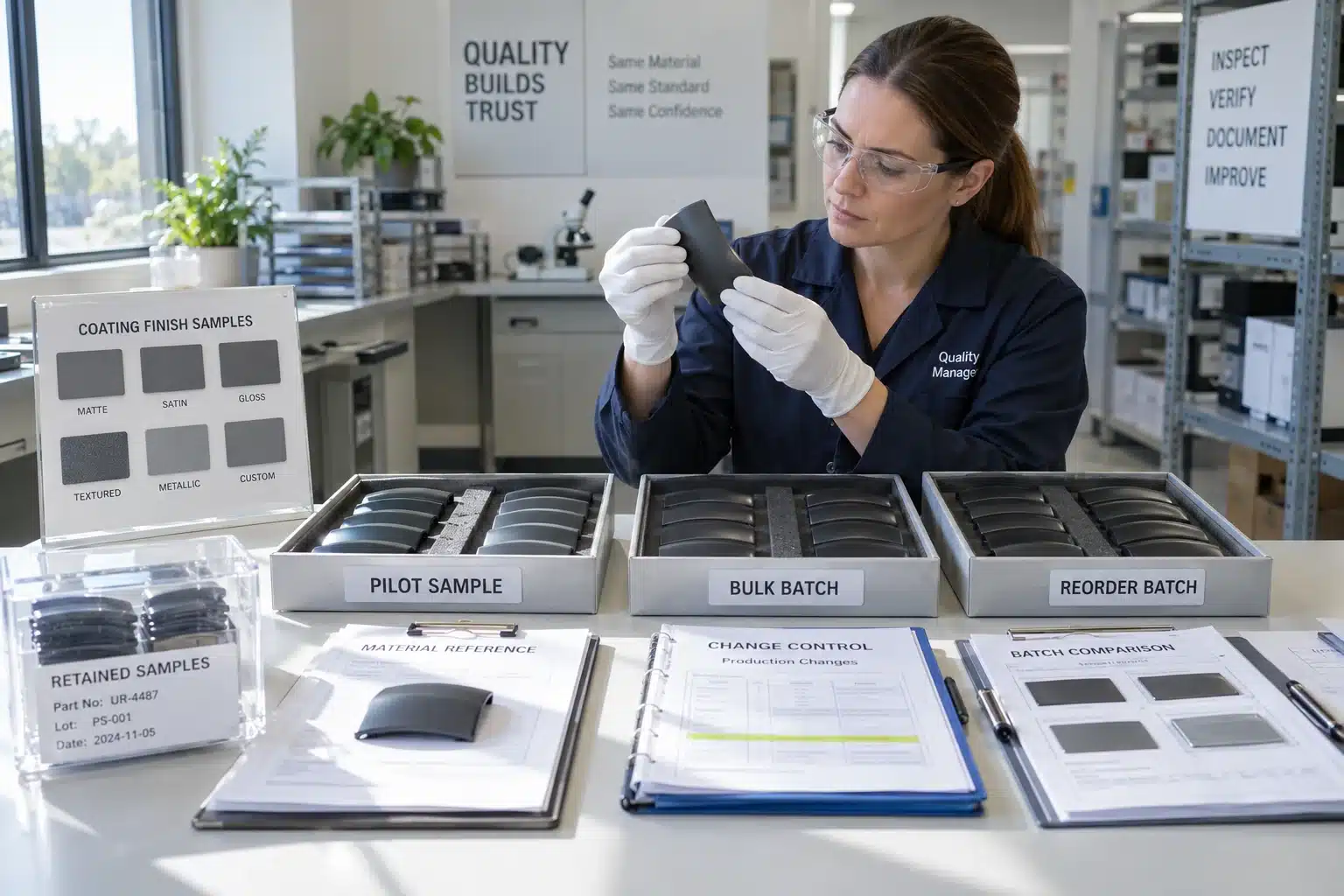
What proof should validate the selected route?
A correct route declaration and an attractive sample still leave a gap if neither can be linked to the pilot lot, production batch, finish system, and evidence used to approve bulk.
Validate the selected route with two records: a Route Declaration Pack that identifies what was approved, and a Route Validation Record that proves the exact SKU against agreed methods and acceptance criteria. You do not need the supplier’s proprietary formula; you need controlled material identity, sample and batch linkage, actual results, and a release decision.
The first record defines product identity. The second proves whether that identified product met the agreed requirement.
| Proof Item | What It Identifies | What It Prevents | Buyer Action |
|---|---|---|---|
| Route declaration | TPU/Cast route | Generic urethane claim | Lock route |
| Material reference | Controlled material version | Silent material drift | Record version |
| Approved sample ID | Physical baseline | Sample ambiguity | Reference sample |
| Pilot lot ID | Scale-up evidence | Hand-picked sample bias | Validate pilot |
| Surface/finish reference | Coating/print stack | Finish drift | Approve system |
| Production batch ID | Bulk identity | Sample-to-bulk mismatch | Link batch |
| Retained sample | Future comparison | Reorder disputes | Store reference |
| Validation record | Actual result/release | Unsupported pass/fail | Approve release |
The exact measurements should follow the product promise. Compression, cover hardness, thickness, dimensional evidence, scuff durability, surface condition, or logo adhesion may matter for one SKU without all being necessary for another.
When your next question is how a measurement is performed, calibrated, distributed, or converted into a release limit, use the dedicated golf ball QC testing guidance.
The surface system also needs to remain attached to the route identity. Correct cover formation can still be followed by changed preparation, residual release material, coating variation, clearcoat variation, curing problems, or different print adhesion.
For a decorated SKU, validate the same relevant cover route + surface treatment + coating/clearcoat + printing/finish system. Detailed method selection belongs in custom golf ball printing and adhesion.
Use this verification request once:
Please declare the proposed urethane cover route and provide the controlled material reference, approved sample ID, pilot-lot reference, approved surface/finish reference, retained-sample reference, and the route-validation record used for bulk approval.
Then put the evidence format into the commercial file:
Bulk acceptance shall use the agreed test method and acceptance window established for the approved pilot. The report shall identify the evaluated samples, raw results where applicable, method or equipment reference, sample ID, batch ID, and final release decision.
Your supplier can protect proprietary chemistry while still proving control. You need a controlled material identity, version, sample and lot linkage, validation result, and change history—not ownership of the recipe.

How do you lock the route from pilot to reorder?
The route can be correct during sampling and still drift later. The SKU name may stay identical while the material reference, cover target, coating, or production pathway changes underneath it.
Sample approval is not route control: lock the approved urethane build from pilot through bulk and reorder by linking its material reference, route, critical cover/finish parameters, sample ID, batch ID, retained reference, and applicable change record. If a buyer-controlled element changes, require disclosure and review before the revised build enters production.
Keep this chain visible:
Approved Sample → Pilot → Bulk → Reorder
| Possible Change | Buyer Risk | Evidence Required | Buyer Action |
|---|---|---|---|
| Material reference | Feel/durability drift | Version declaration | Review change |
| TPU/Cast route | Different process system | New route declaration | Reapprove |
| Cover thickness target | Performance/finish shift | Updated spec/pilot | Revalidate |
| Surface treatment | Adhesion/scuff change | Process reference | Verify finish |
| Coating/clearcoat | Feel/aero/appearance drift | Approved finish record | Compare sample |
| Print/finish system | Logo durability drift | Same-system evidence | Reapprove finish |
| Production route/site | Process variation | Route/site declaration | Assess impact |
Which changes require buyer review?
Not every machine adjustment or internal parameter change belongs in your approval queue. The supplier still needs room to manage its validated process.
The buyer-review boundary should be written around buyer-controlled product characteristics, approved material/process identity, and the validated performance or finish state.
Use:
Disclose → Review → Approve
A reorder that still says “Injection TPU” is not automatically the same controlled product if the approved material reference, cover thickness target, surface treatment, coating, clearcoat, printing system, or another buyer-controlled characteristic has changed.
That is the failure signal: the approved route or surface system changed between pilot and reorder without the review required by the commercial specification.
A buyer-usable clause is:
Supplier shall declare the approved urethane cover route and maintain traceable linkage between the approved sample, pilot lot, bulk batch, controlled material reference, approved surface/finish system, and retained sample. Any applicable route or material-system change requires written buyer approval before production.
Maintain a Route/Version Change Record and compare the reorder with the approved pilot or previous bulk reference.
Your reorder should inherit the approved manufacturing state—not just the old SKU name.
✔ True — The SKU name can stay the same while the manufacturing state behind it changes
Route identity is only one element of version control. Material reference, cover parameters, surface system, and other buyer-controlled characteristics may also determine whether the reorder is still your approved build.
✘ False — “If the reorder still says Injection TPU, it is automatically the same product”
Compare the controlled version and change record rather than relying on the route label or SKU name alone.
When the question becomes whether the supplier’s manufacturing system actually controls the declared route, linked records, exceptions, release, and changes, continue with the deep golf ball factory audit.
FAQ
Are all urethane golf balls cast urethane?
No. Urethane is a material-family description, not a single manufacturing route. TPU covers can be injection- or compression-molded, while Cast Thermoset Urethane uses a reactive casting and curing process, so your supplier should state the actual route being proposed.
Do not assume “premium urethane” means Cast, and do not assume TPU means a lower product grade. Route declaration tells you how the cover is manufactured; exact-SKU evidence tells you what the finished ball delivers. If your program has not yet decided whether it should use urethane at all, resolve the upstream cover-family question first.
Does cast urethane always spin more?
No. Cast can support designs built around premium short-game performance, but the route alone does not determine finished-ball spin. Core and mantle design, compression, cover formulation and thickness, aerodynamics, finish, and the test condition can all affect the result.
Use comparable conditions and exact-SKU evidence before writing a spin claim. If one Cast ball spins more than one TPU ball, first document what else changed. The buyer question is whether that specific Cast build delivers a meaningful, repeatable advantage—not whether the word “Cast” guarantees an RPM increase.
Can Injection TPU be a premium golf ball?
Yes. Injection TPU is a manufacturing route, not a quality grade. A premium TPU golf ball earns that positioning through its finished-SKU performance, durability, finish, consistency, and customer value rather than through assumptions about thermoplastic urethane itself.
Our own two Injection TPU examples show why the distinction matters: the route stayed the same while the measured finished-ball profiles differed. Judge the exact construction and evidence your team is buying, then confirm that the approved state can survive pilot and bulk production.
Is a tacky TPU sample defective?
Not automatically. Mild tackiness should trigger review of residue, color transfer, coating cure, storage response, surface condition, and downstream adhesion rather than an immediate pass or fail based on touch alone. Persistent residue or finish problems deserve escalation.
Check for oily transfer or color on a clean white cloth and review whether the condition changes after controlled storage. If tackiness remains alongside weak coating cure, contamination, or print-adhesion problems, stop approval and investigate. This is an edge case—not proof that tackiness is always acceptable or always defective.
Can route changes affect logo durability?
Yes. A route or material change can alter the surface system that printing must bond to. Surface treatment, coating, clearcoat, curing, and the actual cover/finish combination may change adhesion even when the artwork and nominal print method stay unchanged.
Approve decoration on the relevant production cover and finish stack, retain that printed reference, and revalidate when a buyer-controlled surface-system change could alter appearance or wear. Keep Pad-versus-UV selection and detailed adhesion procedures in the dedicated printing article.
Does TPU or cast decide conformity?
No. TPU or Cast does not determine whether a golf ball is conforming. Conformity belongs to the exact submitted ball type and identifying details, not to the generic urethane route, so neither manufacturing process can be used as a shortcut for legality.
Where conformity matters, verify the exact ball through the official USGA List of Conforming Golf Balls. The database lists conforming ball types individually and allows users to identify entries through the ball’s markings. Keep rules conformity separate from urethane-route verification.
Conclusion
Do not buy a urethane route as a performance shortcut. Declare the route, prove the exact SKU, compare it fairly, validate the pilot, and lock the approved manufacturing and surface-system identity through bulk and reorder.
Use the buyer sequence:
Performance Promise → Route → Exact-SKU Proof → Fair Comparison → Pilot → Bulk Lock → Reorder Control
TPU is a process route, not a performance grade. Cast is a process route, not a guarantee of premium performance. The route matters because it changes the manufacturing system; exact-SKU evidence proves what your customer will actually receive.
Once the route, proof requirements, and change controls are defined, the next question is whether the factory can demonstrate control of that route in real production.
You might also like — How to Audit a China Golf Ball Factory?