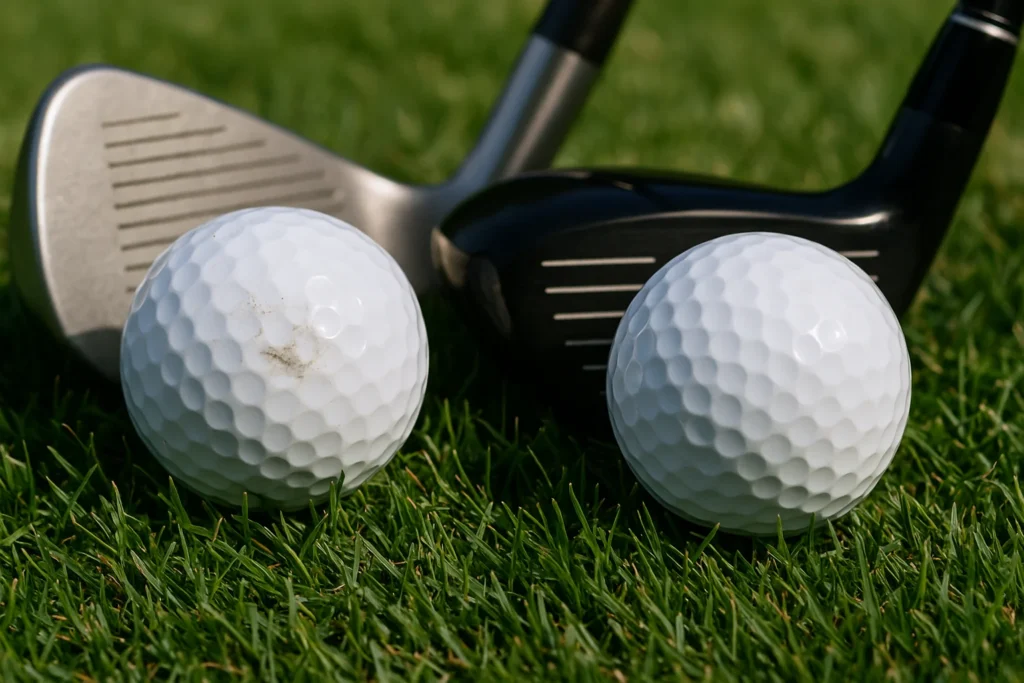
You can choose a more premium golf-ball cover and still make the wrong OEM decision if your channel cannot monetize the performance advantage you are paying for.
For Surlyn vs urethane golf balls, choose Surlyn / ionomer when durability, replacement cost, logo stability, and cost per usable ball matter most. Choose urethane when customers will pay for softer feel, stronger short-game control, and premium positioning—the right cover is the one your channel can sell, replace, and defend.
For an OEM golf ball program, the decision should not begin with which material sounds more premium. It should begin with four commercial questions: Where will the ball be used? How often will it be replaced? Which performance benefit will customers actually notice? Will they pay enough for that benefit to justify the added cost and validation burden?
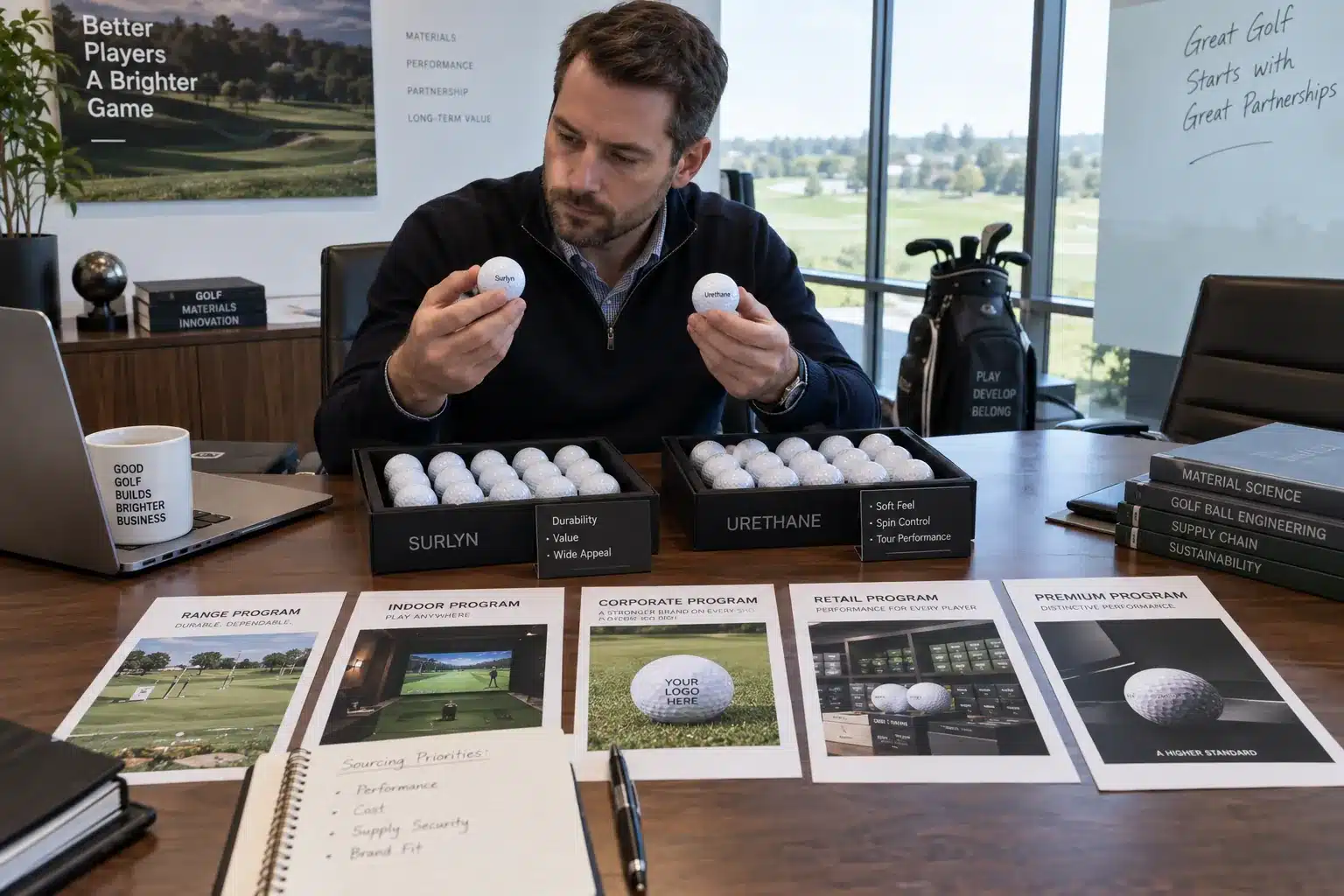
That is why a driving range, indoor golf facility, corporate-logo program, value retailer, and premium DTC brand can all need a reliable golf ball while requiring very different cover materials. A durable Surlyn / ionomer cover may create more value in a high-turnover program, while urethane can make more sense when short-game control and premium feel are central to the product promise.
Cover selection should start with the environment where the ball will be used, lost, replaced, and judged—not with the material that sounds more premium.
Which cover fits your OEM program?
You may enter sourcing asking whether Surlyn or urethane is “better.” That question is too broad because a performance advantage only creates commercial value when your channel can use it.
Start with where the ball will be used, lost, replaced, and judged. Surlyn / ionomer is usually the stronger starting point when durability and replacement economics dominate; urethane becomes more valuable when short-game control, softer feel, or premium positioning changes what your customer will pay for.
Your first decision is therefore not material prestige. It is what the channel rewards and what it punishes.
| Pain / Decision | Starting Direction | Commercial Reason | Action / Evidence |
|---|---|---|---|
| Driving range / academy | Surlyn / ionomer | Repeated impact and replacement burden | Request durability evidence |
| Indoor golf facility | Usually Surlyn / ionomer first | Repeated use and replenishment economics | Validate on actual facility system |
| Corporate / event | Surlyn / ionomer first | Logo presentation and budget control | Approve same-cover printed sample |
| Value retail | Surlyn / ionomer | Price ceiling and complaint control | Define durability promise |
| Premium DTC | Urethane candidate | Feel and short-game story can support premium | Validate customer-facing benefit |
| Flagship performance SKU | Urethane candidate | Control and premium positioning are core promises | Declare urethane route |
External performance evidence also argues against assuming that cover value appears equally in every use condition. In an official ball-turf interaction study, statistically significant differences between the tested Surlyn-covered calibration ball and polyurethane-covered ball appeared in 2 of 25 driver-like comparisons, none of 25 5-iron-like comparisons, and 13 of 30 sand-wedge comparisons.
That does not prove Surlyn and urethane have identical full-flight performance. The research studied ball-turf interaction under controlled inbound conditions. Its useful sourcing implication is narrower: cover-related value can become much more visible in some shot conditions than in others.
Is it range, indoor, promo, retail, or flagship?
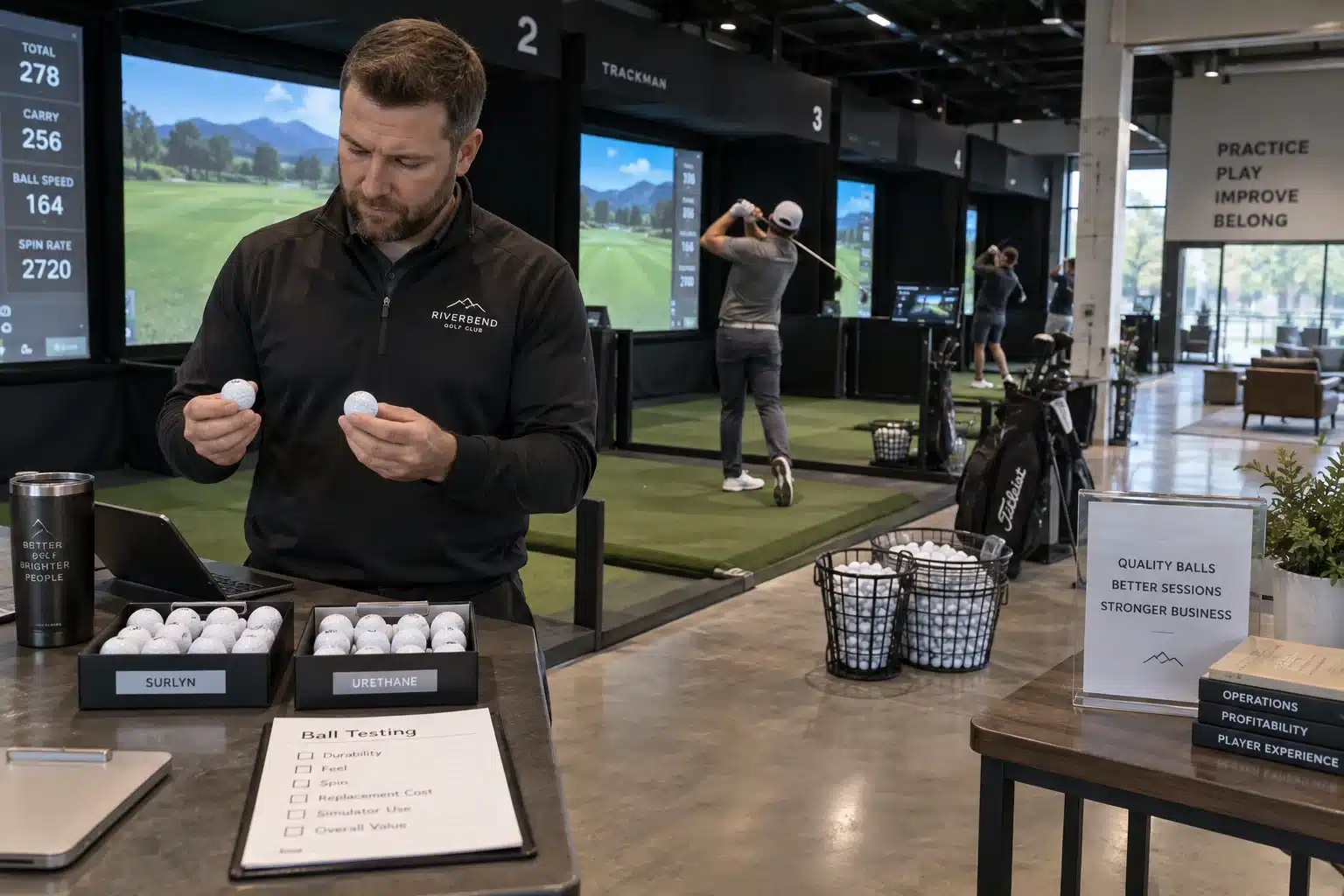
Define the environment before approving the material. Where is the ball used? How often is it replaced? Which complaint hurts the business? Which performance characteristic does the customer actually notice, and will the channel pay for it?
In July 2026, a U.S. indoor-golf facility chain with an approximate annual demand of 9,000 dozen approached us for a 3-piece polyurethane (PU) practice ball. We recommended comparing it with our 2-piece Surlyn practice ball because repeated use, durability, and replacement economics mattered more than maximizing short-game performance.
After both options were tested in the facility, the perceived difference was smaller than expected. Because the two samples also differed in construction, we treated the comparison as an application-fit decision rather than a controlled test of cover material alone.
In this specific project, our internal production costing put the 2-piece Surlyn option at roughly half the production cost of the 3-piece PU option, and the customer selected 3,600 dozen for the initial validation order.
We did not recommend the lower-cost option simply because it was cheaper. We recommended testing it because the customer’s operating environment placed more value on durability and replacement economics than on maximizing short-game performance.
The commercial win came from matching the cover to the operating environment—not from selling the more expensive construction.
A premium cover recommended without a channel-level reason is a failure signal. Request a Channel-Fit Cover Recommendation stating the intended environment, proposed cover family, customer-facing benefit, replacement consideration, and evidence required before bulk approval.
If you have not yet decided whether the program needs a practice, regular-play, or premium ball category, make that upstream decision first with the range vs game vs tour golf ball selection guide.
✔ True — A premium-priced cover can be the wrong commercial choice
If your channel cannot monetize the performance difference, a more expensive material can increase replacement cost without strengthening the customer proposition.
✘ False — “A larger or more premium facility should automatically use urethane”
Your facility size does not decide the cover. Your usage pattern, replacement burden, customer expectation, and measurable performance need do.
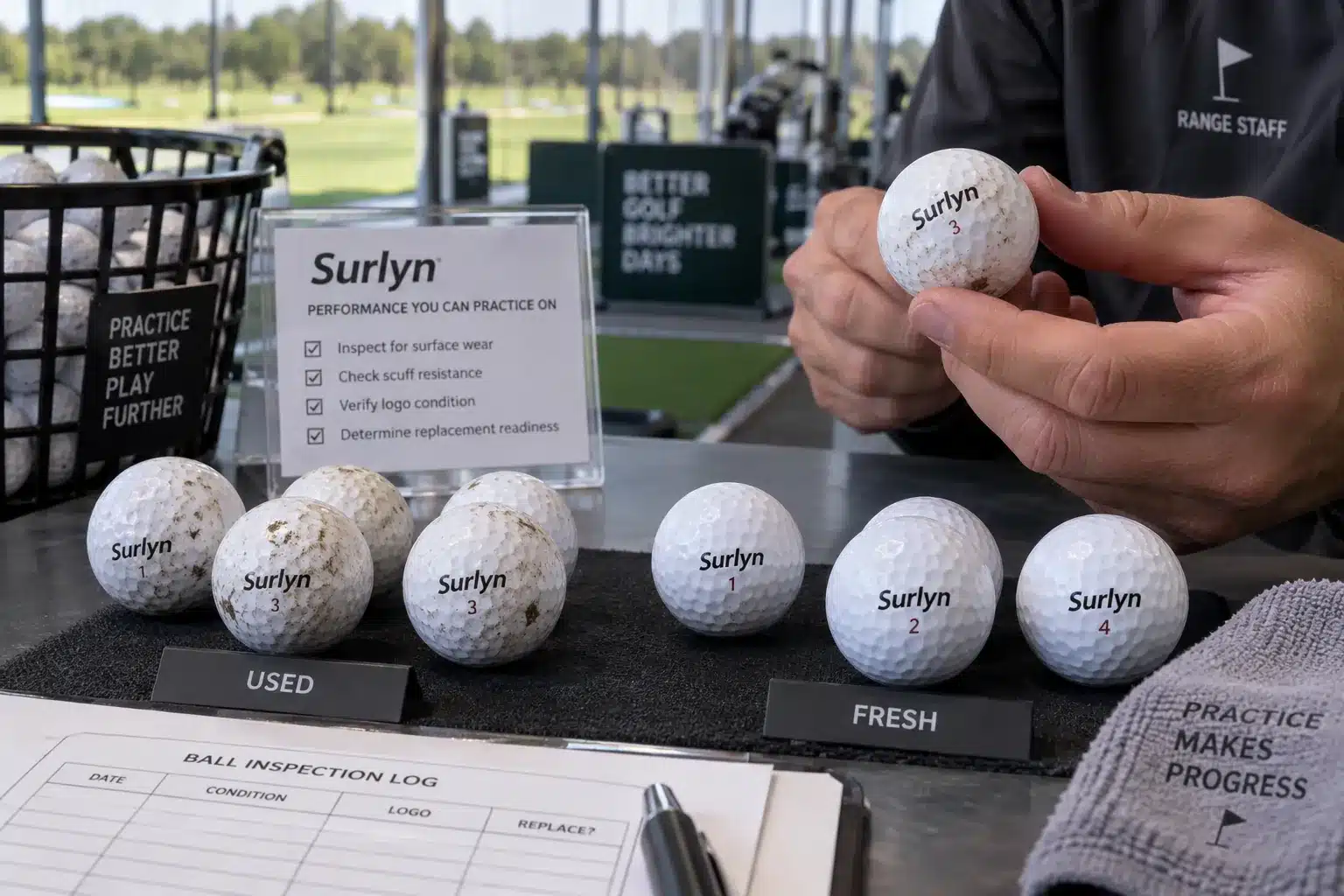
When does Surlyn protect your margin better?
You may dismiss Surlyn because it sounds less premium, even when your program makes money through playable life, repeated use, stable presentation, and predictable replenishment.
Surlyn protects your margin when playable life, repeated-impact durability, replacement cost, and dependable presentation matter more than maximum greenside spin. Do not treat ionomer as a low-end default; for range, indoor, corporate, and value programs, durability can be the premium feature your business actually needs.
SURLYN™ is a branded family of ionomer resins used in golf-ball applications; ionomer is the broader material category. For procurement, the practical question is whether the proposed formulation and cover build match your actual use case.
Material evidence supports the durability-led business case without requiring exaggerated lifetime claims. Dow identifies SURLYN™ 7940 ionomer for golf-ball applications and lists high impact and scuff resistance among the grade’s benefits. Other golf-ball grades can have their own property balance, so one grade should not be treated as a universal specification for every ionomer ball.
For your channel, a more useful framework is:
Annual ball use × replacement frequency × cost per usable ball
That equation is especially important when balls experience repeated impacts, heavy handling, high loss rates, or frequent replenishment. In those programs, a performance benefit that rarely affects the customer’s purchase decision can be difficult to monetize.
Corporate and logo-heavy programs add another dimension. The ball still needs to present well after normal handling, so the selected cover and finish must support the appearance your customer expects. A low unit price is not useful if visible wear or decoration failure creates complaints.
Ask for durability or scuff evidence on the proposed Surlyn / ionomer SKU under a condition relevant to your channel. Define the visible-wear outcome your program can accept before sample approval rather than treating the cover name itself as the acceptance criterion.
Cover material and manufacturing consistency are separate decisions. A controlled ionomer SKU can be more appropriate—and commercially more valuable—than a poorly controlled premium-positioned alternative.

The opposite sourcing mistake is paying more for urethane because the market associates it with premium golf balls without proving that your own customer will reward the difference.
Urethane earns its premium when softer feel, short-game interaction, and control are part of the value your customer is willing to pay for. If those benefits do not change price, positioning, retention, or user experience, a premium cover can add cost without adding equivalent commercial value.
For premium DTC and flagship private-label golf balls, that value equation changes. Feel, wedge interaction, stopping behavior, and short-game control can become part of the reason the customer chooses one SKU over another.
Before approving the cover, ask:
Does the customer notice it?
Does the customer value it?
Can the SKU charge for it?
Can your supply program validate it?
The governing-body research discussed above supports a bounded conclusion: cover-related differences became substantially more visible in the tested sand-wedge ball-turf condition.
As broader independent evidence—not a controlled Surlyn-versus-urethane cover comparison—MyGolfSpy’s 2025 robot testing found that the largest ball-to-ball performance differences in its test appeared on the shortest shots. In its 35-yard wedge test, the spread from highest to lowest spin was nearly 4,000 rpm.
Neither result means urethane matters only with wedges, and the two sources should not be treated as equivalent evidence. The commercial lesson is that short-game differentiation becomes especially important when short-game performance is part of what your SKU promises to sell.
That makes urethane easier to justify for a flagship product than for a corporate giveaway or high-turnover practice ball. For a premium DTC brand, better feel and short-game behavior may strengthen positioning, reviews, repeat purchase, or willingness to pay. In that situation, the higher validation burden can support real commercial value.
Request a short Urethane Value Statement defining the customer-facing benefit, how that benefit will be demonstrated, and what durability trade-off must remain acceptable.
✔ True — Urethane can justify its premium when performance is part of the SKU promise
Premium DTC and flagship programs can monetize softer feel and short-game control when those benefits influence positioning, customer experience, and willingness to pay.
✘ False — “Urethane is automatically the better OEM cover”
Your customer does not pay for material prestige alone. Your customer pays for a performance or positioning benefit that remains meaningful in real use.
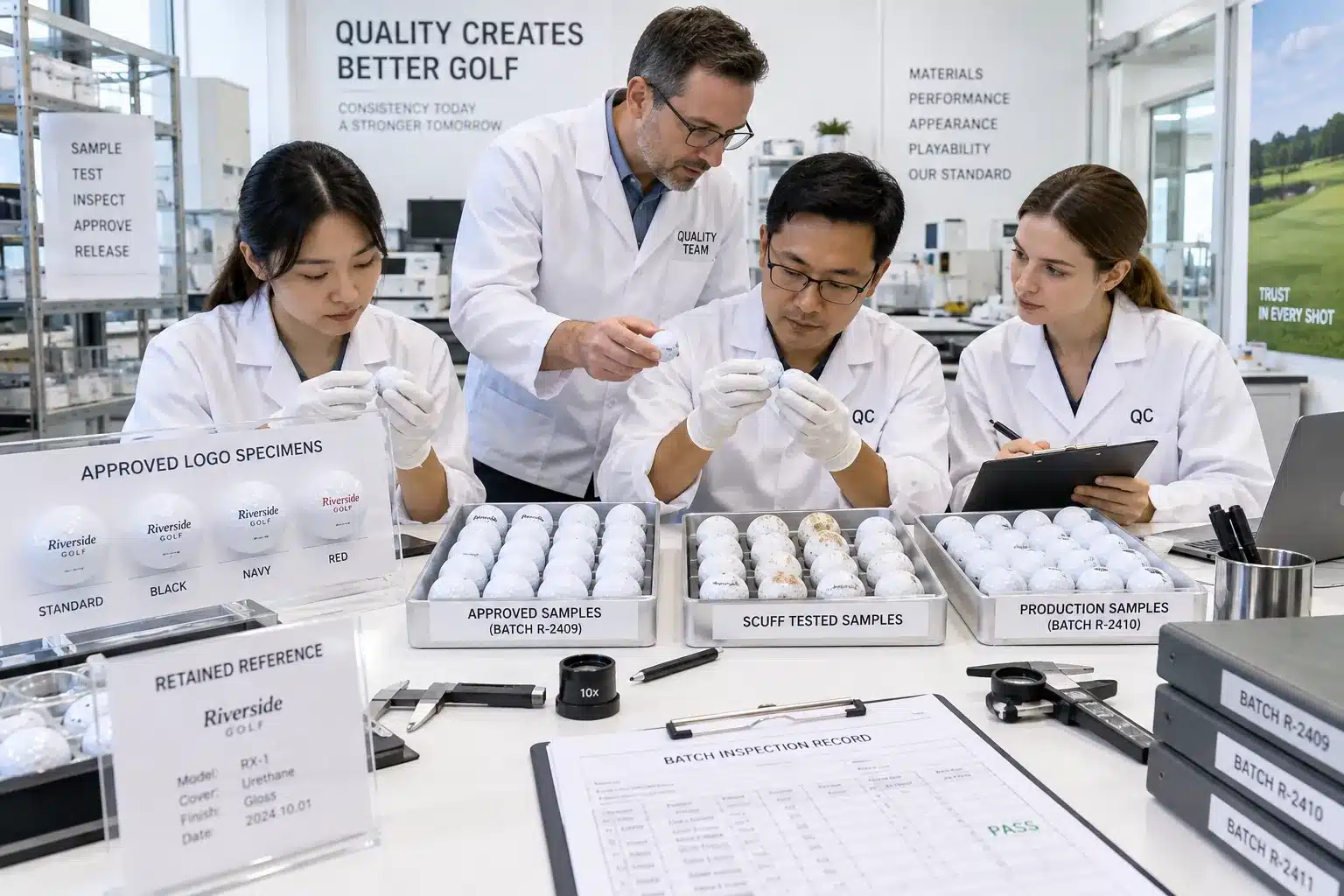
What should your RFQ specify about the cover?
A quotation can say “urethane,” “Surlyn,” or “premium cover” and still leave enough ambiguity for the final product to differ from what your team thought it approved.
Your RFQ should define the cover family, intended channel, construction, customer-facing performance promise, and approved sample reference. If you choose urethane, require the supplier to declare the actual urethane route; “urethane cover” alone is not a complete OEM specification.
| RFQ Decision | What You Specify | What You Avoid | Buyer Action |
|---|---|---|---|
| Cover family | Ionomer/Surlyn or urethane | “Premium cover” | Lock family |
| Use case | Indoor, range, corporate, retail, premium | Generic “for golfers” | State channel |
| Performance promise | Durability, feel, control, positioning | “Best performance” | Define claim |
| Approved reference | Sample/version ID | Verbal approval | Record reference |
| Urethane route | Supplier-declared route | “Urethane” only | Continue route review |
The purpose is not to turn your RFQ into a polymer textbook. It is to convert the commercial decision into a definition the supplier can quote, sample, reproduce, and control.
If urethane wins, require one additional declaration: which urethane route is being quoted?
Titleist’s U.S. urethane cover material guide distinguishes thermoplastic urethane from cast thermoset urethane. That is enough for this decision page. The chemistry, molding route, yield implications, and process-specific sourcing trade-offs belong in the dedicated TPU vs cast urethane cover routes guide.
“Urethane” quoted without a declared route is a failure signal. You have identified a cover family, but not yet a sufficiently clear sourcing specification.
Use this request in your RFQ:
Please state the proposed cover family for this SKU and explain why it fits the intended channel. If urethane is proposed, declare the actual urethane route. Provide the approved sample reference and identify the durability and finish evidence that will be used to validate the selected cover before bulk approval.
Where a change could alter the approved result, version control also belongs in writing:
Supplier shall disclose any proposed change to the approved cover family, urethane route, surface treatment, coating, or print/finish stack before production when that change could alter the approved product performance or appearance.
Once the cover family and required route are defined, use a China golf ball manufacturer shortlist to compare suppliers that can actually support the construction and cover capability your program requires.
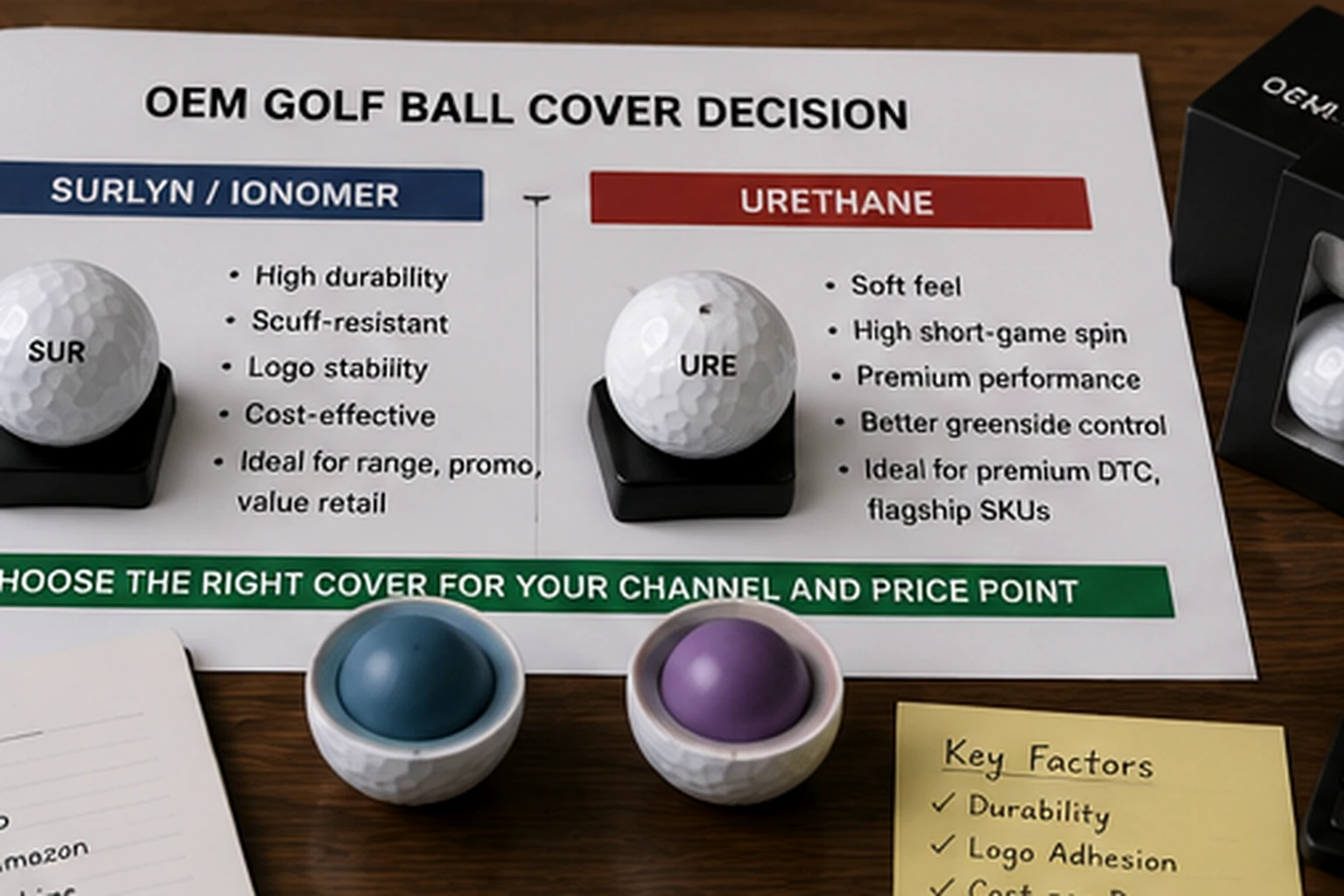
How should you validate the cover before bulk?
A soft, glossy sample with a clean logo can create false confidence. It tells you what one sample looks and feels like, not whether the cover will survive your commercial use case.
Validate the cover in the environment that can punish the wrong decision. Compare clearly identified samples, durability or scuff behavior, compression consistency where relevant, logo adhesion for branded SKUs, and sample-to-bulk references. Approve evidence tied to the chosen cover—not a soft feel or polished sample alone.
Your validation pack should follow the promise you are buying, rather than becoming a generic list of laboratory tests.
| Buyer Risk | Evidence to Request | What It Proves | Buyer Action |
|---|---|---|---|
| Early wear | Relevant durability/scuff evidence | Cover survives intended use | Approve or revise |
| Feel drift | Compression consistency evidence | Approved feel can repeat | Compare with sample |
| Logo failure | Same-cover adhesion/rub evidence | Branding survives finish stack | Approve decoration |
| Sample drift | Sample ID + batch link | Bulk matches approved reference | Trace before release |
| Reorder drift | Retained reference + change record | Approved cover remains controlled | Revalidate if changed |
For an indoor golf facility, validate the exact ball on the tracking environment the facility actually operates. TrackMan’s Ball Conversion guidance recognizes that different ball types can affect ball speed, launch angle, spin rate, and carry before conversion, and provides a workflow for evaluating the appropriate ball category.
The practical lesson is not that simulators “prefer Surlyn.” It is that your facility should validate the actual ball and conversion workflow it will use.
For corporate or private-label balls, logo approval should use the actual approved cover and finish stack. Surface condition, treatment, coating, ink system, and curing can affect adhesion and wear, so a visually similar shell is not a substitute for the production build.
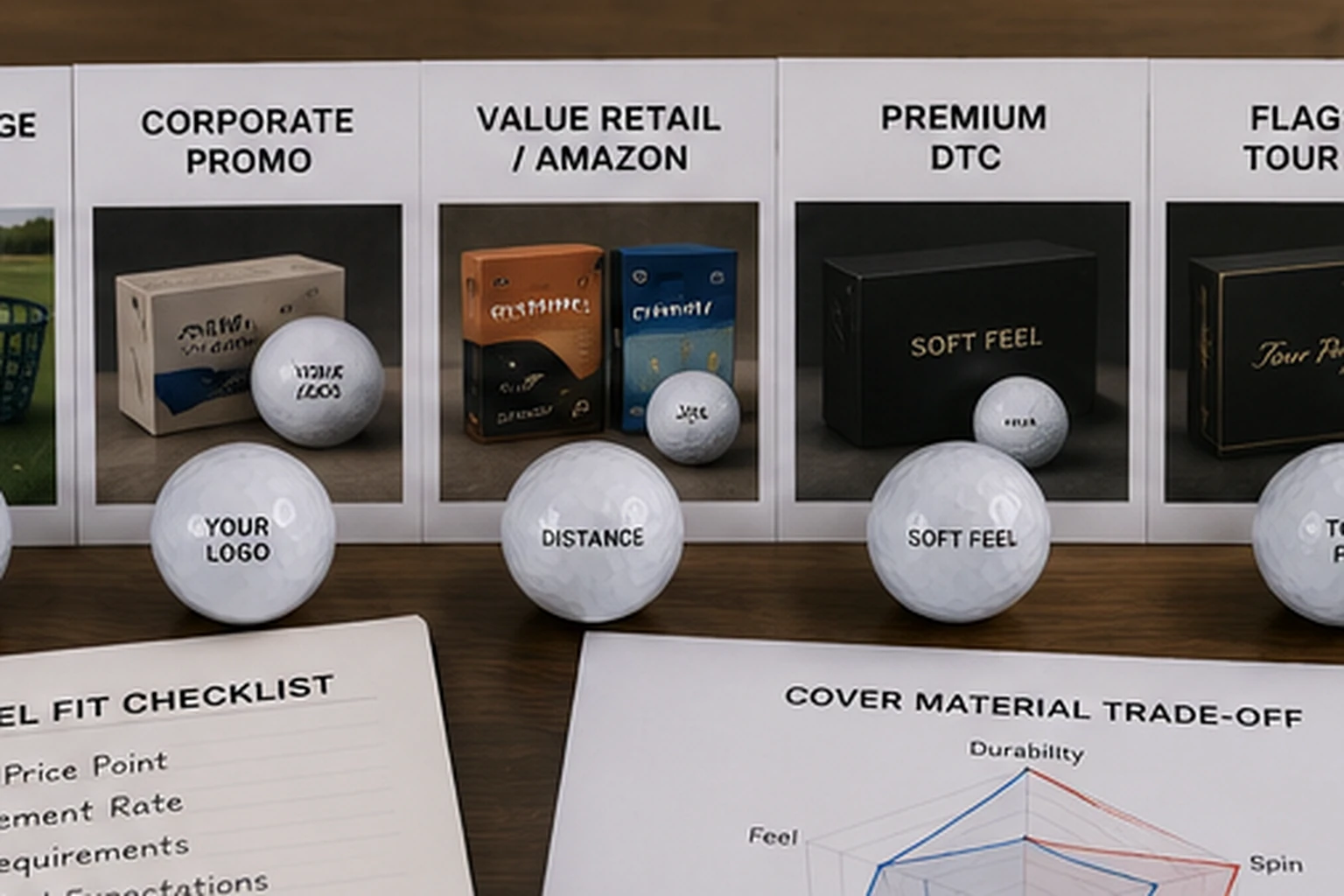
What should you compare before bulk approval?
Compare the intended use environment, actual cover family, durability behavior, relevant feel or performance evidence, printed finish where applicable, and the identity of the approved sample. Then confirm that the production reference remains linked to that approved build.
Do not use an arbitrary universal sample count. The quantity should follow project risk. What matters is that the comparison samples are clearly identified, tested under relevant conditions, and connected to the evidence used for approval.
For bulk acceptance, the requirement can state:
Bulk approval shall be based on the buyer-approved cover family and production reference. Durability or scuff evidence, where required by the intended use case, shall identify the test method, sample ID, and production-batch link used for release.
A soft sample approved without use-case durability or batch-linked evidence is a failure signal.
If decoration becomes the main decision, move to custom golf ball printing methods. If the question becomes test methodology, calibration, distributions, or release limits, use Golf Ball QC in China. If you need to prove that the selected cover remains connected to the approved production history, verify the manufacturing process behind the selected cover route.
✔ True — One sample can help choose a direction without proving bulk consistency
Bulk approval needs evidence tied to the selected cover, use environment, approved sample, and production reference. That is what turns a sample preference into a controlled sourcing decision.
✘ False — “If the urethane sample feels softer, it is automatically the better production choice”
Soft feel may support a premium promise, but it does not prove durability, logo survival, customer value, or production repeatability.
FAQ
Is Surlyn the same as ionomer?
SURLYN™ is a branded family of ionomer resins used in golf-ball applications, while ionomer is the broader material category. For an OEM RFQ, ask for the relevant material family or controlled supplier reference rather than assuming every ionomer formulation has identical properties.
Different ionomer formulations can target different balances of stiffness, resilience, processing, feel, and durability. You do not need polymer-level detail for a normal cover-selection decision, but you should know what family the supplier is proposing when that detail affects your product promise. Treat “ionomer” as the category and the controlled formulation or material reference as the specific production detail.
Are all urethane covers cast urethane?
No. “Urethane” is not a complete production-route specification. Urethane-covered golf balls can use routes such as thermoplastic urethane or cast thermoset urethane, so your supplier should declare the actual route before RFQ or sample approval.
Keep this FAQ at the declaration level. Once urethane has won the cover-family decision, move the process comparison to the dedicated urethane-route guide. Do not assume that a premium-sounding quote means cast construction, and do not let a route discussion replace the commercial cover decision this page is designed to solve.
Can Surlyn-covered balls be conforming?
Yes. Cover material alone does not determine conformity. Current conformity belongs to the exact submitted golf-ball model and its identifying details, so neither Surlyn nor urethane should be used as a shortcut for deciding whether your SKU is conforming.
Where conformity matters, verify the exact model through the official USGA Conforming Club and Ball Lists. Do not transfer status from a different ball or infer legality from the cover material. Choose the cover for the commercial program first; verify exact-model conformity separately when your channel or event claim requires it.
Should logo approval use the exact production cover?
Yes. Approve the logo on the actual cover and finish stack you intend to produce because substrate, surface condition, coating, ink system, and curing can affect adhesion, visible wear, and the appearance of the finished ball.
Keep a same-cover printed approval reference. If the cover, surface treatment, coating, or print/finish stack changes in a way that could affect the approved appearance, review the decoration again. This page establishes the proof requirement; detailed printing-method and adhesion decisions belong in the dedicated printing guide.
Does a softer sample prove urethane is better?
No. Softer feel can support premium positioning, but one sample does not prove durability, customer value, bulk consistency, or repeatability. The cover is commercially better only when the benefit matches what your channel rewards and survives production.
Use subjective feel as one input, not the release decision. Keep the approved sample identified, compare it with the evidence relevant to the use case, and confirm that the bulk reference remains linked to what your team evaluated.
When should a cover change trigger revalidation?
Revalidate when a change to the cover family, urethane route, surface treatment, coating, or another material or finish element could alter the performance or appearance you originally approved. The depth of revalidation should match the consequence of the change.
Compare the change with the retained approval reference and the product promise in your specification. If durability, feel, decoration, or another customer-facing attribute could shift, require relevant evidence before approval. Broader production-route or factory change-control questions belong in the manufacturing-system audit.
Conclusion
Choose the cover by commercial environment first and material prestige second.
Use this decision sequence:
Channel → Monetizable Benefit → Replacement Burden → Cover Family → Evidence
Choose Surlyn / ionomer when durability, replacement economics, and predictable presentation protect the business case. Choose urethane when short-game control, feel, and premium positioning create enough customer value to justify the additional cost and validation burden.
The best cover is not the most expensive cover. It is the cover your channel can sell, replace, and defend.
If urethane has won the cover-family decision, the next question is which urethane route your program should specify.
You might also like — TPU vs Cast Urethane Golf Balls: OEM Buyer Guide