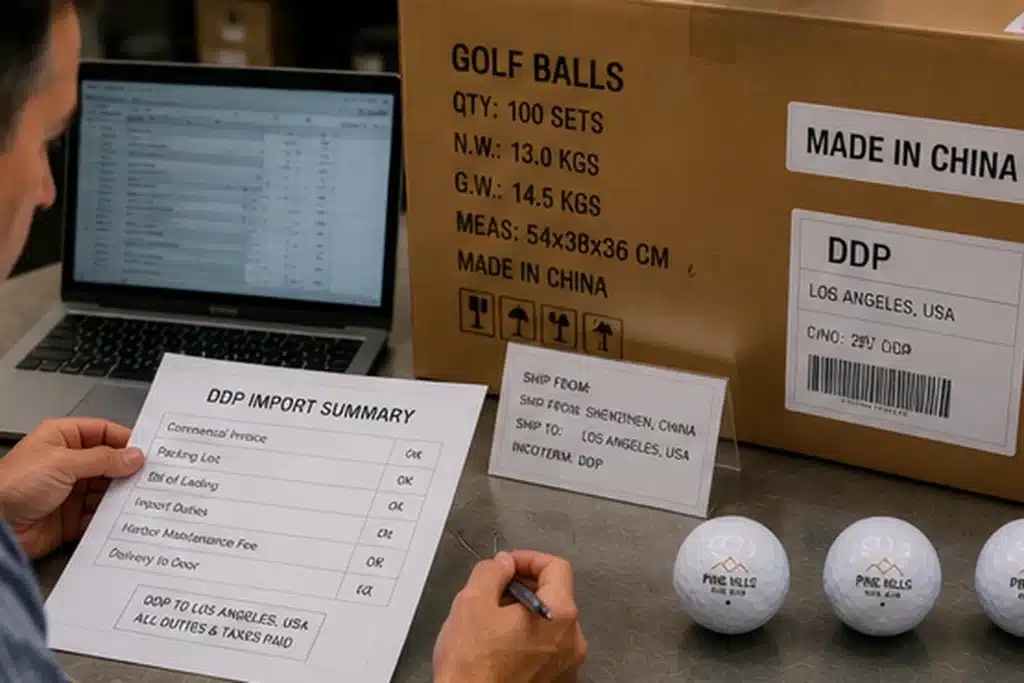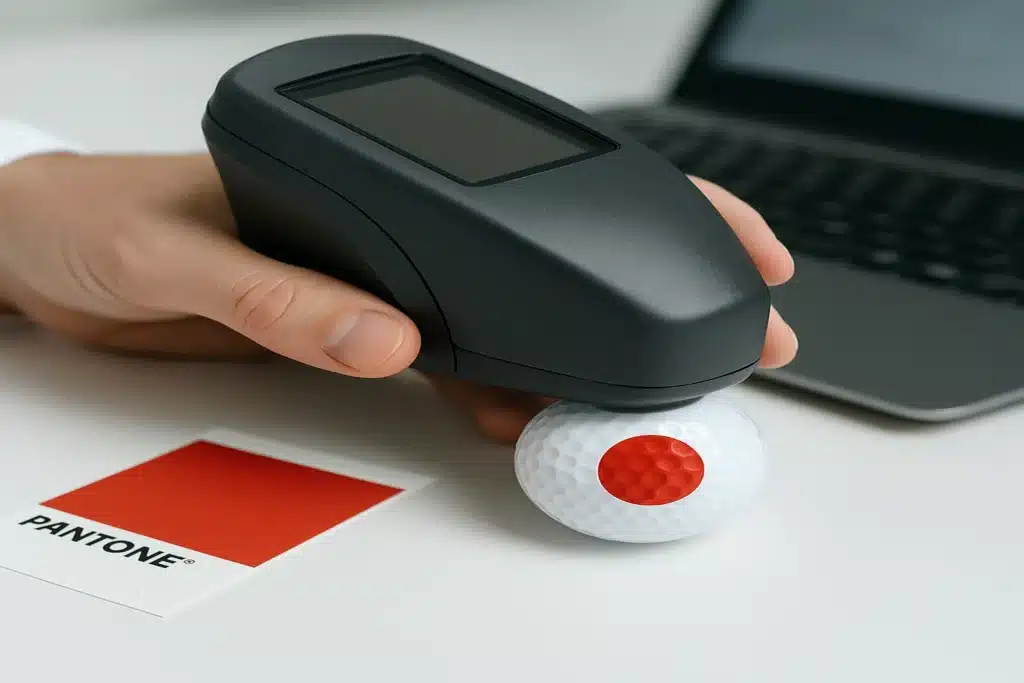
To control Pantone color matching for custom golf balls, start with production-ready vector artwork, a confirmed PMS code, an approved master sample, the right print method, and finished-ball QC data. The logo color should be accepted by agreed ΔE00 tolerance, rub or adhesion-style testing, retained samples, and lot-based color reports—not by screen color or visual approval alone.
A PMS code is the color language, but it is not the full acceptance standard. Golf balls are curved, dimpled, coated surfaces, so the same logo can shift after printing because of surface gloss, ink film thickness, cover material, curing, or clearcoat behavior.
Use this guide to turn custom golf ball logo color from “looks close” into a print-proof, measurable, durable, and repeatable OEM color-control process.
Why is Pantone matching hard on balls?
You may expect a Pantone code to print the same way it appears on paper, but golf balls are small, curved, dimpled, coated, and brutally honest about weak process control.
Pantone matching is harder on golf balls because the logo sits on a curved, dimpled, coated surface, not on flat paper. Your team should approve finished-ball color against a master sample, measured tolerance, and lot report—not from a screen, PDF, or swatch alone.
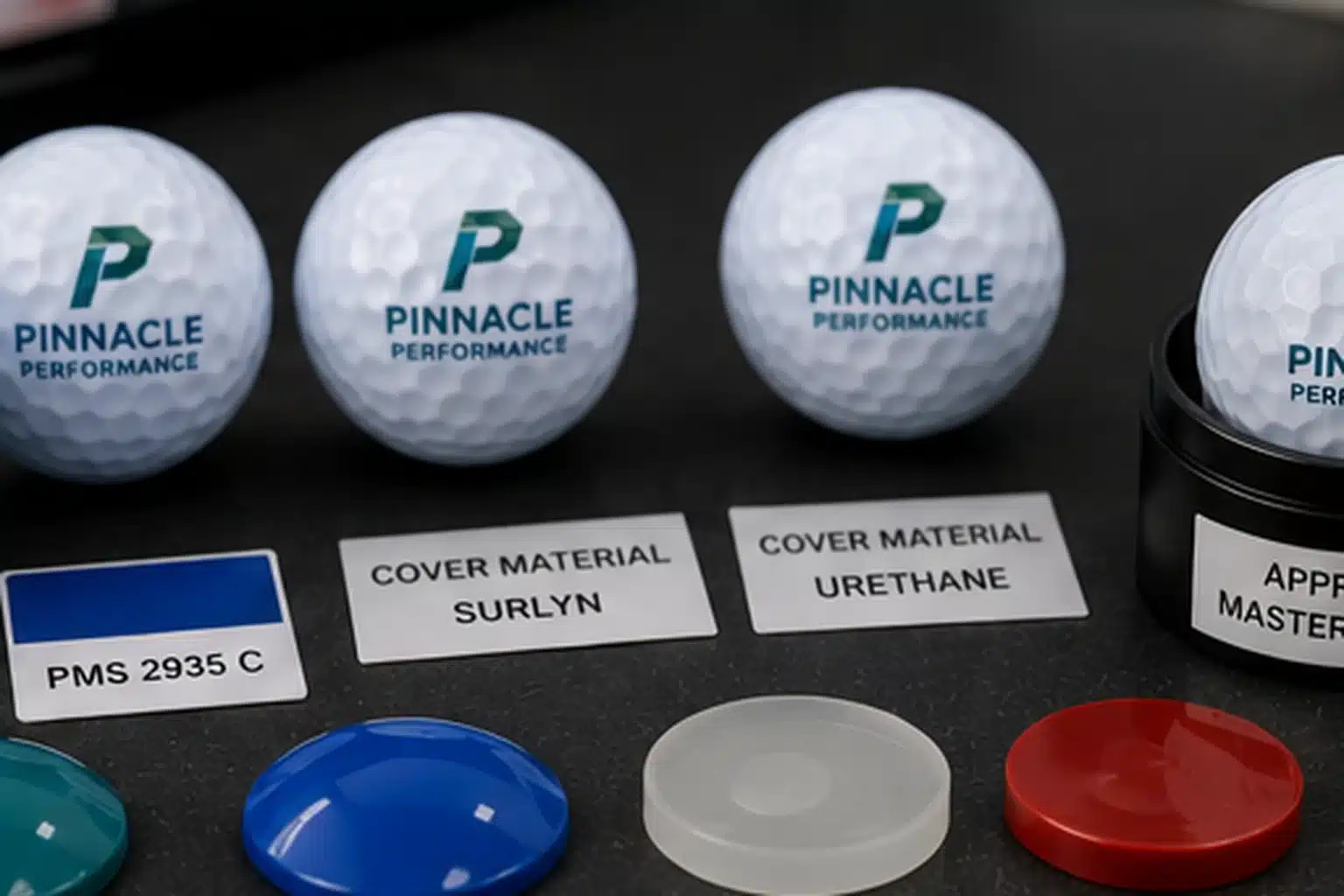
A Pantone code gives your team and supplier a shared language. The Pantone Formula Guide covers 2,390 market-driven spot colors, which helps brand owners define color intent before production. That matters, but it does not finish the job.
A golf ball changes how color behaves. The logo is printed over dimples, curvature, clearcoat, coating gloss, and cover material. Pad pressure can vary across the mark. Ink film thickness may shift from one edge of the logo to another. A glossy clearcoat can make a red look deeper; a different coating stack can make the same blue look cooler or softer.
Cover family also matters, but only as a printing-control issue here. Surlyn/ionomer, TPU, and urethane-family balls can require different cleaning, surface preparation, ink systems, primers, or cure settings. If release-agent residue, coating inconsistency, or weak surface treatment remains, the logo may match visually at approval and still fail durability later.
For corporate gift buyers, that means the logo may look less premium in the box. For tournament organizers, different lots may look mismatched on event day. For DTC golf ball founders, one good sample can become a repeat-order complaint if the process is not measured and retained.
Request printed samples on the exact ball construction and finish your order will use. Check the color under agreed lighting and compare the printed ball against an approved master sample. Do not approve color from a screen or flat proof alone.
✔ True — The golf ball surface changes how color appears
Dimples, gloss, coating thickness, cover material, and surface preparation can all shift how a printed logo looks on the finished ball.
✘ False — “A Pantone code alone controls finished-ball color”
A PMS code is the starting standard. Finished-ball approval still needs a master sample, measured tolerance, durability evidence, and lot traceability.
Dimples, coatings, and cover materials?
Your team should approve color on the real substrate, not on an ideal preview.
A custom logo golf ball is not paper, packaging board, or a phone screen. The same PMS color can look different on a glossy white distance ball, a softer urethane-family ball, a matte-finish practice ball, or a heavily coated promotional ball. Finished-ball color control begins when your supplier proves the logo on the same model, coating, and print method planned for bulk.
What should you approve before ink mixing?
You may think the factory can fix logo color during printing, but many color and clarity failures start with weak files, missing PMS codes, unclear placement, or unrealistic logo size.
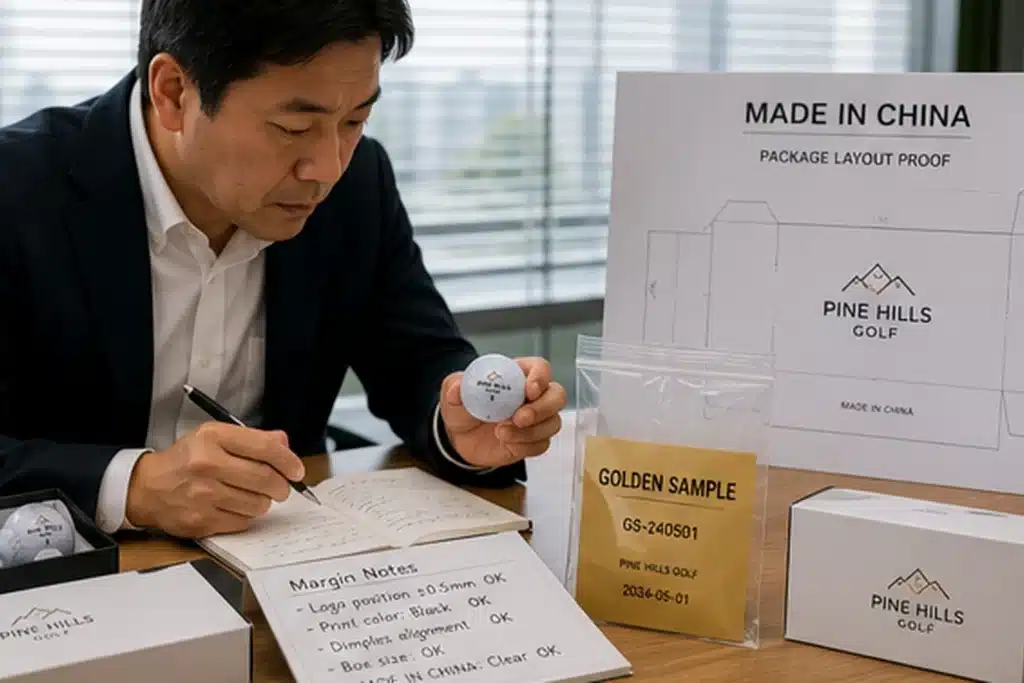
Most custom golf ball logo disputes start before the press runs. Your team should approve vector artwork, PMS code, logo size, print position, color count, side count, and master sample before the supplier mixes ink or prepares production fixtures.
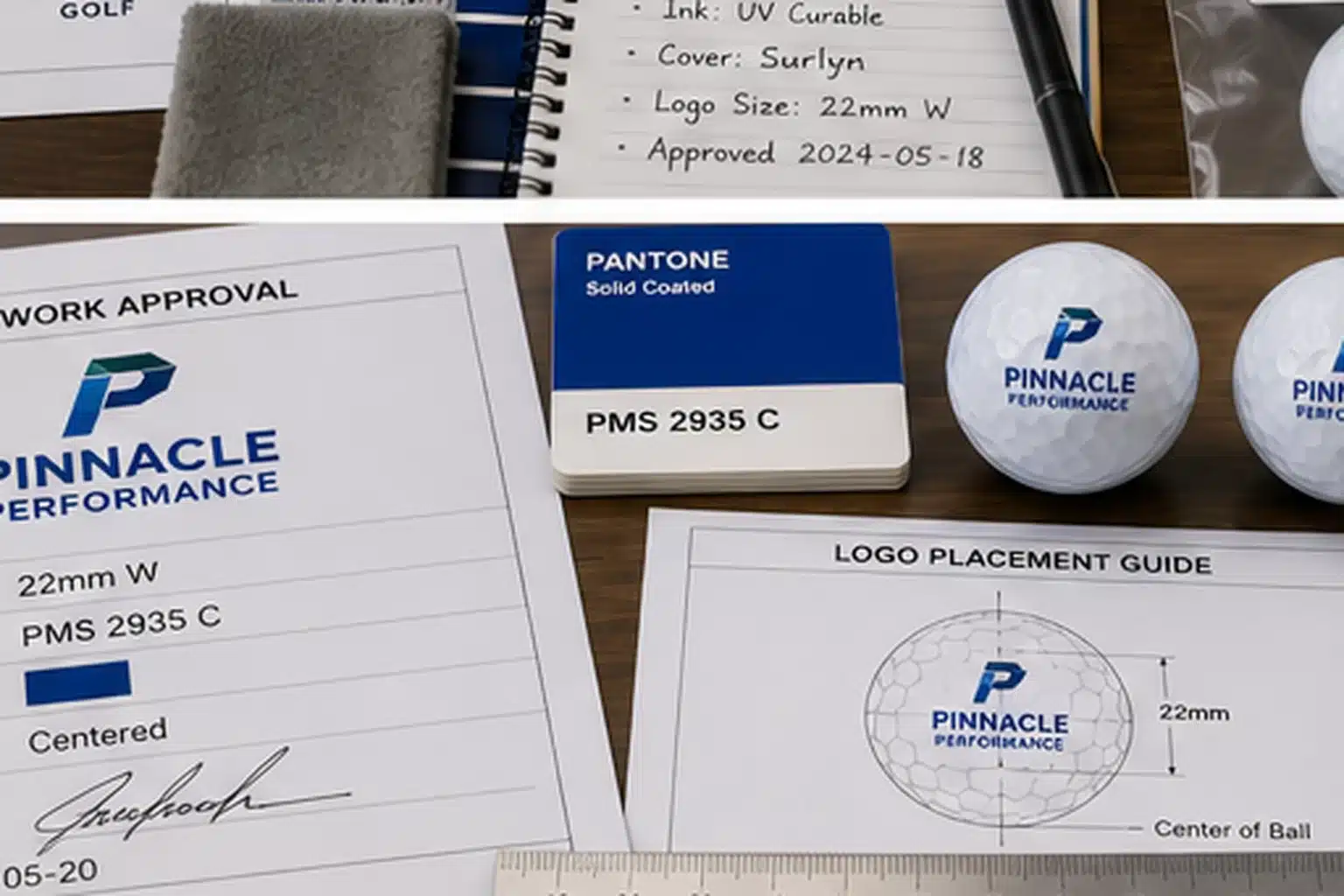
Before ink mixing, the factory needs production-ready artwork. AI, EPS, PDF, or SVG files are safer than JPG, PNG, screenshots, or copied website logos because vector files preserve edges, curves, small text, and line thickness. If your brand mark has thin strokes, small registration marks, or a detailed crest, poor file quality can make the finished logo look fuzzy even when the color formula is correct.
Your pre-press approval pack should include the PMS color code, logo width and height, print position, single-side or double-side requirement, color count, minimum line width, and packaging color reference if presentation matters. Logo size is not a minor detail. Too large, and the logo can distort across dimples or curvature. Too small, and fine details can fill in, break, or disappear.
Do not approve custom golf ball color from RGB screenshots or CMYK conversions alone. Spot color uses a premixed ink directly, while process color uses four or more standard ink colors. For one- or two-color company logo golf balls, Pantone spot color usually gives cleaner control. For gradients, photos, or complex multi-color designs, UV/digital process handling may be needed, and the tolerance discussion should change with it.
Ask for a digital proof that locks PMS code, vector artwork version, logo size, position, side count, color count, and packaging reference where relevant. Check whether the proof matches your brand guide and the actual ball-printing area. Do not allow ink mixing, fixture setup, or sample production until the proof is approved in writing.
Supplier says “match Pantone” but cannot request vector art, PMS code, logo size, or placement is a failure signal.
Vector art, Pantone code, and logo limits?
Your color control starts with the file package your team sends.
A professional OEM supplier should ask for more than “the logo.” Send the editable vector file, PMS code, logo size, print-side requirement, placement map, color count, and packaging reference. The supplier should return a proof showing what will be printed, where it will sit, and which standard controls production.
Which print method protects color best?
You may assume UV is more advanced or pad printing is old-fashioned, but the better method depends on artwork, quantity, color count, budget, timeline, and proof.
Pad printing is usually safer for solid Pantone logos at volume, while UV/digital is useful for complex, multi-color, or small-batch artwork. The right choice depends on color count, artwork detail, MOQ, cost, lead time, and durability testing.
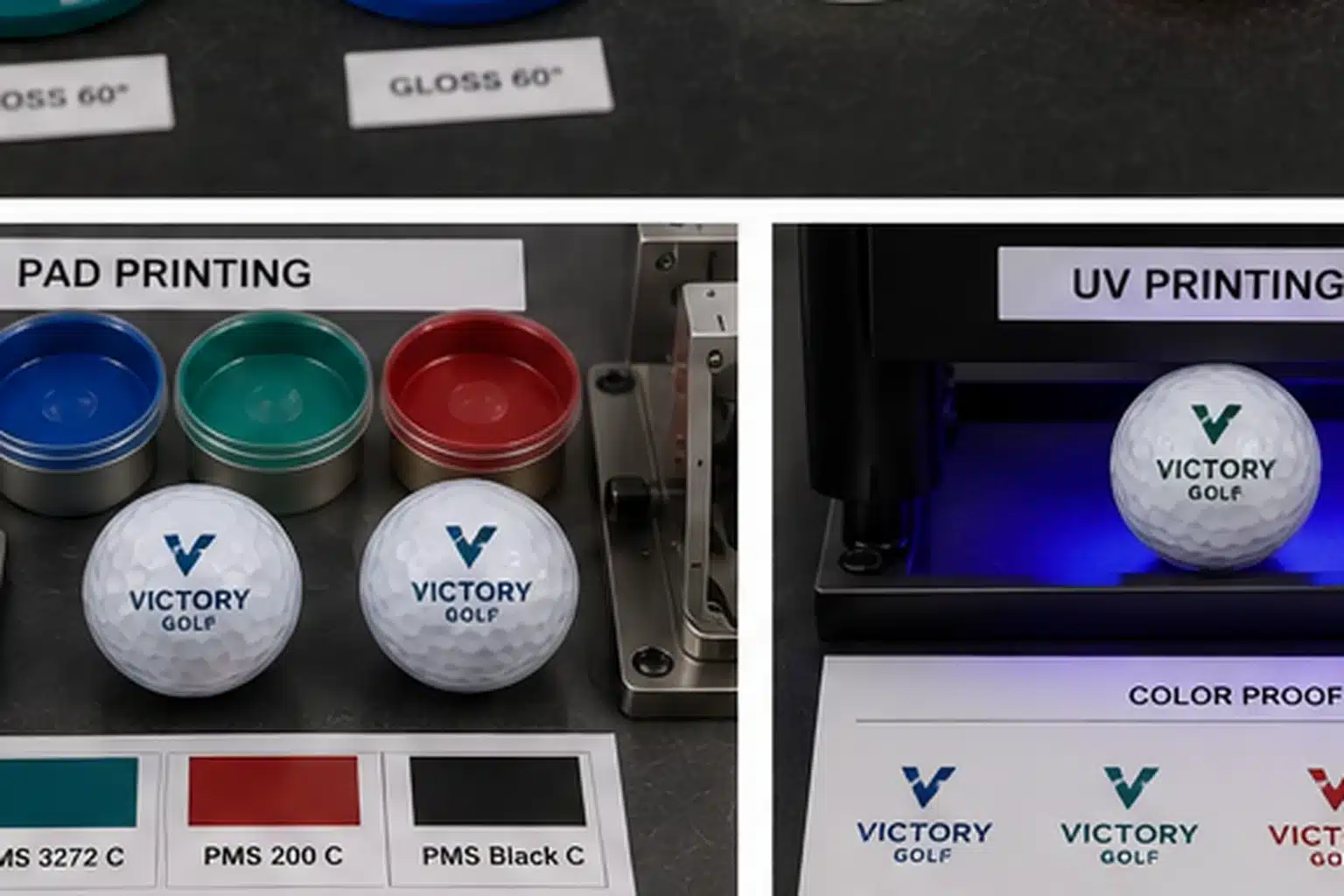
Pad printing remains the safer default for many custom logo golf balls because a soft silicone pad can conform to the curved, dimpled surface. For one- or two-color PMS logos, it supports stable spot-color control, clean edges, and efficient repeat production. That makes it practical for corporate gifts, tournament logo golf balls, pro shop orders, academy programs, and private label packaging sets.
UV/digital printing can be useful when artwork includes multiple colors, gradients, cartoon-style graphics, or many small design versions. It may reduce plate or changeover pressure for small-batch, multi-version orders. It can also help when the buyer wants a more complex visual effect than spot-color pad printing can handle cleanly.
UV is not automatically more durable than pad printing. Logo durability depends on the whole stack: surface cleaning, primer, ink system, curing, clearcoat, cover material, and testing. If the supplier recommends a method without showing test balls and rub results, your team is buying a claim, not a controlled process.
Range balls should prioritize logo visibility, abrasion resistance, recognition, stability, and cost. Corporate gift balls should prioritize Pantone accuracy, clean edges, packaging presentation, and batch-to-batch visual consistency. A premium gift sleeve makes a small color shift more noticeable; a range ball may tolerate a wider color window but not a weak mark that disappears quickly.
| Pain/decision | Better first choice | Buyer risk | Action/evidence |
|---|---|---|---|
| 1–2 PMS colors | Pad printing | Color drift from weak setup | Approve PMS proof |
| Large corporate order | Pad printing | Repeat-lot mismatch | Run test balls |
| Gradient or photo art | UV/digital | Process-color variation | Check ΔE/edge detail |
| Small multi-version run | UV/digital | Fixture inconsistency | Confirm fixture proof |
| Range ball logo | Pad + rub proof | Logo wears too fast | Test durability |
| Premium gift ball | Pad or UV + master sample | Weak presentation | Approve package view |
✔ True — Print method is a risk decision
Pad printing and UV/digital can both work when matched to artwork, quantity, color count, cost, lead time, and durability proof.
✘ False — “UV automatically means stronger or more premium”
A newer-sounding method does not prove durability. Finished-ball rub, adhesion, abrasion-style checks, and retained samples prove durability.
Pad printing vs UV for logo risk?
Your method choice should protect color, cost, lead time, and after-sale risk at the same time.
Ask the supplier to recommend the print method based on your artwork, quantity, color count, durability target, and timeline. Then check whether the recommendation includes test-ball photos, measured color results where practical, and durability evidence—not only a lower unit cost.
Do not choose pad printing or UV until the supplier proves it on your actual ball surface.
How should the Pantone process be controlled?
You may have the right logo file and print method, but color can still drift if proofing, ink mixing, setup, curing, and release rules are casual.
A Pantone process is controlled only when every release gate is written down. Your team should require proof approval, ink verification, on-ball setup, curing validation, durability check, and finished-lot comparison before bulk shipment.
The Pantone color control process should work like a production-release workflow, not a friendly email chain.
First, approve the vector proof. This proof should lock PMS code, logo size, print position, side count, color count, and print method. If the proof is wrong, the production result will be wrong faster.
Second, verify the ink direction. For spot-color pad printing, the supplier should work from the PMS target and confirm the ink drawdown or test target where practical. For UV/digital or process-heavy artwork, the supplier should explain how the color will be reproduced and what tolerance discussion applies.
Third, print on actual balls. Flat panels or paper drawdowns can help, but they do not replace on-ball samples. Setup variables such as pad hardness, cliché depth, viscosity, pressure, fixture alignment, and cure settings should be controlled by the supplier, especially for repeat orders.
Fourth, cure and check adhesion before production release. A logo that looks clean but smears after rubbing has not passed the project.
Fifth, compare the finished lot against the approved master sample. Your team should retain the master ball, and the factory should retain a matching reference sample tied to the same production record.
Request the supplier’s Pantone process checklist from proof approval to lot release. Check whether each stage produces a reviewable artifact: proof, sample, setup note, cure/durability check, and lot report. Do not release mass production unless the approved master ball and process path are documented.
Proof, ink, setup, cure, and release?
Your approval should move through gates, not through casual visual confirmation.
The approved master sample becomes the physical production reference. It should connect the proof, ink direction, print method, curing result, and finished-lot release. One good digital proof does not prove bulk color. The finished ball must prove it on the real surface.
What tests prove color and logo durability?
You may approve a logo that looks close under office lighting, but risk remains if the color is not measured and the logo is not tested.
Color pass is not enough if the logo rubs off. Your team should request Lab* values, ΔE00 results, spectrophotometer details, measurement conditions, dry/wet rub checks, adhesion-style evidence, abrasion notes, and before/after photos.
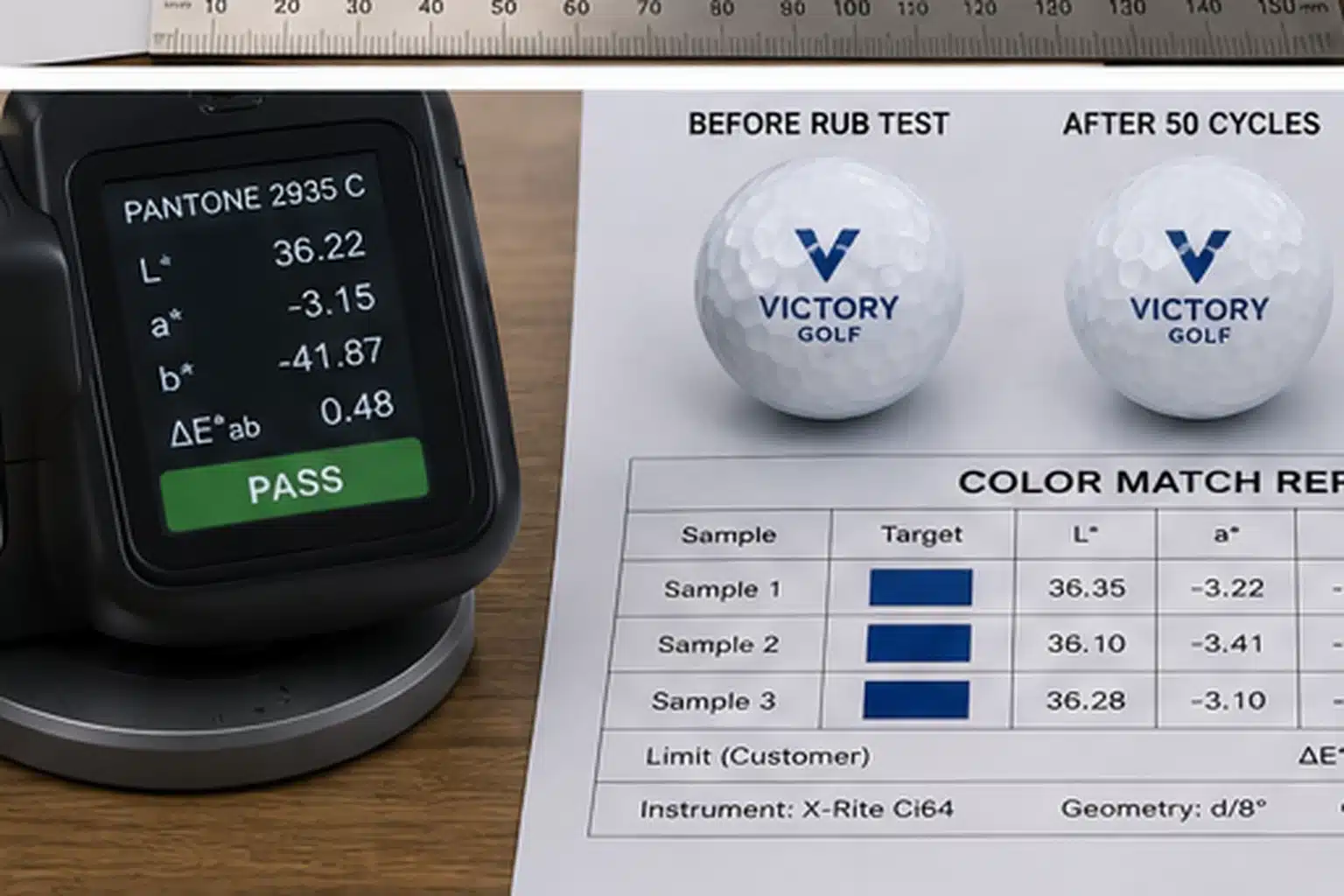
Do not judge brand color only by office lighting. Delta E measures the color difference between a target and a sample. For custom golf balls Pantone matching, the target may be your approved master sample, and the sample should be finished balls from the production lot.
Use an agreed tolerance, not a universal promise. Color tolerance varies by product, material, visual expectation, formula, and commercial risk. Guidance on color tolerance stresses that one size does not fit all and that the selected formula, visual agreement, and customer quality demands matter. Delta E tolerances
Your lot report should state Lab* values, ΔE00 formula, sample size, average and maximum ΔE00, spectrophotometer model, measurement condition, and calibration status. ISO 13655:2017 provides spectral measurement and colorimetric computation procedures for graphic arts images, which is a useful reminder that reports should state measurement conditions so numbers can be compared.
Durability needs separate proof. ASTM D5264 covers abrasion resistance of printed materials using a Sutherland Rub Tester or equivalent, and it supports the buyer-seller idea of a predetermined scuff-resistance standard. For golf balls, use that logic as an adapted on-ball rub check: fixed cradle, fixed pressure, dry and wet cycles, visual inspection, and post-test color or legibility review.
Adhesion and coating references also need careful language. ASTM D3359 provides tape-test methods for rating adhesion and notes limits for non-metallic substrates. ASTM D4060-25 covers Taber abrasion resistance of organic coatings on plane, rigid surfaces. For golf balls, these are useful references for adapted adhesion or coating discussions, not a claim that a flat-panel method automatically fits a dimpled sphere.
Supplier approves color by eyesight only, with no ΔE00 result or retained sample, is a failure signal.
| Pain/decision | Evidence to request | What it proves | Action/evidence |
|---|---|---|---|
| Looks close by eye | Lab* + ΔE00 | Measured color gap | Set tolerance |
| Different readings | Instrument + condition | Comparable reports | Check calibration |
| Logo rubs off | Dry/wet rub check | Ink durability | Review photos |
| Weak adhesion | Tape/adhesion-style check | Surface bond | Agree method |
| Clearcoat concern | Abrasion/coating note | Surface durability | Use adapted test |
| Lot drift | Average/max ΔE00 | Batch consistency | Keep retained sample |
✔ True — Color and durability need separate proof
A logo can match the approved color and still fail if it smears, transfers ink, loses edge clarity, or becomes hard to recognize after use.
✘ False — “Visual approval under office light is enough”
Office light, phone photos, and screen previews are not stable QC evidence. Use measured color data, retained samples, and durability checks.
ΔE00, rub tests, and lot reports?
Your team should approve a logo that stays on-brand after handling, cleaning, and play.
Request a color report and durability report with sample size, method, instrument, calibration status, before/after photos, and retained samples. Check whether color data is measured on finished balls, not only on ink drawdowns or flat panels.
Bulk release shall require approved master sample match, agreed ΔE00 formula and tolerance, stated sample size, spectrophotometer model and calibration status, dry/wet rub or abrasion-style result, visible logo-defect criteria, and lot-based color report before shipment.
Do not approve bulk shipment if color tolerance passes but rub, adhesion, or logo legibility fails.
What should your PO require from the factory?
You may write “match Pantone” in the PO, but that phrase does not define file quality, sample approval, tolerance, durability, sampling, reporting, or remedy.
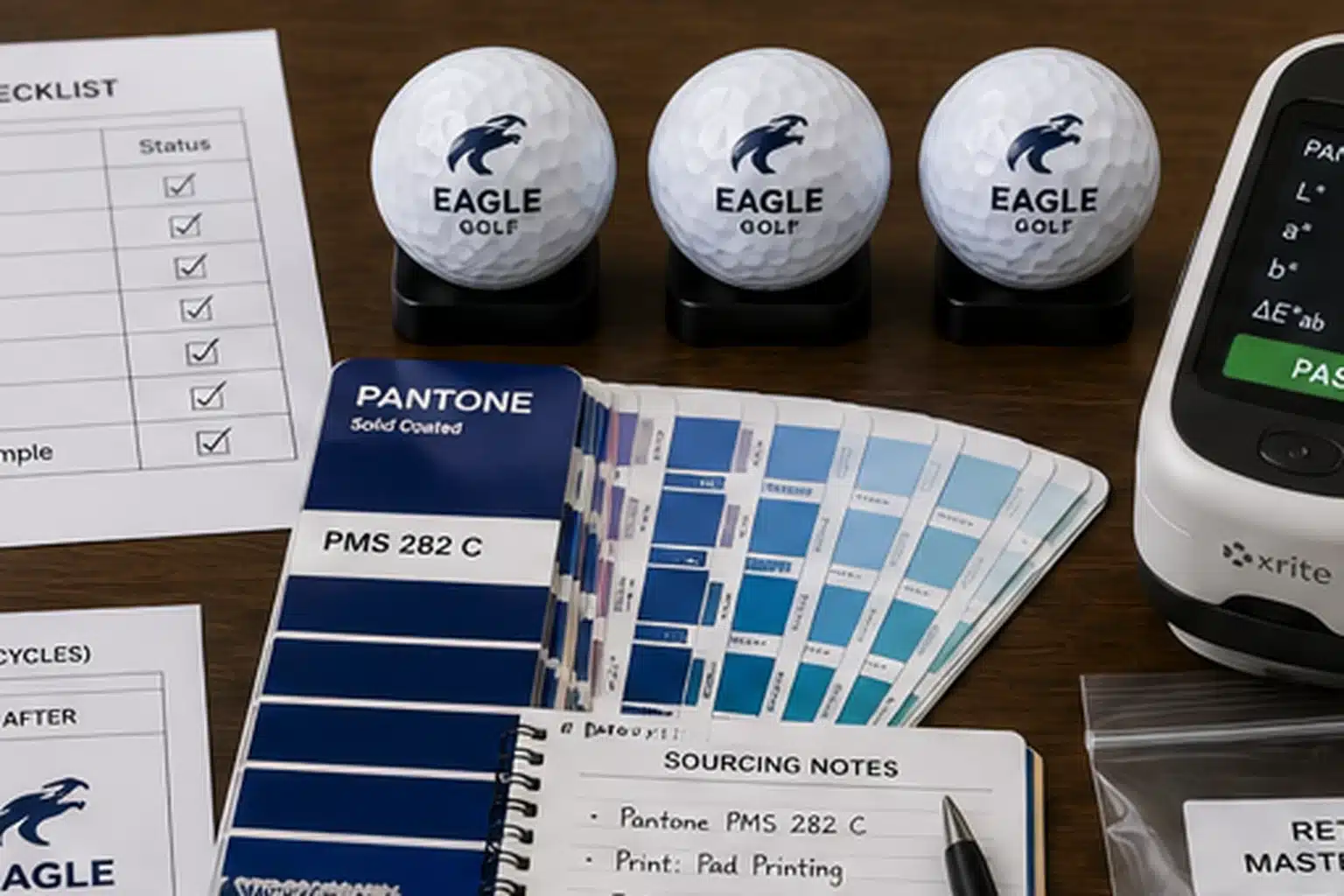
Do not write only “match Pantone” in your PO. Your team should specify PMS code, approved master sample, print method, ΔE00 tolerance, sample size, lot report, durability proof, retained samples, and remedy rules.
Your PO or RFQ should make color acceptance auditable before the dispute exists. A strong order file includes PMS code, physical reference where brand-critical, approved master sample, vector file version, logo size, print position, side count, color count, and selected print method.
For measurement, define the agreed ΔE00 formula and tolerance by project. Do not copy one universal number into every SKU. A premium retail ball, tournament sponsor ball, range ball, and promotional giveaway may need different pass/fail windows. The important point is that buyer and supplier agree on the window before production.
For reporting, request Lab* values, ΔE00 average and maximum, sample size, spectrophotometer model, measurement condition, calibration status, ink batch, production lot, print date, and retained sample. For durability, require dry/wet rub, adhesion-style, or abrasion-style evidence where logo durability matters. For corporate gift or retail presentation, include packaging, sleeve, sticker, or gift box color proof in the same approval path.
Ask the supplier to quote Pantone color control with vector artwork, PMS code, approved master sample, print method, surface preparation, curing method, agreed ΔE00 tolerance, rub/adhesion evidence, lot-based color report, ink batch, production lot, retained sample, and packaging color proof.
Supplier shall link PMS code, vector artwork version, approved master sample, print method, ink batch, production lot, coating/clearcoat batch where applicable, measurement report, retained sample, and packaging proof under one traceable order record.
First-order color QC should be stricter than repeat-order admin. Once several lots show stable reports, retained samples, and low complaint history, your team may streamline approvals. The proof should not disappear.
Serious B2B buyers should approve a measurable color window, not a subjective color promise. A range-ball order may accept a wider color range if the logo stays visible and durable. A corporate gift or retail order may need tighter Pantone matching, cleaner edges, packaging color coordination, and retained samples because the product is judged before anyone hits it.
Tolerances, samples, and acceptance rules?
Your PO should define pass/fail, not just the desired color name.
Request a lot-based color QC package with PMS code, master sample, measurement data, durability proof, ink batch, production lot, retained sample, and packaging proof. Check whether the report ties each printed lot to your approved master sample and artwork version.
Your PO should hold shipment if agreed color, durability, logo placement, or reporting deliverables are missing.
FAQ
What does Pantone matching mean for custom golf balls?
Pantone matching means controlling a custom golf ball logo with a PMS code, approved master sample, finished-ball measurement, agreed ΔE00 tolerance, durability proof, and lot-based QC report—not just choosing a color name.
The PMS code gives your supplier the color language. The approved master sample gives both sides a physical reference. Finished-ball measurement and retained samples help your team control repeat lots, especially when the same logo appears across corporate gifts, tournament balls, retail sleeves, or DTC reorder batches.
Can a factory match my company logo on golf balls?
Yes, a factory can match your company logo on golf balls when your team provides vector artwork, PMS code, logo size, print position, color count, side count, and approves a real printed sample before bulk production.
A supplier cannot reliably match what has not been defined. Send production-ready artwork, not a screenshot. Approve the logo on the actual ball model and finish. For brand-critical projects, ask for measured color data and durability proof before shipment.
What artwork file should you send before printing?
Send AI, EPS, PDF, or SVG vector artwork whenever possible because vector files preserve edges, curves, small text, and line detail better than low-resolution JPG, PNG, or screenshots.
Provide PMS codes separately from the artwork file. Keep logo size and line thickness realistic for a curved, dimpled ball. If the design has gradients, tiny text, or multiple colors, ask the supplier to confirm whether the detail can print cleanly before sample production.
Why not approve golf ball color from a screen?
RGB screen color, CMYK print previews, Pantone spot color, and finished-ball measurements are different control systems, so final approval should come from a printed golf ball sample and measured color data.
Use screen previews for layout and placement. Use Pantone/PMS as the ink reference. Use ΔE00 data, an approved master sample, and retained production samples for lot release. A logo that looks right on a laptop can shift once printed over dimples, coating, gloss, and clearcoat.
Is pad printing or UV better for golf ball logos?
Neither method is always better. Pad printing is usually safer for simple, few-color, repeatable Pantone logos at volume; UV/digital is useful for small-batch, multi-color, gradient, or complex artwork.
Choose by color count, artwork complexity, cost, MOQ, lead time, and durability target. Then require proof on the actual ball surface. Whether the supplier uses pad printing or UV, your team should request finished-ball color proof and rub or adhesion evidence before shipment.
How should a supplier prove the logo color matches?
*Ask for an approved master sample, Lab values, ΔE00 results, spectrophotometer model, measurement condition, calibration status, sample size, ink batch, production lot, and retained sample.**
Measure finished balls, not only flat samples or ink drawdowns. Use an agreed formula and tolerance. Keep average and maximum values in the report because one good-looking ball does not prove the entire lot is controlled.
How should logo durability be tested before bulk?
Use dry/wet rub, scuff, abrasion, or adhesion-style checks before mass production because a logo can match Pantone but still fail if it smears, flakes, transfers color, or loses legibility.
Test on the exact ball finish. Record before/after photos. Reject or rework lots that pass color but fail durability. A durable logo protects your brand after handling, cleaning, range use, gift-box packing, and play.
Conclusion
Pantone color matching on custom golf balls is not controlled by a color name alone. It is controlled by vector artwork, approved Pantone standards, the right print method, surface preparation, curing validation, ΔE00 measurement, rub testing, retained samples, and lot-based QC reports.
Your team should not ask only, “Can you match this Pantone?” Ask how the supplier will prove it on the actual ball surface, how the logo will survive handling, and how the next lot will be tied back to the same master sample.
When your PO defines the PMS code, artwork version, print method, tolerance, durability proof, lot report, retained sample, and packaging color proof, color matching stops being a hope. It becomes a controlled OEM workflow your brand team, QC team, and supplier can all follow.
You might also like — What’s the Real MOQ for Custom Logo Golf Balls in Bulk?