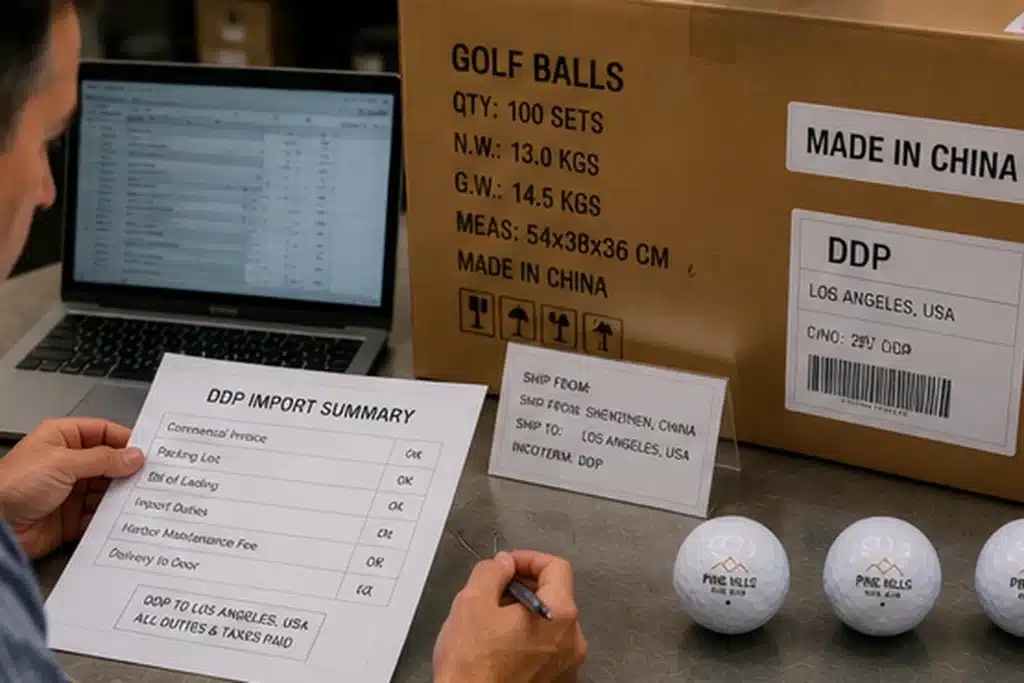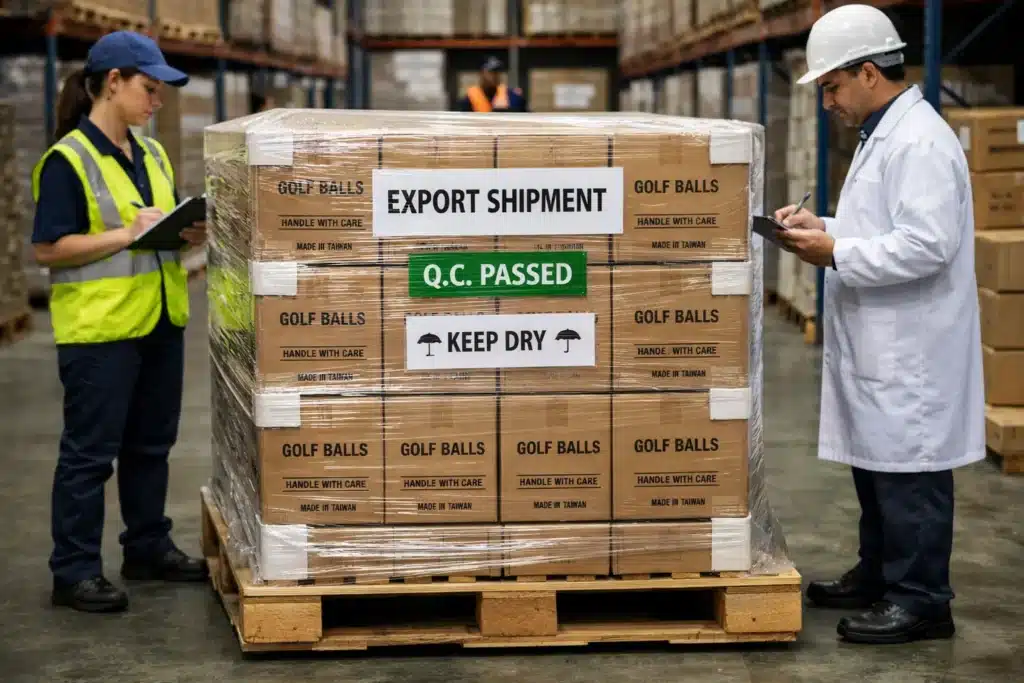
Your launch does not fail when freight is expensive. It fails when your warehouse has no balls.
For China golf ball OEM lead time, plan 90–110 days for a first custom launch when sampling, packaging, curing, PSI, shipping, clearance, and final delivery are counted. Standard existing-mold sampling often takes 10–15 days, mass production usually takes 30–45 days, and sea delivery can add 25–45 days by lane.
A factory’s “30 days” usually means production time, not launch-ready inventory. Your COO calendar must also include USGA timing if needed, custom packaging approval, coating/curing hold, inspection release, cargo-ready handoff, freight, clearance, and warehouse receipt.
| Launch question | Practical planning answer | Calendar gate to lock |
|---|---|---|
| How long for a first custom golf ball launch in China? | Often 90–110 days end to end | Sampling, packaging, curing, PSI, delivery |
| How long for mass production only? | Usually 30–45 days for normal custom programs | Production slot + coating schedule |
| How long for samples? | Often 10–15 days with existing mold/formula | Logo, BOM, construction, sample ID |
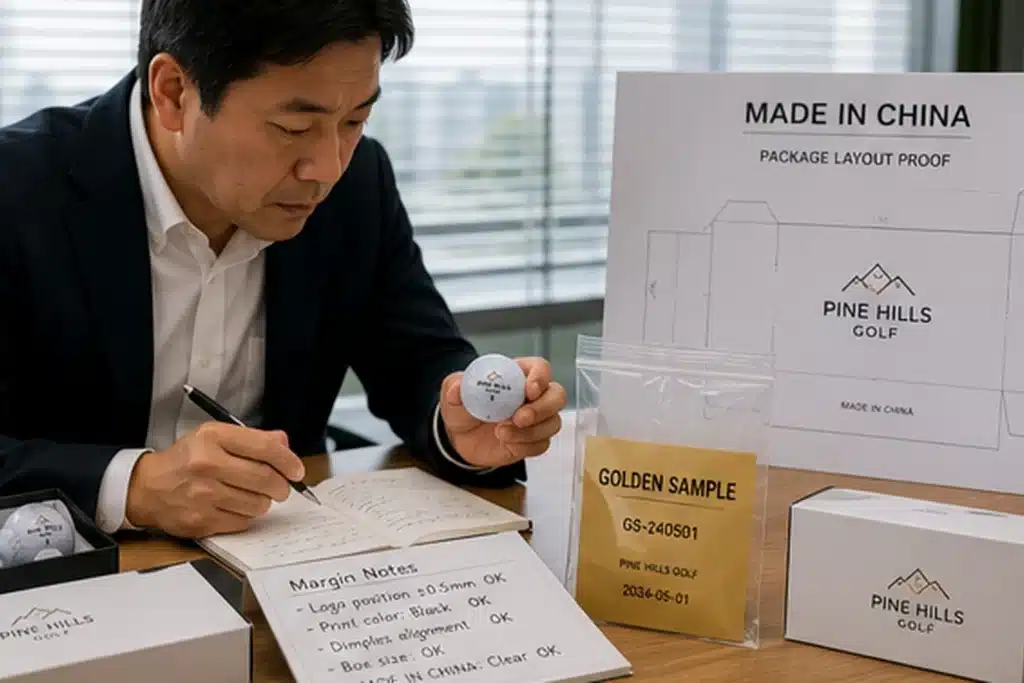
| When should packaging start? | During pilot validation, not after balls finish | Dieline, CMYK/Pantone, barcode, carton label |
| When does USGA timing matter? | When retailer, tournament, or packaging claims depend on listing | Submission window + target publication month |
| When should split-shipment trigger? | When launch date is fixed but QC gates cannot move | Rescue batch by air, main lot by sea |
Use one clock across your team and supplier: cargo-ready → delivered milestone. Cargo-ready means the balls, packaging, curing hold, PSI, carton marks, and release approval are complete. Delivered means the order has reached your warehouse, retailer, fulfillment center, or launch event.
Before approving a 2026 DTC golf brand launch schedule, lock five dates in writing:
-
Pilot approval date: the sample ID, construction, logo, and finish are frozen.
-
USGA/R&A gate if needed: representative samples are submitted early enough for the target publication month.
-
Packaging approval date: dieline, CMYK/Pantone, barcode, claims, and carton labels are approved in parallel with production.
-
Cargo-ready date: mass production, coating/curing hold, PSI, and ship-ready evidence are complete.
-
Delivery milestone: express, air, sea, or split-shipment timing is tied to your warehouse or retailer date.
The practical rule is simple: build the launch calendar backward from the shelf date, not forward from the factory quote. If the date cannot move, use split-shipment for media kits, first retailer fill, or urgent preorders—but do not compress curing, PSI, packaging QC, or USGA-related checks to chase a freight cutoff.
Why is 30-day delivery a launch myth?
You may hear “30 days production” and build a campaign around it, but production days are not the same as launch-ready inventory.
A 30-day production quote is not a 30-day launch plan. For China golf ball OEM, your calendar should include sampling, artwork, packaging, USGA timing if needed, mass production, coating/curing, PSI, cargo-ready, shipping, clearance, and final delivery.
The first calendar mistake is using the wrong clock. Factory lead time usually ends when goods are ship-ready. Your launch deadline ends when inventory is usable at the warehouse, retailer, tournament, fulfillment center, or media-kit packing station. Those are not the same day, and pretending they are is how good campaigns become very expensive apologies.
Use one clock across the supplier, forwarder, warehouse, and your launch team: cargo-ready → delivered milestone. Cargo-ready means the goods have passed release requirements and can be handed to logistics. Delivered means the order has reached the agreed destination point.
| Calendar stage | Typical timing | Hidden risk | Buyer move |
|---|---|---|---|
| Sampling / pilot | 10–15 days | Wrong spec or logo | Lock sample ID |
| Mass production | 30–45 days | Queue and coating delay | Reserve slot |
| Custom packaging | 15–20 days parallel | Dieline / color delay | Start early |
| Curing / QC hold | 24–72h for premium | Sticking / scuffing | Do not compress |
| Sea delivery | 25–45 days lane-dependent | Handoff delays | Plan from cargo-ready |
| Express rescue | 4–7 working days practical | Last-mile and clearance | Use for urgent small batches |
| Air freight rescue | 7–12 days practical | Booking and handoff timing | Use for controlled rescue lots |
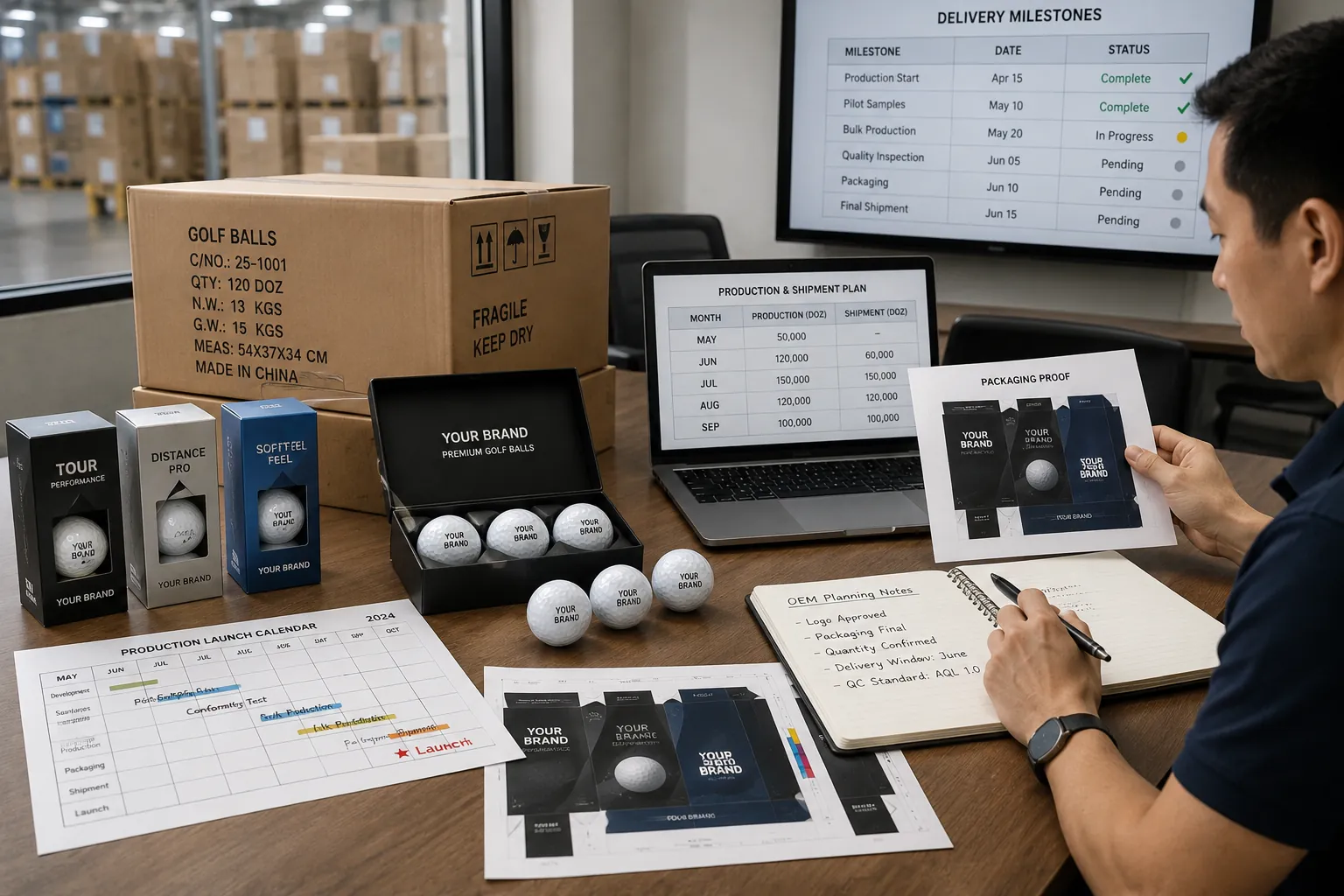
A failure signal appears when a supplier quotes 30 days but cannot define cargo-ready, PSI date, packaging approval, or final delivery milestone. That is not a launch calendar yet. It is a production promise with missing edges.
Request a launch calendar with cargo-ready date and final delivery milestone separated. Confirm which date the supplier calls lead time and which date your team calls launch-ready. Do not approve a campaign date until lead time and delivery date are both defined in the PI/PO.
Supplier shall provide a launch calendar showing pilot approval date, USGA sample shipment date if needed, target publication month, packaging approval date, mass production start, coating/curing hold, PSI date, cargo-ready date, split-shipment trigger, and final delivery milestone.
✔ True — Plan from cargo-ready to delivered.
A launch calendar must include approval, packaging, curing, inspection, freight handoffs, clearance, and final delivery. Production days alone do not protect your sales date.
✘ False — “30-day production means 30-day delivery.”
That phrase can hide packaging, PSI, cargo pickup, customs, last-mile delivery, and lane buffers.
What is the production timeline from zero?
You need to know where the days go before goods are even cargo-ready.
A standard China OEM golf ball program can move from sample to cargo-ready in about 45–70 days, but new tooling, premium packaging, USGA timing, or urethane curing can extend the calendar. Start packaging and compliance work while the pilot ball is being validated.
For existing mold and formula programs, sampling often takes around 10–15 days when logo, construction, cover route, compression target, and packaging direction are clear. Mass production often needs 30–45 days for a normal custom program. Those are planning bands, not universal promises. A logo change, matte finish, new sleeve, retailer barcode, or late claim wording can move the date.
The best launch teams run separate tracks. The ball team approves the pilot. The packaging team locks dielines, CMYK/Pantone values, barcode placement, carton marks, and retail sleeve details. The compliance team checks whether USGA/R&A timing matters. The inspection team reserves PSI before the goods are “almost done.”
| Workstream | Planning range | Can run parallel? | What to lock | Buyer move |
|---|---|---|---|---|
| Existing-mold sample | 10–15d | No | BOM + logo | Approve quickly |
| New tooling | +25–35d | Partly | Dimple/tool spec | Start early |
| Mass production | 30–45d | No | Batch slot | Reserve capacity |
| Custom packaging | 15–20d | Yes | Dieline + colors | Start with pilot |
| PSI booking | 1–3d window | Yes | Inspection criteria | Reserve early |
When does new tooling add days?
New dimple tooling changes the calendar because CNC/EDM machining, trial molding, adjustment, and first-article checks must happen before real production.
If your brand wants a new dimple pattern, new mold, unusual finish, or heavily customized premium construction, add roughly 25–35 days as a planning buffer. Do not place that project into the same calendar as a standard logo print on an existing model.
Request a production timeline with separate tracks for ball production, packaging, USGA timing if needed, and PSI. Confirm whether tooling, packaging, and compliance tasks are sequential or parallel. Do not accept a one-line lead time if packaging, tooling, or compliance gates are still undefined.
✔ True — Packaging should run beside pilot approval.
Dieline, color proof, barcode, carton labels, and claim wording can become a second critical path if your team waits too long.
✘ False — “Packaging starts after balls are finished.”
For launch-critical orders, the ball and the box must move on parallel tracks.
How does USGA timing affect launch?
You may have PR, retailers, or events ready, but the model may not yet appear on the current Conforming Golf Ball List.
USGA timing should run in parallel with China production, not after mass production. The official USGA Conforming Golf Balls List updates on the first Wednesday of each month, so missing a submission window can delay retailer launch, tournament-use claims, and packaging approval by a full month.
USGA/R&A timing is a launch gate, not a factory task that can be rushed at the end. If your model needs competition eligibility or retailer-facing conformity claims, start the compliance clock from pilot approval. Representative pilot samples should match the intended final markings, construction, cover route, finish, and production spec.
Plan at least 4–6 weeks for the practical submission window, and allow more if courier time, queue timing, publication dates, or retesting could affect launch. Use the current USGA equipment submission page and Pinehurst, NC Test Center details when preparing shipment paperwork. Do not rely on outdated address habits or old internal notes.
| USGA gate | What it controls | Launch risk | Buyer move |
|---|---|---|---|
| Pilot sample ready | Representative sample | Wrong spec submitted | Freeze build |
| Sample shipment | Submission clock | Courier / form delay | Ship early |
| Deadline window | Publication month | Missed List update | Track schedule |
| Current List check | Tournament claim | Retailer refusal | Save evidence |
| Packaging claim | Box wording | Printed waste | Wait for listing |
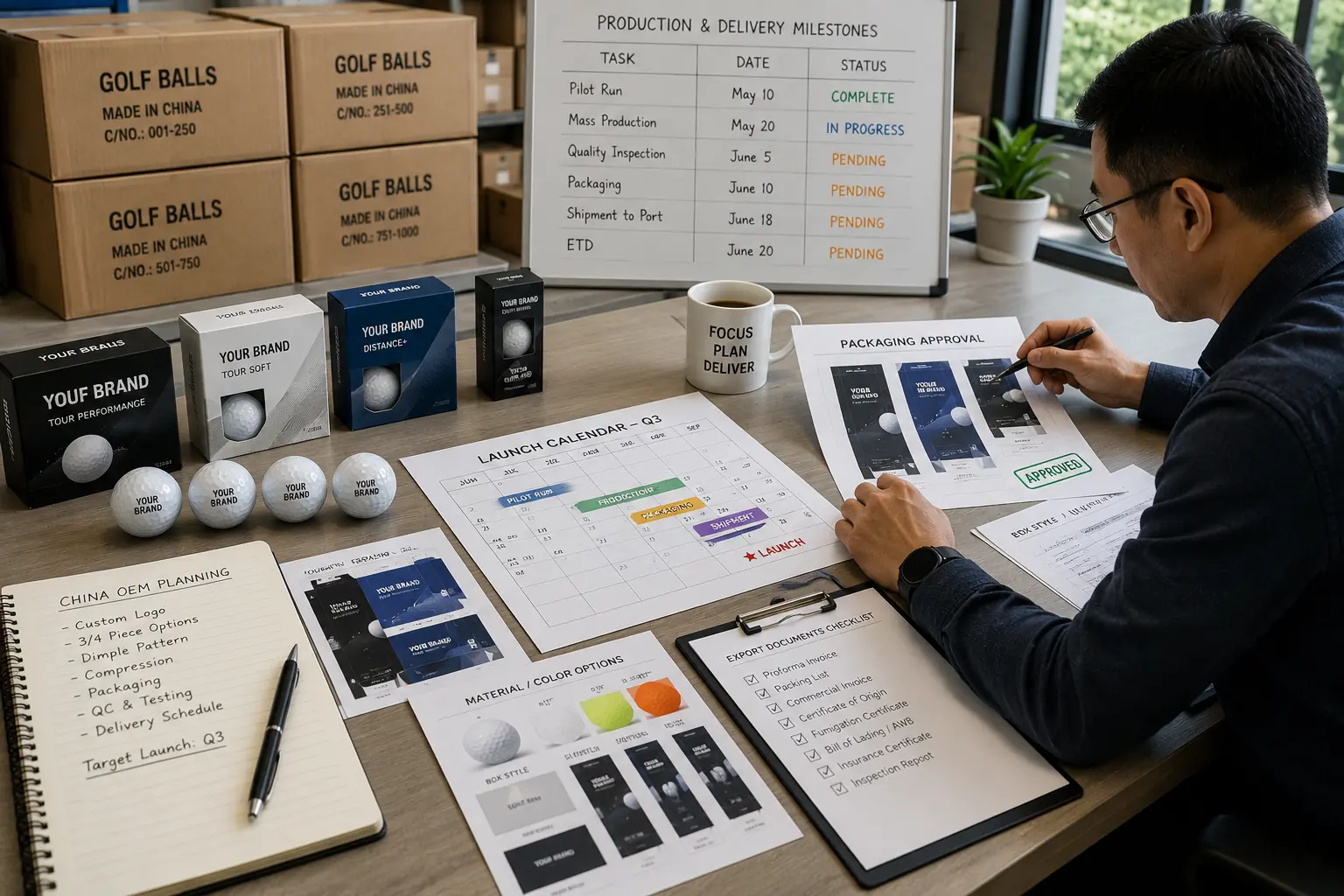
What is the first-Wednesday rule?
The current Conforming Golf Ball List becomes a monthly launch checkpoint. If your ball misses the relevant submission and publication cycle, your campaign may move even if production is ready.
A failure signal appears when a compliance claim depends on USGA listing but no submission date or target publication month appears in the launch calendar. That gap can turn into wasted packaging, postponed retailer onboarding, or a PR launch with no conforming claim to support it.
Request the USGA sample shipment date and target publication month in the launch calendar. Confirm the current publication schedule and save the List evidence before compliance claims print. Do not promise a tournament-ready launch until the exact model appears on the current List.
For deeper submission details such as sample quantity, final markings, Pole/Seam identity, and packaging wording, keep that work in a separate compliance checklist. In this launch calendar, the job is simpler: USGA timing must start early enough that your marketing date does not wait for a monthly list update.
Which silent killers delay OEM orders?
You may think the line is slow, when the real blockers are packaging, curing, PSI, and avoidable approval gaps.
Most China golf ball OEM delays are not caused by slow molding. The silent killers are packaging approvals, USGA timing, new tooling, coating/curing hold, PSI booking, and late artwork or barcode changes. Run these workstreams in parallel or they will control your launch.
The box trap is common. The factory says the balls can be finished in 30 days, so the buyer assumes the full order can ship in 30 days. Then the UV box proof is rejected, foil position changes, barcode size is wrong, or the retailer wants a new carton label. Finished balls wait for packaging, and everyone pretends the delay came from production.
Curing is more dangerous because it is easy to misunderstand. Premium urethane covers and clearcoats may look dry before they are shipment-safe. Coatings continue to dry, cure, form film, build solvent resistance, and stabilize surface behavior after application. Golfara treats 24–72 hours of no-pack hold as a buyer-side QC gate for premium coated balls, depending on coating stack, humidity, temperature, adhesion result, rub-test result where applicable, and QC release.
| Delay killer | Why it happens | Buyer proof | Buyer move |
|---|---|---|---|
| Packaging trap | Dieline/color/finish approvals lag | Approved artwork date | Start with pilot |
| USGA blackout | Monthly List cadence | Target publication month | Submit early |
| New tooling | CNC/EDM/trial/repair | Tooling schedule | Add 25–35d |
| Curing hold | Coating still stabilizes | Adhesion/rub result | Do not pack early |
| PSI queue | Inspection not booked | PSI appointment | Reserve slot |
| Peak queue | Factory prioritizes confirmed orders | Slot confirmation | Pay/approve early |
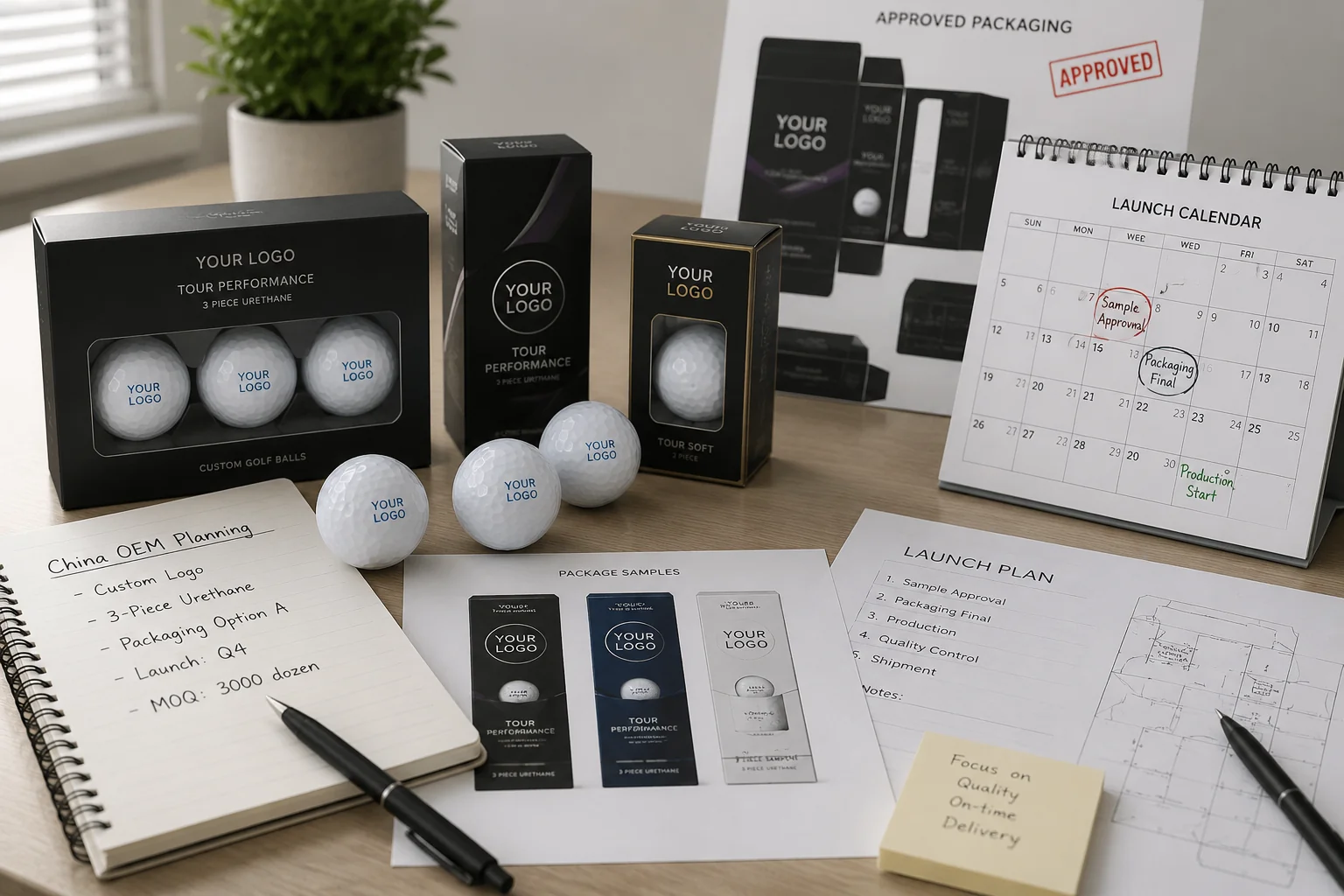
Why should wet chemistry never ship?
Wet chemistry can turn a launch rescue into a product failure. Packing too early may create sticking, scuffing, coating transfer, tray marks, or finish inconsistency.
A failure signal appears when a factory wants to pack premium coated balls before the agreed curing hold or adhesion check is complete. That may save five calendar days and destroy a shipment. You prefer launch certainty, but launch certainty does not come from compressing chemistry. It comes from parallel planning and split-shipment.
Supplier shall not pack premium urethane or clearcoat-finished golf balls before the agreed curing hold is complete. Release shall require coating-stack confirmation, humidity/temperature record where available, adhesion or rub-test result where applicable, PSI approval, batch ID, carton photos, and buyer-approved ship-ready notice.
Request parallel packaging and curing milestones in the PI/PO. Check dieline, CMYK/Pantone, barcode, carton labels, curing hold, PSI date, and cargo-ready evidence. No premium coated ball should be packed before the agreed curing hold and QC release are complete.
When do peak seasons block your launch?
You may place the right order at the wrong time and lose your launch to CNY, Q4 promotions, factory queue priority, or freight handoff pressure.
For a 2026 spring golf launch, Chinese New Year is the calendar risk buyers underestimate. China’s official 2026 public holidays place the Spring Festival holiday in mid-to-late February, and real production disruption can start earlier and recovery may stretch into March, especially for new custom SKUs.
The official holiday is only part of the story. Before Chinese New Year, workers travel, packaging vendors slow down, upstream suppliers avoid risky rush jobs, and factories protect confirmed priority orders. After the holiday, production does not restart like a light switch. Staffing, raw materials, packaging, inspection slots, and freight handoffs come back in layers.
Q4 creates a different pressure. Black Friday, Christmas, corporate gifts, club events, and year-end promotional inventory can crowd packaging, air-space, and freight handoffs. Peak season is not only a shipping issue. It is factory queue, packaging queue, inspection queue, and logistics queue stacked together.
| Launch risk window | What slows down | Best buyer move | Proof to request |
|---|---|---|---|
| Oct–Nov prior year | Design still open | Lock PO for spring | Calendar draft |
| Dec–Jan | Packaging + production pressure | Finish approvals | Slot proof |
| Late Jan–Feb | CNY slowdown | Avoid new starts | Factory holiday plan |
| March | Restart / backlog | Use split-shipment if needed | Cargo-ready update |
| Q4 | Promo and air-space pressure | Book early | Backup mode |
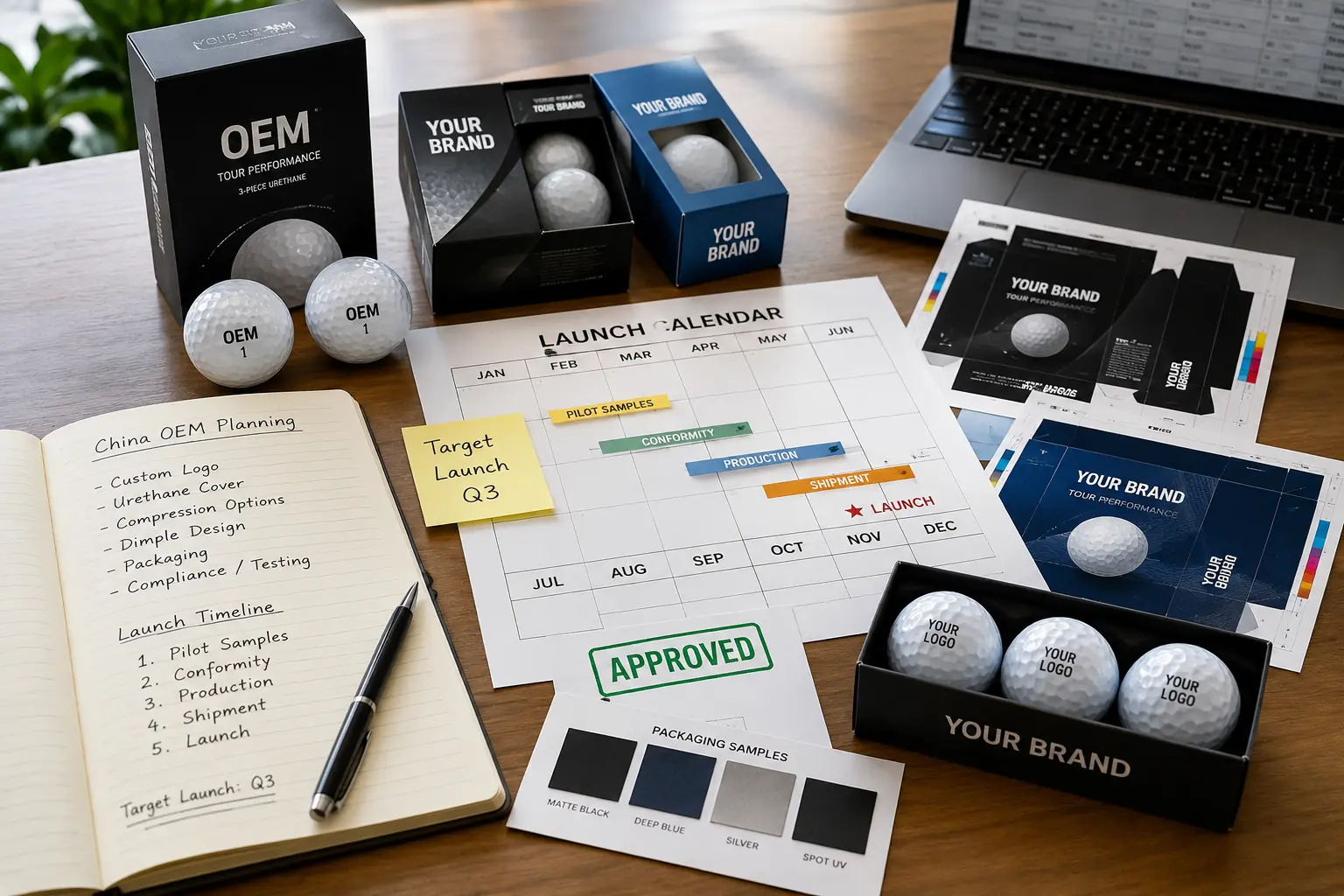
Why is February a black hole?
February is dangerous because official holiday, pre-holiday slowdown, post-holiday restart, and urgent spring demand can overlap. A January PO for an April premium launch is often too late.
For an April golf season launch, a new custom project should usually start in October or November of the previous year. That gives time to lock BOM, logo, USGA needs, packaging direction, pilot samples, packaging proofs, production slot, curing, PSI, and cargo-ready timing before the holiday pressure hits.
Request a factory holiday and peak-season slot plan. Confirm paid-deposit priority, packaging slot, PSI slot, and latest cargo-ready date. Do not schedule launch campaigns through CNY or Q4 without a written backup plan.
✔ True — Peak season is a stacked risk.
Factory queues, packaging approvals, inspection slots, freight cutoffs, and last-mile timing can all tighten at the same time.
✘ False — “A January PO can safely support every April launch.”
For many first custom programs, CNY, USGA timing, packaging, production, and shipping buffers make January too late.
How do you reverse-engineer the launch?
You need a practical calendar that tells you when to approve samples, submit USGA, lock packaging, start mass production, and choose split-shipment.
Reverse-engineer your golf ball launch from the shelf date, not the factory quote. For an April U.S. launch, a new custom China OEM program should often start in October or November, with pilot approval, USGA timing, packaging, production, curing, PSI, cargo-ready, and split-shipment planned backward.
Start with the immovable date: retailer shelf, tournament, media embargo, club drop, preorder promise, or influencer release. Then work backward through delivery, shipping, cargo-ready, PSI, curing, packaging, production, USGA timing if needed, pilot approval, and sample development. If any gate is undefined, your launch date is not protected yet.
| Target timing | Launch task | What must be locked | If skipped |
|---|---|---|---|
| Prior Oct | Lock BOM/logo/packaging direction | Construction + channel claim | CNY risk rises |
| Nov | Pilot + USGA sample prep | Sample ID + markings | Listing slips |
| Nov–Dec | Packaging parallel approval | Dieline + colors | Box trap |
| Dec–Jan | Mass + coating + curing + PSI | Curing hold + QC | Wet chemistry risk |
| Jan end | Cargo-ready before CNY | Cartons + docs | Blackout delay |
| Mar | Warehouse / split delivery | Main lot + rescue batch | No launch stock |
| Apr | Retail / media launch | Inventory + claims | Marketing without product |
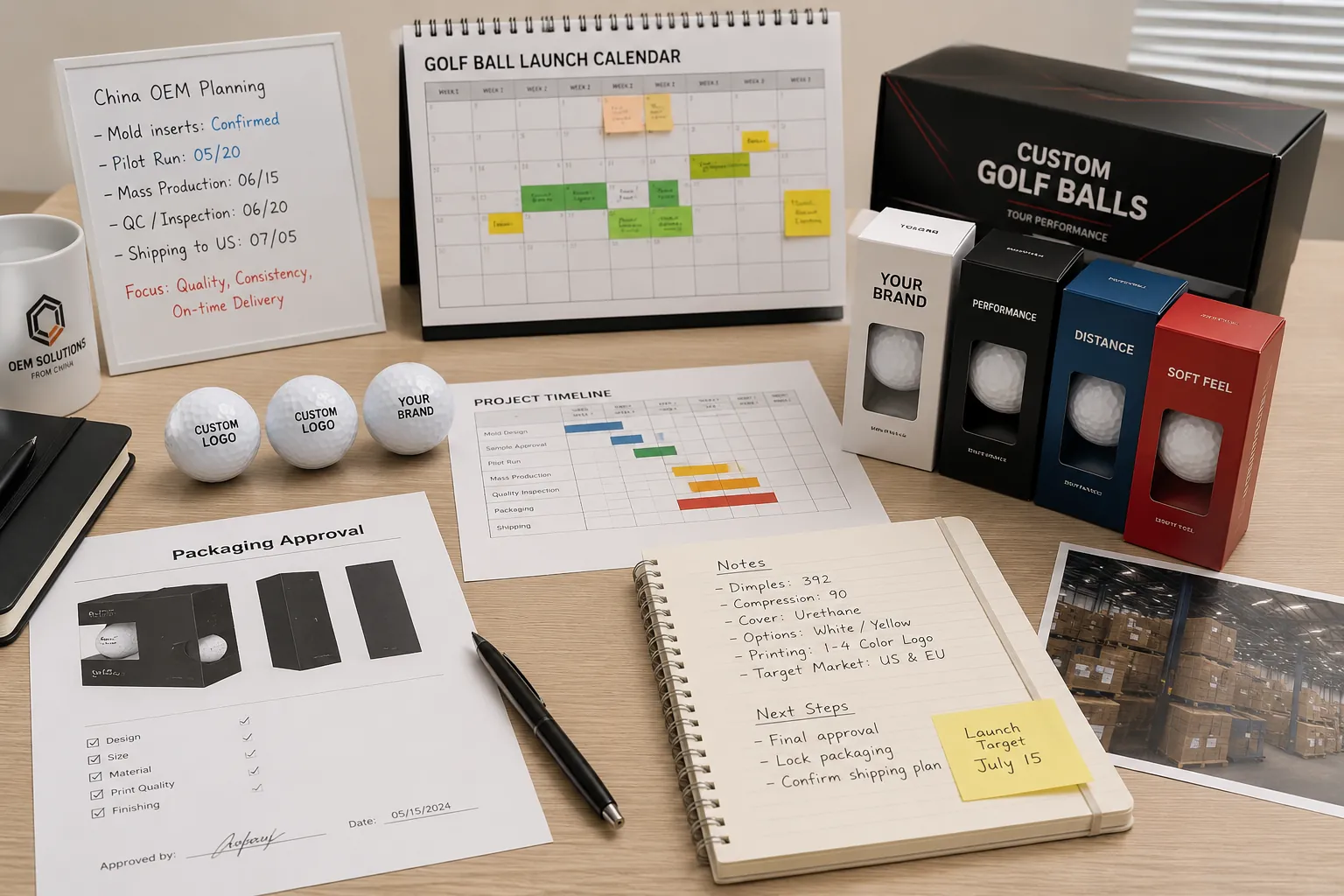
When should split-shipment trigger?
Split-shipment should trigger when the launch date cannot move but product quality gates cannot be compressed. Air or express should rescue momentum, not replace discipline.
For DTC launches, a small rescue batch can protect media reviews, influencer kits, first retailer fill, sales samples, or early preorder customers. Send 100–500 dozen by express or air when the calendar requires it, then let the main lot move by sea. That is different from forcing the factory to pack before curing or skip PSI to hit a freight cutoff.
Ask the supplier to provide one launch calendar showing pilot approval date, USGA sample shipment date, target publication month, packaging dieline approval date, CMYK/Pantone approval date, mass production start, coating/curing hold, PSI date, cargo-ready date, split-shipment trigger, and final delivery milestone.
Request a reverse launch calendar and split-shipment trigger plan. Confirm rescue batch quantity, cargo-ready date, express handoff, air freight handoff, ocean main lot, and delivery milestones. If launch date is at risk, split shipment instead of shortening curing, PSI, packaging QC, or compliance checks.
FAQ
How long does it take to manufacture custom golf balls in China?
For existing mold and formula programs, sampling often takes about 10–15 days and mass production about 30–45 days. With packaging, curing, PSI, freight, and delivery, a first custom launch often needs about 90–110 days of planning.
Add 25–35 days if new tooling or a new dimple pattern is needed. Start packaging while pilot balls are being approved. Define cargo-ready and delivered separately, because factory lead time and launch-ready inventory are not the same clock. Your real launch plan should include sample approval, artwork, packaging, curing hold, PSI, shipping mode, and warehouse receipt.
How long does USGA golf ball testing take?
Plan a 4–6 week buffer at minimum, and more if courier time, submission windows, publication dates, or retesting could affect the launch. The Conforming Golf Ball List updates on the first Wednesday of each month.
Submit from the representative pilot batch. Use the Pinehurst, NC Test Center details from current guidance. Do not print compliance claims or promise tournament-ready retail until the exact model appears on the current List. The USGA clock should run while China production and packaging are moving, not after mass production is complete.
Why is my golf ball shipment from China delayed?
The delay is often not the molding line. Common blockers include custom packaging approvals, coating/curing hold, PSI booking, Chinese New Year or Q4 queues, missed freight cutoffs, and unclear cargo-ready definitions.
Check packaging status first. Confirm curing and PSI release. Ask for a milestone owner by step: factory, packaging vendor, inspection team, forwarder, broker or agent, and last-mile delivery party. If the supplier only says “in production,” ask what still blocks cargo-ready status.
How early should I order golf balls for a spring launch?
For a new April launch, start in October or November of the previous year when custom packaging, USGA timing, or new tooling is involved. January is often too late because of CNY and production restart risk.
Lock BOM and logo early. Avoid February emergency starts. Use split-shipment only as a rescue plan, not as a substitute for missing pilot approval, packaging approval, or curing time. Spring golf launches punish late decisions because factory, packaging, compliance, and logistics pressure often collide.
Can I speed up a golf ball order by skipping curing time?
No. Premium urethane and clearcoat systems need a no-pack hold based on coating stack, humidity, temperature, adhesion or rub checks, and QC release. Compressing curing can cause sticking, scuffing, or finish failure.
Do not pack wet chemistry. Use an air rescue batch if the date is fixed. Write the curing hold into the PO so nobody turns a launch panic into a product defect. Golfara would rather split the shipment than pack premium coated balls before the surface is ready.
What delays custom golf ball packaging?
Color boxes, sleeves, UV, foil, emboss, Pantone/CMYK proofing, dielines, barcodes, carton labels, and retailer requirements can delay the launch if packaging starts after balls are produced.
Approve dielines in parallel with the pilot. Use neutral packaging for early internal samples when needed. Hold compliance wording until listing status is confirmed, so you do not print boxes that cannot be used. Packaging is not decoration in a launch calendar; it is a production workstream.
When should I use air freight or express?
Use express for small urgent rescue batches when door-to-door speed matters most; use air freight for a controlled rescue lot when you need more volume but still cannot wait for sea. Keep the main lot by ocean when the timeline allows.
Express can protect media kits, reviewer samples, early preorders, or first retailer fill. Air freight can protect a larger but still selective launch batch. Define the trigger before PO, including rescue quantity, handoff date, delivery milestone, and who approves the split.
What should a launch calendar include?
A usable launch calendar should show pilot approval, USGA sample shipment if needed, packaging approval, mass production, curing hold, PSI, cargo-ready, split-shipment trigger, and final delivery milestone.
Assign an owner per step. Use one clock across supplier and buyer. Update the calendar after any construction, coating, marking, packaging, quantity, or delivery milestone change. A launch calendar is not a pretty schedule; it is the control document that protects your sell-in date.
Conclusion
Launch reliability starts with a reverse calendar, not a production quote. A China golf ball OEM launch should lock sampling, USGA timing if needed, packaging, curing, PSI, cargo-ready, shipping, and delivery milestones before marketing spend goes live.
When time is tight, split shipment. Do not compress chemistry, skip PSI, rush packaging approval, or print compliance claims before the model is ready. Your customers will only see whether inventory arrives on time, performs correctly, and is ready to sell.
You might also like — What’s the True Landed Cost When Importing Golf Balls from China (DDP Guide)?