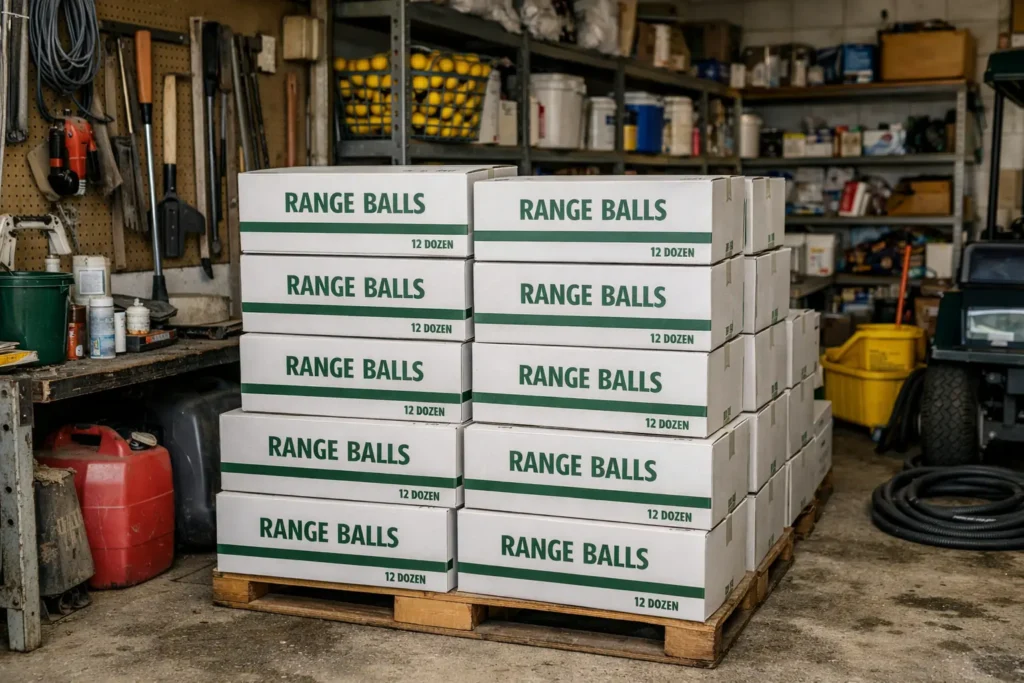
A full storage room can feel safe while quietly trapping cash, aging stock, and slowing every correction.
Micro-batch range ball sourcing can free cash flow when it replaces one large annual bulk order with smaller, scheduled replenishment lots tied to a stock window, reorder point, DDP route proof, lot-linked QC, and receiving inspection. It is planned replenishment, not low-stock gambling.
For a driving range, club, academy, or golf entertainment venue, the real question is not “How many range balls can we stack?” It is “How much working capital should sit in cartons before those balls are actually used?”
Use this guide to compare annual bulk buying and micro-batch replenishment by average inventory, inventory carrying cost, cash tie-up, stock age, reorder timing, DDP visibility, quality continuity, and receiving discipline.
What cash is trapped by annual bulk buying?
You may believe the annual bulk order is cheaper because the unit price is lower, but your facility may be locking working capital into idle stock.
Micro-batching does not have to beat annual bulk buying on unit price; it has to beat it on average inventory, cash lockup, stock age, and correction speed. Your team should compare working capital, inventory carrying cost, storage exposure, and emergency-buy risk before calling a bulk range-ball order cheaper.
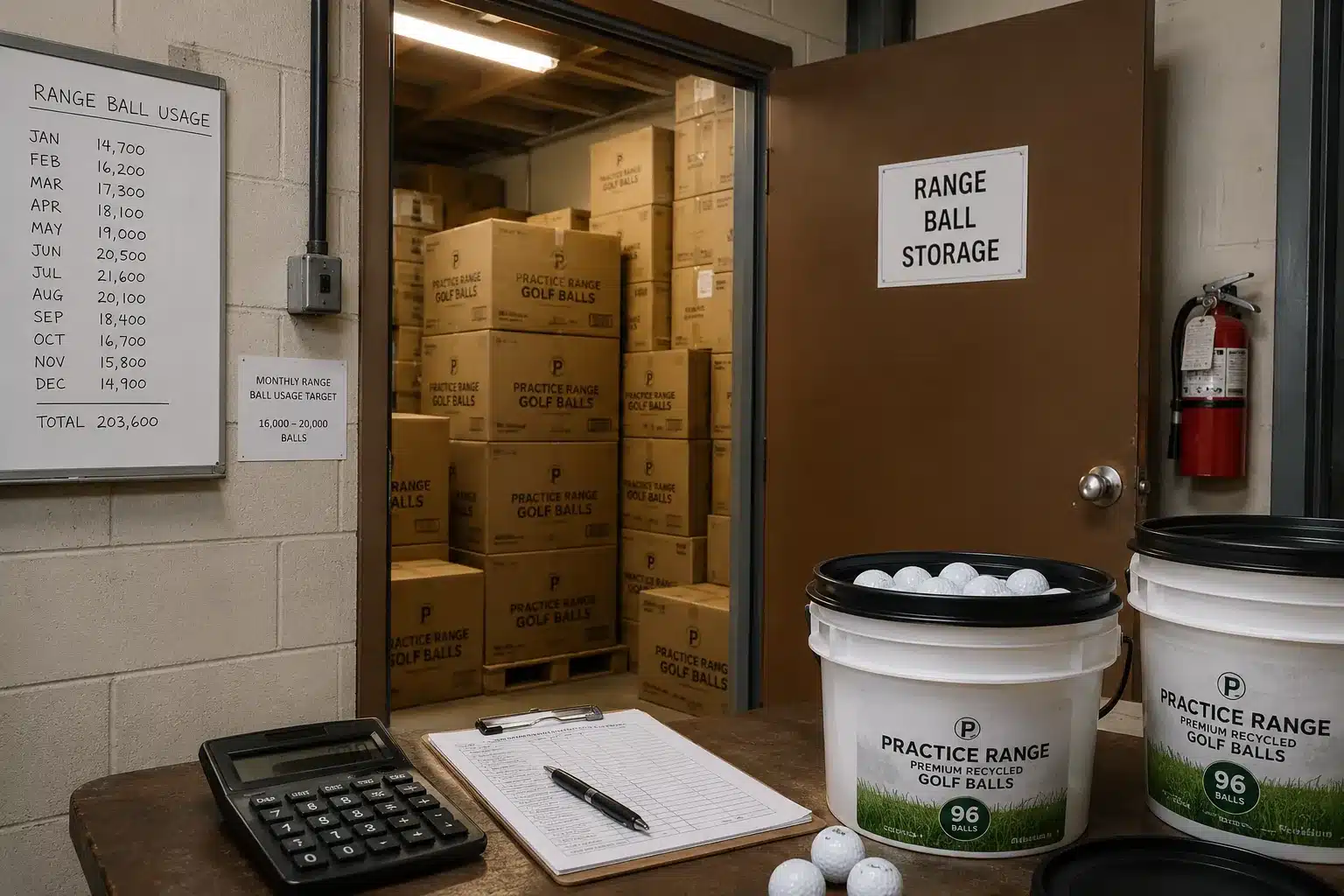
Range-ball replenishment is a high-frequency operating problem, not a one-time buying event. In 2025, U.S. courses recorded more than 500 million rounds for the sixth straight year, which is useful context for why commercial range balls should be treated as working inventory, not a once-a-year supply chore. NGF 2025 rounds context
Annual buying feels safe because the risk it solves is visible: nobody wants to open spring short on driving range balls. The quieter risk is financial. Inventory carrying cost can include capital tied up in stock, storage, insurance, taxes, handling, shrinkage, deterioration, and obsolescence. ISM notes there is no single consensus benchmark, even though many companies use planning ranges and then improve from their own baseline. inventory carrying cost
Use two simple formulas before you praise the bulk discount:
Annual Inventory Carrying Cost = Average Inventory Value × Carrying Cost Rate
Average Inventory Value = (Opening Inventory Value + Ending Inventory Value) ÷ 2
Inventory-cost guidance often groups carrying cost into capital, storage, service, and risk categories. That framework fits range balls well: a carton stored for six months still consumes cash, space, rotation attention, and correction flexibility even if nobody touches it. inventory carrying cost categories
| Pain/decision | Annual bulk model | Micro-batch model | Action/evidence |
|---|---|---|---|
| Opening cash outlay | High upfront spend | Smaller replenishment spend | Model first-order burden |
| Average inventory | Higher midpoint stock | Lower stock window | Calculate carrying cost |
| Storage exposure | Longer local dwell | Shorter local dwell | Set max stock age |
| Correction speed | Slow next-season fix | Faster next-batch fix | Review cadence |
| Forecast error | Large wrong bet | Smaller adjustment loop | Track usage monthly |
| Emergency buy risk | Hidden if forecast fails | Managed by trigger | Set reorder point |
A full storage room with weak reorder certainty is a failure signal. It means your team has solved the emotional problem of seeing stock, but not the operational problem of knowing when, how, and under what evidence the next replenishment batch arrives.
✔ True — Bulk buying can reduce one risk while increasing others
A large order can reduce stockout fear, but it may increase cash tie-up, stock age, storage exposure, and the cost of correcting a wrong quality or usage assumption.
✘ False — “A lower unit price automatically means lower annual cost”
The annual bulk model wins only if it still wins after carrying cost, storage burden, aging risk, emergency reorder risk, and correction speed are included.
That inventory decision is only one part of the economics. To compare replenishment with usable life, rejects, sorting, washer burden, and other operating costs, use the same driving range ball cost framework.
Average inventory, not unit price?
Your team should compare how much cash stays asleep, not only what each ball costs.
Build a cash-flow model with average inventory value, carrying-cost rate, storage burden, stock age, and emergency reorder risk. Compare it against last season’s range-ball usage, reject rate, reorder timing, and storage history.
Do not approve annual bulk buying unless it wins after carrying cost and correction speed are included.

When does micro-batch sourcing make sense?
You may worry that smaller range-ball orders create stockout risk, but weak planning causes stockouts, not micro-batching itself.
Micro-batch sourcing makes sense when your facility defines a stock window, reorder cadence, lead-time buffer, safety stock, and next-order trigger before the season starts. The goal is not to run lean blindly; it is to refill commercial range balls against real usage and real quality evidence.
Micro-batch range ball sourcing is planned replenishment, not understocking. A weak program buys smaller quantities late and hopes. A strong program defines how many balls should be available locally, when the next order should trigger, and how much buffer protects spring opening, tournament weeks, academy camps, and unexpected reject spikes.
Use these working formulas:
Reorder Point = Average Monthly Consumption × Supplier Lead Time in Months + Safety Stock
Safety Stock = Peak-Season Buffer + Delay Buffer + Reject/Sorting Buffer
Your reorder cadence should be based on ball life, not only MOQ. Range-operator guidance describes performance and durability as the two most important factors when choosing practice balls, and longer ball life can reduce seasonal cost. That means your micro-batch plan should track monthly usage, rejects, visible coating wear, logo loss, cracking, coach feedback, and guest comments before deciding whether the next lot should move earlier, later, or change specification. range ball durability
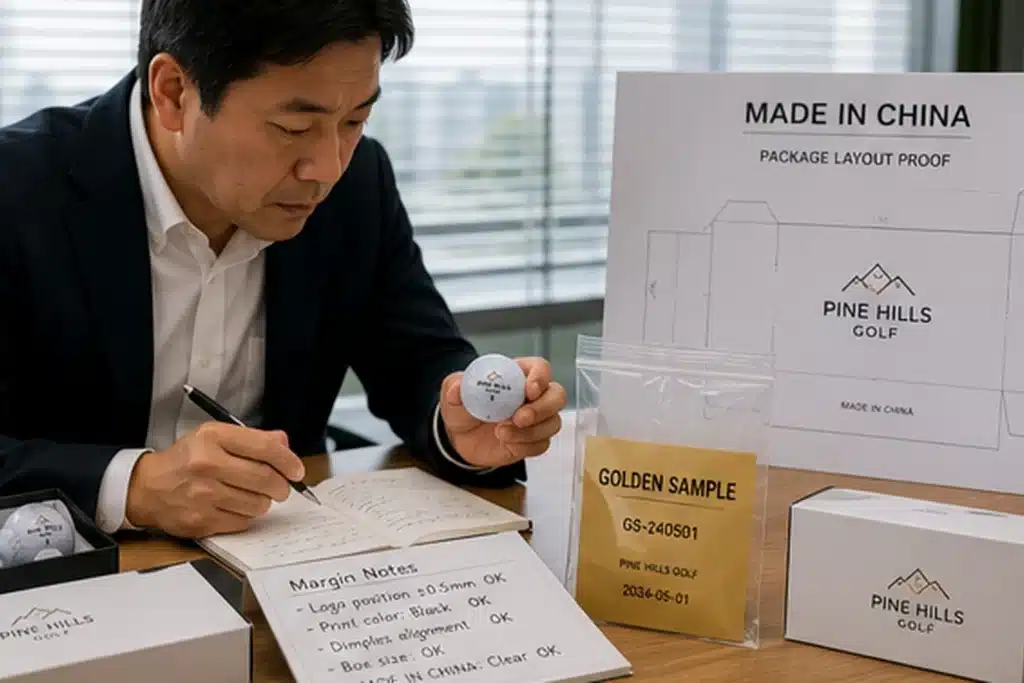
The first micro-batch should validate the operating rhythm. It should prove supplier response, sample-to-bulk consistency, route timing, receiving discipline, and practical stock-window math. It is not just a smaller PO; it is the first test of whether your replenishment system can breathe without panic.
Create a replenishment plan with stock window, monthly consumption, reorder point, safety stock, and review cadence. Test it against your peak-season months, academy camps, tournament weeks, and known supplier lead time. Do not start micro-batching until the next-order trigger is written before inventory gets thin.
Stock window, cadence, reorder triggers?
Your facility can buy smaller only when your reorder trigger is stronger.
A serious range buyer should reduce average inventory without increasing stockout exposure. That means the local stock window must be deliberate: enough balls awake for daily operations, not a full season of cash asleep in cartons.
Write the stock window, reorder point, safety stock, and monthly review date before the first micro-batch range ball sourcing program starts.
How does DDP change replenishment planning?
You may want DDP because import handling feels risky, but DDP only helps cash-flow planning when the supplier can show route milestones and responsibility proof.
DDP reduces handoff uncertainty; it does not replace replenishment planning. Your team still needs a stock window, reorder trigger, receiving inspection, and batch acceptance rule, while the supplier should show named place, route milestones, clearance proof, and final-mile evidence.
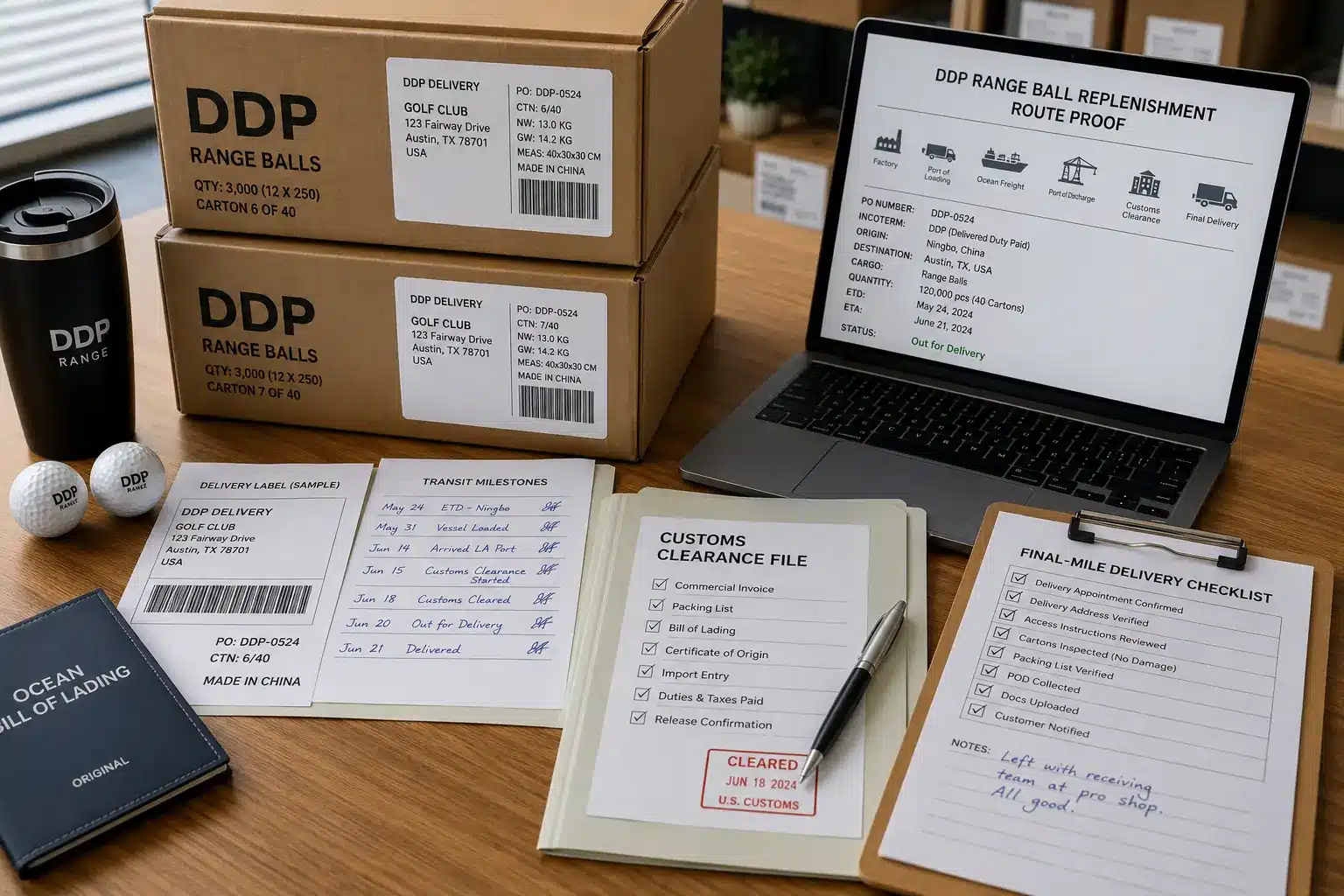
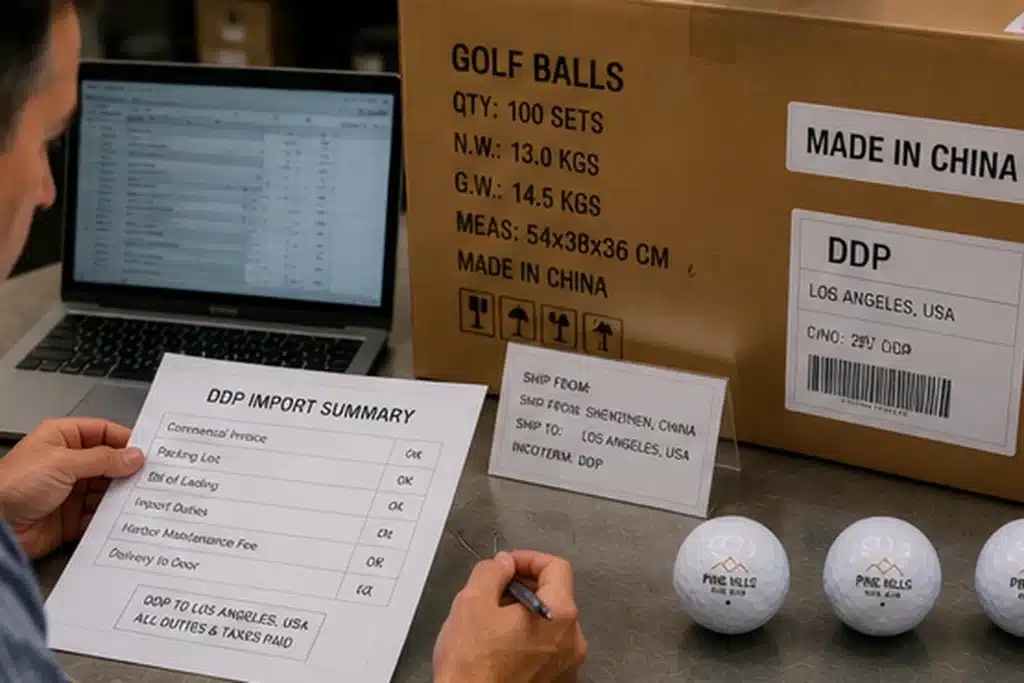
DDP, or Delivered Duty Paid, can reduce import complexity by moving duty handling, import clearance, and final delivery responsibility into the supplier’s service model. That can help a driving range owner, golf club GM, or logistics coordinator plan replenishment with fewer handoff surprises.
But DDP is not magic. International delivery terms clarify the tasks, costs, and risks assigned to buyers and sellers; they do not decide your stock window, reorder point, receiving inspection, or QC acceptance rule. Incoterms guidance
For range-ball replenishment, DDP should show route proof. Ask for the named place, production-ready date, pickup window, main transit route, import clearance responsibility, final-mile plan, proof-of-delivery logic, exception rule, and route-change rule. Your route file should help your team answer a practical question: does this lane fit our reorder trigger and safety stock?
| Pain/decision | DDP should clarify | What it does not decide | Action/evidence |
|---|---|---|---|
| Import anxiety | Named place/responsibility | Stock window | Request DDP proof pack |
| ETA confusion | Route milestones | Reorder point | Separate lead time |
| Clearance worry | Duty/clearance plan | QC acceptance | Review documents |
| Final-mile risk | Delivery proof | Receiving pass/fail | Ask for POD logic |
| Route change | Exception rule | Inventory strategy | Require buyer review |
Supplier offers DDP but cannot show route proof is a failure signal. A DDP proof pack should include named place, route plan, cost components, clearance proof, final-mile evidence, and exception ownership. Check whether the route timeline fits your reorder trigger and safety-stock buffer.
✔ True — DDP is a responsibility and route-visibility tool
DDP can reduce import handoff uncertainty when the supplier shows named place, route milestones, clearance responsibility, and final-mile proof.
✘ False — “DDP means you can skip inventory planning or receiving checks”
DDP controls the delivery responsibility. Your team still controls stock window, reorder trigger, batch acceptance, and receiving release.
Route proof, not a freight promise?
Your DDP plan should make the route visible before your stock window becomes fragile.
DDP reduces handoff uncertainty; it does not eliminate quality risk. The shipment can arrive duty-paid and still fail receiving if the batch ID is missing, cartons are damaged, the retained sample does not match, or the QC summary is not tied to the shipment.
Keep DDP in its lane: route visibility and responsibility. Keep receiving inspection in yours.
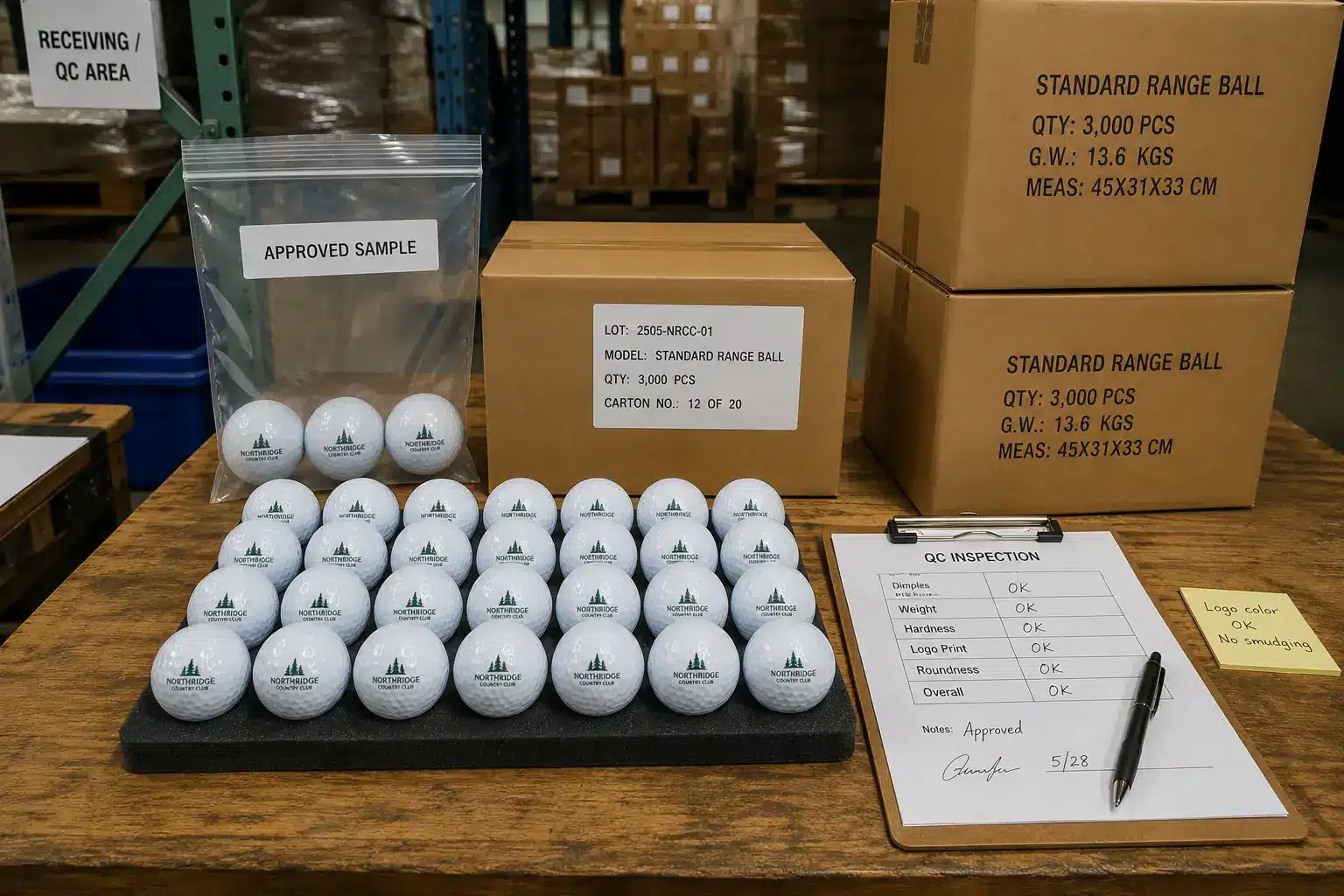
What makes low MOQ work without drift?
You may want low MOQ replenishment, but smaller lots become hard to control when every batch has new artwork, packaging, construction changes, or late approvals.
Low MOQ works best when the build is standard enough to repeat. Your team should use existing construction, standard white range balls, simple logo, ordinary packaging, approved sample, and lot-linked QC before treating micro-batch as safe.
Low MOQ range balls are realistic when the project reduces fixed setup pressure. Existing molds, standard white finish, simple one-color logo, ordinary packaging, and repeatable QC windows make smaller replenishment lots easier to run without turning every batch into a new development project.
Small and complex is still complex. A micro-batch with multi-color artwork, custom packaging, special flight requirements, late logo approval, and changing specs can be slower and riskier than a larger standardized order. The problem is not quantity alone. The problem is how many variables your team changes at the same time.
For range-ball programs, the print standard should be practical. Range balls need clear, durable, recognizable markings, reasonable cost, and stable volume execution. A simple one-color facility logo, range stripe, number, or “PRACTICE” mark is easier to repeat than gift-style artwork. The mark is not just branding; it helps sorting, property identification, and batch control.
Micro-batch sourcing works when your team standardizes the build, cadence, route proof, and receiving gate. Ask the supplier to identify which elements are standard, which elements add setup risk, and which elements raise MOQ or timeline. Check whether the proposed low-MOQ build uses the same mold, finish, logo method, packaging, and QC window across batches.
Do not call a small order micro-batch ready if it changes construction, artwork, packaging, or acceptance rules each time.
Existing builds, simple print, lot-linked QC?
Your micro-batch should simplify the build before it simplifies the cash outlay.
A first replenishment batch should validate the rhythm, not showcase every customization idea at once. Start with the build that is easiest to repeat, easiest to inspect, and easiest to reorder. Add complexity only after the stock window, supplier response, route timing, and receiving checks prove stable.
How should you plan lead time and peaks?
You may think lead time means delivery date, but production readiness, dispatch, transit, clearance, final mile, and receiving buffer are different promises.
A micro-batch program needs reorder triggers, not emergency emails. Your team should separate production-ready date, transit time, delivery date, receiving buffer, and peak-season safety stock before each replenishment batch becomes urgent.
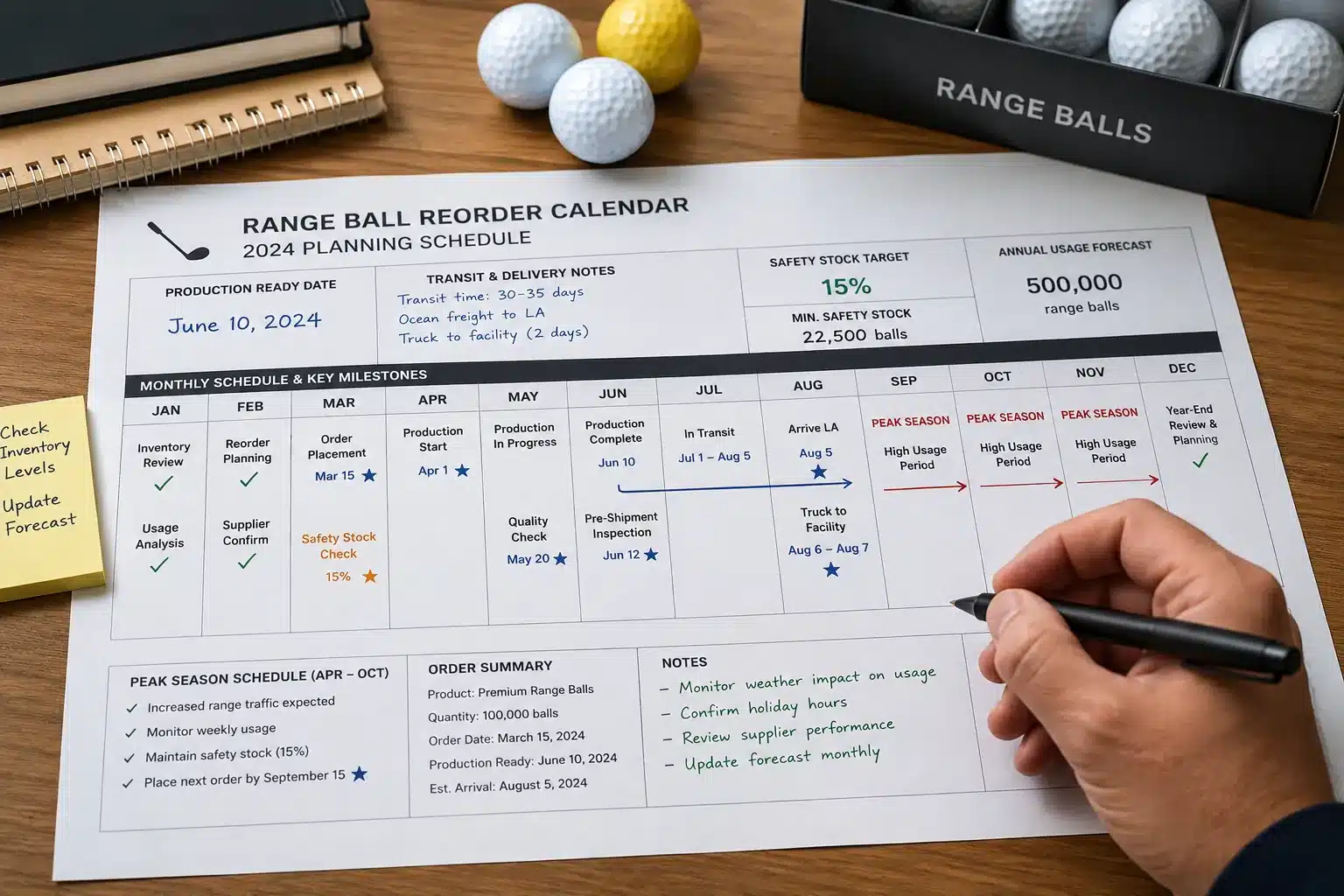
Lead time and delivery date are not the same promise. Production lead time usually starts after deposit received plus spec, logo, packaging, and artwork confirmation, not merely the PO date. Delivery date depends on route, mode, dispatch timing, clearance, final mile, and receiving availability.
That distinction matters for spring opening, tournament weeks, school breaks, academy camps, and holiday traffic. A small order placed late is not a controlled micro-batch. It is an emergency order wearing a nicer shirt.
Your reorder calendar should include production-ready date, dispatch date, transit mode, DDP route milestones, delivery date, receiving inspection window, and safety-stock buffer. It should also account for peak-season capacity. Small orders can still wait in line when the build is complex, proof approval is slow, or packaging is not ready.
| Pain/decision | Planning field | Risk if missing | Action/evidence |
|---|---|---|---|
| PO-date confusion | Lead-time start | False timeline | Define trigger |
| Late art approval | Artwork/spec lock | Production delay | Approve early |
| Peak season | Capacity buffer | Queue risk | Order earlier |
| DDP uncertainty | Route timeline | Hidden handoff | Check milestones |
| Receiving delay | Inspection window | Stock not usable | Add buffer |
| Emergency reorder | Reorder point | Costly rush | Trigger by stock |
Split shipment can help as a transition tactic, especially when your team is moving away from annual hoarding. But split shipment is not the same as a true micro-batch program. Split shipment may mean one larger production lot released in stages. A true micro-batch program uses usage data, reorder points, lot proof, and receiving rules to trigger each replenishment batch.
Request a reorder calendar showing lead-time start, production-ready date, dispatch date, transit mode, delivery date, and receiving-inspection window. Test the calendar against your monthly consumption, peak weeks, safety stock, and supplier capacity.
✔ True — Production-ready date and delivery date are different
A factory may finish production before your shipment reaches the named place. Your plan should separate approval, production, dispatch, transit, final mile, and receiving time.
✘ False — “A small order placed late is a controlled micro-batch”
Late small orders create rush risk. Controlled micro-batching uses reorder triggers before the local stock window becomes fragile.
Production-ready date, transit, delivery date?
Your reorder calendar should protect range operations before your storage room gets nervous.
Do not approve a replenishment cadence unless production lead time and delivery date are written separately. Also confirm whether any factory storage, split release, or staged pickup has a defined window, fee policy, and release schedule.
A micro-batch program fails when it becomes a series of late urgent emails. It works when your calendar triggers action before local inventory gets thin.
What should each micro-batch prove?
You may design a good micro-batch program, but it fails if each arriving lot enters circulation without lot identity, sample match, carton check, or QC continuity.
Receiving inspection protects the cash-flow logic of micro-batching. Each batch should prove lot ID, production date, retained-sample match, carton condition, logo/finish consistency, QC summary, and shipment-file continuity before your team releases it into circulation.
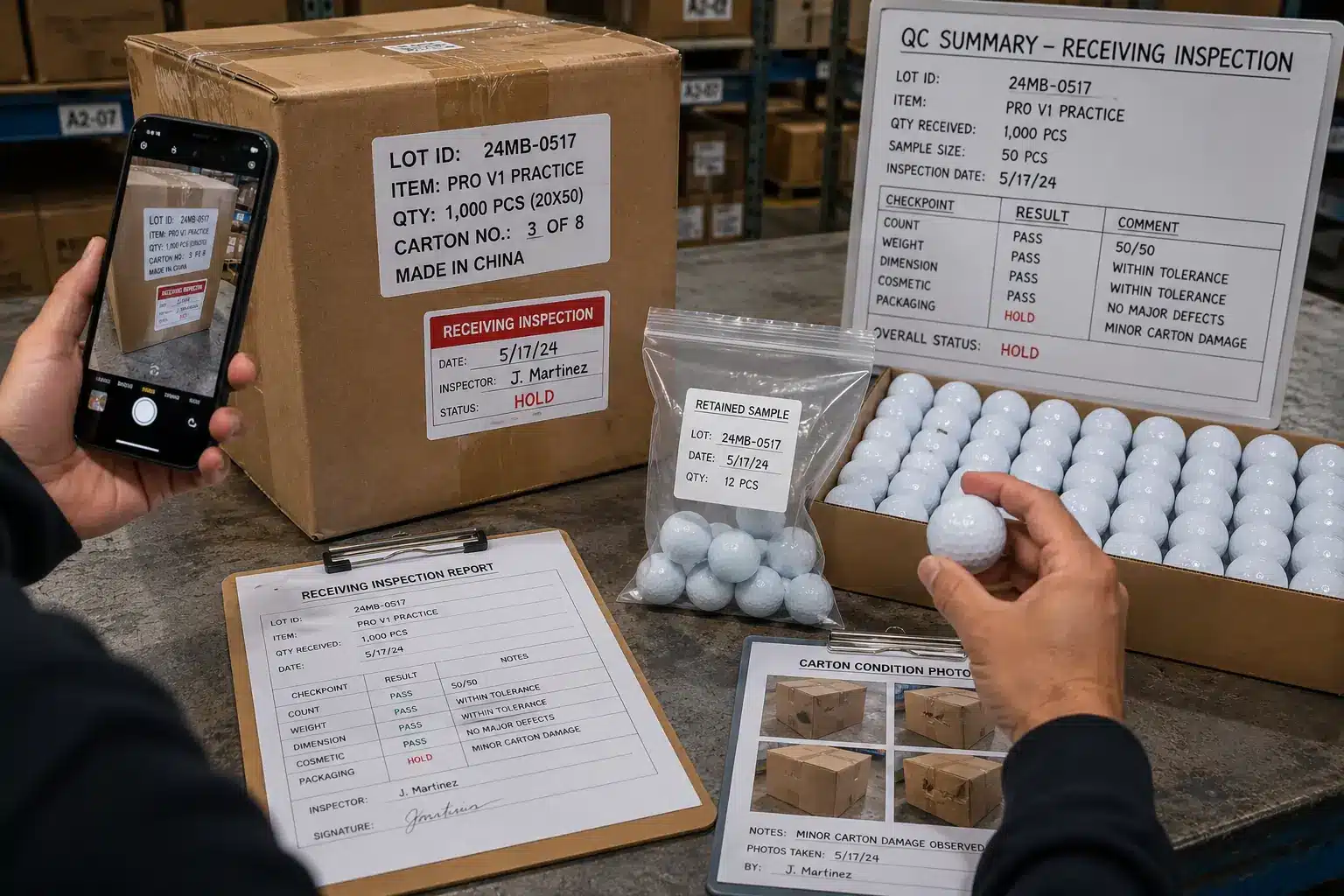
Receiving is where micro-batch range ball sourcing either stays disciplined or collapses into ordinary inventory. Every batch should be checked before it disappears into buckets, bins, and washer cycles.
Start with identity. Confirm lot number, production date, carton labels, packing list, DDP shipment file, and retained-sample reference. Then check condition: carton crush, moisture exposure, packaging integrity, logo/finish consistency, and any visible batch drift.
For first lots or higher-risk batches, request a 12-ball QC summary. Keep it focused: weight, diameter, compression spread, Shore hardness, average/range or standard deviation, equipment model, calibration status, and retained-sample ID. The point is not to turn receiving into a laboratory. The point is to keep each replenishment batch connected to the approved sample and the supplier’s production record.
Baseline golf ball rules provide useful boundary awareness for weight and diameter, including maximum weight and minimum diameter requirements, but this should remain a receiving reference rather than a rules-compliance section. R&A ball conformance categories
Hardness language should also be precise. ASTM D2240 is based on penetration of a specific indentor under specified conditions and is used for durometer hardness, so Shore hardness can help monitor material consistency. It is not the same as whole-ball compression. ASTM D2240
For receiving sampling, use AQL language rather than “check a few top cartons.” ISO 2859-1:2026 specifies AQL-indexed sampling schemes for inspection by attributes and is published as the current edition. For range balls, AQL categories can cover wrong markings, visible cracks, severe coating loss, carton damage, moisture exposure, and missing lot information. ISO 2859-1:2026
Ask the supplier to quote a micro-batch replenishment program with stock window, reorder trigger, DDP route proof, low-complexity build, lot-linked QC, production date, retained sample, carton condition check, receiving checklist, and split-release terms if factory storage is requested.
Supplier shall link each replenishment batch to approved sample, production date, batch ID, retained sample, 12-ball QC summary, carton labels, packing list, DDP shipment file, and receiving inspection record under one traceable micro-batch program.
Each small batch behaves like a new project with no retained sample is a failure signal.
Lot ID, retained sample, carton condition?
Your cash-flow strategy survives only if each arriving batch earns its place in inventory.
Request a receiving pack with lot ID, production date, retained sample, 12-ball QC summary, carton condition photos, and DDP shipment-file continuity. Compare delivered balls against the approved sample and lot-linked QC summary before the batch enters stock.
Each micro-batch shall be accepted only after receiving confirms lot ID, production date, carton condition, retained-sample match, logo/finish consistency, agreed basic QC summary, and no shipment-file discontinuity before the balls enter circulation.
Hold receiving if batch ID, retained sample, carton condition, QC summary, or shipment-file continuity is missing.
FAQ
How many range balls should your facility keep on hand?
Use your monthly consumption, lead time, reject rate, and safety stock instead of a universal number. The right stock window is enough to avoid disruption without trapping a full season of cash.
Track balls used per month, monthly rejects, peak events, delivery lead time, and receiving time. Then add safety stock for spring opening, academy camps, tournament weeks, and delay risk. A country club, public range, academy, and entertainment venue may all need different local stock windows because their usage rhythm and guest standard differ.
How often should you reorder range balls?
Reorder when inventory reaches the trigger point, not when the storage room feels empty. The trigger should combine average consumption, supplier lead time, safety stock, and upcoming peak demand.
Separate production-ready date from delivery date. Advance orders before spring, tournament, or holiday peaks. After each receiving review, adjust the next cadence based on actual consumption, reject rate, delivery reliability, and quality consistency.
Is annual bulk buying cheaper than micro-batch sourcing?
It can be cheaper on unit price, but not always on cash flow. Compare average inventory, carrying cost, storage burden, aging risk, emergency buys, and correction speed.
Annual bulk buying may still win when demand is stable, storage is easy, cash is not constrained, and quality assumptions are already proven. Micro-batch sourcing becomes more attractive when cash tie-up, stock age, local storage, and slow correction are real costs for your operation.
What does micro-batch sourcing mean for range balls?
Micro-batch sourcing means smaller scheduled replenishment lots tied to usage, lead time, route proof, lot-linked QC, and receiving checks. It does not mean buying randomly or accepting weak stock coverage.
A good program defines cadence before ordering. It keeps the first build simple. It ties every batch to a retained sample and shipment file. Micro-batch sourcing is a replenishment system, not a last-minute scramble.
Does DDP make replenishment easier?
Yes, when the supplier can show route proof and final-mile delivery responsibility. DDP helps with handoff visibility, but it does not replace reorder triggers or receiving inspection.
Ask for named-place logic, route milestones, clearance responsibility, and final-mile delivery evidence. Then still check each arriving lot for batch identity, carton condition, retained-sample match, and QC summary. DDP controls the delivery path; it does not prove product continuity by itself.
Is split shipment the same as micro-batching?
No. Split shipment is usually one larger production or booking released in stages; micro-batching is a replenishment system based on usage, reorder points, lot proof, and receiving rules.
Split shipment can help as a transition tactic. It may reduce local storage pressure while your team tests a new cadence. But factory storage is finite, and fees or release windows may apply. Do not treat supplier storage as unlimited free warehousing.
Can low MOQ work for every range-ball type?
Not equally. Standard white 1-piece or 2-piece range balls are usually easier to replenish in smaller lots than complex multi-color, premium-packaged, or special-flight projects.
Use existing molds where possible. Keep logo and packaging simple. Validate limited-flight or floater needs separately because those projects may require different flight windows, materials, testing, and lead-time assumptions.
What should each micro-batch prove on arrival?
Each lot should prove identity, condition, and continuity before entering circulation. Receiving should confirm lot number, production date, retained-sample match, carton condition, QC summary, and shipment-file consistency.
Check carton moisture or crush damage. Compare the lot to the approved retained sample. Hold lots with missing batch proof. Receiving is the last gate that protects the cash-flow logic behind the entire micro-batch program.
Conclusion
Micro-batch range ball sourcing is not about buying less. It is about keeping less cash asleep while maintaining a controlled stock window, written reorder cadence, DDP route proof, lot-linked QC, and receiving checks for every replenishment batch.
Annual hoarding feels safe because the stock is visible. The cost is less visible: working capital trapped in cartons, older inventory, slower correction, and more local storage exposure than the range may need.
A better procurement question is simple: how little cash can your facility keep asleep while still staying reliably supplied? When your team controls reorder triggers, route proof, standard builds, and receiving checks, micro-batching becomes a disciplined cash-flow strategy instead of a low-stock gamble.
You might also like — Golf Ball OEM MOQ: The B2B Guide to Trial Orders & Sourcing