Volumetric weight in custom golf ball shipping is the billable weight created by carton size, not just the real weight of the golf balls.
Forwarders compare volumetric weight with actual gross weight and often charge by the higher chargeable weight. Custom sleeves, PET boxes, EVA inserts, display boxes, filler, and poor master-carton layout can raise shipping cost by increasing CBM even when golf balls are dense.
| Term | What it means | Buyer check |
|---|---|---|
| Actual weight | Real carton weight | Ask for gross weight |
| Volumetric weight | Carton space converted to kg | Request carton L × W × H |
| Chargeable weight | Billing weight | Compare actual vs volumetric |
| CBM | Total shipment volume | Confirm carton count |
| Final packaging | Real production pack-out | Requote after approval |
| DDP quote | Delivered price basis | Verify freight basis |
Use this guide to verify unit size, master carton size, pcs/carton, CBM, gross weight, volumetric weight, chargeable weight, quote divisor, and DDP quote validity before PO approval.
What Is Volumetric Weight in Golf Ball Shipping?
Your team may budget from ball weight, then discover the quote is driven by carton space after custom packaging is finalized.
Volumetric weight is the space-based weight of your packed cartons. In custom golf ball shipping, your team should compare it with actual gross weight because sleeves, PET boxes, EVA inserts, display boxes, and final carton layout can make the chargeable weight higher than expected.
Volumetric weight, also called dimensional weight in many shipping contexts, turns carton volume into a weight equivalent. That matters because air freight, express, and some DDP quote structures may bill the shipment by the higher of actual gross weight and volumetric weight. A compact bulk pack may stay close to actual-weight billing. A display pack with low carton density may not.
| Shipping term | Buyer meaning | What to request | Buyer move |
|---|---|---|---|
| Actual weight | Real carton weight | Gross weight | Compare with volume |
| Net weight | Product weight only | Ball and packaging NW | Do not use alone |
| CBM | Carton volume | Carton dimensions | Calculate shipment volume |
| Volumetric weight | Space converted to kg | Quote divisor | Check billing risk |
| Chargeable weight | Freight billing basis | Higher weight value | Confirm before DDP |
Your first deliverable should be an Estimated Packing List showing gross weight, net weight, CBM, volumetric weight, chargeable weight, carton count, and quote divisor. Recalculate volumetric weight from master carton dimensions and compare it with actual gross weight. DDP or air freight approval should require chargeable weight based on final packaging data, not concept packaging.
✔ True — Volumetric weight can decide the freight quote
A custom golf ball order can look weight-efficient but still bill by carton space if the final packaging creates too much volume.
✘ False — “Golf ball shipping cost always follows actual product weight”
Ball weight matters, but final carton size, pcs/carton, filler, and packaging layout can move the quote to volume-based billing.
Why Can Dense Golf Balls Become Volume Cargo?
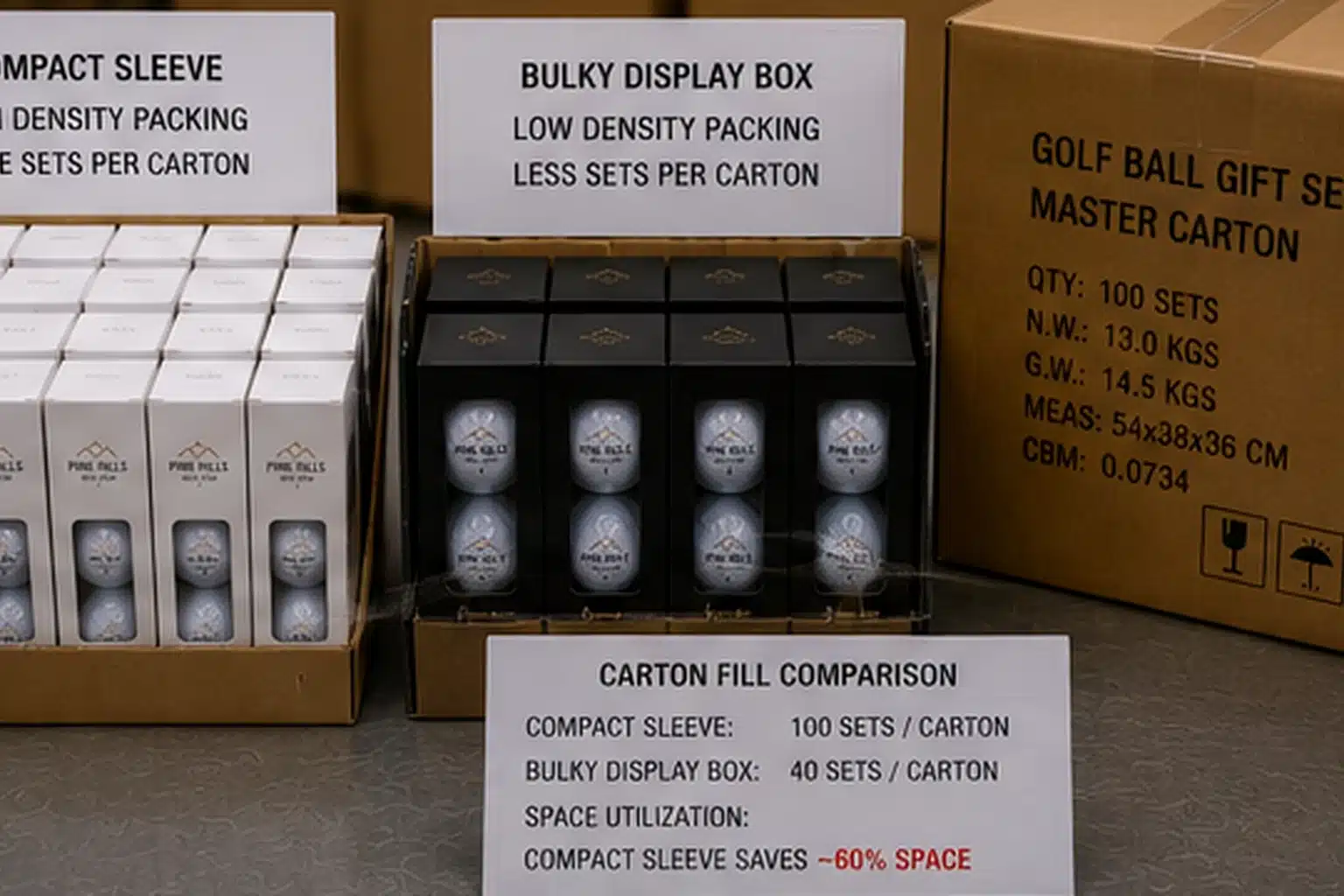
Your team may expect golf balls to ship efficiently because they are dense. That can be true for compact packing, but custom packaging can spread the same balls across more carton volume.
Golf balls are dense, but custom packaging can make the shipment bulky. Your team should not rely only on ball weight or dozen-box weight; it should verify final carton size, pcs/carton, volumetric weight, and chargeable weight after the real packaging layout is confirmed.
Actual weight, DIM weight, or chargeable weight?
Actual gross weight is what the packed carton weighs on a scale. Volumetric weight is calculated from carton dimensions. Chargeable weight is the freight basis your quote uses, often the higher of actual and volumetric weight.
Air cargo references commonly explain volumetric billing as a way to price aircraft space, not only shipment mass. An air cargo volumetric-weight reference describes the general volume ÷ 6000 approach and higher-of-actual-or-volumetric pricing, while a chargeable-weight calculation guide shows how shipment dimensions can be converted into a billable weight. Your team should still confirm the divisor in the actual quote.
| Weight type | What changes it | Why buyers miss it | Evidence to request |
|---|---|---|---|
| Ball-only weight | Ball count | Looks predictable | Product weight reference |
| Packed unit weight | Sleeve or box | Packaging added later | Unit pack weight |
| Carton gross weight | Carton and filler | Often estimated early | Actual carton GW |
| Volumetric weight | Carton size | Hidden until pack-out | L × W × H |
| Chargeable weight | Quote basis | Not split in DDP quote | Forwarder calculation |
A conforming golf ball must not weigh more than 1.620 ounces, or 45.93 grams, so ball-only weight is relatively predictable. That does not protect your freight budget when PET windows, EVA inserts, display spacing, thick paperboard, or oversized cartons increase volume. golf ball weight reference
Your deliverable is a final packaging weight comparison showing ball-only weight, packed unit weight, carton gross weight, volumetric weight, and chargeable weight. Freight quote approval should state whether actual or volumetric weight is driving the chargeable weight.
Which Packaging Details Increase DIM Weight?
Your design team may choose a package because it looks better in photos or retail display. Your logistics team needs to know whether that same package reduces pcs/carton.
Packaging details increase DIM weight when they reduce carton density. Your team should check whether PET windows, EVA inserts, thick board, magnetic lids, display spacing, or filler reduce pcs/carton and increase master carton CBM before confirming the final pack-out.
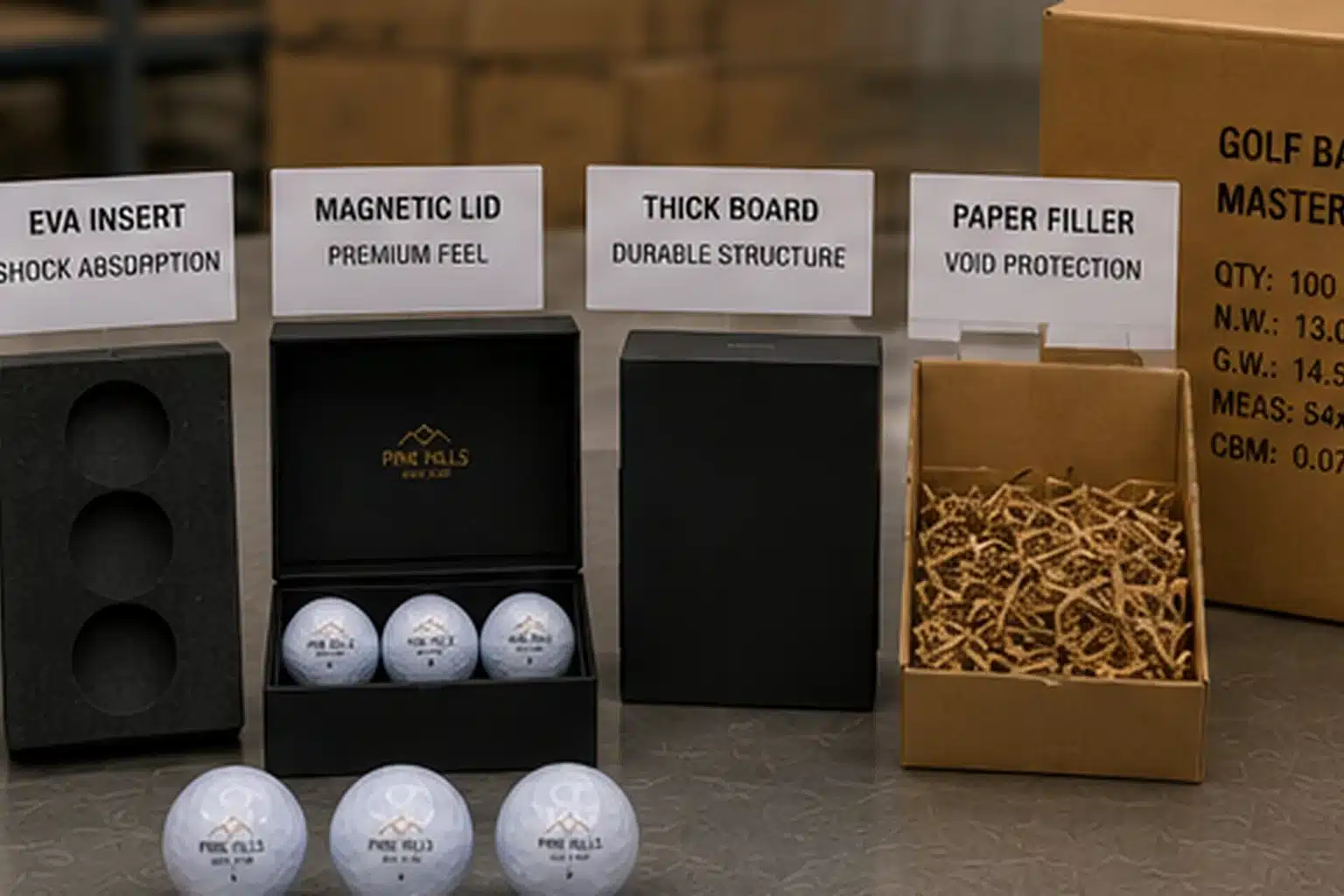
Sleeve, PET, EVA, or display box?
A sleeve, dozen box, PET window box, EVA insert, and magnetic display pack can all be valid choices. The freight risk comes from geometry, not the packaging name. A PET window may force a fixed display shape. EVA can add cushion and presentation space. Magnetic boxes can create rigid volume. Filler can quietly convert a neat sample into a poor master-carton layout.
| Packaging detail | DIM risk | Why it matters | Buyer move |
|---|---|---|---|
| 3-ball sleeve | Low | Packs tightly | Confirm pcs/carton |
| Dozen box | Low–medium | Depends on size | Check carton layout |
| PET window | Medium | Fixed display shape | Compare CBM |
| EVA insert | Medium–high | Adds void space | Check insert thickness |
| Magnetic box | High | Rigid volume | Recalculate freight |
| Filler space | High | Ships empty volume | Ask loading diagram |
Unit boxes fit poorly inside master cartons is a failure signal. Ask for a packaging DIM-risk comparison by unit size, pcs/carton, CBM, and chargeable weight. Compare at least two packaging options using the same order quantity. The final pack-out should be selected after chargeable weight comparison, not visual review alone.
✔ True — Packaging geometry matters more than the packaging name
A compact PET box may ship better than a loose paper box. The buyer should compare dimensions, pcs/carton, carton count, and chargeable weight.
✘ False — “All PET, EVA, or magnetic boxes have the same freight impact”
Freight impact depends on actual box dimensions, insert layout, carton loading, filler, and the divisor in the freight quote.
When Can Your DDP Quote Change?
Your supplier may give an early DDP quote before final packaging is confirmed. Once the real pack-out changes, the quote basis can change too.
Your DDP quote can change when final packaging changes the carton math. If the supplier quoted before unit size, pcs/carton, master carton dimensions, CBM, and chargeable weight were confirmed, your team should request a revised quote based on the final pack-out.
Sample pack or final pack-out?
A concept quote may use estimated box dimensions. A sample quote may use small sample packing. A DDP quote may bundle goods, packaging, freight, duty, tax, and destination handling without showing the freight basis. That makes it hard to see whether the quote is still valid after packaging changes.
| Quote stage | Common assumption | What may change | Buyer move |
|---|---|---|---|
| Concept quote | Estimated box | Unit size | Requote after dieline |
| Sample quote | Small sample pack | Carton layout | Ask production pack-out |
| DDP quote | Estimated freight | Chargeable weight | Confirm quote basis |
| PO approval | Final packaging | Carton count | Freeze pack-out data |
| Shipment booking | Forwarder rate | Divisor or surcharge | Reconfirm validity |
Final packaging changes after freight quote is a failure signal. Corporate gift deadlines and DTC launches often create pressure to approve packaging quickly, but that is exactly when your team needs the freight gate. A DDP quote is only as reliable as its packaging assumptions.
The PO should state that any change to unit package size, tray material, master carton size, pcs/carton, or packaging version requires a revised packing list and freight requote before production or shipment approval.
Your deliverable is a revised DDP or freight quote based on final packaging version and production pack-out. Match quote assumptions against unit size, master carton size, pcs/carton, carton count, CBM, volumetric weight, and chargeable weight. PO approval should require a freight quote based on final packaging, not estimated sample packaging.
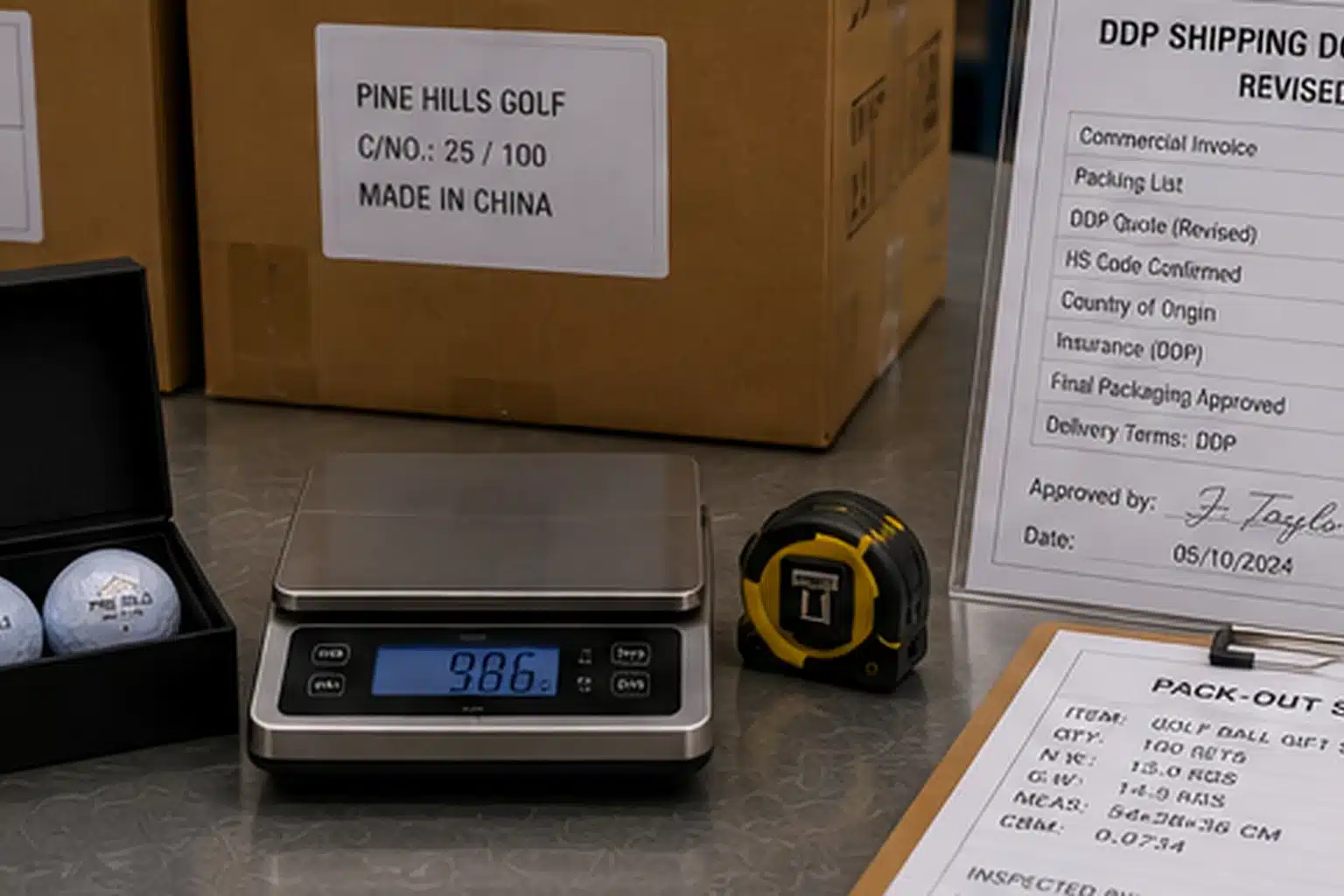
How Do You Compare Carton Efficiency?
Your packaging may look good at the unit level but fail at the carton level. That is where freight surprises like to hide.
Carton efficiency tells your team whether the final package uses space well. A nice-looking custom box can still increase volumetric weight if it lowers pcs/carton, creates filler space, or needs more master cartons for the same order quantity.
Units per carton or box beauty?
A box can look neat in a product render and still create awkward master-carton fit. If the unit box is slightly too wide, too tall, or too rigid, the supplier may reduce pcs/carton or add filler to stabilize the load. That increases carton count and total CBM.
| Carton factor | What it affects | Risk signal | Buyer move |
|---|---|---|---|
| Unit size | Carton fit | Awkward dimensions | Check layout |
| Pcs/carton | Carton count | Too few units | Compare options |
| Filler space | CBM | Bubble wrap gaps | Ask photo |
| Carton dimensions | Volumetric weight | Oversized cartons | Recalculate |
| Carton count | Total CBM | More cartons | Compare pack-out |
| Loading pattern | Density | No diagram | Request layout |
DTC launch teams often approve packaging before logistics data. Add a freight gate before DDP approval. Request a Master Carton Loading Diagram and pack-out photo. Compare carton efficiency for each packaging option using the same order quantity. Final packaging should show stable carton layout, acceptable pcs/carton, and no avoidable dead space.
✔ True — Carton layout can change chargeable weight
Even when the unit box looks unchanged, pcs/carton, filler space, and master carton dimensions can change total CBM.
✘ False — “A good-looking custom box is automatically a good shipping box”
A good shipping box must also pack efficiently, protect the product, and support a quote that matches the final pack-out.
What Should Your Shipping RFQ Include?
Your RFQ may ask for product price, packaging price, and DDP price, but miss the data that explains the quote.
Your shipping RFQ should force the supplier to show chargeable weight, not just DDP price. Ask for unit size, master carton size, pcs/carton, gross weight, net weight, CBM, volumetric weight, chargeable weight, divisor used, final packaging version, and quote validity.
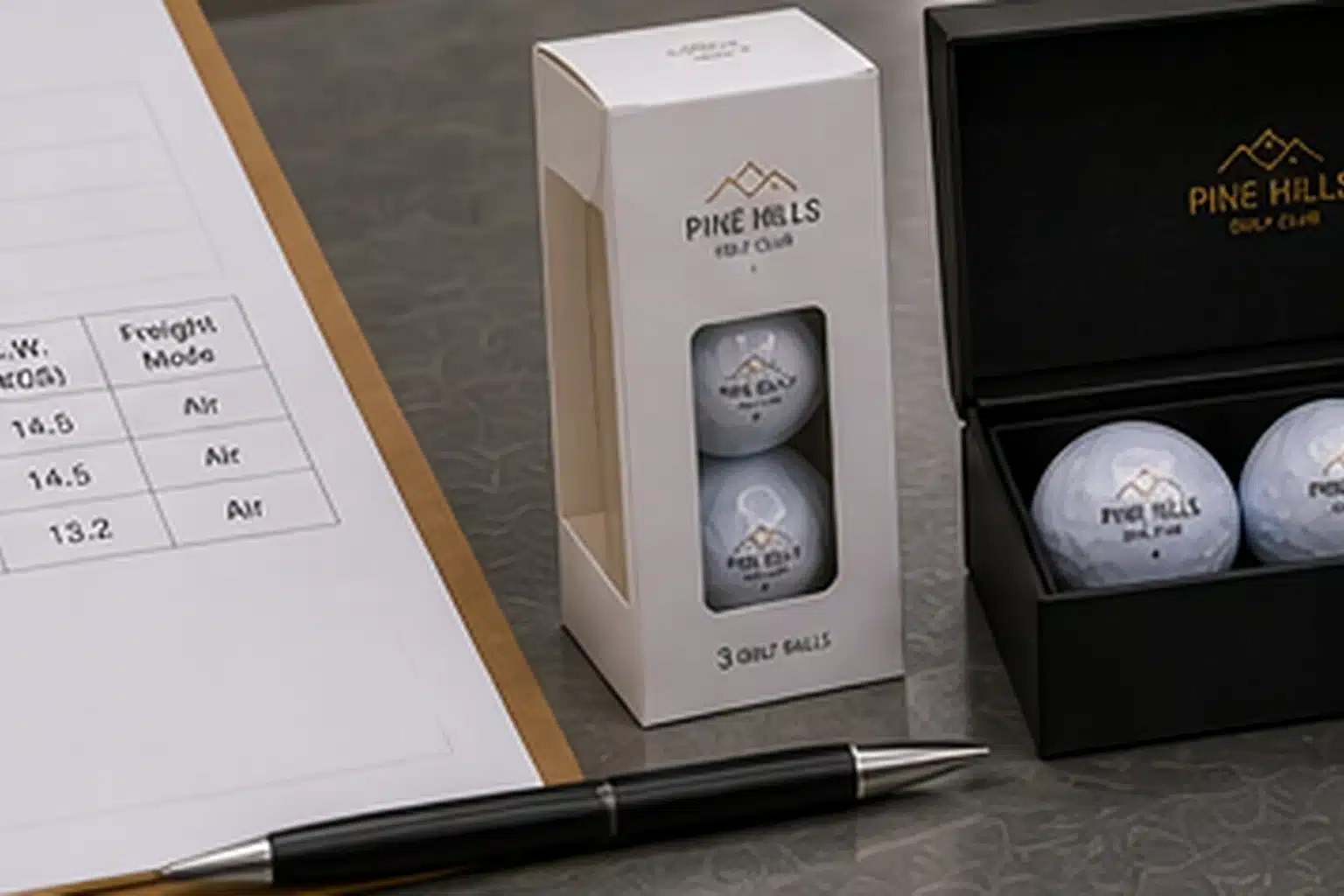
Unit size, carton size, or chargeable weight?
Supplier gives DDP price without chargeable weight is a failure signal. A DDP total may look complete but still hide whether freight is driven by actual weight or volumetric weight. Your team needs the freight basis behind the total.
| RFQ item | Why it matters | What to request | Acceptance evidence |
|---|---|---|---|
| Unit size | Sets carton fit | L × W × H | Final dieline |
| Carton size | Sets volume | Master carton L × W × H | Packing list |
| Pcs/carton | Sets density | Units per carton | Loading diagram |
| Gross weight | Actual weight | Carton GW | Weight record |
| CBM | Shipment volume | Carton CBM | Calculation |
| Volumetric weight | Space weight | Quote divisor | Formula shown |
| Chargeable weight | Billing basis | Higher value | Forwarder basis |
| Quote validity | Price control | Valid-until date | Written quote |
You can place this wording directly into your shipping RFQ:
“Please provide a shipping quote based on the final approved packaging version, including unit package outer dimensions, master carton dimensions, pcs/carton, carton count, gross weight, net weight, CBM, volumetric weight, chargeable weight, divisor used, master carton loading diagram, pack-out photos, DDP quote date, quote validity, and a written note confirming whether actual weight or volumetric weight drives the chargeable weight.”
Supplier shall provide the final packaging version ID, unit package outer dimensions, master carton outer dimensions, pcs/carton, carton count, net weight, gross weight, CBM, volumetric weight, chargeable weight, divisor used, pack-out photos, and master carton loading diagram before freight or DDP quote approval.
Shipping quote approval requires written confirmation that the freight estimate is based on the final approved packaging version and includes actual gross weight, volumetric weight, chargeable weight, quote divisor, DDP quote date, quote validity, and whether actual or volumetric weight drives the billing basis.
FAQ
What is volumetric weight in shipping?
Volumetric weight converts shipment volume into billable weight so forwarders can price the space your cartons occupy. For custom golf ball orders, it matters because packaging can make a dense product ship like bulky cargo.
Request carton dimensions, confirm the divisor, and compare volumetric weight with gross weight. The number is not just a logistics detail. It tells your team whether your final packaging still supports the quoted DDP, air freight, or landed-cost budget.
How is volumetric weight calculated for air freight?
It is commonly calculated from carton length, width, and height using the divisor shown in the freight quote. Some air freight references use a 6000 divisor, while express or carrier-specific quotes may use a different divisor.
Do not assume one divisor applies everywhere. Use final carton size, not sample carton size. Ask the supplier or forwarder to show the calculation so your team can verify chargeable weight before PO approval.
What is the difference between actual and volumetric weight?
Actual weight is what the carton really weighs. Volumetric weight is the space-based weight calculated from carton dimensions. Chargeable weight is often based on whichever value is higher.
Ask for both values before approving shipping. A compact order may bill by actual gross weight. A custom-packaged order with PET, EVA, display space, or poor carton layout may bill by volumetric weight.
What is chargeable weight?
Chargeable weight is the billing weight used in the freight quote, often the higher of actual gross weight and volumetric weight.
Request chargeable weight in writing and ask which weight drives the quote. Check it again after packaging changes. If a supplier gives only a DDP total, your team cannot tell whether the quote is based on actual weight, volume, or an outdated pack-out assumption.
Why did my golf ball DDP quote change?
Your golf ball DDP quote may change because final packaging changed unit size, pcs/carton, master carton size, carton count, CBM, or chargeable weight.
Requote after final packaging. Check quote validity. Compare assumptions line by line: unit size, master carton size, pcs/carton, gross weight, CBM, divisor, and chargeable weight. An early DDP quote should not survive a changed pack-out unchecked.
Does custom packaging increase shipping weight?
Custom packaging can increase actual shipping weight and volumetric weight, especially when it uses PET windows, EVA inserts, display spacing, thick board, magnetic boxes, or filler space.
Not all custom packaging creates the same penalty. Compare versions. Ask for a loading diagram. Calculate freight from final pack-out, not the render or sample idea. The best package supports both presentation and freight control.
How can I reduce dimensional weight?
Reduce empty space, improve pcs/carton, shrink unnecessary margins, revise inserts, and improve master carton layout.
Check unit size, carton layout, and filler use. Compare CBM before approval. A compact air-pack version may work for urgent launches, while larger display packaging can be reserved for planned shipments when timeline and margin allow.
What should I ask before approving custom packaging?
Ask for final unit size, carton size, pcs/carton, gross weight, CBM, volumetric weight, chargeable weight, quote divisor, pack-out photo, and DDP quote validity.
Do not approve from render alone. Request production pack-out data. Freeze the packaging version before the final quote. If the package changes, trigger a revised packing list and freight requote before PO confirmation.
Conclusion
Volumetric weight is a quote-verification tool, not just a logistics definition. It tells your team whether the final custom packaging still matches the DDP, air freight, or landed-cost budget.
Before you approve custom golf ball shipping, make sure the freight quote is based on final packaging, real carton dimensions, pcs/carton, CBM, gross weight, volumetric weight, and chargeable weight.
If your packaging changes the carton math, your DDP quote should change too. Better to catch that at the packaging approval gate than after your margin lands in the rough.
You might also like — How Much Does It Cost to Import Golf Balls from China?