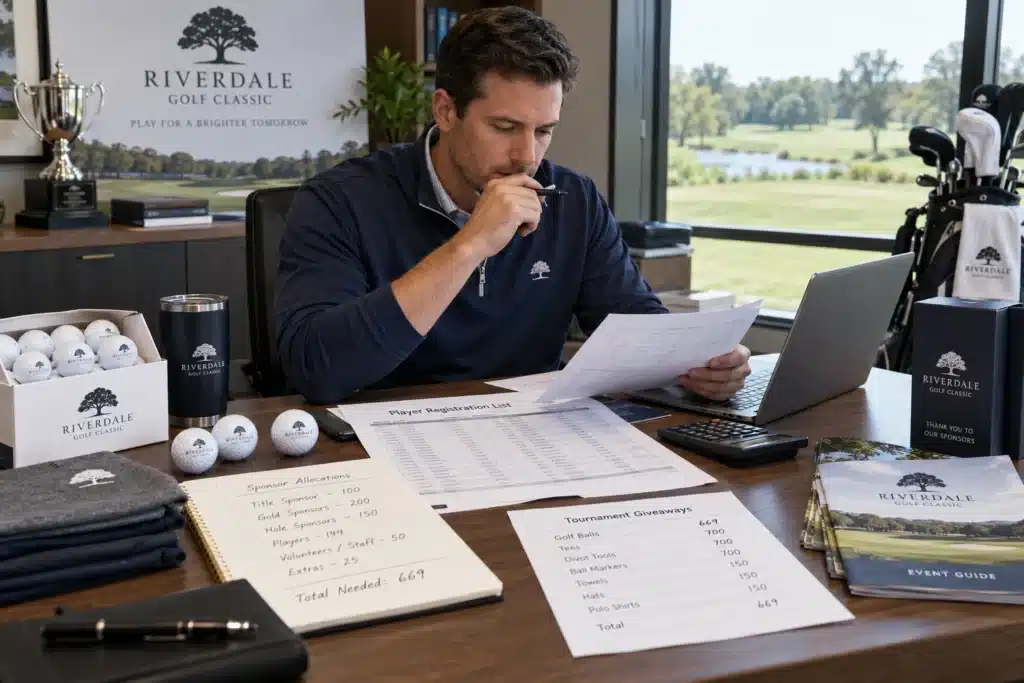
Your player count may be accurate and still leave your tournament short if sponsors, prizes, late registrations, or separate artwork versions were never included in the calculation.
There is no fixed number of custom golf balls a tournament needs. Calculate the player allocation first—confirmed players × balls promised per player—then add named sponsor, VIP, prize, and operational quantities. Split the result by ball or artwork version, then check each version against supplier MOQ and packing constraints.
Your player count is the starting point—not the purchase order. Player allocation is only one bucket in the final tournament quantity.
How should you calculate tournament ball quantity?
A player calculation can be mathematically perfect and still produce the wrong purchase order because golfers may be only one recipient group in your event plan.
Your final tournament order should be built from allocation buckets, not player count alone. Calculate the player commitment first, then add confirmed non-player recipients, contest and prize quantities, named operational allowances, and any approved reusable reserve before splitting the requirement by ball or artwork version.
Current tournaments show why a universal balls-per-player rule is weak. The 2026 PARMA Annual Golf Tournament specifies one sponsor-logo ball for each golfer. The GTSWCA Annual Golf Tournament specifies 72 dozen branded balls so 288 golfers each receive one three-ball sleeve.
Both are valid. Neither is an industry standard.
Use this planning structure:
Event Requirement = Player Allocation + Non-Player Allocation + Contest / Prize Allocation + Named Operational Allowances + Approved Post-Event Reserve
Then convert the Event Requirement into something a supplier can quote:
Event Requirement → Ball / Artwork Version Split → Packing Conversion → Supplier Constraint → Final Order Quantity
| Pain / decision | Buyer input | Calculation role | Do not assume | Buyer response |
|---|---|---|---|---|
| Player commitment | Players + promised unit | Player allocation | Players are the whole order | Calculate |
| Sponsor / VIP | Named recipients | Non-player allocation | Everyone is on roster | Add separately |
| Contests / prizes | Event plan | Prize allocation | Every event is identical | Add if used |
| Operations | Named use or risk | Allowance | Add a generic percentage | Define reason |
| Leftovers | Reuse value | Post-event reserve | More is always safer | Approve or omit |
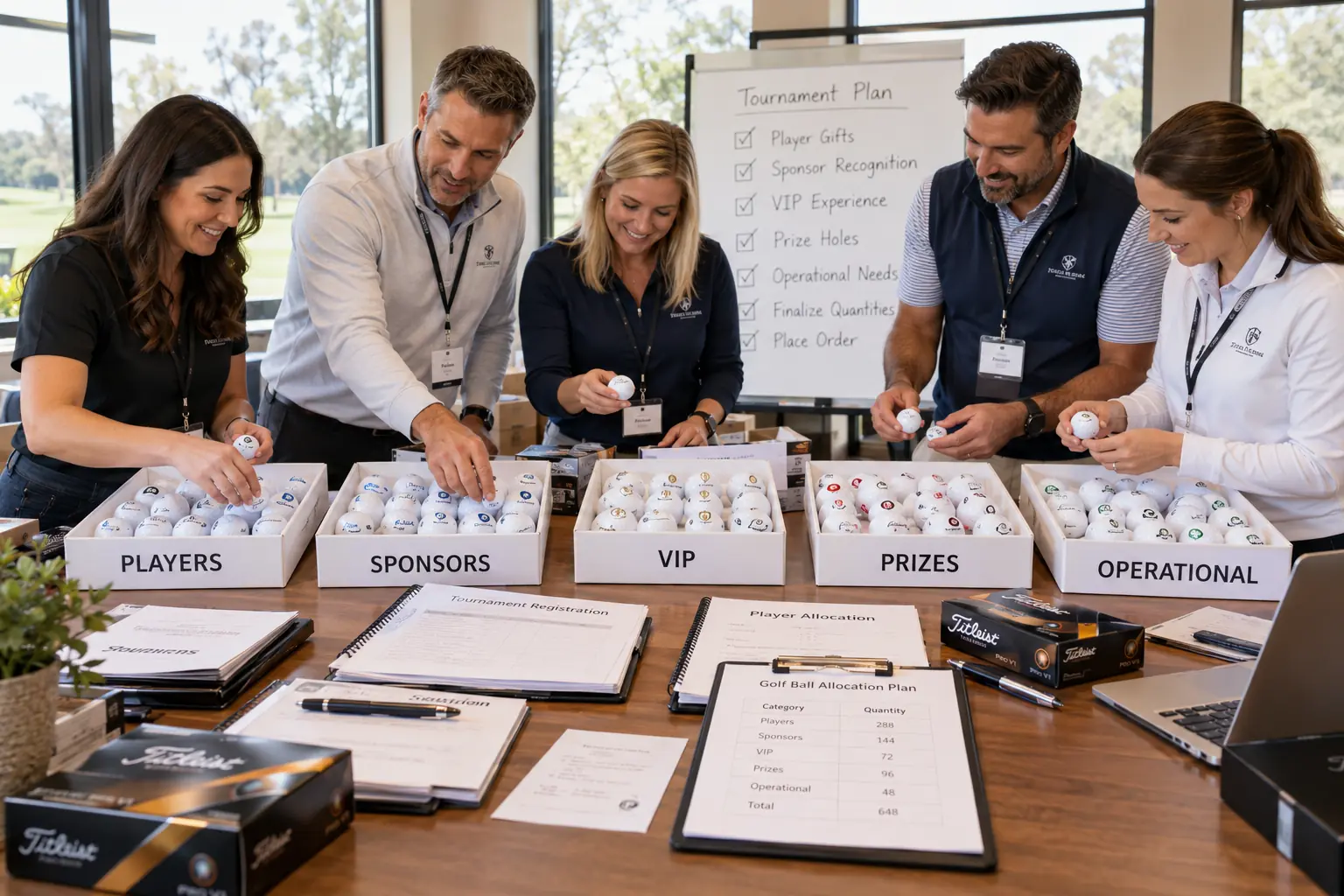
If you have 100 confirmed golfers and promise one sleeve each, 300 balls is your player allocation. It is not automatically your final tournament order.
Build a Tournament Ball Quantity Sheet containing Event Date, Confirmed Players, Distribution Promise, Player Allocation, Non-Player Allocation, Contest / Prize Allocation, Operational Allowances, Post-Event Reserve, Version Split, and Final Order Quantity.
A supplier giving you a tournament quantity before asking how the balls will be distributed is a failure signal.
✔ True — Your player count is the starting quantity input
It defines one important allocation bucket, but your tournament may create additional sponsor, prize, operational, and version-specific obligations.
✘ False — “Player count is automatically the final order quantity”
A correct player calculation can still understate what your event has actually promised to distribute.
How many balls should each player receive?
Searching for a standard such as three balls per golfer reverses the decision. First define what your tournament has promised each player; then calculate the quantity required to fulfill that promise.
Decide what each player should receive before calculating player allocation. One ball, one sleeve, two sleeves, or another defined unit can all be valid tournament formats; the correct quantity comes from your distribution promise, not from a universal balls-per-player benchmark.
Gift Promise Comes Before Ball Quantity.
| Player promise | Allocation logic | What it proves | What it does not prove | Buyer response |
|---|---|---|---|---|
| One ball | Players × 1 | Player giveaway | Final order | Add other buckets |
| One sleeve | Players × 3 | Sleeve commitment | Industry standard | Add other buckets |
| Two sleeves | Players × 6 | Larger gift promise | Best format | Check event role |
| Custom unit | Players × defined unit | Event commitment | Other-recipient demand | Document unit |
The GTSWCA calculation of 288 golfers × 3 balls = 864 balls works because that tournament explicitly promises one sleeve per golfer.
Before multiplying, check your registration package, invitation, sponsor agreement, or internal event brief and record the exact distribution unit.
If the question changes from how many balls to which golf ball belongs in the giveaway, use the corporate and tournament golf-ball sourcing guide. If the decision becomes sleeve, dozen, or gift-pack construction, move to the golf-ball packaging guide.
Who needs balls besides the players?
Your golfer roster can be completely accurate while still omitting sponsor principals, VIPs, contest prizes, registration stock, staff allocations, or other commitments outside the player list.
Count every named recipient or event use outside the golfer roster. Sponsors, VIPs, leadership, contests, prizes, registration, staff, or display needs can create separate allocations, but include only the groups your tournament actually promises or requires—not a blanket “extras” percentage.
Real programs support that separation. The Breast Cancer Coalition’s 2026 sponsorship program includes player distribution and a separate sponsor allocation. The 2026 Brainerd Lakes Chamber Golf Classic separately lists 288 logo golf balls for team packets alongside field-game and prize activities, showing why giveaway and prize requirements should remain separate planning buckets.
In mid-March 2025, we received an urgent inquiry from a U.S. golf resort club planning two early-May tournament sessions for about 300 golfers in total, split into two shotgun waves. The first estimate was 300 × 3, or about 900 balls, so our 1,000-ball custom minimum looked close. We then reviewed potential additional allocations for sponsor principals, VIPs, staff, contest winners, registration/display use, and replacements, alongside an approximately 30-day production requirement and the reuse value of leftover club-logo balls. The customer ultimately ordered 1,500 balls.
The lesson was not that a 300-player tournament should order 1,500 balls. The player allocation was only the starting number; the final order also had to reflect who else might receive balls, how difficult a late shortage would be to correct, and whether leftover inventory would retain value.
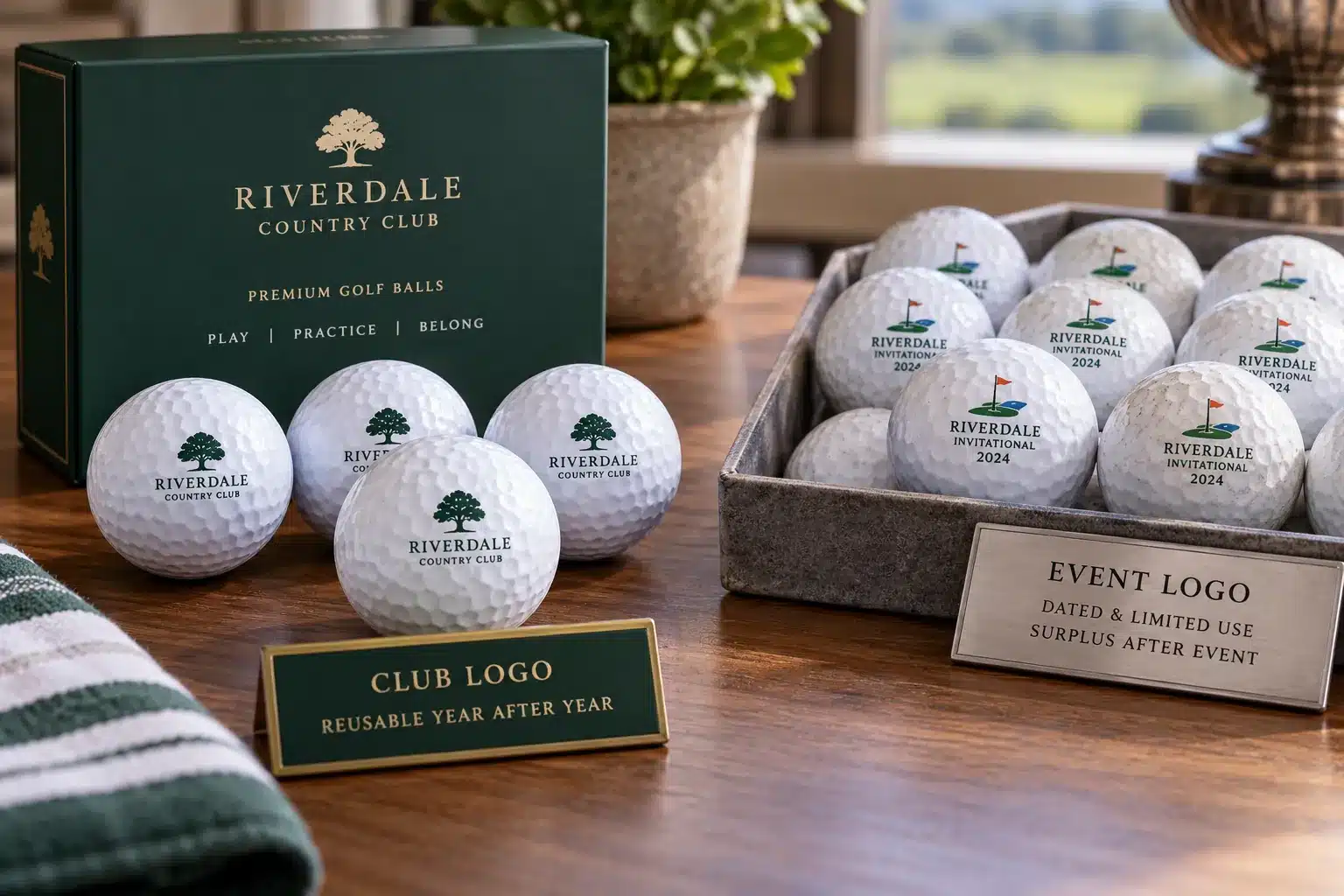
The closer your event is to the supplier’s real production-and-delivery window, the harder—and potentially more expensive—a quantity underestimate can be to correct.
Add only the allocation lines your event actually uses: Sponsor Principals, VIP Guests, Leadership, Committee / Staff, Contest Balls, Prize Balls, Registration / Display Units, or another documented requirement.
If the event is specifically a premium member-guest program and the problem shifts to sponsor-logo durability or gift execution, use the premium member-guest golf-ball guide.
How much extra should your event cover?
A generic “add 10%” rule sounds tidy, but it does not explain whether those extra balls cover roster movement, replacements, registration display, damaged packaging, or another specific risk.
Build extra quantity around named risks rather than a generic percentage. Define whether you are covering late registrations, replacement requests, display units, packaging damage, or an agreed acceptance risk. Then decide separately whether leftover balls have enough post-event value to justify a deliberate reserve.
| Pain / decision | Extra bucket | What it protects | Evidence required | Buyer response |
|---|---|---|---|---|
| Roster movement | Registration reserve | Late confirmed players | Registration policy | Set quantity |
| Pre-play use | Display / sample | Registration presentation | Event plan | Count separately |
| Replacement need | Service reserve | Damaged distribution unit | Event policy | Define rule |
| Decoration risk | Acceptance allowance | Artwork / visual issues | QC agreement | Verify responsibility |
| Post-freeze change | Emergency reserve | Small approved change | Freeze policy | Use only if needed |
Ordered Quantity ≠ Required Accepted-Good Quantity
If your event requires a defined quantity of usable decorated balls, your PO should state whether that means units shipped or units accepted after the agreed visual and packaging checks.
Do not invent a reject rate. If your supplier commits to delivering the required accepted-good quantity and replacing nonconforming units, another arbitrary defect allowance can double-count the same risk.
✔ True — Every extra quantity should have a named reason
Registration reserve, prizes, display units, and acceptance protection solve different problems and should remain visible separately.
✘ False — “Every tournament should add the same percentage buffer”
A fixed percentage can overprotect one event while still missing the actual shortage risk in another.
For each approved version, record the Required Accepted-Good Quantity and define how shortfalls, wrong-artwork units, rejected balls, or damaged packaged units will be replaced, remade, or otherwise dispositioned.
Will leftover balls still have value after the event?
Over-ordering is not equally expensive for every tournament. Unused balls with an evergreen club crest can retain value after the event, while balls tied to a specific date, year, anniversary, or one-time campaign may become dead inventory immediately.
Reusable artwork may include an evergreen club crest, corporate logo, continuing sponsor identity, or unchanged recurring-event mark. Event-specific artwork may include an exact year, date, anniversary reference, temporary campaign, or one-time co-branding.
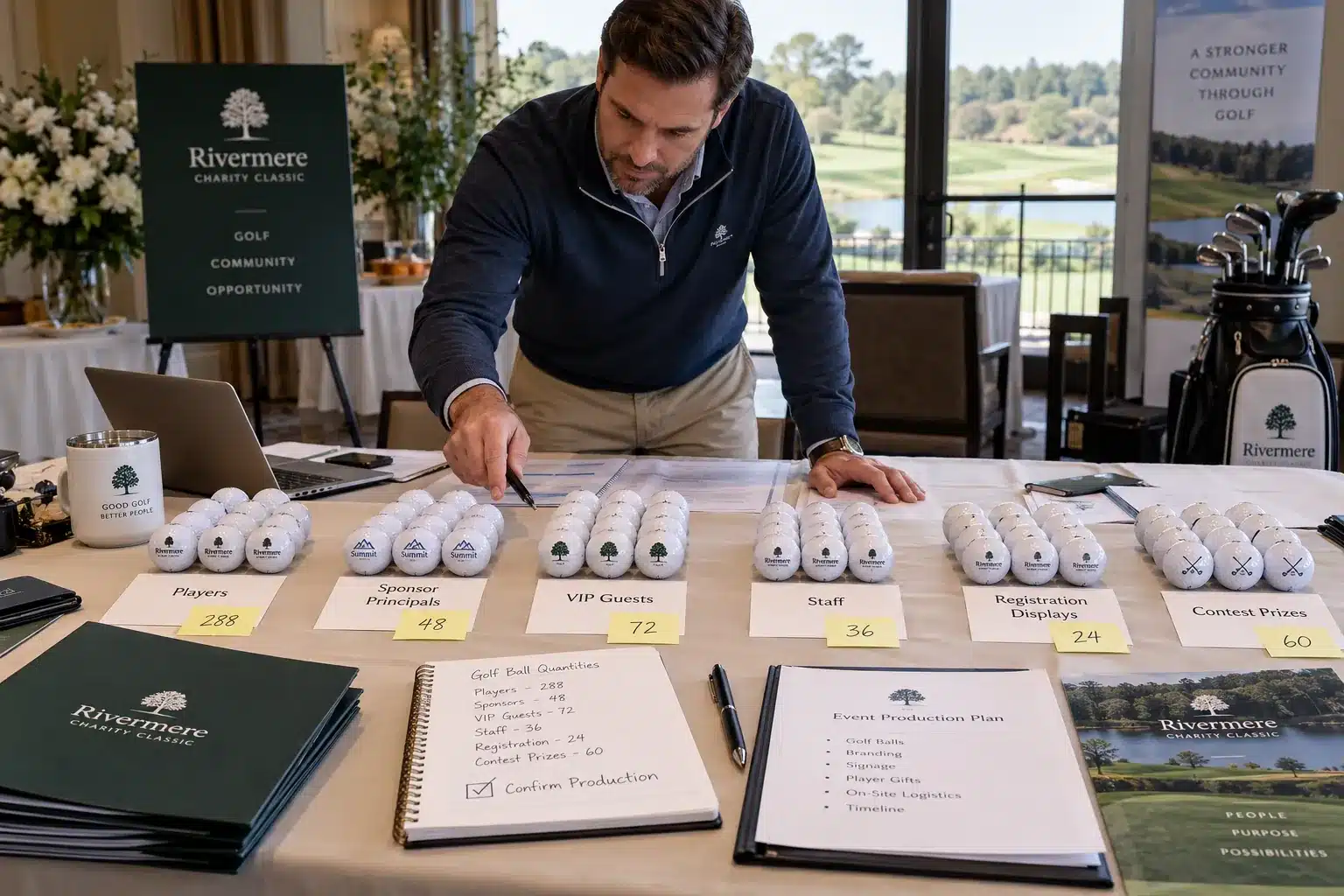
In the resort-club project above, unused evergreen club-logo balls could still serve as commemorative items or guest gifts. A year-specific tournament design would have created a different over-order risk.
Mark each artwork version Reusable / Conditionally Reusable / Event-Specific. Approve a Post-Event Reserve only after documenting where that inventory could be used.
Reusable artwork does not mean you should automatically order more. It means the downside of controlled overage is different.
Do Different Sponsors Need Separate Ball Versions?
Several sponsor names do not automatically require several golf-ball versions. Splitting too early can create unnecessary production lines and purchasing overage before your team has defined what each version actually does.
Not every sponsor needs a separate golf-ball version. Decide the tournament’s branding structure first, then calculate each approved ball version as its own quantity line before supplier MOQ is applied. Create a separate version only when it has a clear recipient, distribution, or event purpose.
The number of sponsors and the number of golf-ball versions are different decisions.
Your tournament might use:
-
One Event Logo Version for the main player distribution.
-
Event Logo + Title Sponsor Version when the lead sponsor has a distinct entitlement.
-
Several Sponsor-Specific Versions when sponsors have separately defined recipient or distribution commitments.
-
One Main Ball Version + Supporting Sponsor Recognition Elsewhere when other sponsors are recognized on sleeves, packaging, signage, or other event materials rather than through separate ball versions.
The useful question is not:
How many sponsors do we have?
It is:
Which approved ball versions have a distinct distribution job?
Suppose your total tournament requirement is 2,000 balls. Once the branding structure is approved, that requirement might become:
| Artwork Version | Ball SKU | Intended Recipient / Use | Required Quantity |
|---|---|---|---|
| Event Logo Version | Approved event SKU | Main player distribution | 1,200 |
| Title Sponsor Version | Approved sponsor SKU | Sponsor allocation | 500 |
| VIP Version | Approved VIP SKU | VIP distribution | 300 |
Your tournament still needs 2,000 balls. From a production and purchasing perspective, however, you now have three quantity lines rather than one 2,000-ball version.
That distinction needs to be visible before MOQ is checked. A supplier may accept the total tournament volume while one individual artwork version still falls below its applicable production minimum.
Create a Version Allocation Sheet before checking supplier MOQ. At minimum, record:
-
Artwork-Version ID
-
Ball SKU
-
Intended Recipient / Use
-
Required Quantity
Do not create another version merely because another sponsor exists. If a sponsor-specific ball has no defined recipient, contractual entitlement, distribution plan, or event purpose, the extra version may add purchasing complexity without solving a quantity problem.
If your question moves from how many versions and how many balls per version to how multiple logos should actually be printed, positioned, or color-controlled, use the custom golf-ball logo printing guide.
How Should MOQ Shape the Final Order?
Once your ball and artwork versions are approved, compare the required quantity for each version with the supplier’s actual production minimums and packing increments.
Supplier MOQ can change how many balls you finally purchase, but it does not change how many balls your tournament actually needs. Keep the Event Requirement visible, then apply the relevant MOQ or packing constraint to each approved version separately.
Use this sequence:
Event Requirement → Approved Version Quantities → Packing Conversion → Supplier MOQ / Increment → Final Order Quantity
Current published supplier programs demonstrate why those numbers must remain separate. Titleist’s custom-logo program currently lists a six-dozen minimum per model. Callaway’s corporate-logo program publishes different minimums for golf balls and several packaged formats. Bridgestone’s customized-ball program currently lists a 12-dozen minimum for its single-logo route and different production windows for other decoration routes.
These are current supplier examples, not tournament standards. Verify the live program before releasing the PO.
A 100-ball event requirement does not become a 144-ball event requirement merely because a supplier route requires 144. You still have a 100-ball Event Requirement facing a 144-ball purchasing constraint.
| Pain / decision | Version | Event Requirement | Supplier constraint | Buyer response |
|---|---|---|---|---|
| Player ball | Version A | Variable | Quote separately | Confirm MOQ |
| Sponsor ball | Version B | Variable | Quote separately | Confirm MOQ |
| VIP ball | Version C | Variable | Quote separately | Confirm MOQ |
| Prize ball | Version D if used | Variable | Quote separately | Simplify if needed |
| Accepted output | Each version | Required usable qty | QC / replacement rule | Write acceptance |
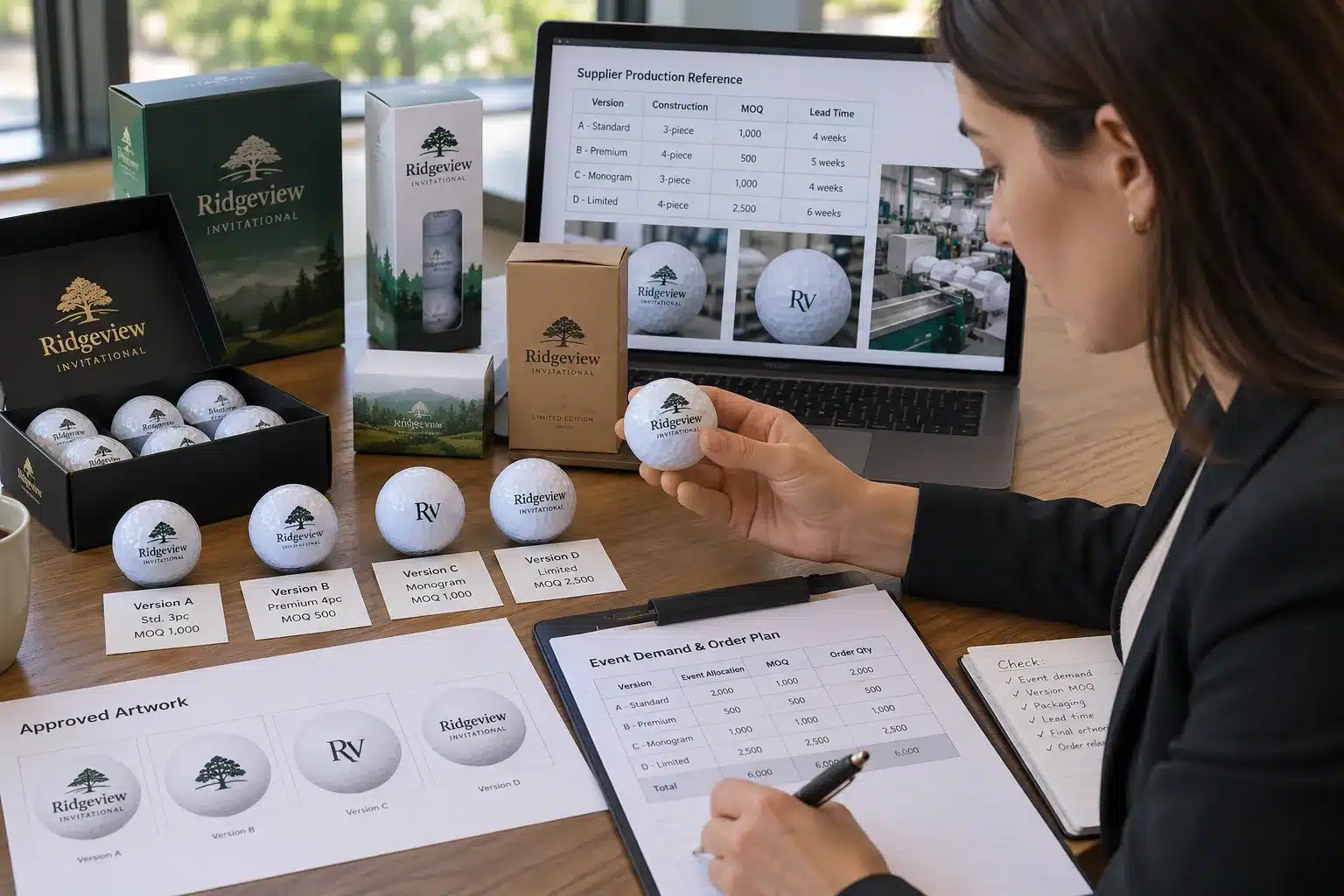
One total order number hiding several approved ball or artwork versions is a failure signal. Procurement should be able to see both the tournament requirement and any supplier-driven overage for each version.
Calculate quantity first, split versions second, and check MOQ last.
In the RFQ, ask the supplier to confirm quantity by ball SKU and artwork version, accepted-good quantity, MOQ per version, packaging increment, proof-approval deadline, and production-release quantity.
Supplier shall confirm the final quantity separately by ball SKU and approved artwork version and identify each production lot by batch reference linked to the approved version.
Buyer acceptance shall be based on the agreed accepted-good quantity for each approved ball and artwork version after the specified visual and packaging checks; any shortfall, wrong-artwork units, or rejected units shall follow the agreed remake, replacement, or written-disposition rule.
Before production release, establish a Quantity Freeze:
Confirmed Player Baseline → Allocation Buckets → Artwork Versions Frozen → MOQ / Pack Constraints Reconciled → Quantity Freeze → Named Contingency
The freeze does not assume your roster will never move. It prevents every small registration change from reopening artwork, packing, and production quantities.
After MOQ, packing increments, and acceptance requirements are reconciled, convert the Version Allocation Sheet into a Final Version-Level Quantity Sheet showing Ball SKU, Artwork Version, Intended Recipient / Use, Event Requirement, Packing Unit, Required Accepted-Good Quantity, Supplier MOQ / Increment, Quantity Freeze Date, and Approved Final Order Quantity.
If supplier minimums become the main problem, use the custom golf ball MOQ guide.
✔ True — Supplier MOQ can change how many balls you finally purchase
Once your Event Requirement and approved version quantities are known, a supplier minimum or packing increment may create controlled purchasing overage.
✘ False — “Supplier MOQ tells you how many golf balls the tournament needs”
Demand and purchasing constraints are different numbers. Preserve the event requirement even when the chosen production route forces a larger order.
FAQ
What if my final player count is not confirmed?
Use the best confirmed roster available at the quantity-freeze point and separate known player allocation from a named late-registration allowance. Do not repeatedly reopen production for every small movement in the registration list.
-
Track confirmed and unconfirmed registrations separately.
-
Define what the post-freeze allowance covers.
-
Escalate changes that exceed the approved allowance.
Should sponsors who are not playing be counted?
Yes, when the sponsorship agreement or event plan gives them a separate ball entitlement. A sponsor principal can create a real quantity requirement even when that person never appears on the golfer roster.
-
Check sponsor-package commitments.
-
Record the entitlement separately.
-
Do not invent a sponsor allocation where none was promised.
What if my calculated quantity is below the supplier MOQ?
Keep the true event requirement visible. Then decide whether to accept controlled overage, simplify artwork versions, change the pack or customization route, or select another supplier option.
-
Preserve the original Event Requirement.
-
Identify the binding minimum.
-
Record the resulting purchasing overage.
Should my PO state shipped quantity or accepted-good quantity?
For a fixed tournament distribution commitment, define how many balls must remain acceptable and usable after the agreed inspection. A nominal shipped quantity may not protect you if wrong-version or rejected units are included.
-
State the required accepted-good quantity.
-
Define the inspection scope.
-
Define remake, replacement, or written-disposition treatment.
Do tournament golf balls have to be ordered by the dozen?
Not always. Your event requirement should remain in actual ball quantities first; the final purchasing increment depends on the supplier route, ball model, customization program, and packaging format.
-
Keep the true event requirement visible.
-
Convert it into the supplier’s accepted sleeve, dozen, or carton increment later.
-
Use the custom golf ball MOQ guide when the minimum or increment becomes the main constraint.
Does a night-golf tournament use the same quantity model?
Not necessarily. LED events can require swap stock, activation-failure allowance, and different loss assumptions, so the standard custom-ball model should not be reused unchanged.
-
Keep normal recipient commitments visible.
-
Calculate LED-specific operational reserve separately.
Conclusion
Your tournament quantity should come from real distribution commitments—not a universal balls-per-player rule. Calculate player and non-player allocations, protect only named risks, decide whether leftover inventory retains value, split the requirement into approved ball and artwork versions, and only then apply supplier MOQ.
Event Need → Version Quantity → Supplier Constraint → Final Order
You might also like — Custom Logo Golf Ball MOQ: What Actually Sets the Minimum?