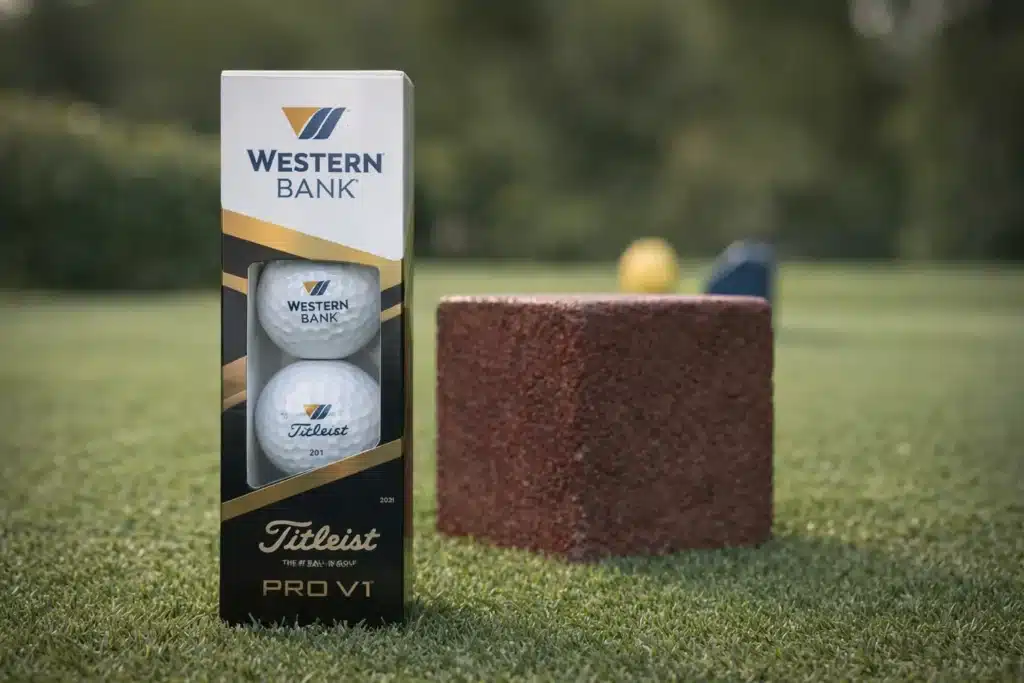
At a premium member-guest event, a sponsor logo does not fail in the sleeve. It fails when wedge grooves, sand, moisture, and high-friction spin hit an exposed surface print.
Sponsor logos rub off custom golf balls when the mark sits on the finished outer surface instead of being protected inside the OEM finish stack. For premium country club member-guest gifts, the safer standard is under-clear-coat logo placement, a credible urethane platform, wedge-scuff proof, and clubhouse-arrival planning before PO approval.
This is not a normal logo-ball order. It is VIP golf event sponsor branding under impact. If the logo smears on the first tee, the sponsor sees cheap execution; if the ball feels hard and clicky, low-handicap guests notice; if delivery misses the clubhouse date, the registration table tells the story.
Premium tournament gifts should be approved by logo durability, platform fit, connected proof-stack evidence, and confirmed clubhouse arrival—not by artwork mockups alone.
Why do sponsor logos fail on the first tee?
Your buyer may approve a beautiful sleeve and a sharp sponsor logo, then watch that logo smear after the first bunker shot or wedge strike.
Sponsor-logo failure is usually not an artwork problem. It happens when the logo is printed on the exposed outer surface of a finished golf ball. For a premium member-guest event, the safer standard is under-clear-coat logo placement, where the sponsor mark is protected inside the OEM finish stack instead of sitting naked against wedge grooves, sand, moisture, and abrasion.
Surface Print Is Decoration
Local surface printing treats the logo as decoration; OEM finishing treats it as part of the surface system. That difference decides whether the sponsor mark survives the first real strike.
A fast local overprint usually adds a graphic to a completed ball. It may look sharp in a proof photo, but the ink still sits in the danger zone: exposed to wedge grooves, sand, moisture, bag abrasion, and cleaning. Under-clear-coat golf ball printing moves the sponsor mark into the finish stack, where paint, indicia, clear coat, cure, and inspection work together.
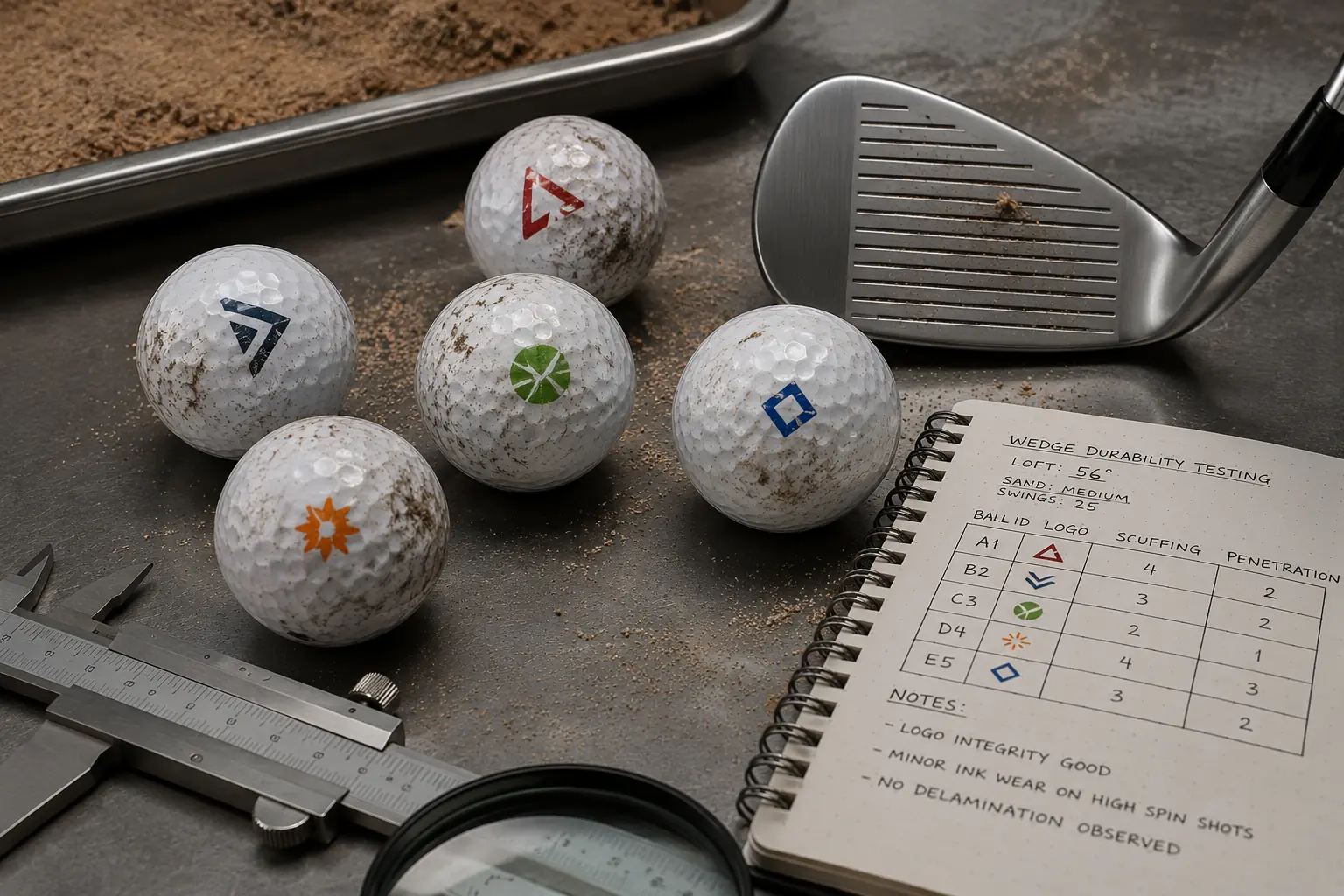
A U.S. premium member-guest order used fast local surface printing on tour-level blanks to protect the event schedule. The sleeve presentation looked clean, and the sponsor mark seemed sharp at registration. Once the balls met bunker sand and wedge contact, the logo smeared and transferred. The club had to apologize to the sponsor after the gift failed in the exact moment it was supposed to build prestige. The failure was not artwork quality; it was logo position inside the surface system.
| Pain / decision | Weak approach | OEM-grade approach | Evidence to request |
|---|---|---|---|
| Fast logo order | Surface overprint | Finish-stack placement | Same-platform A/B proof. |
| Sponsor visibility | Pretty sleeve proof | Post-impact logo legibility | Macro before/after photos. |
| Durability claim | “Durable enough” | Method-defined evaluation | Wedge-scuff method. |
| Approval risk | Artwork signoff only | Decorated SKU approval | Locked proof version. |
A premium club is not buying a logo ball; it is buying sponsor reputation under impact. Ask for same-platform A/B samples comparing exposed surface print and under-clear-coat placement. Verify logo legibility after one wedge-scuff and one bunker-abrasion method using the same logo size, ball platform, lighting, and camera angle.
A failure signal appears when the supplier provides a beautiful mockup but no decorated-batch proof. For machine-level process choices, keep that decision separate and review Custom Golf Ball Printing Methods: Pad vs. UV & Adhesion Standards. This article is about tournament risk: do not approve sponsor balls on artwork alone; require post-contact macro evidence.
✔ True — First-tee logo failure is a finish-system risk.
If a sponsor mark degrades immediately, the issue is usually where the graphic sits in the surface system and how that system was controlled before the event.
✘ False — “A premium-looking proof guarantees sponsor-safe durability.”
Registration-table beauty proves little about contact durability. Tournament gifts are judged after impact, not only before unboxing.
What makes under-clear-coat logos last?
You may hear under-clear-coat and imagine thicker varnish. That misunderstanding can create a new problem: protection that damages the ball’s surface.
Under-clear-coat printing is not thicker varnish; it is controlled finish-stack engineering. Your supplier must show where the sponsor mark sits, how the clear coat is controlled, and why the coating protects the logo without pooling inside dimples or changing flight behavior.
Microns Matter in the Finish Stack
A golf ball dimple is a micron-scale aerodynamic feature, not a decorative texture. Logo protection has to respect the surface that makes the ball fly.
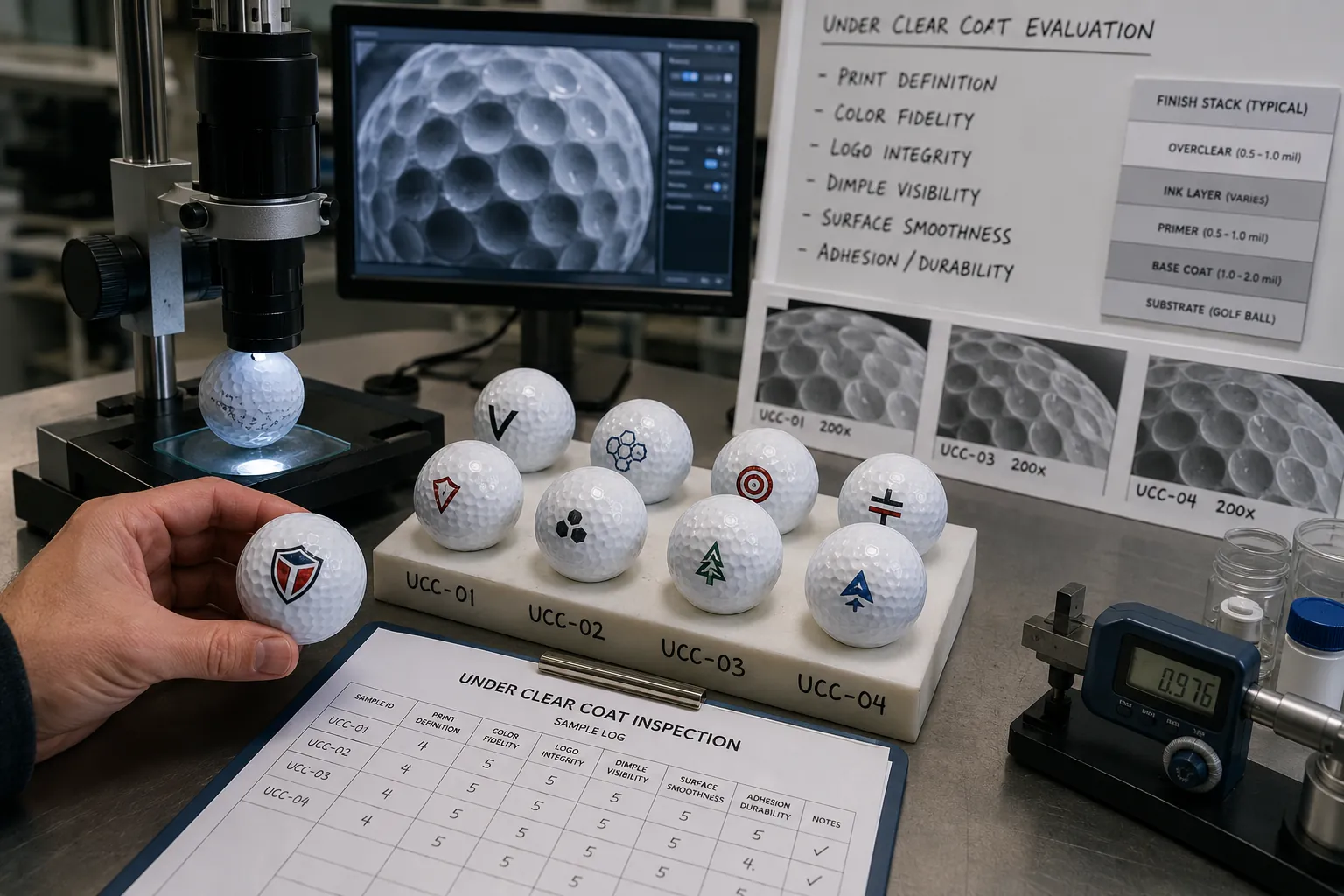
Many golf ball dimples sit around the 250-micron depth scale, and golf ball aerodynamics guidance explains that dimple shape, depth, edge angle, and count influence lift, drag, trajectory, peak height, and distance. That is why careless clear coat is not harmless. If a local shop tries to protect a logo by flooding the surface, clear coat can pool inside dimples and change the geometry that controls the flight window.
Published coating literature also supports the micron-control logic. One golf ball coating patent describes a UV-curable paint layer commonly around 5–30 μm, especially 10–20 μm, and warns that overly thick paint may alter dimple shape. That does not make any patent a Golfara process claim; it supports the buying principle. For sponsor-logo golf balls, protection should be a controlled micron window, not “more varnish.” The goal is logo protection without dimple flooding.
| Pain / decision | Bad protection | Controlled OEM finish | Evidence to request |
|---|---|---|---|
| Logo rubs off | Exposed ink | Logo under clear coat | Finish-stack sequence. |
| Over-varnish risk | Thick clear coat | Micron-managed coating | Coating target range. |
| Dimple pooling | Clear coat fills dimples | No-pooling inspection | Macro / microscope proof. |
| Vague durability | Claim only | Method + sample evidence | Decorated sample visual. |
A failure signal appears when a supplier says “durable print” but cannot explain where the logo sits relative to paint and clear coat. Request finish-stack disclosure showing surface preparation, paint or primer, indicia, clear coat, cure, and inspection. The PO should state that the sponsor logo shall be placed within the OEM finish stack and protected under the clear coat, with macro proof of the decorated sample and no visible pooling inside dimples.
Reject any under-clear-coat claim that cannot show logo position, coating control, and no-pooling evidence. That is not over-engineering. It is how a club avoids turning sponsor dignity into a coating experiment.
Is a hard gift ball a VIP insult?
A logo can survive perfectly and still make the event feel cheap if low-handicap guests notice a hard, clicky promo ball.
A premium gift fails when the logo survives but the ball feels cheap. Your member-guest room may include low-handicap players, sponsor principals, and club leaders who notice hard feel, clicky sound, and weak short-game response faster than packaging can distract them.
Define the Urethane Platform
Prestige events need platform fit, not just logo durability. The ball has to feel credible in the same hands that judge the sponsor presentation.
A 2-piece Surlyn or ionomer distance ball can make sense for value-first outings, large charity events, or high-volume giveaways. It is durable, familiar, and budget-friendly. That does not make it the right object for a premium country club member-guest gift. In that room, a low-handicap guest may read the ball immediately: clicky sound off the putter, firmer cover feel, lower short-game grip, and a “promo ball” signal that no magnetic gift box can fully hide.
For prestige-first events, ask for at least one premium urethane-platform option. Cast thermoset urethane is the strongest benchmark for high-end feel and short-game credibility; injection TPU urethane may still work in some programs if the supplier discloses material route and decorated-sample performance. Keep the material explanation practical. You are not teaching polymer chemistry in the boardroom. You are protecting event fit.
| Gift-ball platform | VIP reaction risk | What to verify | Decision |
|---|---|---|---|
| 2-piece Surlyn / ionomer | Cheap promo-ball signal | Blind feel and short-game check | Avoid for prestige-first events. |
| 3-piece injection TPU urethane | Better feel, still needs proof | Material disclosure and spin baseline | Use with decorated proof. |
| 3-piece cast urethane | Strongest prestige fit | Short-game window and cutaway | Use as benchmark option. |
| Unknown urethane claim | Prestige language only | Cover type and process disclosure | Hold approval. |
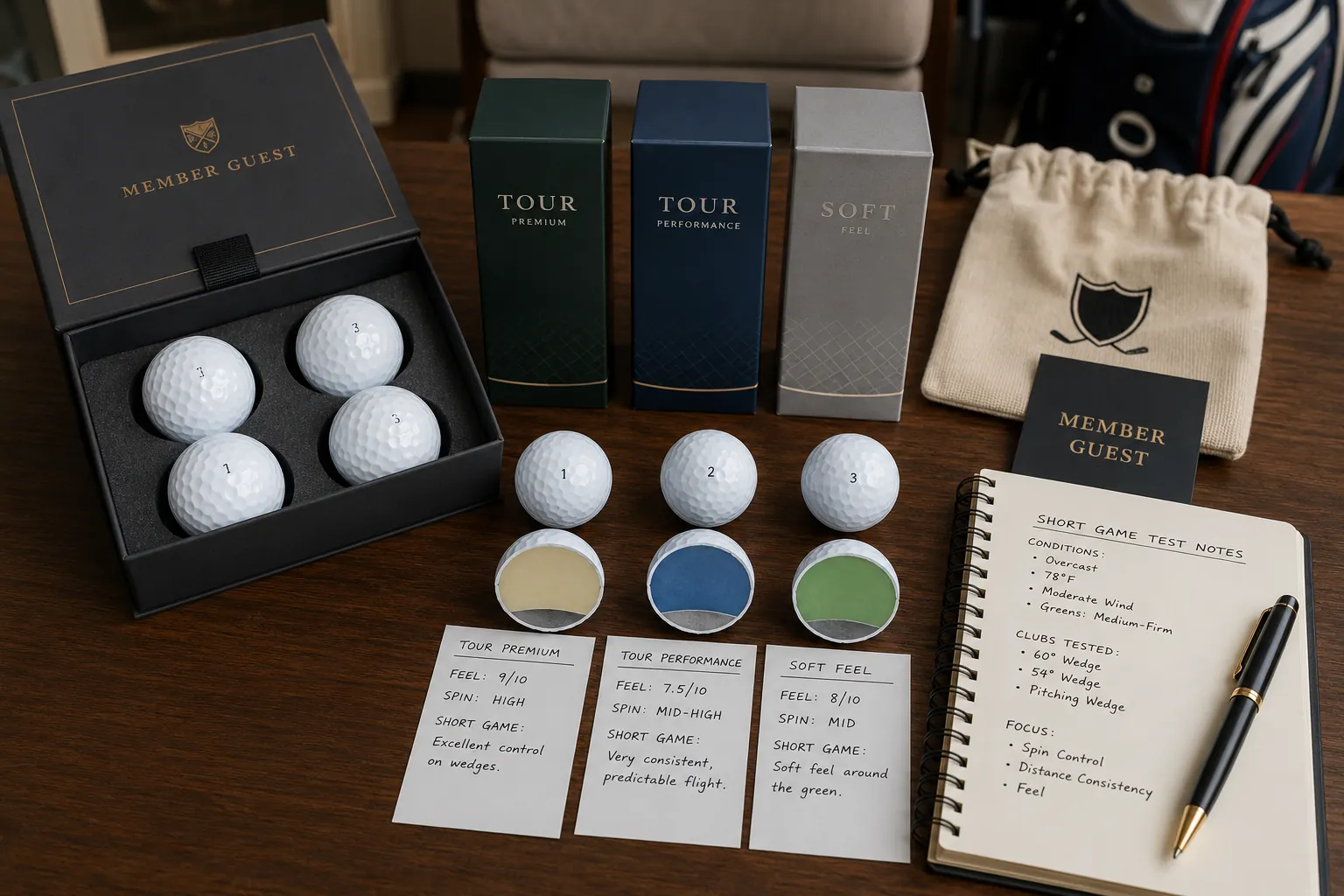
Ask for construction, cover type, feel and spin positioning, and decorated-sample proof. Have the Head Pro or fitter compare the candidate against a premium control ball in short-game and simulator use. Do not approve a prestige gift platform until the ball passes fit-for-event notes, not only logo approval.
Premium clubs buy reputation protection, not cheap logo decoration. If the room is full of players who will notice feel immediately, your procurement standard should notice it first.
✔ True — A ball can be good and still be wrong for a prestige event.
A durable value ball may be sensible in another setting. That still does not make it the right gift for a member-guest where advanced players judge feel quickly.
✘ False — “Premium packaging can hide a cheap-feeling platform.”
Better players read sound, cover feel, and short-game response fast. Once they do, the entire gift feels more transactional than prestigious.
How much wedge abuse must the logo survive?
You may judge the logo in the sleeve, while the real failure environment is wedge grooves, sand, moisture, and high spin.
Tournament logos do not fail in the box; they fail under spin and abrasion. Your proof should simulate the contact that matters: wedge grooves, sand, moisture, and high-friction shear, then show whether the sponsor mark remains legible after the agreed test.
Wedge Spin Is a Logo Destroyer
A wedge shot can become a logo-durability trial. The sponsor mark has to face friction, not just photography.
Spin-rate measurement guidance defines spin rate as the golf ball’s rate of rotation immediately after separation from the club face, and tour-average performance materials treat spin rate as a core performance field. For a tournament-buyer discussion, a careful way to frame the destructive test is an 8,000–10,000 rpm wedge-spin environment, not a claim that every player produces the same number. The point is physical: exposed ink is being asked to survive sharp grooves, sand, moisture, cover deformation, and high-friction shear.
A local surface print may look perfect in a sleeve, then smear under one bunker shot. Under-clear-coat placement survives better because the mark is sealed inside the finish stack instead of sitting exposed on top of it. Even then, your approval should be evidence-based. No supplier should win a premium tournament order with a render and a smile.
Request macro before/after photos after wedge-scuff or bunker-abrasion testing on the decorated SKU. Verify that the supplier tests the final logo placement, not a different ball body or unrelated print sample. Approval should require sponsor-logo legibility after the agreed evaluation method, with the same lighting, camera distance, ball platform, logo position, and scuff method.
This is where durable sponsor logo golf balls separate themselves from nice-looking custom corporate tournament golf balls. The sponsor pays for visibility after contact, not just in the presentation tray.
How do you guarantee clubhouse arrival?
Your tournament date cannot move, but proof approval, production, packing, customs, and last-mile delivery can all drift if unmanaged.
For tournament gifts, the only date that matters is clubhouse arrival. Your plan should run backward from the registration table, then lock artwork, proof approval, production, decorated QC, freight mode, customs clearance, and final delivery in one schedule.
Backward-Planned DDP
Factory completion is not event readiness. The gift is only ready when it reaches the clubhouse with enough time for receiving, sorting, and problem handling.
A member-guest is a one-date business problem. The sponsor dinner does not move because the goods are “almost there.” The shotgun start does not wait for customs. Your schedule has to start with the required clubhouse arrival date, then work backward through arrival buffer, customs clearance, freight mode, export documents, QC, pack-out, production, proof approval, and artwork lock.
| Schedule decision | Weak plan | Controlled plan | Evidence to request |
|---|---|---|---|
| Date target | Factory finish date | Clubhouse arrival date | Backward timeline. |
| Artwork | Creative task | Schedule gate | Artwork lock date. |
| Proof | Email approval | Physical / decorated proof gate | Proof approval record. |
| Freight | Discuss late | DDP option planned early | Freight mode + buffer. |
| Event risk | “Goods are coming” | Goods received before event | Receiving checklist. |
A failure signal appears when lead time is quoted without a clubhouse arrival date. Ask whether the supplier’s timeline ends at factory completion, cargo-ready, port arrival, or clubhouse delivery. Those are not the same milestone.
Request an artwork-ready to clubhouse-arrival schedule with proof, production, QC, export, freight, customs clearance, and final delivery milestones. The PO should state that lead time and delivery date are separate fields, and that the required clubhouse arrival date and agreed arrival buffer control the schedule. For more production-calendar detail, use How Long Does It Take to Manufacture Golf Balls? (OEM Production Timeline). For freight, customs, DDP, and delivered-cost modeling, use The True Landed Cost of China Golf Balls: DDP & Import Duty Guide.
✔ True — Lead time and delivery date are separate.
A factory can finish production on time while the tournament gift still misses the registration table. Plan from clubhouse arrival, not factory optimism.
✘ False — “Factory completion equals tournament readiness.”
Tournament readiness means decorated goods are received, checked, and ready for distribution before members and sponsors arrive.
What proof stack should you demand?
A beautiful mockup, a plain premium sample, and a separate logo sample do not prove the decorated tournament SKU.
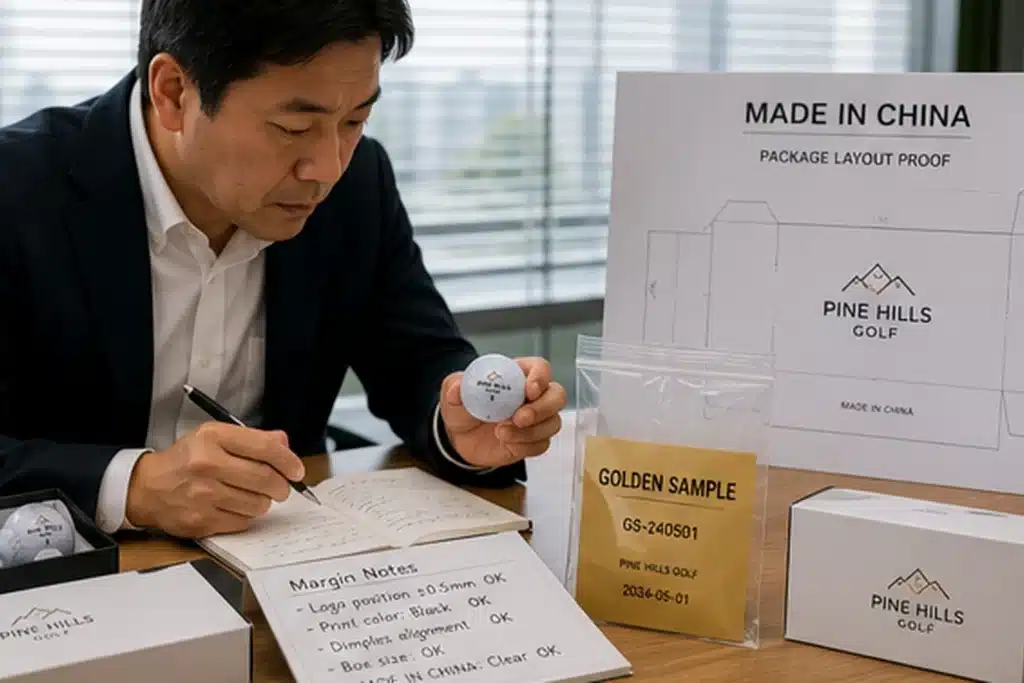
Approve the decorated SKU, not disconnected confidence props. Your proof stack should connect finish-stack method, under-clear-coat placement, wedge-scuff evidence, platform construction, decorated-batch QC, proof version, packing list, and receiving checklist before the PO is released.
One Platform, Connected Evidence
Every proof item should point to the same production version. If the sample, QC report, and packing list cannot connect, the program still has drift risk.
A professional proof stack does not need to be theatrical. It needs to be traceable. The supplier should show the actual decorated ball, the surface system, the platform, the scuff evidence, the QC report, and the version control that follows the lot into shipment. A supplier who sends unrelated samples is not proving the product; they are decorating the meeting.
| Proof item | What to request | Failure signal | Acceptance action |
|---|---|---|---|
| Finish stack | Logo layer position | “Durable print” only | Require method disclosure. |
| A/B durability | Surface vs under-clear-coat | Different ball bodies | Use same platform. |
| Macro proof | Before/after scuff photos | PDF mockup only | Hold approval. |
| Coating control | Micron window / no pooling | “More varnish” language | Require sample evidence. |
| Platform fit | Urethane option + construction | Luxury box, cheap ball | Run Head Pro check. |
| Traceability | Proof version to QC and packing list | Samples and reports mismatch | Lock version control. |
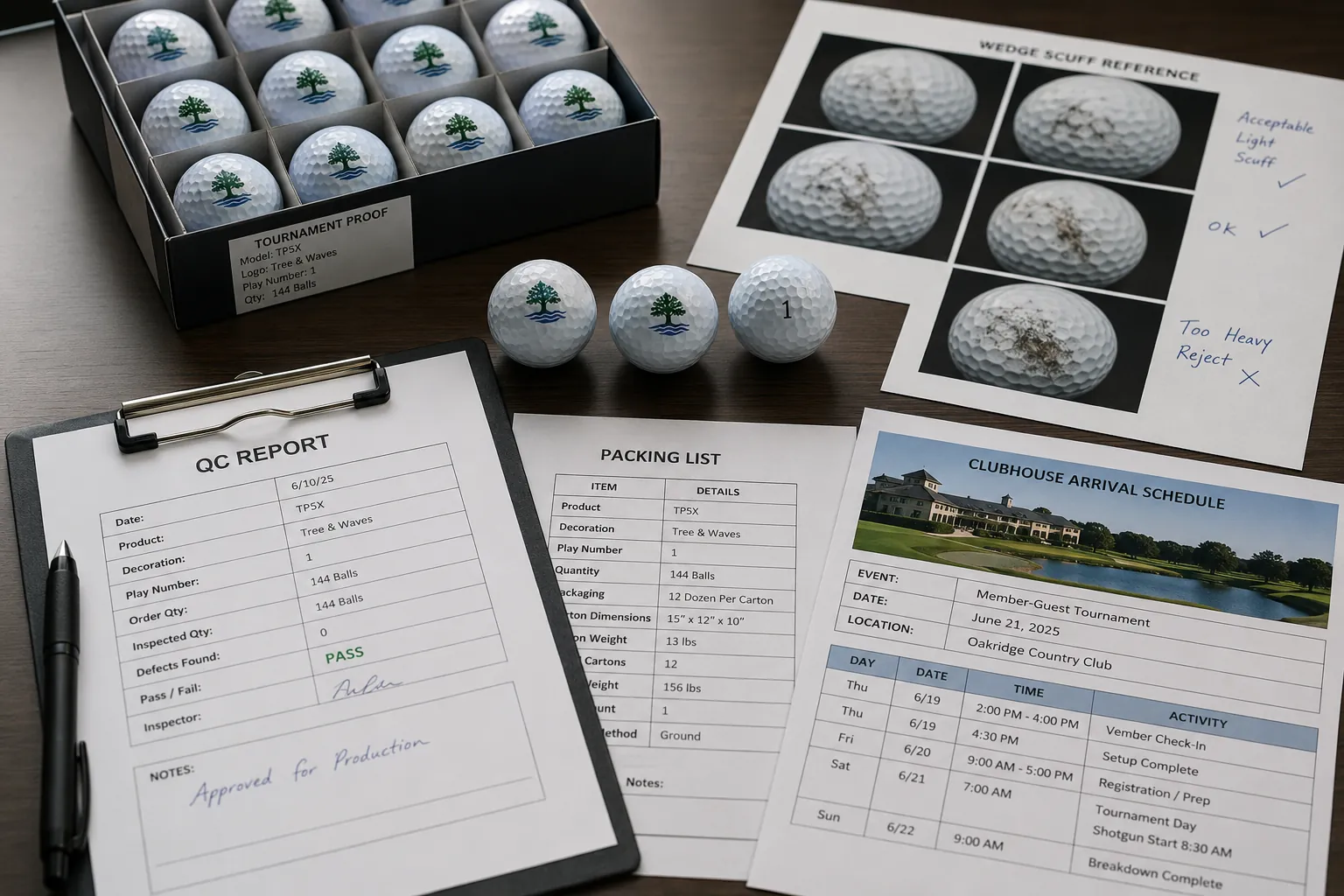
Hold approval until every evidence item refers to the same decorated SKU and production version.
Request one fixed tournament-gift ball platform across surface print and under-clear-coat treatments, with finish-stack disclosure, macro before/after wedge-scuff evidence, decorated-batch QC pack, proof-version control, and clubhouse-arrival schedule.
The PO should state that the final approved tournament ball must match the approved artwork placement, decorated finish stack, and internal construction of the pre-production sample. Buyer acceptance should be based on logo legibility after the agreed wedge-scuff or bunker-abrasion method, artwork position, color consistency, and decorated-batch QC results. Supplier should issue one locked proof version before production and reference that same version on the decorated-sample approval, QC report, batch record, packing list, and shipment documents.
Do not release PO approval if proof version, decorated sample, QC report, and packing list cannot be tied together. That is not mistrust. That is the difference between a premium event program and confidence theater.
FAQ
Why do custom corporate logos rub off balls?
Custom corporate logos often rub off because the mark is printed on the exposed outer surface instead of being protected inside the OEM finish stack.
Ask where the logo sits relative to paint and topcoat. Then request same-platform A/B proof comparing exposed surface print with under-clear-coat placement. Static artwork does not prove durability. Macro before/after photos from wedge-scuff or bunker-abrasion checks are more useful because they show what happens after the ball enters the event environment.
Are 2-piece balls acceptable for member-guests?
They can work for value-first or high-volume events, but they are risky as the default prestige choice for a serious member-guest.
Judge by guest profile and event status. A 2-piece distance ball can be practical in a charity scramble, but a prestige member-guest room may include low-handicap players, sponsor principals, and club leaders who notice feel quickly. Use a premium urethane platform as the benchmark and have the Head Pro or fitter test short-game credibility before approval.
Is under-clear-coat just extra varnish?
No. The useful distinction is controlled finish-stack placement, not simply adding a thicker clear layer over the logo.
Ask for the finish-stack sequence and evidence showing where the sponsor mark sits relative to paint and topcoat. A careless thick clear layer can pool inside dimples and change surface geometry. A proper OEM finish controls protection in a micron-managed coating system while preserving the aerodynamic surface. Request macro or microscope evidence of the actual decorated sample.
How fast can tournament balls arrive?
Tournament balls can arrive quickly for some events, but only when proof, production, QC, DDP, customs, and final delivery are planned backward from clubhouse arrival.
Separate lead time from delivery date. A factory-finished date does not help if the registration table is empty. Set clubhouse arrival as the schedule target, require an arrival buffer, and write proof approval, production, QC, freight mode, customs clearance, and final delivery milestones into the PI or PO.
How many balls suit a 100-player event?
Start from players, sponsor principals, reserves, replacements, and visual rejects rather than a retail inventory mindset.
A 100-player member-guest often needs more than one sleeve per player because sponsor principals, club leadership, extra display units, contingency stock, and visual rejects must be considered. Keep the calculation operational, not bargain-focused. Confirm gift format first, then decide whether the order is one sleeve, two sleeves, a boxed set, or a sponsor-specific allocation.
What belongs in the evaluation kit?
A useful evaluation kit connects one decorated SKU to durability proof, platform evidence, QC data, proof version, and receiving control.
Ask for same-platform surface versus under-clear-coat comparison, macro before/after scuff evidence, construction or cover disclosure, decorated-batch QC, locked proof version, packing-list traceability, and receiving checklist. If those pieces do not connect back to the same decorated product, the kit is incomplete and the order still depends too much on trust.
Conclusion
A member-guest tee gift is not a promo giveaway. It is sponsor reputation under impact.
When the logo fades, the club looks careless. When the ball feels cheap, the event feels cheaper than the sleeve suggests. When the shipment arrives late, the registration table tells the whole story without saying a word.
You might also like — USGA Conforming Golf Balls: 2026 Compliance Costs in China OEM