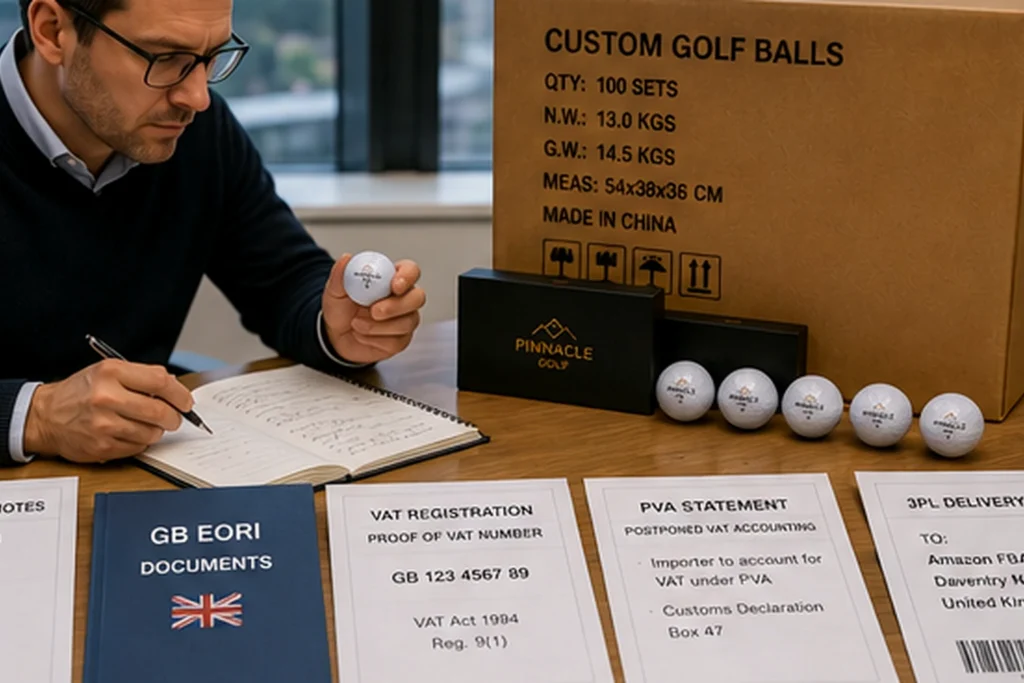
To import golf balls from China to the UK, verify the shipment file before accepting DDP—not after VAT proof or 3PL receiving issues appear.
Your UK import file should confirm commodity code 9506 32 00, GB EORI route, importer role, import VAT handling, PVA or CDS proof path, DDP scope, 3PL receiving rules, pallet specs, carton labels, and delivery appointment before shipment.
| UK import check | Buyer risk | What to request | Buyer action |
|---|---|---|---|
| Commodity code | Wrong import file | 9506 32 00 review | Broker check |
| GB EORI | Weak importer record | Importer role proof | Confirm before PO |
| Import VAT | Cash-flow / reclaim issue | VAT / PVA path | Accountant review |
| PVA statement | Missing evidence | CDS statement route | Keep records |
| DDP scope | Hidden IOR | Named importer | Audit quote |
| 3PL delivery | Turn-away risk | Routing guide | Book slot |
| Pallet / labels | Warehouse rejection | Pallet spec + labels | Approve before ship |
Use this guide to check whether your China golf ball shipment is UK-ready before cargo leaves China.
What Should UK Buyers Check First?
Your team may search how to import golf balls from China to the UK and expect a customs or DDP answer. The stronger first check is whether the shipment can support UK import records, VAT evidence, and warehouse receiving.
Your first UK import check is not whether a supplier can quote DDP; it is whether your shipment is commodity-code-ready, GB-EORI-ready, VAT-proof-ready, PVA-ready, and warehouse-ready. Before PO approval, request importer role, VAT proof path, 3PL receiving rules, labels, pallet specs, delivery appointment rules, and final delivery proof.
The UK risk is not only “can the goods enter?” It is also “can your finance team use the file?” and “will your warehouse accept the delivery?” A supplier can quote DDP UK while leaving the importer role unclear, the GB EORI route hidden, the VAT evidence weak, the PVA path unavailable, or the 3PL delivery rules untouched.
| First check | Buyer risk | What to request | Buyer action |
|---|---|---|---|
| Commodity code | Wrong import file | 9506 32 00 review | Broker check |
| GB EORI | Weak importer record | EORI route | Confirm role |
| VAT handling | Cash-flow issue | VAT / PVA note | Ask accountant |
| PVA proof | Missing statement | CDS proof path | Keep records |
| 3PL rules | Warehouse rejection | Routing guide | Book slot |
| Labels / pallets | Turn-away risk | Spec confirmation | Approve before ship |
As of 2026, verify again before shipment. UK tariff treatment, import VAT file path, PVA eligibility, EORI requirements, CDS proof access, 3PL receiving rules, Amazon UK routing instructions, pallet requirements, label rules, and delivery appointment conditions can vary by buyer status, broker, destination warehouse, and shipment structure.
Your deliverable is a UK Import Readiness Pack. Match the supplier quote against commodity code basis, importer role, GB EORI route, import VAT path, PVA proof path, final warehouse address, and 3PL receiving guide. Shipment approval requires a UK import and warehouse file, not only a DDP price.
✔ True — UK import planning starts with customs, VAT proof, importer role, and warehouse receiving visibility
A useful UK quote should show commodity-code basis, GB EORI route, VAT evidence path, PVA proof access, 3PL rules, labels, and delivery appointment scope before shipment.
✘ False — “A DDP UK price proves the shipment is automatically VAT-ready and 3PL-ready”
DDP can simplify buying, but only when the import file and warehouse delivery scope are auditable.
Which Commodity Code Applies in the UK?
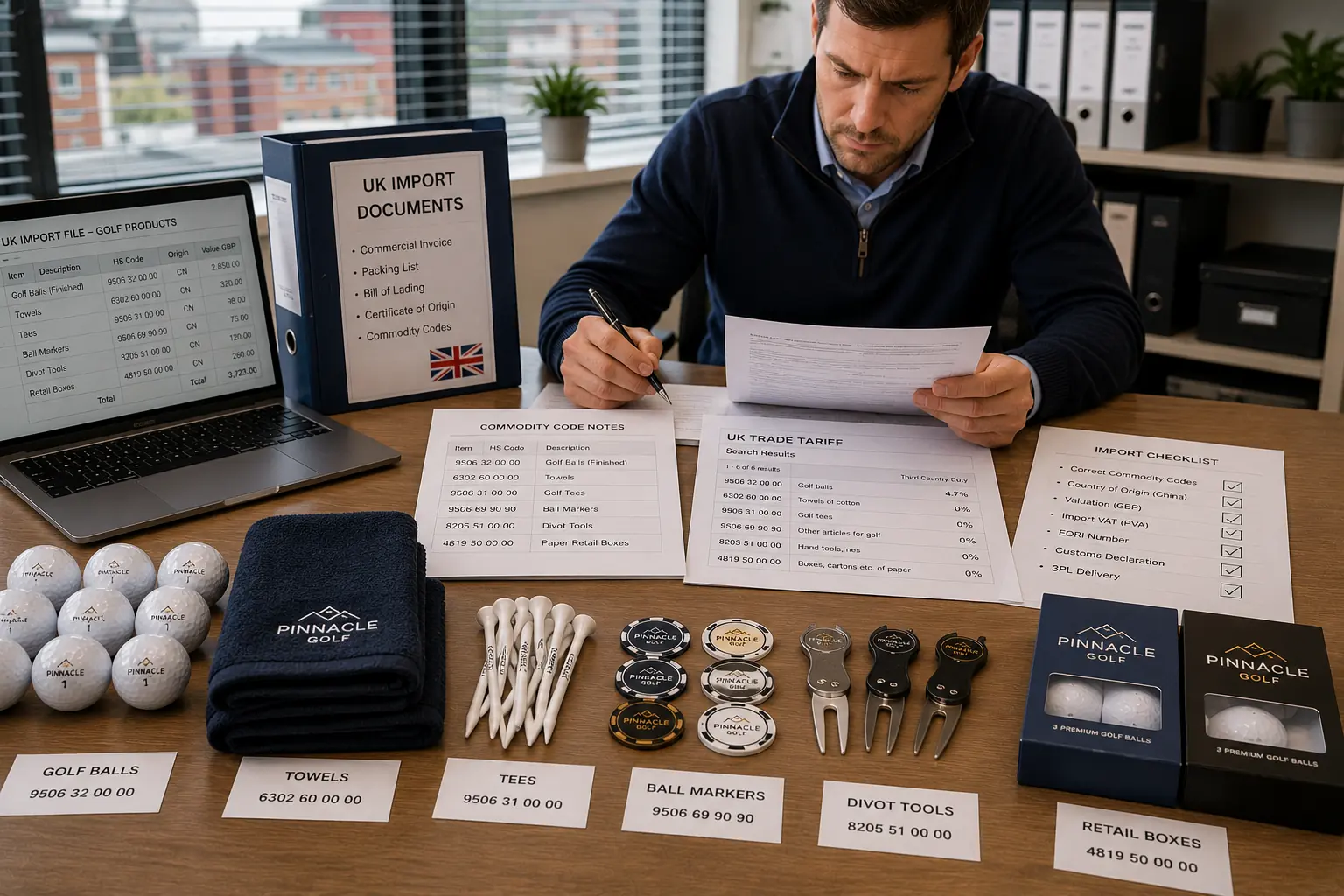
Your supplier may describe the order as “golf goods” or “sports goods,” but your UK import file needs a precise commodity-code basis. Finished golf balls are different from mixed gift kits that include towels, tees, markers, divot tools, or accessories.
Finished golf balls can start from UK commodity code 9506 32 00 for review, but mixed gift kits need item-level checking. Your team should ask the supplier to separate balls, towels, tees, markers, divot tools, accessories, retail boxes, and promotional bundles before the commercial invoice is approved.
For finished golf balls, the UK Trade Info commodity reference identifies golf balls under commodity code 95 06 32 00. Use the UK Trade Tariff to confirm the current commodity code, duty, VAT treatment, and import requirements at shipment date. Do not rely on a copied code from another market.
| Item type | Import-file risk | What to request | Buyer action |
|---|---|---|---|
| Finished balls | Generic description | 9506 32 00 basis | Broker check |
| Towels | Mixed kit issue | Separate line | Review code |
| Tees / markers | Hidden accessory | Item list | Split invoice |
| Gift box | Value / description gap | Packaging note | Match records |
| Promo bundle | Misclassification | Full breakdown | Check before ship |
| Carton labels | Warehouse mismatch | SKU label proof | Approve labels |
A generic “sporting goods” description is a failure signal for UK golf ball imports. It may pass a quick sales conversation, but it weakens the commercial invoice, packing list, SKU file, broker instruction, and warehouse receiving record. If your order includes custom logo balls plus accessories, split the product and accessory lines before the supplier issues the final invoice.
Your deliverable is a UK Commodity Code and Product Split Note. Confirm finished-ball code basis, mixed accessory lines, commercial invoice description, packing list, SKU labels, COO marking, and broker review before shipment. Any accessory, gift component, or promotional bundle should trigger item-level review before invoice approval.
Who Should Be Importer in the UK?
Your supplier may offer DDP UK without naming who acts as importer. That creates risk because your finance team needs to know whose GB EORI, VAT number, broker record, and import declaration path support the UK file.
Your UK DDP quote should name the importer role and GB EORI route before shipment. If your team cannot see whose importer record, VAT number, broker instruction, and declaration proof support the file, the quote may be convenient but weak for accounting, audit, and warehouse execution.
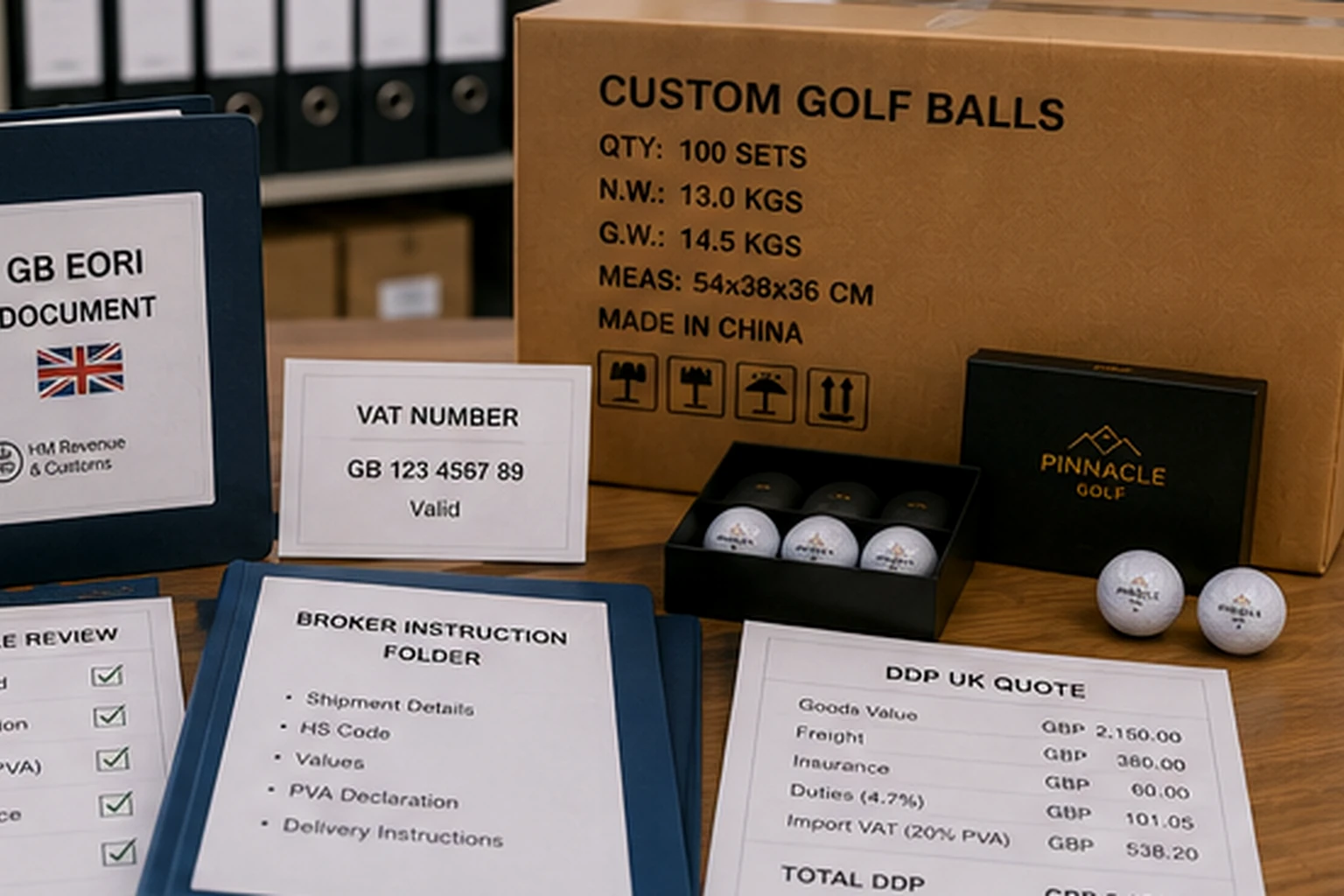
GOV.UK explains that you may need an EORI number if you move goods between Great Britain and another country, and its EORI guidance separates Great Britain from Northern Ireland routes. Use the official EORI guidance and which EORI number you need page before accepting DDP terms. Your broker and accountant should confirm how the importer role supports the VAT file.
| Importer item | Buyer risk | What to request | Buyer action |
|---|---|---|---|
| Named importer | Hidden IOR | Importer field | Confirm before PO |
| GB EORI | File mismatch | EORI route | Verify records |
| VAT number | PVA issue | VAT handling note | Ask accountant |
| Broker role | Weak instruction | Broker note | Review scope |
| DDP terms | Hidden assumption | VAT-paid / unpaid scope | Audit quote |
| NI delivery | Different route | NI review | Check separately |
Supplier quotes DDP UK without naming importer role or GB EORI route is a failure signal. Do not assume every DDP route protects your import and VAT records. The buyer, supplier, broker, forwarder, or another party may appear in different roles, and those roles should be visible before PO approval.
The PO should state that importer role, GB EORI route, broker instruction, declaration proof path, and DDP VAT-paid or VAT-unpaid scope must be confirmed before shipment release. Your deliverable is Importer Role and GB EORI Confirmation. No DDP approval without written importer-role and GB EORI route confirmation.
✔ True — Importer role and GB EORI route should be visible before DDP approval
Your UK file should connect importer role, GB EORI, VAT handling, broker instruction, commercial invoice, and declaration proof before the shipment moves.
✘ False — “If the supplier quotes DDP, the UK buyer’s import and VAT file is automatically protected”
A convenient DDP quote can still be IOR-blind if the importer record and proof path are not defined.
Can PVA Protect Your Import VAT File?
Your supplier may say import VAT is included, paid, postponed, or handled. That answer is not enough for a UK B2B buyer. Your finance team needs to know whether import VAT evidence, PVA statement access, CDS records, and VAT return support are available.
PVA can help only when your import VAT file is visible, eligible, and tied to the correct UK records. Your team should verify VAT registration, importer role, GB EORI, declaration instruction, CDS statement path, import VAT proof, and accountant review before accepting VAT-included or VAT-unpaid DDP terms.
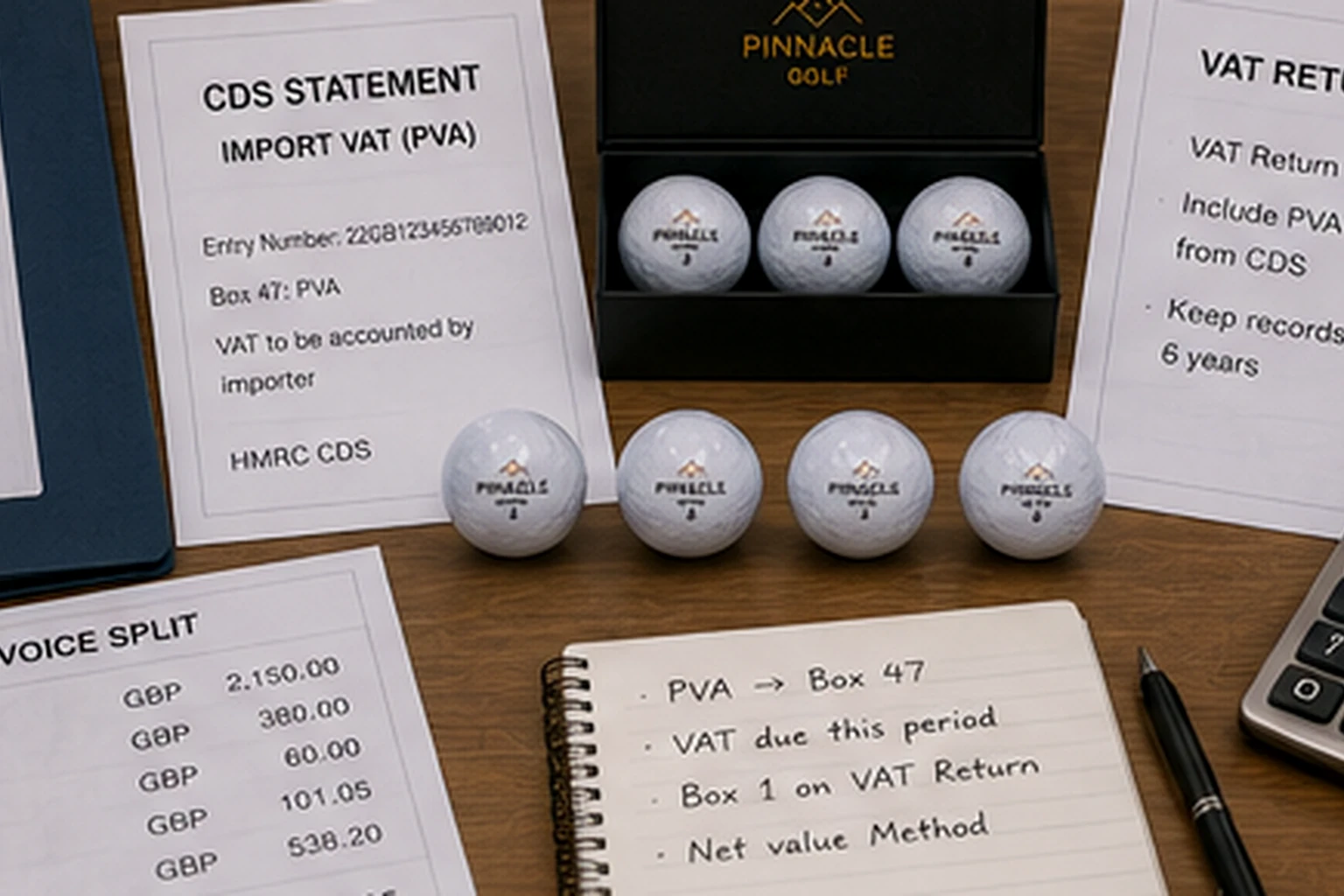
The UK standard VAT rate is 20%, so import VAT evidence should be part of your DDP review. Use UK VAT rates guidance as general context, then ask your accountant and broker how import VAT will be handled for your shipment. PVA is not a VAT exemption and should not be sold as a magic 20% saving.
| VAT question | Why it matters | What to request | Buyer action |
|---|---|---|---|
| VAT registered? | PVA eligibility | VAT number route | Ask accountant |
| Who imports? | Statement owner | Importer proof | Confirm role |
| GB EORI | Record match | EORI field | Check file |
| PVA instruction | VAT treatment | Broker note | Verify before ship |
| CDS statement | Evidence path | Statement access | Keep records |
| DDP wording | Hidden VAT | Paid / unpaid scope | Clarify terms |
HMRC guidance says that if you account for import VAT on your VAT Return, you must access the Customs Declaration Service to get a monthly postponed import VAT statement online. The guidance also says the monthly statement contains information to support your claim under normal rules. Use the official postponed import VAT statement guidance and VAT Return guidance for import VAT when building your proof path.
VAT is “included” but PVA statement or import VAT proof path is unclear is a failure signal. VAT approval should require written confirmation of VAT registration route, importer role, GB EORI, PVA instruction, CDS statement access or other import VAT evidence, and accountant review before DDP acceptance.
Your deliverable is an Import VAT and PVA Proof Path. DDP approval requires import VAT proof visibility, not only “VAT included” wording.
Will Your UK 3PL Accept Delivery?
Your golf balls can clear customs and still fail at the UK warehouse. A strict 3PL, Amazon UK fulfilment centre, retailer DC, distributor warehouse, or DTC fulfilment partner may reject delivery if pallet size, booking reference, carton labels, SKU labels, delivery appointment, or truck access is wrong.
UK warehouse delivery should be approved before cargo leaves China, not arranged after customs clearance. Your team should provide the 3PL routing guide, pallet specs, carton label rules, booking reference process, delivery appointment window, truck access, tail-lift needs, and redelivery terms before shipment booking.
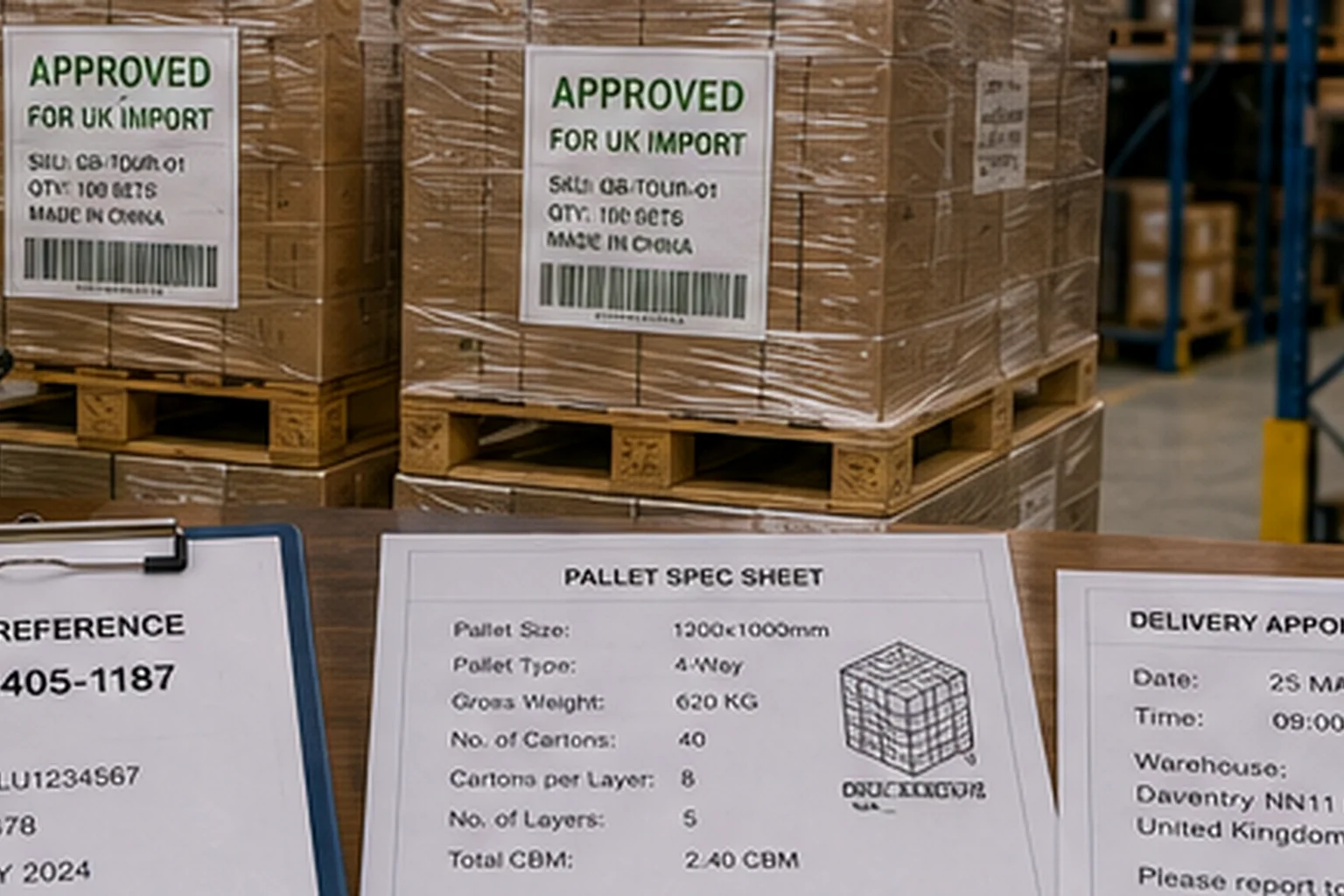
Do not treat final-mile delivery as a generic line in the quote. The receiving address type matters: Amazon UK, 3PL, retailer DC, golf distributor, pro shop, event venue, driving range, or office delivery can each require different labels, pallets, appointment rules, and carrier instructions.
| Receiving item | Turn-away risk | What to request | Buyer action |
|---|---|---|---|
| Warehouse type | Wrong route | 3PL / Amazon / DC | Confirm address |
| Pallet size | Rejection | Routing guide | Approve spec |
| Carton label | Receiving delay | Label template | Check proof |
| SKU label | Picking error | SKU label rule | Match records |
| Booking slot | Turn-away fee | Appointment rule | Book before delivery |
| Truck access | Failed delivery | Dock / tail-lift note | Confirm carrier |
| Redelivery | Extra cost | Redelivery terms | Add to RFQ |
If the delivery is to Amazon UK, follow the current Amazon Seller Central LTL and truckload delivery guidance for the shipment, pallet, label, booking, and delivery process. Amazon Seller Central guidance states that UK LTL or truckload deliveries may use 1,000 × 1,200 mm four-way-access wood pallets or 1,000 × 1,200 mm CHEP pallets, but your team should still verify the active routing guide in your own Seller Central account before booking. Amazon UK is a useful strict receiving example, but do not generalize Amazon rules to every UK 3PL. A golf distributor warehouse, DTC fulfilment centre, retailer DC, or event venue may use different pallet and booking rules.
Warehouse delivery arranged without the 3PL routing guide or booking rules is a failure signal. UK warehouse receiving can be stricter than customs clearance; a shipment can be customs-cleared and still turned away at the dock.
Your deliverable is a UK 3PL Receiving Compliance Plan. Confirm final warehouse address, routing guide, pallet dimensions, carton labels, SKU labels, booking reference, delivery appointment, truck access, tail-lift, forklift availability, and redelivery terms before shipment booking.
✔ True — UK warehouse delivery depends on the current receiving guide
Your 3PL, Amazon account, retailer DC, or fulfilment warehouse may have specific rules for pallets, labels, booking, truck access, and delivery appointment.
✘ False — “Customs clearance means the 3PL, Amazon warehouse, or retailer DC will automatically accept the shipment”
A warehouse can reject a delivery that clears customs if labels, pallet specs, booking, or access rules are wrong.
What Should Your UK RFQ Require?
Your RFQ may ask for unit price, logo printing, packaging, DDP UK, and lead time. That is not enough if the supplier cannot show commodity-code basis, importer role, GB EORI route, import VAT proof path, and warehouse receiving compliance.
Your UK RFQ should lock commodity code, importer role, VAT proof, PVA path, and 3PL receiving rules before accepting DDP. Ask for GB EORI route, product split, invoice structure, COO marks, packing list, pallet specs, carton labels, delivery appointment rules, booking reference, and final delivery proof.
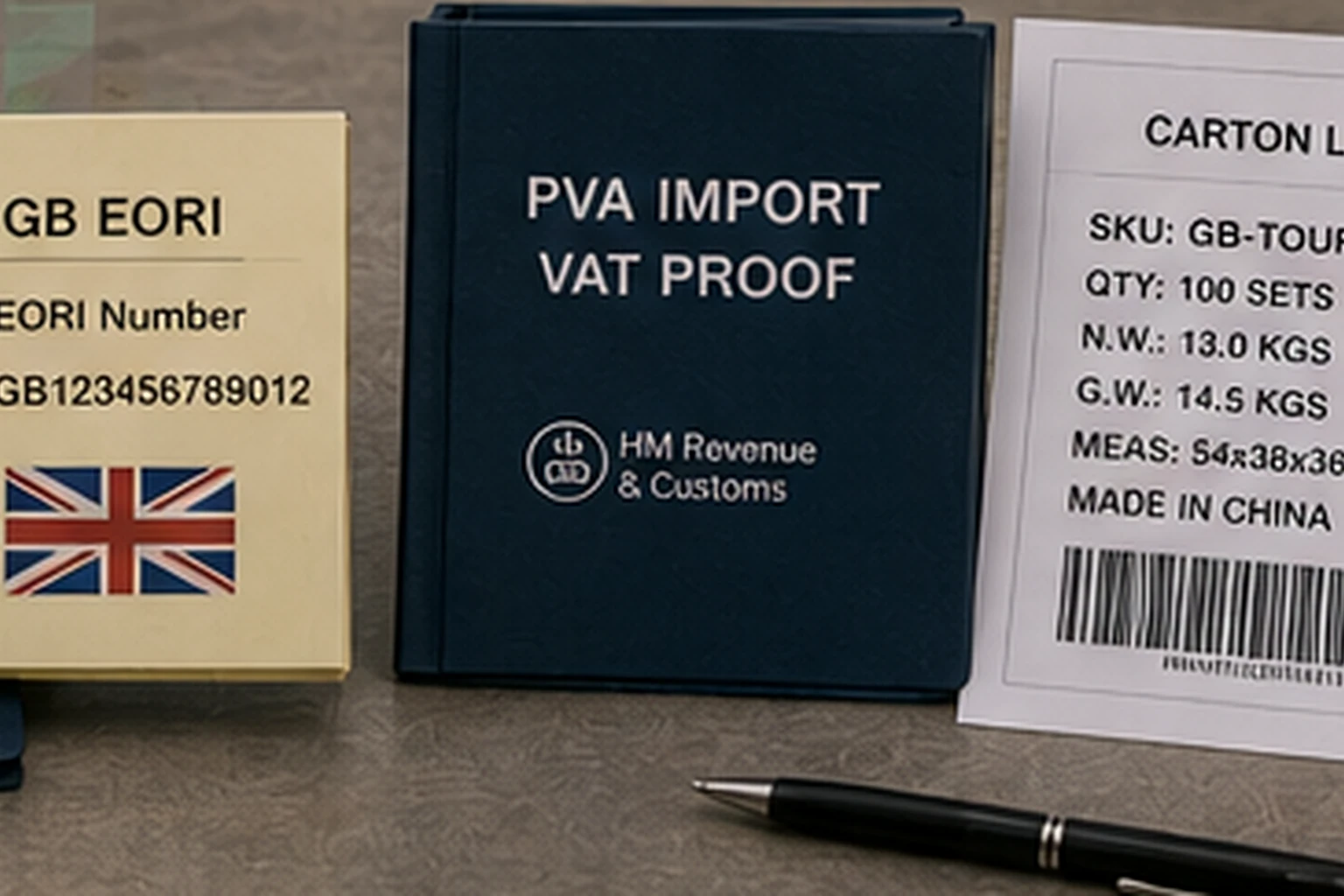
A UK-bound RFQ should make the import file and warehouse file visible at the same time. Small-batch gift orders, event gifts, DTC launch stock, Amazon UK inventory, driving range replenishment, and distributor bulk shipments may need different route, label, packing, and receiving controls. Do not force every shipment into one DDP template.
| RFQ item | Why it matters | What to request | Acceptance evidence |
|---|---|---|---|
| Commodity code | Customs file | 9506 32 00 basis | Broker note |
| Product split | Mixed kit risk | Item list | Invoice match |
| Importer role | VAT file | Named importer | EORI proof |
| PVA path | VAT evidence | CDS / PVA route | Accountant check |
| DDP scope | Hidden cost | VAT-paid / unpaid terms | Written scope |
| COO label | Origin proof | Made in China photo | Packaging proof |
| Pallets / labels | 3PL acceptance | Routing-guide match | Warehouse sign-off |
| Appointment | Turn-away risk | Booking rule | Delivery proof |
Supplier shall provide a UK-bound shipment file before release, including commodity code basis, product and accessory breakdown, importer role, GB EORI route, import VAT handling route, PVA or import VAT proof path, commercial invoice, packing list, COO / Made in China carton marking, SKU and carton labels, estimated packing list, pallet dimensions, carton count, gross weight, CBM, final warehouse address, 3PL routing guide, delivery appointment rules, booking reference requirement, and final delivery proof.
Buyer approval of a UK-bound shipment requires written confirmation that the quote is based on shipment-date commodity-code review, verified importer and GB EORI route, approved import VAT / PVA evidence path, approved invoice split, approved COO marking, approved pallet and carton-label specifications, and written 3PL delivery rules.
Your RFQ can read as follows.
“Please quote this UK-bound golf ball shipment based on our final warehouse address and receiving rules. Confirm the UK commodity code basis, product and accessory breakdown, importer role, GB EORI route, import VAT handling, PVA or import VAT proof path, commercial invoice split, DDP VAT-paid or VAT-unpaid scope, COO / Made in China carton marking, estimated packing list, pallet dimensions, carton labels, 3PL delivery appointment rules, booking reference requirement, and final delivery proof before shipment approval.”
Any change to importer role, broker route, invoice structure, packaging label, carton size, pallet configuration, warehouse address, or delivery appointment rule should require written buyer approval before shipment.
FAQ
What is the UK commodity code for golf balls?
Finished golf balls can start from UK commodity code 9506 32 00 / 9506320000 for review, but your team should verify the current code, product mix, and shipment-date treatment before shipment.
Ask your supplier to separate finished golf balls from towels, tees, markers, divot tools, accessories, and gift-kit items. Match the commodity code, commercial invoice, packing list, SKU records, and carton labels. Do not let the file describe the goods only as “sports goods.”
Do I pay import duty from China to the UK?
Duty depends on current UK tariff treatment, origin, product mix, and shipment-date classification, so your team should ask a broker to verify the commodity code before the commercial invoice is approved.
Do not use an old landed-cost sheet as proof. A finished-ball code may not cover a promotional gift set with accessories. Keep classification proof in the shipment file, but remember that duty is only one part of the UK import decision. Import VAT, importer role, PVA proof, and warehouse receiving still matter.
Do I need a GB EORI number to import into the UK?
For imports into Great Britain, your team should confirm whether a GB EORI is required and how it appears in the import file before accepting DDP terms.
Great Britain means England, Scotland, and Wales. Northern Ireland may require separate review, especially when goods move through different routes. Confirm importer role, broker instruction, EORI route, VAT number route, and declaration proof before PO approval. Do not assume your supplier’s DDP process automatically protects your records.
What is Postponed VAT Accounting in the UK?
Postponed VAT Accounting is an import VAT accounting method, not a VAT exemption; it can support cash flow and recordkeeping when the declaration and buyer file meet the required conditions.
Ask your broker and accountant whether your shipment can use PVA and whether the import declaration will carry the correct details. Your finance team should know how to access the postponed import VAT statement or other import VAT evidence. PVA should be treated as a proof path, not a slogan.
What is a postponed import VAT statement?
A postponed import VAT statement is the monthly online evidence path used when import VAT is accounted for on the VAT Return through the Customs Declaration Service.
Your finance team should confirm who can access the statement, which EORI it is tied to, and whether the statement supports the VAT Return evidence needed for the shipment. Ask this before shipment, because proof access after clearance can be harder to fix.
Can I claim back import VAT on DDP shipments?
It depends on importer role, VAT registration, EORI route, and import VAT evidence; do not assume VAT-included DDP creates a usable VAT file for your business.
Ask who appears as importer, whose GB EORI is used, whether PVA is instructed, whether a CDS statement or other import VAT proof is available, and how your accountant will review the record. DDP can be useful, but VAT-blind DDP can weaken the file.
Does DDP include UK import VAT?
Not automatically in a way that helps your finance team; the quote should state VAT-paid or VAT-unpaid scope, importer role, GB EORI route, and proof documents.
A one-line DDP total is not enough. Ask whether import VAT is paid, postponed, or handled through another route. Confirm whether PVA is supported, whether import VAT evidence can be accessed, and whether the commercial invoice split is clear enough for accounting review.
What should Amazon UK or a UK 3PL receive before delivery?
Your warehouse should receive booking, pallet, carton label, SKU label, delivery appointment, access, and delivery-proof details before the carrier arrives.
Send the current routing guide to the supplier before packing. Ask for pallet photos, carton label proofs, SKU labels, booking reference, appointment confirmation, and truck-access requirements. If the shipment is for Amazon UK, verify the current Seller Central guidance in your own account before booking delivery.
Should small-batch gifts and bulk distributor orders use the same UK route?
Not always; small promo or gift orders may need courier or air routing, while distributor bulk usually needs pallet control, 3PL booking, EPL accuracy, and carton-label approval.
A corporate gift order may be deadline-driven and packaging-sensitive. A distributor or driving range replenishment order may be palletized and warehouse-driven. Match route, labels, pallet plan, packing list, delivery address, and appointment rules to the order type before shipment booking.
What should a UK DDP quote include?
A UK DDP quote should include commodity code basis, product split, importer role, GB EORI route, import VAT handling, PVA proof path, invoice split, COO labels, pallet specs, 3PL rules, and delivery proof.
Reject vague “door to door” wording. Ask for auditable import evidence, VAT proof path, warehouse receiving rules, pallet and carton-label specifications, booking reference requirements, and final delivery proof before shipment release.
Conclusion
The safest UK import is not the cleanest DDP price. It is the shipment your team can verify across commodity code, GB EORI, importer role, import VAT, PVA proof, and warehouse receiving.
Before importing golf balls from China to the UK, confirm the commodity-code basis, product split, importer role, GB EORI route, import VAT handling, PVA proof path, commercial invoice split, COO labels, estimated packing list, pallet specs, carton labels, final warehouse address, 3PL delivery appointment, booking reference, and delivery proof.
If the supplier cannot prove those details before shipment, your order is not yet UK-ready. The golf balls may clear customs, but your VAT file or warehouse door can still say no.
You might also like — How to Import Golf Balls from China to Germany?