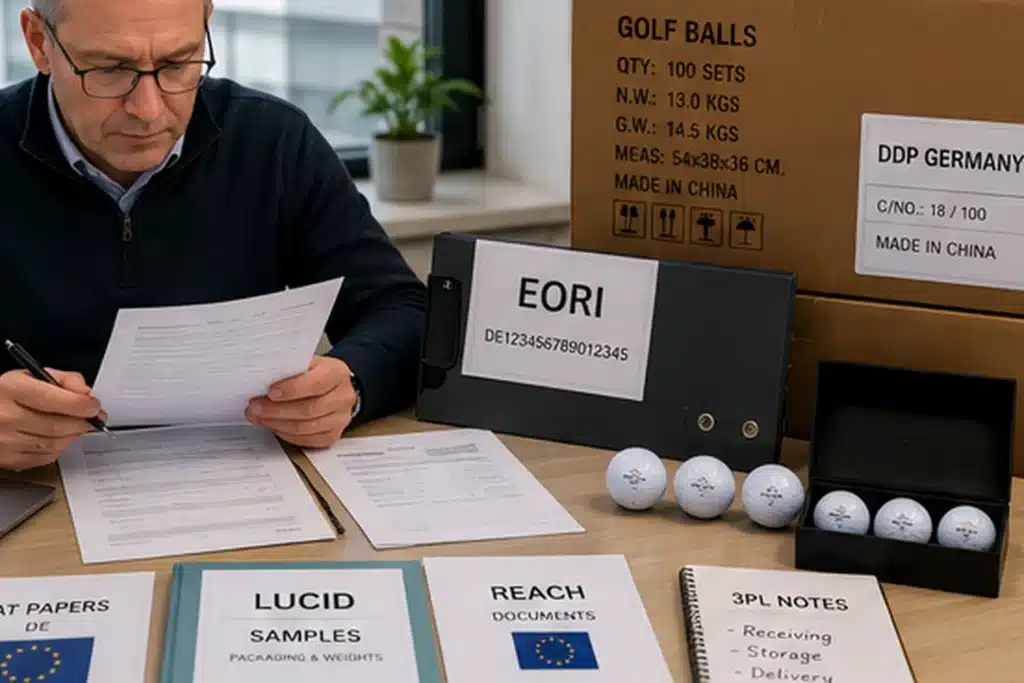
Indonesia can make serious golf balls, but access and yield decide whether it works for your OEM launch.
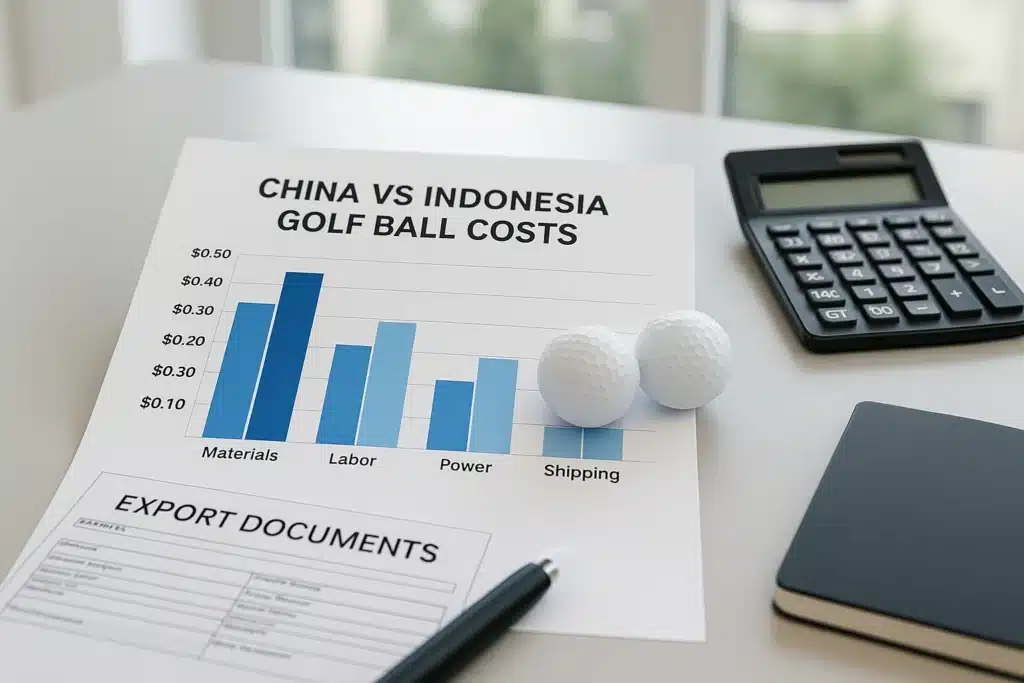
For China vs Indonesia golf ball costs in 2026, Indonesia is usually cheaper on direct labor at about $0.02–$0.05/ball versus China at $0.05–$0.12/ball. But China often offers more open OEM access, stronger packaging flexibility, and a clearer pilot-to-mass path for independent 3/4-layer urethane programs.
| Country | Best cost advantage | Best OEM role | Main sourcing risk |
|---|---|---|---|
| China | Packaging flexibility, open capacity, faster validation | 3/4-layer urethane, volume Surlyn, DTC launches, multi-SKU programs | Must verify supplier capability, QC data, and batch repeatability |
| Indonesia | Lower direct labor and slightly lower power | Affiliated production, ASEAN-origin stories, simple Surlyn, relabel or event programs | High-end capacity may be captive or hard for third-party buyers to book |
The answer is simple for sourcing teams: Indonesia may win the labor line, while China often wins the independent OEM execution path. The wrong comparison is country versus country; the right comparison is captive capacity versus open OEM access, then FOB price versus yield-adjusted landed cost.
Before you move a golf ball project from China to Indonesia, check five decision gates:
-
Cost gap: materials are similar at about $0.15–$0.32/ball, so labor is not the whole decision.
-
Open capacity: SRI / Dunlop proves Indonesia capability; it does not guarantee third-party OEM slots.
-
Yield control: 3/4-layer urethane needs FPY, scrap, rework, CT/X-ray, and Cpk proof.
-
Packaging CBM: compact cartons and fold-flat packaging can protect US landed cost.
-
Compliance path: USGA/R&A conformance and batch QA must both be verified before scale.
This guide does not dismiss Indonesia. It separates serious manufacturing capability from buyer-access reality, then helps you decide which country protects your margin, packaging plan, launch calendar, and repeat-order quality.
What is the 2026 China-Indonesia cost gap?
You see Indonesia’s lower labor number and may assume it wins, but high-end urethane cost depends on yield, validation speed, packaging, and open capacity.
Indonesia can be cheaper on direct labor, but China can still win total OEM cost for independent multi-layer urethane. Materials are similar at $0.15–$0.32 per ball, while China’s packaging ecosystem, open capacity, validation speed, and yield control can protect US landed cost.
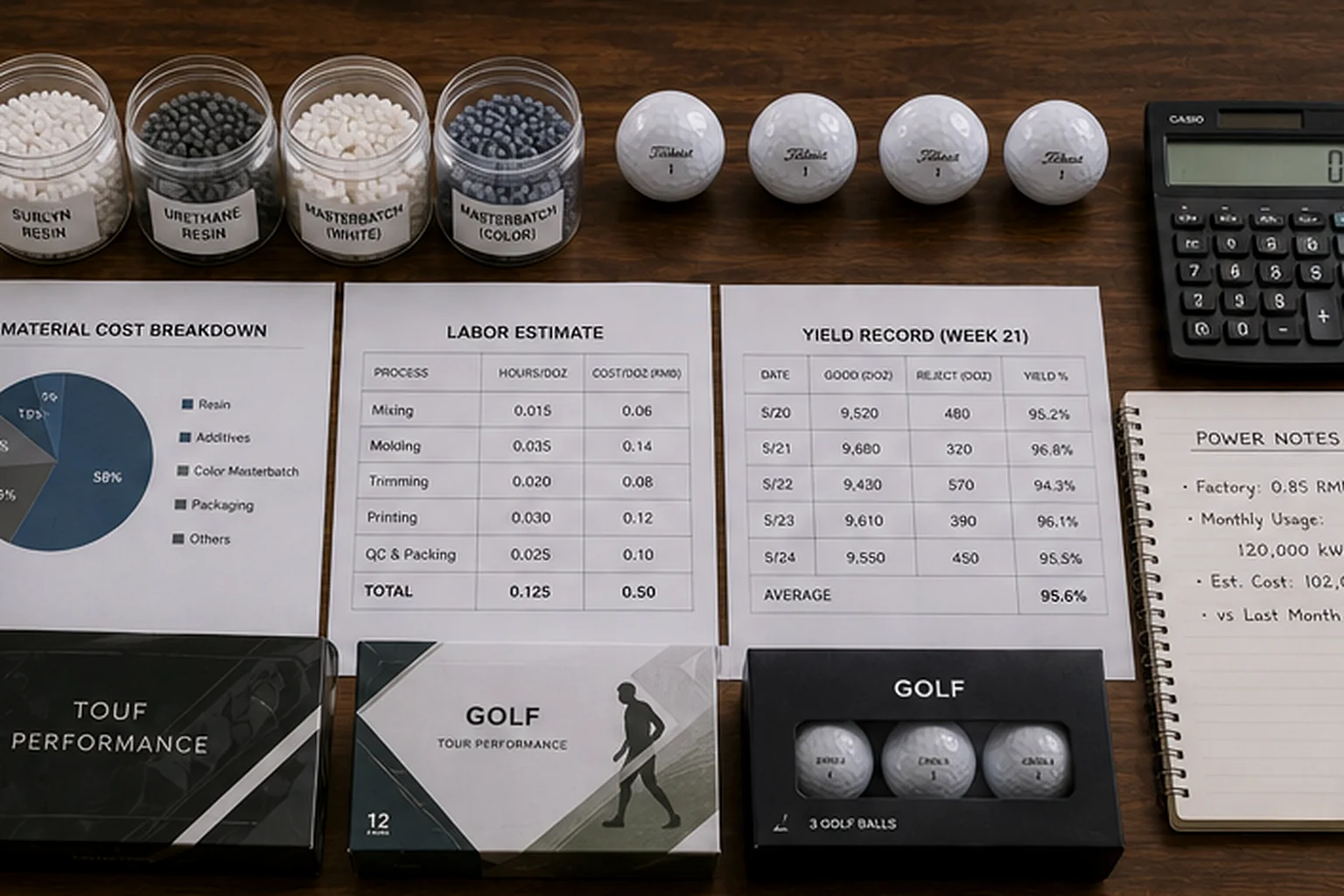
The first spreadsheet often flatters Indonesia. Direct labor can run about $0.02–$0.05/ball in Indonesia versus $0.05–$0.12/ball in China. Power can also lean Indonesia at about $0.004–$0.008/ball versus China at $0.005–$0.013/ball. Those differences matter, especially for simple 2-piece Surlyn, relabel, or event programs.
But a golf ball OEM manufacturing cost breakdown is not only a wage table. Materials remain the largest visible cost band at about $0.15–$0.32/ball in both countries because ionomers, TPU, cast-urethane systems, PBR rubber, crosslinkers, paints, and additives follow global chemical supply-chain logic. Country deltas are usually modest; scrap and rework are factory-specific.
Use the cost table as the starting point, then add yield and packaging before you decide.
| Cost pillar | China | Indonesia | What it really means | Buyer move |
|---|---|---|---|---|
| Materials | $0.15–$0.32 | $0.15–$0.32 | Global chemical pricing limits country gap | Model grams + scrap |
| Power | $0.005–$0.013 | $0.004–$0.008 | Indonesia slightly lower | Check kWh and cure load |
| Labor | $0.05–$0.12 | $0.02–$0.05 | Indonesia labor edge | Do not ignore yield |
| Packaging | $0.08–$0.20 | $0.10–$0.22 | China has stronger packaging flexibility | Request CBM/dozen |
| Yield / rework | Factory-specific | Factory-specific | Can erase labor savings | Ask FPY + rework |
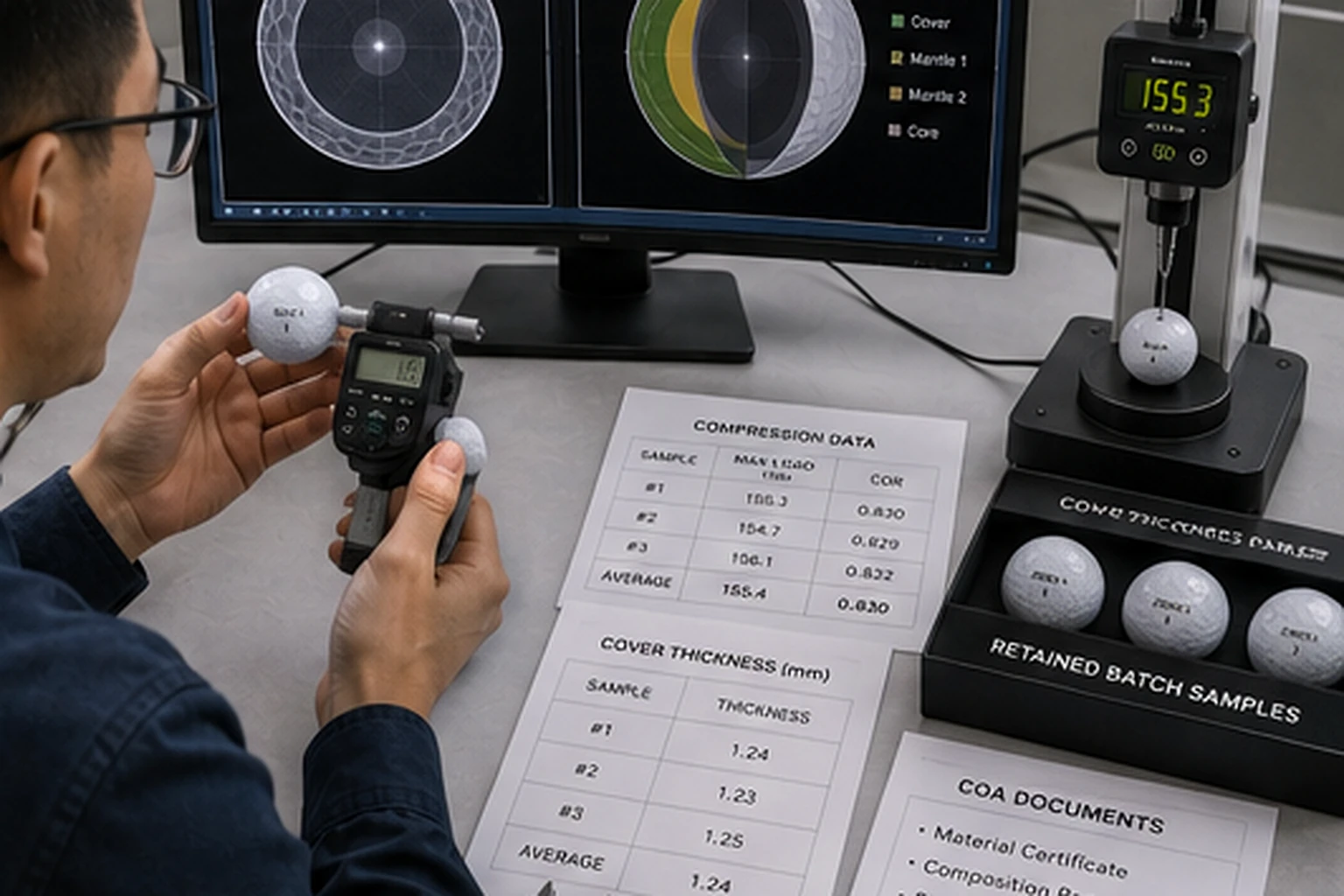
A failure signal appears when an Indonesia quote wins on labor but gives no FPY, scrap rate, repaint rate, recure data, or shell-thickness evidence. That quote is not cheaper yet. It is only less complete. For simple Surlyn balls, the labor edge may matter. For 3/4-layer urethane, a small increase in scrap, repainting, recuring, or failed concentricity checks can consume the labor advantage before the first container ships.
CFO buyers prefer yield-adjusted cost because it reflects the real route to sellable inventory. Request same-spec China and Indonesia quotes with labor, materials, power, packaging, yield, rework, and CBM assumptions separated. Compare US landed cost by SKU role, not labor alone.
Why does a $0.02 labor edge not win?
Because high-end golf ball cost is yield-adjusted. The expensive loss is not only operator time; it is resin, coating capacity, rejected covers, repeat testing, and delayed launch revenue.
For 3/4-layer urethane, the factory must hold core centering, mantle behavior, cover thickness, coating window, compression distribution, and cosmetic finish together. If any of those drift, you pay twice: once in waste and again in calendar uncertainty. A low labor line cannot protect you from a weak thermal window, poor shell-thickness control, or off-center internal construction.
Do not approve a 3/4-layer urethane transfer unless FPY, scrap, rework, and validation evidence support the labor savings. A practical acceptance gate should include FPY, scrap/rework rate, compression distribution, CT/X-ray or cut-ball concentricity evidence, cover-thickness data, and retained samples linked to the approved sample.
✔ True — Indonesia’s labor advantage is real.
Lower direct labor can help simple builds, especially when specs, packaging, and timing are straightforward. It should be modeled, not ignored.
✘ False — “Indonesia wins because labor is cheaper.”
Multi-layer urethane should be judged by yield-adjusted landed cost, including scrap, rework, validation time, packaging CBM, and launch risk.
Is Indonesia open OEM or captive capacity?
You may see SRI / Dunlop manufacturing in Indonesia and assume your independent brand can book similar high-end capacity.
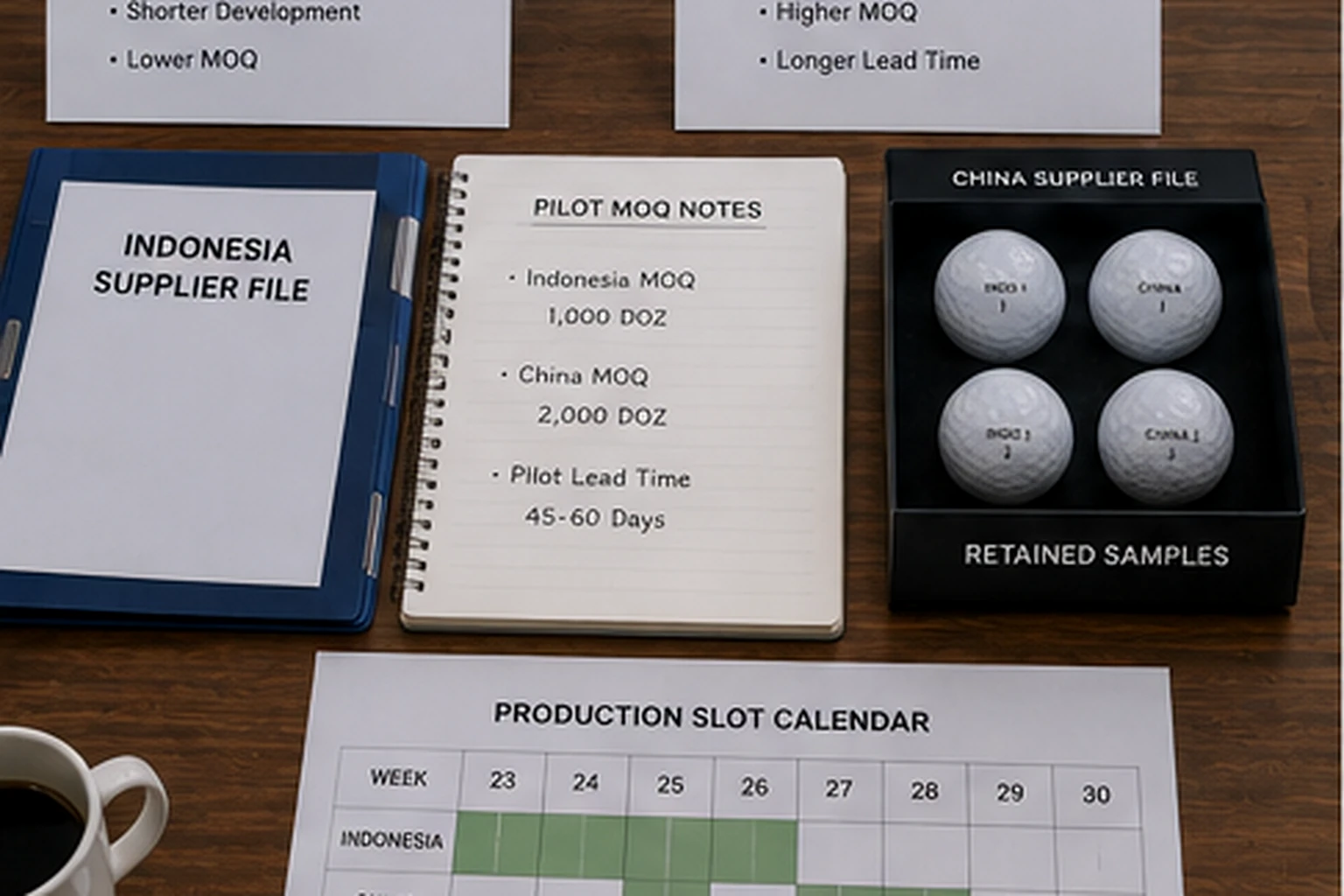
Indonesia has proven golf ball manufacturing capability, but open OEM access is the buyer’s real question. SRI / Dunlop-linked production proves technique; it does not automatically mean independent DTC brands can book predictable 3/4-layer urethane pilot and mass slots.
Indonesia deserves respect in golf ball manufacturing. Sumitomo Rubber Industries reports that P.T. Sumi Rubber Indonesia began producing golf balls in April 1998, and Dunlop’s official story also records the commencement of golf ball manufacturing by P.T. Sumi Rubber Indonesia. For sourcing teams, the lesson is not to dismiss Indonesia. The lesson is to separate proven manufacturing capability from open third-party OEM access. See the official SRI Indonesia manufacturing note and Dunlop Sports story.
The practical issue for independent OEM buyers is different: can your brand access that capacity on predictable terms? Captive capacity means technical resources may serve affiliated or in-house brands first. Open OEM capacity means a third-party buyer can request pilot MOQ, mass MOQ, slot windows, construction route, validation schedule, and batch QC evidence with a realistic chance of booking the line.
| Decision point | Indonesia signal | China signal | Buyer move |
|---|---|---|---|
| Technical capability | Proven in affiliated ecosystems | Broad supplier base | Respect both |
| Open OEM access | Limited / case-by-case | More open third-party options | Ask slot windows |
| Pilot MOQ | May be project-based | More negotiable pilots | Request T0/T1 plan |
| Multi-layer Urethane | Capability exists, access constrained | More open routes | Verify capacity |
| Launch certainty | Depends on affiliation and slots | More alternates | Plan backup |
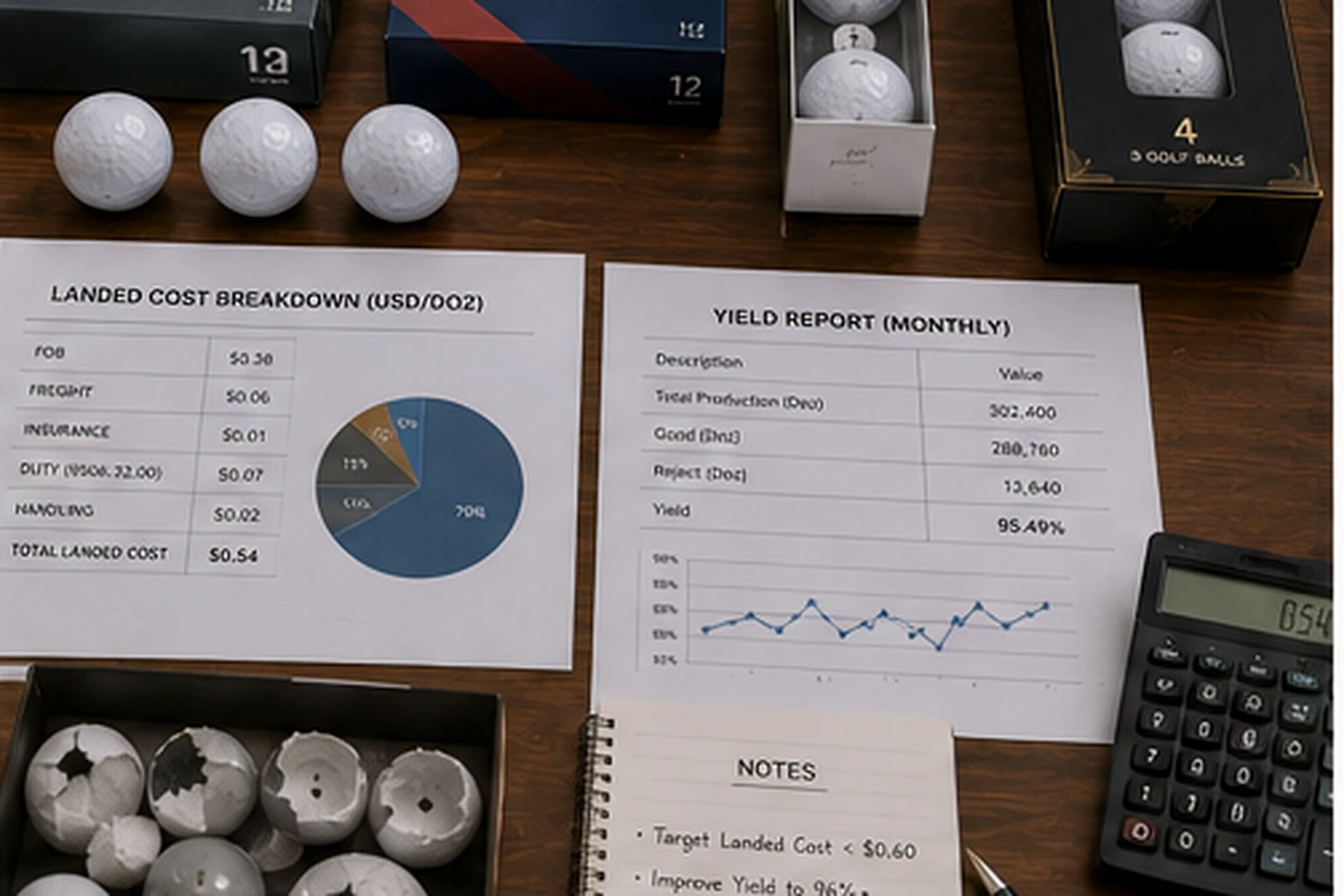
CPO buyers prefer open capacity because open capacity creates calendar options. If one supplier’s coating line is full, a China open OEM network may offer another qualified path. If an Indonesia slot is tied to an affiliated production calendar, your timing may depend on someone else’s priority.
This is where many sourcing plans go wrong. “Indonesia can make premium balls” is true. “Your independent brand can book that exact capacity next quarter” is a separate question. Treat famous-brand presence as proof of technical credibility, not proof of external availability.
Can third-party brands book the line?
They may be able to, but the supplier must prove access. Famous-brand manufacturing presence is not the same thing as an available OEM window.
A failure signal appears when a supplier references Indonesia major-brand capability but cannot offer third-party slot windows, pilot MOQ, mass MOQ, or external customer rules. That is not a technical refusal; it is an access warning. Your project may still work, but it needs earlier commitment, stricter acceptance gates, and a backup path.
Ask whether Indonesia capacity is available for third-party OEM or only affiliated / in-house production. Request available slot windows, pilot MOQ, mass MOQ, external customer rules, and 3/4-layer urethane eligibility. Treat Indonesia as viable only when the supplier proves open access, not only famous-brand presence.
Supplier should confirm whether the quoted capacity is open third-party OEM, affiliated production, or in-house brand production, and identify slot windows, pilot MOQ, mass MOQ, approved sample ID, dimple tool ID, construction route, cover route, production batch ID, and retained-sample policy before pilot approval.
How do yield and packaging change landed cost?
You may save a few cents on labor but lose more through scrap, repainting, packaging CBM, local print limitations, or missed launch windows.
Packaging and yield can overturn a labor-cost comparison. In golf ball OEM, a cheaper labor line may lose if urethane scrap rises, repainting adds loops, or bulky packaging increases CBM. China’s packaging ecosystem can protect landed cost through compact, fold-flat designs.
Materials are global; scrap is local. A supplier can quote the same material band as another country and still cost more after rejected covers, coating loops, off-center layers, or missed approval windows. For cast urethane golf ball mass production, the real cost swing often sits inside the factory’s process control, not the country’s wage table.
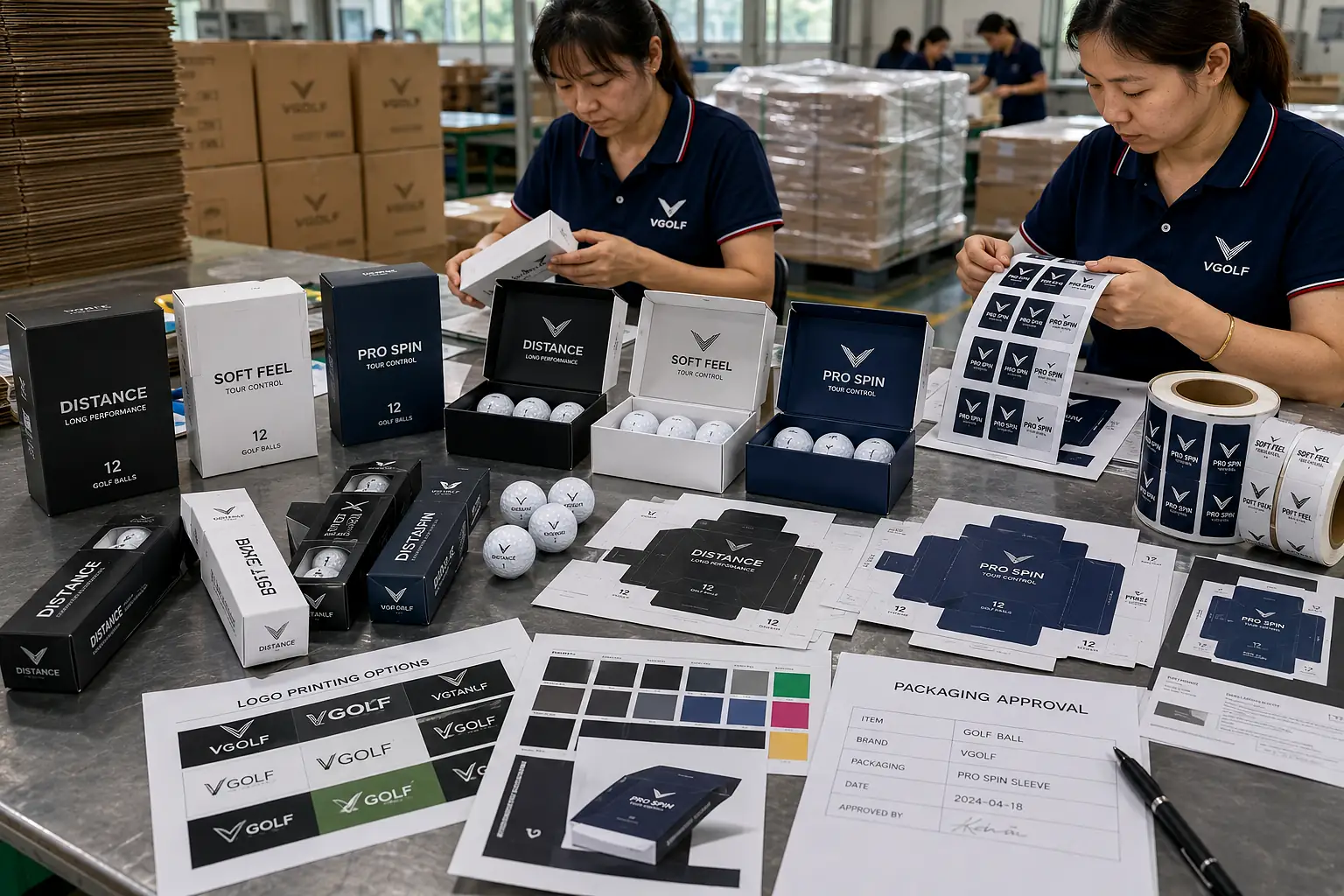
Packaging works the same way. A box is not just a box. It affects CBM per dozen, carton count, pallet loading, print MOQ, insert choice, retail display, sampling speed, and container efficiency. China’s packaging advantage is not only cheaper paper. It is the density of sleeve makers, dozen-box suppliers, color-box printers, EVA insert vendors, label shops, carton factories, and export packing teams that can iterate quickly.
| Margin risk | How it appears | Buyer proof | Buyer move |
|---|---|---|---|
| Scrap / rework | Rejected covers or repaint loops | FPY + rework rate | Model yield-adjusted cost |
| Shell drift | Uneven cover thickness | CT / thickness data | Gate before mass |
| Concentricity | Flight / feel drift | X-ray/CT samples | Reject weak proof |
| Packaging CBM | Air shipped in cartons | CBM/dozen + pallet plan | Use fold-flat where possible |
| Launch delay | Repeated approvals | Validation timeline | Reserve backup slot |
When does packaging erase labor savings?
Packaging erases labor savings when the carton ships air, requires high MOQ, delays approval, or forces expensive local kitting. The FOB ball price can still look fine while landed cost quietly worsens.
For volume programs, fold-flat sleeves, compact dozen cartons, dense master cartons, and realistic pallet plans matter. For premium kits, rigid boxes, EVA, windows, and gift structures can be useful, but they must be modeled against freight and channel value. If Indonesia production requires expensive local packaging or cross-border packaging coordination, the labor advantage may shrink.
Request premium packaging and fold-flat packaging quotes with carton dimensions, dozens per carton, CBM per dozen, carton gross weight, and pallet loading plan. Compare landed cost after packaging CBM and rework assumptions. Do not choose Indonesia or China by FOB until packaging CBM and yield assumptions are visible.
A packaging quote that excludes CBM/dozen, carton dimensions, or pallet plan is the third failure signal. It may be fine for a sample, but it is not ready for a CFO’s landed-cost model.
✔ True — Packaging is part of landed cost engineering.
Box price matters, but CBM, carton shape, pallet load, print MOQ, and kitting time can change the real margin.
✘ False — “Packaging is a small cost item.”
A bulky gift pack can erase labor savings if it lowers container efficiency or delays the launch window.
Which QC gates protect Urethane scale-up?
You need proof that samples can repeat at scale, especially if you are considering Indonesia for complex urethane or switching from China.
USGA/R&A listing proves design conformance, not batch repeatability. Before scaling China or Indonesia OEM orders, require compression data, COR/IV, CT/X-ray concentricity, cover-thickness Cpk, weight checks, retained samples, and batch-linked COA evidence.
USGA/R&A conformance is not a country label. It evaluates whether a submitted ball model meets rules-related requirements such as weight, size, spherical symmetry, initial velocity, and overall distance. The Conforming Golf Ball List supports tournament and serious retail acceptance, but it does not replace shipment-level process control. For current official references, check the USGA List of Conforming Golf Balls and the R&A Conforming Ball List.
This matters for both China and Indonesia. A listed design can still drift if a new batch changes compression, cover thickness, coating cure, center alignment, paint stack, or markings. A premium OEM decision should separate design eligibility from lot consistency. Listing gets the model into the market; batch QA keeps every shipment defensible.
| Gate | What it proves | Evidence to request | Buyer move |
|---|---|---|---|
| USGA/R&A status | Design eligibility | Current model listing / submission plan | Verify markings |
| Compression | Feel and speed consistency | Raw values + range | Compare pilot vs mass |
| COR / IV | Energy return | Test report | Confirm same method |
| CT / X-ray | Concentricity | Images by batch | Reject hidden drift |
| Cover thickness | Spin / durability control | Cpk≥1.33 where available | Gate before scale |
| Retained samples | Reorder investigation | Lot-linked samples | Hold for claims |
What should the COA include?
A useful COA should connect the approved sample to the actual batch. It should include model marking, sample ID, batch ID, raw measurements, equipment ID, calibration date, and retained-sample plan.
Use Cpk≥1.33 as a buyer-side process capability target where the supplier can support it, not as an official golf-ball regulatory requirement. For 3/4-layer urethane, your team should request compression distribution, COR/IV data where applicable, CT/X-ray or cut-ball concentricity proof, cover-thickness data, weight checks, finish inspection, and retained samples.
Ask the supplier to confirm whether capacity is open third-party OEM or affiliated/in-house production, then provide pilot MOQ, mass MOQ, slot windows, FPY, scrap/rework rate, compression distribution, CT/X-ray concentricity samples, shell-thickness Cpk, retained-sample policy, and current USGA/R&A listing or submission path.
Do not scale from sample to mass without COA and retained-sample proof. A good sample proves possibility. A batch-linked file proves control.
✔ True — Listing is the ticket in.
USGA/R&A status supports eligibility, but lot-level QA protects feel, flight, finish, and reorder consistency.
✘ False — “Listed models do not need inspection.”
Batch variance still happens. Compression, CT/X-ray, cover thickness, and retained samples protect the shipment.
Which China OEMs fit open-capacity orders?
You need to keep the indexed China supplier entities while turning them into a buyer-action table.
For open-capacity China OEM sourcing, start with Grasbird, Golfara, MLG Sports, and Shenzhen Xinjintian. Use the list to screen capability, MOQ, packaging route, Urethane access, sample timing, and QC evidence before comparing against Indonesia’s tighter external OEM windows.
China’s advantage is not that every factory can make every tour-style ball. That would be a dangerous assumption. The advantage is that China has more visible third-party OEM paths for independent buyers: more quoting routes, more packaging options, more pilot conversations, and more alternate suppliers when calendars move.
Use this China OEM list as a screening tool, not final approval.
| Company | Location | Capabilities | MOQ | Buyer move |
|---|---|---|---|---|
| Grasbird | Hangzhou, Zhejiang | 2-piece Surlyn; some 3-piece | 3,000–5,000 pcs | Verify spec and tolerance |
| Golfara | Ningbo, Zhejiang | 2/3/4-layer; Urethane-covered models | from 1,000 pcs | Use for pilot / volume path |
| MLG Sports | Xiamen, Fujian | 2/3/4/5-piece Surlyn and Urethane | 2,000–3,000 pcs | Verify multilayer route |
| Shenzhen Xinjintian | Shenzhen, Guangdong | 2/3/4-piece; mold/line claims | 2,000–3,000 pcs | Verify factory control |
Golfara fits the open-capacity discussion when your team needs a practical China pilot path, packaging CBM review, Urethane validation, sample-to-mass QC planning, and export communication. If your Indonesia access is real and your origin story matters, Indonesia may still be worth piloting. If your calendar is tight and you need visible third-party options, China is usually easier to operationalize.
Request current MOQ, construction capability, cover route, packaging CBM, sample timeline, and recent QC pack. Compare each supplier under the same construction and same buyer gate. Approve by proof of open capacity and repeatability, not by name alone.
✔ True — A China supplier list starts screening.
The list helps you find open-capacity options, but approval still depends on QC proof, packaging CBM, sample timing, and repeatability.
✘ False — “A China supplier list is enough to place volume.”
A supplier must prove the exact route, batch controls, packaging plan, and production window before you scale.
FAQ
Is it cheaper to manufacture golf balls in China or Indonesia?
Indonesia is usually cheaper on direct labor, but China can be cheaper in total landed cost for independent multi-layer urethane because open capacity, packaging flexibility, yield control, and validation speed matter.
Compare materials, labor, power, packaging, yield, rework, and launch timing together. Indonesia’s labor range is attractive, but high-end urethane can lose money through scrap, repainting, recuring, failed concentricity, or limited external capacity. Use US landed cost by SKU role, not labor cost alone.
Where are Srixon and major golf balls manufactured?
SRI / Dunlop-linked production proves Indonesia has real golf ball manufacturing capability, but buyers should separate famous-brand production from open third-party OEM access.
Indonesia’s manufacturing base deserves respect. The buyer issue is not whether serious balls can be made there. The issue is whether your independent brand can access the right line, slot window, MOQ, and batch QA process. Ask whether the factory accepts external OEM before planning a 4-layer urethane launch.
What makes up golf ball manufacturing cost?
Golf ball manufacturing cost includes materials, power, labor, packaging, yield loss, rework, validation time, and logistics. For multi-layer urethane, material and rework risk can outweigh a small labor saving.
Materials include ionomer, TPU or cast-urethane systems, rubber, crosslinkers, paints, and additives. Power covers molding, curing, coating, and finishing. Labor matters, but so do scrap rate, repaint loops, packaging CBM, carton loading, pilot repeats, and delayed launch windows.
Why is packaging cost important in OEM golf balls?
Packaging affects more than box price. It changes CBM, carton count, pallet load, freight, print MOQ, kitting time, retail presentation, and landed cost.
A compact dozen carton can protect margin. A rigid gift pack can help sell premium value, but only when the channel pays for it. Ask for CBM per dozen, dozens per carton, carton gross weight, pallet plan, and both fold-flat and premium packaging options before comparing FOB prices.
Can Indonesia do stable 4-layer urethane for OEM?
Indonesia has proven technical capability in affiliated ecosystems, but independent buyers should verify open OEM access before assuming stable 4-layer urethane capacity.
Ask for third-party slot windows, pilot MOQ, mass MOQ, FPY, scrap rate, rework rate, CT/X-ray evidence, cover-thickness Cpk where available, and retained samples. Pilot before scaling. If timing is tight, keep a China backup path until the Indonesia line proves both access and repeatability.
What MOQ can I negotiate for a first urethane run?
China often offers more visible pilot paths for independent buyers, while Indonesia may be case-by-case if capacity is affiliated or limited. The final MOQ depends on tooling, formula, cover route, packaging, and forecast quality.
Ask for a T0/T1 pilot plan. Provide artwork readiness, packaging direction, target channel, and forecast. Tie scale-up to COA thresholds, retained samples, and shipment data. Do not accept a low MOQ if the supplier cannot explain the validation path.
Does USGA/R&A listing guarantee retail quality?
No. USGA/R&A listing supports rules conformance, but buyers still need batch QA for compression, COR/IV, CT/X-ray, cover thickness, weight, finish, and retained samples.
The list helps with tournament and serious retail eligibility. It does not prove every shipment matches the approved sample. Verify current listing or submission path, lock markings, request batch-linked COA data, and keep retained samples for reorders and claim investigation.
Should I use Indonesia for ASEAN origin?
Indonesia can support origin-led narratives when access and timing work. Use it when the origin story matters and the supplier can prove capacity, QC, and delivery.
Separate brand narrative from production access. If Indonesia origin helps your retail story, verify capacity early and build calendar buffer. For tight launches or independent 3/4-layer urethane projects, keep China as a backup or primary open-OEM path until the Indonesia route is proven.
Conclusion
Indonesia proves capability, but China usually proves open OEM scalability for independent buyers. That distinction matters more than country reputation. Use Indonesia when origin, affiliation, and capacity access are real; use China when you need visible pilot MOQ, packaging flexibility, multiple suppliers, and yield-adjusted urethane scale-up.
For simple Surlyn, events, and origin-led programs, Indonesia can be a serious option. For independent 3/4-layer urethane, DTC launch timing, compact packaging, and repeatable batch controls, China is often easier to execute.
You might also like — USGA Conforming Golf Balls: 2026 Compliance Costs in China OEM