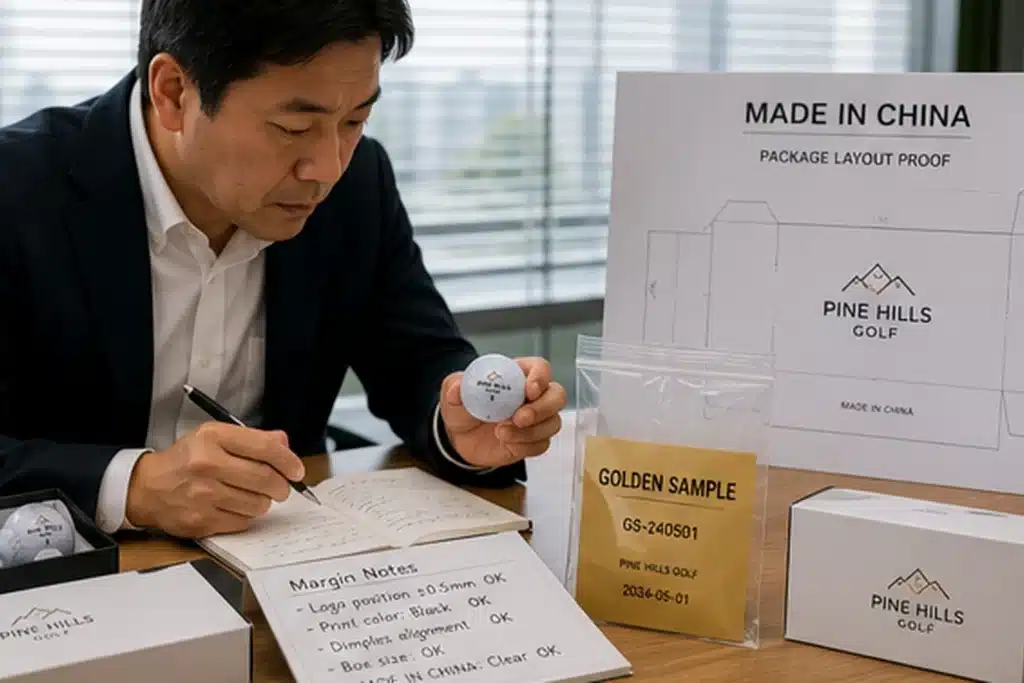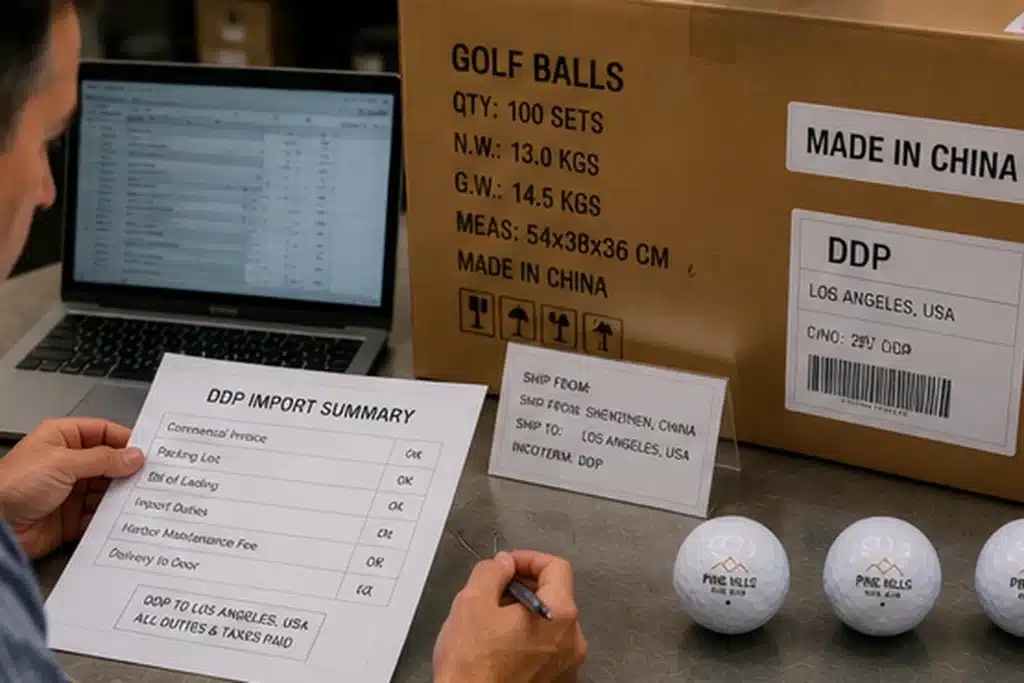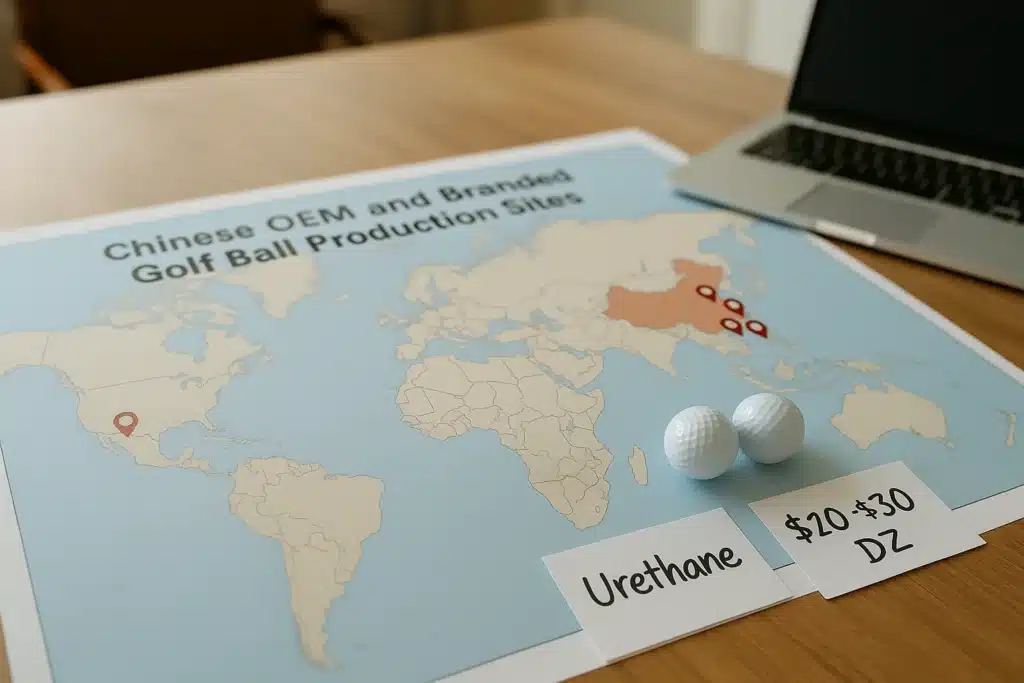
For buyers, Chinese OEM vs branded golf balls is not a country-of-origin debate. It is a verification question: can the chosen ball deliver the wedge spin, cover durability, conformity, cost scope, and batch consistency your market will judge?
Buyers comparing Chinese OEM and branded golf balls should verify the cover route, wedge-spin and dispersion data, exact-model USGA/R&A conformity, retail-ready cost scope, and three-batch QC before choosing. Branded balls still lead where flagship consistency matters; verified OEM balls can win when margin, customization, and launch speed fit the target customer.
A lower OEM quote is attractive, but it becomes expensive if your private-label or DTC golf ball disappoints around the green, scuffs too quickly, drifts between batches, or is marketed as a Pro V1 alternative without enough proof.
Use this guide to decide whether your program needs branded performance, Chinese OEM customization, or a mixed portfolio backed by cover-process proof, same-setup testing, retained samples, and batch-level validation instead of assumptions.
Where do branded balls still lead?
You may want OEM savings, but flagship branded balls still earn part of their premium through process control, formula custody, validation depth, and repeatability.
Branded flagship balls still lead when formula custody, controlled manufacturing, validation depth, and tight repeatability matter more than unit cost. Your team should ask what OEM process controls replace that brand-owned discipline before treating a lower quote as equal performance.
The best starting point is simple: quality follows process, not passport.
A branded tour ball is not expensive only because the box carries a famous logo. Premium brands protect cover chemistry, core recipes, process timing, curing discipline, inspection routines, retained samples, and corrective-action loops over many production cycles. That control helps reduce the tiny differences that become visible as spin dispersion, feel drift, cover wear, and review complaints.
That does not make every Chinese OEM golf ball inferior. It does mean your OEM program needs a replacement for brand-owned discipline. For a DTC golf ball brand, private label buyer, importer, or golf retailer, the real question is: what proof will your customer expect when your ball is compared with a known branded control?
China OEM strength usually sits in cost control, faster customization, packaging integration, flexible launch quantities, private-label execution, and practical product development support. That can be a very strong business model. It becomes risky only when the product claim outruns the proof.
DTC and private-label buyers should buy proof for the performance their customers actually reward, not a country-origin story.
| Pain/decision | Brand advantage | OEM buyer risk | Evidence to request |
|---|---|---|---|
| Tour comparison | Formula custody | Overclaiming parity | Cover-route declaration |
| Review risk | Tight repeatability | Batch drift | SPC or batch records |
| Spin trust | Validation depth | Short-game gap | Wedge-spin comparison |
| Retail claim | Brand equity | Expectation mismatch | Positioning brief |
| Cost pressure | Higher overhead | Margin squeeze | Proof needed by channel |
Before you compare a Chinese OEM ball with a branded flagship, write down the claim you plan to make to your customer. Is it “tour-level wedge spin,” “Pro V1 alternative,” “premium urethane feel,” or simply “better value with custom branding”? Each claim needs a different proof stack.
Match every claim with supplier evidence: cover-route declaration, same-setup wedge-spin data, dispersion results, scuff resistance, 12-ball QC records, retained samples, and batch records. If the proof is strong, you can support the claim. If the proof is partial, narrow the claim. If the proof is missing, avoid the claim.
Do not position an OEM ball as flagship-equivalent unless the data supports that exact comparison.
✔ True — Quality follows process, not passport
A branded ball can justify its premium through controlled manufacturing, validation depth, and repeatability. An OEM ball can compete only when its process and data support the claim.
✘ False — “Country alone decides performance”
Origin can signal sourcing context, but it does not replace cover-route proof, QC data, spin testing, retained samples, and batch control.
Controlled plants and tolerance windows?
Your first decision is not China versus brand; it is what level of proof your market will punish you for missing.
If your target player expects tour-level control, your OEM program must prove more than “urethane,” “soft feel,” or “long distance.” If your customer wants a strong value ball with reliable feel, durability, and custom branding, you may not need a flagship-cost structure. The buyer decision starts with positioning, then proof.
Is the real gap distance or wedge spin?
Your sample may look close on driver distance, but reviews and repeat purchases can be decided by wedge spin, dispersion, cover durability, and consistency.
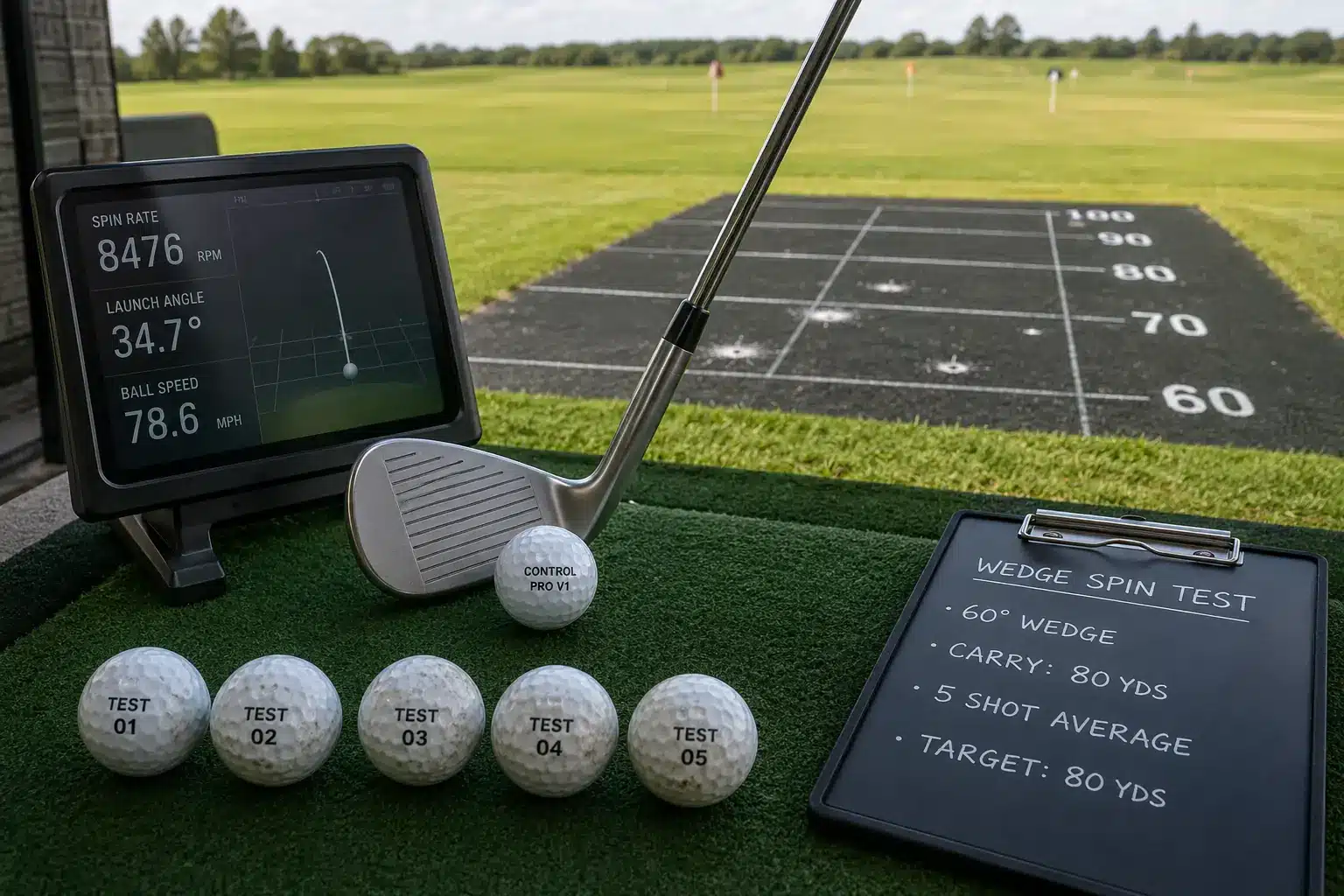
The practical gap is usually not only driver distance; it is wedge spin, dispersion, cover durability, and batch repeatability. Your team should compare OEM samples against a named control ball on the same setup, then validate the result across three production lots.
Driver distance is easy to overvalue because it creates a clean headline. A Chinese OEM golf ball can look close to a branded control off the tee, especially when the buyer only checks average carry. That still does not prove retail parity.
The harder tests are closer to scoring. Wedge spin, iron dispersion, cover scuffing, wet/dry behavior, compression consistency, and lot-to-lot repeatability tell you whether the ball can survive real customer comparison. Better players often forgive a small distance difference more easily than poor green control, inconsistent feel, or a cover that marks too quickly.
For a private label golf ball versus Pro V1-style comparison, do not lock your product story to one driver session. Use the same launch monitor or robot setup, the same ball conditioning, the same test environment, and the same named control ball. Then repeat across lots. A single impressive average can hide wide dispersion.
| Pain/decision | Metric | Why it matters | Evidence to request |
|---|---|---|---|
| Distance claim | Driver carry | Easy to overvalue | Same-device A/B |
| Green control | Wedge spin | Shows scoring feel | 50–80 yd test |
| Retail reviews | Dispersion | Signals consistency | Shot-spread data |
| Cover trust | Scuff resistance | Affects repeat use | Wear screen |
| Batch risk | Lot-to-lot delta | Protects reorder | 3-lot validation |
Request a same-setup performance comparison against a named branded or golden sample. Check driver distance, wedge spin, iron and wedge dispersion, cover durability, and lot-to-lot repeatability.
Do not approve a Pro V1 alternative claim from driver distance alone.
Driver parity vs greenside control?
Your customer may forgive a small distance difference, but they will notice poor green control, cover scuffing, or inconsistent feel.
This is where many “OEM golf balls vs name brand” comparisons become misleading. The buyer sees close driver carry and assumes the decision is finished. The reviewer sees a wedge release too far, a cover mark too early, or a second batch that feels different. If reviews drive repeat purchase, spend on wedge testing, dispersion data, and batch control before chasing the lowest EXW quote.
Which cover process changes performance?
Your supplier may say “urethane,” but that word can hide different cover routes with different spin ceilings, feel profiles, scuff resistance, cost, and validation needs.
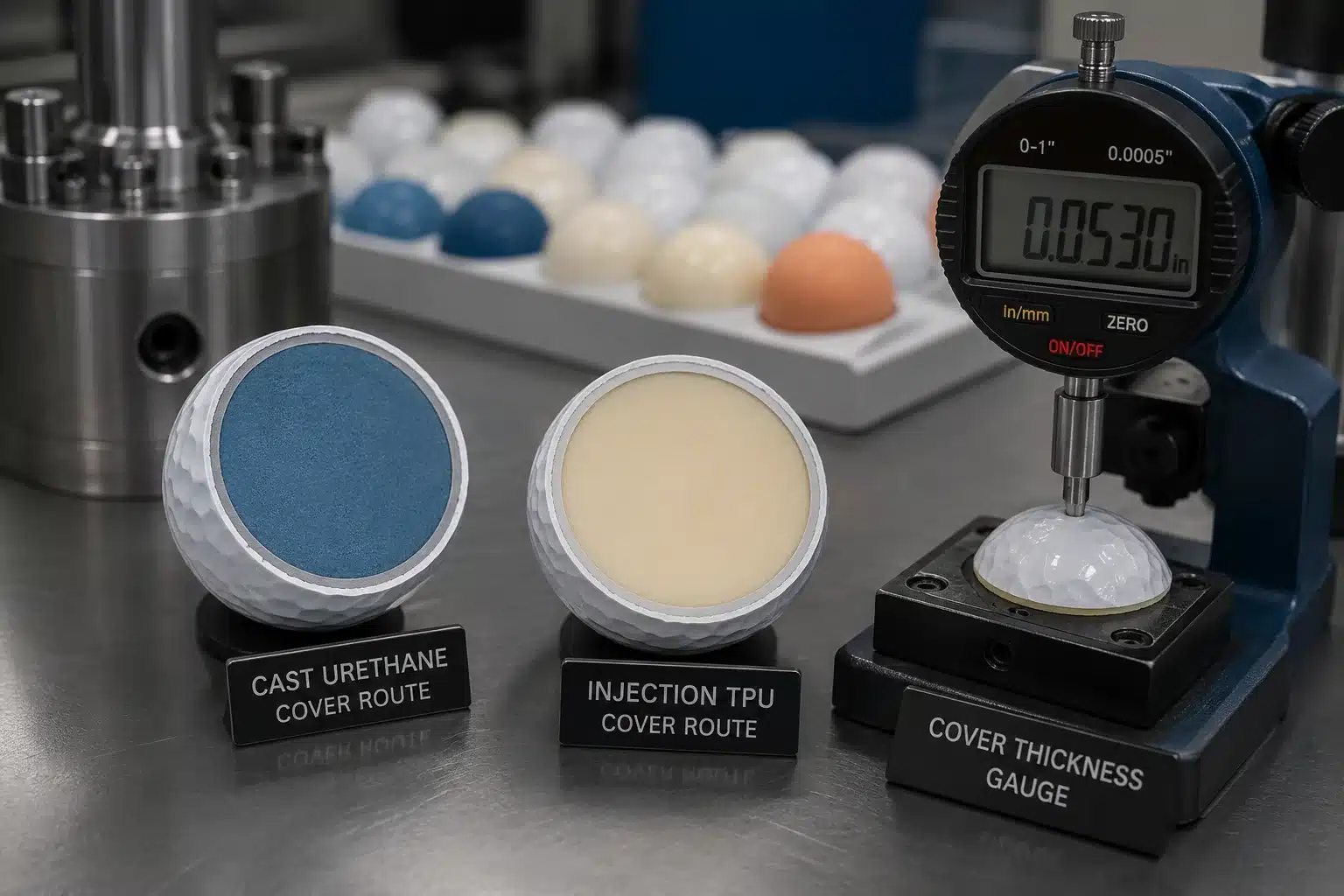
Do not compare “urethane” labels alone. Your team should ask whether the cover is cast thermoset urethane, injection-molded TPU, or a hot-press/spray route, then verify wedge spin, scuff resistance, cover thickness, yellowing, and batch consistency.
“Urethane cover golf balls” is useful search language, but it is not specific enough for an RFQ.
A cast thermoset urethane cover is the premium short-game route many buyers associate with tour-level feel and greenside control. It can support softer feel, higher spin potential, and stronger cut resistance, but it usually requires more demanding process control, longer validation, and higher cost.
Injection-molded TPU is different. It can be a scalable and cost-friendly value-premium route, and many Chinese OEM urethane programs sit closer to that world. TPU can make sense for DTC, retail challenger, academy, or custom programs when the target market values price, durability, and launch speed more than maximum wedge spin.
Hot-press or spray routes can reduce cost and speed up production, but they need tighter scuff, yellowing, cover-thickness, and spin verification before a buyer positions the ball too aggressively.
Supplier says “same as Pro V1” with no cover-route proof is a failure signal.
| Pain/decision | Cover route | Buyer meaning | Evidence to request |
|---|---|---|---|
| Tour feel | Cast urethane | Higher spin ceiling | Cure-route proof |
| Value premium | Injection TPU | Scalable / cost-friendly | Spin and scuff data |
| Budget speed | Hot-press/spray | Lower cost / faster | Wear and yellowing screen |
| Marketing risk | Vague urethane | Overclaim risk | Process declaration |
| Bulk drift | Thickness window | Consistency risk | Cover-thickness data |
Supplier shall declare the actual cover route, cover-thickness target, curing or molding route, and any cover or coating change before pilot or bulk approval.
Request a cover-process declaration and cover-route proof. Check whether the cover is cast thermoset urethane, injection TPU, or another route; then compare spin, scuff, cover thickness, and appearance stability.
Do not allow “urethane” to stand alone as a finished performance specification.
✔ True — Cover route changes performance and cost
Cast urethane, injection TPU, and hot-press or spray routes can all support different business goals. The right choice depends on spin target, cost target, validation depth, and customer expectation.
✘ False — “Every urethane cover means the same construction”
Broad material language can hide major process differences. A serious buyer asks for the route, then checks performance data.
Cast urethane vs injection TPU?
Your product claim should match the cover route your supplier can actually prove.
If your brand says “tour-level urethane,” your proof burden rises. If your market wants a value-premium DTC ball, injection TPU may be enough when the spin, scuff, and consistency data are honest. The problem is not TPU. The problem is vague language that lets a buyer market one route as another.
Can OEM balls be conforming?
Your buyer may ask whether Chinese OEM balls are legal, but conformity is not a country question; it depends on the exact model, markings, list status, and use.
Chinese OEM golf balls can be conforming, but conformity is exact-model based, not country based. Your team should check current list status, model markings, and intended use, while remembering that conformance proves legality—not Pro V1-level spin, durability, or consistency.
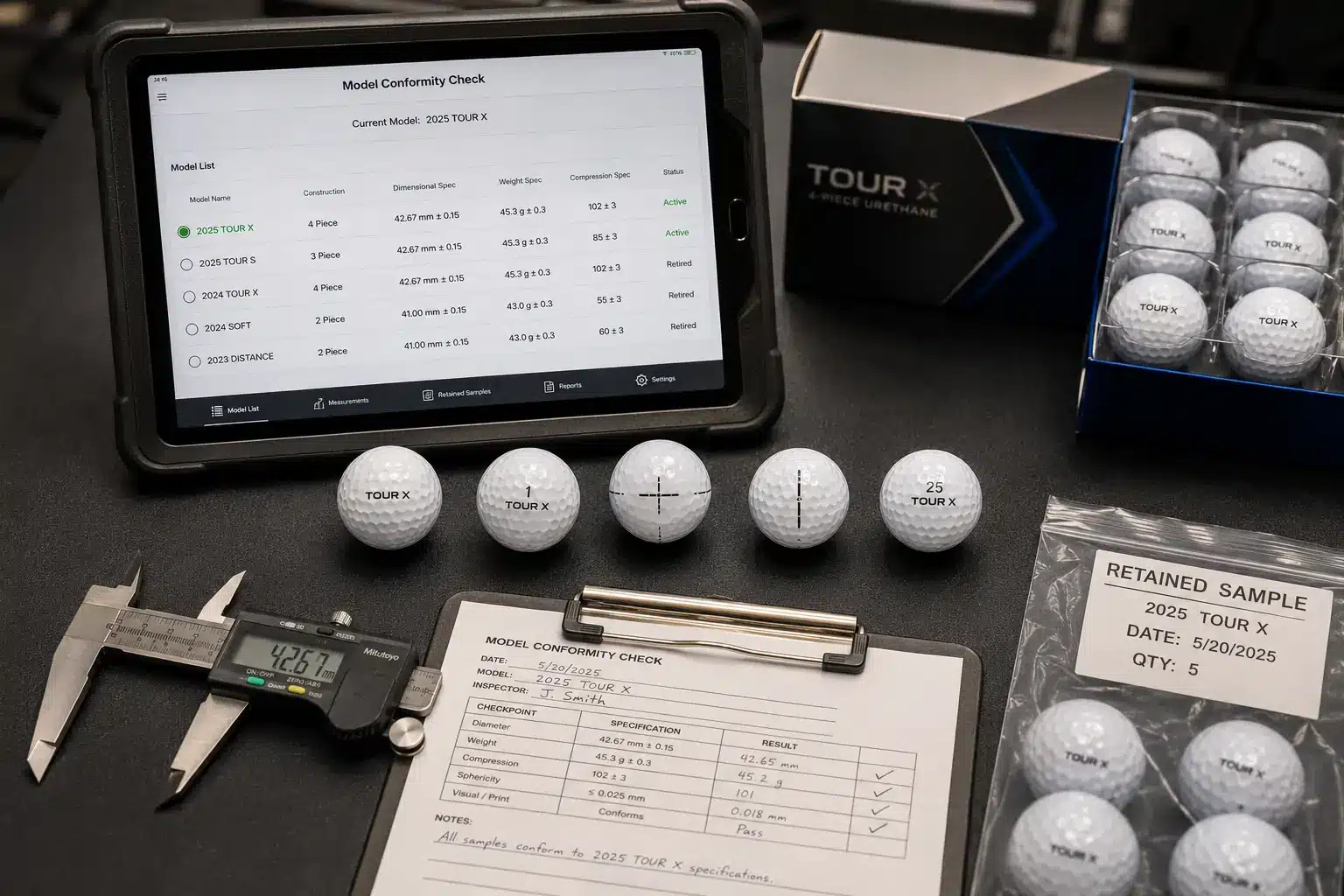
A conforming golf ball list is not a national ranking system. It does not say “China good” or “China bad.” It says a submitted ball model, with specific markings and construction, has been evaluated for the relevant rules context.
That distinction matters for private label and DTC buyers. The USGA Conforming Golf Ball List is organized around the markings shown on the ball, including pole and seam markings, so your check should match the exact model, visible marking, packaging reference, and current list entry—not only the supplier’s broad “USGA conforming” claim.
The R&A Conforming Ball List follows the same buyer logic: a ball must be submitted, evaluated, and listed for the relevant period. A factory may have produced conforming models before. Another model may have a lapsed listing. A lapsed listing is not automatically a quality verdict, but it can be a tournament-use problem. If your customer needs event legality, you need the current exact model status, not a historical screenshot or a broad supplier statement.
Conformance also does not prove retail quality. It does not certify wedge-spin parity, cover durability, micro-dispersion, yellowing resistance, or batch repeatability. It is an entry gate, not a premium-performance badge.
Conforming claim with no exact current model check is a failure signal.
Buyer acceptance should reference the exact model name, pole/seam marking, packaging reference, current USGA/R&A list status where required, and any re-submission plan if the ball will be sold under a private-label brand.
Request exact-model conformity status or a submission plan when tournament or event use requires it. Check current list status, model markings, packaging reference, brand or submission ownership, and whether your use case actually requires list status.
Do not accept broad “USGA conforming” language unless the exact model and current status are verified.
Model listing, not country of origin?
Your compliance question should follow the model you will sell, not the country where it is made.
If your project is a club practice ball, academy ball, corporate gift, or value DTC SKU, formal list status may or may not matter. If your buyer expects tournament use, it matters immediately. The safe move is to define the use case first, then check the exact model, marking, and current status.
What cost savings are real?
Your team may compare a branded retail dozen with an OEM EXW quote and think the gap is pure savings, but retail price and factory price include different scopes.
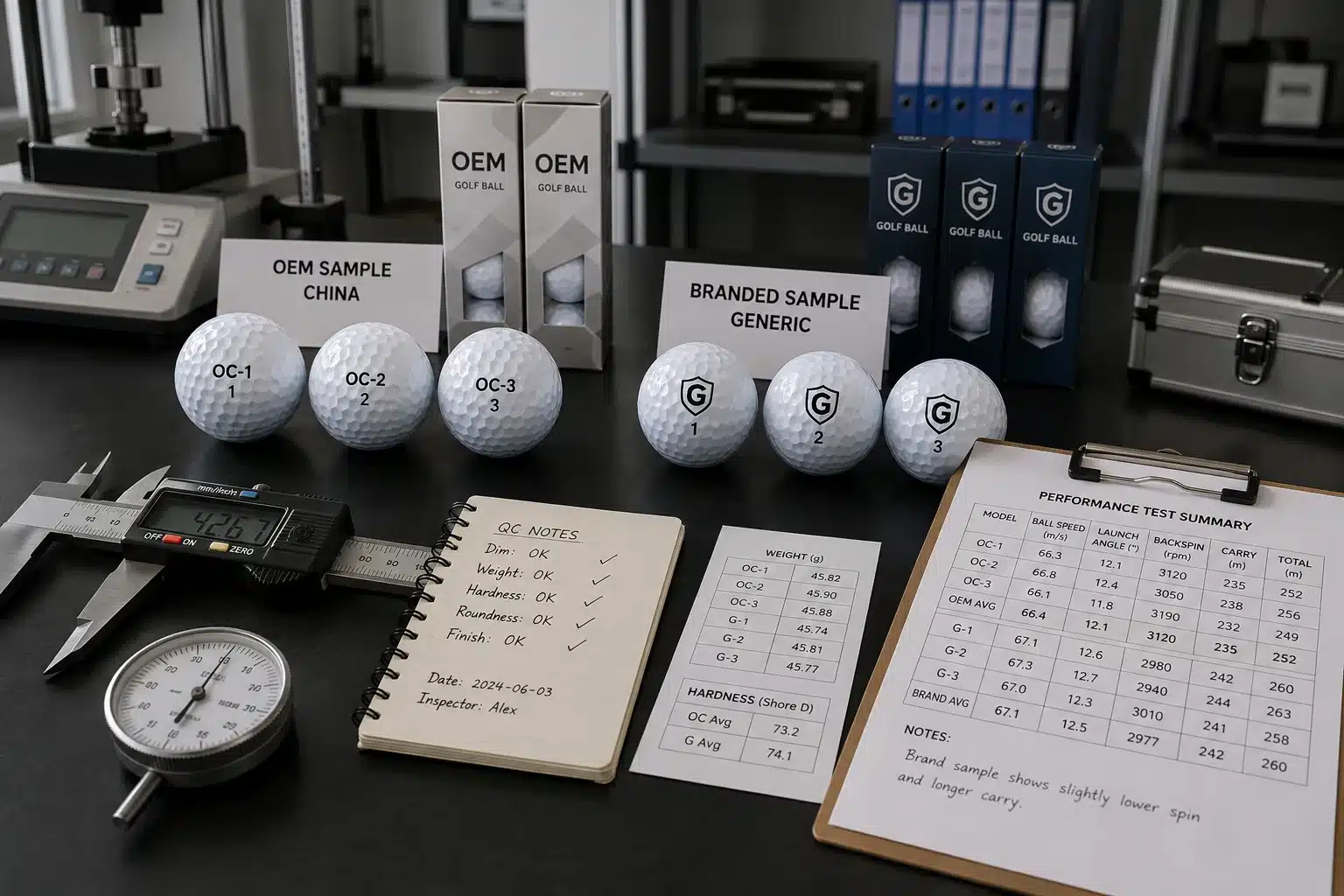
OEM savings are real only when the quote includes the proof your market requires. Your team should compare retail MSRP, channel margin, packaging, testing, QC, logistics, returns, MOQ, and launch speed—not only branded price versus factory EXW.
Brand retail price carries more than manufacturing cost. It includes product development, validation, factory control, inventory, packaging, retail channels, consumer trust, marketing, warranty exposure, and return risk. Whether a buyer likes that system or not, those costs support the retail promise.
An OEM quote is different. A China OEM golf ball quote may be attractive because it focuses on factory-controlled cost, direct customization, packaging integration, and faster launch. But EXW price does not automatically include the testing, conformity work, retail packaging, logistics, after-sale risk, content, reviews, or QA depth needed to make the product retail-ready.
This is where lower price can be excellent—or dangerous. If the quote includes a declared cover route, three-lot validation, packaging control, retained samples, and batch-level QC, the margin story becomes much stronger. If the quote removes proof, the savings can disappear through returns, bad reviews, and reorder distrust.
| Pain/decision | Cost item | Hidden risk | Evidence to request |
|---|---|---|---|
| Retail anchor | Brand MSRP | Not factory cost | Separate scope |
| Low EXW | Testing excluded | Weak proof | Add QC budget |
| Fast launch | OEM customization | Artwork drift | Lock specs |
| MOQ pressure | Route complexity | Cash tied up | Confirm MOQ |
| Margin target | Returns/reviews | Retail risk | Validate lots |
Build a landed and retail-ready cost sheet, not just an EXW comparison. Check what the quote includes: cover route, testing, inspection, packaging, shipping term, MOQ, lead time, conformity status, retained samples, and change control.
Do not approve the lowest quote if it removes the QC and validation your customer will judge.
✔ True — Lower price can still be retail-ready if proof is included
OEM savings become useful when the quote still supports testing, repeatability, packaging, and batch control. A low price without proof can move cost from production into returns and lost trust.
✘ False — “Half the price means no trade-offs”
A lower quote may reflect a smarter route, a different cover process, fewer validation steps, a different packaging scope, or missing retail-ready controls. Separate those before you celebrate the margin.
Retail markup vs factory-controlled cost?
Your margin improves only if the lower cost survives reviews, reorders, and retailer confidence.
China OEM value is strongest when your team uses it honestly: faster customization, controlled cost, packaging options, flexible launch quantities, and supplier-side responsiveness. It is weakest when your brand sells “same as Pro V1” but buys a lower route with no three-batch proof.
When should you choose OEM or branded?
You need a final route decision, but it should be based on target customer, performance floor, margin, review risk, validation depth, and proof.
Choose branded balls when flagship greenside spin and lowest variance are non-negotiable; choose Chinese OEM when verified performance, stronger margin, customization, and launch speed fit your market. Your team should require three-batch validation, a 12-ball QC pack, retained samples, and change control before scaling.
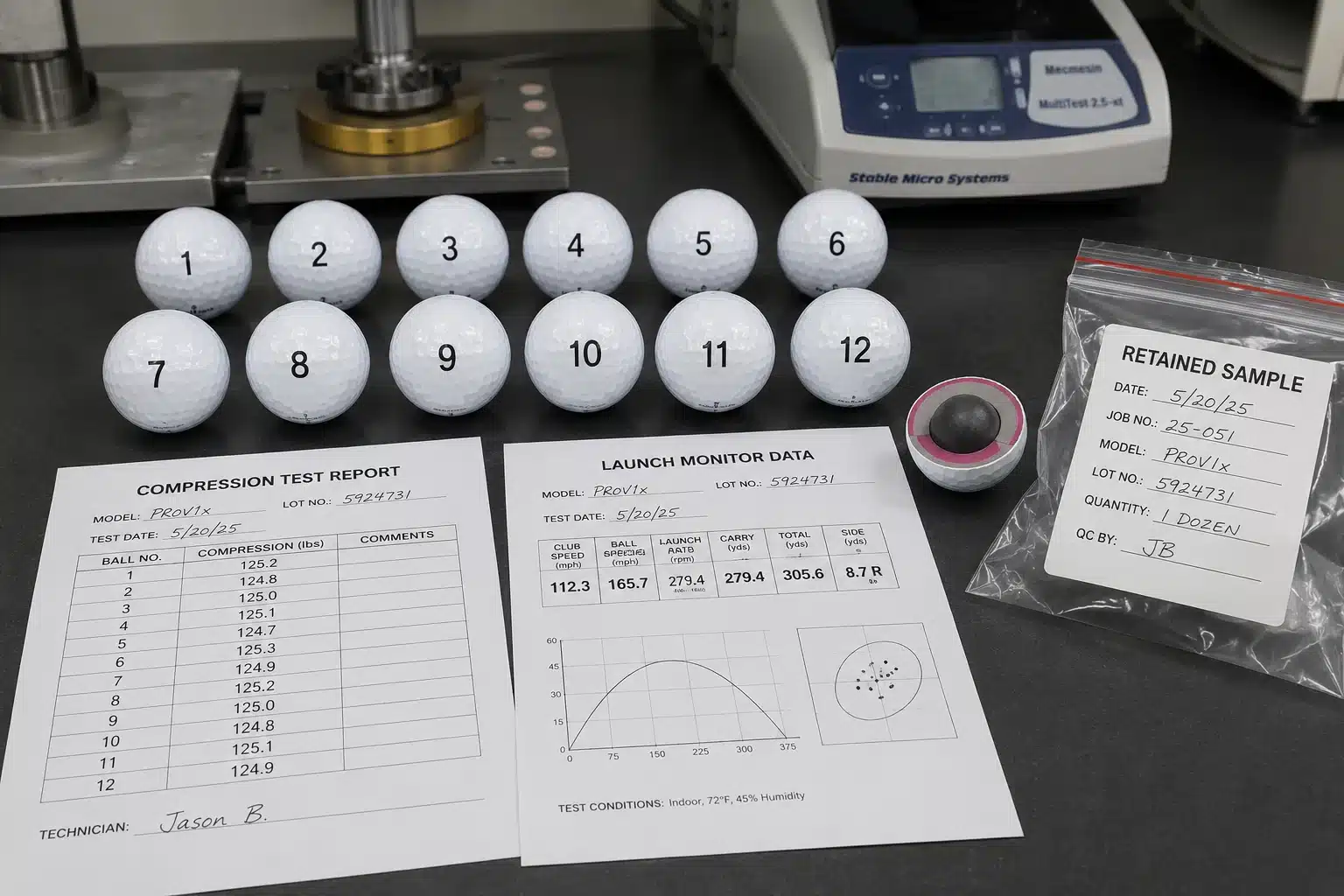
The real decision is not “Chinese OEM golf balls or branded golf balls?” It is route fit.
If your revenue depends on elite-player reviews, wedge control, and very low variance, the branded flagship path may be the cleaner decision. If your market rewards value, customization, solid durability, and honest performance, OEM can make strong business sense. If you want a DTC hero SKU, the middle path may be OEM cast urethane or a premium OEM route with strict validation.
Great sample with no three-batch data is a failure signal.
| Pain/decision | Better route | Why it fits | Evidence to request |
|---|---|---|---|
| Tour spin floor | Branded flagship | Lowest variance | Use brand route |
| DTC hero SKU | OEM cast + SPC | Margin + proof | Validate 3 lots |
| Value retail | OEM TPU | Cost + performance | Test wedge/scuff |
| Club/academy | OEM value build | Durability + price | Check QC |
| Promo/gift | OEM 2-piece | Customization speed | Confirm specs |
| Clone claim | Avoid | IP/expectation risk | Reposition product |
Ask the OEM supplier to quote one defined ball route with cover-process declaration, target player/channel/price band, three-lot validation plan, 12-ball QC pack, wedge-spin and dispersion comparison, scuff/yellowing screen, exact-model conformity status if needed, retained samples, AQL receiving rule, and written change-control terms.
A serious 12-ball QC pack should include raw values, average, range, and standard deviation where relevant. Request weight, diameter, compression, hardness, cover thickness, concentricity, dimple or coating fields where relevant, spin and dispersion data, scuff or yellowing evidence, equipment notes, and calibration dates when available.
For higher-maturity suppliers, ask for X-ray or CT evidence when construction complexity requires it. Ask for retained samples on both sides, sealed approval samples, batch records, packing list match, AQL-style receiving rules, and written approval before any formula, cover, mold, curing, coating, print, or packaging change.
Supplier shall lock one approved OEM proof version and reference that version on cover-process declaration, three-batch validation report, 12-ball QC pack, spin and dispersion test file, scuff or yellowing evidence, conformity record if required, retained sample, batch record, packing list, and receiving inspection file.
Request a three-batch OEM validation pack and route-fit decision table. Check raw QC data, spin and dispersion comparison, scuff or yellowing results, equipment and calibration notes, retained samples, batch records, and change-control terms.
Do not scale an OEM program unless the proof supports the positioning claim you will make to customers.
Three-batch proof and route fit?
Your best route is the one your customer will reward and your proof can defend.
A Pro V1 clone claim creates a proof burden most programs do not need. A value-premium ball, academy ball, DTC challenger ball, or custom retail SKU can win without pretending to be a tour flagship. The smarter question is what your customer will notice, what your margin requires, and what your supplier can prove repeatedly.
FAQ
Are Chinese OEM golf balls any good?
Chinese OEM golf balls can be good when the cover route, process control, validation, and batch consistency are proven. Quality depends on proof, not country alone, so buyers should compare data rather than argue about origin.
Ask for a cover-route declaration, three-batch validation, 12-ball QC data, and a same-setup comparison against a named control ball. A good-looking sample is useful, but it does not prove bulk stability. Judge the supplier by raw data, retained samples, and change-control discipline.
Can OEM golf balls perform like Pro V1?
Some OEM builds may be close enough for their target market, but Pro V1-like claims need proof in wedge spin, dispersion, cover durability, feel, and repeatability across more than one production lot.
Do not rely on driver distance alone. Use the same launch monitor, conditioning, and control ball for A/B testing. Then validate more than one lot. If your brand wants to make a tour-level comparison, the proof stack must be strong enough to survive side-by-side review.
Where do branded balls still outperform OEM balls?
Branded flagships usually lead where short-game spin, dispersion, cover control, validation depth, and long-run repeatability are most important. That advantage matters most when your customer expects tour-style scoring control.
That does not mean OEM is wrong. It means the route should match the buyer. Better players and review-driven retail products are more sensitive to wedge spin, iron dispersion, feel, and cover wear. Club, academy, promotional, and value retail programs may prioritize durability, customization, price, and predictable supply.
Can Chinese OEM balls be USGA/R&A conforming?
Yes, if the exact model is submitted and listed or otherwise verified for the required use. Conformity is model-based, not country-based, and broad factory claims are not enough for tournament-related buyers.
Check current list status, exact markings, and packaging model reference. Do not treat broad supplier claims as tournament clearance. Also remember that conformity proves legality for the relevant rules context; it does not prove flagship wedge spin, long-term durability, or batch consistency.
Does urethane mean the same cover process?
No. Cast thermoset urethane and injection-molded TPU can both sit under broad urethane language, but they differ in process, cost, feel, spin ceiling, scuff resistance, and validation burden.
Ask for the actual cover route. Then verify cover thickness, wedge spin, scuff resistance, yellowing behavior, and batch consistency. “Urethane” is a material family signal, not a complete performance specification.
What cost savings are real with OEM balls?
OEM savings can be real, but the quote must be compared against the full retail-ready cost: testing, QC, packaging, logistics, returns, marketing, retailer requirements, conformity needs, and channel expectations.
Do not compare MSRP to EXW alone. Add validation, packaging, freight, receiving inspection, after-sale risk, content, and retailer requirements. A lower quote is valuable when it still includes the proof your customer will judge. It is risky when proof is stripped out to hit a headline price.
What proof should buyers request from an OEM?
Ask for cover-route disclosure, three-batch validation, 12-ball QC raw data, wedge-spin and dispersion comparison, scuff/yellowing evidence, retained samples, AQL rules, and written change control tied to the shipped batch.
The best files include raw values, statistics, equipment notes, calibration dates, batch IDs, retained samples, and acceptance criteria. Tie proof to the shipped batch, not only to a pretty sample. If the supplier says mass production will improve, ask for the data before you scale.
Are Pro V1 alternatives good for DTC brands?
They can be if the brand positions them honestly and verifies the performance its customers care about. Avoid clone language unless the proof can survive side-by-side testing, review scrutiny, and repeat-order comparison.
Define the target player, price band, channel, and review risk before choosing the route. A DTC ball does not need to be a perfect flagship clone to succeed. It does need a believable value story, stable production, and enough testing to protect repeat purchase.
Conclusion
Chinese OEM balls are not judged by origin, and branded balls are not justified by logo alone.
The real decision is whether your program needs flagship-level wedge spin, cover durability, and batch consistency—or whether verified OEM performance gives you better margin, faster launch, and enough proof for your target market.
Do not buy assumptions. Verify the cover route, test the performance gap, check exact-model conformity where needed, compare true cost scope, and lock three-batch proof before you scale.
You might also like — 2026 Guide to Golf Ball OEM in China: Factory Audit Checklist & Sourcing Secrets