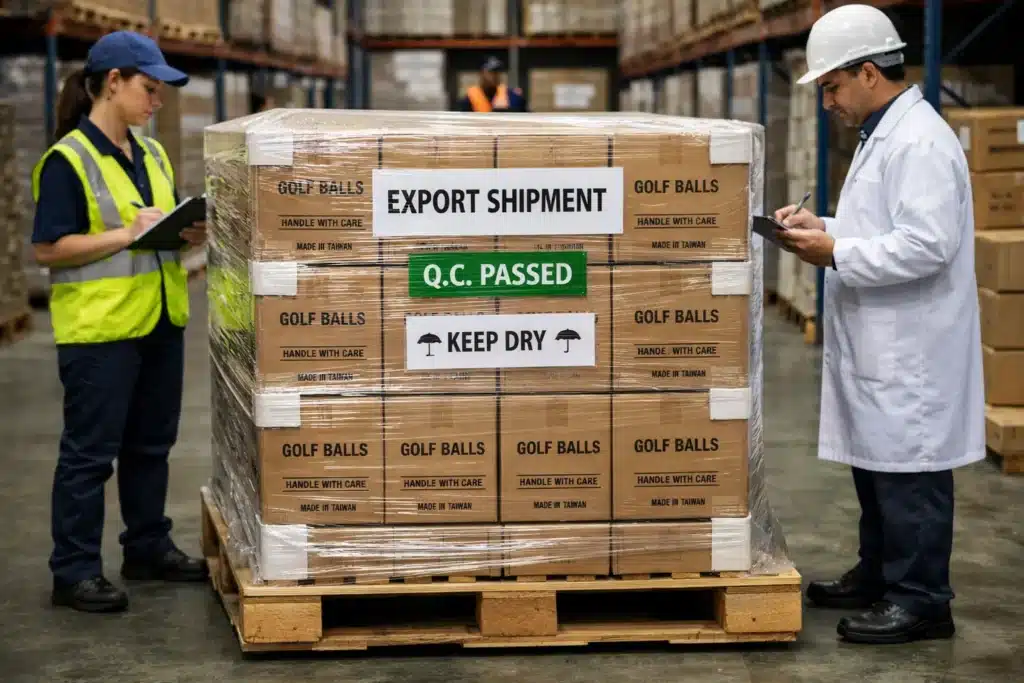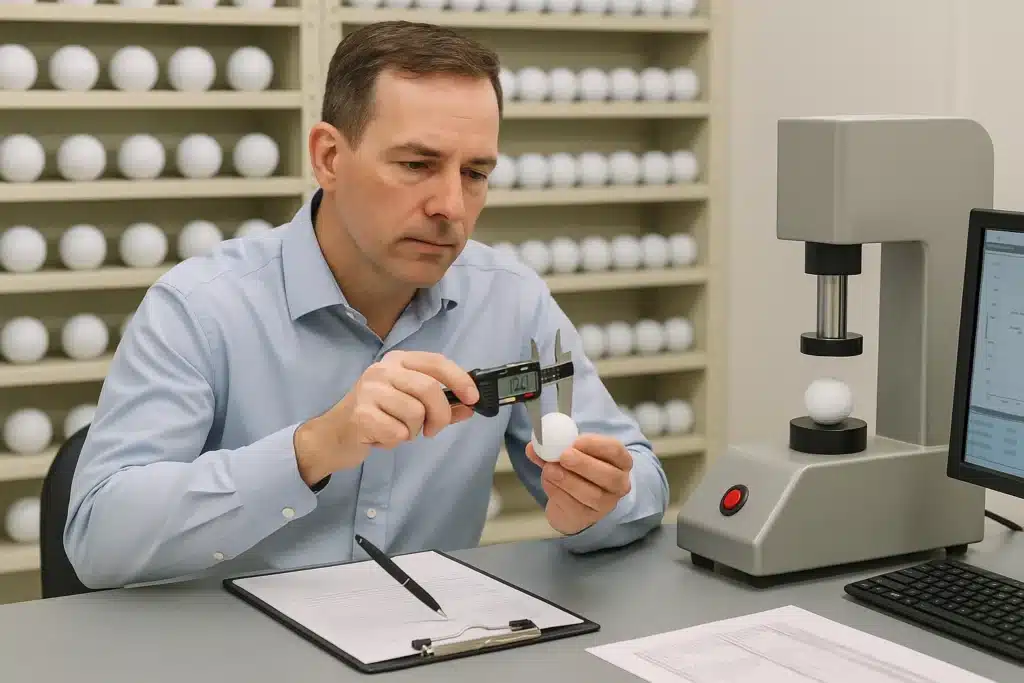
Defective golf balls don’t just disappoint golfers—they quietly destroy margins, trigger returns and damage your logo. This guide shows you how to audit a factory’s QC before problems ship.
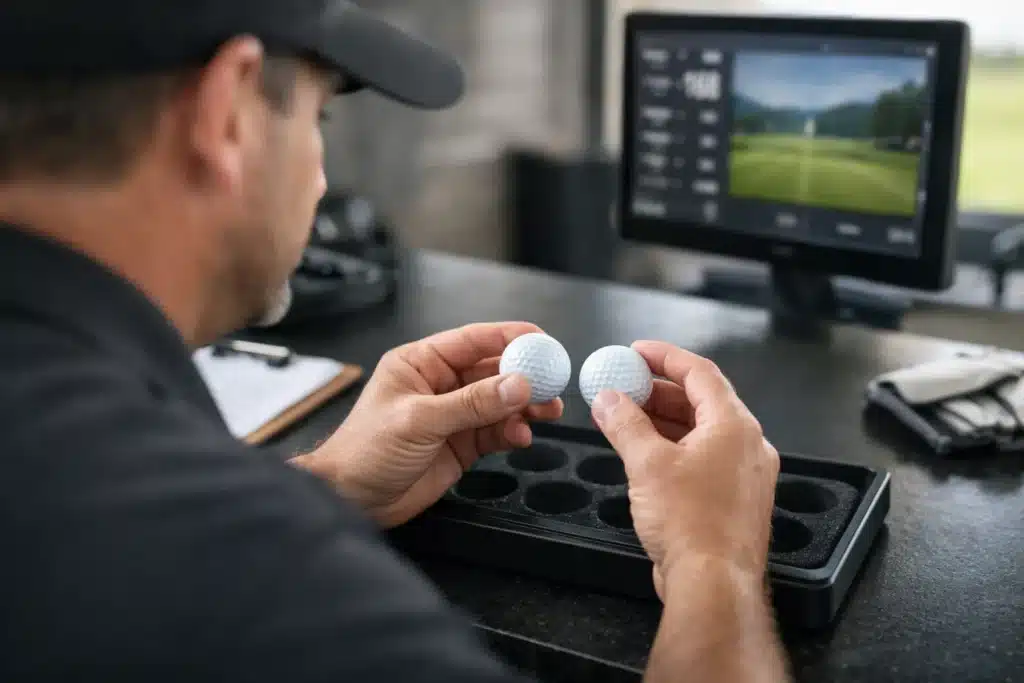
A standard golf ball quality control audit is a structured on-site factory inspection that reviews processes, test equipment and sampling records. It checks ball weight, diameter, core centering, compression, cover durability and flight performance against USGA/R&A limits and the plant’s tighter in-house golf ball manufacturing quality control standards, using ISO 2859-1 AQL sampling.
Most private-label brands still rely on “looks fine” checks and glossy samples. In the sections that follow, you’ll see how to turn a factory visit into a seven-step golf ball factory audit checklist you can run yourself or hand to a third-party inspector.
How do golf ball defects hurt your brand and budget?
You rarely see golf ball defects until customers complain. By then you’re fighting refunds, bad reviews and awkward conversations with your OEM. The cost of weak QC is always higher than the cost of prevention.
Defective golf balls don’t just mean a few bad shots. They create warranty claims, carton-by-carton sorting costs and awkward inventory write-offs. For private-label brands, inconsistent compression, weight or flight makes every repeat order a gamble, eroding customer loyalty and gross margin far faster than the unit cost of proper factory QC.
A failed batch rarely looks dramatic on day one. It might start as a “hot” or “dead” feel, scuffed covers after a few holes, or one customer email about inconsistent distance. By the time you see a pattern, product is already on shelves and every corrective action is expensive.
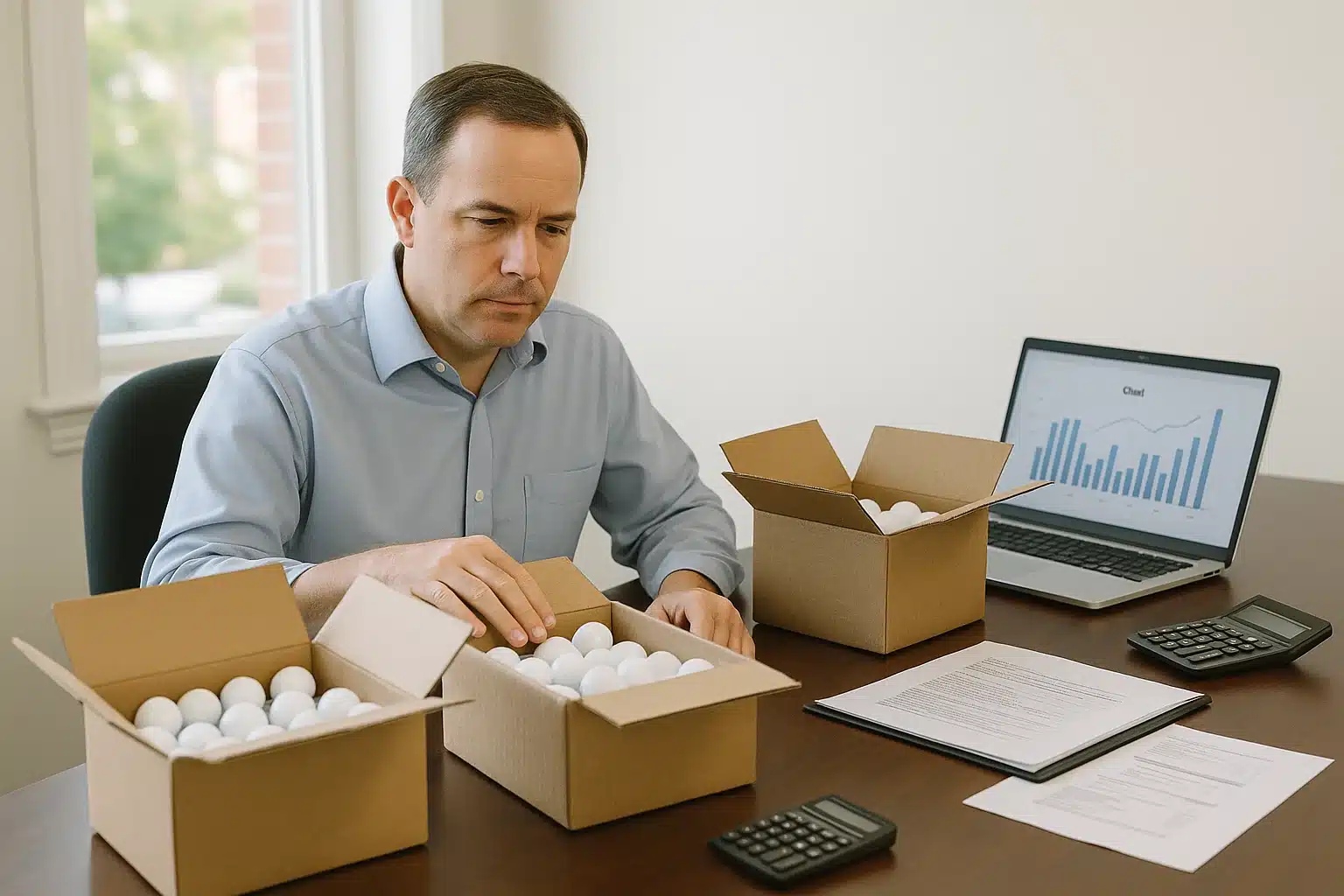
Now add the hidden costs: emergency re-inspection, rework, airfreight replacements and discounts to clear suspect stock. Serious OEM golf ball manufacturing quality control systems avoid these fire drills by sitting safely inside USGA/R&A limits and sampling every lot using ISO 2859-1 AQL (typically Critical 0.0, Major 2.5, Minor 4.0). Structural problems like off-center cores or voids are the biggest long-term risk; they don’t show in casual visual checks but they wreck consistency, especially across repeat orders and peak seasons when lines are overloaded.
What types of golf ball defects hurt you most?
Group defects into structural, performance and cosmetic so you can react with the right urgency and the right inspection requirement.
| Defect type | Short-term impact | Long-term brand risk | What to demand in QC |
|---|---|---|---|
| Structural | Off-center cores, voids, layer shifts | Unstable distance and spin between batches | X-ray or cut-ball checks per lot; concentricity limits |
| Performance | “Hot” or “dead” feel, distance spread | Players lose trust and switch brands | Compression and COR distributions, not single numbers |
| Cosmetic | Specks, minor logo blur, small paint runs | Limited for value lines, higher for premium positioning | Clear cosmetic criteria and AQL for minor defects |
Once you see defects this way, you can write purchase orders and inspection criteria that match your positioning: tougher rules on structural and performance issues for hero SKUs, more flexibility on cosmetics for value lines.
✔ True — Visual checks are only the first layer of QC
A clean logo and round-looking ball are necessary, but they tell you nothing about core centering, compression spread or COR. Structural and performance issues often hide behind perfect cosmetics.
✘ False — “If a ball looks round and the logo is correct, it’s good enough for my brand.”
Relying on appearance alone is how brands drift into inconsistent distance and feel. Real golf ball factory audit checklists always include lab tests and sampling data.
How do you run a 7-step golf ball QC checklist?
Most factory tours are a blur of mixers, presses and paint booths. Without a structured checklist, you leave with photos instead of hard data. A 7-step audit turns your visit into measurable risk control.
A practical golf ball QC audit follows seven steps: check raw materials, verify core centering and compression, confirm cover molding and dimple geometry, test paint and adhesion, validate flight and COR, stress-test durability, then finish with visual, weight and diameter checks under an AQL plan. Each step produces data, not just impressions.
The 7-Step Golf Ball Quality Verification Checklist
- Raw material verification (rubber, ionomer, urethane; certificates and batch traceability).
- Core centering and compression sampling (ATTI/ADC tester plus X-ray for concentricity).
- Cover molding and dimple symmetry checks (process parameters plus ring/dimple gauges).
- Paint, clear coat and logo adhesion tests (cross-hatch, solvent rub, abrasion).
- Aerodynamic and flight stability checks (robot or air-cannon orientation tests).
- Durability and shear resistance tests (guillotine/repeated impact).
- Final AQL visual and dimensional inspection (weight, diameter, critical/major/minor counts).
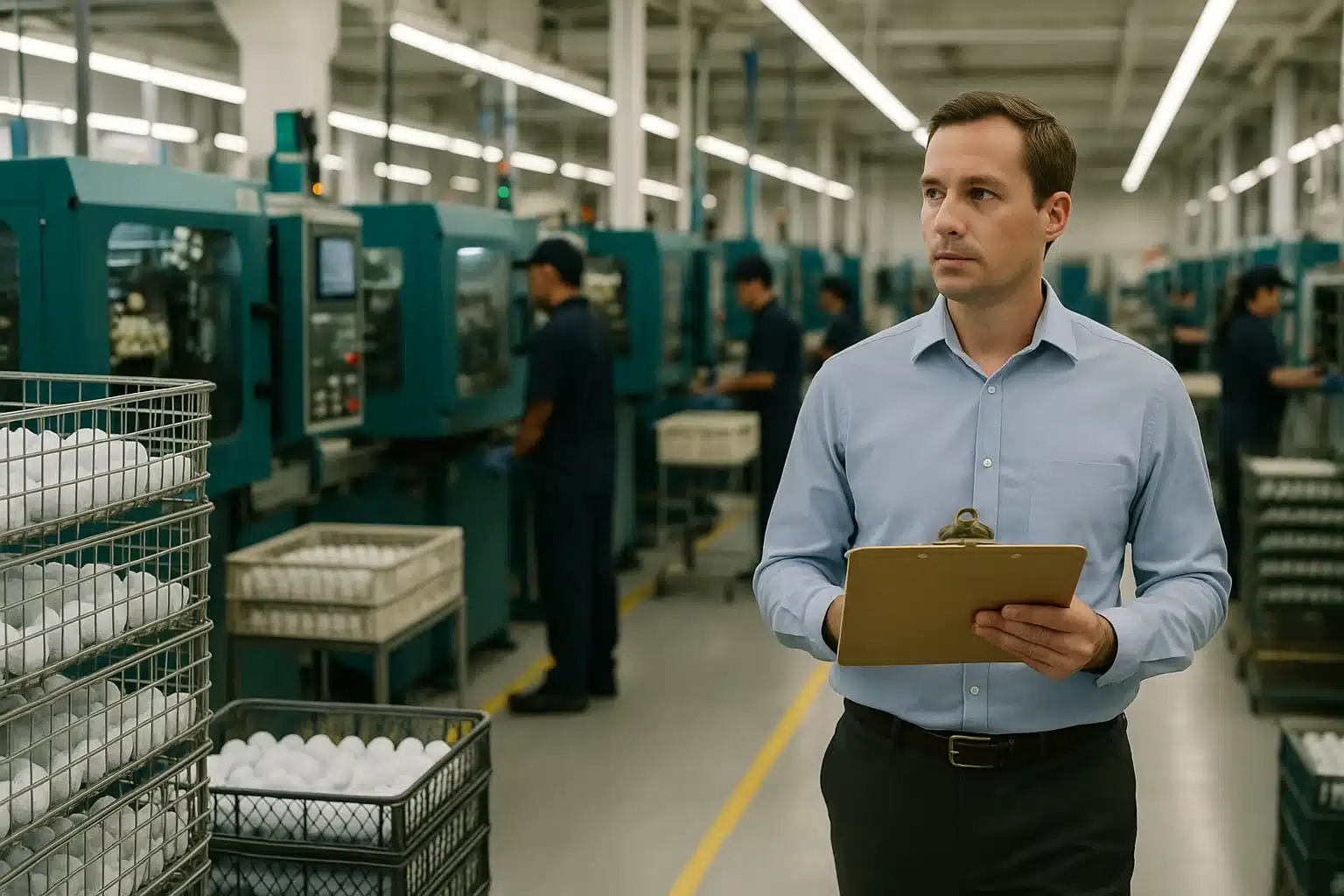
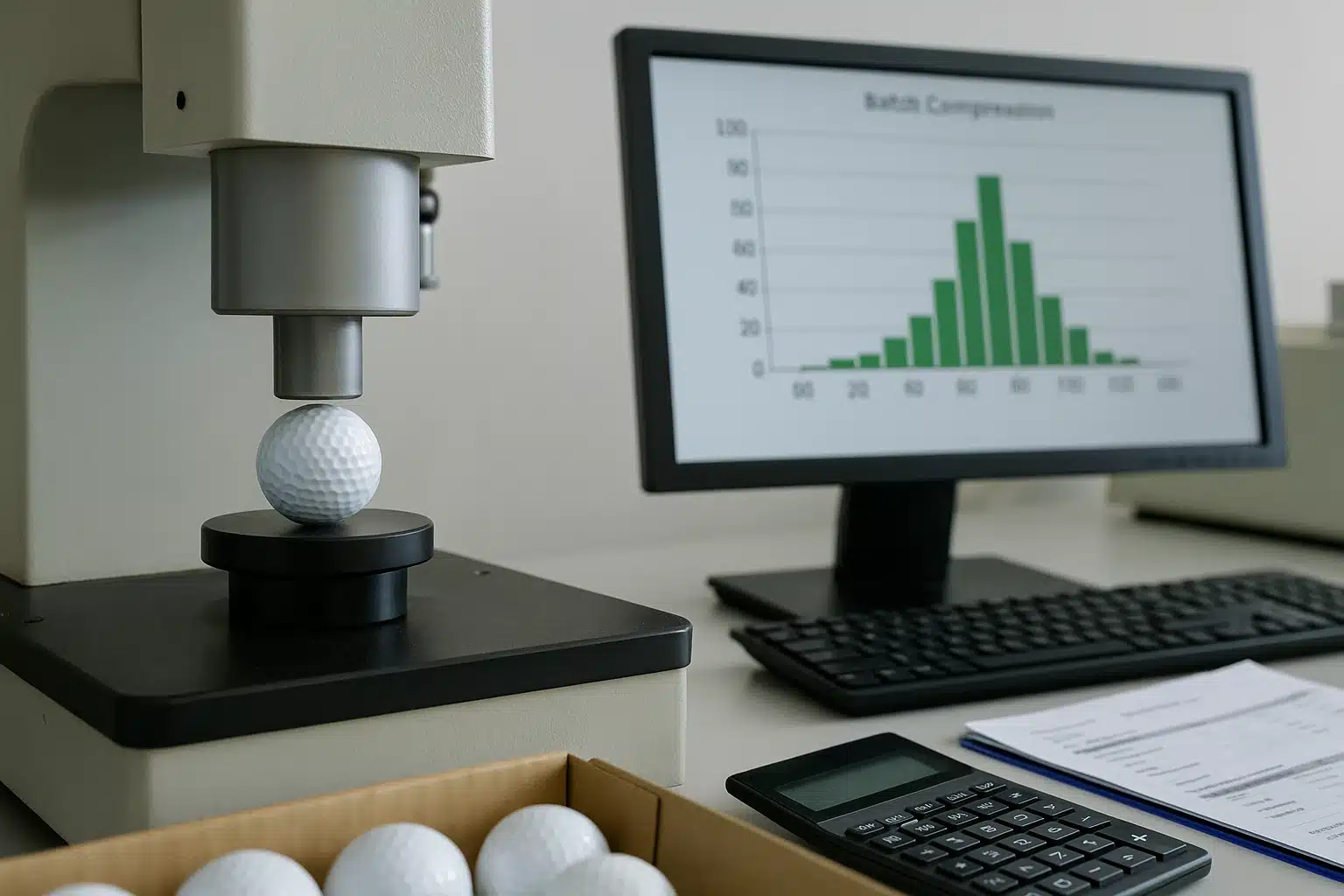
In Step 1, focus on supplier and batch control: are rubber, Surlyn/ionomers and urethanes from known brands, and can the factory trace each lot into production orders and test records? Step 2 is where classic golf ball compression testing happens. Ask to see compression data on at least 12–24 balls per model, with a mean and spread, not just a single “90 compression” number. Modern ADC automated testers can laser-measure diameter, compress the ball to a defined load and weigh it in one pass, feeding every result to a spreadsheet.
Step 3 checks cover injection or compression molding and dimple geometry. Look for documented molding temperatures and pressures, plus gauges for dimple depth and symmetry. Step 4 verifies that paint and clear coat survive cross-hatch cuts, tape pulls and solvent rubs without peeling logos. Step 5 is your aerodynamic and COR check: air-cannon or robot tests at set club speeds, with the ball hit in different orientations (logo up, seam up) to confirm stable carry and coefficient of restitution. Step 6 is about durability: repeated high-speed impacts into a plate or club face, checking for cover cracking or shearing. Finally, Step 7 is the ISO 2859-1 AQL inspection: for a 1,000-ball lot, code letter L usually means 200 balls sampled with Critical 0.0, Major 2.5, Minor 4.0.
Whether you rely on an ISO 9001 golf factory or a third-party inspection in China, this list should become a standard appendix in your POs and pre-shipment inspection (PSI) briefs.
How should you brief inspectors before the factory visit?
Turn the seven steps into a one-page inspection brief that specifies inspection level, AQLs and key test equipment.
List which tests must appear in the report (compression distribution, COR/IV data, X-ray or cut-ball images), which photos you expect (ADC tester, air cannon, X-ray cabinet, sample racks), and how defects should be classified as critical, major or minor. The clearer your brief, the less room there is for “passed visual check” reports that hide performance problems.
To help you set expectations, use this compact Defect Tolerance Table to distinguish consumer vs tournament-grade demands:
| Dimension | Consumer-grade approach | Tournament-grade approach | When to choose / recommendation |
|---|---|---|---|
| Structural defects | Standard Critical 0.0, Major 2.5, Minor 4.0 | Same AQLs, but tighter limits on core centering and layer defects | Value balls where occasional cosmetic rework is acceptable |
| Performance consistency | Slightly wider compression and distance spread | Tighter compression and distance spread within in-house specs | Hero SKUs and serious-player balls |
| Cosmetic defects | More minor paint specks and small logo flaws allowed | Very low tolerance for visible blemishes | Premium or tour-style product lines |
| Documentation expectations | Basic batch records and occasional lab reports | Full batch reports, trend charts and retained samples | Any model where you claim “tour-level” performance |
Choose the column that matches each model’s positioning and make sure your inspector and supplier are aligned.
✔ True — AQL sampling finds problems efficiently
ISO 2859-1 plans let you infer lot quality from a statistically chosen sample, balancing detection power and cost. It’s the standard language of professional consumer-goods inspections.
✘ False — “100% visual checking is always better than an AQL plan for golf balls.”
100% visual checks are slow, inconsistent and blind to structural issues. AQL sampling plus targeted lab tests catches deeper problems without tearing open every box you paid for.
Which QC metrics and test reports should you demand?
Your supplier’s lab can print pages of numbers, but only a handful decide performance and legality. If you don’t ask for those metrics, you can’t compare factories—or repeat a winning recipe.
For golf balls, the critical QC metrics are compression, COR/initial velocity, weight and diameter spread, core concentricity, dimple geometry and durability. A serious factory can show you batch-level reports for these, aligned with USGA/R&A limits but tightened by in-house specs so every dozen feels and flies consistently.
Start with the “outer fence”: the Rules of Golf. USGA/R&A limits say ball weight must not exceed 45.93 g and diameter must be at least 42.67 mm, with strict specs on spherical symmetry, initial velocity (250 ft/s with 2% tolerance) and overall distance. A factory talking about OEM golf ball testing standards should know these numbers instantly.
Then look at the “inner fence”: in-house QC targets. A serious factory might aim for a weight window like 45.3–45.8 g and a diameter band around 42.70–42.80 mm, rejecting anything outside that band even if it still technically passes USGA limits. For initial velocity and COR, they’ll keep the average comfortably under the 250 ft/s ceiling and monitor each batch so performance doesn’t creep upward.
There are three reports you should always request. First, a compression distribution: at least 12–24 balls per model, with mean and standard deviation, not just a marketing “90 compression” label. Second, COR/velocity data from an air cannon or impact rig, showing inbound and rebound speed and the resulting coefficient of restitution. Third, structural evidence: either cut cross-section images or X-ray scans showing core centering and layer thickness. Different builds still need the same principle—tight control of geometry—even if the construction (2-piece Surlyn vs 3-piece urethane) changes.
How do you quickly read compression, COR and cross-section data?
Think in patterns rather than isolated numbers. A good factory shows tight compression clusters, stable COR across orientations and clean, concentric layers on every cross-section.
For compression, look for a narrow spread so feel is consistent from dozen to dozen. COR and initial velocity should sit comfortably below the legal ceiling with minimal variation between impacts and orientations. Cross-sections or X-ray images should show the core sitting dead center, with even cover thickness around the ball. Any obvious shift or eccentricity is a red flag that mold setup or process control is weak.
Use this table to turn lab outputs into sourcing decisions:
| Metric | Why it matters | What to ask supplier for |
|---|---|---|
| Compression distribution | Controls feel and launch conditions | Mean and spread over 12–24 balls per batch |
| COR / initial velocity | Governs distance and legal compliance | Air-cannon or rig report with average and range vs internal limit |
| Weight & diameter spread | Affects consistency, flight and conformance | Histogram or summary specced inside USGA/R&A fences |
| Core concentricity | Key to stable spin and distance | X-ray or cut-ball images from random batch samples |
| Dimple consistency | Influences aerodynamics and wind behaviour | Dimple depth and pattern checks, including symmetry tests |
| Durability cycles | Determines cover life and customer satisfaction | Number of high-speed hits survived before cracking or shearing |
With these reports, you can benchmark multiple factories on data, not just price quotes or logo sheets.
✔ True — USGA approval is a snapshot, not a lifetime guarantee
A model that once appeared on the USGA conforming list proved it met the Rules at that moment with that construction. Later batches can drift if materials, molds or processes change.
✘ False — “If a ball model once passed USGA, we can safely skip future batch testing.”
You still need ongoing compression, COR and dimensional checks on each production lot. Conformance status plus fresh lab data is what protects you from accidental non-compliance.
How does a pro OEM run a ‘zero-defect’ golf ball QC system?
Any factory can claim “100% inspection”. Fewer can show a documented QC protocol with named equipment, sampling plans and continuous improvement. That’s what separates a reliable OEM from a commodity workshop.
A professional golf ball OEM runs QC at three levels: in-process controls on core molding and cover thickness, lab tests on compression, COR and concentricity, and outgoing AQL inspections on each lot. Machines, sampling plans and action limits are documented so defects trigger adjustment, not arguments with customers.
In a modern OEM, QC starts long before a ball is painted. Incoming rubber and resin are checked against specs, then cores are compression-molded under tightly controlled temperature and pressure. In-process control means measuring core diameter and hardness every defined number of cycles, checking mold wear, and using X-ray sampling to spot any off-center cores before they become thousands of finished balls.

In the cover and dimple stage, cavity pressure, curing time and cooling profiles are monitored to keep thickness and dimple depth within narrow limits. Paint booths run with controlled humidity and dust management so adhesion tests are stable over time. In the lab, an ADC size–weight–compression tester tracks every ball’s key metrics, while air-cannon COR rigs simulate driver impacts at speeds safely below the USGA initial velocity limit. Outgoing ISO 2859-1 AQL inspections then verify that visual defects are within agreed limits and that no critical defects leave the factory.
What questions reveal whether a factory truly owns its QC?
A factory that actually lives “zero-defect” will answer operational questions clearly, not defensively.
Ask which compression tester, air cannon and X-ray system they use, how often they calibrate them, and who signs off on batch reports. When a lot fails AQL—for example, too many major paint or logo defects—what happens? Are root causes traced, or are cartons simply re-sorted? Finally, ask whether they have ever submitted a ball to USGA/R&A testing, and what they learned from that process, even if they’re not renewing every SKU annually.
To structure the conversation, map production steps to concrete controls:
| Production step | Key risk | Control method | Evidence to request |
|---|---|---|---|
| Incoming materials | Inconsistent rubber/resin properties | Supplier approval and batch tests | Certificates, hardness/viscosity data |
| Core molding | Off-center or wrong-compression cores | Press parameter control and core sampling | Core size/compression records, X-ray samples |
| Cover & dimples | Uneven cover thickness, dimple defects | Mold maintenance and dimensional checks | Dimple gauges, thickness and symmetry records |
| Painting & coating | Peeling logos, poor durability | Adhesion and abrasion testing | Cross-hatch/tape test reports, wear photos |
| Packing & labelling | Mixed models or wrong prints | Barcode checks and line clearance procedures | Packing SOPs, label samples, traceability logs |
If a factory struggles to provide this evidence, their “zero-defect” message is marketing, not a system.
✔ True — Smaller factories can still achieve tour-level QC
Capability depends more on tooling, lab equipment and management discipline than on building size. Some focused OEMs run specialised lines with excellent QC for specific ball types.
✘ False — “Only very large factories can run ‘tour-level’ QC on multi-layer urethane balls.”
During audits, prioritise process control, test reports and responsiveness to data over headcount. A mid-size factory with strong engineering often outperforms a huge one chasing volume.
When should you use 3rd-party audits or USGA conformance?
Internal QC data is valuable, but it’s also self-reported. Third-party audits and USGA/R&A conformance testing give you an external benchmark—if you use them strategically instead of as expensive stickers.
Third-party audits validate what the factory claims about processes, equipment and records, while USGA/R&A conformance proves a model meets the Rules of Golf. Serious OEMs often mirror the same tests in-house and only send selected models for formal listing, because annual fees and sample requirements make full-range certification uneconomical.
Third-party factory audits from providers like SGS or Intertek typically combine a process walkthrough with document review and an AQL inspection or pre-shipment inspection (PSI). Auditors verify whether the equipment you saw in sales decks is installed, calibrated and used; whether workers follow SOPs; and whether quality records look complete and consistent. Social compliance and safety topics may also be included, depending on your program.
USGA/R&A conformance, by contrast, is model-specific. You or your OEM submit samples and fees so that a particular ball model can be tested for weight, size, initial velocity and overall distance. Passing models appear on the conforming list and must usually be renewed annually. Many OEM suppliers in China, Korea or Vietnam have passed conformance with at least one ball to prove capability, but don’t renew every private-label variant because margins are slim.
From a buyer’s perspective, you don’t need every SKU on the list. If your customers play casual rounds, mirroring the same test methods in-house and staying comfortably inside USGA limits is normally enough. If you target tournaments that enforce the conforming list, you’ll want at least one or two hero models listed under your brand or your OEM’s brand and clearly marked on packaging.

How do you budget smartly for audits and conformance?
Think of audits and conformance as layers of insurance rather than fixed annual habits.
Prioritise third-party audits when you onboard a new factory, move tooling, or see worrying drift in inspection reports. Combine them with your own 7-step golf ball factory audit checklist so the auditor validates exactly what you care about. For USGA/R&A, reserve budget for one or two flagship models where tournament play or brand positioning justifies the annual fee and sample cost. Secondary colours or minor cosmetic variants can ride on mirrored test methods and in-house QC, if construction is identical.
Use this simple view:
| Scenario | Risk level | Recommended action | Cost rough order |
|---|---|---|---|
| New OEM in unfamiliar region | High | Full third-party factory audit plus your 7-step QC checklist | Moderate one-off |
| Stable OEM, no major changes | Medium | Annual process/QC mini-audit, focus on lab data trends | Low recurring |
| Launching a tournament-focused hero model | High | USGA/R&A conformance for that model plus strengthened QC | Annual fee plus sample cost per model |
| Value line for casual play | Lower | Mirror USGA tests in-house; no formal listing required | Ongoing lab and inspection spend only |
This keeps you investing in verification where it moves risk and revenue, not just for decoration.
FAQ
Can a 2-piece Surlyn ball ever be “tournament-grade” for serious players?
Yes. The Rules of Golf don’t care how many layers a ball has or whether the cover is Surlyn or urethane; they care about measured performance. A 2-piece ball with tight QC and, where relevant, a place on the conforming list can absolutely be tournament-grade.
In practice, many amateur and even club-level tournament players use well-designed 2-piece ionomer balls because they offer stable distance, durability and lower cost. Urethane covers usually provide more greenside spin and feel, but they are not a legal requirement. When auditing factories, focus on the same metrics regardless of construction: compression distribution, COR/initial velocity, dimensions and structural integrity. If you plan to market a 2-piece ball as “tournament-ready”, you may also decide to certify that specific model with USGA/R&A and make sure packaging and marketing accurately reflect the test results.
How many balls should an inspector actually open in a 1,000-piece order?
For a typical 1,000-ball lot, ISO 2859-1 with General Inspection Level II and AQL 0.0 / 2.5 / 4.0 leads to a 200-ball sample. All 200 are checked for critical, major and minor defects; exceeding the acceptance numbers means the lot fails.
Concretely, your booking form would specify Critical 0.0 (no critical defects allowed), Major 2.5 and Minor 4.0. The AQL table maps your lot size (1,000) and inspection level (II) to a code letter (commonly L), and from there to a sample size of 200 balls. Your inspector then classifies every defect: exposed core or cracked ball as critical, ring-gauge failures or heavy logo mis-registration as major, tiny paint specks as minor. If they find any critical defects, more than roughly ten majors or around fourteen minors in that sample, the shipment doesn’t pass and corrective actions are required.
What’s the difference between “critical”, “major” and “minor” defects on golf balls?
Critical defects make the ball unsafe or clearly non-conforming; one is enough to fail the lot. Major defects hurt performance or branding, while minor defects are small cosmetic issues most golfers never notice. AQL levels express how many of each you’ll accept.
For golf ball QC, a critical defect might be a large crack, an exposed core, or a sharp foreign object embedded in the cover—anything that could cause harm or obvious non-conformance. Major defects include serious paint adhesion failures, severely off-round balls that fail a ring gauge, or logo errors big enough to damage branding even if the ball still meets USGA dimensions. Minor defects cover slight scuffs, tiny dust specks under clear coat or minor print offsets. When you write inspection criteria, define examples in each class and attach AQL levels so your inspector and supplier are aligned on what “pass” means.
Do I really need a supplier with in-house X-ray or CT scanning?
For higher-end multi-layer balls, in-house X-ray is highly desirable because it reveals off-center cores and internal voids that visual checks simply cannot see. For simpler constructions or low volumes, outsourcing occasional X-ray or CT checks to a lab can be enough.
X-ray or CT images show whether the core is perfectly centered and whether layer thicknesses are uniform. Off-center cores can cause subtle but important changes in spin and distance, even when the ball looks fine on the outside. If your business leans on 3-piece urethane or other complex builds, choosing an OEM with micro-focus X-ray capability and a clear sampling plan is a strong advantage. For 2-piece Surlyn balls or small private-label runs, it may be more economical to send periodic samples to an external lab while still performing compression, COR and dimensional checks in-house.
How often should I re-audit an existing golf ball factory if orders are stable?
Most brands should plan a focused process and QC audit at least once a year for a stable factory, with extra checks after major changes in materials, tooling, ownership or output. Seasonal spikes or new models may justify additional spot inspections.
Factories evolve: new workers join, equipment is replaced, and production schedules fluctuate with demand. An annual audit using your 7-step checklist keeps everyone honest about compression, COR and dimensional control, and it refreshes your view of documentation and calibration habits. If the factory introduces new materials, moves molds, changes owners or suddenly ramps volume, schedule another audit or at least a reinforced pre-shipment inspection. During busy seasons in major golf ball manufacturing hubs, you may also book additional inspections to verify that rush orders are not bypassing normal QC.
If a Chinese factory isn’t renewing USGA certification, should I walk away?
Not necessarily. Many OEM factories prove capability by certifying one or more models, then pause renewals because annual fees and samples don’t make sense for every private-label ball. What matters is whether current production still mirrors that certified construction—and whether data supports it.
In your audit, ask which models have been certified historically and under whose brand. Then check whether the same molds, constructions and materials are used for your balls. Request up-to-date lab reports on compression, COR, weight and diameter, and, if needed, commission a third-party lab to replicate key tests. For casual or non-tournament markets, mirroring USGA/R&A test methods with extra safety margin is typically enough. If you’re building a flagship tournament-focused line, consider budgeting to list that specific model, even if the OEM’s generic private-label model isn’t currently on the conforming list.
Conclusion
USGA and R&A rules define the outer fence for legal golf ball performance. A serious OEM builds a tighter inner fence with in-house specs on weight, size, compression and COR, and uses AQL sampling to hold every lot inside that envelope.
Your job as a buyer is to make those fences visible. A structured 7-step golf ball factory audit checklist—covering materials, core centering, cover molding, paint, aerodynamics, durability and final inspection—turns factory visits and pre-shipment inspections into repeatable, data-driven routines instead of hopeful tours.
You might also like — Are Chinese Golf Balls Any Good? (Quality, Standards & Real OEM Insights)