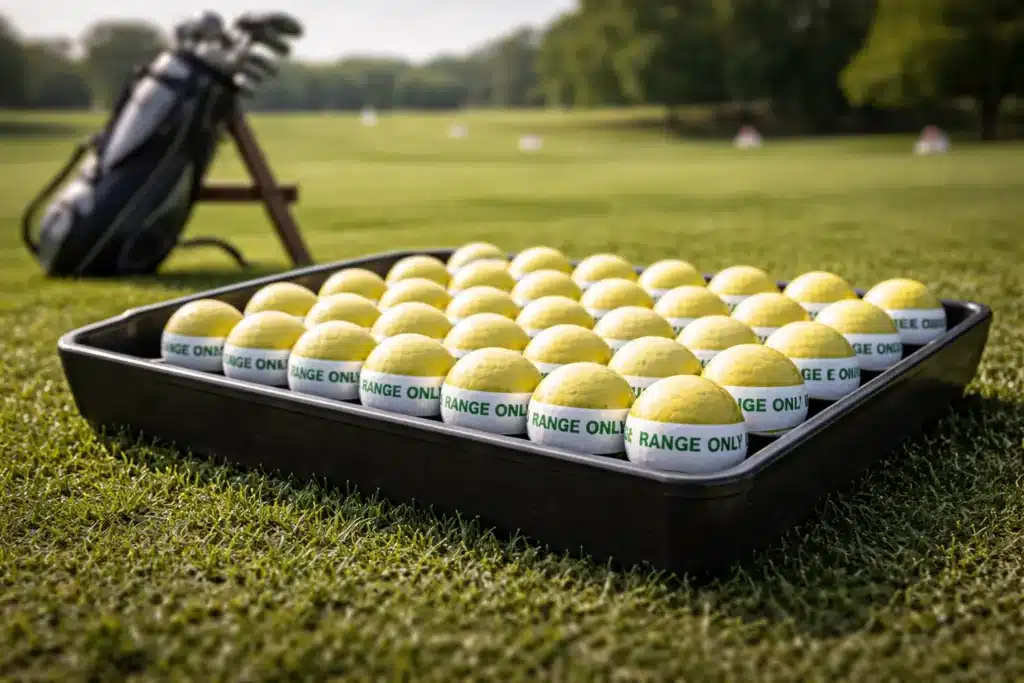
You stop range ball theft without losing feel by making premium practice balls unmistakably facility-only while keeping the same approved internal platform. The safest anti-theft range ball is not a worse ball; it is a good-feeling ball with bold PRACTICE marks, wraparound stripes, split two-tone visuals, or facility codes that make it awkward to use on the course.
Range ball shrinkage rises when a practice ball feels premium but still looks like a golfer’s normal on-course ball. One ball leaves in a pocket after a lesson. A few stay in cart baskets after warm-up. Over a season, that quiet loss becomes replenishment pressure, staff frustration, and a finance problem.
Use this guide to reduce stolen range balls and driving range shrinkage with facility-only graphics, social-distance recognition tests, shrinkage modeling, decorated-ball proof, and PO acceptance rules.
You upgrade the range to improve practice quality, but the replenishment budget starts acting like somebody opened a quiet side door in your inventory.
Premium range balls disappear first when they feel like a golfer’s on-course ball and still look socially usable outside the range. Your team should fix the visual identity before sacrificing feel, because better practice quality is not the mistake; pocketable appearance is.
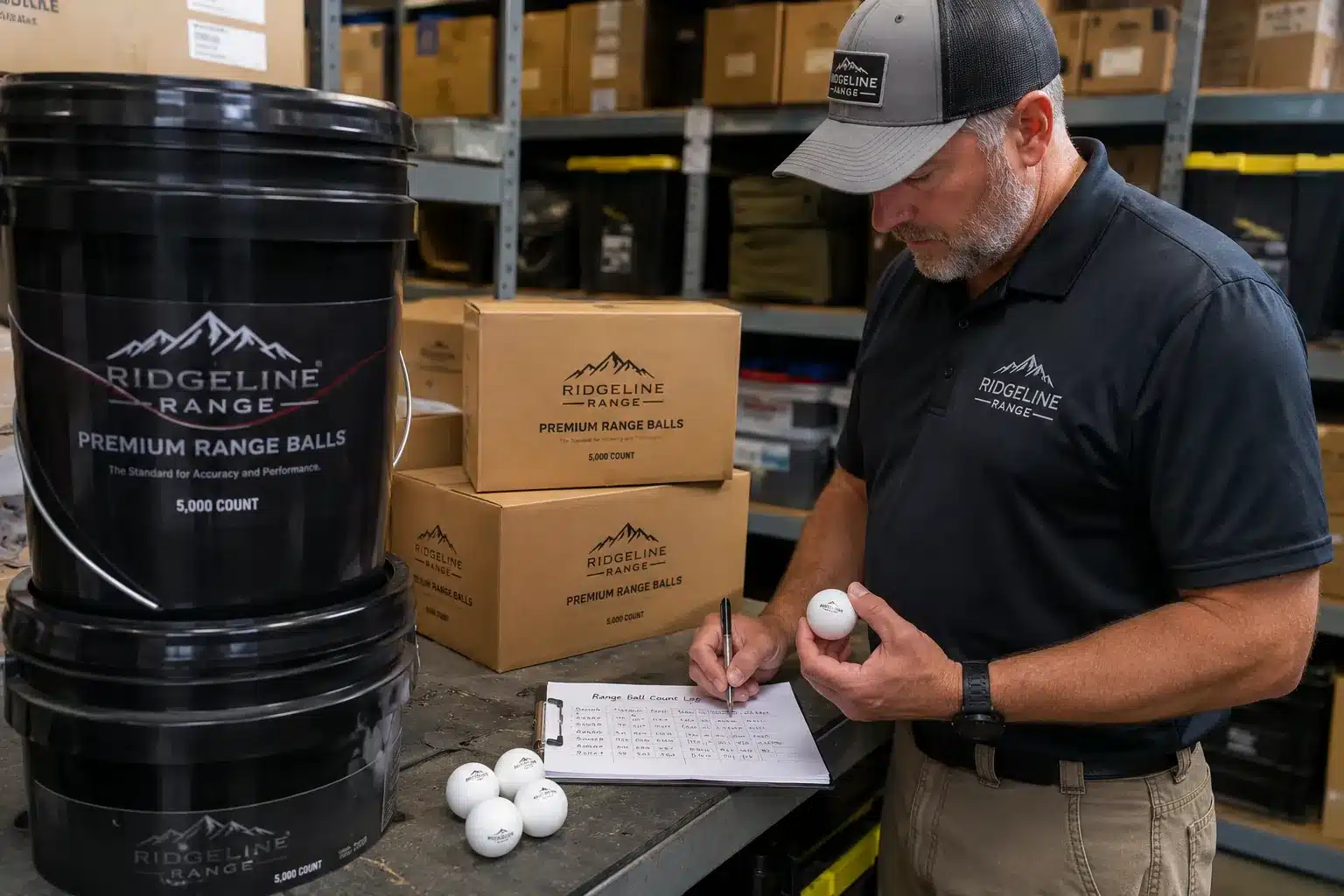
This is the premium penalty. A better practice ball can create more credible wedge feedback, better launch-window confidence, and a range experience that feels closer to real golf. That upgrade can be the right move for a private club, academy, resort, or premium public range. The problem begins when the upgraded ball still looks like something a golfer would happily use later.
A plain white premium-feel range ball creates low social friction. One ball slips into a pocket after a lesson. Two stay in a cart basket after warm-up. A few end up in a side pocket because they look close enough to gamer balls. The daily loss feels too small to start a confrontation, but the monthly replenishment pattern tells the truth.
Range-ball shrinkage is not imaginary. In 2024, a Thunder Bay driving range reported roughly 5,000 missing balls in one summer. Other reported cases include thousands of balls taken from a New Zealand range and 2,500 bright yellow balls marked as club property stolen from a Canadian facility. These are individual reports, not industry averages, but they show why shrinkage can become a replenishment issue rather than a small nuisance. reported 5,000 missing balls reported New Zealand range theft reported 2,500 stolen balls
The first buyer move is not downgrading feel. It is reconciling loss. Compare monthly replenishment orders against visible wear, breakage, picker loss, seasonal traffic, academy use, and physical reject counts. If the reorder rhythm is worse than normal wear explains, your issue may be pocketability.
For many private ranges, the answer is not a hard “range rock” or a full retail-style tour ball. A controlled mid-tier practice platform can keep feedback credible while giving your visual system room to create ownership cues. Keep the material decision disciplined, but do not let it distract from the main point: golfers are less tempted by a ball that clearly belongs to the facility.
Premium-feel balls that still look like retail gamer balls are a failure signal.
Build a 12-month shrinkage reconciliation sheet separating wear, breakage, picker loss, and unexplained loss. Do not downgrade feel until your team proves whether the real issue is performance cost or visual pocketability.
✔ True — Better practice quality is not the mistake
A better ball can improve member experience, coaching feedback, and range credibility. The mistake is pairing premium feel with a cover that still looks easy to take onto the course.
✘ False — “Staff reminders alone can solve premium ball shrinkage”
Staff can reduce abuse at the margins, but product design decides whether the ball feels awkward to pocket in the first place.
Premium feel vs pocketable appearance?
Your team should protect the practice experience and the replenishment budget at the same time.
Theft prevention versus player experience is a false tradeoff. If your range ball feels good but looks owned, the player still gets the practice benefit while the ball loses its first-tee usability. That is the design target.
What makes a range ball hard to pocket?
You may think a small logo, red stripe, or neat alignment line is enough, but modern retail balls already use bold visuals that can make subtle markings look normal.
A range ball becomes hard to pocket when it reads as facility property from social distance, not just when it has a logo. Your team should test oversized PRACTICE marks, wraparound stripes, split two-tone covers, and facility codes from tee, cart, and bag distance.
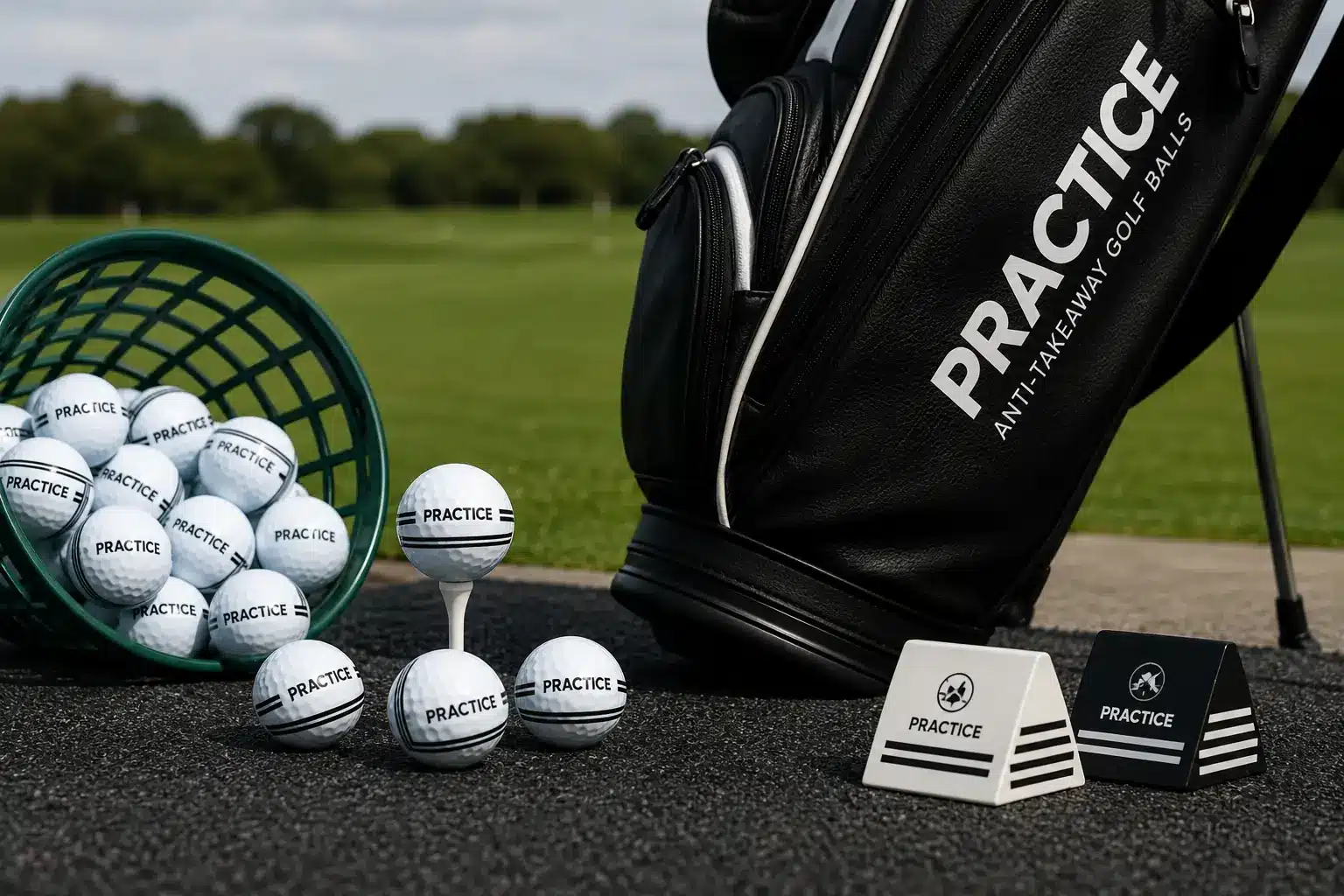
A small logo is usually branding. It is not automatically range ball theft prevention. If a golfer can pull the ball out on the first tee and nobody notices, the design is visible but not protective.
This matters more now because retail golf balls have trained players to accept stronger graphics. TaylorMade promotes ClearPath Alignment on pix models, Titleist AIM uses an extended alignment sidestamp, and Callaway offers 360 Triple Track alignment designs. A neat stripe or tasteful side logo may therefore look premium, not owned. ClearPath Alignment example Titleist AIM example Triple Track example
The anti-theft brief needs a different standard: social-distance recognition. A golfer should recognize the ball as range property at tee distance, cart distance, and bag distance. An oversized PRACTICE mark changes the social meaning. A wraparound stripe stays visible when the ball rotates. A split two-tone cover makes the whole object feel range-only. A facility code helps sorting and reinforces ownership.
| Pain/decision | Visual route | Deterrence risk | Action/evidence |
|---|---|---|---|
| Small logo | Brand mark only | Still pocketable | Use for branding |
| Retail-like line | Alignment look | May look premium | Reject if retail-like |
| Oversized PRACTICE | Clear property signal | Lower social comfort | Test visibility |
| Wraparound stripe | Visible when rotated | Strong recognition | Review from distance |
| Split two-tone | Facility-only identity | Needs SKU proof | Test final ball |
| Facility code | Sorting and tracking | Useful with stripe | Add to artwork |
Design that looks visible but not facility-only at bag distance is a failure signal.
Request three artwork directions on the same internal platform: a retail-like line, a wraparound stripe, and a split two-tone or oversized PRACTICE route. Review each from tee, cart, and bag distance before sampling.
Reject any layout that can be mistaken for a retail alignment graphic at social distance.
Social-distance recognition test?
Your visual system should make the ball awkward to take, not unpleasant to hit.
Recognition is not ugliness. The ball can still look clean, professional, and worthy of a premium facility. It simply needs to tell the social truth quickly: this is range property, not a gamer ball.
How can graphics deter theft without hurting feel?
You may worry that bold graphics will change feel or launch data, but the bigger risk is uncontrolled decoration or proof taken from the wrong sample.
Anti-theft graphics do not have to sacrifice feel when the final decorated SKU is engineered and tested as the product. Your team should compare the decorated sample against the approved control, then verify launch feel, coating durability, print legibility, and batch spread.
The decorated ball is the product. Not the plain sister model. Not the concept rendering. Not the same-core sample without the facility-only treatment. The final decorated SKU is what your members will hit, wash, sort, and see on the practice tee.
A factory-applied visual system belongs inside a controlled build. Pad printing often fits simple, high-volume, few-color range markings because it can be repeatable and cost practical. UV printing can fit more complex or multi-color graphics, but the process name alone does not prove durability. Print life depends on the ball surface, ink, curing, surface treatment, protective layer, and actual wash, rub, handling, and impact testing.
For range-ball theft prevention, print quality is not a decoration issue. The mark must stay readable after washing, picking, hitting, storage, and repeated handling, or the anti-theft system slowly disappears.
This is also why aftermarket repainting is the wrong mental model. A facility-only mark should be engineered into the finished SKU, not added as an uncontrolled cosmetic layer after the ball platform has already been approved. If the supplier proves the plain ball but ships a decorated version with different coating behavior, your approval file has a hole in it.
Supplier shall test and quote the final decorated SKU, not only the plain control ball, and shall identify the internal platform, print/coating method, visual layout, and proof revision used for approval.
Ask for decorated-ball launch notes, cutaway or construction confirmation, and print/coating summary. Compare the decorated candidate to the same internal platform, not to an unrelated plain sample. Use weight, diameter, compression, Shore D, visual-defect rate, logo legibility, and coating/print evidence as part of the same decision.
Do not approve artwork or mass production unless the final decorated SKU protects feel, legibility, and durability.
✔ True — The decorated SKU must prove itself
The ball your members hit is the decorated version, not the plain control. Testing should follow the final printed and coated SKU into approval.
✘ False — “A plain control sample proves the final anti-theft ball”
A plain sample can confirm the base platform, but it does not prove print durability, logo legibility, coating behavior, or decorated-batch consistency.
Factory printing vs aftermarket repaint?
Your team should buy the ball your members will actually hit, not the concept version.
The right question is not “Will the stripe hurt performance?” The right question is “Can the supplier prove this decorated ball still behaves like the approved platform?” That keeps the conversation practical, testable, and fair to both procurement and golf staff.
What does shrinkage cost your range?
You may know balls are disappearing, but your finance team may not see shrinkage until it becomes another avoidable replenishment order.
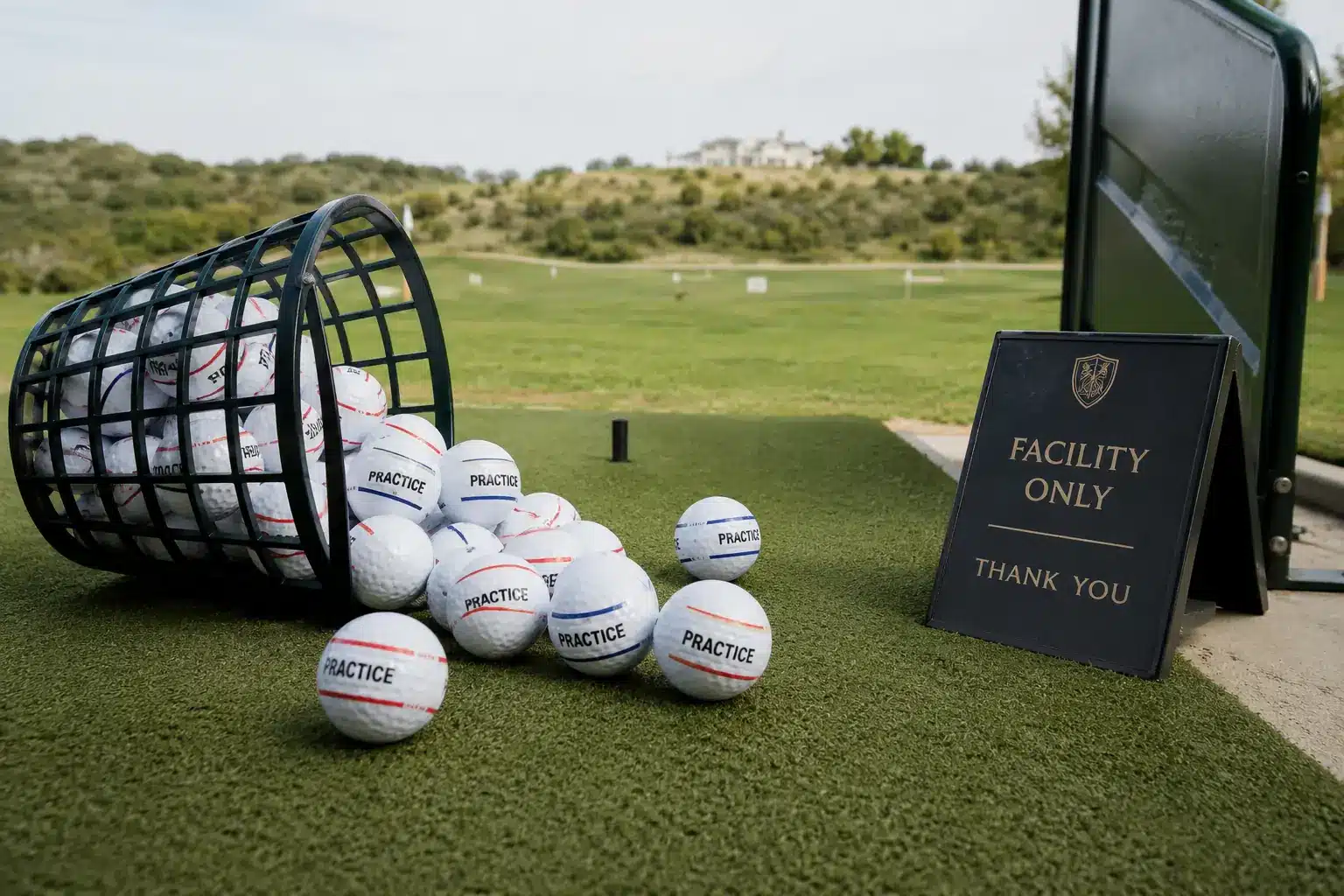
Range ball shrinkage becomes a finance issue when unexplained loss triggers avoidable replenishment. Your team should model fleet size, replacement value, monthly loss, labor, emergency replenishment, and visual-treatment premium as scenarios until monthly counts replace assumptions.
Shrinkage is only one driver in the wider range-ball economics model. To compare it with usable life, wear rejects, sorting, washer burden, and replenishment on the same basis, use our range ball TCO framework.
Shrinkage is easy to complain about and hard to approve against unless the math is visible. The cleanest approach is scenario modeling. That does not mean pretending every facility loses the same percentage. It means showing finance what would happen under conservative, base, and aggressive assumptions, then replacing assumptions with actual monthly counts.
Use these formulas:
Annual Shrinkage Cost = Fleet Size × Unit Replacement Value × Monthly Shrinkage Rate × 12
Operational Shrinkage Cost = Annual Shrinkage Cost + Sorting / Counting Labor + Emergency Replenishment Premium + Guest / Member Experience Cost
Labor belongs in the model. Current U.S. wage data can act as a public labor-cost anchor for grounds-related work, but your range should use its local wage, overtime rules, and actual minutes spent counting, sorting, replenishing, and investigating range-ball loss. labor wage reference
| Pain/decision | Plain-white loss | Facility-only loss | Action/evidence |
|---|---|---|---|
| Conservative case | Variable A | Variable B | Replace with counts |
| Base case | Variable C | Variable D | Model payback |
| Aggressive case | Variable E | Variable F | Escalate finance review |
| Labor burden | Counting/sorting time | Reduced handling | Use local wage |
| Emergency buys | Rush replenishment | Planned reorder | Track premium |
For a 10,000-ball fleet, even small monthly loss changes can become meaningful. If your facility-only visual system adds only a few cents per ball, the payback threshold may be lower than the team expects. You do not need shrinkage to vanish. You need avoided replacement exposure to exceed the visual-treatment premium.
Build a shrinkage model using your fleet size, replacement value, monthly loss, labor time, and expected visual-treatment premium. Replace scenario assumptions with monthly counts as soon as receiving and range staff can track them.
Do not approve or reject anti-theft visuals until the payback threshold is visible.
Scenario model, not fake average?
Your finance team should see shrinkage as a measurable replenishment leak, not a vague complaint.
Keep every percentage labeled as a scenario until your own data replaces it. That gives your GM, finance team, and head pro a shared language: not “members are taking balls,” but “unexplained loss is changing our replacement economics.”
How should you test anti-theft designs?
You may approve the design that looks best on a mockup, but theft deterrence must be judged on recognition, feel, durability, and the actual decorated ball.
Test anti-theft designs on the same internal platform so your team compares visibility, not different golf balls. Review a retail-like line, wraparound stripe, and split two-tone or oversized PRACTICE route from tee, cart, and bag distance before approving samples.
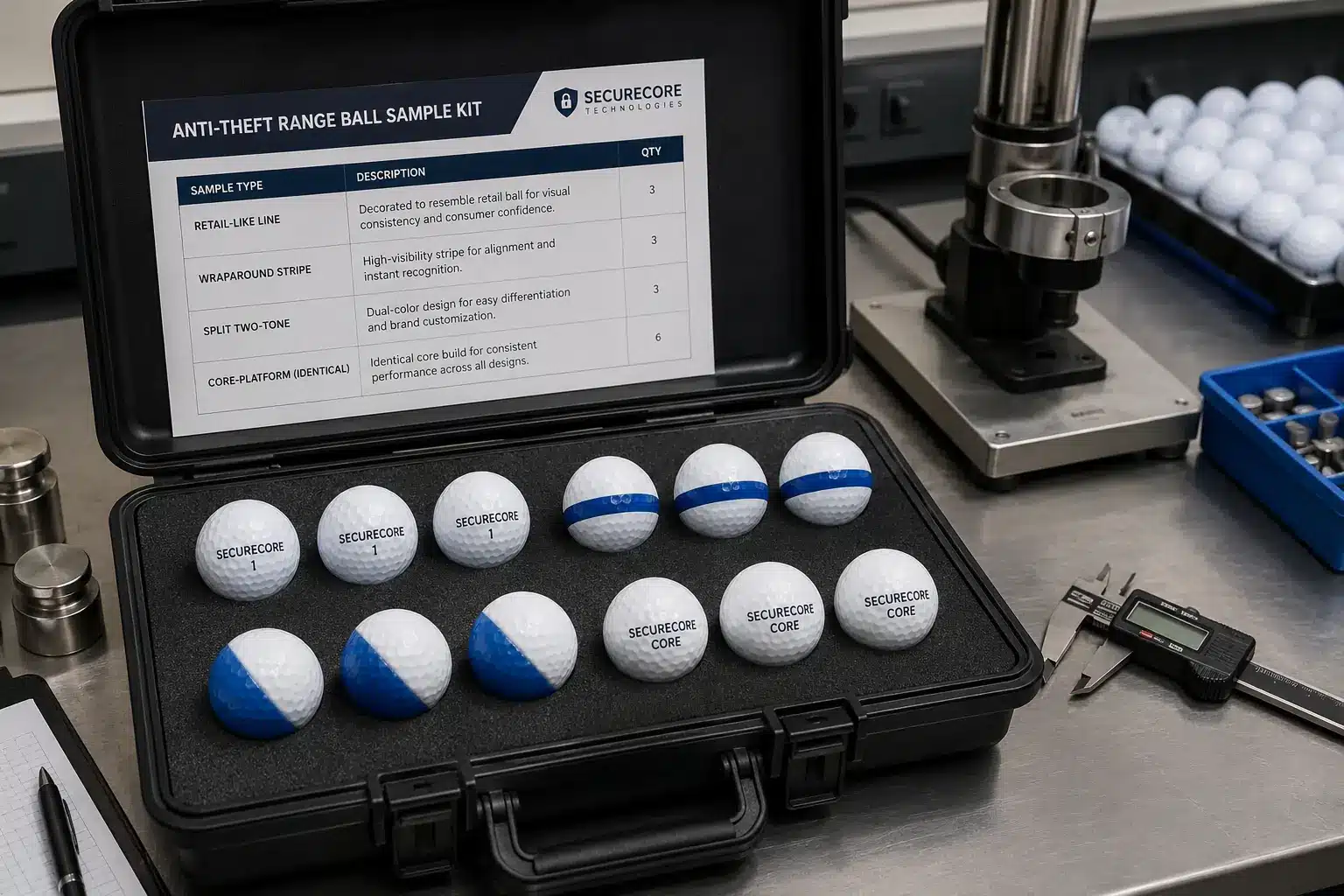
Use one internal platform and three visual routes. Otherwise your team will argue about feel when it should be judging recognition. The point is to isolate the visual system, not mix three different ball constructions into one decision.
Start with a retail-like line treatment. It gives you a control design: neat, familiar, probably not deterrent enough. Then test a wraparound stripe that remains visible after rotation. Finally, test a split two-tone or oversized PRACTICE system that makes the ball feel unmistakably range-only.
Review the three routes at tee distance, cart distance, and bag distance. Then ask separate questions. Does the design deter pocketing? Does it still feel appropriate for the facility brand? Does the print stay legible? Does the final decorated ball still feel like the approved platform? Does range staff find it easier to sort?
Artwork control matters too. Confirm vector artwork, mark size, mark position, stripe width, color zones, side coverage, facility code, and revision code before pre-production. Range-ball printing must remain legible after washing, picking, hitting, and handling.
Have the GM, head pro, range staff, and procurement score deterrence and feel separately. A design can be excellent at brand appearance and weak at theft deterrence. Another can be very strong visually but require better durability evidence before approval.
Request pre-production samples for three visual routes on the same internal platform. Score each route for social-distance recognition, range aesthetics, washer or abrasion durability, launch or feel notes, and staff sorting utility.
Do not move to bulk until the winning design proves recognition and remains legible after handling exposure.
✔ True — Social-distance recognition is a test
Anti-theft artwork should be judged where pocketing decisions happen: in the tray, cart, bag, and first-tee setting, not only on a clean design screen.
✘ False — “The best-looking mockup is automatically the best anti-theft design”
A beautiful mockup can still look retail-like, fade after handling, or fail to identify the ball as facility property at social distance.
Same platform, three visual routes?
Your team should test deterrence where pocketing decisions happen, not only on a design screen.
A beautiful mockup is not enough. The ball has to work in a tray, a cart, a bag pocket, and a golfer’s hand. If the facility-only cue disappears in those situations, the artwork has not done its job.
What proof should your PO require?
You may receive a beautiful mockup and a quick quote, but the PO must prove the final decorated ball, not just artwork.
Do not buy anti-theft range balls from artwork alone. Your PO should require final decorated samples, 12-ball QC raw data, print/coating durability evidence, retained samples, AQL-based receiving rules, and a locked production version tied to the artwork revision.
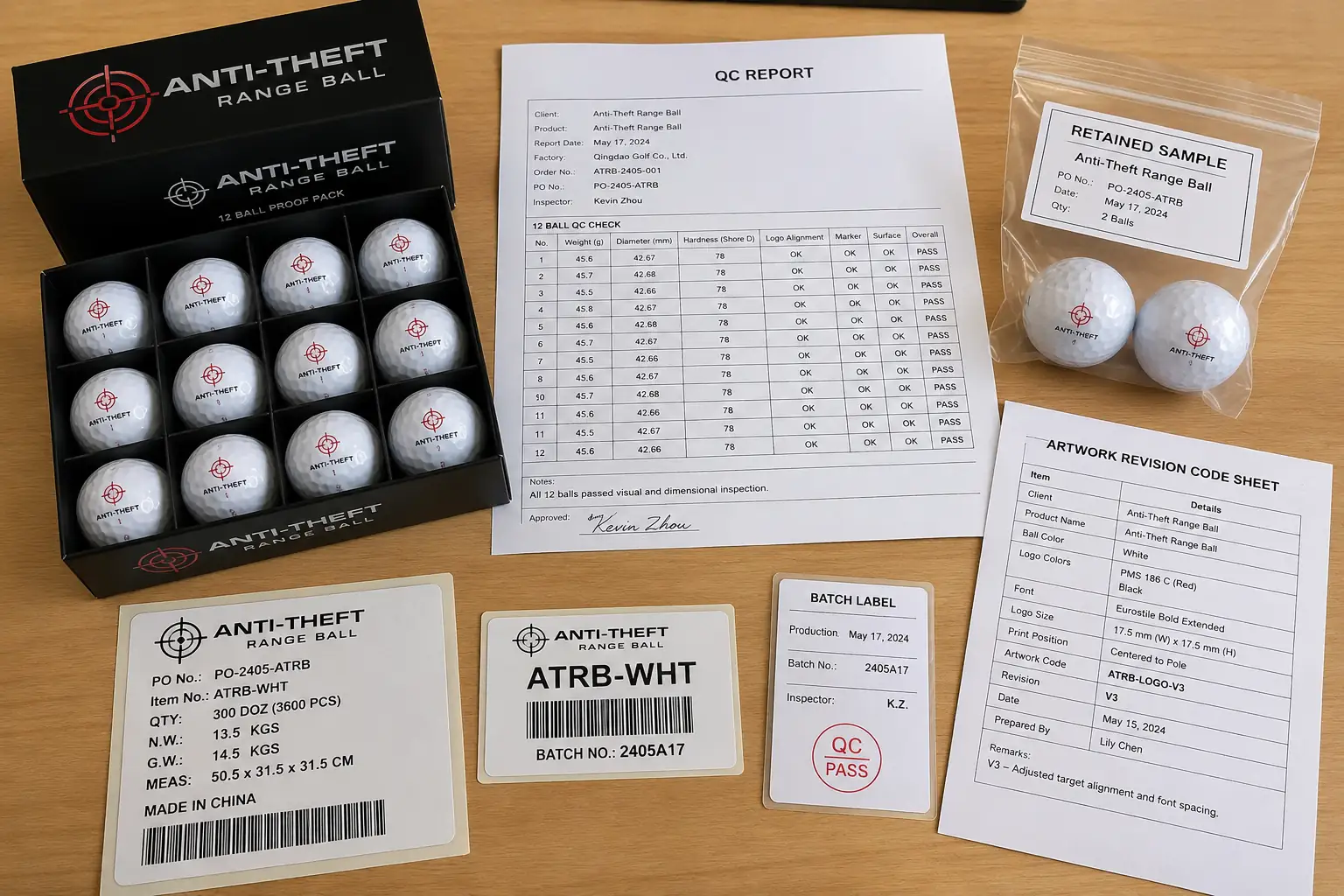
The decorated ball is the approval object. Not the PDF proof. Not a plain control ball. Not a photo of a single perfect sample. Your team needs the final decorated sample, the same internal platform, the same visual treatment, the same print/coating process, and the same production version that will ship.
Ask the supplier to quote one fixed internal platform across three anti-theft visual routes, with final decorated-ball samples, launch/feel notes, 12-ball QC report, print/coating method note, washer or abrasion evidence, retained sample, artwork revision, and production version control.
A 12-ball QC report should include raw values, average, range or standard deviation, device list, calibration date where available, weight, diameter, compression, Shore D, visual defects, and coating or print result. This is how your team avoids one hero sample pretending to represent a bulk shipment.
Use standards as reference frameworks, not magic labels. ASTM D5264 can support buyer-seller thinking for printed-material rub or scuff resistance, ASTM D4060 can support relative coating-abrasion comparison, and ASTM D2240 can support Shore hardness control. ISO 2859-1 can support AQL-indexed receiving inspection. The PO should still define the actual on-ball method, sample size, accept/reject rule, and retained-sample process. ASTM D5264 ASTM D4060 ASTM D2240 ISO 2859-1
Supplier shows artwork mockups but no decorated-ball QC is a failure signal.
| Pain/decision | Proof item | Why it matters | Action/evidence |
|---|---|---|---|
| Mockup only | Decorated sample | Proves final SKU | Approve actual ball |
| Hero sample | 12-ball QC | Shows spread | Review raw data |
| Weak print | Rub/washer evidence | Checks legibility | Set method |
| Sample drift | Version code | Locks artwork | Tie to PO |
| Receiving dispute | AQL plan | Defines defects | Train receiving |
| No baseline | Retained sample | Supports claims | Seal samples |
Supplier shall link approved anti-theft artwork revision, final decorated-ball sample, internal platform, print/coating method, 12-ball QC report, retained sample, production batch ID, packing list, and receiving inspection record under one traceable proof version.
Buyer acceptance requires final decorated samples, legible facility-only markings after agreed wash/rub exposure, approved artwork position and scale, raw 12-ball QC data, compression and Shore hardness window, visual-defect limit, retained sample match, and written approval for any change to artwork, coating, print method, or internal construction.
Request an anti-theft range ball proof pack: decorated samples, launch/feel notes, 12-ball QC, print/coating evidence, retained sample, AQL receiving plan, and version control. Check that the artwork proof, QC report, batch record, packing list, and retained sample all reference the same proof version.
Hold shipment if artwork revision, decorated sample, QC data, print durability, or retained-sample match is missing.
Decorated sample, QC pack, version lock?
Your PO should stop shrinkage design from drifting between mockup, sample, and mass production.
Do not accept “mass production will improve” unless the proof version is retested and reapproved. Any change to artwork scale, stripe width, PRACTICE mark size, color zone, coating process, internal construction, or production version should require written buyer approval.
FAQ
Do golfers really steal range balls?
Yes, range-ball loss is a real operating issue, but your team should treat it as shrinkage rather than blaming every golfer. Unexplained loss should be separated from breakage, picker loss, seasonal usage, and visible rejects.
Track monthly counts. Compare replenishment rhythm. Use facility-only visuals before downgrading feel. A professional shrinkage model helps your team discuss the problem without turning the article, meeting, or member conversation into a moral lecture.
Is taking range balls from a golf course theft?
Most facilities treat range balls as course property, not as balls purchased by the golfer. Keep the wording operational unless your facility wants legal language reviewed locally.
Use property-of-course language in signage and operating rules. Viera East’s official policy states that all range balls and range ball containers are the property of Viera East Golf Course, and that removing them may result in the player being asked to leave or banned from the facility. The buying point is simple: make ownership obvious on the ball itself, not only on a sign. course property policy
Will bold graphics change launch monitor numbers?
They do not have to, but the final decorated ball must prove it. Test the decorated SKU, not only the plain control model or a similar sister construction.
Request launch or play-feel notes. Compare against the same internal platform. Keep 12-ball QC and retained samples. A bold visual treatment is not the enemy; unverified decoration, coating drift, and sample-to-bulk mismatch are the real risks.
Do red stripes still stop range ball theft?
They can help, but simple stripes may no longer be enough if they look like retail alignment graphics. The mark must read as facility-only from social distance.
Test from tee, cart, and bag distance. Use wraparound identity where possible. Pair stripes with PRACTICE text, a facility code, unusual color blocking, or split two-tone visuals. If the stripe still looks like a premium retail alignment feature, it may not create enough social friction.
Can pad printing survive commercial washer use?
It can, but durability depends on the full print and coating system, not the process name alone. Ask for washer, rub, or abrasion evidence on the actual decorated SKU.
Request before/after proof. Check logo legibility. Avoid assuming UV is automatically stronger. The practical question is whether the mark remains readable after washing, picking, hitting, storage, and handling in your range environment.
What should be in a first sample kit?
A useful kit should compare deterrence, feel, and proof on the same platform. Do not approve unrelated mockups, plain controls, and decorated samples as if they were one product.
Ask for three visual routes on one core, artwork proof with revision code, launch/feel notes, 12-ball QC, print/coating summary, washer or abrasion evidence, and retained sample. That keeps the decision about the visual system, not about unrelated ball builds.
What should you ask a supplier before buying?
Ask for decorated-ball samples, print/coating method, washer or abrasion evidence, launch or feel notes, 12-ball QC, retained samples, AQL receiving plan, and production version control.
Reject artwork-only approvals. Tie proof to the shipment. Require written change approval. The final decorated SKU should be traceable from artwork proof to QC report, batch record, packing list, retained sample, and receiving inspection.
Conclusion
The best anti-theft range ball is not the one golfers hate to hit. It is the one they enjoy hitting on the range and would feel awkward pulling out on the first tee.
Keep the internal platform credible. Make the visual system unmistakably facility-only. Approve only what the final decorated SKU can prove.
When your team controls shrinkage math, social-distance recognition, decorated-ball testing, and PO proof, theft prevention stops being a staff reminder and becomes a product system.
You might also like — Are Cheap Golf Balls Damaging Your Impact Screen?