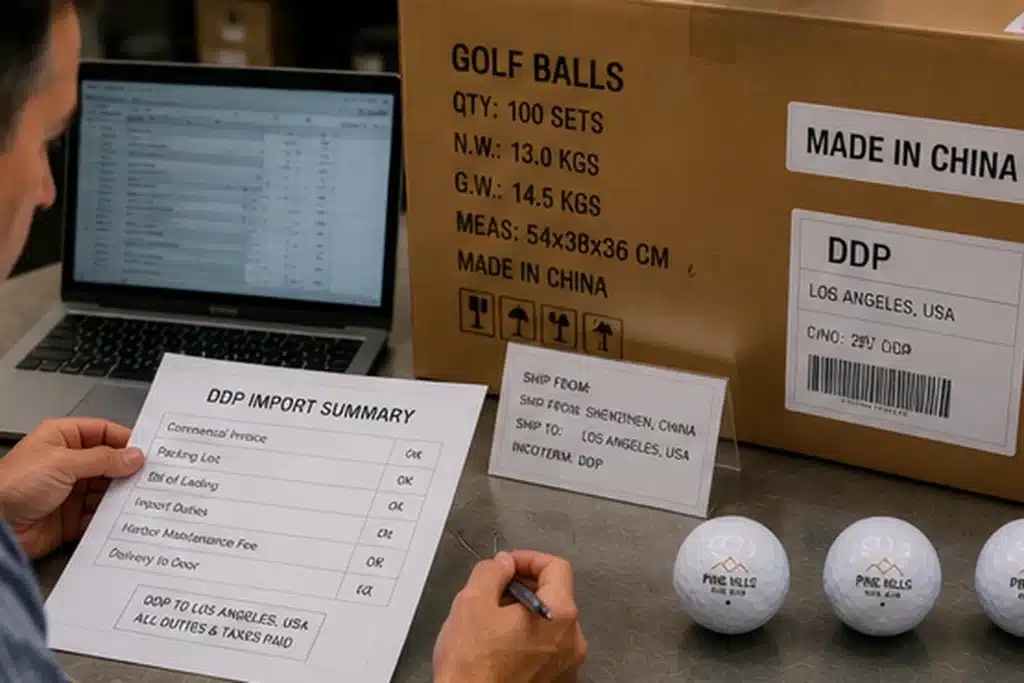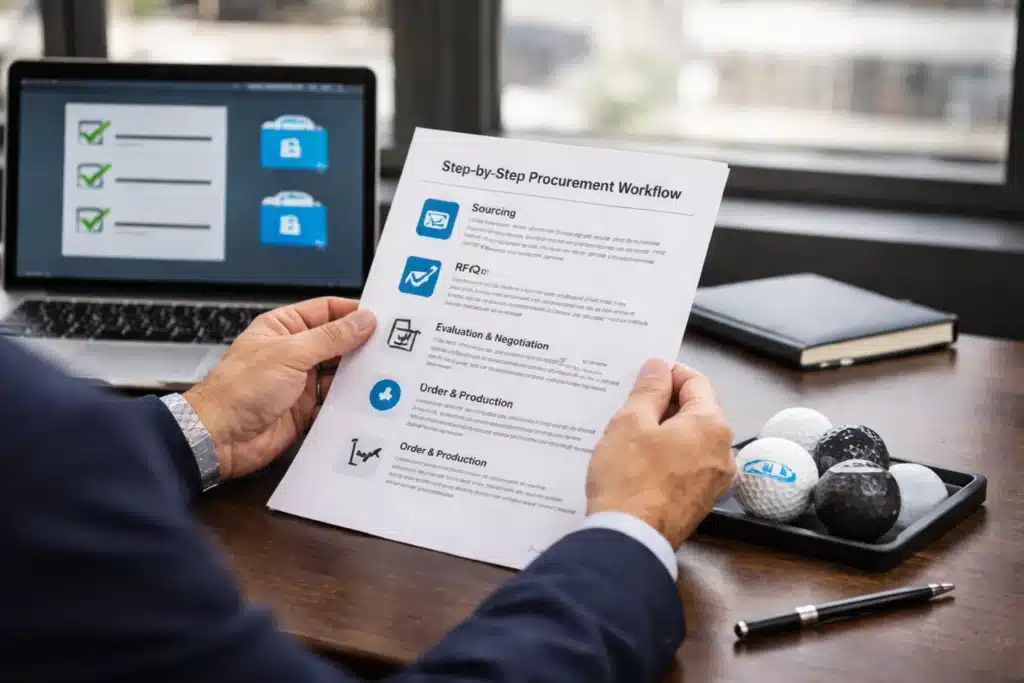
You cannot unsend CAD. Once full dimple geometry enters an uncontrolled supplier chat, your best design may already be outside your control.
To safely share golf ball CAD with a China OEM, use a contract-first, split-file workflow: sign the NNN first, share only RFQ-safe files, test the factory with blank-ball samples, watermark packaging dielines, and send production CAD only through VDR-style links with named-user access, expiry, and audit logs.
Your goal is not to “trust faster.” Your goal is to release only enough information for the next decision: quote, material test, tooling, packaging sample, or final production.
| CAD-sharing gate | What you can send | What you should hold back | Release condition |
|---|---|---|---|
| RFQ | Performance target, material family, masked 2D section | Native CAD, STEP, full dimple map | Supplier can quote from low-risk files |
| Material test | Public-mold or blank-ball requirements | Private surface geometry | Factory proves core / cover capability |
| Packaging sample | Supplier-marked dieline or print PDF | Clean source AI files | Trace version is logged |
| Tooling | Controlled STEP / IGES or mold reference | Broad internal distribution | NNN, PI, tooling deposit, named users |
| Production | Final CAD, BOM, QC specs | Uncontrolled copies | VDR-style log and expiry controls |
Your NNN is the first gate, not the whole system. This guide focuses on the operational question that comes next: what exactly should you send, when, to whom, and through which channel?
How do you protect files after NNN?
You may think the legal agreement solves the problem, but most CAD leaks happen later through early file release, wrong recipients, uncontrolled chats, or clean packaging files.
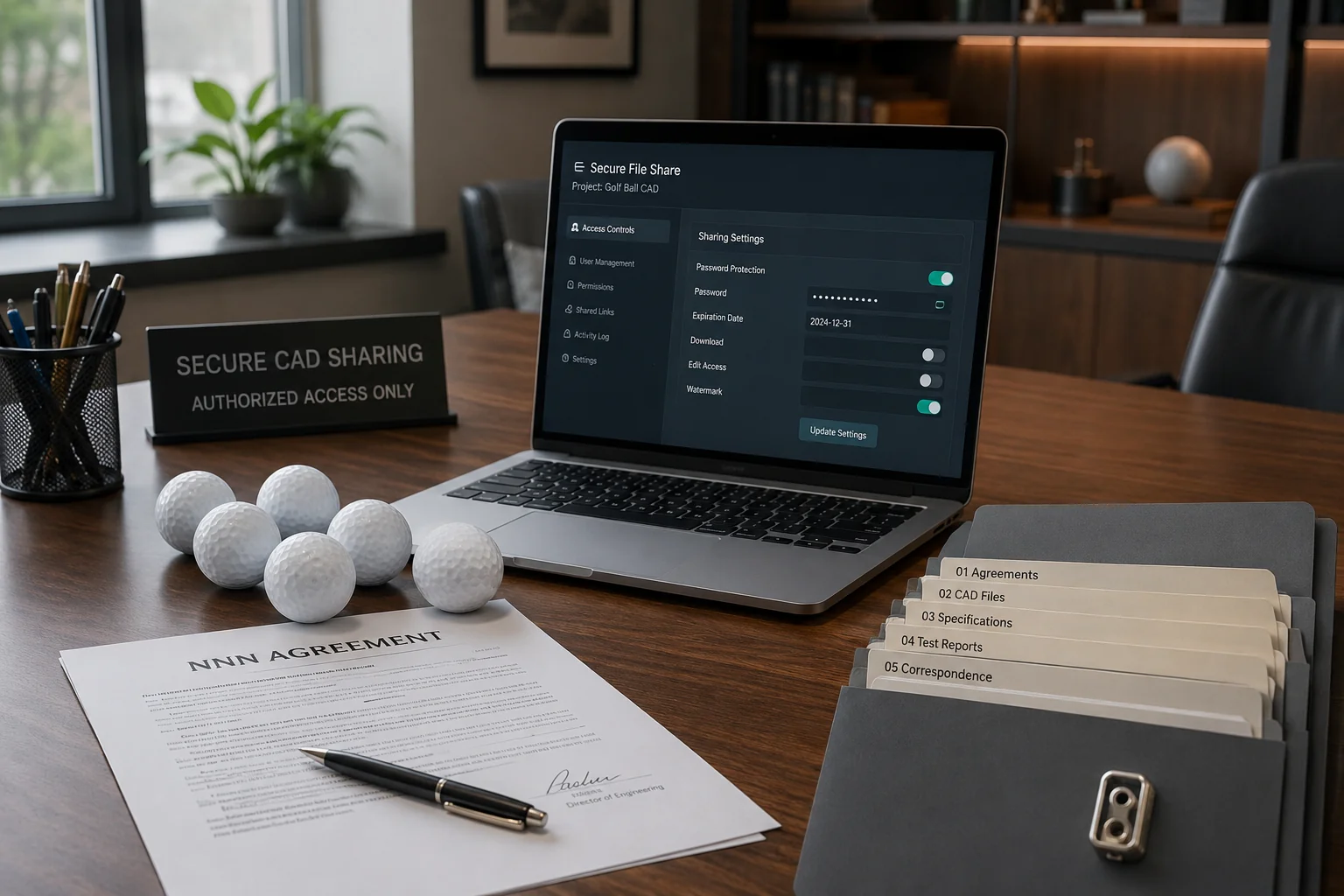
Signing an NNN does not make CAD safe by itself. Your next control is operational: treat golf ball CAD as an information asset, release files by stage, limit each person to the files needed for the task, and keep a versioned audit trail.
A premium golf ball design is not “one drawing.” It can include dimple geometry, layer structure, compression target, cover route, tooling assumptions, packaging dielines, print files, and launch visuals. If sales, tooling, printing, packaging, and subcontractors all see the whole file set, your staged disclosure is mostly theater with nicer paperwork.
Use an information-security mindset: protect confidentiality, integrity, and availability through risk-based file controls. ISO/IEC 27001 information security management Then apply least privilege principle. Sales may see the RFQ pack. Tooling engineers may see controlled geometry. Packaging vendors should see only packaging files. A printer does not need core, mantle, compression, or dimple data.
| File risk | Rookie mistake | Safer control | Buyer move |
|---|---|---|---|
| Full CAD leak | Send STEP in RFQ | Split-file stages | Mask early files |
| Wrong recipient | Sales gets everything | Least privilege | Name file users |
| No trace | Email / WeChat file | Audit log | Track access |
| Packaging leak | Clean dieline sent | Poison-pill version | Mark every vendor |
| Local copy | Download forever | Expiring link | Revoke access |
Ask for a file-recipient list before sending anything sensitive. Confirm name, role, file need, access level, and expiry date. No named recipient and no access log, no production-grade CAD release.
✔ True — NNN is a gate, not a file-control system.
The agreement creates leverage, but daily protection comes from staged release, named users, version control, and access records. That is where many CAD leaks are prevented.
✘ False — “Once the NNN is signed, we can send full CAD.”
Full CAD should wait until the file stage, recipient list, access channel, and release purpose are clear.
You may send full SolidWorks, STEP, or IGES files to several suppliers just to get pricing, exposing the most valuable part before anyone earns trust.
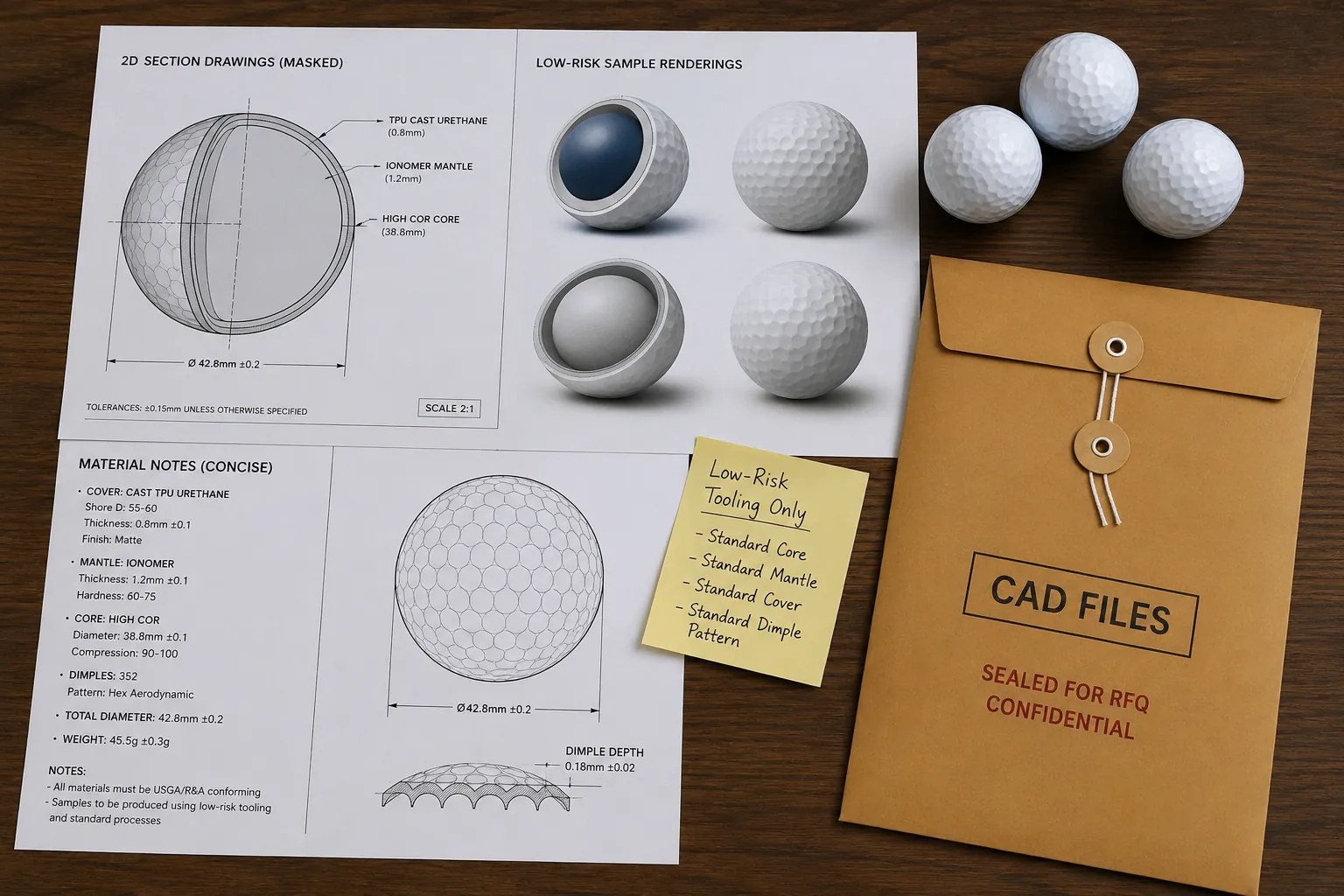
At RFQ stage, do not send the whole golf ball. Share performance targets, material family, masked 2D sections, packaging scope, and only low-risk visualization files; hold STEP, IGES, native CAD, and full dimple geometry until terms, tooling payment, and file-access controls are locked.
Split-file transfer separates what a factory needs to quote from what it needs to manufacture. Early RFQ usually needs construction class, cover type, target feel, performance tier, packaging scope, print complexity, and masked dimensions. It does not need a complete editable 3D dimple map. The question to ask is not “Can they quote?” It is “What is the least sensitive file that lets them quote responsibly?”
The first failure signal is: “Send full STEP now so we can quote.” STEP and IGES are tooling-ready exchange files. They are useful when the project is moving into controlled tooling, but they are too generous for price discovery. STEP files are widely used in manufacturing because they can preserve precise CAD geometry and product structure, which is exactly why they should not be casual RFQ attachments. STEP files preserve precise CAD geometry
A low-resolution STL or 3D PDF can help show direction when visualization is unavoidable. Mesh files can be useful for reference, but they are not the same as handing over clean production CAD. That difference matters when your goal is to communicate shape direction without releasing final editable manufacturing geometry. STL mesh editing limitations
| File type | Leak risk | Best stage | Buyer move |
|---|---|---|---|
| Native CAD | Extreme | Final production | Release last |
| STEP / IGES | High | Tooling-ready | Use only after deposit |
| Low-res STL | Medium-low | RFQ / feasibility | Use for visualization |
| 3D PDF | Medium-low | RFQ review | Keep restricted |
| 2D section | Medium | RFQ | Mask sensitive geometry |
| Packaging PDF | High | Packaging sample | Add poison pill |
How should you split CAD risk?
Split CAD by decision stage: RFQ files help quote, sample files help test, tooling files help build, and production files go only to approved engineers.
Buyer shall release design files in stages. RFQ-stage files shall be limited to masked drawings, performance targets, material families, and low-risk visualization files. Production-grade CAD, STEP, IGES, dimple geometry, and tooling files shall be released only after NNN execution, PI approval, tooling deposit, named-user access confirmation, and file-transfer log setup.
Send an RFQ-safe split-file pack. Ask the supplier which decision requires each requested file. Do not release full dimple CAD just to get a rough quote.
How can blank balls test the factory?
You may want to test urethane chemistry, compression control, rebound, curing, or cover shear before giving away private dimple geometry.
Use a blank-ball or public-mold proxy test before releasing private dimple CAD. If your goal is to check compression, urethane cover quality, clearcoat adhesion, curing, rebound, or wedge shear, the factory can prove material capability before it sees your crown-jewel surface geometry.
A blank-ball proxy test is a golf-specific way to separate factory capability from design exposure. The factory can use an existing public mold, a standard dimple pattern, or a smooth proxy ball to show whether its material system deserves the next stage. This will not prove final flight. It will prove whether the core, cover, coating, and curing process are worth trusting.
R&D buyers prefer controlled testing. If a factory wants your private dimple CAD before passing material tests, pause. You do not need to expose your most distinctive surface design to learn whether the urethane cover peels, compression drifts, or clearcoat adhesion fails. A factory that cannot pass a public-mold material screen has not earned access to private geometry.
Treat the blank-ball test as a CAD-release gate, not as a replacement for a full golf ball QC testing process. It helps you decide whether the supplier deserves the next file stage.
| Test goal | Needs private dimples? | Proxy method | Buyer move |
|---|---|---|---|
| Compression | No | Blank / public mold | Test first |
| Cover shear | No | Urethane proxy ball | Hold CAD |
| Clearcoat adhesion | No | Public-mold sample | Check cure |
| Rebound trend | Usually no | Existing mold | Compare lots |
| Final flight | Yes | Private dimple CAD | Release later |
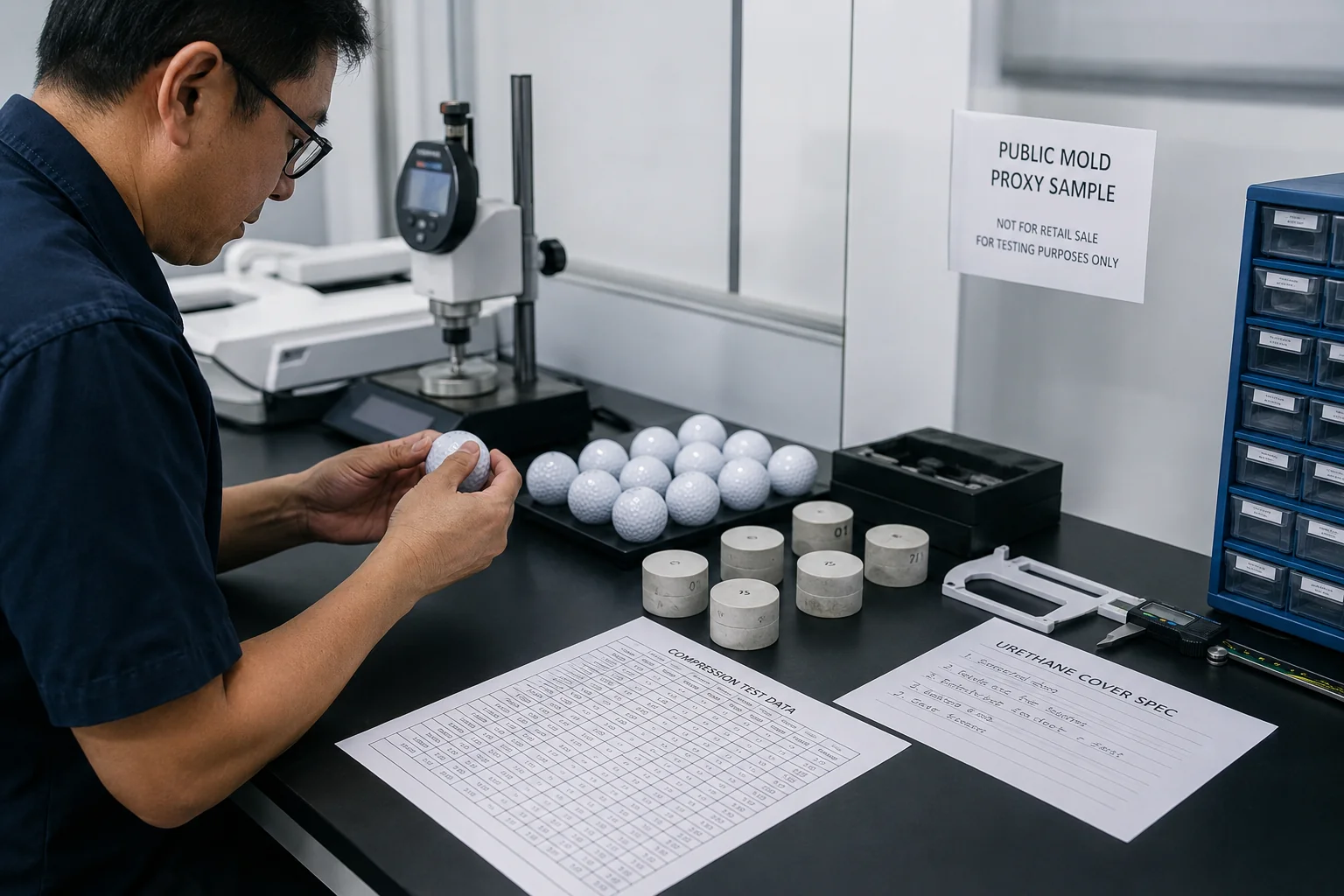
Request a blank-ball or public-mold test report. Review compression, rebound, urethane shear, clearcoat adhesion, and curing behavior. Do not release private dimple geometry until the factory passes material-process screening.
✔ True — You can test material capability before revealing private geometry.
Compression, coating adhesion, cover shear, and curing behavior can often be screened on public-mold or blank-ball samples. Final flight testing can wait for the private design stage.
✘ False — “We must send private dimple CAD to test the factory.”
That uses your crown-jewel file as a supplier qualification tool. Test the factory first, then release the geometry.
How do you watermark packaging files?
You may protect the ball CAD but send clean AI, PDF, or dieline files to a factory or packaging subcontractor, making the box easier to copy than the ball.
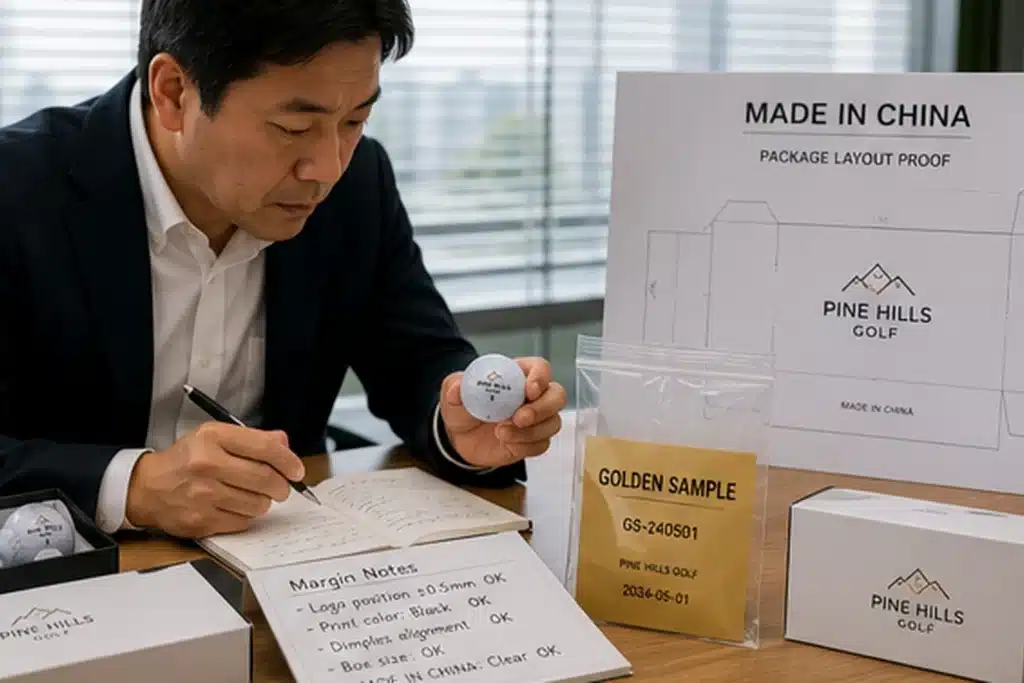
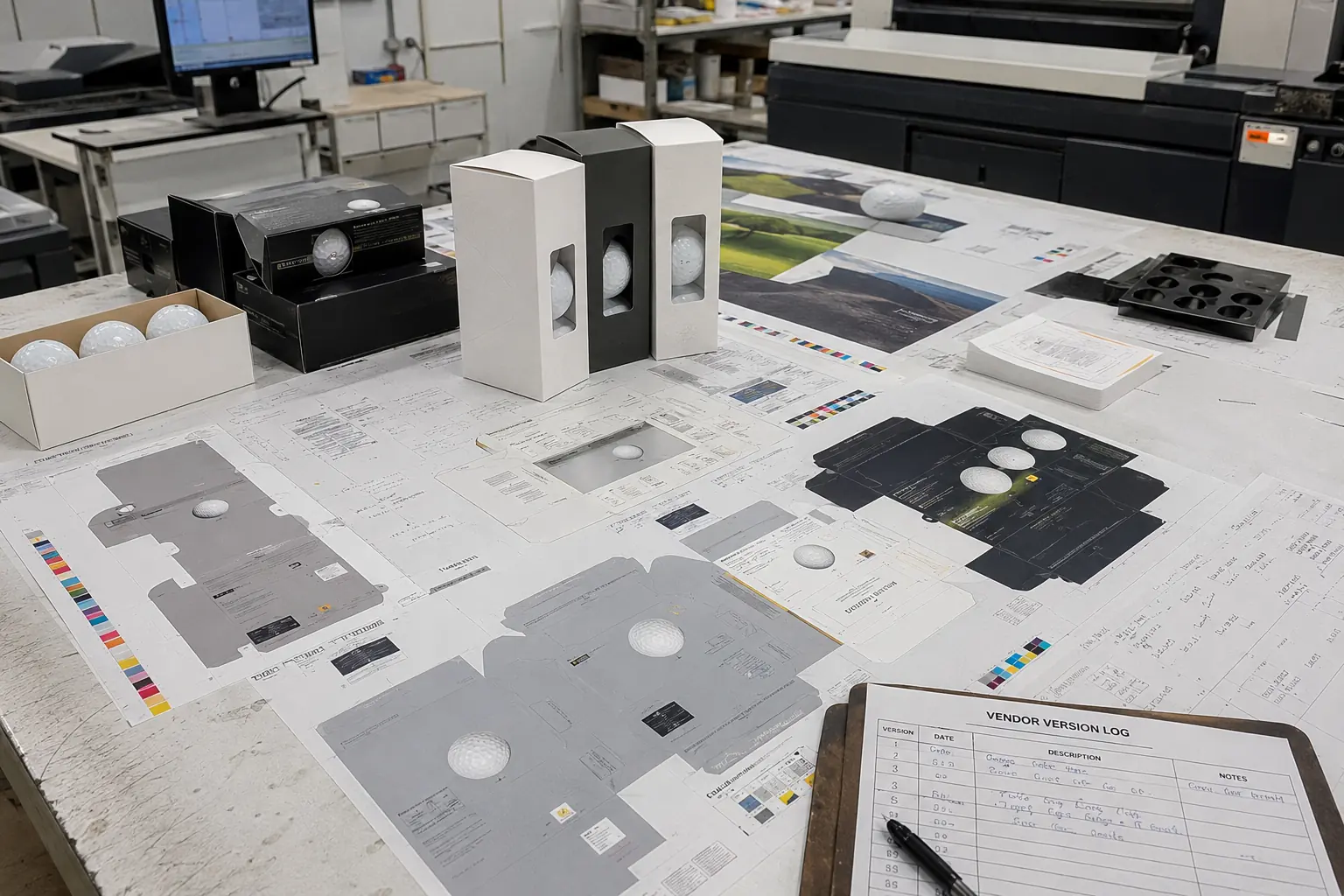
Packaging files should not leave your team clean. Before sending dielines, AI files, or print PDFs to a China OEM or packaging subcontractor, add supplier-specific trace markers such as micro-text, hidden layer names, custom color aliases, metadata, or controlled non-consumer-facing marks.
Golf ball launches involve more external hands than buyers expect. A color box printer may see the dieline. A sleeve supplier may see artwork. A gift-box vendor may see structural files. A photo vendor may see launch visuals. An insert tray supplier may see product positioning before the market does.
DTC founders prefer leak traceability because packaging can leak faster than technical CAD. A competitor may not need your core structure to copy your shelf presence. They may copy the premium box, color system, layout, insert, or launch visuals first.
A digital poison pill makes each supplier version traceable. It should not degrade print quality, mislead consumers, or create visible errors in customer-facing areas. Use subtle identifiers: micro-text on an inside flap, a hidden layer name, a supplier-specific spot-color alias, a tiny off-artboard code, metadata, or a one-pixel alignment marker outside the live art area. This works as trace evidence and a leak-path indicator, not as courtroom-proof magic. forensic watermarking
| Poison pill | Where to place | What it shows | Buyer move |
|---|---|---|---|
| Micro-text | Fold / flap area | Version source | Use per supplier |
| Hidden layer name | AI / PDF file | File lineage | Keep log |
| Color alias | Spot color name | Supplier version | Use unique naming |
| One-pixel marker | Dieline edge | Leak trace | Avoid print impact |
| Metadata tag | File properties | Custody path | Preserve export copy |
What makes a poison pill safe?
A safe poison pill is traceable, supplier-specific, and invisible or harmless to the end customer. It should help identify a leak without damaging packaging accuracy.
Keep a version log showing which factory, printer, or packaging vendor received each identifier. Do not rely on memory or “final-final-2.pdf,” the official file name of chaos. Use controlled marks that do not affect barcode readability, retail compliance, legal text, safety warnings, or consumer-facing claims.
Supplier may not remove, flatten, alter, or disclose supplier-specific trace identifiers in packaging dielines, artwork layers, color names, metadata, or file versions without written approval.
Create supplier-specific packaging file versions. Keep a log showing which supplier received which marker. Never send clean source AI or dieline files to an uncontrolled packaging chain.
Which channels are safe for CAD?
You may let the supplier pull you into WeChat, email attachments, or group chats because it feels fast, then lose control over downloads and forwarding.
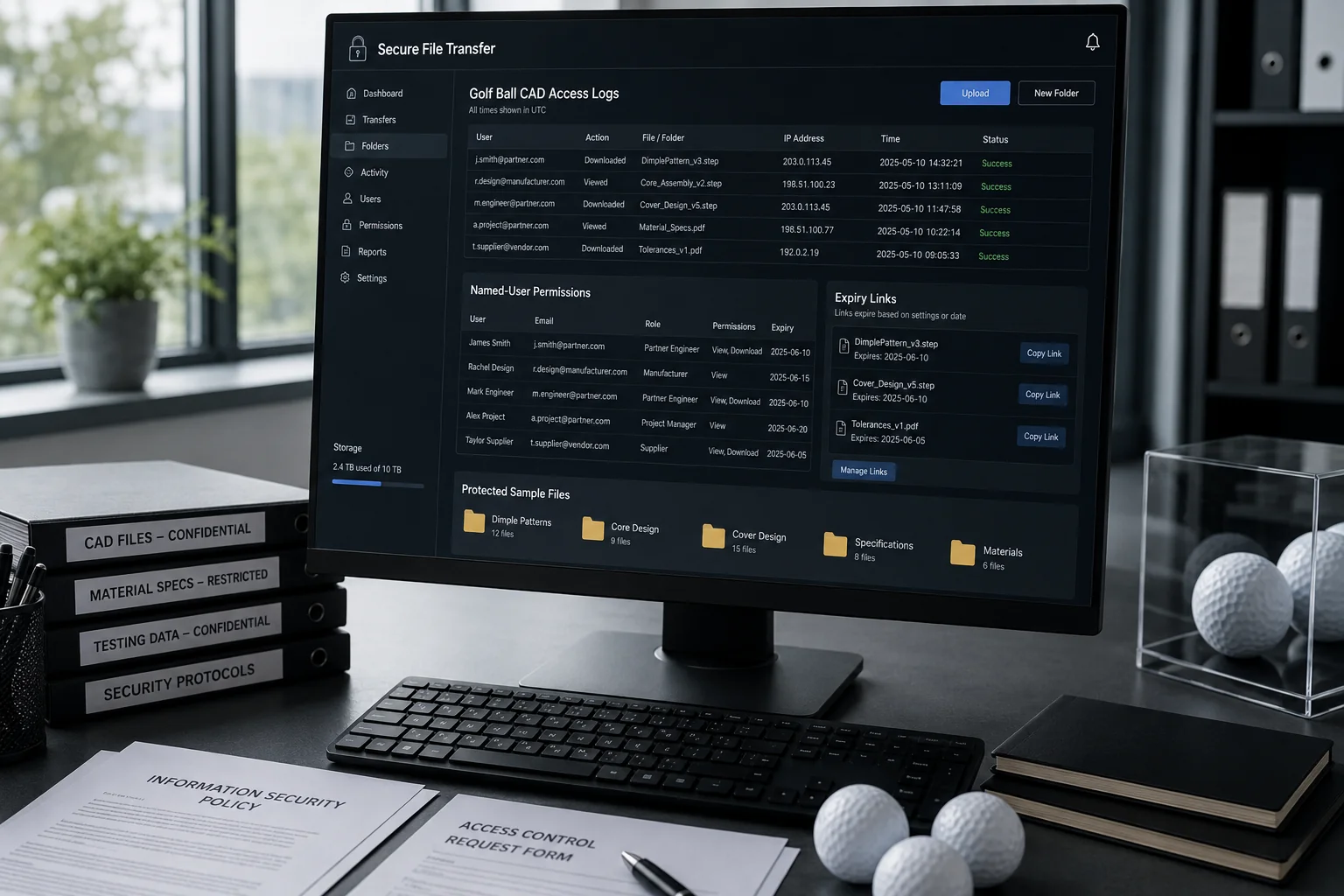
Do not send production CAD through WeChat or ordinary email attachments. Use a VDR-style workflow with named-user access, MFA, view-only settings where possible, download restrictions, expiry links, dynamic watermarking, revocable permissions, and audit logs showing who opened which file and when.
WeChat is useful for project updates. It is not a safe place for production CAD, full dimple maps, source AI files, or tooling packages. The same is true for ordinary email attachments. Once a file is downloaded, forwarded, copied to a local drive, or dropped into a group chat, your custody trail becomes weak.
For early RFQ, a controlled secure link with a short expiry may be enough. For production CAD, use VDR-style behavior: named accounts, no public links, MFA, view-only access where possible, download or print restrictions, dynamic watermarks, expiry, revocable access, and audit logs. VDR-style workflows are commonly used for sensitive document review because they can support permissions, watermarking, access controls, and audit trails. virtual data room security features
These controls do not prevent screenshots or all local misuse, but they create access visibility and a stronger evidence trail. That is the real buyer-side value. You are not making CAD impossible to steal; you are making casual misuse harder, uncontrolled sharing more visible, and supplier accountability easier to discuss.
The third failure signal is familiar: sales asks you to drop CAD into a WeChat group chat. A serious supplier should be able to work inside a controlled file-release process, even if daily communication still happens quickly.
| Channel | CAD risk | Acceptable use | Buyer move |
|---|---|---|---|
| WeChat group | Extreme | Status updates only | Ban CAD |
| Email attachment | High | Low-risk docs only | Avoid production files |
| Public cloud link | High | Non-sensitive files | No public links |
| Secure cloud link | Medium | RFQ / sample pack | Add expiry |
| VDR / data room | Lower | Production CAD | Use audit logs |
What should a VDR log show?
A VDR log should show who accessed which file, why they needed it, when access started, when it expires, whether download was allowed, and whether deletion or return was confirmed.
Before releasing production-grade CAD, ask the supplier to confirm the file release stage, named file recipients, approved channel, view/download permissions, expiry settings, version log, deletion / return status, and whether packaging files will carry supplier-specific tracking marks.
Supplier shall maintain a file access and version log for all buyer design files, including file name, file type, version number, recipient name, department, purpose, access date, permission level, expiry date, download status, and deletion or return confirmation.
No production CAD through WeChat, public links, USB transfers, or uncontrolled email attachments. If a supplier cannot work with named-user access and basic audit trails, it is not ready for high-value OEM CAD.
✔ True — Trust does not replace file custody.
A trusted supplier can still have uncontrolled forwarding, broad group access, or unmanaged local copies. Named-user access and audit logs protect both sides.
✘ False — “WeChat is fine if the supplier is trustworthy.”
Use WeChat for scheduling and quick updates. Keep production CAD in controlled links or VDR-style workflows.
FAQ
How do I securely send CAD files to a manufacturer in China?
Do not send core CAD through WeChat or ordinary email attachments. Use a staged file-release workflow with NNN completed first, RFQ-safe files early, and production CAD only through named-user secure links or VDR-style access.
Start with masked 2D drawings, material families, performance targets, and packaging scope. Hold STEP, IGES, native CAD, and full dimple geometry until the tooling-ready stage. Use view-only or restricted access where possible, add expiry, and keep an access log showing who opened which file and when. The safest workflow is not one tool; it is a sequence of gates.
Can a Chinese factory reverse engineer my 3D golf ball design?
If you send editable production-grade geometry too early, the risk increases. STEP, IGES, and native CAD can expose useful geometry for manufacturing or modification, especially when full dimple surfaces are included.
Use lower-risk visualization files early. Send 2D sections instead of full 3D where possible. Hold complete dimple CAD until after NNN, PI approval, tooling deposit, and access controls. Release files only to named engineers who need that geometry for the next production decision. Do not use your most valuable file to test whether a supplier is serious.
What is the safest way to test quality without sharing CAD?
Use a blank-ball, smooth proxy, public-mold, or existing-mold test before releasing private dimple geometry. Material and process capability can be screened before the factory sees your most sensitive surface design.
Test compression, rebound or COR proxy, urethane shear resistance, clearcoat adhesion, curing behavior, and surface durability. This will not prove final aerodynamic performance, but it can prove whether the factory deserves the next disclosure stage. If the proxy fails, keep your private CAD locked and move the project before the crown-jewel file leaves your control.
How can I protect packaging dielines from leaking?
Send supplier-specific packaging versions with trace markers, not clean source files. Packaging dielines, artwork, UV layers, and gift-box structures can leak through printers, photo vendors, or packaging subcontractors.
Use micro-text, hidden layer names, supplier-specific color aliases, metadata, or off-artboard codes. Keep a file-version log so each vendor’s version is traceable. Avoid consumer-facing errors or visible marks that could damage the pack. Include packaging vendors in your disclosure-control workflow, and avoid sending clean source AI files unless the vendor role truly requires them.
Is WeChat safe for golf ball CAD sharing?
No. WeChat may be useful for project communication, but it should not carry production CAD, full dimple maps, source AI files, tooling packages, or other crown-jewel design assets.
Use WeChat for scheduling, status updates, and quick clarification. Keep sensitive files in controlled links or VDR workflows with named users, expiry, and audit logs. WeChat speed is tempting, but once a core file enters a group chat, your custody trail becomes weak. Fast communication is useful; uncontrolled file custody is not.
What files are safe to send during RFQ?
RFQ-stage files should answer cost and feasibility questions without releasing crown-jewel geometry. Send performance targets, material family, cover route, masked 2D sections, packaging scope, and low-risk visualization files when needed.
Avoid native CAD, STEP, IGES, and full dimple maps at RFQ. If a supplier asks for more, ask what decision the file unlocks. Many early quotes can be built from construction class, material direction, tolerances, packaging scope, and masked geometry. A supplier that cannot explain why it needs a file probably should not receive it yet.
When should I send STEP or IGES files?
Send STEP or IGES only when the supplier has moved beyond RFQ and the project is tooling-ready. These files are useful for manufacturing, but they carry too much editable geometry for early supplier screening.
Confirm NNN first. Confirm PI and tooling deposit. Confirm named recipient and secure file workflow. Log version, access, expiry, and deletion or return status. STEP and IGES should support controlled tooling work, not casual price discovery. Release them like production assets, not like quote attachments.
Should packaging vendors see golf ball CAD?
No. Packaging vendors should only see the assets needed to make packaging. They do not need core, mantle, compression, dimple geometry, tooling files, or technical performance targets.
Give packaging-specific files only. Add trace markers to dielines and print files. Require flow-down confidentiality and destruction controls where subcontractors are involved. Keep the packaging release separate from the technical CAD release so one vendor cannot see the whole product system. The fewer people who see the whole ball, the less fragile your IP position becomes.
Conclusion
Safe CAD sharing is not about paranoia. It is about staged disclosure. You cannot control every supplier forever, but you can control what you release, when you release it, who can access it, how long access lasts, and whether you can trace a leak.
The strongest buyers do not send “the whole ball” at RFQ. They release only enough information for the next decision: quote, material test, sample, tooling, or production.
You might also like — How to Choose a Reliable Golf Ball Manufacturer in China?