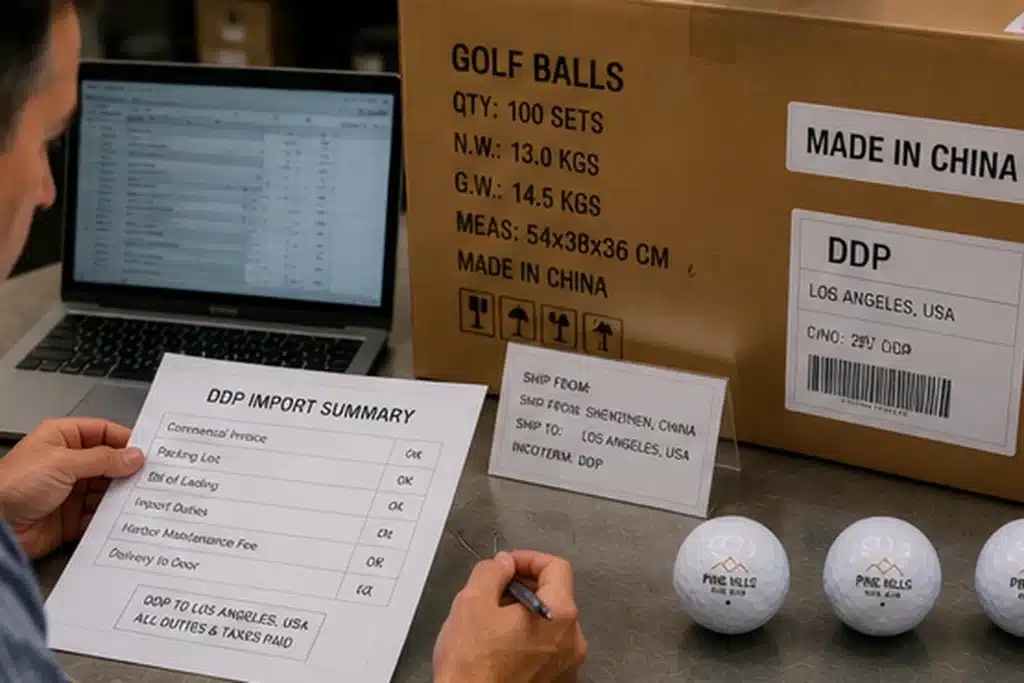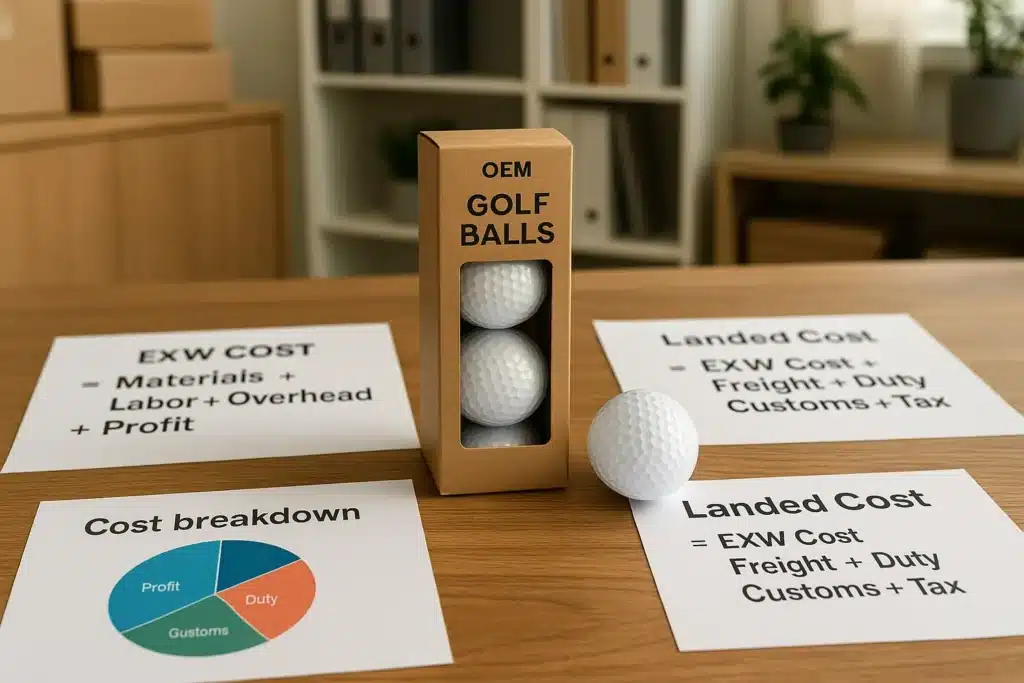
Cheap labor can look decisive until resin, packaging, duty, and bookable capacity enter the model.
For 2026 golf ball OEM sourcing, China usually remains the lowest-cost mainline for 10k–20k 2-piece Surlyn and standard 12-ball packaging. Vietnam becomes useful when EU-bound high-value SKUs have narrow EXW gaps and clean origin documents. Thailand is the premium urethane benchmark, but only when third-party capacity is actually bookable.
| Country | 2026 OEM role | 20k 2-piece Surlyn EXW | 20k 3-layer urethane EXW | Best sourcing use |
|---|---|---|---|---|
| China | Volume mainline | $0.55–0.75/ball | $1.45–1.90/ball | 2-piece Surlyn, fast inserts, pilot MOQ, standard boxes |
| Vietnam | EU-origin hedge | $0.60–0.85/ball | $1.60–2.20/ball | EU high-value SKUs when EXW gap is narrow |
| Thailand | Premium benchmark | $0.65–0.90/ball | $1.70–2.40/ball | Urethane halo SKUs if capacity and MOQ are accessible |
The sourcing mistake is treating Vietnam and Thailand as simple “cheaper alternatives” to China. Vietnam’s labor advantage can disappear if resin, rubber, coating, box approval, and setup loops are imported or slower. Thailand’s tour-grade credibility is real, but premium capacity can be captive, high-MOQ, or difficult for smaller DTC brands to book.
Before shifting production, run five CFO checks:
-
EXW gap: is China still $0.05–0.10/ball lower on 2-piece Surlyn?
-
Packaging cost: does the 12-ball color box stay near China’s $0.28–0.45 range, or rise in Vietnam/Thailand?
-
EU duty flip: under HS 9506.32, does origin saving beat the China EXW gap?
-
Material origin: where do ionomer/Surlyn-type resin, PBR rubber, ZDA, coating, ink, and boxes come from?
-
Open capacity: is the line third-party OEM, or captive / brand-owned capacity with limited slots?
The practical China+1 answer is not “leave China.” It is use China for volume Surlyn and packaging speed, model Vietnam for EU-sensitive high-value SKUs, and treat Thailand as a premium benchmark only after MOQ, timing, and open OEM access are confirmed.
Which country fits each OEM role?
You need a fast country-level answer before digging into EXW, duty, box costs, and capacity details.
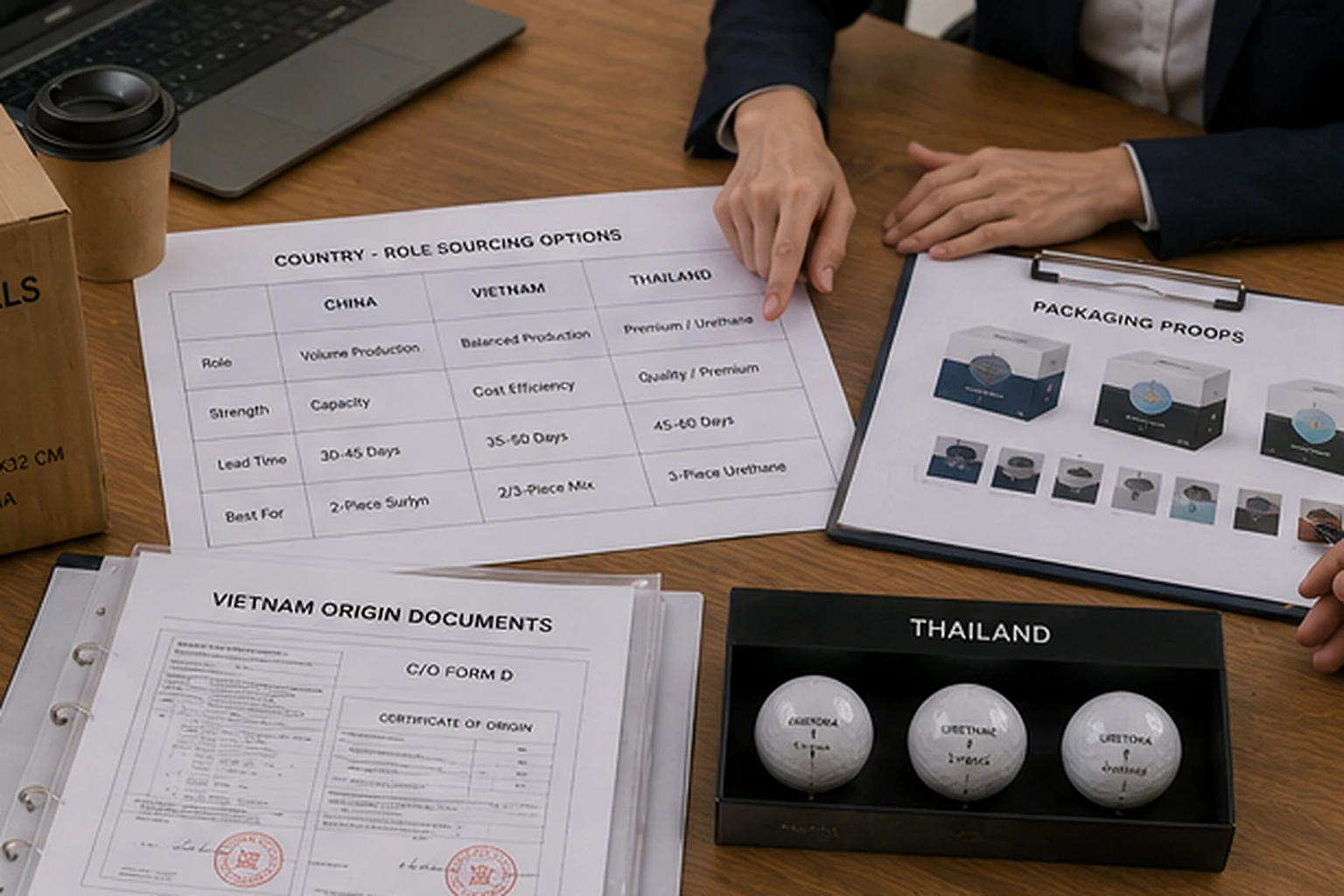
China, Vietnam, and Thailand do not compete on the same role. China usually wins volume Surlyn and packaging speed; Vietnam works as an EU-origin hedge when EXW gaps are narrow; Thailand is the premium urethane benchmark, but buyers must confirm open third-party capacity.
China’s advantage is no longer only labor. It is supplier density: ionomer and Surlyn-type cover access, molds, inks, coatings, color boxes, sleeves, labels, cartons, and small-batch OEM communication sitting close together. That helps 2-piece Surlyn, practice, promo, and private-label golf ball programs move from quote to production with fewer handoffs.
Vietnam is not “cheaper China.” It is a selective hedge. It can help when destination, origin documentation, and a narrow EXW gap make the math work. Thailand deserves respect for premium urethane manufacturing; Acushnet’s 2025 Form 10-K identifies golf ball manufacturing facilities in Massachusetts and Thailand. But many high-end lines are brand-owned or tightly allocated, which can make third-party DTC access difficult.
| Country | Best-fit role | Main advantage | Main risk | Buyer move |
|---|---|---|---|---|
| China | Volume Surlyn / standard packaging | EXW, inserts, open OEM | Not every line is tour-grade | Use for volume SKUs |
| Vietnam | EU-origin hedge / mid-to-high spillover | Origin option when gaps are close | Material import and setup loops | Model duty flip |
| Thailand | Premium urethane benchmark | Mature tour-grade know-how | Captive capacity and high MOQ | Verify bookable slots |
Why is Thailand not always bookable?
Thailand can be a premium benchmark without being an easy OEM door. Brand-owned tour-ball plants prove capability, but they may not offer low-MOQ third-party slots.
A sourcing plan fails when it treats “manufactured in Thailand” as equal to “available for my DTC launch.” CPO buyers prefer bookable capacity: pilot MOQ, mass MOQ, production window, construction route, quality file, and change-control terms. If a Thailand supplier cannot confirm external OEM rules, the route may still be excellent, but not usable for your launch calendar.
Build a SKU-by-country role map before requesting quotes. Confirm SKU type, destination market, EXW gap, packaging scope, origin documentation, and production-slot access. Do not move a SKU to Vietnam or Thailand unless the country role matches your margin and timeline goal.
✔ True — China+1 is role-based sourcing.
China, Vietnam, and Thailand can all matter, but each country should serve a specific SKU role, margin case, and risk hedge.
✘ False — “Vietnam and Thailand are interchangeable alternatives to China.”
Vietnam is mainly an origin and rising-capacity hedge; Thailand is a premium benchmark with tighter access.
What is the 2026 EXW price matrix?
You need the numbers first because your buyer or CFO is comparing country quotes line by line.
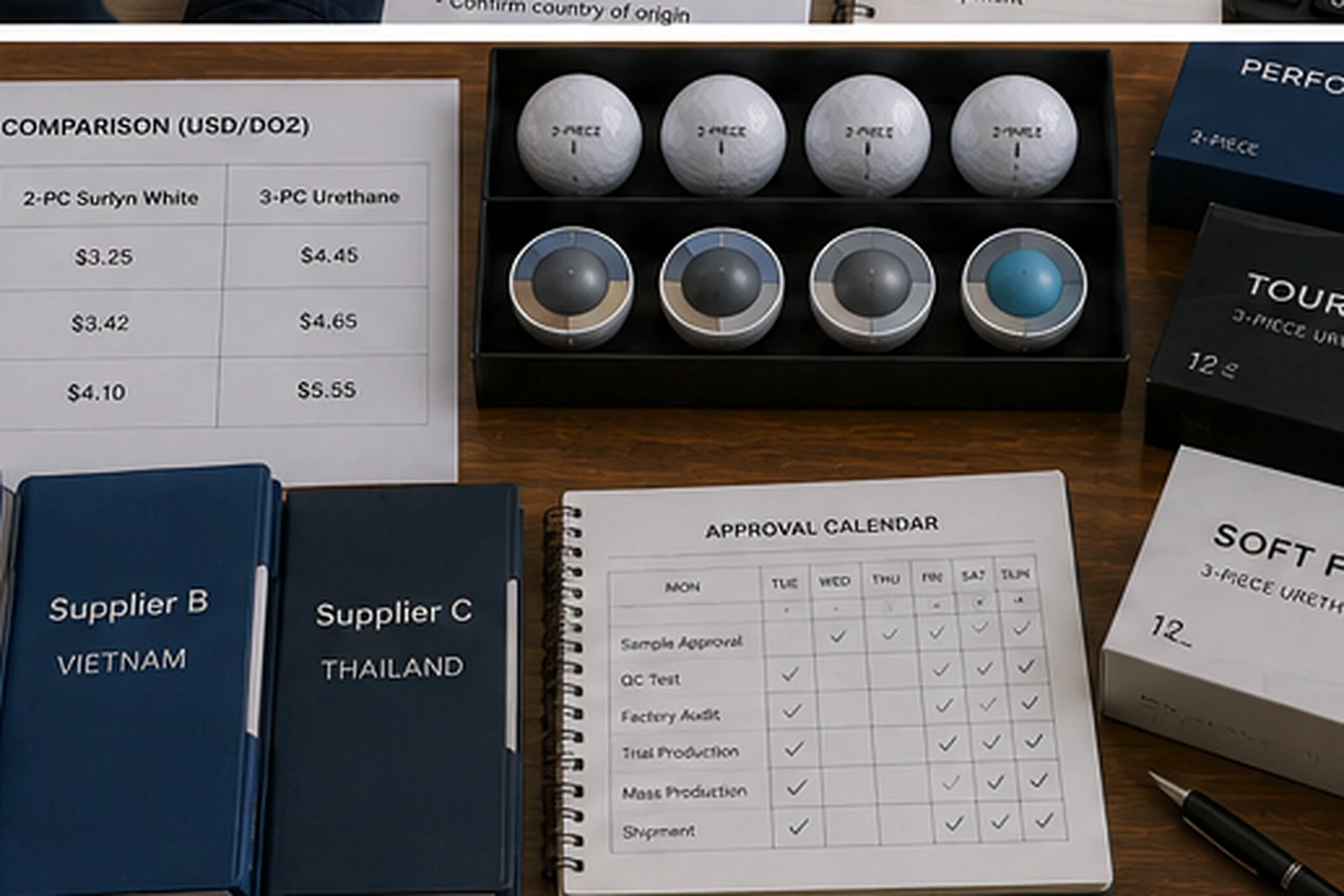
At 20k pcs, China usually leads 2-piece Surlyn EXW at $0.55–0.75/ball, versus Vietnam at $0.60–0.85 and Thailand at $0.65–0.90. For 3-layer urethane, China is $1.45–1.90, Vietnam $1.60–2.20, and Thailand $1.70–2.40.
The matrix only works when assumptions are equal. Baseline here means 20k pcs, white balls, standard print, no new dimple tool, standard QA, and normal factory scheduling. For packaging, baseline means 1,000 12-ball color boxes with E/F insert, 157g coated paper, 4C printing, and matte lamination. Change the cover route, finish, color, dimple tool, packaging structure, or QC scope, and the quote changes.
China’s lower 2-piece Surlyn EXW is strongest when the SKU is simple, the packaging is standard, and the order needs fast artwork or insert flexibility. Thailand’s higher urethane price can still be rational if the SKU is a halo product where yield, consistency, and review risk matter more than EXW.
| Country | 2-piece Surlyn EXW | 3-layer urethane EXW | 12-ball color box | Buyer move |
|---|---|---|---|---|
| China | $0.55–0.75 / 25–40d | $1.45–1.90 / 45–70d | $0.28–0.45 / 10–18d | Use as base quote |
| Vietnam | $0.60–0.85 / 35–55d | $1.60–2.20 / 55–85d | $0.32–0.50 / 12–20d | Check origin value |
| Thailand | $0.65–0.90 / 35–60d | $1.70–2.40 / 55–90d | $0.35–0.55 / 12–22d | Verify capacity access |
Which assumptions make the matrix fair?
Quote the same ball, same box, same artwork, same QC scope, and same production window. Otherwise, your spreadsheet is comparing three different SKUs wearing the same name.
Request same-spec EXW quotes under the same construction, print, box spec, and QC scope. Ask whether urethane means TPU or cast urethane. Confirm whether the box includes sleeves, insert, dozen box, barcode label, master carton, and prepress fees. Compare quote assumptions before comparing country prices.
Do not compare a China standard Surlyn quote against a Vietnam origin-sensitive urethane quote as if they were the same SKU. A golf ball OEM cost matrix only works when every quote uses the same construction, packaging spec, QC scope, and production window.
Write into the quote sheet: same construction, same cover route, same print, same 12-ball box, same QC scope, same pilot quantity, same production window, and same approval deadline before EXW comparison.
Does Vietnam labor beat materials?
You may want to move orders to Vietnam because labor looks cheaper, but golf balls are chemical-engineered products.
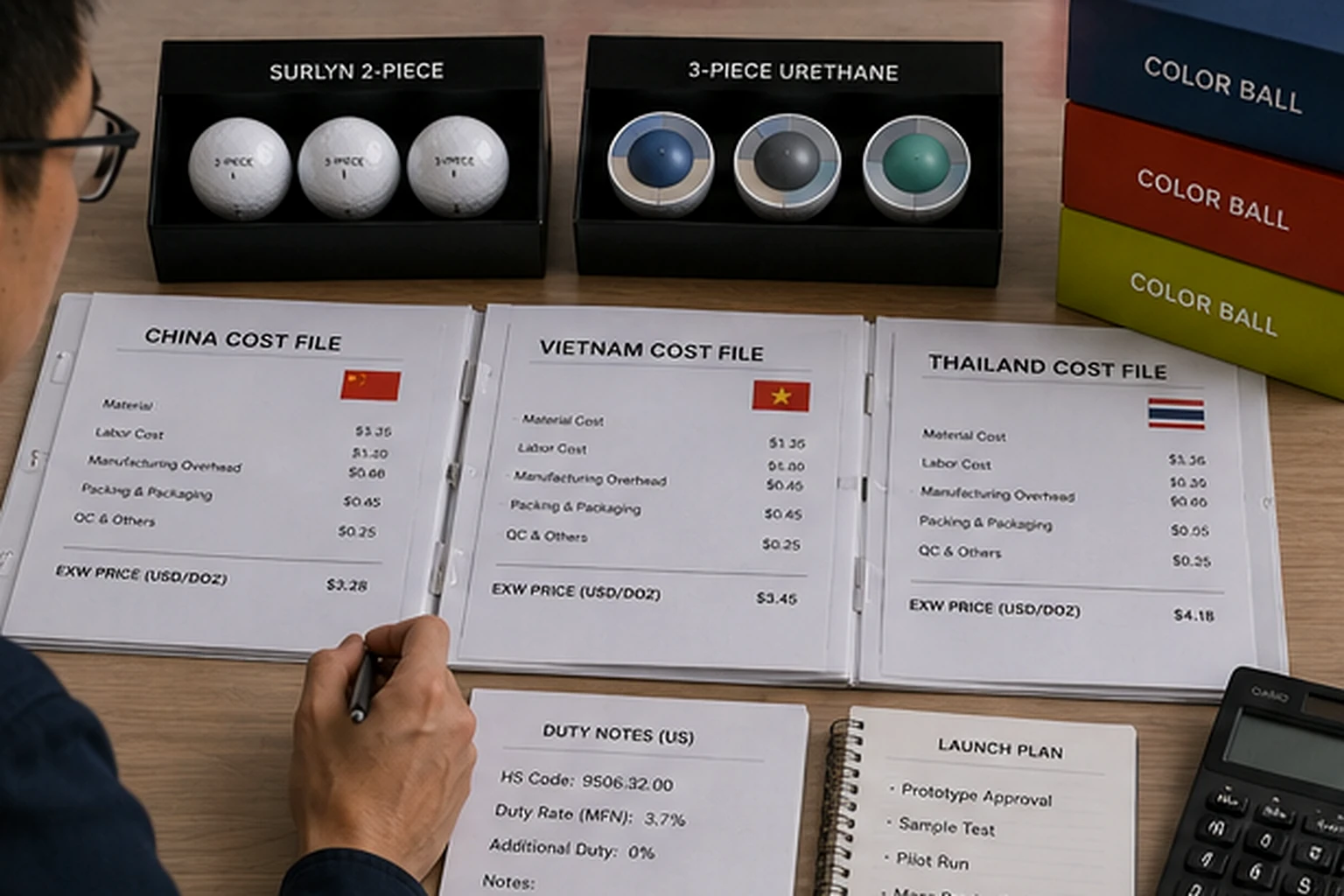
Vietnam labor does not automatically beat China EXW because golf balls are chemical-engineered products. SURLYN-type ionomers, TPU, cast urethane systems, PBR rubber, ZDA, coatings, inks, and boxes still follow regional or global supply chains, so material access and packaging speed matter.
Resin is global; labor is one line item. A golf ball is not stitched apparel. The bill of materials can include ionomer or Surlyn-type cover material, TPU, cast urethane systems, polybutadiene rubber core material, ZDA crosslinker, coating resin, clearcoat, ink, sleeves, inserts, dozen boxes, and cartons. Lower labor helps only when those inputs, yields, and setup loops do not give the savings back.
Vietnam can source serious materials. The issue is not capability; it is whether the quoted EXW includes the same material origin, yield assumption, and packaging approval speed. High-grade inputs may still move through China, Taiwan, Japan, Korea, or global chemical distributors. China’s advantage is the density of resin access, mold support, coating suppliers, printing, packaging, and short approval loops.
| Cost illusion | What happens | China edge | Buyer move |
|---|---|---|---|
| Cheap labor | Only one cost line falls | Scale and process density | Compare full EXW |
| Resin discount | Usually not automatic | Material access | Ask supply origin |
| Packaging parity | Small runs cost more outside China | Fast plates/boxes | Quote same box |
| Fast transfer | Tooling/setup repeats | Existing dimple tools | Check sunk cost |
| Origin advantage | Works only near margin | EXW gap may still win | Run EU flip test |
A failure signal appears when a Vietnam quote wins on labor but cannot identify resin, rubber, coating, or packaging sourcing origin. The quote may still be good, but it is not complete enough for a CFO decision.
Why is resin global?
Golf ball materials are part of a specialized chemical supply chain. The cover, core, crosslinker, coating, and ink system determine more cost than the final assembly wage suggests.
Ask suppliers to identify material sourcing origin for resin, rubber, ZDA, coatings, inks, and packaging. Compare EXW after material sourcing, box cost, setup, and yield assumptions. Keep 10k–20k 2-piece Surlyn in China when China remains $0.05–0.10/ball lower and destination duty does not flip the result.
Require the quote to separate ball EXW, resin/rubber sourcing origin, box EXW, plate or make-ready fees, and pilot setup. If the supplier cannot separate those lines, your team is not seeing the cost matrix; it is seeing a number with fog around it.
✔ True — Lower labor can help Vietnam.
Vietnam can be competitive when materials, packaging, origin, and scheduling align. It should be modeled seriously.
✘ False — “Vietnam is cheaper because labor is lower.”
Lower labor helps only when material sourcing, packaging setup, yield, and production access do not erase the gap.
When does EU origin flip cost?
You may be a European buyer worried about China duty, but origin only flips the result when the EXW gap is narrow enough.
Vietnam origin matters most for EU-bound golf balls when the EXW gap is small. At a 2.7% EU duty model, Vietnam may flip a high-value urethane quote if the China–Vietnam EXW gap is only $0.02–0.05/ball and origin documents are clean.
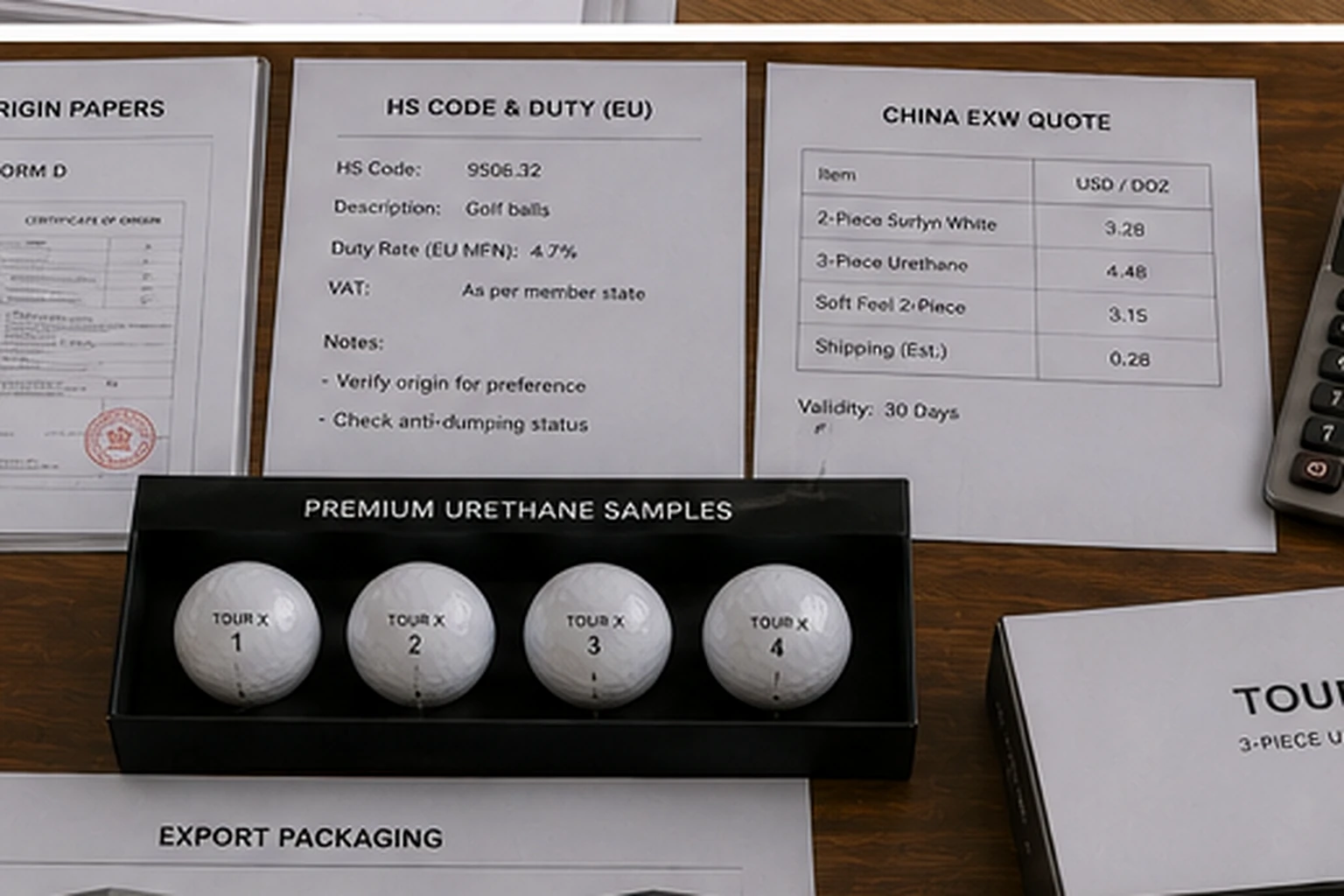
Use HS 9506.32 / 9506 32 00 for golf balls as the working classification, then verify at PO date. The EU third-country duty for golf balls is commonly modeled around 2.7%, but buyers should confirm the current rate, origin rules, and procedures in Access2Markets or the official TARIC consultation tool before placing the order. Tariff work is a moving target; spreadsheets should not pretend otherwise.
Vietnam can qualify for preferential treatment when rules of origin and origin declaration requirements are satisfied under the applicable EU-Vietnam trade framework. That is useful, but not magic. If China is $0.05–0.10/ball cheaper on a 2-piece Surlyn SKU, the 2.7% duty line usually does not beat China’s EXW and packaging advantage. If a high-value urethane quote is nearly tied, origin can matter.
| SKU | China EXW | Vietnam EXW | EU duty reading | Likely decision |
|---|---|---|---|---|
| 2-piece Surlyn | $0.65 | $0.72 | China + 2.7%; VN preference possible | China likely still wins |
| 3-layer urethane | $1.70 | $1.75 | Gap near duty value | Vietnam worth modeling |
| Premium urethane | $1.90 | $1.92 | Gap very narrow | Vietnam may flip if docs clean |
How do you run the flip test?
Start with the EXW gap, then compare it against the duty value and documentation risk. Origin only wins when the savings are larger than the operational gap.
A simple CFO test works well:
Duty saving per ball ≈ China EXW × EU duty rate − Vietnam preferential duty.
Then subtract any added box cost, setup delay, origin-document risk, and validation cost. A failure signal appears when an EU order claims origin advantage but has no origin declaration path. In that case, the Vietnam quote is not an EU-origin strategy yet. It is just a quote.
Supplier shall quote HS 9506.32 separately by country of origin and confirm resin/rubber sourcing origin for ionomer or Surlyn-type cover, TPU or cast urethane system, PBR core rubber, ZDA, paint, clearcoat, and packaging materials. For EU shipments, supplier shall state whether origin declaration and bill-of-materials origin breakdown can support preferential treatment.
Use Vietnam origin only when duty savings exceed EXW, packaging, setup, and validation gaps.
How should China+1 sourcing work?
You may want to diversify, but moving tools, specs, and packaging too quickly can create sunk cost and batch drift.
A strong China+1 golf ball strategy does not move every SKU out of China. Keep volume Surlyn and fast packaging in China, model Vietnam for EU-bound high-value SKUs when EXW gaps are narrow, and treat Thailand as a premium benchmark only after capacity is bookable.
China should remain the mainline for volume 2-piece Surlyn, standard packaging, small or medium pilots, seasonal inserts, and fast replenishment. Vietnam should be tested where EU origin, high-value SKU economics, and flexible launch timing justify the setup. Thailand should be evaluated for premium urethane only after open capacity, MOQ, queue time, and sample-to-mass controls are visible.
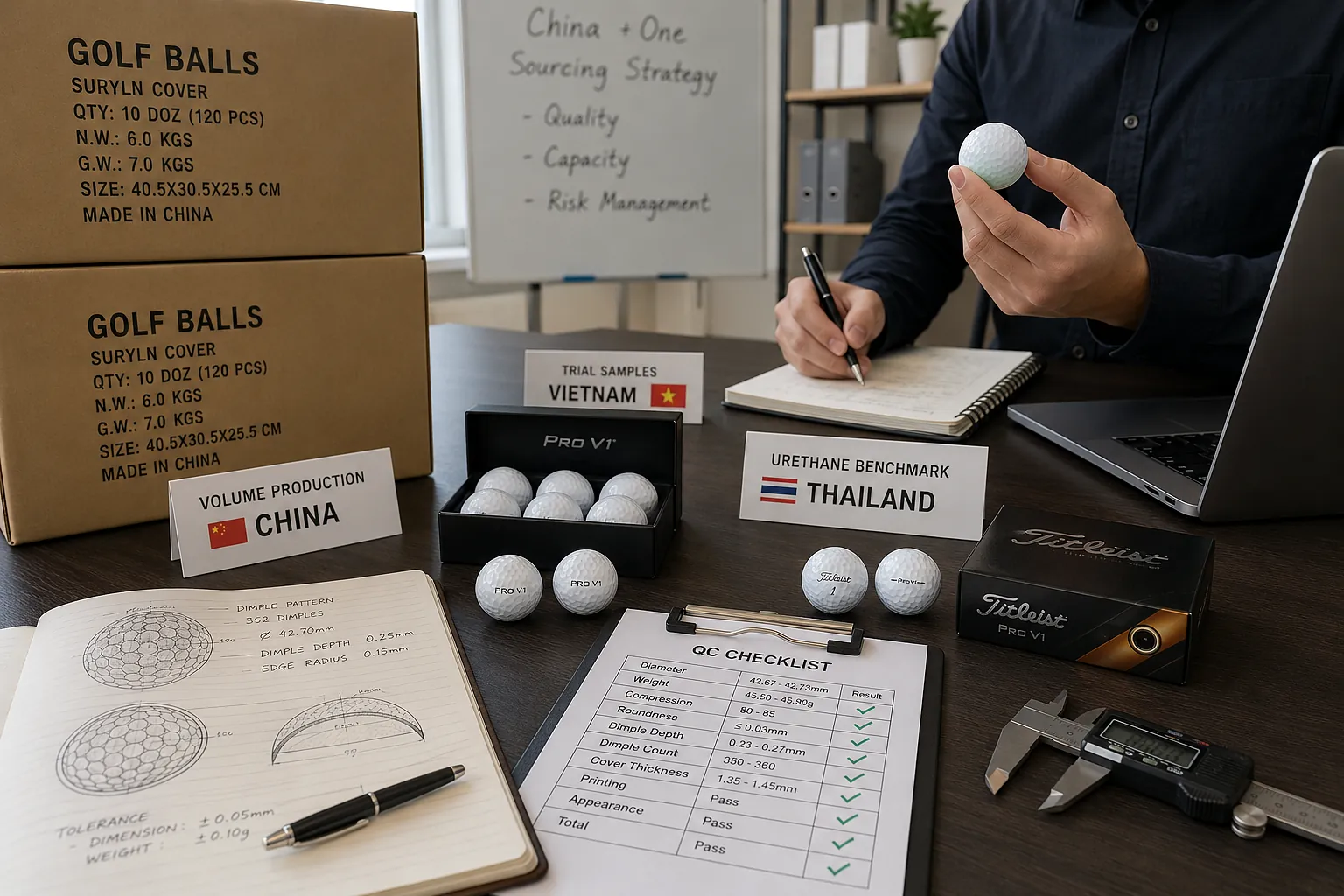
The tool-transfer trap is real. Mold ownership is only the first question. A master dimple tool may behave differently on another machine because of injection pressure, cooling channels, shrinkage, fixture fit, and process settings. What looks like a quick transfer can become resampling, performance drift, rejected lots, and two months of calendar loss.
| SKU role | Primary route | Backup / hedge | Main risk | Buyer move |
|---|---|---|---|---|
| Volume Surlyn | China | Vietnam only if gap closes | Material/box penalty | Keep China mainline |
| EU high-value urethane | China or Vietnam | Dual-source pilot | Origin docs / spec drift | Run flip test |
| Tour-grade halo | Thailand if bookable | China high-spec pilot | Captive capacity | Verify slots |
| Seasonal promo | China | Vietnam if origin required | Packaging timing | Lock print windows |
| Tool transfer | Avoid unless necessary | Rebuild pilot plan | Shrinkage/resampling | Price sunk cost |
What can break during tool transfer?
The tool may move, but the process does not move with it. Machine fit, shrinkage, cooling, material flow, coating, and color matching can all change.
If production is split across China, Vietnam, or Thailand, supplier shall lock compression target, dimple-tool ID, cover material, paint stack, CIELAB Lab* color values, gloss range, packaging dieline, approved sample ID, production batch ID, and change-control rule before pilot approval.
A failure signal appears when a Thailand supplier references tour-grade capability but cannot confirm third-party pilot slots. Benchmark capacity is not useful unless your team can secure MOQ, slot, and change-control terms. CPO buyers prefer bookable capacity over brochure capability.
Ask each supplier to quote the same SKU by EXW, cover route, resin/rubber sourcing origin, 12-ball box spec, packaging lead time, EU origin declaration capability, pilot MOQ, mass MOQ, next open production window, and whether the capacity is open third-party OEM or captive / brand-owned.
Do not move molds or SKUs until payback beats resampling, tooling, origin, packaging, and launch-risk costs.
✔ True — China+1 means controlled diversification.
A strong plan keeps China where it protects margin and adds Vietnam or Thailand only where the SKU economics justify complexity.
✘ False — “China+1 means replacing China.”
Replacing every SKU by labor headline can raise cost, slow packaging, and create new validation risk.
FAQ
Is it cheaper to manufacture golf balls in Vietnam or China?
For 10k–20k 2-piece Surlyn, China usually remains cheaper on EXW and packaging. Vietnam becomes attractive when the destination is the EU, the SKU value is higher, and the China–Vietnam EXW gap is narrow enough for origin benefits to matter.
Compare same-spec EXW first. Add material sourcing, color box setup, plate fees, pilot timing, and yield assumptions. Run the EU duty flip test only when the quote gap is close. If China is still $0.05–0.10/ball lower on a simple Surlyn SKU, Vietnam labor usually does not overturn the full cost model.
Why do major golf brands manufacture in Thailand?
Thailand has proven premium golf ball manufacturing depth, including brand-owned premium capacity in Rayong. For independent DTC brands, the issue is not whether Thailand can make great balls; it is whether the line is open, bookable, and MOQ-feasible.
Ask whether capacity is third-party OEM or captive. Confirm pilot MOQ, mass MOQ, next available slot, construction route, and QC deliverables. Thailand can be a strong benchmark, but benchmark quality is not the same as accessible production.
Does China still have a cost advantage in 2026?
Yes, conditionally. China’s advantage is strongest in volume 2-piece Surlyn, standard packaging, fast inserts, low pilot MOQ, and open OEM flexibility—not simply cheap labor.
Use China for volume SKUs where EXW, packaging speed, and replenishment matter. Model Vietnam for EU-sensitive high-value SKUs. Verify Thailand for premium capacity access. The best 2026 answer is not “always China”; it is “China where density wins.”
What is China Plus One in golf ball sourcing?
China+1 means keeping China where it protects margin and speed, while adding Vietnam or Thailand for specific origin, risk, or premium positioning needs.
Do not move every SKU. Keep common specs locked across countries: compression, dimple tool, cover material, paint stack, color, gloss, and packaging structure. Use shared QC gates so customers do not notice a country switch in flight, feel, finish, or box presentation.
When does Vietnam origin help EU golf ball imports?
Vietnam origin helps when the EXW gap is small, the destination is the EU, and the supplier can provide clean origin documentation under the applicable trade agreement.
Check HS 9506.32 and verify the current duty, origin rules, and documentation path in Access2Markets or TARIC at PO date. Do not assume preference without documents. A low Vietnam quote without origin proof is not a tariff hedge.
Why does packaging matter in a country-cost matrix?
Packaging affects EXW, approval speed, make-ready, plate fees, MOQ, box quality, and cross-border coordination. China often keeps an advantage on 1,000-box color runs because the print ecosystem is dense.
Quote the same 12-ball box spec across all countries: E/F insert, 157g coated paper, 4C printing, matte lamination, plate fees, and lead time. Avoid overspec packaging during pilot runs unless the channel will pay for it.
Can I move my dimple mold from China to Vietnam?
Sometimes, but mold ownership is only the first issue. Machine fit, injection pressure, cooling channels, shrinkage, and revalidation can force new sampling and delay payback.
Confirm mold ownership, machine compatibility, tool wear, cooling design, and sample approval cost before moving anything. Budget resampling and test loss. A two-cent labor target can disappear quickly if tool transfer creates two months of engineering work.
Should a DTC brand choose Thailand for urethane?
Thailand can be excellent for premium urethane if you can book the capacity and accept the MOQ, timeline, and cost. If you need low pilot MOQ and rapid iteration, a high-spec China open OEM route may be more practical.
Verify open capacity, not only capability. Compare pilot access, sample timing, slot windows, and QC scope. Keep quality gates consistent if you later dual-source between China, Vietnam, and Thailand.
Conclusion
The 2026 answer is not “leave China” or “stay in China forever.” China remains the volume Surlyn and packaging mainline; Vietnam is a selective EU-origin hedge when EXW gaps are narrow; Thailand is the premium benchmark where capacity is truly bookable.
You should assign countries by SKU role, not by labor headlines. A 2-piece Surlyn promo ball, a high-value EU urethane SKU, and a tour-grade halo ball do not belong in the same sourcing box.
You might also like — What’s the True Landed Cost When Importing Golf Balls from China (DDP Guide)?