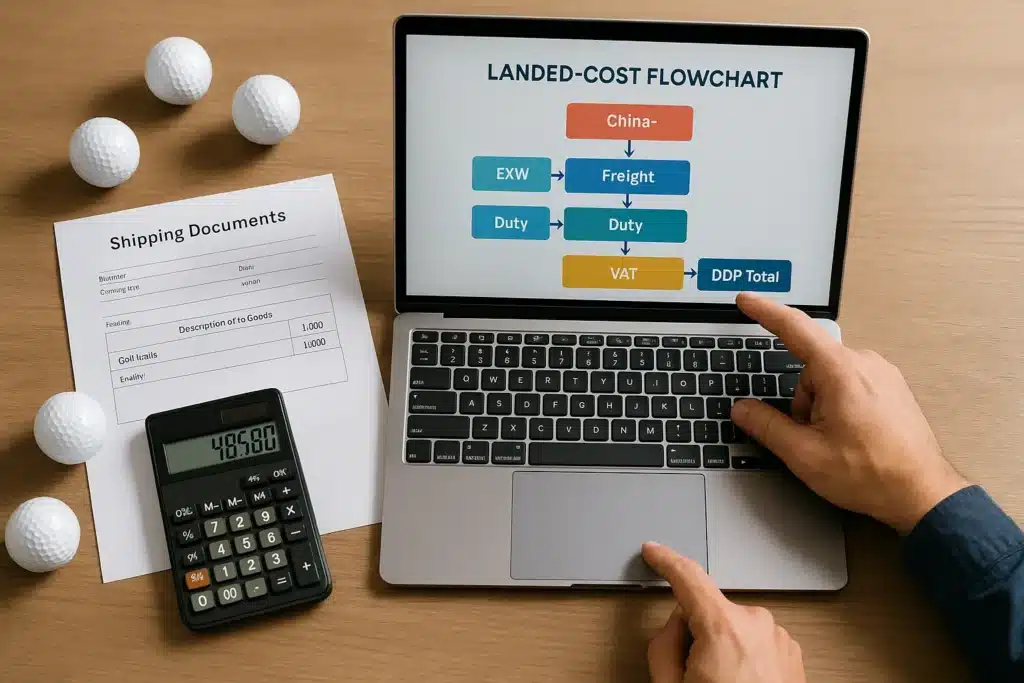
A DDP golf ball quote can still be wrong even when the golf ball HS code is right. “Tax included” does not tell you which customs-value basis was used, whether the tariff check is current, who acts as Importer of Record, or who owns costs when customs or delivery does not go as planned.
For U.S. imports, finished standalone golf balls generally fall under HTS 9506.32.00.00. If the shipment includes gift-set accessories or other merchandise, verify the complete configuration separately; for China-origin goods, also verify current additional tariff treatment before relying on the duty assumption.
For a decision-ready DDP quote, verify six control points:
-
the classification basis
-
the customs-value support
-
the applicable duty and fee layers
-
the assigned customs responsibility
-
the shipment-linked evidence
-
the refresh timing for changing assumptions
This guide answers one procurement question: Can you prove that the customs and DDP assumptions inside this quote apply to this shipment?

Which HTS Code Should Golf Balls Use?
A supplier can type “golf balls” or “sports goods” on a quotation in seconds. Your risk begins when that generic description becomes the classification basis behind a duty assumption you are expected to approve.
Your golf ball DDP quote is only as reliable as the HTS classification behind it. For finished standalone golf balls, start U.S. classification review with HTS 9506.32.00.00, then confirm that the code fits the exact SKU, shipment configuration, and accessories; use country of origin separately when verifying additional tariff treatment.
For finished standalone golf balls, the 9506.32 family is the logical U.S. classification starting point. Instead of relying on a code copied from a prior invoice, check the current U.S. HTS schedule against the merchandise you are actually buying.
That distinction matters because classification starts with the goods, not the supplier’s shorthand description.
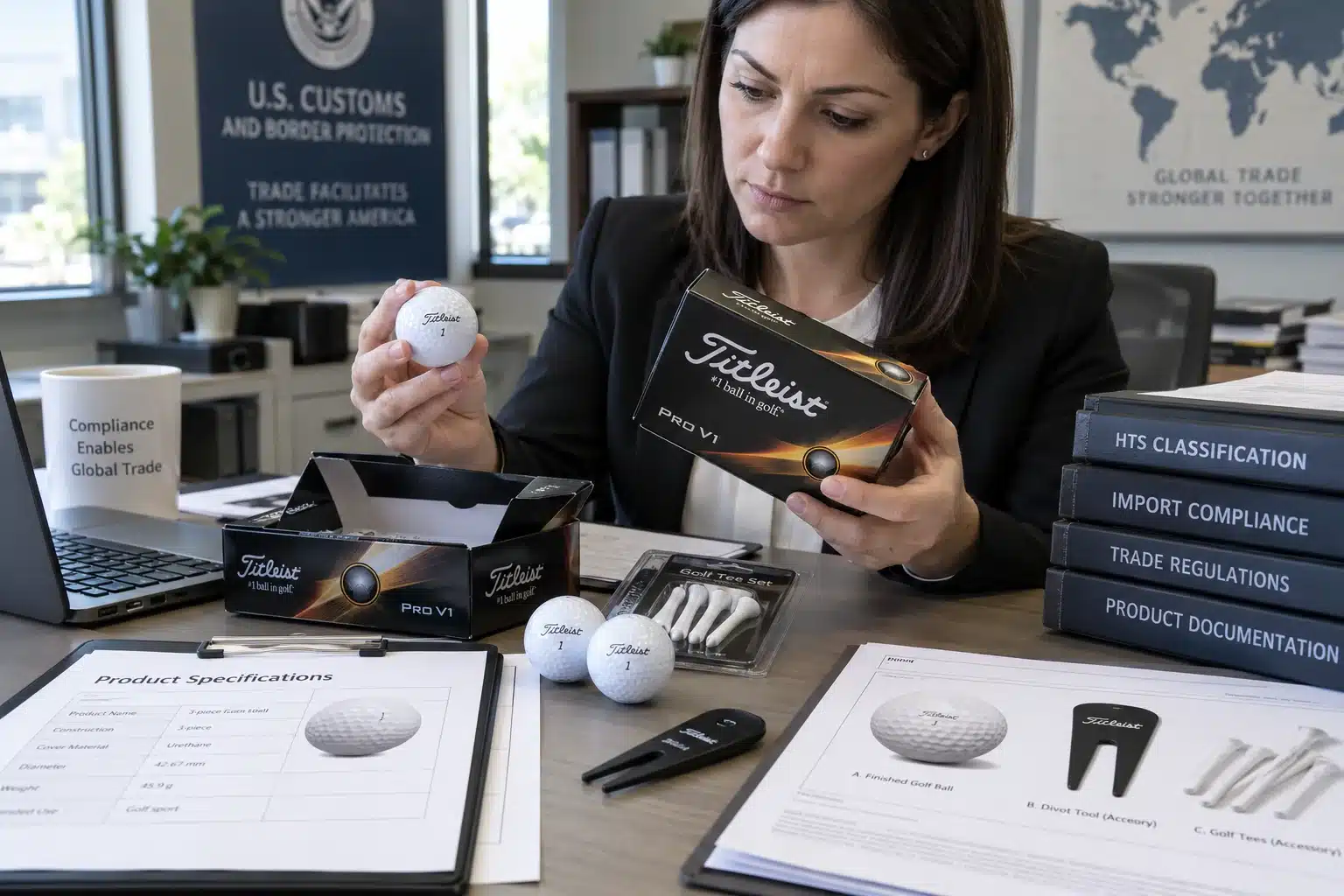
A retail dozen containing only finished golf balls presents a much cleaner classification question than a promotional set containing balls plus tees, markers, towels, divot tools, brushes, or other accessories. Packaging alone does not automatically change the classification, but adding other merchandise can change what your broker needs to review.
| Product configuration | Classification risk | Verification action |
|---|---|---|
| Standalone golf balls | Generic sports-code assumption | Confirm HTS basis before approval |
| Golf balls with accessories | Mixed-component classification risk | Request broker review |
| Custom gift sets | Bundle treatment uncertainty | Verify complete shipment configuration |
Keep a Classification Basis Record with the proposed HTS code, SKU or revision, product description, pack configuration, accessory list where applicable, evidence source, verification date, and broker confirmation when needed.
Country of origin belongs beside that record, but for a different reason. The merchandise determines the classification analysis; origin becomes important when you move to additional tariff treatment and other origin-dependent customs questions.
This separation keeps two buyer decisions from being blurred into one:
What is the merchandise?
and
What additional treatment applies because of where it originates?
Request the proposed HTS basis together with the current product configuration before approving the duty assumption. If a supplier can provide only “this is the code we always use,” you still do not know whether the evidence matches your shipment.
✔ True — Classification follows the merchandise you are actually importing
Finished standalone golf balls have a clear classification starting point, while a mixed promotional set can introduce additional merchandise that requires broader review.
✘ False — “Every shipment containing golf balls automatically uses the same classification”
A familiar product name does not replace the item breakdown. Confirm the SKU, set contents, and accessories before accepting the classification behind your DDP quote.
What Duty Layers Must You Verify?
“Tax included” sounds reassuring until your procurement or finance team asks which treatment was included, when it was checked, and whether customs user fees or broker charges sit inside the same number.
A golf ball import duty number is not a permanent product specification; verify the live HTS treatment, China-origin Section 301 status where applicable, shipment date, customs user-fee assumptions, and broker scope before accepting a DDP calculation. The base tariff line is only one part of the verification.
Start with the tariff treatment associated with the current HTS classification. Then separate the origin-dependent questions.
For China-origin goods, Section 301 should be treated as a dated verification step. The official USTR Section 301 search tool asks users to work from the HTS subheading to determine whether a product is subject to a Section 301 action and what additional duty treatment applies.
For Section 301 review, use the 8-digit HTS subheading in the USTR search tool, save the result, and record the date checked. For a 9506.32.00.00 starting point, that means reviewing the applicable 8-digit subheading rather than copying a percentage from an old supplier quotation.
That small process change creates a much stronger purchasing record.
| Input | Why it can change | Buyer verification action |
|---|---|---|
| HTS treatment | Classification or schedule changes | Verify current tariff basis |
| Section 301 status | Additional treatment can change | Check current USTR status |
| MPF / HMF | Applicability depends on entry and transport | Confirm included/excluded |
| Broker fees | Service scope varies | Request responsibility statement |
Customs user fees belong in the same review, but they do not need to turn this article into a fee calculator.
The merchandise-processing-fee framework is set out in 19 CFR 24.23, while 19 CFR 24.24 addresses Harbor Maintenance Fee treatment for qualifying commercial vessel cargo.
For procurement, the useful questions are simpler:
Is the fee applicable? Is it included in the DDP amount? Who is responsible if the assumption changes?
Do not confuse a base tariff result with total import exposure. Your approval file should separately show the classification checked, origin, Section 301 review date, applicable user-fee treatment, broker scope, and the evidence used.
That turns “tax included” from a sales phrase into something your team can verify.

Can Your DDP Quote Be Supported?
One door-delivered number is convenient for purchasing. It becomes uncomfortable when finance asks for the merchandise-value basis, customs asks for support, or the evidence belongs to a different shipment.
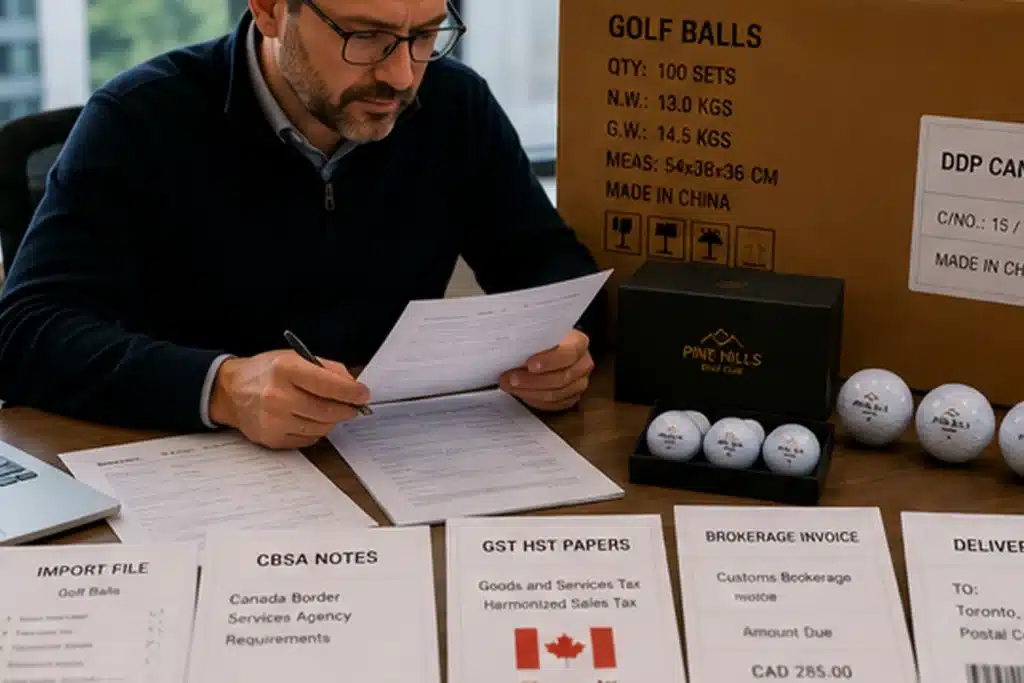
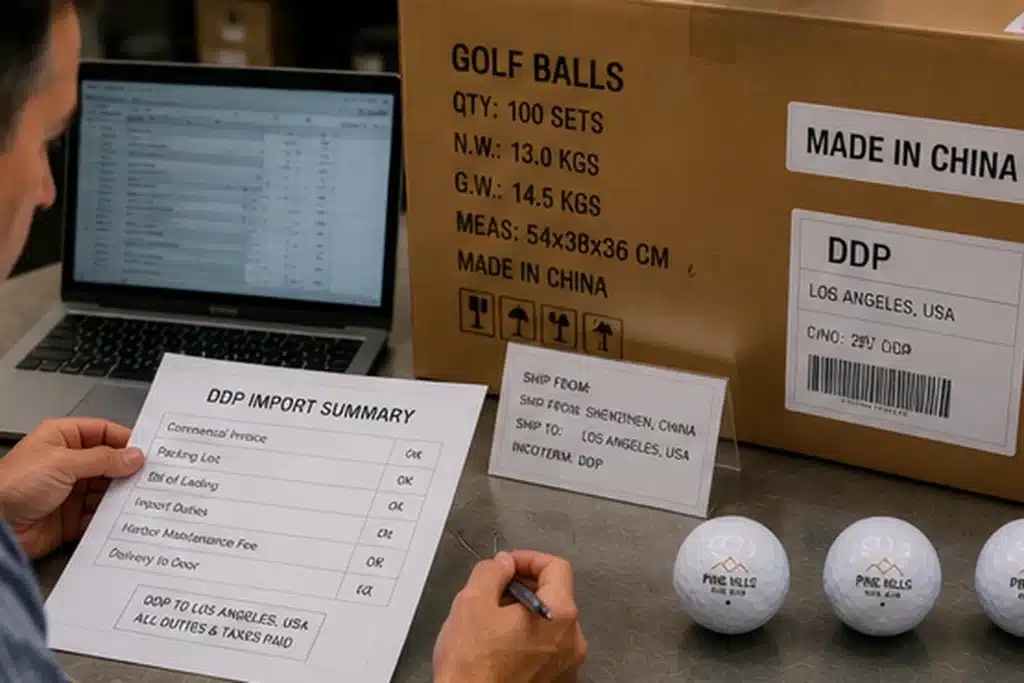
A DDP price becomes stronger when each important assumption can be traced to evidence. Separate the customs-value basis, freight and insurance treatment where applicable, duty and fee assumptions, origin-marking proof, and shipment reference before approval so the quoted DDP total is commercially convenient without becoming a customs black box.
The distinction worth preserving is:
Commercial DDP Price ≠ Customs-Value Support
A supplier can quote one commercial amount for delivery to your named destination. The customs-value question is separate.
For U.S. imports, 19 CFR 152.103 sets out the transaction-value rules. The analysis generally starts with the price actually paid or payable for the imported merchandise, with specific rules governing adjustments and the treatment of transportation and insurance.
That is why a one-line DDP total should not be the only record behind the customs value.
Where freight or insurance is treated separately under the applicable valuation rules, retain supporting documentation. Do not create artificial deductions or ask a supplier to lower the merchandise value simply to reduce duty.
| Evidence item | Risk if missing | Buyer action |
|---|---|---|
| Product-value basis | Weak customs-value support | Request supporting record |
| Freight / insurance support | Mixed cost assumptions | Confirm treatment |
| Duty assumptions | Stale calculation | Record verification date |
| Shipment reference | Proof relates to another order | Link evidence to shipment |
Country-of-origin marking belongs in this evidence chain as well.
Under 19 CFR 134.11, foreign-origin articles or their containers generally must carry country-of-origin marking that meets the applicable conspicuousness, legibility, permanence, and English-language requirements.
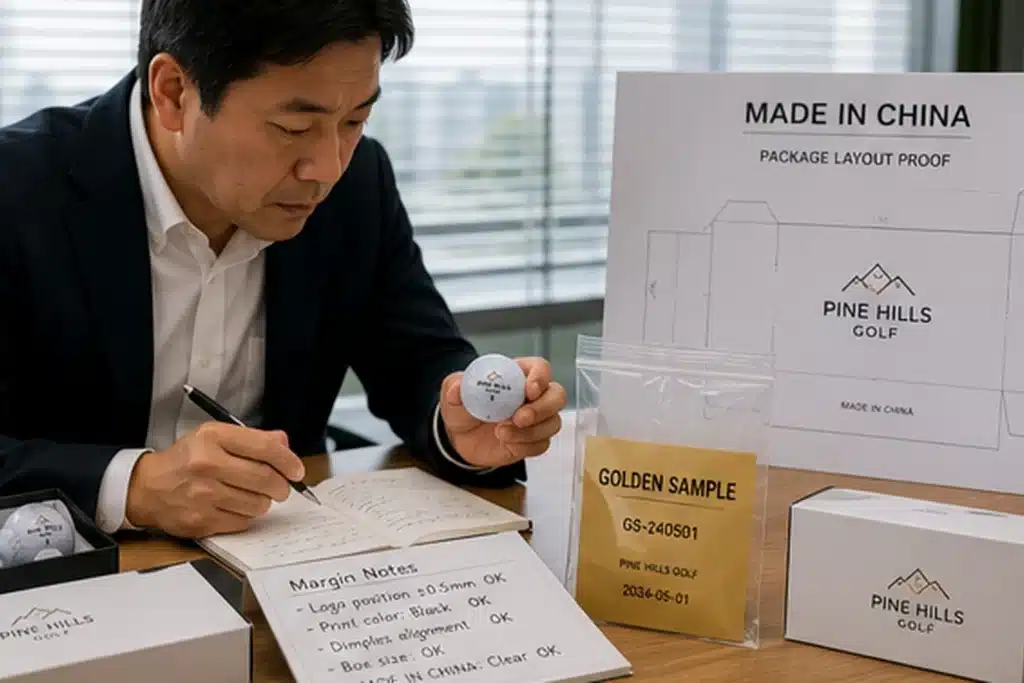
For a China-made private-label golf ball program, that means “Made in China” should be treated as a packaging release gate, not a correction somebody notices after the shipment has left.
If the retail box, gift box, sleeve, or master-carton artwork is still open, resolve the detailed pack configuration in the OEM golf ball packaging options guide. For customs verification, keep the approved packaging revision and marking proof linked to the shipment.
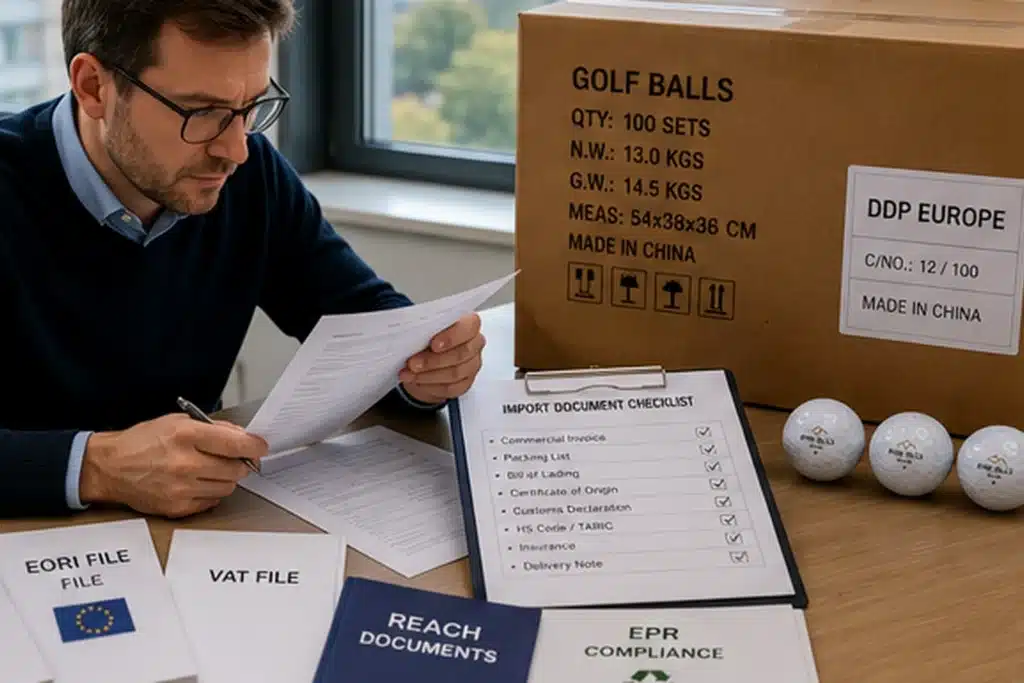
Your main working file should be a DDP Verification Pack containing the classification basis, country of origin, customs-value support, tariff and fee assumptions, verification dates, approved origin-marking proof, responsibility records, quote validity, and PO or shipment reference.
A warning sign appears when the supplier says “tax included” but cannot show the classification or rate basis behind that statement. Experienced buyers often prefer an auditable DDP assumption over a lower headline number that cannot survive a finance or customs review.
Supplier shall identify the HTS classification, country of origin, customs-value basis, applicable duty or fee assumptions, Importer of Record arrangement, broker responsibility, quote-validity date, and refresh trigger used for the quoted shipment. Any change before shipment release shall be disclosed.
If physical freight becomes the unresolved variable, move that question to the dedicated golf ball freight calculation guide instead of turning customs verification into a CBM or chargeable-weight exercise.
✔ True — A single DDP price can still have an auditable evidence trail
Your quotation can remain commercially simple while the supporting file shows the value basis, tariff assumptions, origin marking, and records used for the actual shipment.
✘ False — “A one-line DDP invoice is enough because the seller handles customs”
DDP can simplify execution, but a commercial total does not by itself prove classification, customs value, duty treatment, or entry responsibility.

Who Owns DDP Costs and Exceptions?
DDP looks easiest while the shipment moves normally. Its real quality becomes visible when customs raises a question, final delivery fails, cargo is damaged, or an unexpected charge appears.
A DDP quote is not fully verified until you know who handles the shipment when everything goes right—and who protects you when something goes wrong. Confirm the Importer of Record arrangement, broker control, delivery scope, insurance handling, exception costs, and recovery process before shipment release.
The Incoterms guidance published by the U.S. International Trade Administration explains that Incoterms® allocate tasks, costs, and risks between sellers and buyers. It also makes clear that Incoterms do not answer every sale condition, documentation issue, delayed-delivery problem, liability question, or dispute.
That gap is where your contract and DDP Responsibility Matrix matter.
| Scenario | Ownership question | Evidence needed |
|---|---|---|
| Normal export and international transport | Who arranges and pays? | Written DDP scope |
| Import clearance | Who is IOR and who controls the broker? | IOR / broker confirmation |
| Final delivery | What named destination and normal scope are included? | Delivery-scope statement |
| Transit loss or damage | Who manages claim and recovery? | Insurance + replacement / reimbursement terms |
| Customs exam, storage, or re-delivery | Who pays if triggered? | Exception-cost matrix |
The Importer of Record deserves particular attention.
Under 19 U.S.C. §1484, the eligible party acting as Importer of Record has reasonable-care responsibilities in the entry process. A customs broker can act within the entry arrangement, but your DDP file should still identify who is actually acting as IOR and who controls the customs record.
That means:
“Our forwarder handles customs”
is not a complete answer.
You need to know who appears in the entry arrangement, which party controls the broker, and who responds if classification, value, or supporting documents are questioned.
A second warning sign is a DDP quotation that identifies neither the IOR nor the owner of customs or transport exceptions. The door price may still be attractive, but the responsibility boundary remains unfinished.
For Golfara-managed DDP shipments, our forwarding partners arrange cargo insurance for each shipment. If confirmed transit loss or damage occurs, we handle the customer-side claim process rather than asking the buyer to pursue the carrier or insurer directly. We resolve the affected goods through replacement and replacement delivery at no additional charge to the buyer, or reimbursement of the agreed goods value, according to the shipment terms.
The buyer should not have to become the freight-claim manager. The exact insurance, reimbursement, replacement, customs-exception, and re-delivery terms should still be written into the commercial agreement for the shipment being approved.
For our current DDP service, we coordinate export handling in China, international transportation, import customs clearance under the agreed DDP arrangement, and delivery to the customer’s named destination. For a standard shipment within the confirmed scope, you mainly provide accurate receiving information rather than separately arranging the normal forwarder, customs clearance, or final-mile delivery.
The important distinction is that this is a service commitment that should be written into the quote—not an assumption you should make simply because “DDP” appears on it. DDP should never be treated as shorthand for “every imaginable exception is automatically included.”
Request a DDP Responsibility Matrix before approval. It should define normal transport, import clearance, final delivery, IOR and broker control, insurance handling, transit loss or damage, and contract-defined exception costs.
If your team needs the operational sequence after these decisions have been approved, use the separate guide to import golf balls from China to the USA for the execution workflow.

How Do You Control DDP Changes?
The most dangerous customs assumption is often not an obviously incorrect one. It is an old assumption copied from a successful shipment because the supplier and SKU still look familiar.
A tariff assumption without a verification date is not a buying control; record the HTS basis, origin, source checked, customs treatment, responsibility setup, and evidence date, then define what event requires another review. Previous clearance is history—not automatic current approval.
Build version control into the DDP file.
A previous shipment can demonstrate what was used at that time. It does not automatically prove that the same treatment applies to the current booking or reorder.
The underlying trigger might be regulatory, commercial, or operational:
| Control item | Risk | Refresh action |
|---|---|---|
| HTS basis | Old classification reused | Reconfirm before shipment |
| Duty treatment | Policy or measure changes | Refresh current review |
| IOR setup | Responsibility changes | Confirm entry arrangement |
| Packaging proof | Artwork revision changes | Review latest proof |
A useful DDP Assumption Register connects:
HTS basis → origin → evidence source → date checked → broker confirmation → shipment reference → refresh trigger
For Section 301, the control is especially clear: keep the 8-digit subheading used for the search, the result, and the date checked. A percentage copied into a costing spreadsheet without those fields is difficult to audit later.
The same discipline applies to origin marking. If the box or carton artwork changes after “Made in China” marking was approved, the old artwork is still historical evidence—but it no longer proves the current pack revision.
And it applies to responsibility. A new forwarder, broker, importer arrangement, or final-delivery provider can change the operational assumptions even if the golf ball SKU did not move by a millimeter.
A duty assumption copied from an old shipment without a verification date is a clear sign that your reorder is relying on memory rather than current evidence.
Shipment approval requires evidence linking the quoted shipment to classification basis, customs-value support, applicable duty and fee assumptions, origin-marking proof, responsibility assignment, and agreed exception-cost handling.
Before release, your team should be able to answer:
What was checked?
Which shipment does the evidence support?
When was it checked?
What changed since the last order?
What event requires another review?
Customs rates and related assumptions are changing inputs, not permanent golf ball specifications. The buying control is not the number alone; it is the number plus its basis, evidence, date, and refresh trigger.
✔ True — Previous customs records are useful evidence without being permanent approval
Keep prior shipment records because they show what was used before. Then refresh any classification, tariff, IOR, packaging, or responsibility assumption whose basis has changed.
✘ False — “The last shipment cleared, so the reorder can reuse the same customs assumptions”
Successful clearance describes the previous shipment. It does not prove that today’s tariff treatment, shipment configuration, packaging revision, or responsibility setup remains the same.
FAQ
Does DDP include customs clearance and duties?
DDP generally assigns extensive delivery and import-clearance obligations to the seller, but your team should still verify the IOR arrangement, customs-value basis, tariff assumptions, broker role, named destination, and treatment of costs that fall outside the normal shipment scope.
The Incoterm tells you how core tasks, costs, and risks are allocated; it does not replace the underlying commercial agreement or customs evidence. Ask what “included” covers for the specific shipment, who controls the import entry, and how an exception will be handled. A strong DDP offer should remain understandable when the salesperson is no longer in the room.
Who is responsible if DDP cargo is damaged?
Damage handling should be defined before shipment rather than inferred from the letters DDP. For Golfara-managed DDP shipments, forwarding partners arrange cargo insurance, while we remain responsible for customer-side resolution through the agreed replacement or reimbursement process when transit loss or damage is confirmed.
Your agreement should identify who reports the damage, who manages the carrier or insurance claim, what evidence is needed, and how the commercial recovery reaches you. The buyer should not discover after a damaged delivery that the supplier and forwarder each expected the other party to handle the claim.
Do golf ball gift sets use the same classification?
Not necessarily. Finished standalone golf balls have a clear U.S. classification starting point, while gift sets containing tees, towels, divot tools, markers, brushes, or other merchandise can require a broader classification review based on the complete contents of the imported set.
Give the customs broker an itemized product description rather than simply calling the shipment a “golf ball gift set.” Save that item breakdown with the classification record. Decorative retail packaging is not the same issue as adding other merchandise; the buyer-side control is to show exactly what the set contains.
What if the supplier changes the forwarder before shipment?
Treat a forwarder change as a verification trigger whenever it affects the DDP scope, broker arrangement, Importer of Record setup, insurance, customs documentation, final-delivery process, or exception handling. The product may be unchanged while the operating responsibilities behind the quote have moved.
Ask the supplier to confirm what remains identical and what changed. Update the responsibility matrix and shipment references rather than assuming the previous forwarder’s procedures transferred automatically. This is especially important where customs entry, insurance, or customer-side claims depend on the logistics provider.
Who pays customs exam, storage, or re-delivery charges under DDP?
Do not assume every exceptional charge is automatically resolved by the three letters DDP. Identify customs exams, storage, failed delivery, address changes, re-delivery, and other foreseeable exceptions in the commercial responsibility matrix, then document which party bears each cost if triggered.
Incoterms define core task, cost, and risk allocation, but they do not settle every contract condition or dispute. Your quotation or sales terms should therefore separate the normal DDP scope from exception scenarios. This prevents a buyer and supplier from discovering different interpretations only after a charge has already occurred.
What records should you retain after a DDP shipment clears?
Retain records that show what customs and commercial assumptions actually supported the shipment: classification basis, country of origin, customs-value support, tariff and fee review, marking proof, IOR and broker arrangement, responsibility records, and evidence tied to the final shipment reference.
Keep the cleared shipment as a historical version rather than overwriting it when the next order arrives. That record gives procurement a starting point for reorder review and makes changes easier to identify. The next shipment can reuse verified facts that remain valid, but any time-sensitive or configuration-dependent assumption should be refreshed before approval.
Conclusion
The goal is not to find the golf ball DDP quote with the lowest friendly-looking total. It is to approve a number your procurement, finance, and import teams can defend because the classification is verified, the customs-value basis is supported, responsibility is assigned, assumptions are current, and the evidence belongs to the shipment.
Classify → Value → Stack → Assign → Prove → Refresh. Once those customs and DDP inputs are controlled, continue with the broader guide on our website.
You might also like — How Much Does It Cost to Import Golf Balls from China?