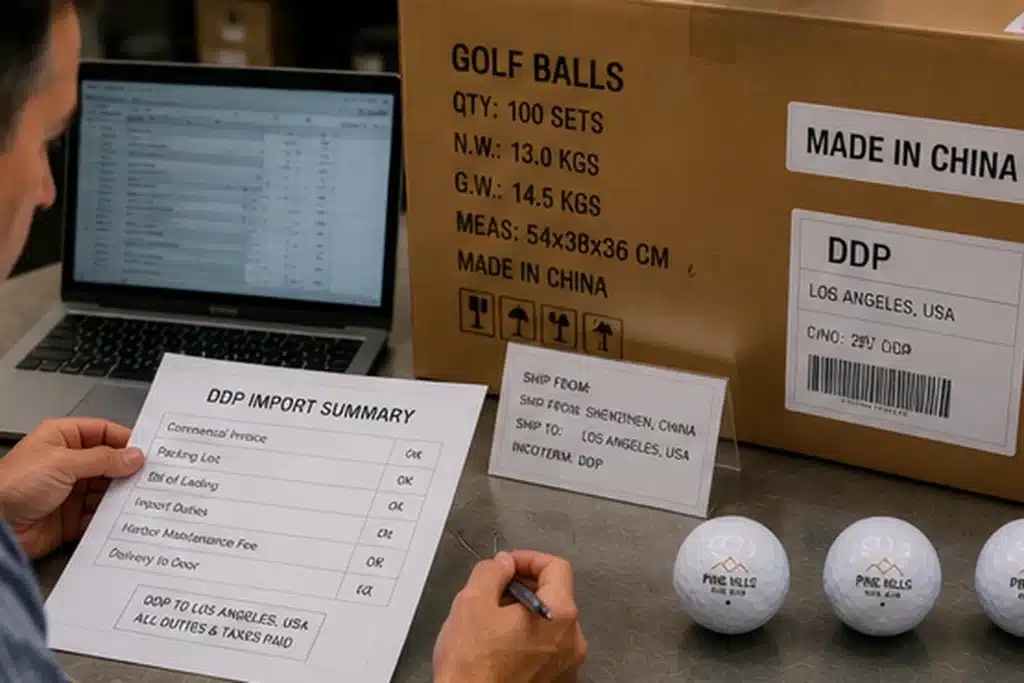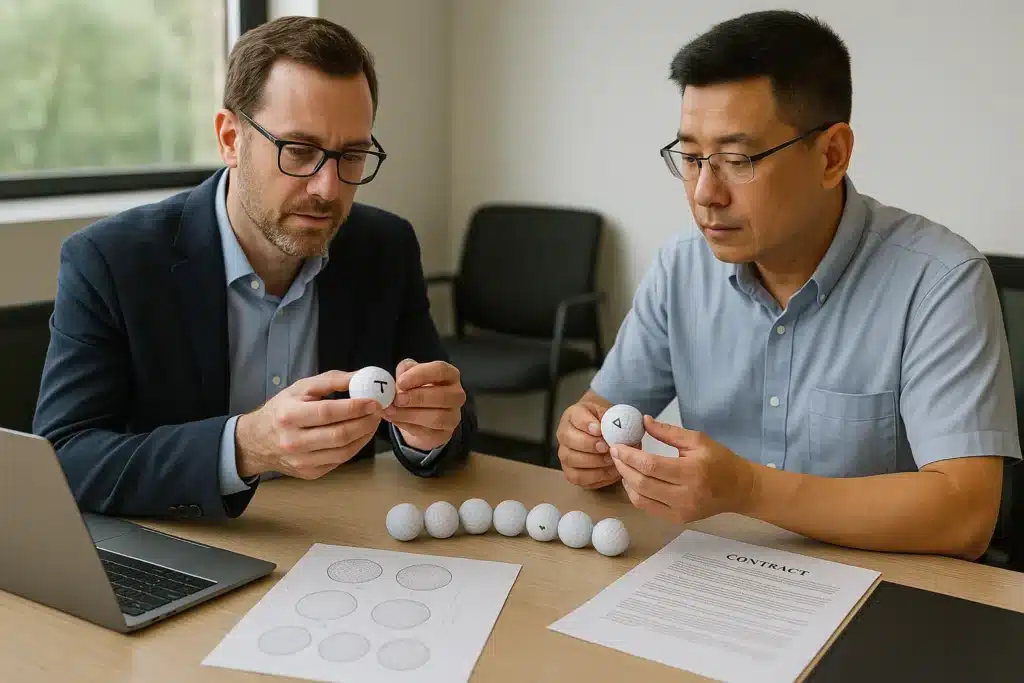
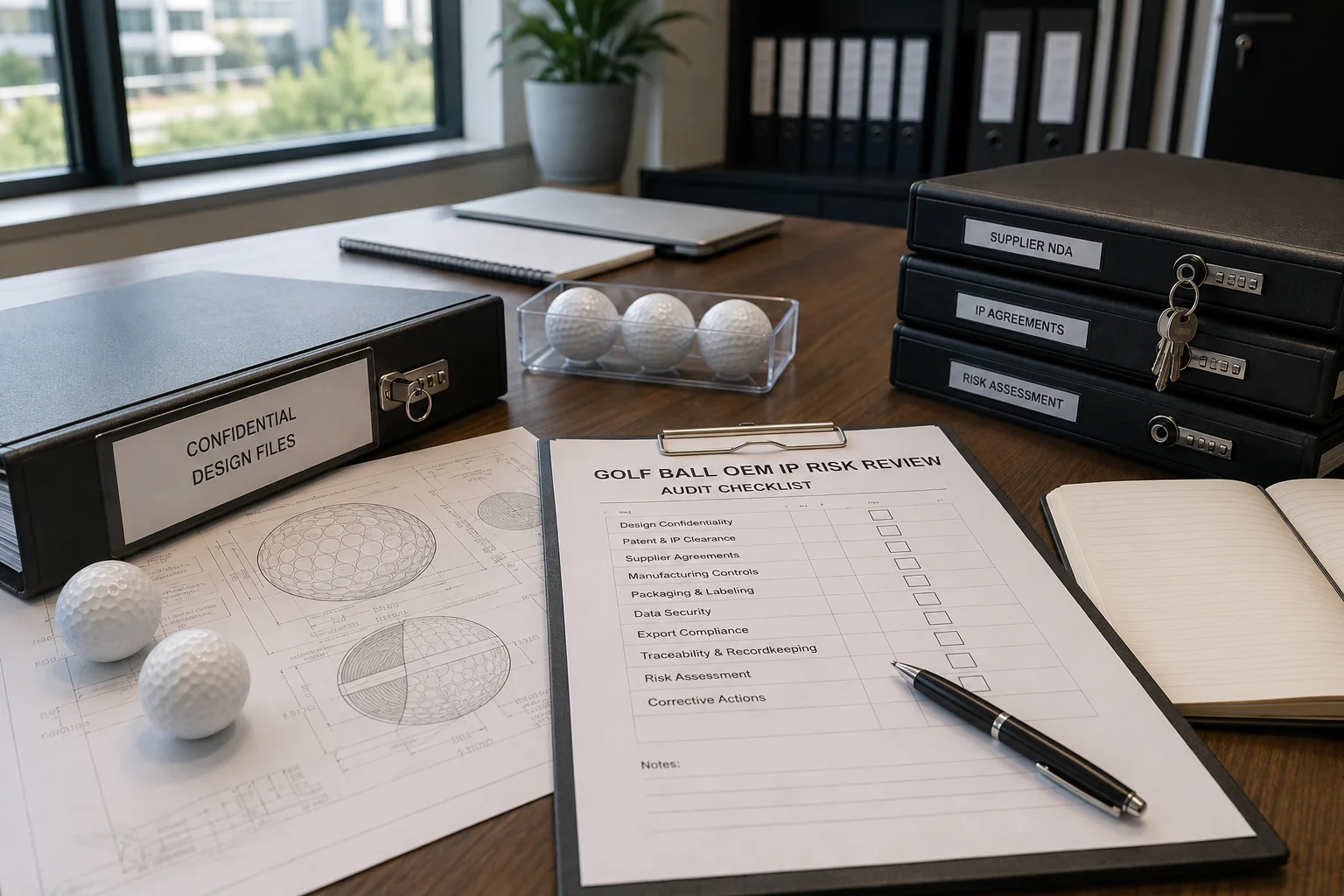
Your golf ball design is usually not stolen when it appears online. The risk often starts earlier, when a supplier treats your artwork, tooling, samples, packaging files, or production overruns as reusable factory assets.
The five biggest IP red flags in a China golf ball factory are NNN refusal, free tooling without buyer ownership, customer designs displayed as sales proof, undisclosed packaging subcontractors, and no overrun or scrap destruction protocol. Screen these risks before you share full dimple files, packaging artwork, tooling drawings, launch visuals, or customer-channel information.
For OEM buyers, the safest supplier is not the one that simply says “we respect confidentiality.” It is the one that lets you write control into contracts, tooling schedules, subcontractor obligations, showroom rules, production records, and destruction logs.
| IP red flag | Factory trap | What it can leak | Buyer evidence to request |
|---|---|---|---|
| NNN refusal | NDA covers secrecy, not self-use | dimple files, packaging, channels | China-law NNN acceptance before full disclosure. |
| Free tooling | factory controls mold assets | dimple masters, inserts, CAD records | Buyer-owned tooling schedule and no-reuse rule. |
| Showroom display | client IP becomes sales proof | logos, private samples, unreleased packaging | Written display-permission policy. |
| Hidden subcontractors | files leave the main factory | dielines, UV layers, gift boxes | Subcontractor disclosure and flow-down obligations. |
| Ghost shifts | extra balls become gray inventory | overruns, X-outs, blank balls, packaging waste | Quantity reconciliation and destruction proof. |
This guide does not replace legal advice, trademark filing, or technical file-security planning. It helps you read supplier behavior before your design becomes factory inventory.
Why Is NNN Refusal the First Red Flag?
Your U.S. NDA may look strong, but your real risk is factory self-use, marketplace leakage, and a supplier selling around you after your launch works.
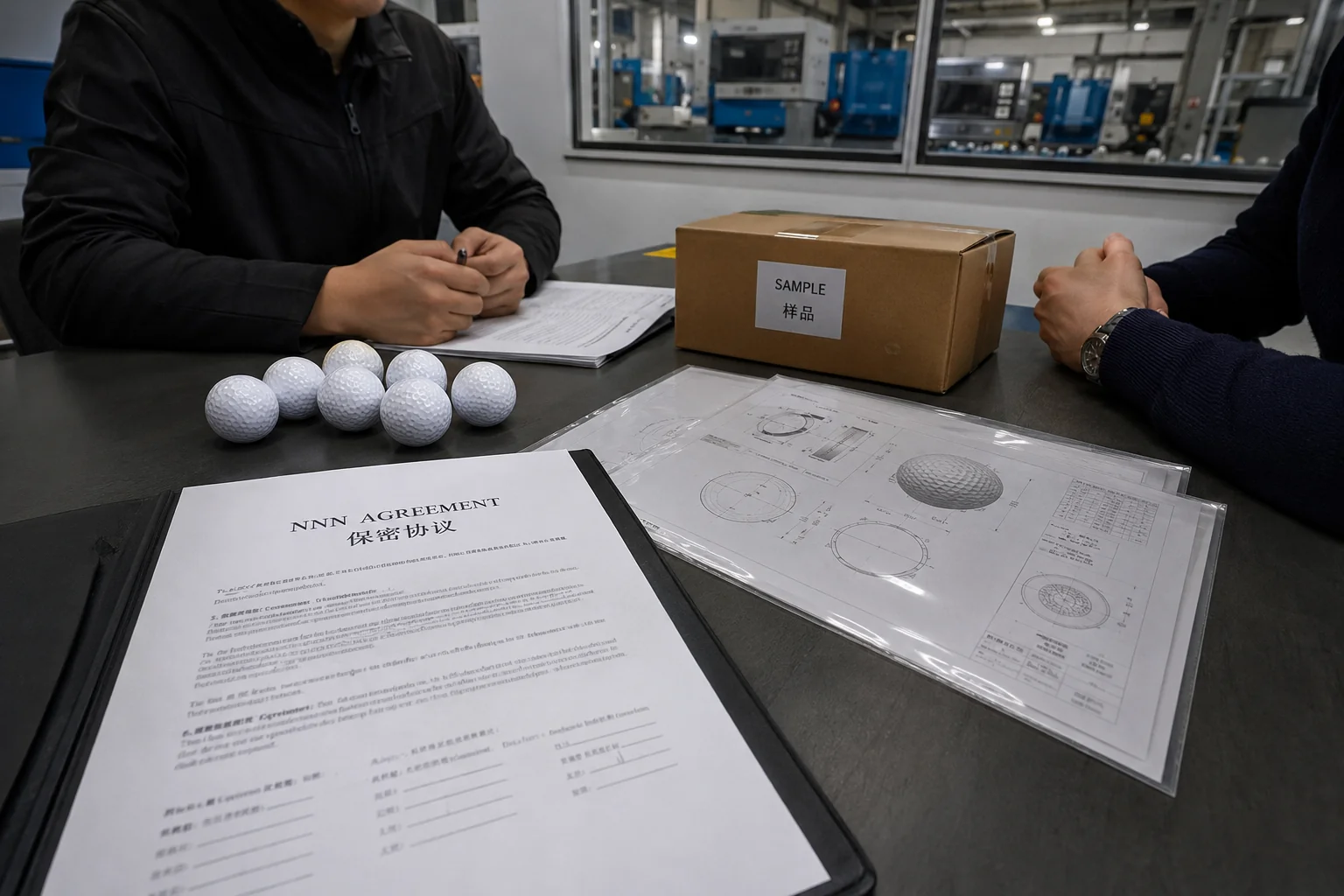
A factory that refuses non-use, non-disclosure, and non-circumvention controls is showing you how it may treat your golf ball IP later. A standard NDA may protect secrecy, but a China OEM NNN should also block factory self-use, backdoor selling, and circumvention of your customers or channels.
A Western-style NDA usually focuses on disclosure: the supplier should not share your information with outsiders. Golf ball OEM risk goes further. A factory may never email your CAD file to a third party, yet still use your dimple pattern, compression target, packaging layout, sample ball, or customer opportunity for itself. That is why NNN logic matters: non-disclosure, non-use, and non-circumvention. China NNN agreement
The first failure signal is simple: “Your U.S. NDA is enough.” It may not be enough for a China manufacturing relationship where the sensitive act happens inside the factory, with your tooling, artwork, and channel strategy already visible. Ask counsel to prepare a China-appropriate, bilingual NNN or equivalent manufacturing confidentiality agreement before full file disclosure.
| Contract signal | What it means | IP risk | Buyer move |
|---|---|---|---|
| Accepts China-law NNN | Understands local OEM risk | Lower | Continue review |
| Wants English NDA only | Treats IP as admin | High | Push back |
| Rejects non-use | Wants design freedom | Very high | Stop disclosure |
| Rejects non-circumvention | May sell around you | Very high | Protect channels |
| Avoids Chinese text / venue | Weak local leverage | High | Lawyer review |
What Does NNN Block That NDA Misses?
NNN blocks three separate risks: disclosure, factory self-use, and channel circumvention. The second and third are where many OEM golf ball problems begin.
Supplier shall not disclose, use, copy, sell, display, register, transfer, or route buyer artwork, dimple patterns, CAD files, molds, compression targets, packaging files, samples, customer information, or project data outside buyer-approved orders. Supplier shall provide the signed confidentiality / NNN version, tooling ownership schedule, subcontractor list, destruction protocol, and no-resale commitment before receiving full production files.
Ask the supplier to confirm NNN acceptance before full spec disclosure. Check whether non-use and non-circumvention are written, not merely implied. Do not release full dimple CAD, packaging files, product photos, or customer-channel information to a supplier that rejects NNN logic.
A short trademark reminder belongs here, not a full legal guide: discuss China filing early with counsel before sharing artwork, brand names, packaging files, or launch visuals. Early filing can reduce exposure if a supplier, trader, packaging vendor, or affiliate tries to register or misuse brand assets first. China trademark filing
✔ True — China OEM IP risk is not only about secrecy.
A factory can keep your file “confidential” and still use your dimple pattern, packaging idea, or channel opportunity for its own benefit. That is why non-use and non-circumvention matter.
✘ False — “A standard U.S. NDA is enough for China golf ball OEM.”
It may help with disclosure, but it is usually insufficient when the risk is self-use, backdoor selling, or marketplace circumvention.
When Is Free Tooling a Mold Trap?
You may save a tooling fee upfront, then discover the factory controls the mold, dimple master, inserts, and derived CAD records after your product succeeds.
Free tooling becomes an IP trap when the factory uses the waived mold fee to control your dimple design. For serious OEM golf balls, buyer-specific molds, dimple masters, inserts, CAD files, and tooling records should be buyer-owned, exclusive, marked, and removable after payment.
Free tooling is not automatically theft. It becomes dangerous when paired with vague ownership. If the factory pays for the mold, it often expects control. That can be acceptable for generic promo balls, but it is risky for unique dimple patterns, custom alignment marks, private compression platforms, or premium packaging-linked launches.
If you pay tooling or NRE, paying alone is still not enough. The agreement should list the assets: core molds, cover molds, dimple masters, inserts, printing plates, fixtures, CAD files, drawings, and derivative tooling records. The supplier may store tools as a custodian, but it should not reuse, modify, copy, display, transfer, pledge, or withhold them. tooling ownership agreement
For private-label and DTC launches, buyer-owned tooling protects future optionality because your team can control exclusivity, transfer rights, no-reuse obligations, and supplier-switching risk. The failure signal is: “We waive tooling, but the mold stays with us.” That is not a discount. It is a long-term control problem disguised as a short-term saving.
| Tooling offer | Hidden risk | Safe evidence | Buyer move |
|---|---|---|---|
| “Free mold” | Factory owns design asset | Written exclusivity | Ask ownership first |
| Vague mold fee | Buyer paid but cannot move it | Tooling schedule | Define asset list |
| Factory-owned tooling | Shared dimple risk | No third-party use | Avoid unique designs |
| Buyer-owned tooling | Control and transfer | Release rights | Preferred path |
| No tooling inventory | Hard to audit | Mold ID and photos | Require log |
What Should Buyer-Owned Tooling Include?
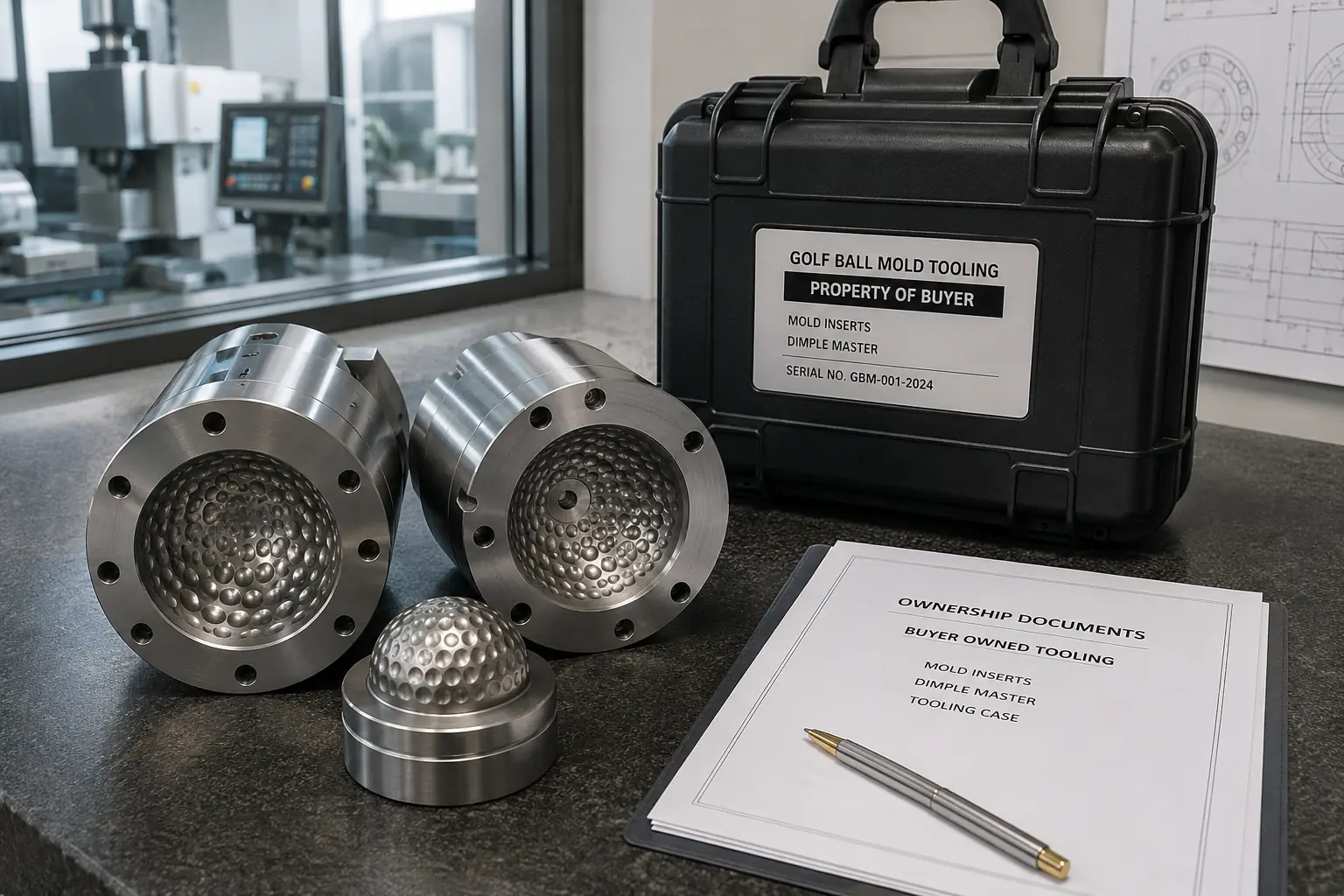
Buyer-owned tooling should cover every project-specific asset, not just the word “mold.” Golf ball IP often lives in dimple masters, inserts, files, and derived records.
Upon full payment of tooling or NRE charges, buyer owns all project-specific molds, inserts, dimple masters, printing plates, fixtures, CAD files, drawings, and derivative tooling records. Supplier holds tooling only as custodian and may not reuse, copy, modify, transfer, display, pledge, or withhold it.
Request a buyer-owned exclusive tooling schedule. Verify the asset list, ownership trigger, no-reuse rule, transfer right, release period, mold ID, and storage location. No clear buyer-owned tooling clause, no unique dimple or mold payment.
What Does the Showroom Reveal?
You may judge a factory by its showroom, but the display shelf can reveal whether customer IP is treated as confidential or as sales decoration.
A golf ball factory’s showroom can reveal its IP culture before you sign anything. If it displays customer-logo balls, unreleased packaging, private dimple samples, or “OEM tour” products as sales trophies, assume your design could become the next display item.
The showroom test works on Zoom, at a trade fair, or during a site visit. Look past the smiling sales team. What is on the shelf? If you see another DTC brand’s logo, private alignment mark, custom sleeve, unreleased gift box, or special dimple sample being used as proof of “our capability,” ask one question: did that customer give written display permission?
Not every displayed product is illegal. Some brands approve display samples. The red flag is casual exposure. Golf balls are especially sensitive because a visible dimple pattern, model name, alignment line, packaging dieline, or cross-section sample can reveal enough for a copycat launch. Showroom behavior tells you how the supplier treats other people’s secrecy when nobody is watching.
| Showroom signal | What it reveals | Risk level | Buyer move |
|---|---|---|---|
| Customer-logo balls | Client IP used for sales | High | Ask permission basis |
| Unreleased packaging | Launch secrecy risk | High | Stop file sharing |
| Private dimple samples | Design leakage | High | Avoid unique tooling |
| Blurred famous brands | Overrun / clone culture | Very high | Walk away |
| Generic sample balls | Lower risk | Medium | Continue audit |
Which Display Items Should Worry You?
Worry about any item that reveals another buyer’s private brand, private tooling, private packaging, or unreleased launch concept. Your product may be treated the same way.
Ask for the supplier’s showroom and sample-display policy. Check whether customer samples are hidden, anonymized, or displayed only with written permission. Do not share unreleased files with a factory that uses other customers’ IP as marketing decoration.
✔ True — Showroom samples reveal IP culture.
A factory that casually displays private-logo products may see client work as sales material, not confidential property. That is a business habit, not a small mistake.
✘ False — “Showroom samples only prove capability.”
They also show whether the supplier understands permission, launch secrecy, and client confidentiality.
Where Can Packaging Files Leak?
You may secure the ball factory, but your artwork, dielines, UV print layers, insert trays, and gift-box design can leak through secondary vendors.
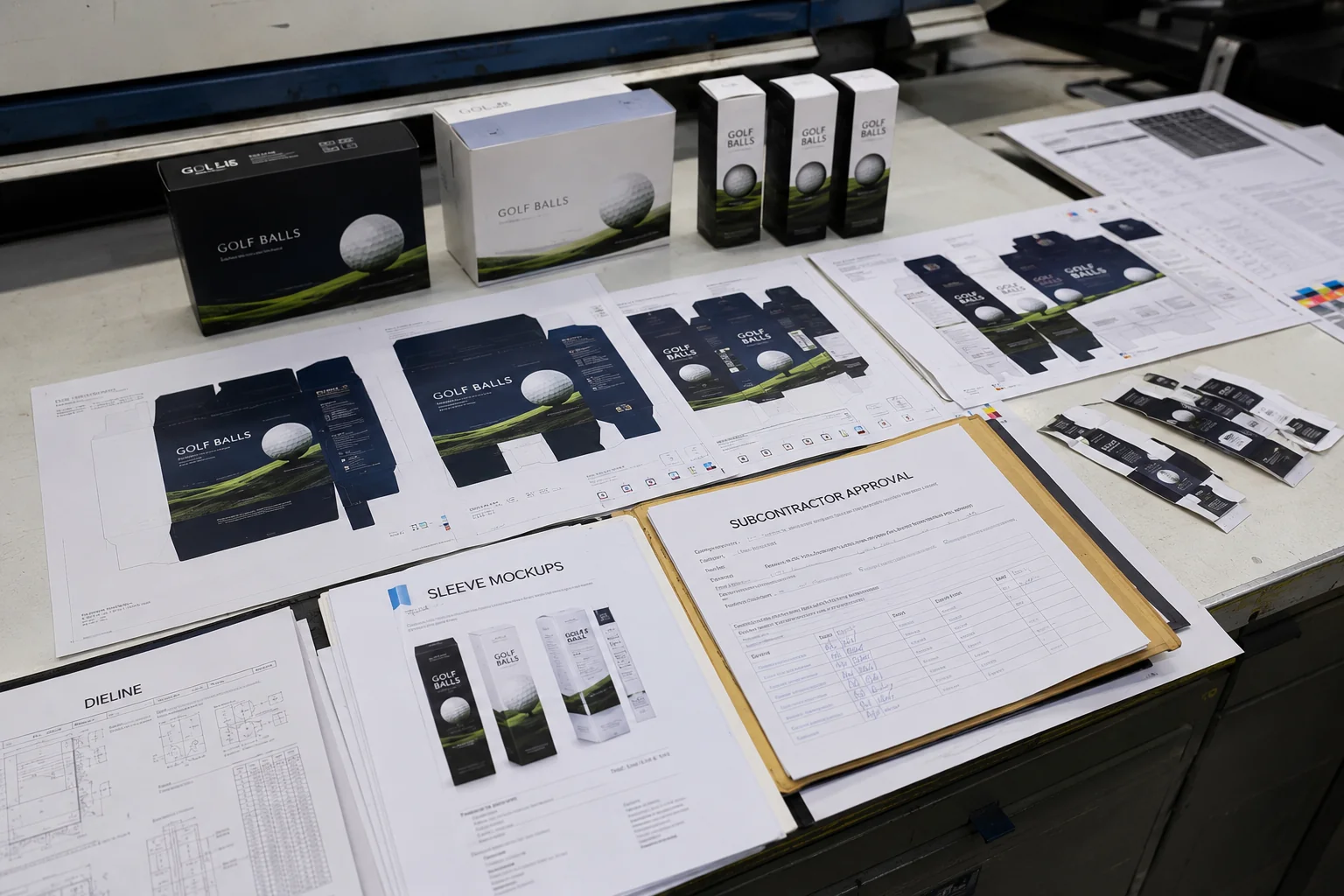
Your golf ball IP can leak outside the ball factory through packaging and print subcontractors. If the OEM refuses to name who sees your artwork, dielines, gift-box files, or product samples—or refuses flow-down NNN obligations—your protection has a subcontractor hole.
Golf ball launches are not only balls. They include dozen boxes, sleeves, alignment diagrams, retail cartons, inner trays, UV finishes, foil stamping, product photography, and sometimes premium gift packaging. Those files may pass through color box printers, insert tray suppliers, coating vendors, photo studios, mold polishers, or repair shops. A disciplined ball factory can still leak through an undisciplined subcontractor.
CPO buyers prefer leak prevention, so subcontractor flow-down matters as much as the main factory contract. Ask who will see buyer artwork, packaging files, tooling files, samples, or private brand assets. The answer “we cannot tell you; it is our internal resource” is not reassuring when your luxury box dieline may be easier to copy than the ball itself.
IP leakage is not only a paperwork problem. If a bad actor gains control of brand assets, packaging files, or lookalike goods connected to export orders, the issue can move beyond private negotiation into customs, marketplace, distributor, or enforcement disputes. Keep customs and IP-recordal questions with counsel, but treat packaging-file control as an OEM sourcing issue from day one.
| Subcontractor touchpoint | What they see | Leakage risk | Buyer move |
|---|---|---|---|
| Color box printer | Artwork and dieline | Brand copy | Require flow-down NNN |
| Insert tray supplier | Packaging structure | Gift-pack clone | Limit files |
| UV / foil vendor | Premium finish files | Lookalike packaging | Approve vendor |
| Photo studio | Launch visuals | Pre-launch leak | Ban sharing |
| Mold repair / polish | Dimple geometry | Tooling leak | Contract coverage |
Which Subcontractors Must Be Disclosed?
Disclose any subcontractor that can see your artwork, tooling files, samples, packaging structure, or launch visuals. Hidden access creates hidden leakage.
Request a subcontractor disclosure and flow-down confidentiality plan. Verify which vendors see files or samples, and require back-to-back obligations. No undisclosed subcontractor should receive buyer files or samples without equivalent controls.
How Do Ghost Shifts Leak Inventory?
You may order a fixed quantity, then find unauthorized overruns, X-outs, misprints, blank balls, or factory seconds sold through marketplaces.
Ghost shifts and scrap leakage turn your OEM order into black-market inventory. Unauthorized overruns, X-outs, misprints, blank balls, and rejected packaging should never become factory property; they must be reported, buyer-controlled, reworked, purchased, or destroyed with proof.
A ghost shift means unauthorized extra production outside the approved PO quantity, approved production window, or buyer-controlled inventory plan. The factory may use your tooling, materials, dimple pattern, packaging files, or production setup after the official run is complete. Even if the logo is removed, the structure, dimple layout, packaging style, or launch timing can still leak value.
Small overrun or underrun tolerance may exist in custom manufacturing, but tolerance is not permission to create side inventory. The issue is not normal production variance; the issue is unauthorized ownership, sale, or use of buyer-derived goods. Any extra buyer-branded or buyer-derived goods should be reported and reconciled. They may be purchased by you, held under your instruction, reworked, or destroyed with proof. The failure signal is: “Extra balls are factory stock.” That is not factory stock; it is buyer-controlled inventory with direct IP and channel-risk exposure.
| Leakage item | Factory excuse | IP risk | Required proof | Buyer move |
|---|---|---|---|---|
| Overruns | “Normal extra” | Side inventory | Quantity log | Buyer controls |
| Misprints | “Waste stock” | Logo leakage | Destruction video | No resale |
| X-outs | “Practice balls” | Brand dilution | Scrap log | Destroy or buy |
| Blank balls | “No logo, no issue” | Dimple / structure leak | Batch link | Control sale |
| Packaging waste | “Only boxes” | Artwork clone | Destroy proof | Audit printer |
What Proof Should Destruction Include?
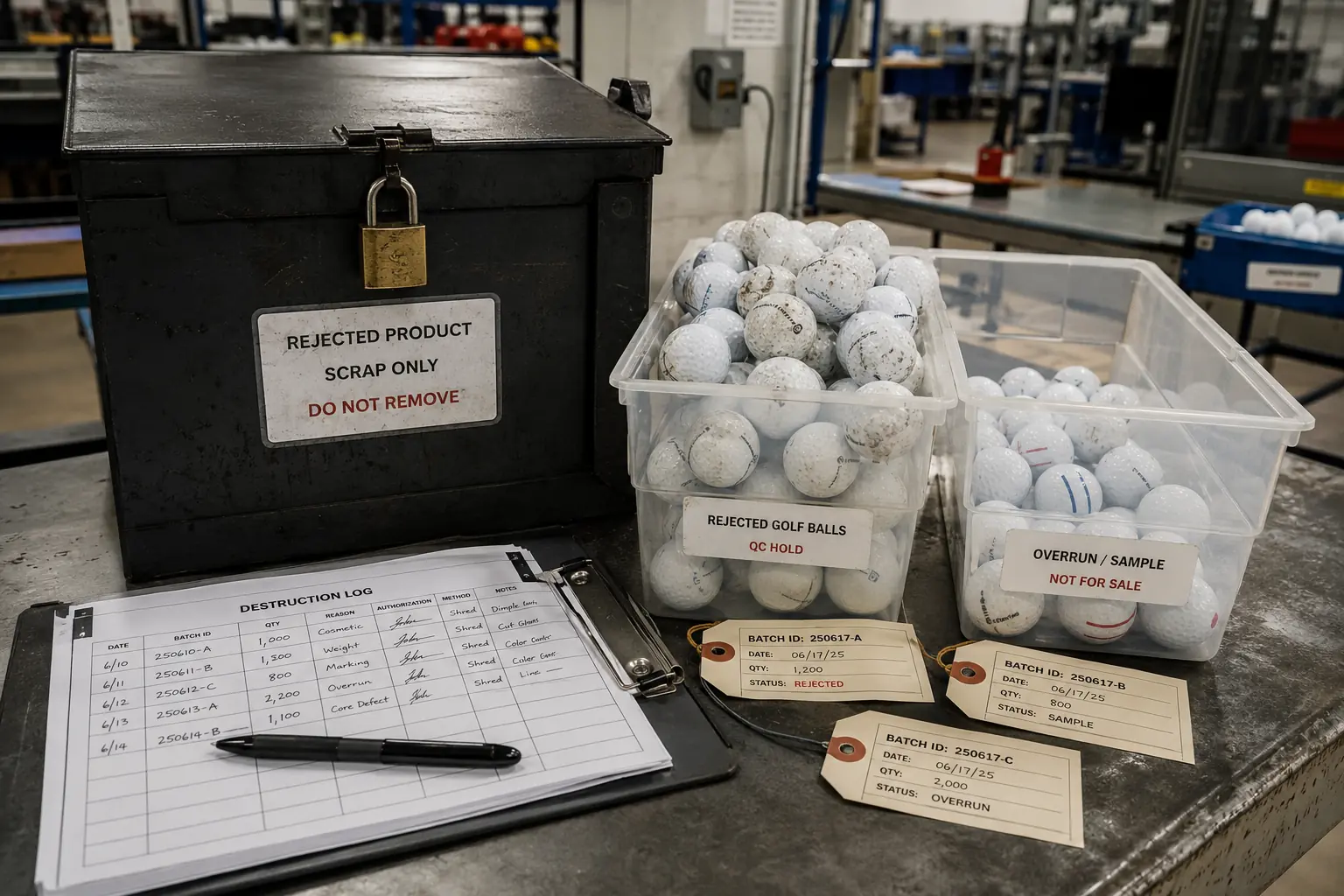
Destruction proof should include quantities, batch numbers, dates, staff responsibility, photos or video, and reconciliation against produced, shipped, held, and destroyed goods.
Ask the supplier to provide an IP-risk audit pack before full disclosure: China-law NNN response, buyer-owned tooling terms, subcontractor flow-down plan, showroom / sample-display policy, overrun and scrap destruction protocol, marketplace overrun policy, tooling inventory method, and written no-use / no-circumvention / no-resale commitments.
Request the destruction protocol before PO. Verify batch logs, quantity reconciliation, destruction records, locked scrap handling, and marketplace monitoring. No written destruction protocol, no buyer-branded mass production.
✔ True — Overruns and rejects are still controlled goods.
Even without a logo, extra balls can reveal dimple patterns, construction, packaging timing, or market positioning. They need buyer instructions, reconciliation, and destruction proof.
✘ False — “Extra balls are harmless if the logo is removed.”
Blank balls, X-outs, misprints, and packaging waste can still leak value through marketplaces or offline channels.
FAQ
Is a Standard NDA Enough for China Golf Ball OEM?
Usually not by itself. A standard NDA may focus on disclosure, while China golf ball OEM risk also includes factory self-use, backdoor selling, and customer-channel circumvention.
Use counsel to prepare a China-appropriate NNN or equivalent manufacturing confidentiality agreement before full disclosure. Do not share full dimple files, tooling drawings, packaging artwork, sample balls, or customer-channel information before the supplier accepts non-disclosure, non-use, and non-circumvention controls.
Who owns the golf ball mold if the factory pays for it?
If the factory pays for tooling or waives tooling fees, you should assume it may claim control unless the contract says otherwise. Free tooling is often exchanged for supplier leverage.
Buyer-specific tooling should be buyer-owned if you need exclusivity. Include dimple masters, inserts, printing plates, CAD files, fixtures, drawings, and derivative records. Write transfer, no-reuse, no-display, and release rights before sample tooling starts, not after you want to switch factories. For generic public tooling, factory ownership may be acceptable; for private dimple, private inserts, or buyer-specific tooling, ownership and exclusivity should be written before tooling starts.
What is a ghost shift in China manufacturing?
A ghost shift is unauthorized extra production using your tooling, materials, design, or packaging outside the approved PO quantity. In golf balls, it can create blank balls, overruns, X-outs, or factory seconds.
The risk is not only quantity. It damages price control, launch secrecy, and channel trust. Require produced-shipped-held-destroyed reconciliation, scrap logs, and destruction proof. Scan marketplaces for suspicious “OEM overrun,” “no-logo tour ball,” or lookalike inventory tied to your design.
How can I stop a factory from selling rejected balls?
Put overrun, X-out, misprint, scrap, retained-sample, and packaging-waste handling into the PO before production. Rejected balls should never become casual factory inventory.
Require destruction logs with batch numbers, quantities, dates, and responsible staff. Ask for photo or video evidence. Ban donation, resale, repacking, showroom use, and sample use without written approval. Reconcile produced, shipped, held, destroyed, and retained quantities before repeat orders.
Why are packaging subcontractors an IP risk?
Packaging subcontractors may see your dielines, artwork, UV layers, gift-box structure, and launch visuals before the market does, so they can leak your brand presentation even if the ball factory behaves.
Ask who prints boxes, sleeves, inserts, cartons, labels, and premium packaging. Require back-to-back NNN obligations and destruction rules. Limit file access by vendor role. Include color proofs, waste sheets, defective cartons, and photo samples in your destruction protocol.
Is a trading company always too risky?
Not always, but the real manufacturer must be named and bound. The entity holding molds, files, samples, and overruns must accept the relevant IP controls.
A trader may help with language, logistics, or sourcing coordination. The danger is letting full specs circulate through anonymous factories. Ask for live production visibility, identify the actual manufacturer, and make sure contracts reach the party that can leak or protect the IP.
What should an IP-safe factory show on video?
It should show controlled access, limited customer samples, secure tooling storage, labeled scrap handling, and no uncontrolled client-logo displays. The background often tells you more than the sales pitch.
Ask to see the sample room, tooling area, showroom shelf, and scrap bins. Watch whether customer products are exposed. Ask where rejected balls go and how they are logged. A factory that handles other customers’ IP carefully is more likely to handle yours carefully.
Should I register my trademark in China before OEM work?
Discuss China trademark filing early with counsel before sharing artwork, packaging, or launch visuals. Early filing can reduce vulnerability if a supplier, trader, packaging affiliate, or bad-faith actor tries to register first.
This article focuses on factory red flags, not trademark filing strategy. Still, brand owners should treat trademark review as part of launch hygiene. Once your logo, packaging, and channel plan enter the manufacturing chain, waiting until after problems appear may reduce your leverage.
Conclusion
China golf ball IP risk rarely appears as one dramatic theft event. It usually appears first as supplier behavior: refusing non-use controls, offering free tooling without ownership, showing other customers’ products, hiding packaging subcontractors, or refusing to document overruns and scrap destruction.
A safer factory does not merely promise honesty. It lets your team write controls into confidentiality terms, tooling schedules, subcontractor obligations, showroom rules, production records, retained-sample rules, and destruction logs.
Before full disclosure, request the evidence pack: signed confidentiality / NNN terms, buyer-owned tooling schedule, subcontractor disclosure, display-permission policy, overrun reconciliation, scrap destruction protocol, and no-resale commitment.
You might also like — How to Source OEM Golf Balls from China: The PO Negotiation Guide