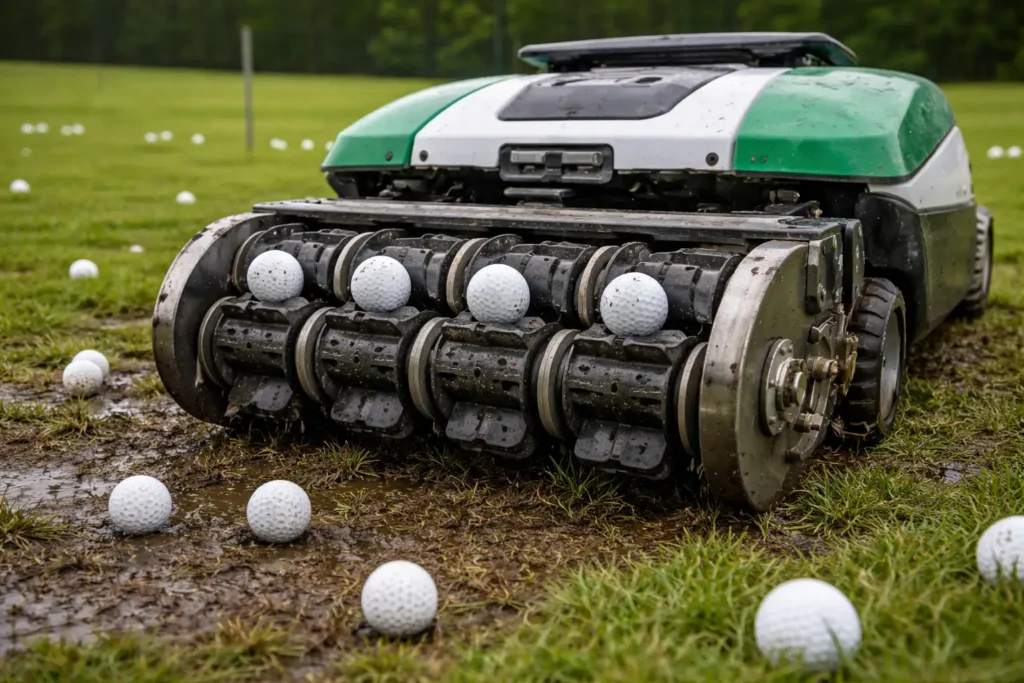
Yes, out-of-round range balls can jam robotic pickers when swollen, cracked, dirty, oversize, rough, or misshapen balls no longer pass cleanly through pickup discs, ball channels, washers, dispensers, or other handling points. To reduce robotic picker jams, your team should verify post-use roundness, remove damaged balls before re-entry, and require caliper or ring-gauge proof before bulk buying.
You bought automation to remove labor, but one unstable ball can drag staff back into jam clearing, restart work, and manual inspection. In an automated driving range, the ball is no longer just a consumable. It is a mechanical input that must stay round, stable, smooth, and traceable after repeated use.
Use this guide to separate robot faults from ball-induced jam risk, then turn automation-ready range balls into a measurable buying, screening, and receiving standard.
You may treat range balls as low-cost consumables, but your automated range pays again when unstable balls create jams, manual labor, and delayed return flow.
A cheap range ball can stop a premium robot when it loses the geometry automation expects. In an automated driving range, the real cost is not the ball alone; it is jam clearing, manual rollback, delayed ball return, washer starvation, dispenser shortage, and uptime loss.
The automation paradox is painful because the robotic golf ball picker was purchased to remove labor from the field. When staff have to walk out, clear jams, restart equipment, inspect buckets, and babysit the return chain, the labor-saving story starts going backward. The ball has quietly changed from a consumable into an automation-risk input.
At the time of review, public robotic picker examples show why the stakes are not small. One RP-1250 listing shows a price of $33,400 and 12,500 daily ball-picking capacity, while another public RP-1250 page lists 15,000 golf balls per 24 hours from €22,990. A different autonomous range picker page cites up to 60,000 golf balls daily. These are examples, not universal prices or guarantees, but they support the buying point: a low-cost ball can interfere with a five-figure automation asset. public picker price and capacity public 24-hour capacity high-capacity picker example
A robotic golf ball picker is not a standalone gadget. It is the first link in a ball-handling system. The chain looks like this:
picker jam → slower return flow → washer starvation → dispenser inventory weakens → bucket sales or bay service slows
That is why per-ball price is not enough. The ball physically touches the automation chain over and over again. Once it becomes swollen, cracked, rough, dirty, or out-of-round, the robot is no longer processing a stable object. It is processing a defect.
| Pain/decision | What seems saved | What may get hit | Action/evidence |
|---|---|---|---|
| Lowest-cost ball | Pennies per ball | Automation uptime | Model jam cost |
| Mixed inventory | Simpler stock | Geometry stability | Segregate balls |
| No screening | Less handling | Hidden damaged balls | Add reject bin |
| Fresh sample only | Fast approval | Post-use drift | Request used proof |
| Machine blamed first | Quick repair story | Root cause clarity | Check ball fit |
Build a jam-sensitive TCO worksheet using jam events, intervention minutes, labor rate, delayed return flow, wear exposure, and sales interruption. Compare the worksheet against your own jam log, restart notes, picker route history, washer delays, and dispenser shortages.
Do not approve the lowest ball quote unless it wins after automation uptime and manual rollback are included.
✔ True — Robots are geometry-dependent systems
The core issue is not that robotic pickers are fragile. They are designed around predictable ball size, shape, and surface condition.
✘ False — “A cheap ball only affects ball cost”
In an automated range, a poor ball can also affect intervention labor, restart time, washer flow, dispenser availability, and selling-hour reliability.
Ball cost vs automation uptime?
Your facility bought automation to avoid labor rollback, so your ball spec must protect automation uptime.
A range ball that still flies may still be wrong for automation. That is the shift procurement has to make. The buying question is not only “Can this ball be hit?” It is “Can this ball stay round, stable, smooth, and traceable after repeated use?”
Where do picker jams actually start?
You may blame the picker when it jams, but the first cause to rule out is whether damaged balls are entering geometry-sensitive handling points.
Picker jams often start when the ball stops behaving like a predictable round mechanical input. A swollen, cracked, dirty, rough, or out-of-round range ball can wedge, resist, or drag through pickup discs, channels, washers, and dispensers instead of passing cleanly.
Different robotic picker and range ball picker machine designs vary. Some use pickup wheels, some use channels, guides, baskets, elevators, blowers, or conveyors downstream. The mechanical principle is still similar: the system expects golf-ball geometry.
A round ball passes. A misshapen ball resists.
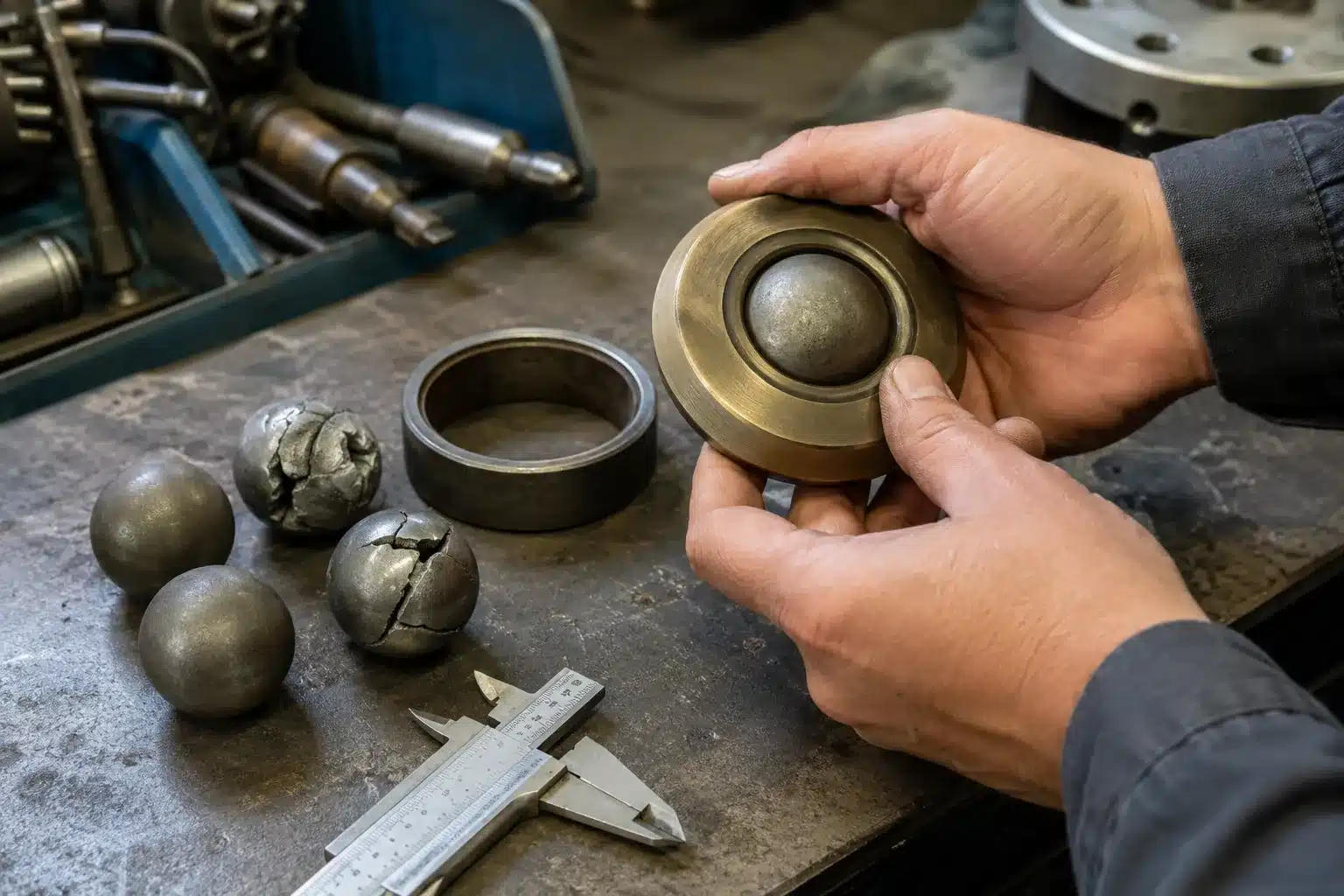
The baseline measurement language is useful here, but it should not be overstated. R&A equipment rules state that a ball diameter must not be less than 1.680 inches / 42.67 mm, and the official size protocol uses a metal ring gauge. A USGA equipment page uses the same ring-gauge language. For automation buyers, that does not mean rules conformance guarantees no jams. It means caliper and ring-gauge language gives your team a practical way to discuss diameter drift, swelling, and oversize rejects with suppliers. ball size and ring-gauge rule ring-gauge measurement language
Your team can use a simple check path before blaming the machine alone:
-
diameter or ring gauge flags oversize or swollen balls
-
caliper checks can reveal egg-shaped or bulged samples
-
visual crack checks remove unstable balls before re-entry
-
surface checks catch rough covers, burrs, mud, and heavy dirt
-
retained samples connect approved geometry to bulk lots
Out-of-round is a system-risk defect, not an appearance complaint. It can affect the picker in the field and the wider range ball handling system after collection.
Request fit-logic evidence: a same-geometry diagram or demo showing nominal, swollen, cracked, and misshapen balls against the handling spacing. Use caliper or ring-gauge checks to separate machine fault from ball-induced geometry risk.
Remove balls that are cracked, visibly swollen, severe out-of-round, rough, or oversize before blaming the picker alone.
The snug-fit geometry problem?
Your maintenance team needs a ball-screening path before it spends time chasing the wrong fault.
A robot fault is possible. So is a ball-induced jam. The clean troubleshooting sequence is to inspect ball condition, verify handling geometry, and then investigate mechanical settings or worn parts. That keeps your team from repairing the robot while feeding it the same bad input.
What makes a range ball automation-ready?
You may think a ball is acceptable because it still flies, but automation-ready means it remains mechanically compatible after repeated use.
An automation-ready range ball is not just durable at impact; it stays round, stable, smooth, and traceable after repeated use. Your team should verify core integrity, roundness or concentricity, cover condition, diameter retention, and post-use geometry before calling a ball picker-friendly.
Roundness is not a warehouse appearance check. It begins with mold design, molding control, material stability, and whether the used ball still keeps its shape after repeated impact. A fresh sample can look perfect in a carton and still fail after repeated hits, washing, picking, and handling.
The first variable is core integrity. If the core cracks, shifts, or relaxes unevenly, the cover can bulge and the ball may start drifting away from round. The second variable is roundness or concentricity. One round sample on a desk proves little. The production lot has to hold diameter and geometry. The third variable is cover condition. Even when the first jam begins as a geometry problem, rough cover, burrs, chips, or heavy dirt can add friction through channels and downstream equipment.
| Pain/decision | Ball variable | System risk | Action/evidence |
|---|---|---|---|
| Bulge risk | Core integrity | Crack-driven shape drift | Cut used sample |
| Disc wedging | Roundness | Out-of-round resistance | Use caliper |
| Batch drift | Concentricity | Unstable geometry | Request QC |
| Channel friction | Cover condition | Rough handling | Inspect surface |
| Washer issue | Dirty/damaged surface | Downstream stuck risk | Screen after use |
| Sample drift | Version control | Bulk mismatch | Lock proof |
For many high-consumption range settings, durable 2-piece ionomer or Surlyn-style constructions may be common, but the material label is not enough. Automation-ready is about post-use shape retention and surface stability, not just a familiar cover category.
One round sample with no post-use data is a failure signal.
Supplier shall identify the automation-use ball platform, diameter target, core route, cover route, compression window, and post-use geometry test method before buyer approval.
Request an automation-use ball standard with core integrity, post-use roundness, cover condition, diameter window, and surface-defect limits. Compare fresh and post-use balls from the same candidate lot after impact and wash exposure.
Do not approve automation use unless the ball retains automation-friendly geometry and surface condition after repeated-use testing.
✔ True — Good for range use is not the same as good for automation
A ball can still fly acceptably and still become a bad mechanical input for picker, washer, dispenser, or return equipment.
✘ False — “If one sample is round, the lot is fine”
Automation stability is a batch and post-use question. One hero sample does not prove diameter, roundness, core integrity, or surface condition across production.
Roundness, core, and cover condition?
Your team should approve the ball after it has been used, not only when it looks perfect in a carton.
A stronger supplier can explain how the ball was molded, how geometry is checked, how batch spread is measured, and how used-ball stability is verified. A weaker supplier may only say “durable” or “perfectly round.” For automation, adjectives are not enough.
How should you screen balls after use?
You may put any ball that still flies back into circulation, but automation equipment needs a stricter rule than normal playability.
A ball can be hittable and still be unsafe for automation. Your team should remove cracked, swollen, egg-shaped, oversize, dirty, rough-surface, burr-marked, or unknown mixed-lot balls before they re-enter the picker, washer, dispenser, or return workflow.
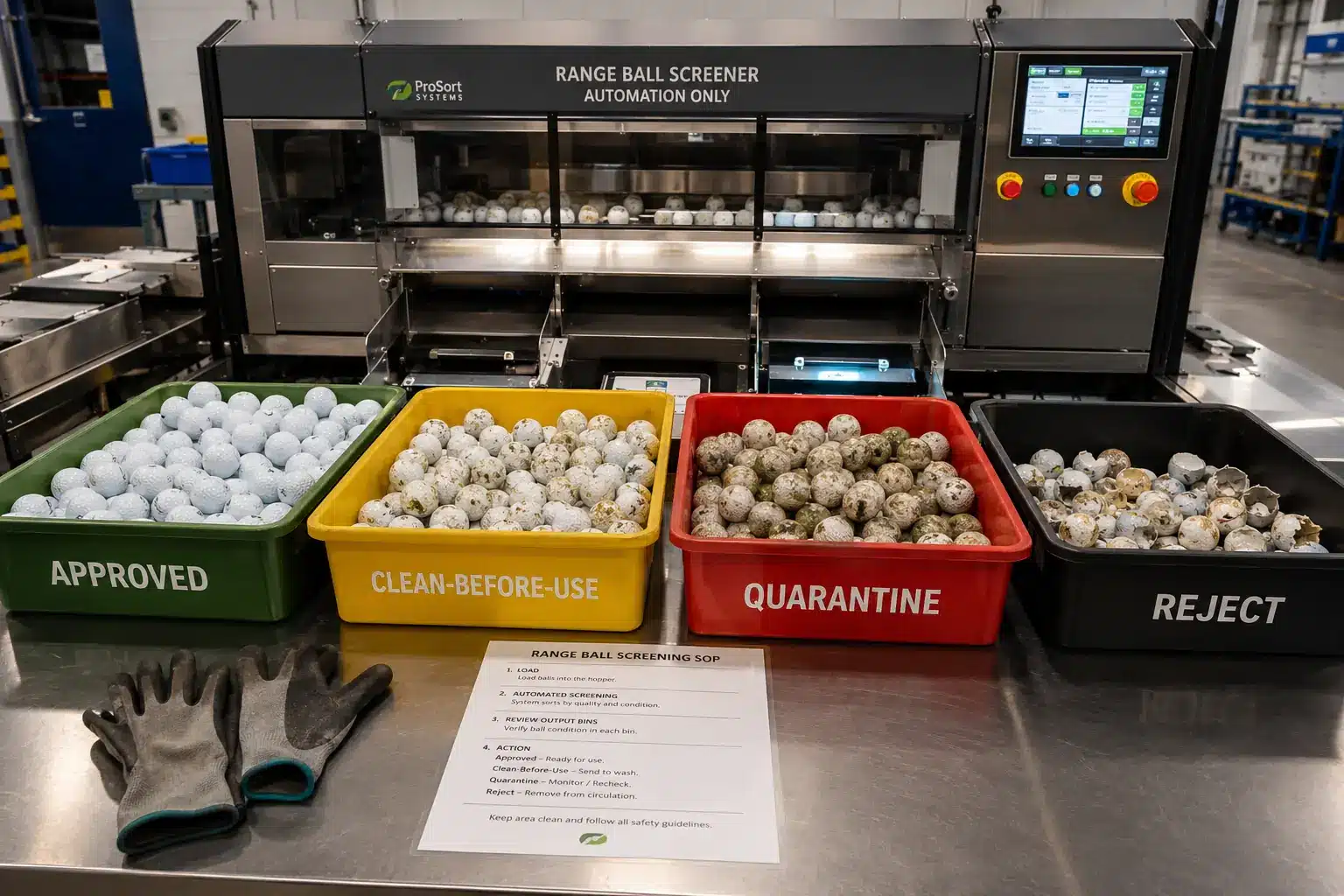
Playable is not the same as automation-ready.
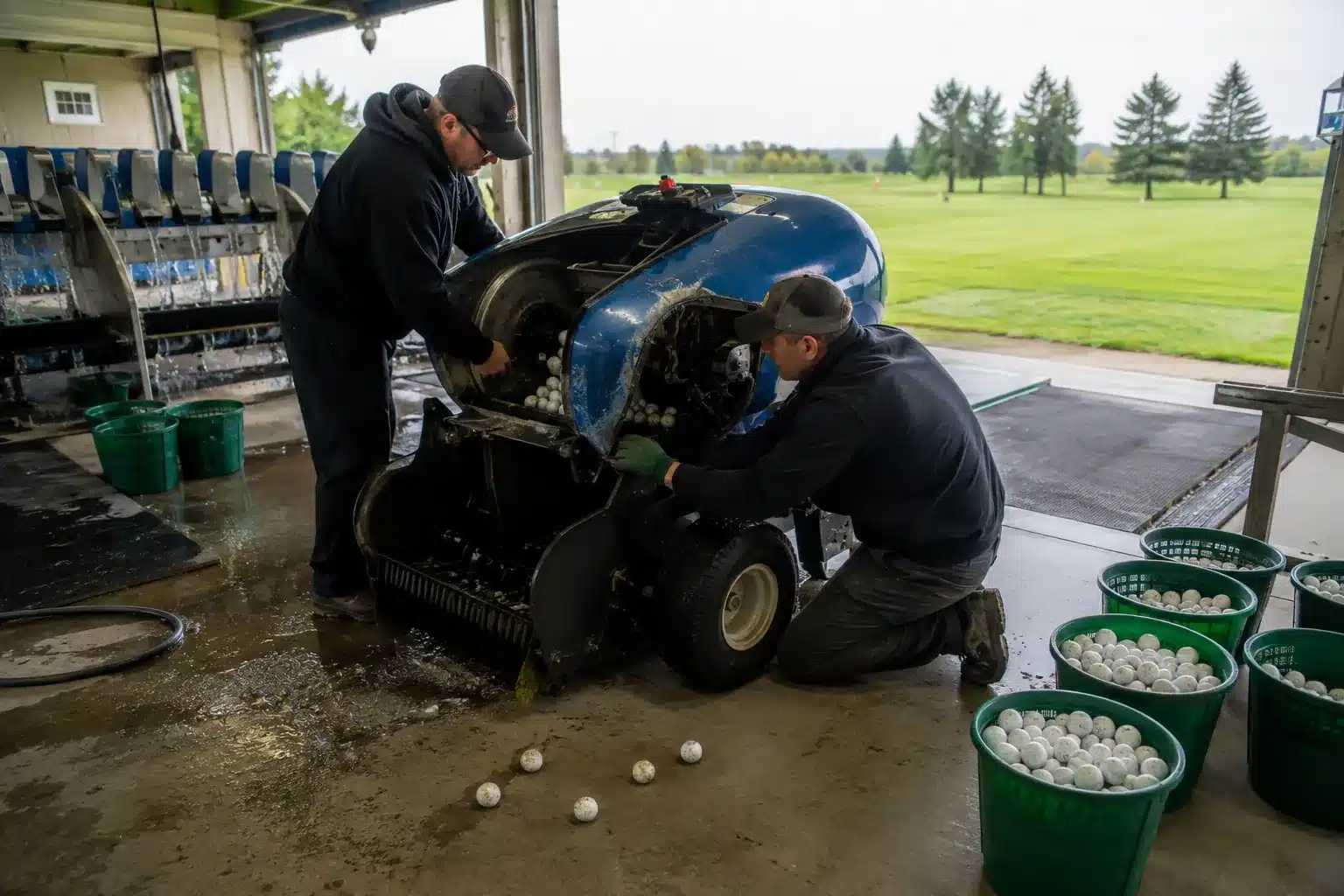
This is not only a theory. A commercial ball washer manual warns operators not to use oversize or damaged golf balls. A range dispenser manual states that balls must be clean and undamaged or they may get stuck and cause machine failure. A blower-system manual uses the same clean-and-undamaged logic for transporting golf balls. Your exact equipment may differ, but the operating principle is clear: damaged and dirty balls are not neutral inputs. washer manual warning dispenser manual guidance blower manual guidance
Your staff needs a rule that is easy to enforce at speed. Build four categories: automation-approved, clean-before-use, quarantine, and reject. A reject bin is not a punishment bin. It is uptime insurance.
| Pain/decision | Ball condition | Automation rule | Action/evidence |
|---|---|---|---|
| Visible crack | Cracked ball | Reject | Use reject bin |
| Shape drift | Swollen / egg-shaped | Reject | Measure or hold |
| Size risk | Oversize by gauge | Reject | Check diameter |
| Friction risk | Rough surface / burr | Hold | Inspect surface |
| Contamination | Mud / heavy dirt | Clean first | Recheck ball |
| Unknown source | Mixed lot | Quarantine | Sort before use |
If automation-use balls are marked for segregation, the mark must survive washing and handling well enough for staff to keep automation inventory separate. That is the only printing point this article needs: identification has to support operations.
Hittable damaged balls returning to automation is a failure signal.
Receiving may quarantine any lot or used-ball stream that includes cracked, swollen, oversize, out-of-round, rough-surface, dirty, or untraceable balls before automation release.
Write a post-use screening SOP with approved, clean-before-use, quarantine, and reject categories. Audit rejected balls against jam events to see whether crack, swelling, dirt, or rough-surface categories correlate with stoppages.
No cracked, swollen, out-of-round, oversize, rough, or unknown mixed-lot ball re-enters automation without inspection.
Remove hittable but unsafe balls?
Your staff needs a rule that removes the risky ball before the robot has to find it.
The best SOP is boring, visible, and repeatable. Keep reject bins near the sorting point. Train staff to remove suspect balls before they re-enter the robotic picker chain. For multi-site operators, use the same reject categories across locations so jam data can be compared.
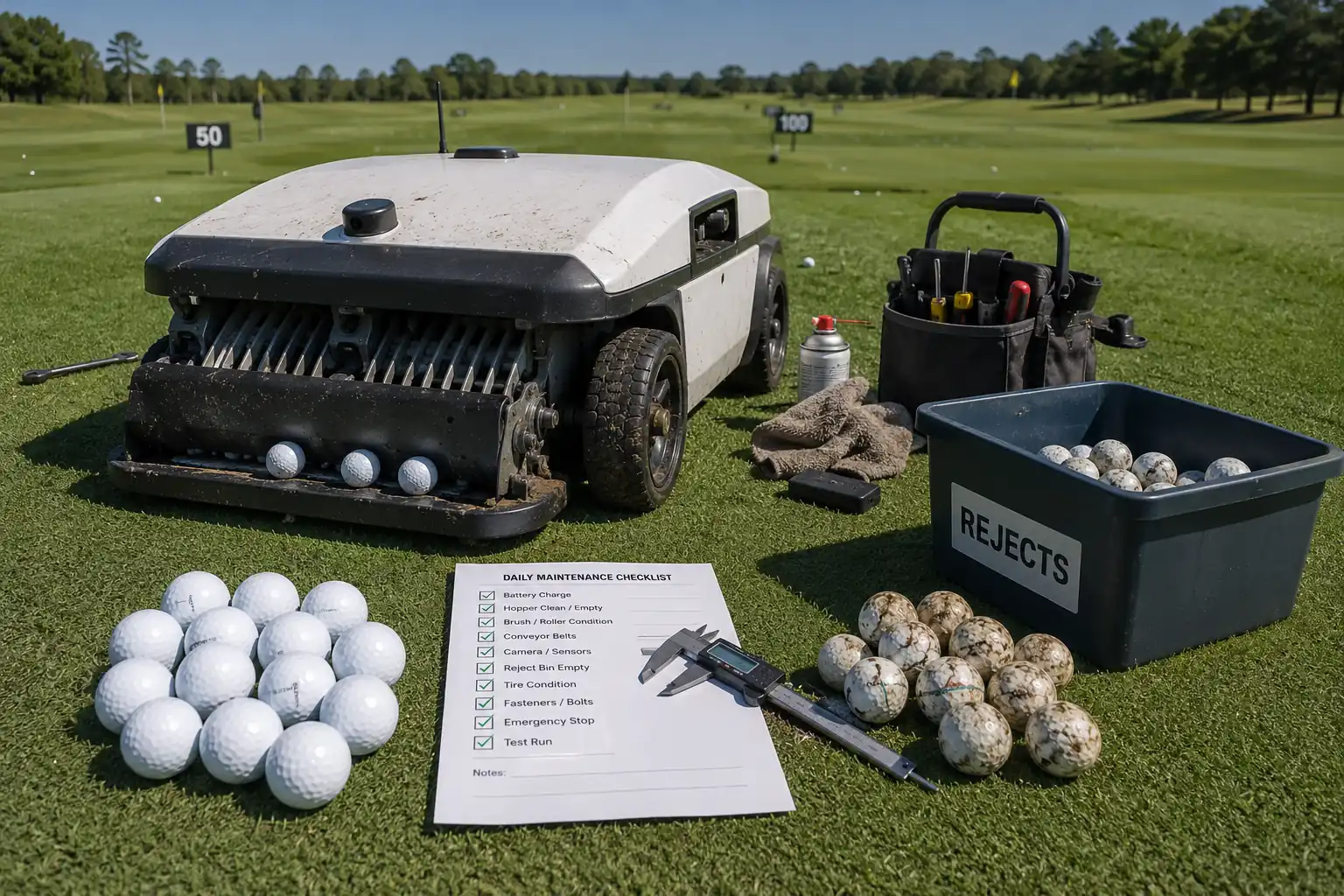
What does one picker jam really cost?
You may treat a jam as one stuck ball, but in your automated range it can slow return flow, washer feed, dispenser inventory, labor allocation, and bucket sales.
One picker jam costs more than one stuck ball when it interrupts the picker-to-washer-to-dispenser chain. Your team should model intervention labor, restart time, wear exposure, delayed return flow, dispenser shortages, and lost bucket or bay revenue before choosing by ball price.
The picker is the first link in the uptime chain. When it stops, the return flow slows. When return slows, the washer may receive fewer balls. When the washer falls behind, clean-ball inventory may weaken. When the dispenser runs thin, bucket sales, lesson flow, or bay service can be affected.
A range equipment manual describes a ball management system where a ball washer can connect to an elevator, conveyor, or blower to transport clean, undamaged balls from washer to dispenser, while a ball picker collects used balls from the range. That is exactly the system view your TCO model should use. ball management workflow
Use this formula:
Jam-Sensitive Ball TCO = Ball Purchase Cost + Jam Intervention Labor + Restart / Inspection Time + Wear-Part Exposure + Delayed Ball Return + Lost Bucket / Bay Revenue
For monthly review:
Monthly Jam Cost = Jam Events × Average Intervention Minutes ÷ 60 × Labor Rate + Downtime / Delayed Sales Estimate + Wear-Part / Service Allowance
Manual intervention is not free. Public U.S. occupational wage data can serve as a labor-cost anchor, but your team should replace it with local wage, overtime rules, intervention minutes, restart time, and jam frequency from your own records. labor wage reference
Do not invent motor, service, or revenue numbers. Use verified invoices where you have them. Use variables where you do not. For multi-site range operators, keep jam categories consistent: ball-induced, machine setting, mud/debris, worn part, unknown. That makes comparisons possible across locations.
Create a jam-sensitive TCO model using your jam count, intervention minutes, restart time, labor cost, delayed return flow, and sales exposure. Compare current-ball jam logs against a tested automation-ready ball trial.
Jam cost is one operating-cost driver, not the whole range-ball economics model. To compare it with usable life, rejects, sorting, washer burden, and replenishment, use our cost per usable hit framework.
Do not classify a cheaper ball as savings unless the jam-sensitive model remains favorable.
✔ True — Downtime and manual rollback are revenue-model inputs
A picker jam can affect more than maintenance time. It can slow the ball-return chain that supports range service and bucket availability.
✘ False — “A picker jam is only a maintenance anecdote”
If jams repeatedly pull staff into the field or slow dispenser inventory, they belong in the operating model, not only the repair notes.
Jam-sensitive TCO model?
Your team should price the chain reaction, not just the object stuck in the picker.
The goal is not to make the model complicated. The goal is to stop hiding intervention labor inside “maintenance.” Once jam count, intervention minutes, and delayed return flow are visible, the procurement decision becomes much clearer.
What proof should your PO require?
You may receive a clean sample and a fast quote, but automation-ready claims need batch evidence, post-use proof, and receiving rules tied to the exact production version.
Automation-ready is a proof system, not a slogan. Your PO should require caliper or ring-gauge evidence, post-use geometry proof, core cross-section evidence, 12-ball QC raw data, retained samples, AQL receiving rules, and locked version control tied to the production lot.
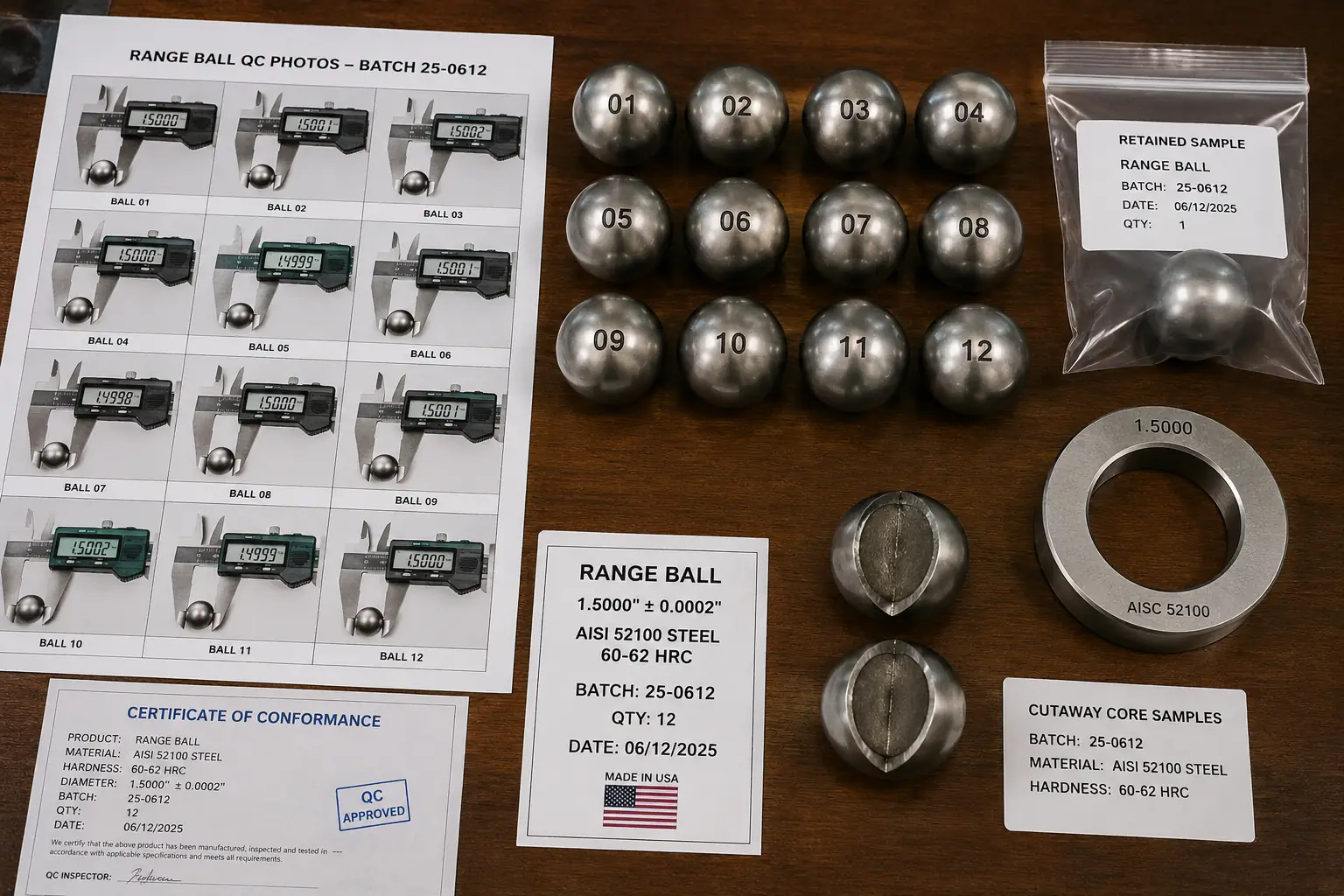
Fast quote, vague method is a failure signal.
Ask the supplier to quote one automation-use range-ball platform with caliper or ring-gauge evidence, post-use diameter and roundness proof, core cross-section evidence, 12-ball QC raw data, surface-condition classification, retained sample, AQL receiving plan, and locked production version control.
A 12-ball QC report should include raw values, average, range, standard deviation where available, device list, calibration date where available, diameter, weight, compression, Shore hardness, and surface condition. If the automation risk is high, request core cross-section evidence for crack, void, or bulge risk.
Use reference methods carefully. ASTM D2240 can support Shore hardness as a material-consistency field, ASTM D4060 can support relative coating-abrasion comparison, and ISO 2859-1 can support AQL-based inspection by attributes. These are reference methods and acceptance frameworks, not golf-ball-robot certification standards. ASTM D2240 ASTM D4060 ISO 2859-1
| Pain/decision | Proof item | What it verifies | Action/evidence |
|---|---|---|---|
| Vague roundness | Caliper / ring gauge | Diameter geometry | Reject vague claims |
| Fresh-only proof | Post-use check | Shape retention | Compare used samples |
| Core bulge risk | Cross-section | Crack / void risk | Review cut sample |
| Hero sample | 12-ball QC | Batch spread | Review raw data |
| Material drift | Shore hardness | Cover window | Check method |
| Bulk mismatch | Version lock | Sample-to-lot trace | Hold if broken |
Request an automation-use acceptance pack with diameter/geometry proof, post-use retention, 12-ball QC, surface classification, retained sample, and version control. Check whether approved sample, post-use proof, QC report, batch record, packing list, and receiving inspection all reference the same locked version.
Hold shipment if geometry proof, post-use data, 12-ball QC, retained sample, or version traceability is missing.
Roundness proof and version lock?
Your PO should keep supplier drift out of your picker workflow.
Do not accept “mass production will improve” unless the proof version is retested and reapproved. Any change to core formulation, cover blend, molding condition, diameter target, coating process, compression window, or deployment guidance should require written buyer approval before shipment.
FAQ
Why does my robotic golf ball picker keep jamming?
The problem is not always the robot. A preventable cause is feeding geometry-sensitive equipment with swollen, cracked, misshapen, dirty, or unstable balls after use.
Inspect ball condition before blaming the machine. Separate machine fault from ball-induced jam risk. Check diameter, roundness, cracks, dirt, rough cover, and whether suspect balls came from a mixed or older lot. A good jam log should identify both machine conditions and ball conditions.
What does out-of-round mean for range balls?
Out-of-round means the ball no longer behaves like a predictable spherical input. It may still fly, but it can resist, wedge, or drag through automated handling points.
Use caliper or ring-gauge checks. Compare fresh and used samples. Remove severe geometry defects from automation use. The key point is simple: a ball that is still playable may no longer be automation-ready.
Can damaged balls jam the washer or dispenser?
Yes. Damaged, oversize, dirty, or rough balls can create downstream handling risk, so the issue is not confined to the picker alone.
Think picker-to-washer-to-dispenser workflow. Use clean and undamaged ball rules. Keep a reject bin before re-entry. If your washer, blower, conveyor, or dispenser manual has stricter rules, use those rules as the local operating standard.
Can a ball still be playable but not automation-ready?
Yes. Normal hitting acceptability is not the same as robotic handling acceptability because automation depends on geometry, surface condition, and consistent passage through equipment.
Do not use flight alone as acceptance. Check post-use roundness. Separate range playability from automation deployment. That distinction prevents “still hittable” balls from becoming mechanical inputs that your robot has to reject the hard way.
What diameter should range balls be checked against?
USGA/R&A size rules provide useful measurement language, but robot compatibility also depends on post-use roundness, swelling, cracks, surface condition, and your equipment’s handling geometry.
Use rules only as baseline context. Do not treat conformance as a no-jam guarantee. Ask for caliper or ring-gauge proof, then define your own automation-use reject limits with the equipment and supplier.
Are robotic pickers worth it if balls cause downtime?
They can be, but uptime depends on the full system: ball spec, post-use screening, jam logs, staff intervention time, and return-flow reliability.
Track jam frequency. Calculate manual rollback cost. Test automation-ready balls before scaling. The robot’s value improves when the balls feeding it stay round, clean, stable, and traceable after repeated use.
What should automation-ready samples include?
A strong sample kit should include caliper or ring-gauge photos, post-use geometry proof, cut-open samples, 12-ball QC data, retained samples, surface-condition evidence, and locked production version control.
Reject one-sample approvals. Ask for raw values and spread. Tie proof to the shipment. The sample, QC report, retained sample, batch record, packing list, and receiving inspection should all point to the same approved production version.
Conclusion
In an automated range, the ball is no longer a standalone consumable. It is a mechanical input that must stay round, stable, smooth, and traceable after repeated use.
Define the automation-use spec. Screen damaged balls before re-entry. Model jam cost. Approve only what the proof stack supports.
A cheap ball only stays cheap if it protects the automation system it feeds. If it creates jams, manual rollback, and delayed return flow, the robot is not the problem by itself. The input is.
You might also like — China Golf Ball OEM: How to Negotiate Pricing Without Sacrificing Quality