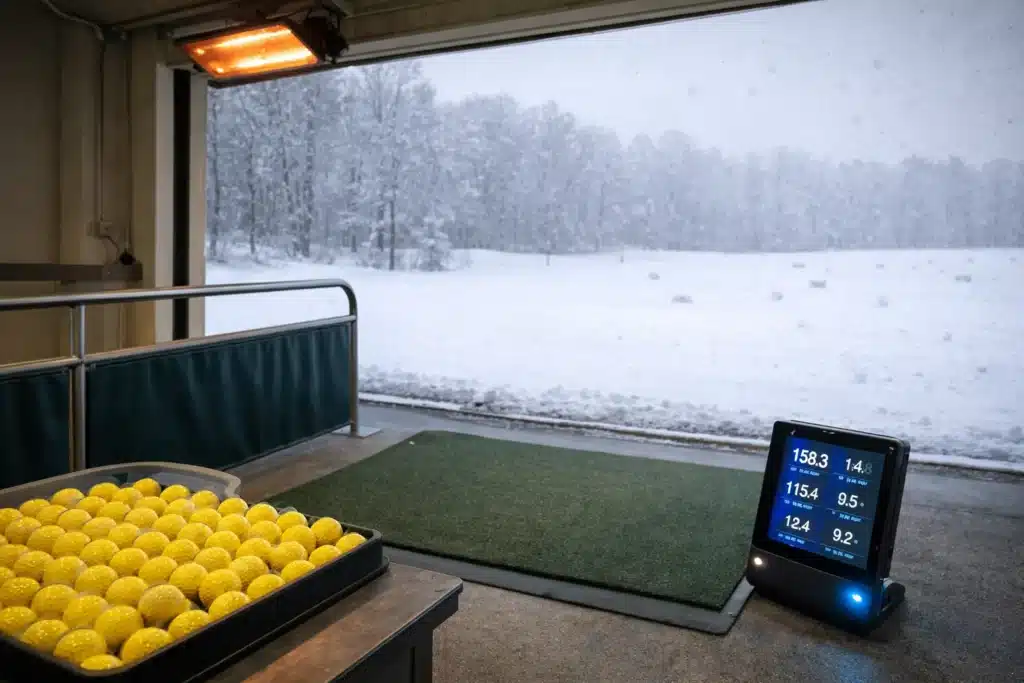
Heated bays should verify cold-soak handling, impact resistance, launch-monitor A/B results, receiving acclimation, and batch-linked QC before buying winter range balls. Bay heat warms the player, not inventory that sat in cold storage, trailers, cages, loading areas, or unheated rooms.
A heated bay can feel premium while cold-soaked range balls still crack, fly short, feel harsh, or trigger complaints. The guest sees the screen number and the split ball; your buying team needs to control what happened before first strike.
You are not buying “cold weather range balls” as a label. You are buying a winter inventory program that must survive transport, storage, receiving, acclimation, hitting, sorting, and complaint review.
Use this guide to separate comfort marketing from winter inventory control, then turn winter range-ball buying into a testable heated-bay program.
Why are heated bays still exposed?
You may heat the bay, the mat area, and the lounge, but your balls may still arrive cold-soaked from trailers, cages, docks, or storage.
Heated bays are still exposed when the player is warm but the range balls are cold-soaked. Your team should verify where winter inventory sits before first use, then add receiving acclimation, storage controls, and batch records before cold stock enters premium bays.
The strongest operating truth is simple: a heated bay warms the golfer, not the inventory.
That mismatch hides in plain sight. The bay is warm. The screen looks professional. The food-and-beverage experience feels premium. The booking price may be higher than a normal outdoor range session. Then a bucket that sat overnight in an outdoor cage, cold trailer, loading area, or unheated back room reaches the mat. The guest does not see the storage chain. They only feel a harsh strike, watch a shorter screen number, or notice a cracked range ball.
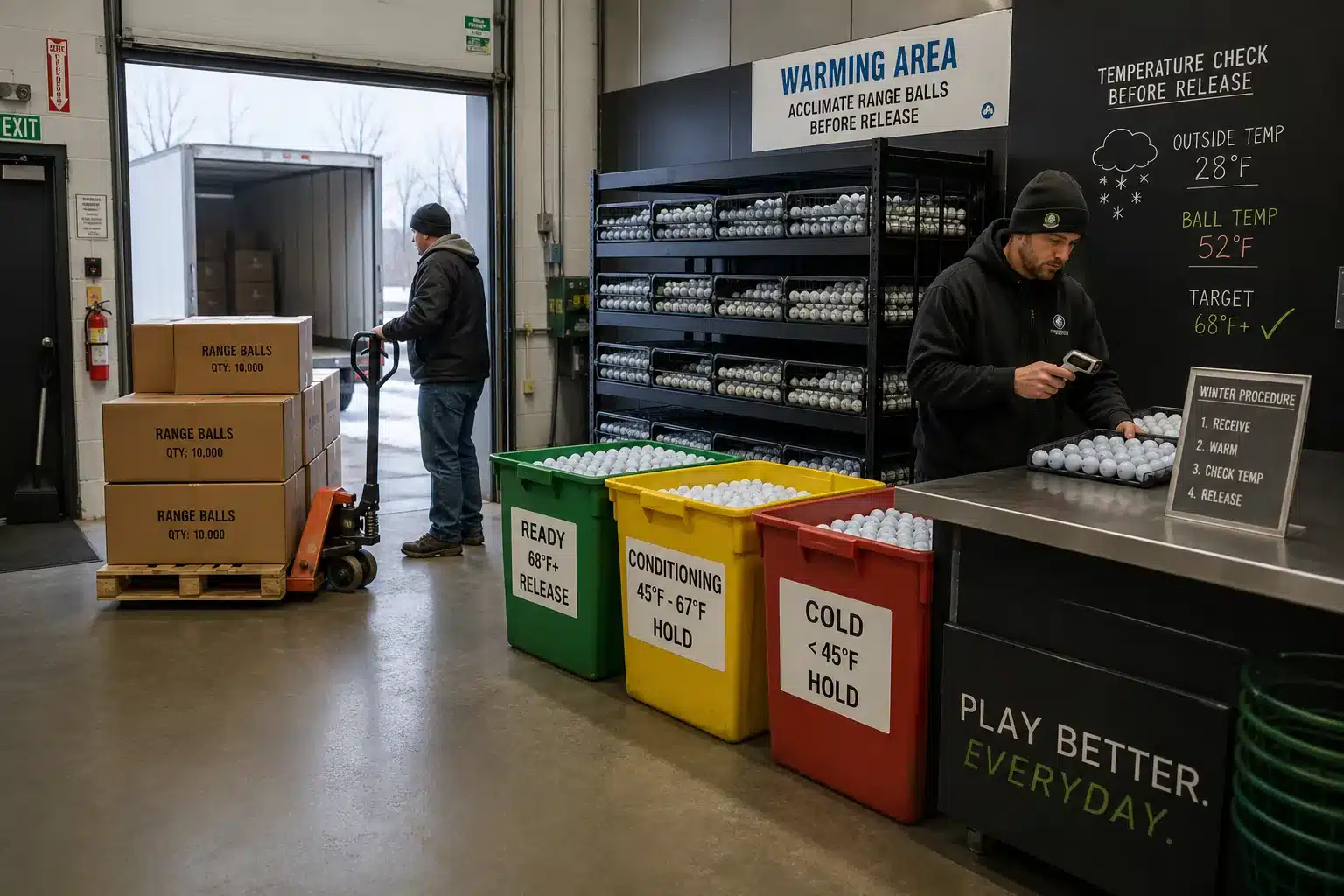
Public golf-ball temperature guidance explains that a cold ball can lose some material resiliency, reducing initial velocity off the clubface, and recommends indoor storage plus gradual return to normal temperature after extreme exposure. For heated bays, that supports a practical buying rule: do not let a warm guest environment hide cold inventory condition. cold-ball temperature guidance
A winter bay program should map the full path: supplier shipment, receiving dock, outdoor staging, storage room, basket fill, bay release, and post-use sorting. If that path is not written, staff will fill the gaps differently on busy nights. One shift may hold cold cartons. Another may send them straight to premium bays.
Cold shipment released directly to heated bays is a failure signal.
| Pain/decision | Where risk starts | What your team sees | Action/evidence |
|---|---|---|---|
| Cold first strike | Outdoor cage | Hard feel | Add acclimation |
| Crack spike | Cold trailer | Visible splits | Check storage |
| Short screen numbers | Unheated room | Weak launch | Run A/B test |
| Complaint pile | No handling flow | Blame unclear | Map chain |
| Receiving dispute | Cold dock release | No proof | Hold stock |
Create an arrival-to-first-use winter handling flow. Check transport exposure, dock conditions, storage temperature, basket release process, and whether cold stock is acclimated before play.
Do not release winter stock into heated bays until the receiving acclimation SOP is completed.
✔ True — A warm bay does not automatically mean winter-ready balls
The player can be comfortable while the inventory is still cold-soaked from transport, staging, or storage. Winter performance starts before impact.
✘ False — “If the bay is heated, the ball problem is solved”
Bay heat improves the guest environment. It does not replace a receiving, storage, and acclimation process for winter stock.
Warm players, cold inventory?
Your bay experience is only as stable as the inventory condition behind it.
This is not a golfer-comfort problem first. It is storage, transport, receiving, and release-to-play control. A winter driving range can lose margin by treating heated bay range balls as ordinary cartons instead of temperature-exposed performance inventory.
Can cold-soaked balls crack on impact?
You may see cracks only after the guest hits the ball, but the risk was already shaped by cold soaking and unverified winter construction.
Cold-soaked range balls can become more crack-prone when the full construction is not verified for low-temperature impact. Your team should require a cold-soak method, sample IDs, strike setup, visible-failure threshold, crack-rate record, and shipment batch link before approval.
Do not write this as “30°F always shatters range balls.” That is not how a careful buyer should think. Different constructions, covers, cores, impact speeds, storage paths, and acclimation windows can produce different results. The real question is whether the exact winter range ball being quoted has been tested under the conditions your heated bay may create.
“Winter durable” is not a specification. It is a claim waiting for a method.
ASTM D746 is useful language because it covers brittleness temperature for plastics and elastomers under specified impact conditions. It is not a golf-ball-specific standard, and it should not be presented as one. It simply helps procurement ask better questions: What was the soak temperature? How long were samples held? Which sample IDs were tested? What impact setup was used? What counted as a visible crack, split, shatter, fragment, or severe deformation? brittleness-temperature reference
That is the difference between a sales promise and winter proof. General-purpose range balls may perform acceptably in mild weather and still be the wrong choice for winter heated bays if cold-soak impact behavior is not verified.
| Pain/decision | Test field | Why it matters | Action/evidence |
|---|---|---|---|
| Vague winter claim | Soak temperature | Defines condition | Write method |
| Unclear exposure | Soak time | Controls test | Record duration |
| Sample mismatch | Sample ID | Links proof | Tie to batch |
| Soft video proof | Strike setup | Shows impact | Specify method |
| Dispute risk | Failure threshold | Defines crack/split | Set hold rule |
| Bulk drift | Batch link | Supports claims | Match shipment |
Shipment acceptance should follow the agreed cold-soak method, visible crack/split/shatter threshold, and batch-linked record.
Request a batch-linked cold-soak impact report and video. Confirm soak temperature and time, sample IDs, strike setup, visible-failure threshold, post-impact inspection, and batch reference.
Hold approval if the cold-soak method or visible-failure threshold is missing.
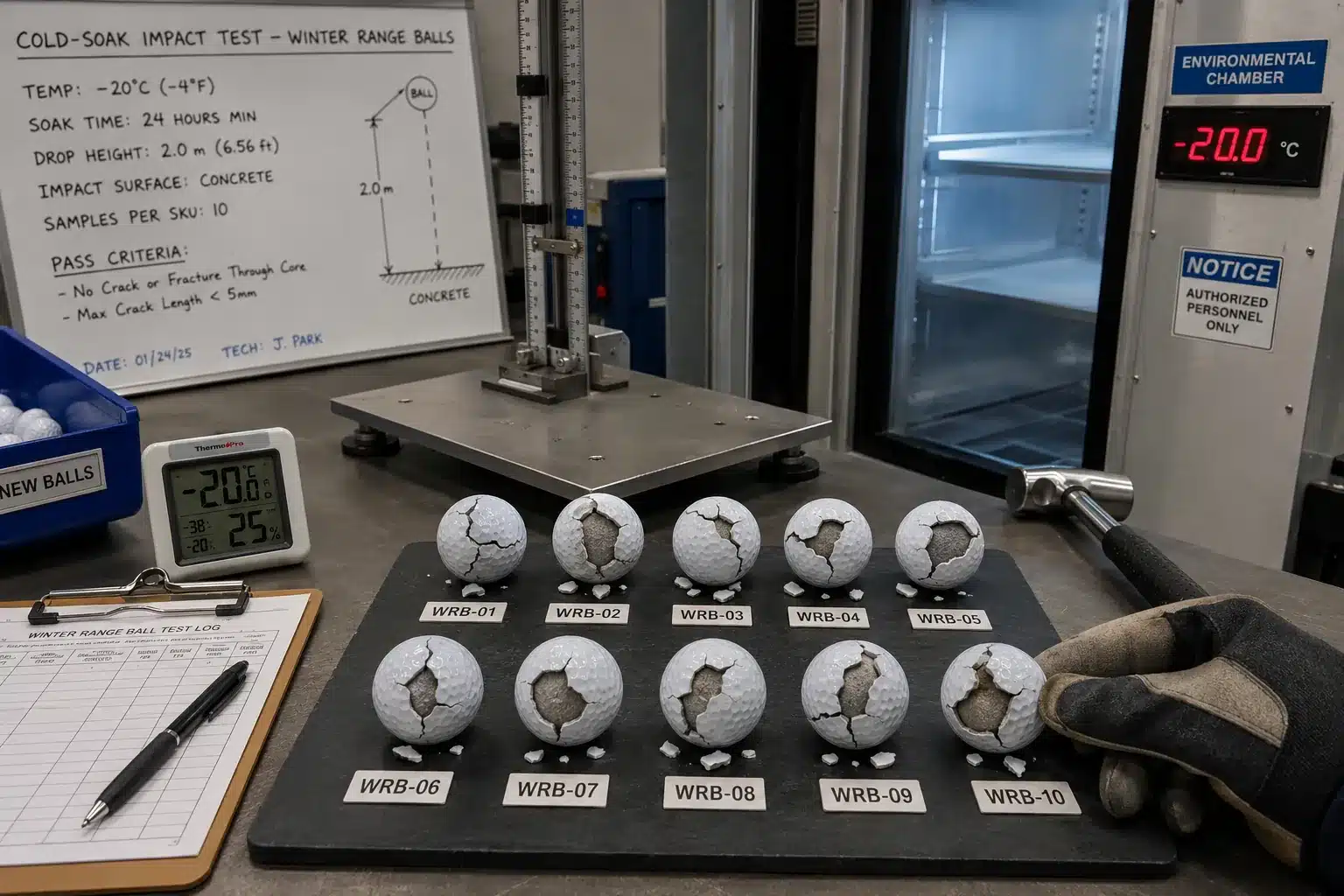
Cold-crack method and failure threshold?
Your team should define winter failure before the first guest complaint defines it for you.
A visible split is not just a scrap event. It can create guest concern, sorting labor, replacement pressure, and a harder conversation with the supplier. If your PO does not define winter failure, every cracked ball becomes a debate.
Why do winter screen numbers drop?
You may hear guests complain that the launch monitor is wrong, but cold-soaked balls can create real ball-speed, carry, feel, and post-impact differences.
Winter screen numbers can drop because the ball condition changed, not because the launch monitor is wrong. Your team should compare room-temperature and cold-soaked samples on the same device, then record ball speed, carry, feel, cracks, and usable-after-impact rate.
A shorter winter number can be real.
Public temperature guidance separates two issues. Cold air can make the ball fly shorter because denser air increases aerodynamic forces, while a cold golf ball can also lose material resiliency and reduce initial velocity. Your heated bay should not copy any public distance estimate as its own fixed loss. Your facility needs its own same-device comparison. winter distance guidance
That matters because launch monitors make winter inconsistency visible. A guest paying for heated bay time expects credible feedback. A coach wants usable patterns. A fitter wants trust in the data. If cold-soaked stock flattens ball speed or carry, staff may blame the screen when the device is simply reporting the ball condition.
Run a controlled A/B check:
-
room-temperature control balls
-
cold-soaked sample balls
-
recovered or acclimated sample balls, if your SOP includes stabilization
-
same device
-
same strike protocol where practical
-
same recording sheet
-
same post-impact inspection rule
Record ball speed, carry, feel, crack rate, and usable-after-impact rate. Add short player feedback because dead feel often appears before the team has enough data to see the pattern.
For a teaching or fitting bay, add one more field: launch-window confidence. The question is not only whether the ball goes shorter. It is whether the coach or fitter can still trust the comparison being shown to the player.
Create a room-temperature vs cold-soak same-device A/B test. Use the same launch monitor or simulator setup, then compare the delta before blaming the equipment, the player, or the screen system.
Do not accept or reject winter balls on screen complaints until the same-device A/B test is complete.
✔ True — The device may be reporting reality
If the ball was cold-soaked, weaker ball speed, shorter carry, and flatter feel can be real performance signals, not monitor noise.
✘ False — “Winter distance loss should be blamed on the monitor first”
Your staff needs a same-device A/B test before it blames TrackMan, Toptracer, the simulator, or the guest.
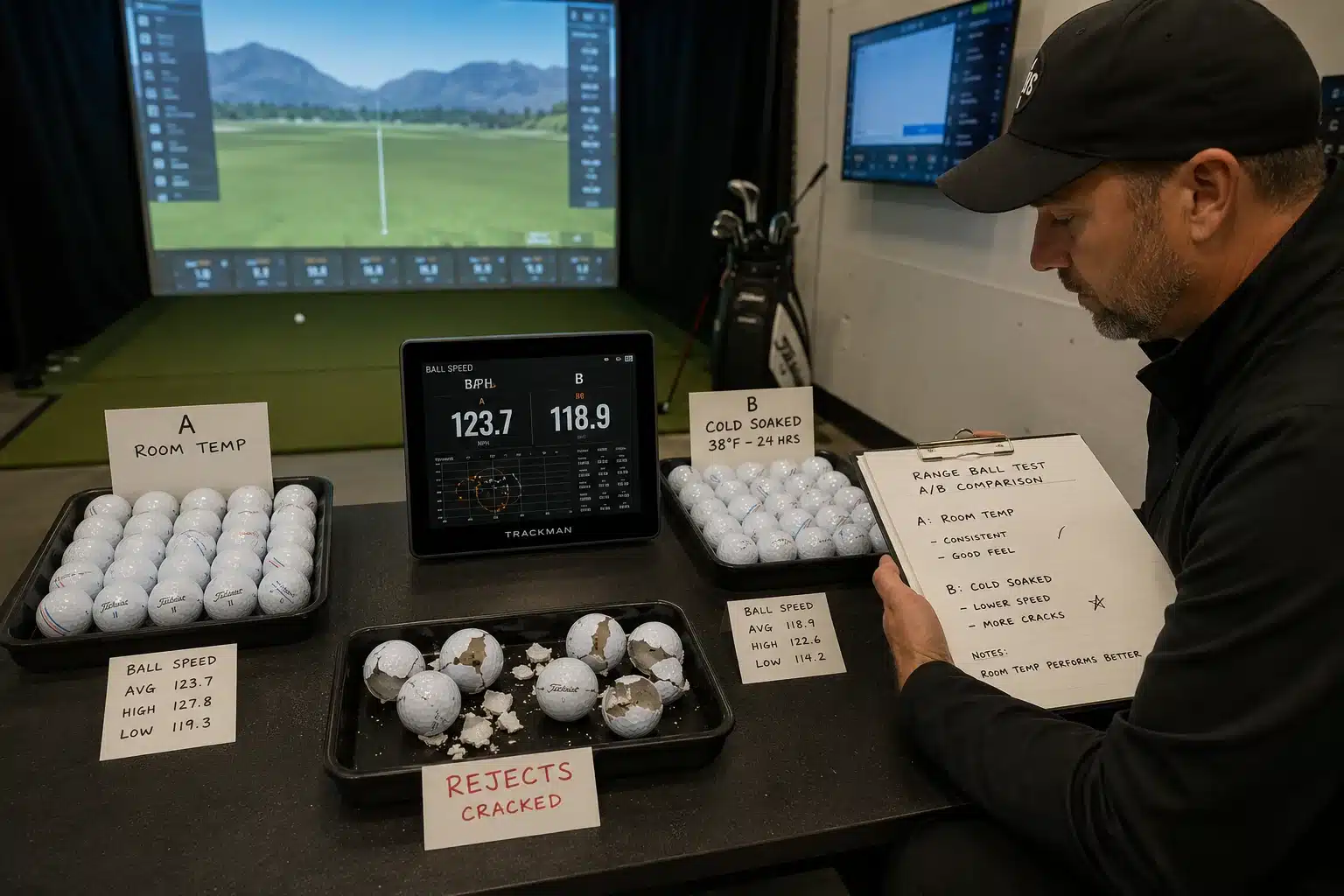
Room-temp vs cold-soak A/B test?
Your staff needs evidence before it blames the launch monitor or the guest.
The best comparison is simple: same device, same bay, same ball model, different temperature condition. If the cold-soaked group shows weaker speed, shorter carry, harsher feel, or more visible damage, the ball and handling path deserve attention before the monitor does.
Can winter failures trigger club complaints?
You may not prove a cold-soaked ball damaged a driver, but a harsh strike, visible split, or ricochet concern can still become a premium-equipment complaint.
The winter risk is not that every cold-soaked ball damages a driver; it is that harsh feel, visible splitting, or ricochet concern can trigger a claim-management path. Your team should connect complaints to batch ID, retained sample, cold-soak record, receiving release, and corrective action.
Keep the claim careful. Do not tell guests that every cold ball is a driver risk. Do not tell ownership the risk is imaginary either.
The commercial reality sits in the middle. A guest feels an unusually harsh strike. A ball shows a visible split. The guest checks the clubface. Staff pause the session. Management asks where the balls came from, whether that batch was winter-tested, and whether retained samples exist. Now the failed consumable is pulling attention toward a much more expensive piece of equipment.
Public driver launch material has shown premium driver MAP in the several-hundred-dollar range, including $649 and $849 Premium. The point is not that one cold-soaked ball automatically causes damage. The point is that several-hundred-dollar driver exposure makes complaint handling more sensitive than a simple scrap-ball replacement. premium driver price context
Write the investigation path before winter starts. Staff should be able to log incident time, bay, batch ID, visible ball condition, retained-sample reference, whether the stock completed receiving acclimation, and whether the shipment has a matching cold-soak record. If the supplier has corrective-action terms, those should already be in the PO.
Request a winter complaint investigation path. Check whether staff can trace a complaint to batch ID, retained sample, winter test record, receiving release, and supplier corrective-action terms.
Do not approve a winter program if complaints cannot be traced to a batch and retained sample.
Complaint path before liability claims?
Your team should not be forced to investigate winter complaints from memory.
A complaint does not have to become a legal event to cost money. It can interrupt a booked bay, pull staff off task, create a refund discussion, weaken guest trust, and make the facility look less prepared than it really is.
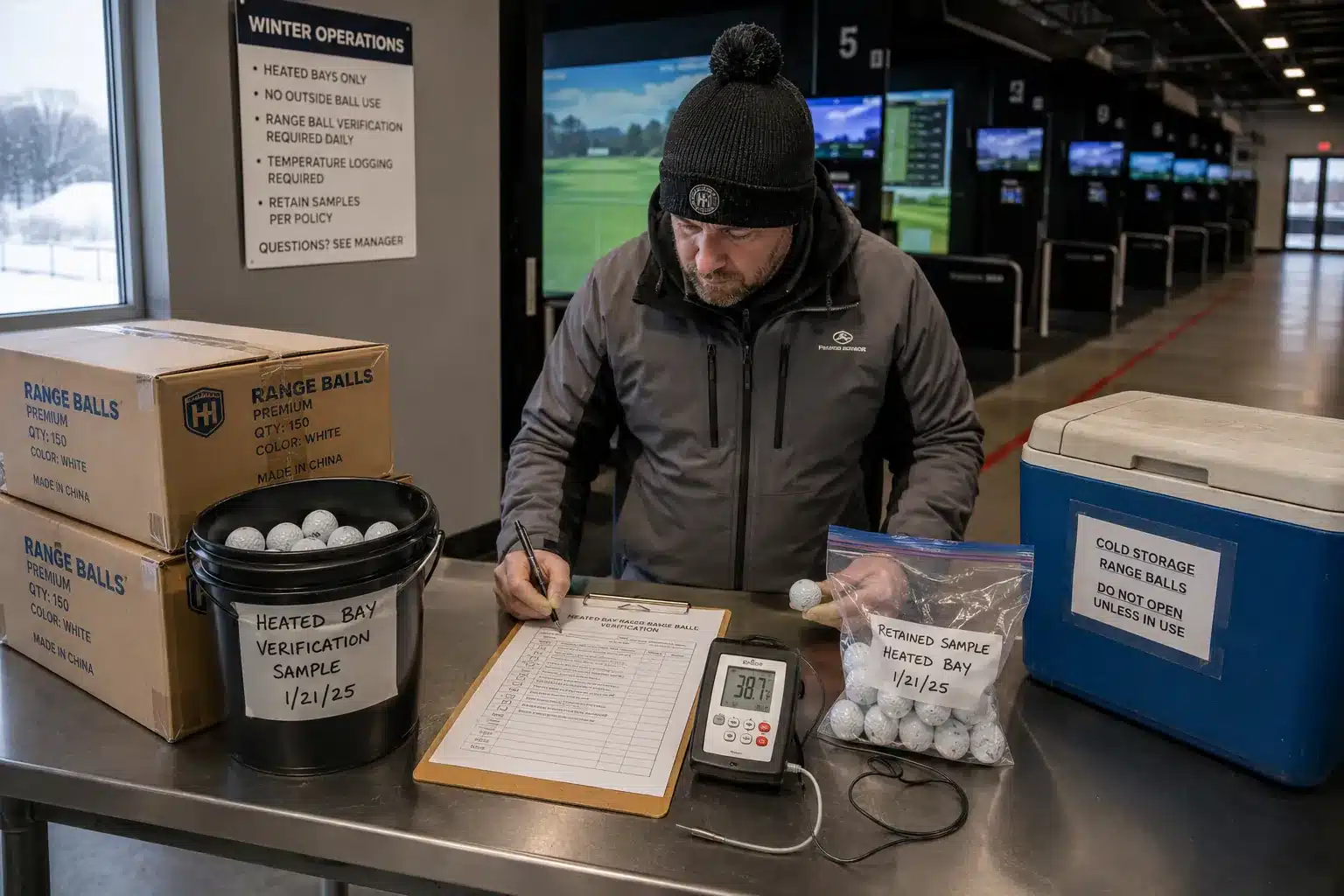
What makes a ball safer for winter use?
You may be offered a softer compression claim, but winter suitability depends on construction, molding consistency, cover toughness, core resilience, and repeated-impact proof.
A safer winter range ball is not proven by lower compression alone. Your team should verify core resilience, cover toughness, molding consistency, Shore hardness or compression window, repeated-impact integrity, and cold-soak behavior before calling a ball winter-ready.
A winter range ball is a controlled build, not a warmer-sounding product name.
Lower compression can help screening, especially when buyers are trying to reduce harsh feel. But lower compression alone does not prove cold-soak durability. A ball can feel promising in a room-temperature sample and still fail winter use if the cover system, core response, coating, molding control, or batch consistency is weak.
Winter readiness starts in the build. Mold design affects size, weight, and shape. Compression molding requires control of temperature, pressure, and speed for consistency. Coating can affect hardness, gloss, surface condition, and flight behavior. For heated bay use, those process details should not become a chemistry lecture. They should become buyer controls: what changed, what is measured, and how the first bulk lot will match the approved sample.
| Pain/decision | Winter variable | Why it matters | Action/evidence |
|---|---|---|---|
| Crack risk | Cover toughness | Reduces visible failure | Ask method |
| Dead feel | Core resilience | Supports response | Run A/B test |
| Batch drift | Molding control | Keeps consistency | Review QC |
| Hard strike | Shore / compression | Tracks window | Request data |
| Screen trust | Repeated impact | Checks durability | Tie to lot |
| Slogan risk | Formula version | Stops drift | Lock version |
ASTM D2240 can support Shore hardness as a material-consistency field for rubber-like or plastic materials. Use it as one QC reference, not as proof that a ball is safe under all winter use. Shore hardness reference
Lower compression claim replaces cold-soak proof is a failure signal.
Supplier shall identify the winter formula version, compression window, Shore hardness or equivalent hardness field, core/cover rationale, repeated-impact evidence, and cold-soak test connection before production approval.
Request a winter-use construction note and controlled formula version. Check compression window, Shore hardness, core/cover rationale, repeated-impact evidence, and cold-soak test connection.
Do not approve winter-use claims unless construction, cold-soak behavior, and QC data support the same formula version.
✔ True — Winter-safe means more stable under winter conditions, not summer-identical
A stronger winter ball should reduce crack risk, preserve a more stable feel window, and support more defensible screen data after cold exposure.
✘ False — “Lower compression alone proves winter performance”
Compression helps the discussion, but the real answer lives in the full construction, cold-soak method, and batch-linked proof.
Construction, compression, and toughness?
Your procurement team should buy a winter program, not one softer-sounding number.
For a first winter formula, keep the variables controlled. Use a pilot lot, retained sample, simple packaging, and first-bulk comparison before scaling. That protects the season without overcommitting inventory.
What proof should your PO require?
You may receive a good sample and a confident quote, but the order is protected only when winter method, batch record, shipment handling, and receiving SOP all connect.
Do not approve winter range balls from a room-temperature sample alone. Your PO should require cold-soak method, sample IDs, visible-failure threshold, 12-ball QC, retained sample, batch ID, freeze-handling checklist, receiving acclimation SOP, and written corrective action.
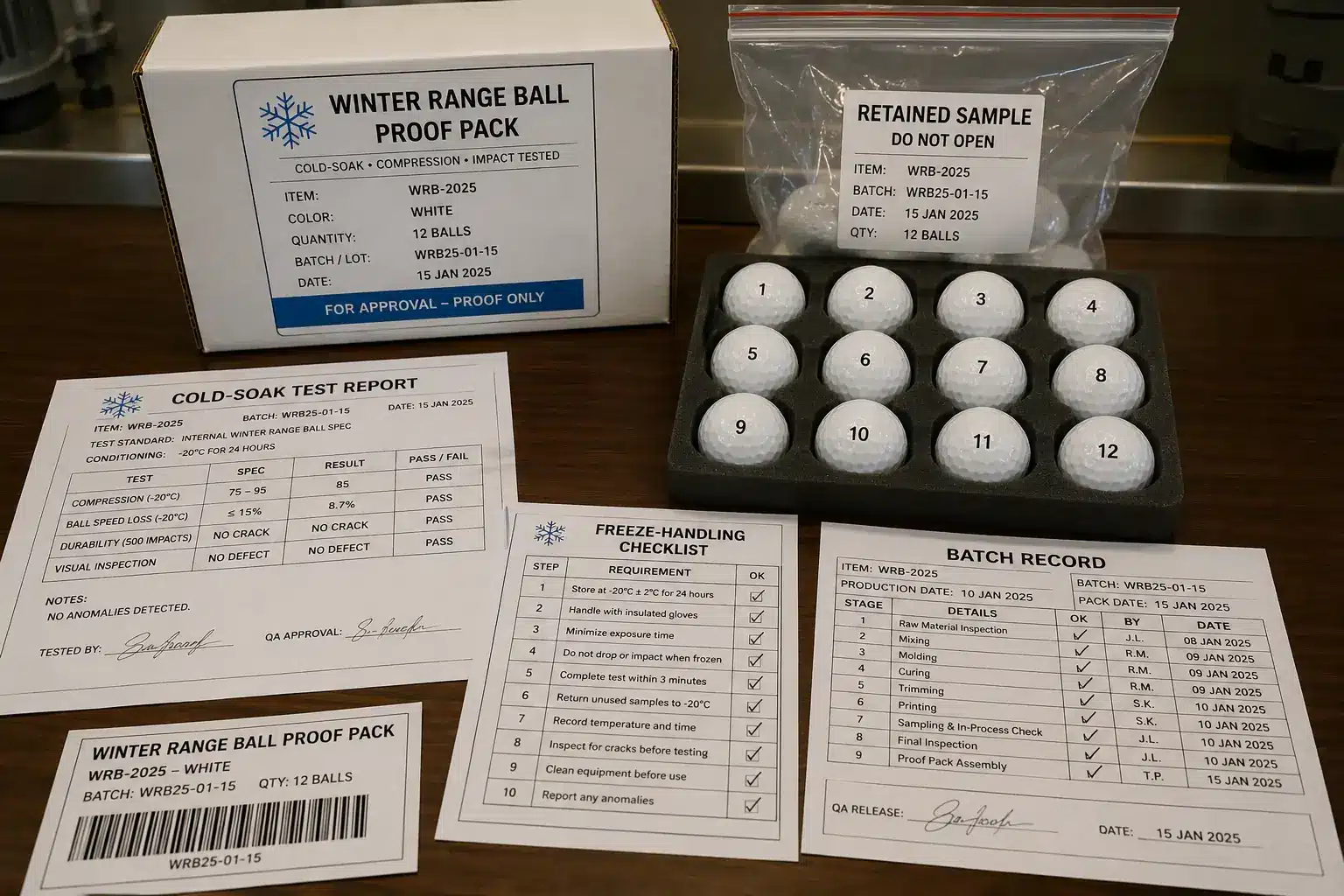
Supplier only shows room-temperature QC is a failure signal.
Ask the supplier to quote one winter-use range-ball program with cold-soak impact method, soak temperature/time, sample IDs, strike setup, visible-failure threshold, room-temperature vs cold-soak A/B notes, 12-ball QC report, retained sample, batch ID, freeze-handling checklist, receiving acclimation SOP, and written corrective-action path.
A winter acceptance pack should include:
-
cold-soak verification method
-
soak temperature and soak time
-
sample IDs and retained sample reference
-
strike setup and post-impact inspection
-
visible crack, split, shatter, fragment, or severe-deformation threshold
-
room-temperature vs cold-soak A/B notes
-
12-ball QC report with raw values, average, range or SD, equipment model, calibration status where available, environment conditions where relevant, weight, diameter, compression, Shore hardness, and visual defects
-
batch ID, production date, formula version, packing list, and winter durability record
-
freeze-handling checklist
-
receiving acclimation SOP
-
corrective-action path if the batch fails the agreed method
Use standards as reference frameworks, not fake “winter golf ball certification.” ASTM D746 can support brittle-failure language for plastics and elastomers under specified impact conditions. ASTM D2240 can support Shore hardness as a consistency field. ISO 2859-1 can support AQL-based inspection by attributes for receiving rules. A formal golf-ball test protocol also controls ball conditioning before testing, which is useful as a measurement-control analogy, not a heated-bay receiving standard. brittleness-temperature reference Shore hardness reference AQL inspection framework ball-test conditioning protocol
| Pain/decision | Proof item | What it verifies | Action/evidence |
|---|---|---|---|
| Room-temp proof | Cold-soak method | Winter condition | Write protocol |
| Sample mismatch | Sample ID | Proof linkage | Tie to batch |
| Crack dispute | Failure threshold | Pass/hold rule | Define defects |
| Hero sample | 12-ball QC | Batch spread | Review raw data |
| Transport risk | Freeze handling | Cold exposure | Label cartons |
| Cold release | Acclimation SOP | Use readiness | Hold stock |
| Bulk drift | Retained sample | Physical baseline | Seal reference |
Winter durability can fail in logistics before it fails in play. Freeze-protection shipping guidance commonly emphasizes clear BOL instructions, package labels, insulation or thermal protection where needed, protected storage planning, and temperature monitoring for sensitive lanes. For winter range balls, write the handling path into the PO rather than leaving it to memory. freeze-protection shipping guidance
For high-risk winter lanes, require “Protect From Freezing” on cartons and the BOL, pallet cover or insulated blanket when appropriate, a temperature logger when receipt disputes would be costly, and receiving acclimation before release to heated bays.
Request a winter range-ball acceptance pack with cold-soak proof, A/B notes, 12-ball QC, retained sample, freeze-handling checklist, and receiving SOP. Check whether the cold-soak report, QC sheet, batch record, carton labels, packing list, retained sample, and receiving inspection reference the same proof version.
Hold shipment if cold-soak method, batch ID, retained sample, QC report, freeze-handling evidence, or receiving acclimation release is missing.
Batch link, acclimation, retained sample?
Your PO should protect winter uptime before the first cold shipment reaches the dock.
Do not accept “mass production will improve” unless the final proof version is retested and reapproved. Approve a pilot lot first, compare approved sample against first-bulk QC, then scale only after winter evidence matches the retained sample.
FAQ
Do cold-soaked range balls lose distance in heated bays?
Cold-soaked range balls can lose distance in heated bays when ball condition affects resilience, initial velocity, feel, or post-impact behavior. Your team should verify the actual delta with same-device A/B testing instead of assuming a fixed winter loss.
Record ball speed, carry, feel, crack rate, and usable-after-impact rate for room-temperature balls and cold-soaked samples. Cold air, cold ball condition, swing changes, clothing, and bay setup can all affect winter numbers. A heated bay needs its own comparison before blaming the launch monitor, the player, or the screen system.
Can cold-soaked range balls crack on impact?
Cold-soaked range balls can become more crack-prone when the construction is not verified for low-temperature impact. Treat cracking as a test-method question, not as a scare claim or a guaranteed failure.
Ask for soak temperature, soak time, sample IDs, strike setup, post-impact inspection, and a visible crack or split threshold. A credible winter durability record should show what was tested, what counted as failure, and how the tested samples connect to the shipment batch.
Is lower compression enough for winter balls?
Lower compression is not enough to prove winter durability. It may help screening, but winter-ready range balls also need verified construction, cover toughness, core response, hardness or compression control, cold-soak behavior, and batch-linked proof.
A lower-compression claim can sound reassuring, especially when the goal is a softer winter feel. The risk is using one number to replace a full winter program. Ask how the ball behaves after cold soaking, whether the approved formula version is locked, and whether the first bulk lot matches the retained sample.
Can heated bays warm balls before use?
Heated bays can support guest comfort, but cold inventory still needs a receiving and acclimation process. Cold stock should not move directly from trailer, dock, cage, or unheated storage into premium bay play.
Create an acclimation SOP and document release timing. Separate cold storage from bay release. This helps staff avoid sending cold-exposed stock directly to players and helps procurement separate handling issues from product-construction issues when cracks, harsh feel, or short screen numbers appear.
What makes a range ball winter-ready?
A winter-ready range ball has a construction and handling program that performs under cold-soak conditions, not just a softer label. The proof should connect formula version, cold-soak impact behavior, QC data, retained sample, and receiving SOP.
Verify the core and cover route. Check compression or Shore hardness window. Use retained samples and first-bulk comparison. A winter program should also include cold-soak impact proof, batch ID, freeze-handling notes, receiving acclimation, and written corrective action if the batch fails the agreed method.
Can cold balls trigger premium driver complaints?
Cold balls can trigger complaint-management risk when harsh feel, visible splits, or ricochet concerns appear. Do not state guaranteed club damage; build a traceable investigation path before the winter bay season starts.
Use batch ID, retained samples, receiving release records, and corrective-action terms. Your team should be able to connect an incident to the exact winter lot, cold-soak proof, and supplier response path without relying on memory. That protects staff from improvising during a sensitive guest conversation.
What should a winter durability report include?
A winter durability report should include method, soak temperature/time, sample IDs, strike setup, visible-failure criteria, crack-rate record, device list, calibration date where available, retained sample, and shipment batch reference.
Reject pass/fail screenshots alone. Ask for raw records and a batch link. The supplier’s winter claim is only useful when the tested version, retained sample, QC report, packing list, and shipped batch are traceable to the same controlled proof version.
Can winter packaging or logo durability fail?
Yes, freeze-thaw exposure can affect surface appearance, print adhesion, carton condition, and receiving disputes, so keep the check narrow but written for logoed or bay-marked winter range balls.
Inspect carton condition, moisture exposure, crushed boxes, and visible freezing damage. If the winter ball carries bay IDs or range markings, ask whether freeze-thaw exposure affects print adhesion, surface appearance, or scuff resistance after handling and cleaning. Define visible defects before the shipment arrives.
Conclusion
A heated bay protects the player, not the inventory. A winter range-ball program is only defensible when cold-soak handling, impact proof, launch-monitor A/B data, receiving acclimation, and batch-linked QC all point to the same controlled version.
Your team should not buy winter range balls from a softer-sounding claim or a room-temperature sample alone.
Control the route from shipment to first strike. Lock the winter proof version. Keep retained samples. Require cold-soak impact evidence. Then your heated bay can protect the experience it promises, instead of letting cold inventory define it.
You might also like — Cheap Commercial Range Balls: What Is the Real TCO?